
SIMPLE LEVELLING INTRODUCTION It is a method of
- Slides: 31
SIMPLE LEVELLING
INTRODUCTION • It is a method of surveying used for determination difference of elevations • The elevation of a point is its vertical distance above or below reference line • That reference line is called as datum(M. S. L)
BASIC DEFINATIONS Ø Vertical line: It is the line indicated by a freely suspended plumb bob Ø Level surface: The level surface is perpendicular to the direction of gravity at every point Ø Mean sea level(M. S. L): The MSL at a location is obtained by averaging the ht of the surface of the sea for all stages of the tides for a long period, usually 19 yrs.
• Geoid: The MSL at a particular location on the earth if extended in all directions over the entire earth would form an undulating spheroid called geoid • Datum surface or Datum: It is a level surface which is taken as a reference surface for determination of elevations of various points • Elevation: It is the vertical distance of the point above or below the datum surface • Reduced level (R. L): The reduced level of a point is height relative to the datum
Bench Mark (B. M) • Bench mark is a fixed point of known elevation above the datum. Any point whose known elevation is definitely known can be used as a bench mark • These are usually in the form of metal discs, generally bronze discs, set in concrete, large rock, foot path or kerb.
Types of bench marks Ø Great trigonometrical survey bench marks (GTS) Ø Permanent bench marks Ø Temporary bench marks Ø Arbitrary bench marks
GTS bench marks • These are established by survey of India through out the country • The elevations of the bench marks are correct to two decimal places of a metre • These are determined with respect to the MSL at Bombay port
Permanent bench marks • These are established between GTS bench marks • Fixed by public works department (P. W. D) • Isolated rocks, culverts, gate pillars of public • These elevations are less accurate than GTS • These are marked on plane surface in the shape of rectangle
Temporary bench marks • These are established temporarily whenever required • These are used for singly day works • These are fixed between permanent bench marks • These are established on stable points such as boundary wall, gate pillars, root of old trees etc
Arbitrary bench mark • These elevations are arbitrary assume for leveling of small area • The elevations do not refer to any fixed datum such as M. S. L • These bench are used most of the construction • While selecting the arbitrary bench mark, make sure that is the lowest value of the site
Types of levelling instruments • A levelling instrument should consist of Ø A levelling head with three foot screws which enables to bring in its centre Ø A telescope Ø A bubble tube Ø A tripod
Types of levelling instruments • Dumpy level • Y level • Modern tilting level • Automatic level
Dumpy level • The telescope is rigidly fixed to supports • Bubble tube attached to the telescope • The telescope can be rotated about axis • A focusing screw provided for clear visible • It is also having prismatic compass for taking the bearings
Y level • It is very delicate instrument • It consist of loose parts • The advantage of Y level is permanent adjustment can carried out very easily
Tilting level • In this the telescope has a small motion about horizontal axis it is known as tilting level • In this line of collimation is made horizontal for each point of telescope by mean of tilting screw
Automatic level • It is having operational comfort and pleasure handling • High speed • Free from errors • Unaffected by surrounding external forces • High precision
Types of levelling staves • Folding type 4 m levelling staff • Telescope sopwith levelling staff • Aluminum telescopic staff • Holding of staff
Component parts of levelling instrument • The body of the telescope with focussing arrangements • Object lens or objective • Eye piece • Diaphragm
Concept of important terms in levelling • Line of collimation: line of collimation or line of sight is the line joining the point of intersection of the cross wires of the diaphragm to the optical centre of the objective • Reduce level: It is the vertical distance above or below the M. S. L. or B. M is called as reduced level
• Bench mark: It is a permanent reference point whose elevation or reduce level is known. All levelling operations start from bench marks • Height of instrument: It is line elevation of collimation when the levelling is perfectly levelled • Back sight: It is the reading taken on a bench mark after setting up of the instrument • Fore sight: It is last reading taken before the shifting of the instrument • Intermediate sight: All the sights are taken between the B. S and F. S are intermediate sight
• Change point (C. P): A change point is a point denoting the shifting of the level • Station : A station is a point denoting whose elevation is to be determined
Adjustments of levelling instrument • Two types of adjustments ü Temporary adjustments ü Permanent adjustments
Temporary adjustment ü Fixing the instrument on the tripod ü Approximate levelling by tripod legs ü Accurate levelling b foot screws ü Focussing the eye piece ü Focussing the object glass
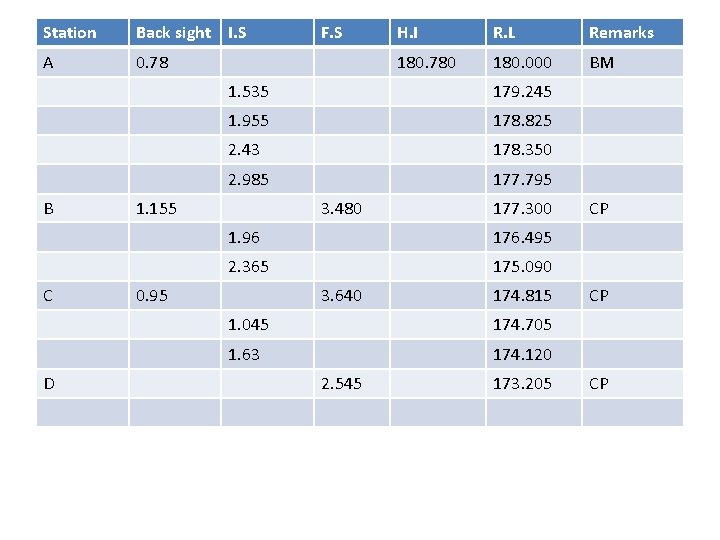
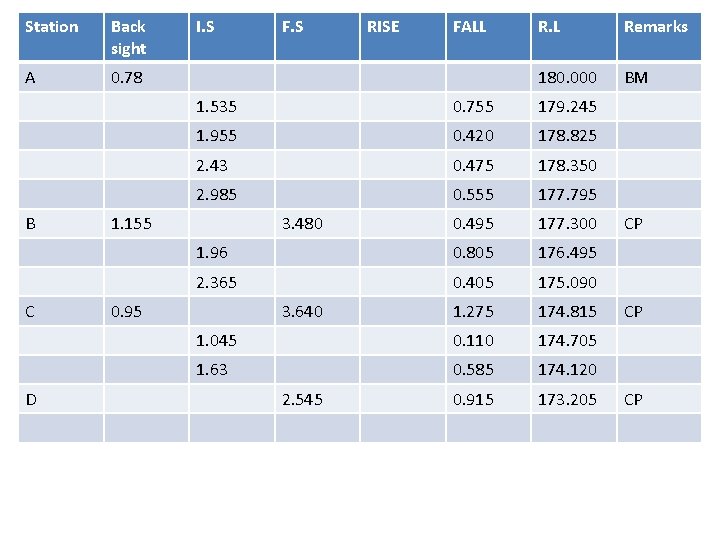
Reduction of levels • Height of collimation method • Rise and fall method
Station Back sight I. S A 0. 78 B C D F. S H. I R. L Remarks 180. 780 180. 000 BM 1. 535 179. 245 1. 955 178. 825 2. 43 178. 350 2. 985 177. 795 1. 155 3. 480 177. 300 1. 96 176. 495 2. 365 175. 090 0. 95 3. 640 174. 815 1. 045 174. 705 1. 63 174. 120 2. 545 173. 205 CP CP CP
Station Back sight A 0. 78 B C D I. S F. S RISE FALL R. L Remarks 180. 000 BM 1. 535 0. 755 179. 245 1. 955 0. 420 178. 825 2. 43 0. 475 178. 350 2. 985 0. 555 177. 795 0. 495 177. 300 1. 96 0. 805 176. 495 2. 365 0. 405 175. 090 1. 275 174. 815 1. 045 0. 110 174. 705 1. 63 0. 585 174. 120 0. 915 173. 205 1. 155 3. 480 0. 95 3. 640 2. 545 CP CP CP
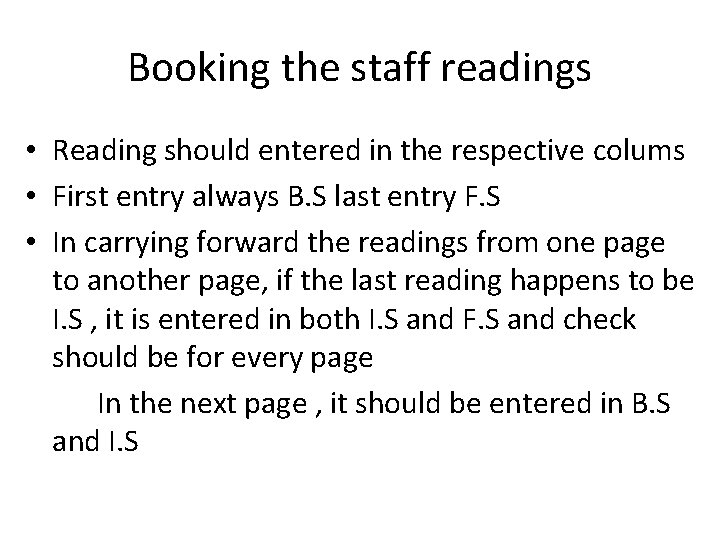
Booking the staff readings • Reading should entered in the respective colums • First entry always B. S last entry F. S • In carrying forward the readings from one page to another page, if the last reading happens to be I. S , it is entered in both I. S and F. S and check should be for every page In the next page , it should be entered in B. S and I. S
Errors in levelling Ø Instrumental errors • By imperfect permanent adjustment • Faulty focussing • Defective bubble tube • The staff
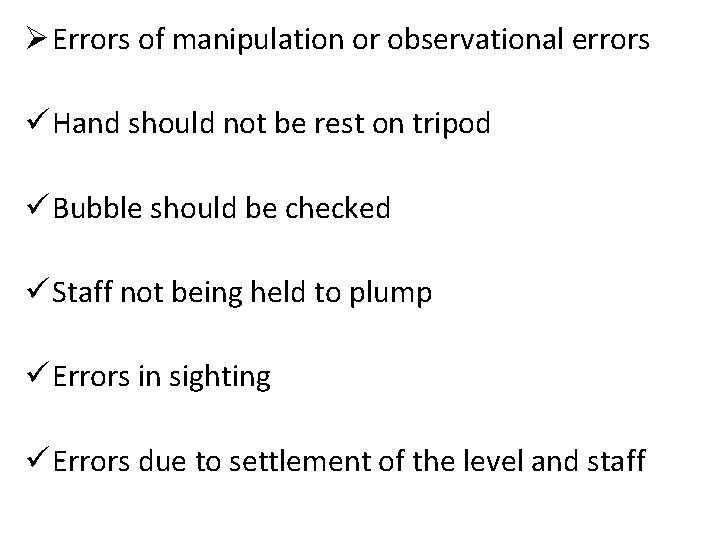
Ø Errors of manipulation or observational errors ü Hand should not be rest on tripod ü Bubble should be checked ü Staff not being held to plump ü Errors in sighting ü Errors due to settlement of the level and staff
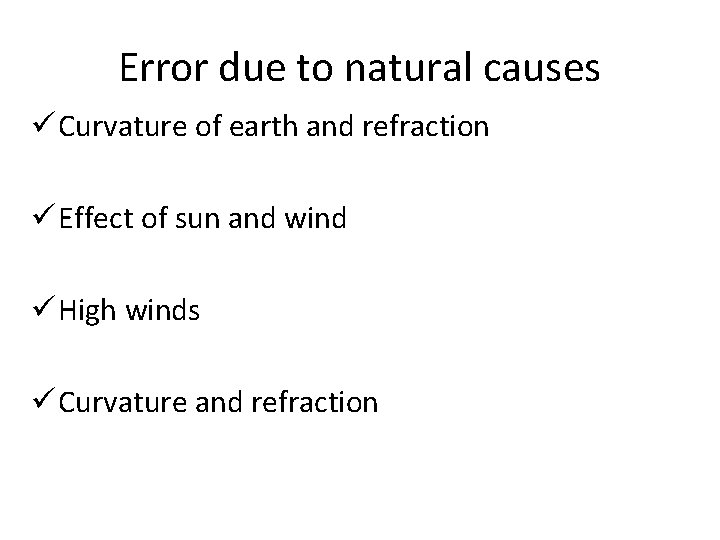
Error due to natural causes ü Curvature of earth and refraction ü Effect of sun and wind ü High winds ü Curvature and refraction
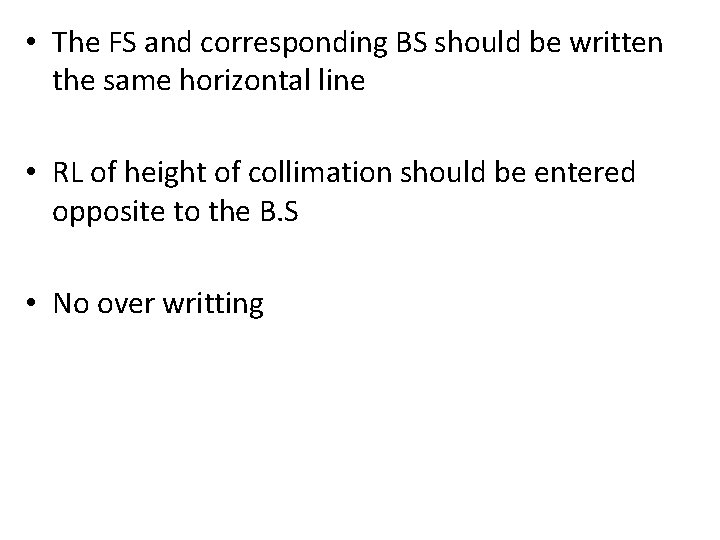
• The FS and corresponding BS should be written the same horizontal line • RL of height of collimation should be entered opposite to the B. S • No over writting