
Simple Lattice Trapdoor Sampling from a Broad Class
Simple Lattice Trapdoor Sampling from a Broad Class of Distributions Vadim Lyubashevsky and Daniel Wichs
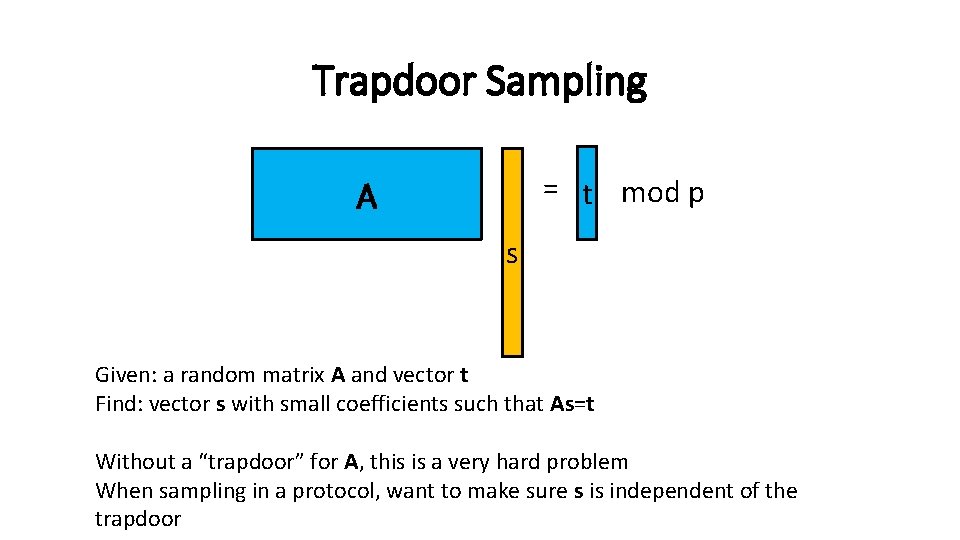
Trapdoor Sampling = t mod p A s Given: a random matrix A and vector t Find: vector s with small coefficients such that As=t Without a “trapdoor” for A, this is a very hard problem When sampling in a protocol, want to make sure s is independent of the trapdoor
Trapdoor Sampling First algorithm: Gentry, Peikert, Vaikuntanathan (2008) • Very “geometric” • The distribution of s is a discrete Gaussian Agrawal, Boneh, Boyen (2010) + Micciancio, Peikert (2012) • More “algebraic” (you don’t even see the lattices) • Still s needs to be a discrete Gaussian Are Gaussians “fundamental” to trapdoor sampling?
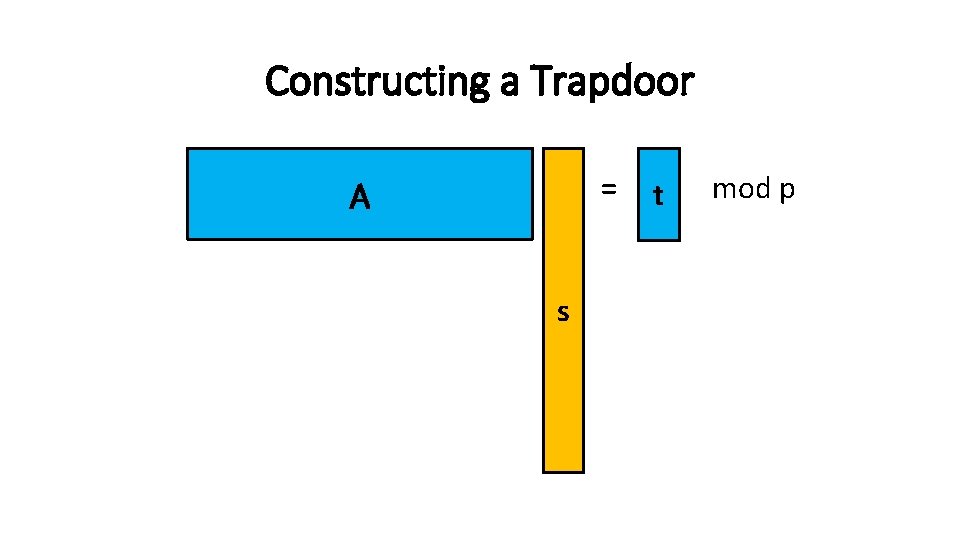
Constructing a Trapdoor = A s t mod p

Constructing a Trapdoor A 1 A 2 = s 1 s 2 t mod p

Constructing a Trapdoor A = A 1 Random matrix A 1 R + G Random matrix with small coefficients Special matrix that is easy to invert
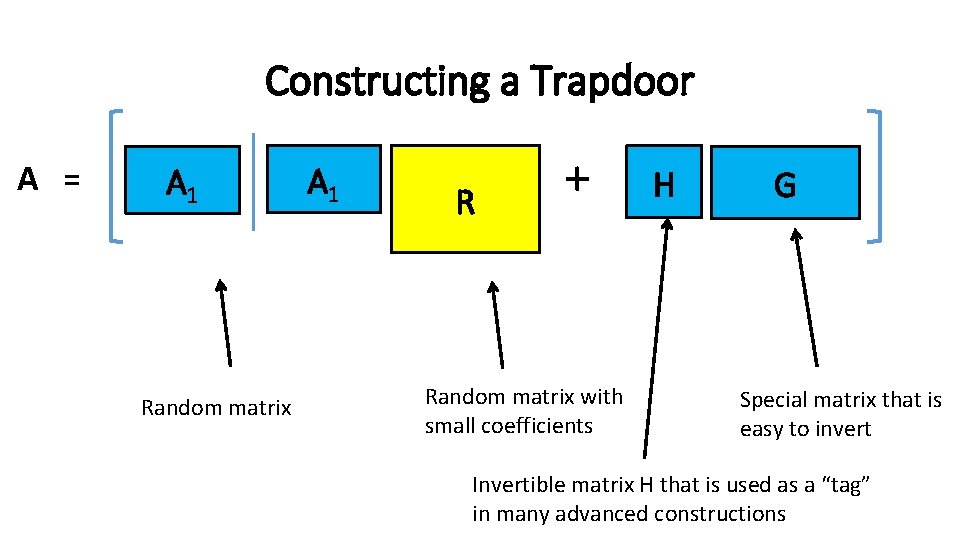
Constructing a Trapdoor A = A 1 Random matrix A 1 R + Random matrix with small coefficients H G Special matrix that is easy to invert Invertible matrix H that is used as a “tag” in many advanced constructions
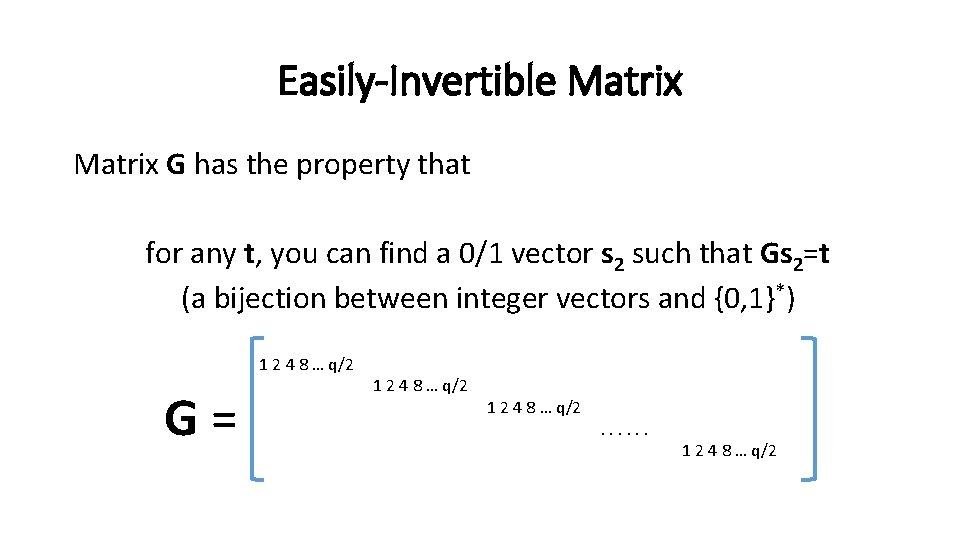
Easily-Invertible Matrix G has the property that for any t, you can find a 0/1 vector s 2 such that Gs 2=t (a bijection between integer vectors and {0, 1}*) 1 2 4 8 … q/2 G= 1 2 4 8 … q/2 . . . 1 2 4 8 … q/2
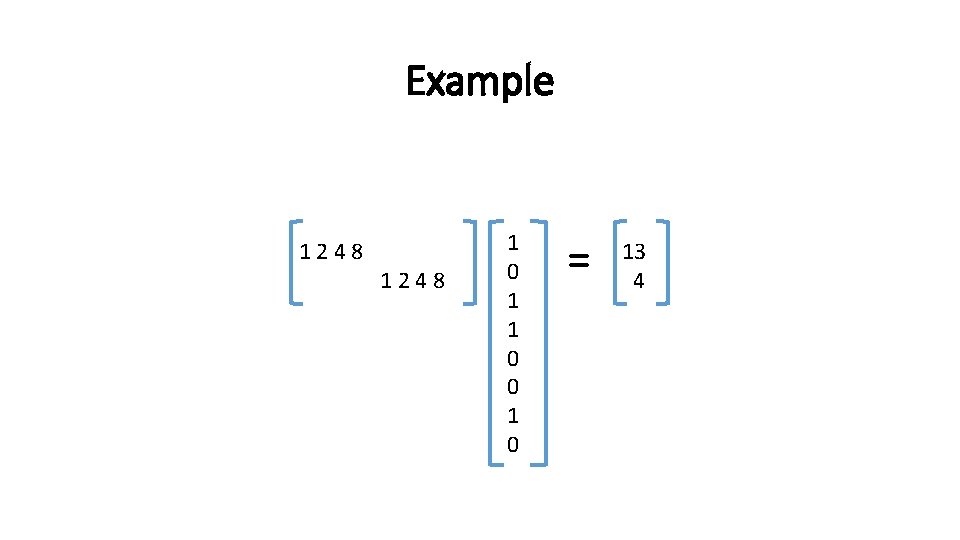
Example 1248 1 0 1 1 0 0 1 0 = 13 4
![Inverting with a Trapdoor A = [A 1 | A 2 ] = [A](http://slidetodoc.com/presentation_image_h2/8a2ae7d7a485c068bd18ccb196e3b893/image-10.jpg "Inverting with a Trapdoor A = [A 1 | A 2 ] = [A")
Inverting with a Trapdoor A = [A 1 | A 2 ] = [A 1 | A 1 R+G] Want to find a small s such that As=t s = (s 1, s 2) t = As = A 1 s 1+(A 1 R+G)s 2 = A 1(s 1+Rs 2) + Gs 2 set to 0 t = Gs 2 s 1 = - Rs 2 Reveals R Bad
![Inverting with a Trapdoor A = [A 1 | A 2 ] = [A](http://slidetodoc.com/presentation_image_h2/8a2ae7d7a485c068bd18ccb196e3b893/image-11.jpg "Inverting with a Trapdoor A = [A 1 | A 2 ] = [A")
Inverting with a Trapdoor A = [A 1 | A 2 ] = [A 1 | A 1 R+G] Want to find a small s such that As=t s = (s 1, s 2) t = As = A 1 s 1+(A 1 R+G)s 2 = A 1(s 1+Rs 2) + Gs 2 small y t - A 1 y = Gs 2 s 1 = y - Rs 2 Intuition: y helps to hide R
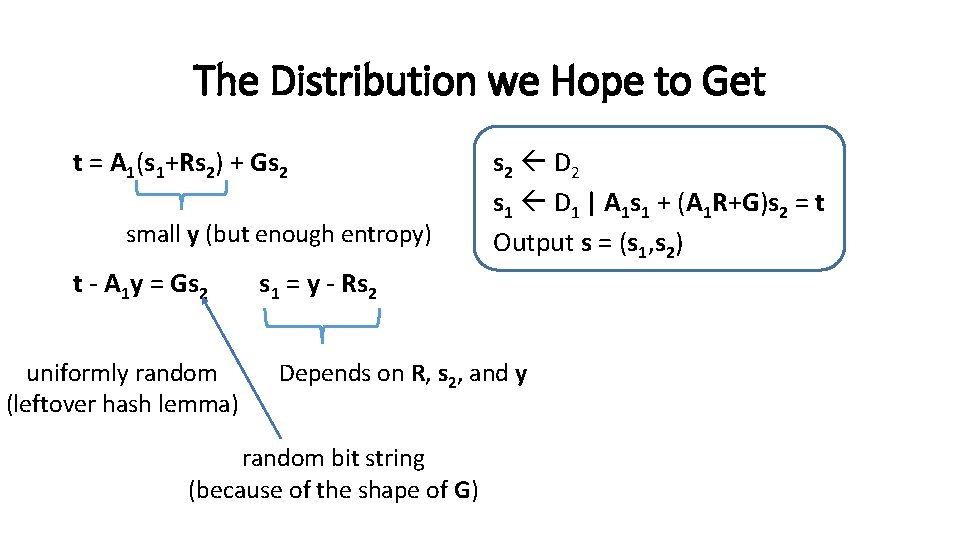
The Distribution we Hope to Get t = A 1(s 1+Rs 2) + Gs 2 small y (but enough entropy) t - A 1 y = Gs 2 uniformly random (leftover hash lemma) s 2 D 2 s 1 D 1 | A 1 s 1 + (A 1 R+G)s 2 = t Output s = (s 1, s 2) s 1 = y - Rs 2 Depends on R, s 2, and y random bit string (because of the shape of G)
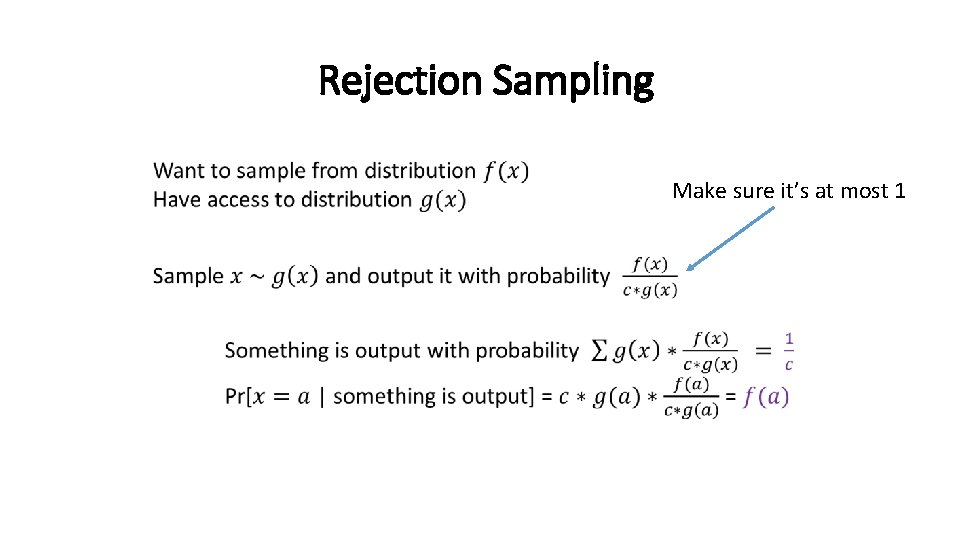
Rejection Sampling Make sure it’s at most 1
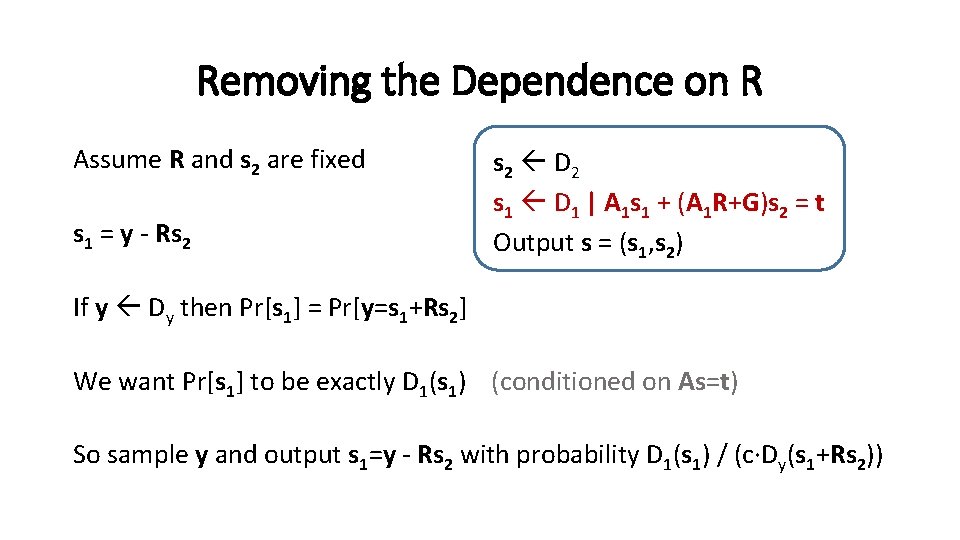
Removing the Dependence on R Assume R and s 2 are fixed s 1 = y - Rs 2 D 2 s 1 D 1 | A 1 s 1 + (A 1 R+G)s 2 = t Output s = (s 1, s 2) If y Dy then Pr[s 1] = Pr[y=s 1+Rs 2] We want Pr[s 1] to be exactly D 1(s 1) (conditioned on As=t) So sample y and output s 1=y - Rs 2 with probability D 1(s 1) / (c∙Dy(s 1+Rs 2))
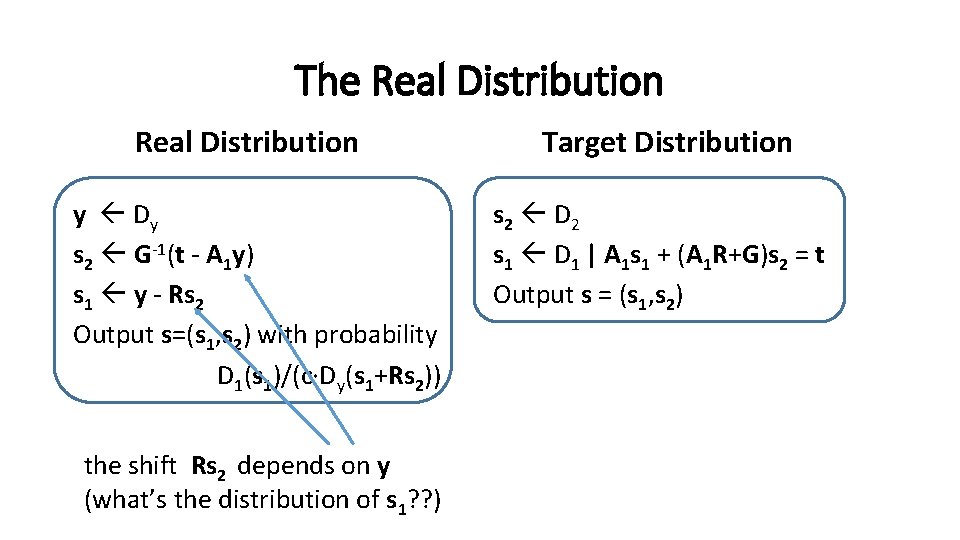
The Real Distribution y Dy s 2 G-1(t - A 1 y) s 1 y - Rs 2 Output s=(s 1, s 2) with probability D 1(s 1)/(c∙Dy(s 1+Rs 2)) the shift Rs 2 depends on y (what’s the distribution of s 1? ? ) Target Distribution s 2 D 2 s 1 D 1 | A 1 s 1 + (A 1 R+G)s 2 = t Output s = (s 1, s 2)
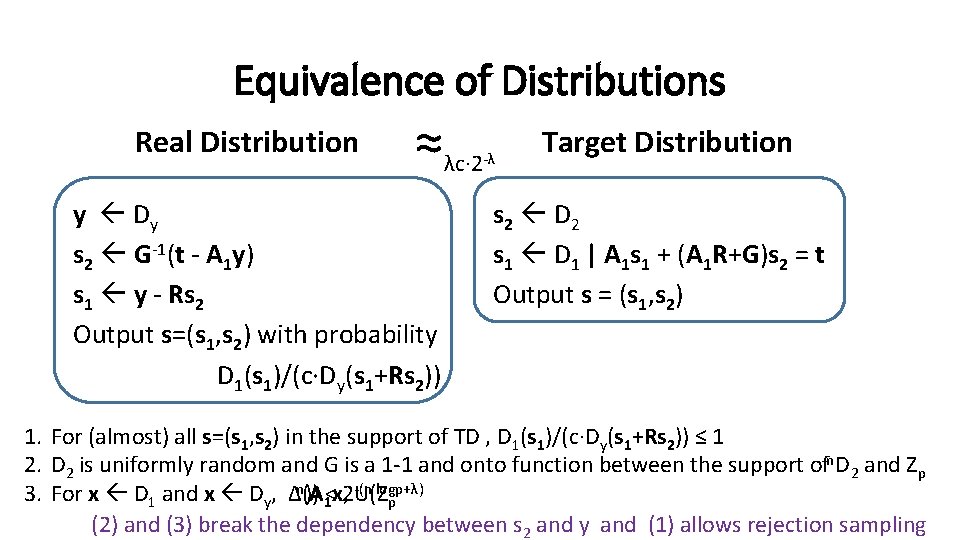
Equivalence of Distributions Real Distribution ≈ y Dy s 2 G-1(t - A 1 y) s 1 y - Rs 2 Output s=(s 1, s 2) with probability D 1(s 1)/(c∙Dy(s 1+Rs 2)) λc∙ 2 -λ Target Distribution s 2 D 2 s 1 D 1 | A 1 s 1 + (A 1 R+G)s 2 = t Output s = (s 1, s 2) 1. For (almost) all s=(s 1, s 2) in the support of TD , D 1(s 1)/(c∙Dy(s 1+Rs 2)) ≤ 1 2. D 2 is uniformly random and G is a 1 -1 and onto function between the support ofn D 2 and Zp n)) <x, 2 U(Z -(n logp+λ) 3. For x D 1 and x Dy, Δ(A 1 p (2) and (3) break the dependency between s 2 and y and (1) allows rejection sampling
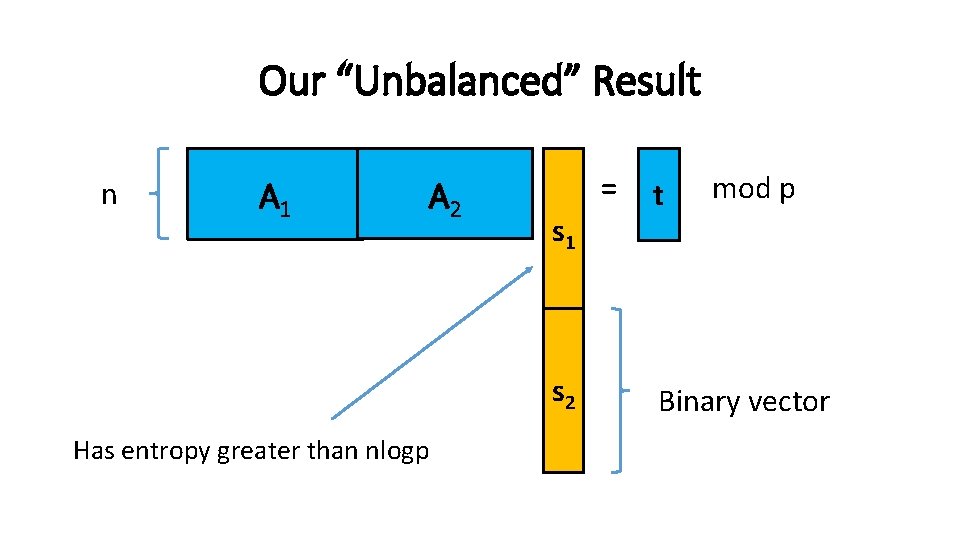
Our “Unbalanced” Result n A 1 A 2 = s 1 s 2 Has entropy greater than nlogp t mod p Binary vector
Is the Gaussian Distribution “Fundamental” to Lattices My opinion • To lattices – YES • A Gaussian distribution centered at any point in space is uniform over Rn / L for any “small-enough” lattice L • To lattice cryptography – NO • We usually work with random lattices of a special form • Can use the leftover hash lemma to argue uniformity • But … Gaussians are often an optimization
What Distribution to use in Practice? Gaussians are often (always? ) the “optimal” distribution to use for minimizing the parameters But … Sampling Gaussians requires high(er) precision so maybe too costly in low-power devices Try to use the distribution that minimizes parameters try to improve the efficiency later
- Slides: 19