
Simple Harmonic Motion Physics 1425 Lecture 28 Michael
- Slides: 27
Simple Harmonic Motion Physics 1425 Lecture 28 Michael Fowler, UVa
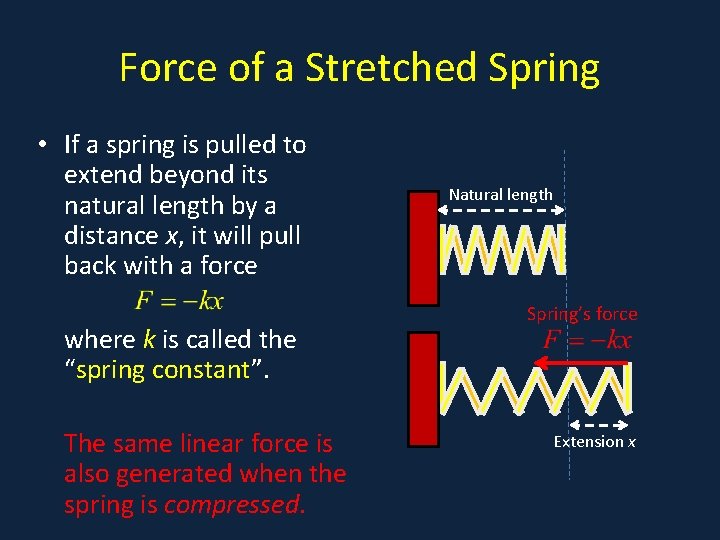
Force of a Stretched Spring • If a spring is pulled to extend beyond its natural length by a distance x, it will pull back with a force where k is called the “spring constant”. The same linear force is also generated when the spring is compressed. • A Natural length Spring’s force Extension x
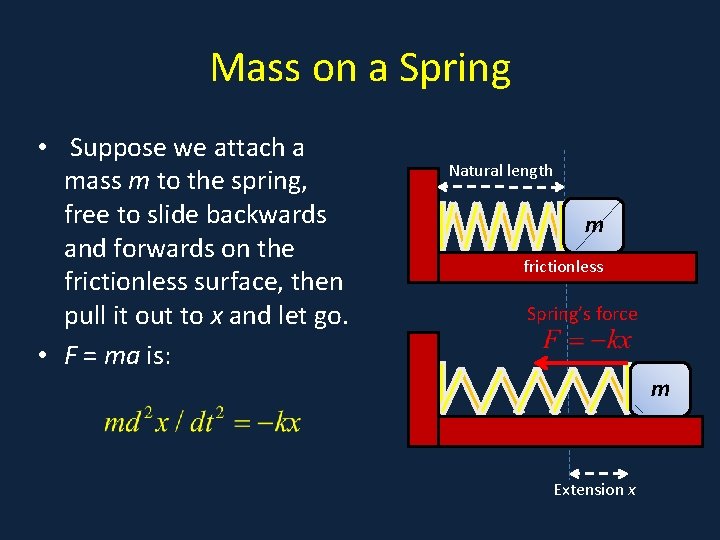
Mass on a Spring • A • Suppose we attach a mass m to the spring, free to slide backwards and forwards on the frictionless surface, then pull it out to x and let go. • F = ma is: Natural length m frictionless Spring’s force m Extension x
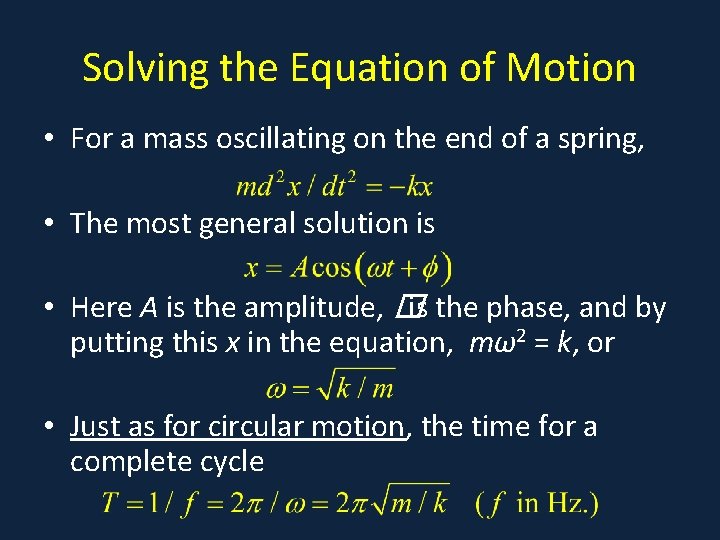
Solving the Equation of Motion • For a mass oscillating on the end of a spring, • The most general solution is • Here A is the amplitude, �is the phase, and by putting this x in the equation, mω2 = k, or • Just as for circular motion, the time for a complete cycle
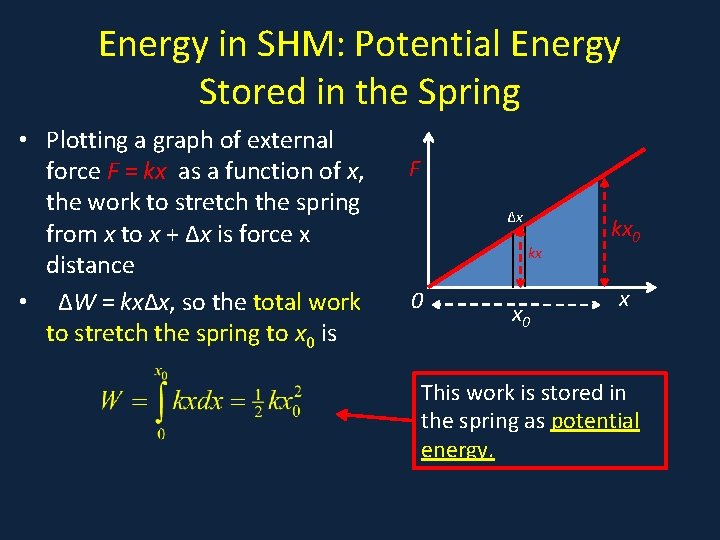
Energy in SHM: Potential Energy Stored in the Spring • Plotting a graph of external • A F force F = kx as a function of x, the work to stretch the spring from x to x + Δx is force x distance 0 • ΔW = kxΔx, so the total work to stretch the spring to x 0 is Δx kx x 0 kx 0 x This work is stored in the spring as potential energy.
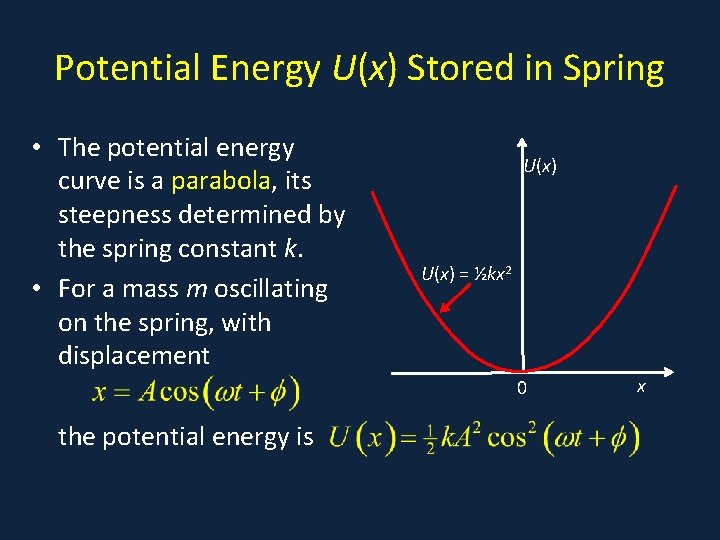
Potential Energy U(x) Stored in Spring • X • The potential energy curve is a parabola, its steepness determined by the spring constant k. U(x) = ½kx 2 • For a mass m oscillating on the spring, with displacement U(x) 0 the potential energy is x
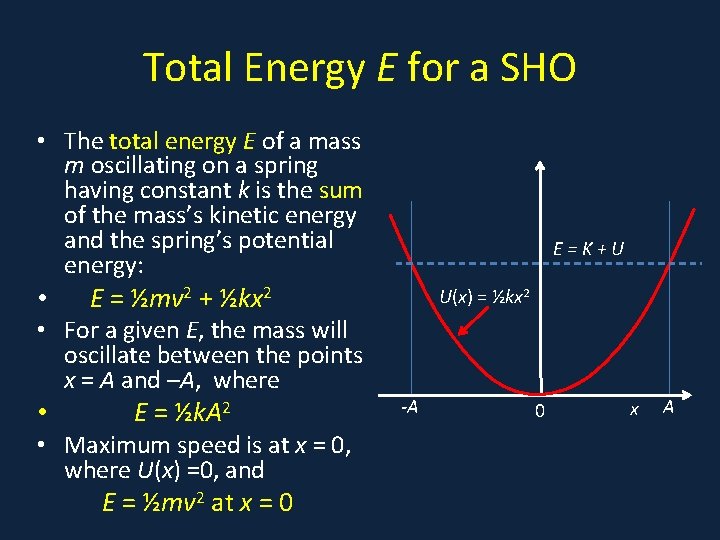
Total Energy E for a SHO • The total energy E of a mass • X m oscillating on a spring having constant k is the sum of the mass’s kinetic energy and the spring’s potential energy: • E = ½mv 2 + ½kx 2 • For a given E, the mass will oscillate between the points x = A and –A, where • E = ½k. A 2 • Maximum speed is at x = 0, where U(x) =0, and E = ½mv 2 at x = 0 E=K+U U(x) = ½kx 2 -A 0 x A
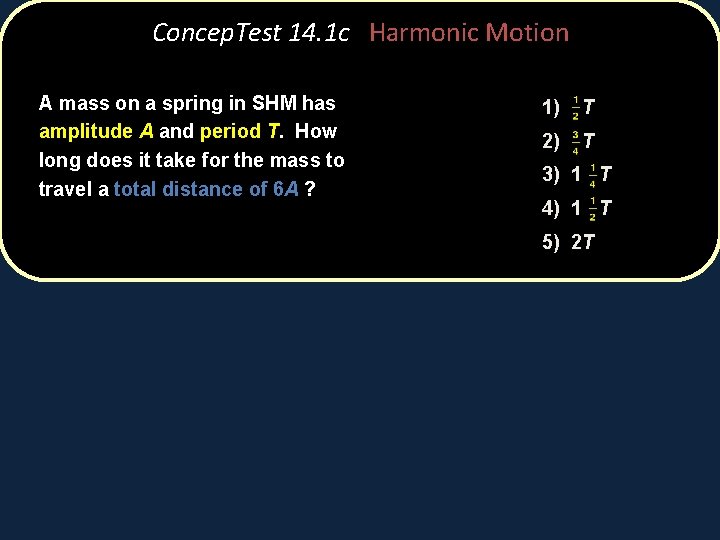
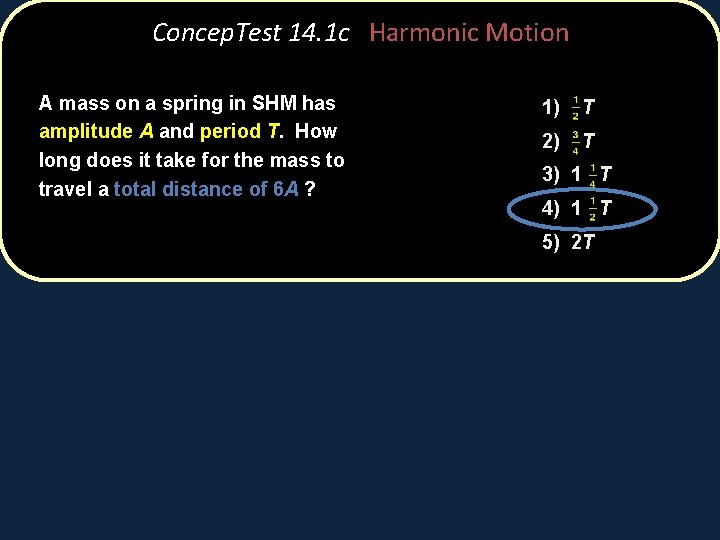
Concep. Test 14. 1 c Harmonic Motion A mass on a spring in SHM has amplitude A and period T. How long does it take for the mass to travel a total distance of 6 A ? 1) T 2) T 3) 1 T 4) 1 T 5) 2 T
Concep. Test 14. 1 c Harmonic Motion A mass on a spring in SHM has amplitude A and period T. How long does it take for the mass to travel a total distance of 6 A ? 1) T 2) T 3) 1 T 4) 1 T 5) 2 T
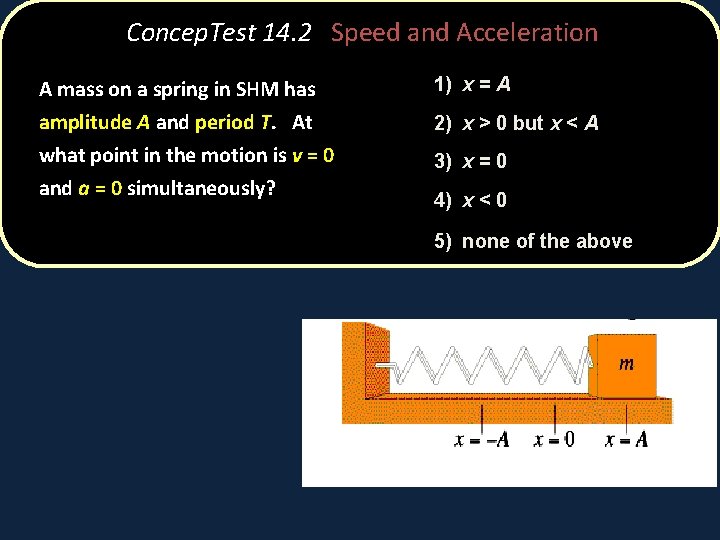
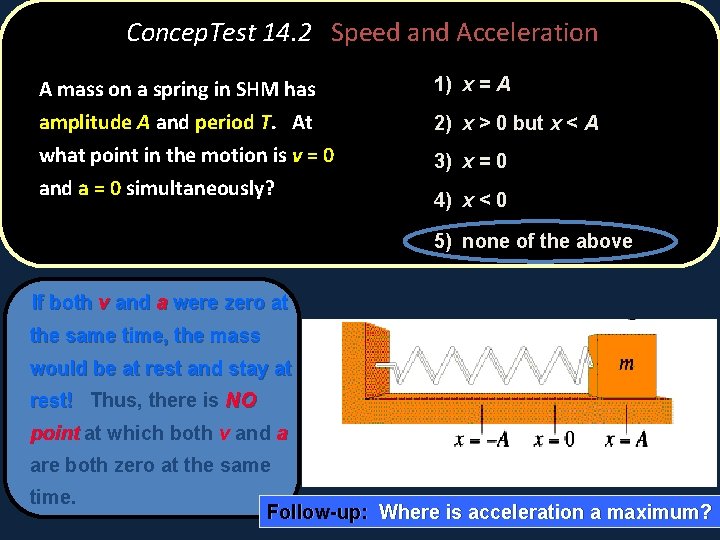
Concep. Test 14. 2 Speed and Acceleration A mass on a spring in SHM has amplitude A and period T. At what point in the motion is v = 0 and a = 0 simultaneously? 1) x = A 2) x > 0 but x < A 3) x = 0 4) x < 0 5) none of the above
Concep. Test 14. 2 Speed and Acceleration A mass on a spring in SHM has amplitude A and period T. At what point in the motion is v = 0 and a = 0 simultaneously? 1) x = A 2) x > 0 but x < A 3) x = 0 4) x < 0 5) none of the above If both v and a were zero at the same time, the mass would be at rest and stay at rest! Thus, there is NO point at which both v and a are both zero at the same time. Follow-up: Where is acceleration a maximum?
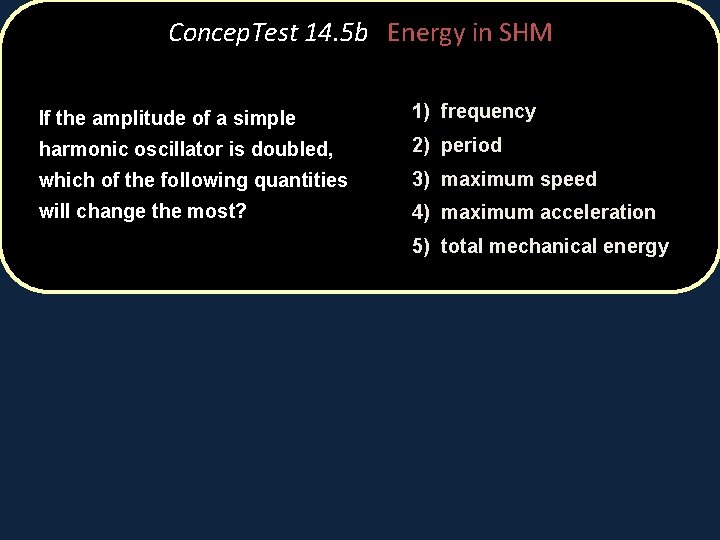
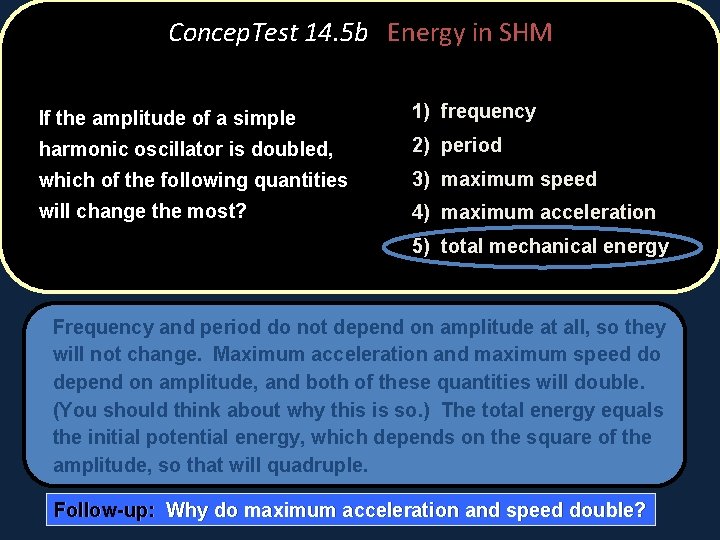
Concep. Test 14. 5 b Energy in SHM If the amplitude of a simple 1) frequency harmonic oscillator is doubled, 2) period which of the following quantities 3) maximum speed will change the most? 4) maximum acceleration 5) total mechanical energy
Concep. Test 14. 5 b Energy in SHM If the amplitude of a simple 1) frequency harmonic oscillator is doubled, 2) period which of the following quantities 3) maximum speed will change the most? 4) maximum acceleration 5) total mechanical energy Frequency and period do not depend on amplitude at all, so they will not change. Maximum acceleration and maximum speed do depend on amplitude, and both of these quantities will double. (You should think about why this is so. ) The total energy equals the initial potential energy, which depends on the square of the amplitude, so that will quadruple. Follow-up: Why do maximum acceleration and speed double?
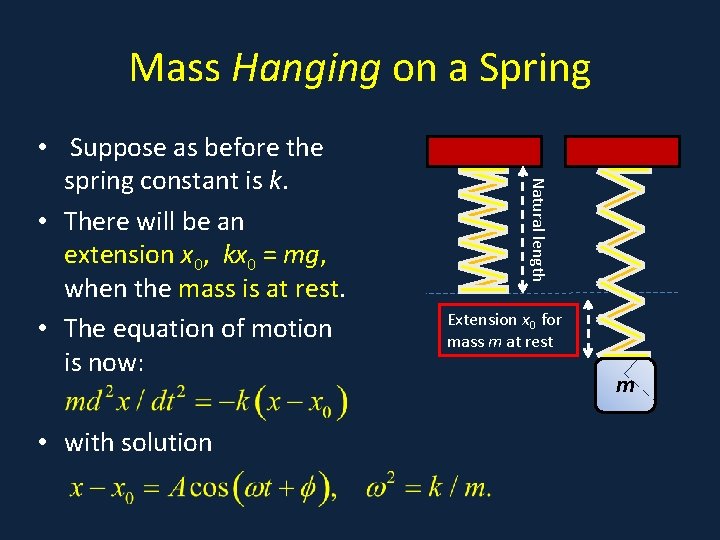
Mass Hanging on a Spring • with solution Natural length • A • Suppose as before the spring constant is k. • There will be an extension x 0, kx 0 = mg, when the mass is at rest. • The equation of motion is now: Extension x 0 for mass m at rest m
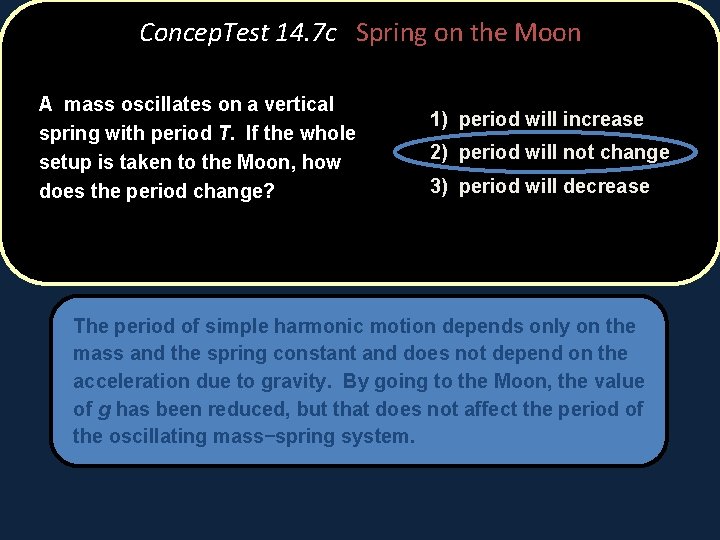
Concep. Test 14. 7 c Spring on the Moon A mass oscillates on a vertical spring with period T. If the whole setup is taken to the Moon, how does the period change? 1) period will increase 2) period will not change 3) period will decrease
Concep. Test 14. 7 c Spring on the Moon A mass oscillates on a vertical spring with period T. If the whole setup is taken to the Moon, how does the period change? 1) period will increase 2) period will not change 3) period will decrease The period of simple harmonic motion depends only on the mass and the spring constant and does not depend on the acceleration due to gravity. By going to the Moon, the value of g has been reduced, but that does not affect the period of the oscillating mass–spring system.
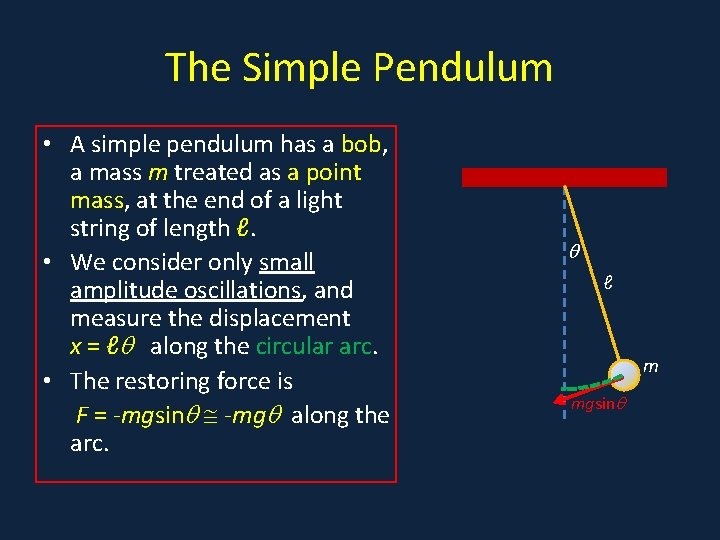
The Simple Pendulum • A simple pendulum has a bob, a mass m treated as a point mass, at the end of a light string of length ℓ. • We consider only small amplitude oscillations, and measure the displacement x = ℓ along the circular arc. • The restoring force is F = -mgsin -mg along the arc. • v ℓ m mgsin
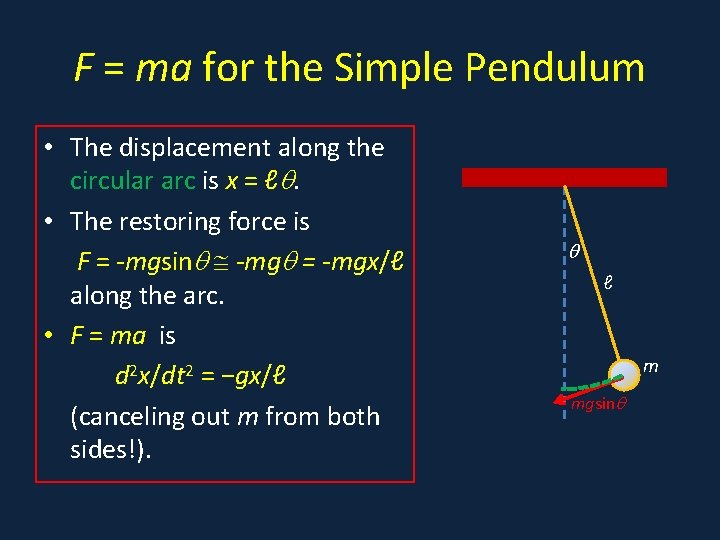
F = ma for the Simple Pendulum • The displacement along the • v circular arc is x = ℓ. • The restoring force is F = -mgsin -mg = -mgx/ℓ along the arc. • F = ma is d 2 x/dt 2 = −gx/ℓ (canceling out m from both sides!). ℓ m mgsin
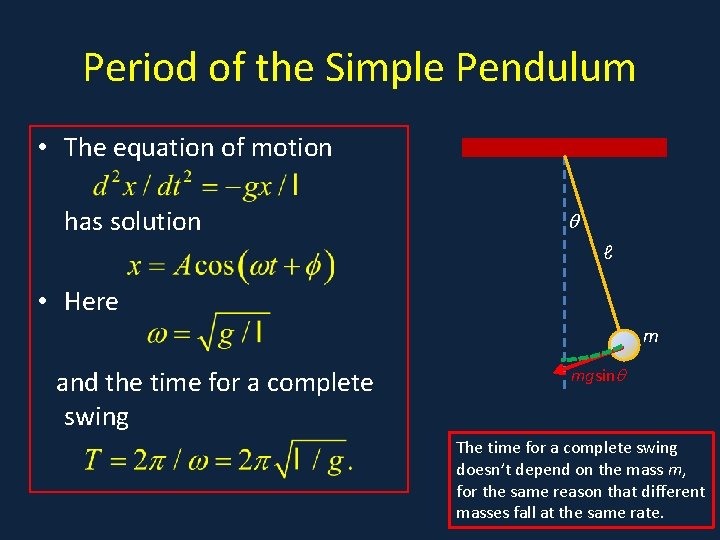
Period of the Simple Pendulum • The equation of motion has solution • v ℓ • Here m and the time for a complete swing mgsin The time for a complete swing doesn’t depend on the mass m, for the same reason that different masses fall at the same rate.
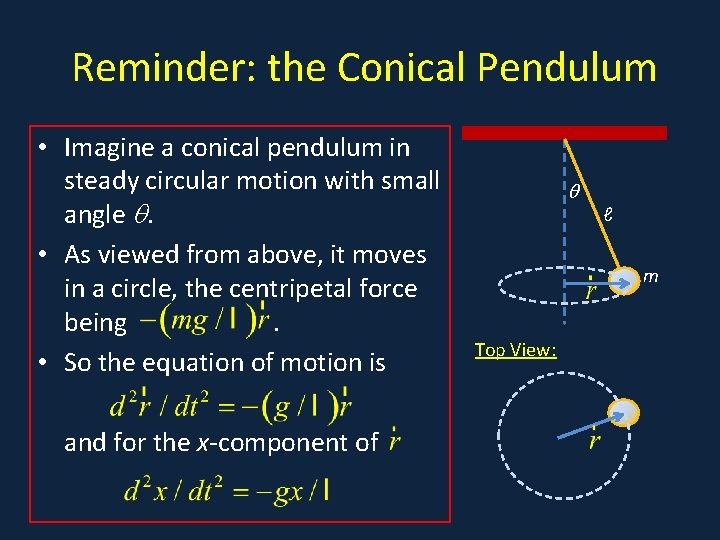
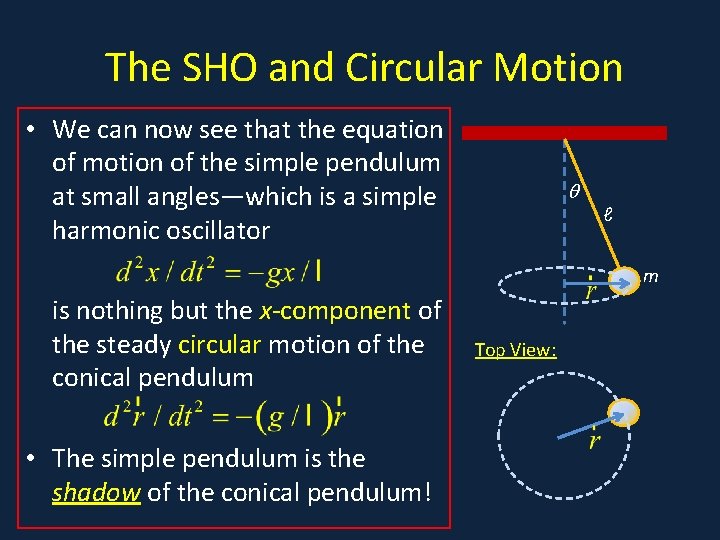
Reminder: the Conical Pendulum • Imagine a conical pendulum in • v steady circular motion with small angle . • As viewed from above, it moves in a circle, the centripetal force being. Top View: • So the equation of motion is and for the x-component of ℓ m
The SHO and Circular Motion • We can now see that the equation • v of motion of the simple pendulum at small angles—which is a simple harmonic oscillator ℓ m is nothing but the x-component of the steady circular motion of the conical pendulum • The simple pendulum is the shadow of the conical pendulum! Top View:
Concep. Test 14. 9 Grandfather Clock A grandfather clock has a weight at the bottom of the pendulum that can be moved up or down. If the clock is running slow, what should you do to adjust the time properly? 1) move the weight up 2) move the weight down 3) moving the weight will not matter 4) call the repairman
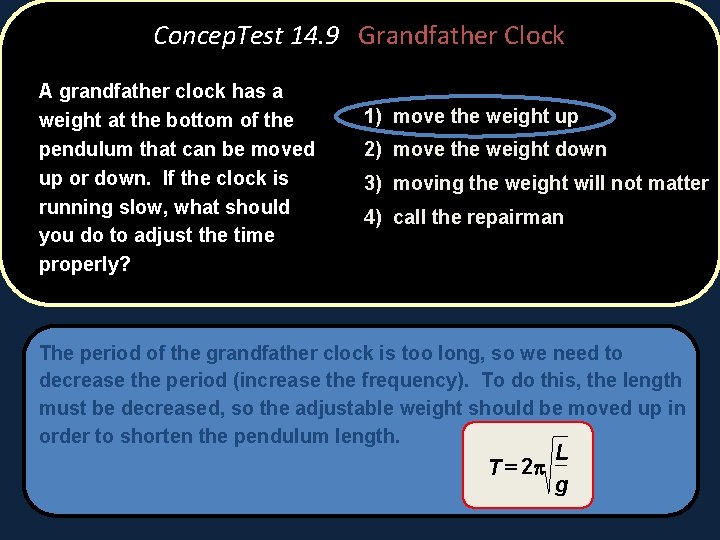
Concep. Test 14. 9 Grandfather Clock A grandfather clock has a weight at the bottom of the pendulum that can be moved up or down. If the clock is running slow, what should you do to adjust the time properly? 1) move the weight up 2) move the weight down 3) moving the weight will not matter 4) call the repairman The period of the grandfather clock is too long, so we need to decrease the period (increase the frequency). To do this, the length must be decreased, so the adjustable weight should be moved up in order to shorten the pendulum length. L T = 2 p g
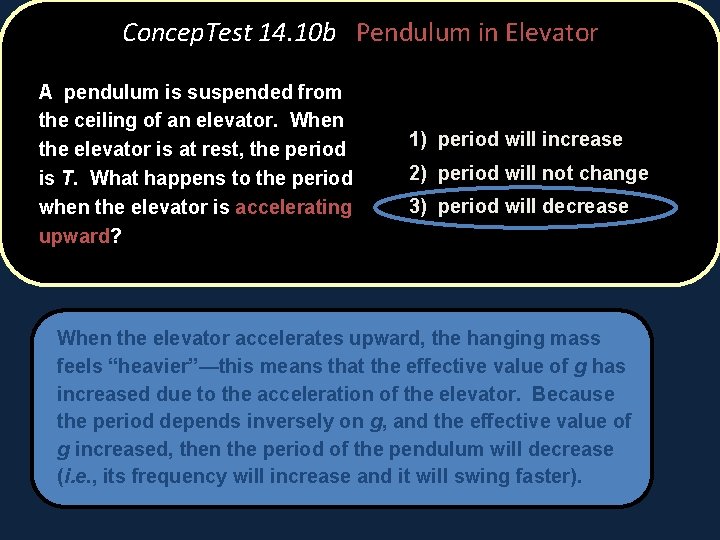
Concep. Test 14. 10 b Pendulum in Elevator A pendulum is suspended from the ceiling of an elevator. When the elevator is at rest, the period is T. What happens to the period when the elevator is accelerating upward? 1) period will increase 2) period will not change 3) period will decrease
Concep. Test 14. 10 b Pendulum in Elevator A pendulum is suspended from the ceiling of an elevator. When the elevator is at rest, the period is T. What happens to the period when the elevator is accelerating upward? 1) period will increase 2) period will not change 3) period will decrease When the elevator accelerates upward, the hanging mass feels “heavier”—this means that the effective value of g has increased due to the acceleration of the elevator. Because the period depends inversely on g, and the effective value of g increased, then the period of the pendulum will decrease (i. e. , its frequency will increase and it will swing faster).
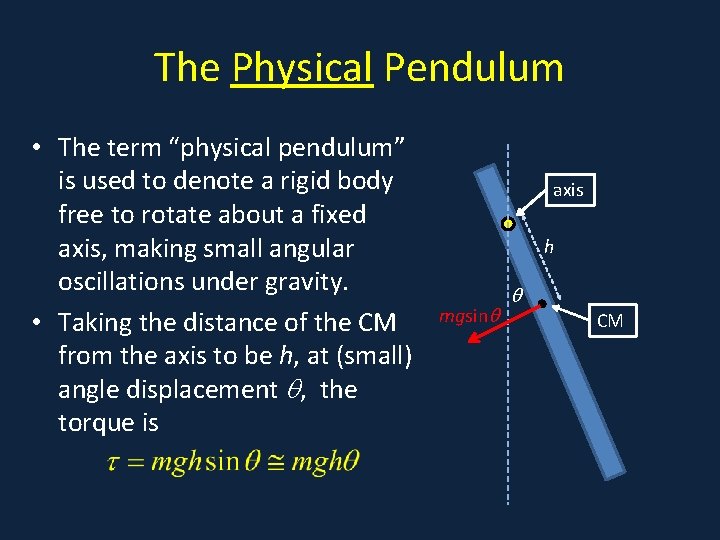
The Physical Pendulum • The term “physical pendulum” • v is used to denote a rigid body free to rotate about a fixed axis, making small angular oscillations under gravity. • Taking the distance of the CM mgsin from the axis to be h, at (small) angle displacement , the torque is axis h CM
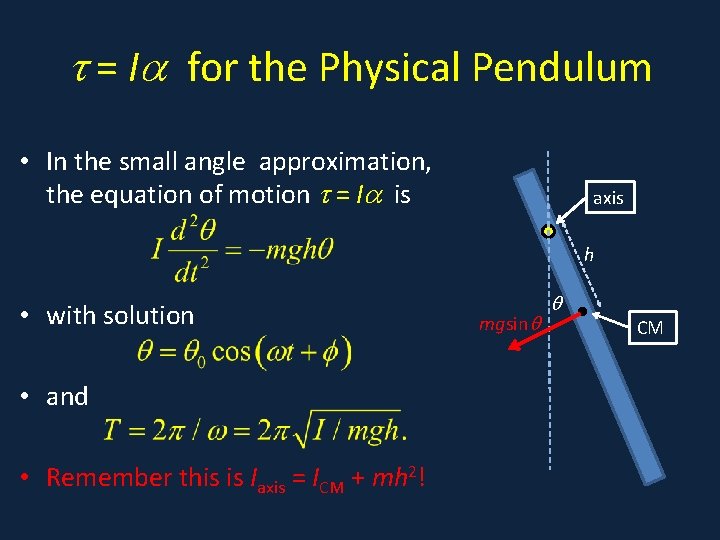
= I for the Physical Pendulum • In the small angle approximation, the equation of motion = I is • v axis h • with solution • and • Remember this is Iaxis = ICM + mh 2! mgsin CM