
Simple Harmonic Motion Periodic Motion Periodic motion is

- Slides: 15
Simple Harmonic Motion
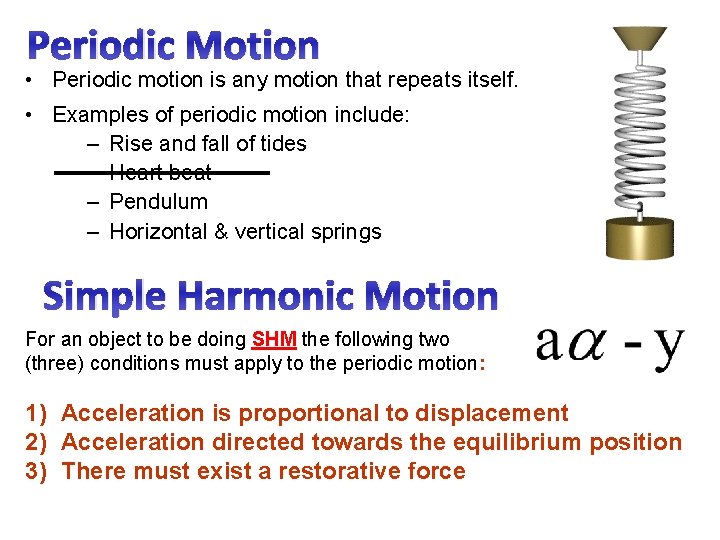
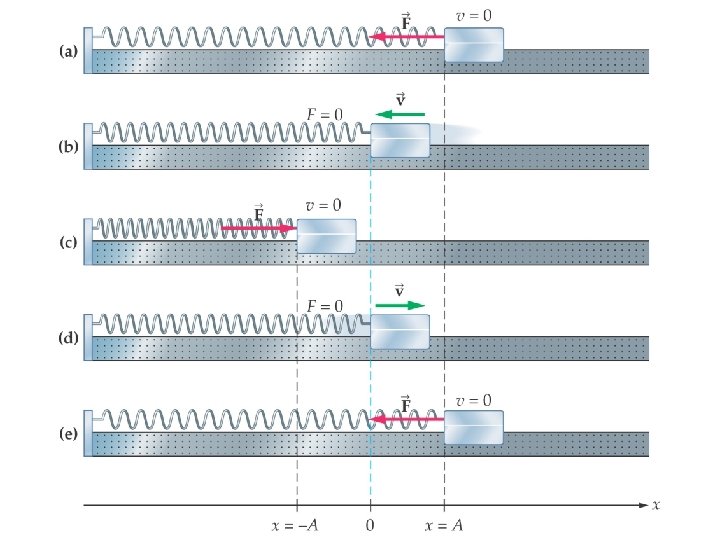
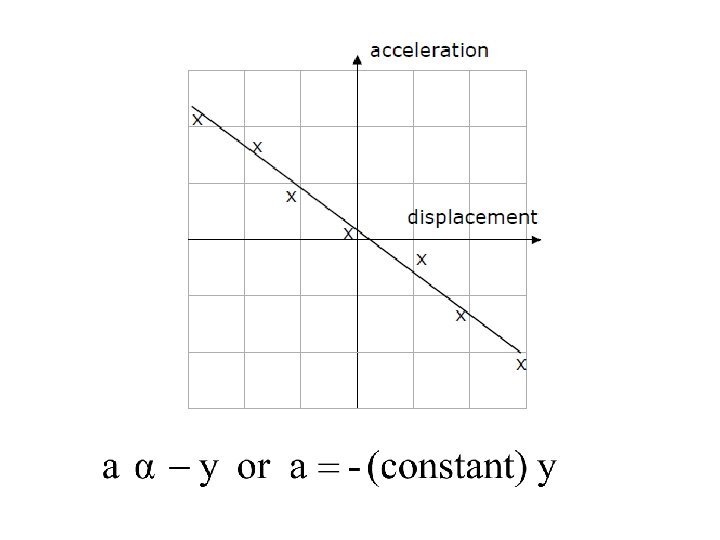
Periodic Motion • Periodic motion is any motion that repeats itself. • Examples of periodic motion include: – Rise and fall of tides – Heart beat – Pendulum – Horizontal & vertical springs Simple Harmonic Motion For an object to be doing SHM the following two (three) conditions must apply to the periodic motion: 1) Acceleration is proportional to displacement 2) Acceleration directed towards the equilibrium position 3) There must exist a restorative force
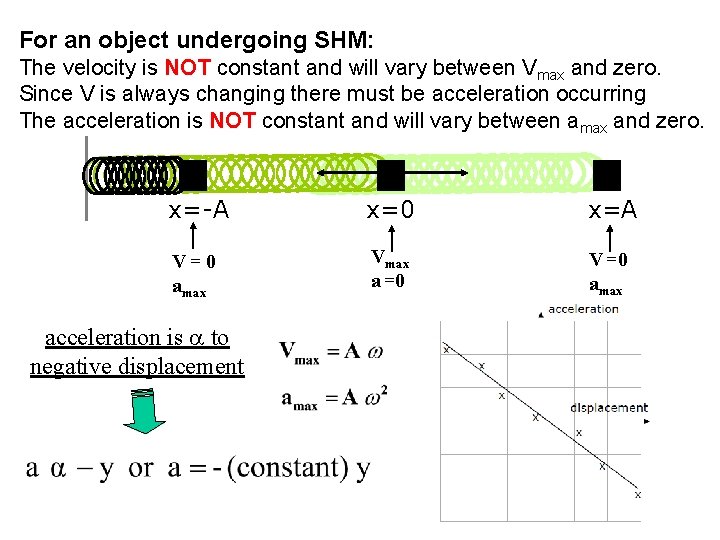
For an object undergoing SHM: The velocity is NOT constant and will vary between Vmax and zero. Since V is always changing there must be acceleration occurring The acceleration is NOT constant and will vary between amax and zero. x=-A x=0 x=A V= 0 amax Vmax a =0 V =0 amax acceleration is to negative displacement
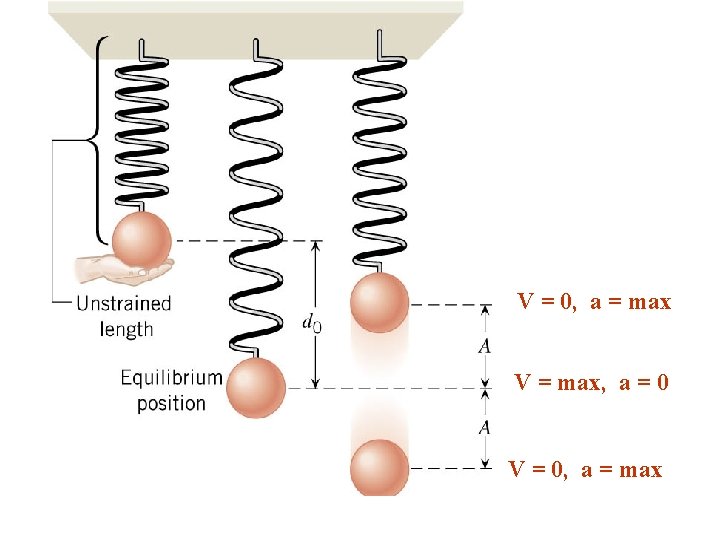
V = 0, a = max V = max, a = 0 V = 0, a = max
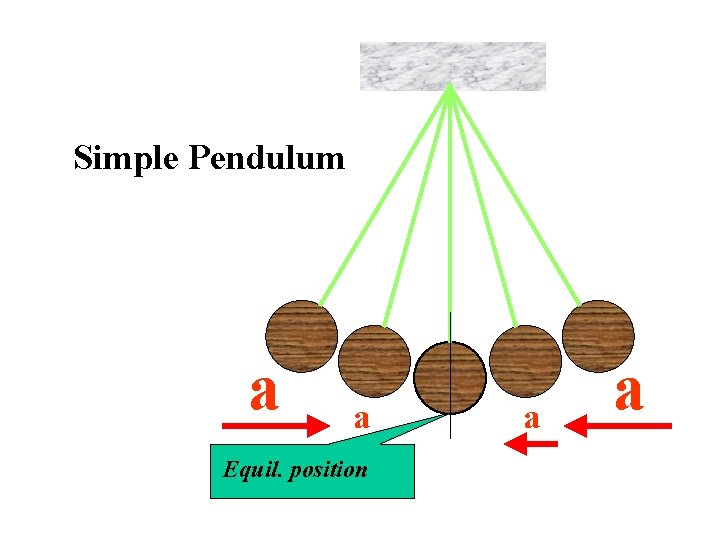
Simple Pendulum a a Equil. position a a
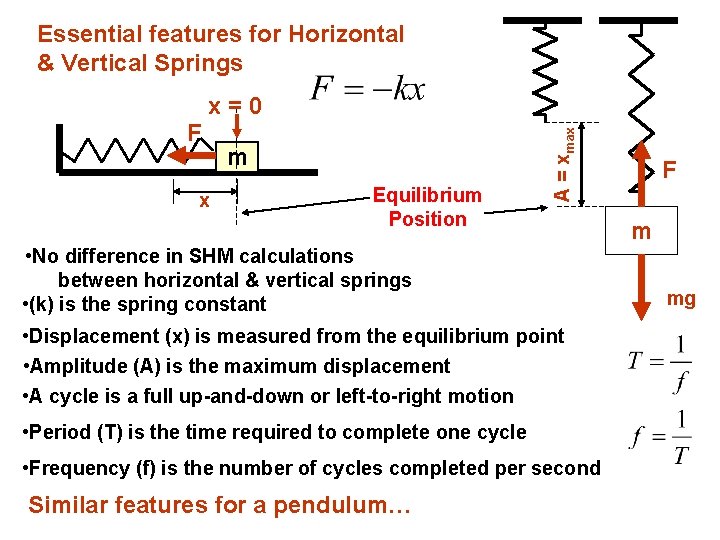
Essential features for Horizontal & Vertical Springs x m Equilibrium Position A = xmax F x=0 • No difference in SHM calculations between horizontal & vertical springs • (k) is the spring constant • Displacement (x) is measured from the equilibrium point • Amplitude (A) is the maximum displacement • A cycle is a full up-and-down or left-to-right motion • Period (T) is the time required to complete one cycle • Frequency (f) is the number of cycles completed per second Similar features for a pendulum… F m mg
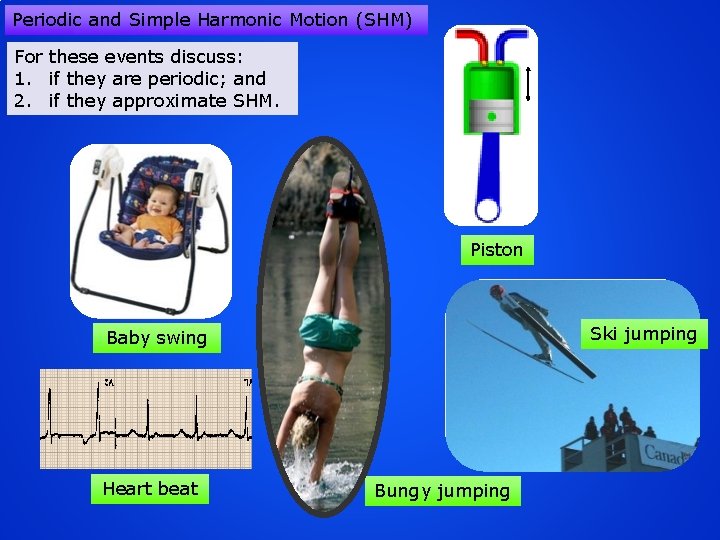
Periodic and Simple Harmonic Motion (SHM) For these events discuss: 1. if they are periodic; and 2. if they approximate SHM. Piston Ski jumping Baby swing Heart beat Bungy jumping
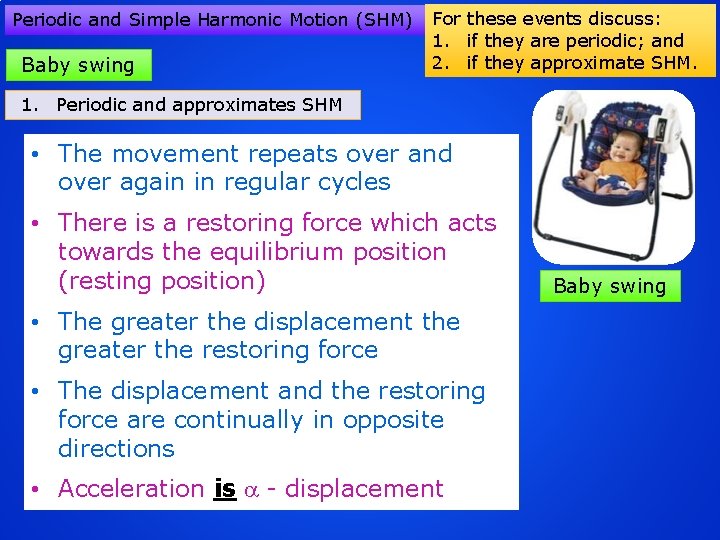
Periodic and Simple Harmonic Motion (SHM) Baby swing For these events discuss: 1. if they are periodic; and 2. if they approximate SHM. 1. Periodic and approximates SHM • The movement repeats over and over again in regular cycles • There is a restoring force which acts towards the equilibrium position (resting position) • The greater the displacement the greater the restoring force • The displacement and the restoring force are continually in opposite directions • Acceleration is - displacement Baby swing
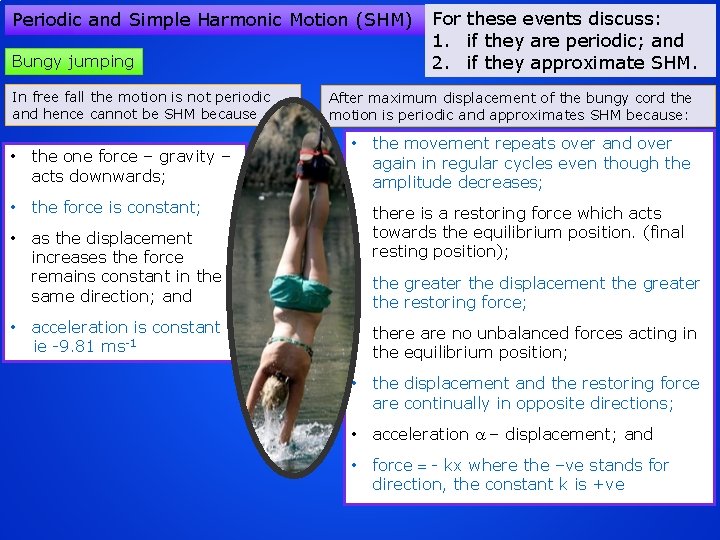
Periodic and Simple Harmonic Motion (SHM) Bungy jumping In free fall the motion is not periodic and hence cannot be SHM because • the one force – gravity – acts downwards; • the force is constant; • as the displacement increases the force remains constant in the same direction; and • acceleration is constant ie -9. 81 ms-1 For these events discuss: 1. if they are periodic; and 2. if they approximate SHM. After maximum displacement of the bungy cord the motion is periodic and approximates SHM because: • the movement repeats over and over again in regular cycles even though the amplitude decreases; • there is a restoring force which acts towards the equilibrium position. (final resting position); • the greater the displacement the greater the restoring force; • there are no unbalanced forces acting in the equilibrium position; • the displacement and the restoring force are continually in opposite directions; • acceleration – displacement; and • force = - kx where the –ve stands for direction, the constant k is +ve
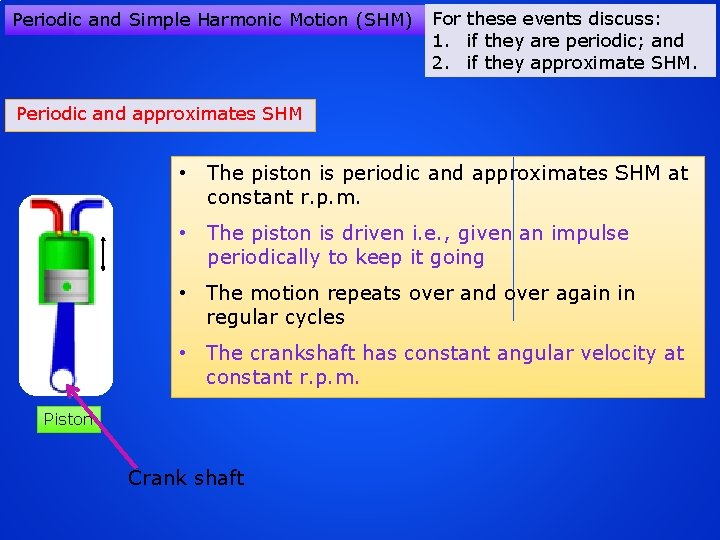
Periodic and Simple Harmonic Motion (SHM) For these events discuss: 1. if they are periodic; and 2. if they approximate SHM. Periodic and approximates SHM • The piston is periodic and approximates SHM at constant r. p. m. • The piston is driven i. e. , given an impulse periodically to keep it going • The motion repeats over and over again in regular cycles • The crankshaft has constant angular velocity at constant r. p. m. Piston Crank shaft
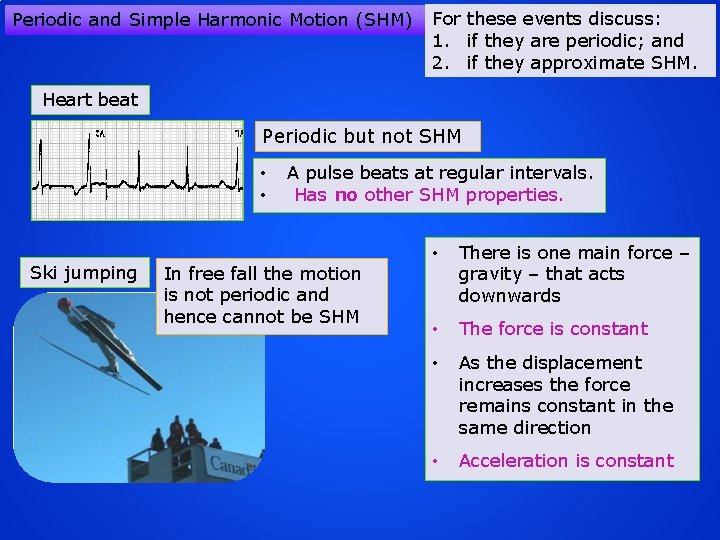
Periodic and Simple Harmonic Motion (SHM) For these events discuss: 1. if they are periodic; and 2. if they approximate SHM. Heart beat Periodic but not SHM • • Ski jumping A pulse beats at regular intervals. Has no other SHM properties. In free fall the motion is not periodic and hence cannot be SHM • There is one main force – gravity – that acts downwards • The force is constant • As the displacement increases the force remains constant in the same direction • Acceleration is constant