
Simple Harmonic Motion Periodic Motion A motion back
Simple Harmonic Motion
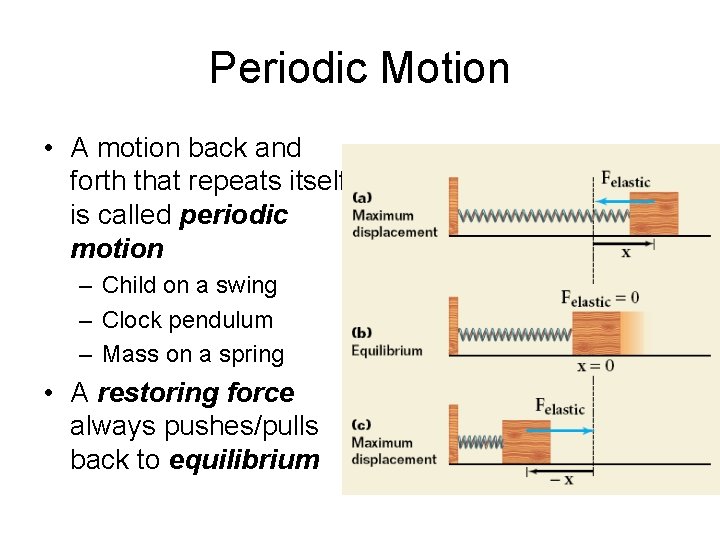
Periodic Motion • A motion back and forth that repeats itself is called periodic motion – Child on a swing – Clock pendulum – Mass on a spring • A restoring force always pushes/pulls back to equilibrium
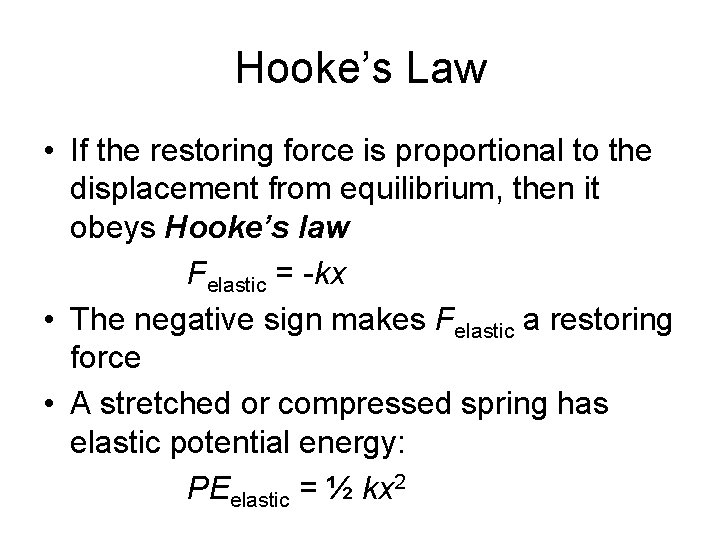
Hooke’s Law • If the restoring force is proportional to the displacement from equilibrium, then it obeys Hooke’s law Felastic = -kx • The negative sign makes Felastic a restoring force • A stretched or compressed spring has elastic potential energy: PEelastic = ½ kx 2
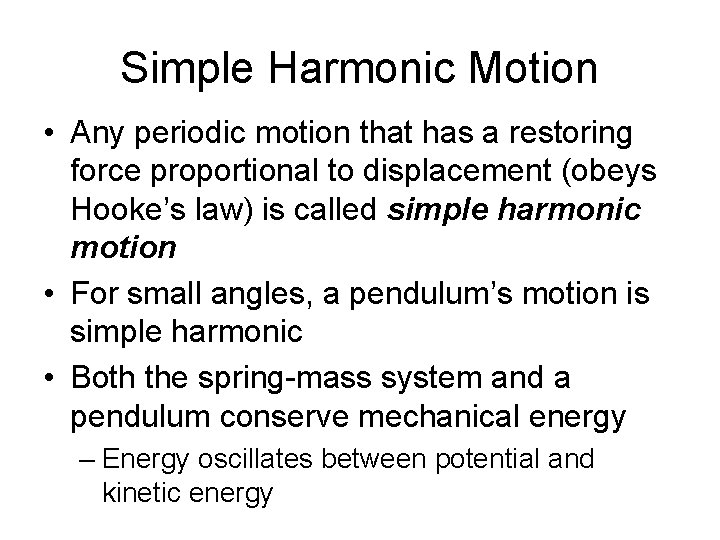
Simple Harmonic Motion • Any periodic motion that has a restoring force proportional to displacement (obeys Hooke’s law) is called simple harmonic motion • For small angles, a pendulum’s motion is simple harmonic • Both the spring-mass system and a pendulum conserve mechanical energy – Energy oscillates between potential and kinetic energy

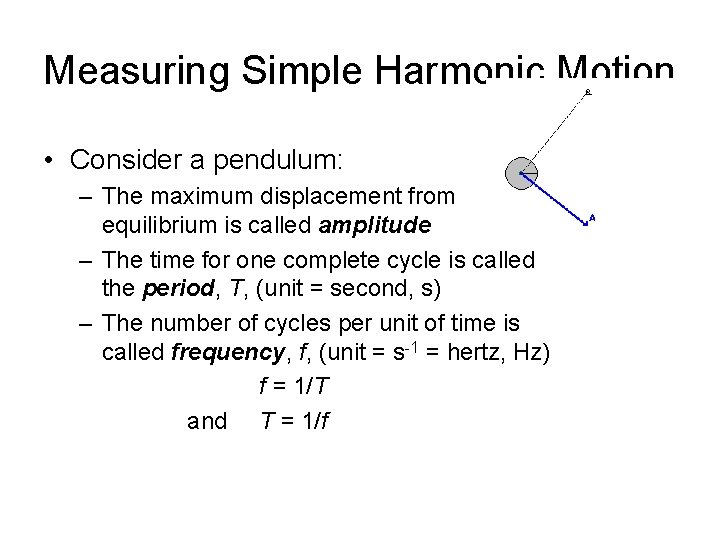
Measuring Simple Harmonic Motion • Consider a pendulum: – The maximum displacement from equilibrium is called amplitude – The time for one complete cycle is called the period, T, (unit = second, s) – The number of cycles per unit of time is called frequency, f, (unit = s-1 = hertz, Hz) f = 1/T and T = 1/f
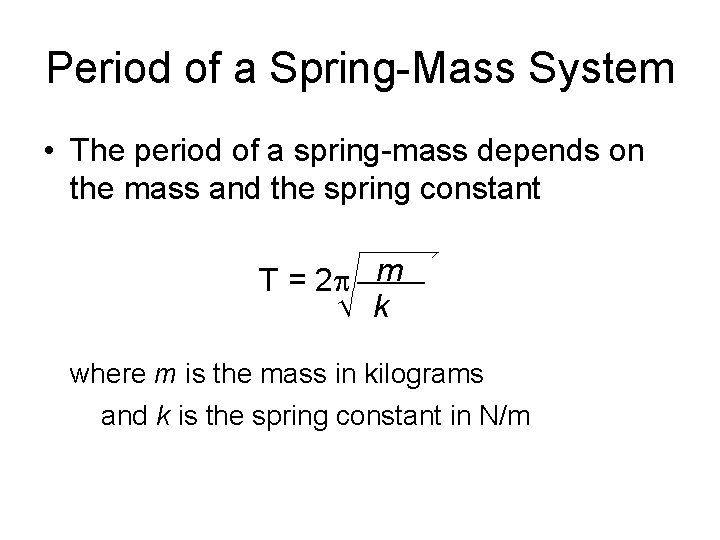
Period of a Spring-Mass System • The period of a spring-mass depends on the mass and the spring constant m T = 2 k where m is the mass in kilograms and k is the spring constant in N/m
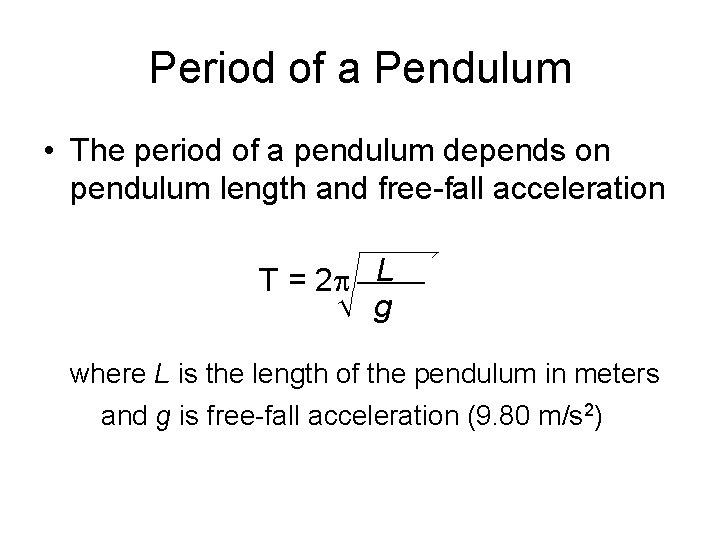
Period of a Pendulum • The period of a pendulum depends on pendulum length and free-fall acceleration L T = 2 g where L is the length of the pendulum in meters and g is free-fall acceleration (9. 80 m/s 2)
- Slides: 8