
Simple Harmonic Motion Elliott There are four different
- Slides: 23
Simple Harmonic Motion Elliott
There are four different kinds of motion that we can encounter in Physics: • • Linear (in a straight line) Circular (going round in a circle) Rotational (spinning on an axis) Oscillations (going backwards and forwards in a to-and-fro movement. )
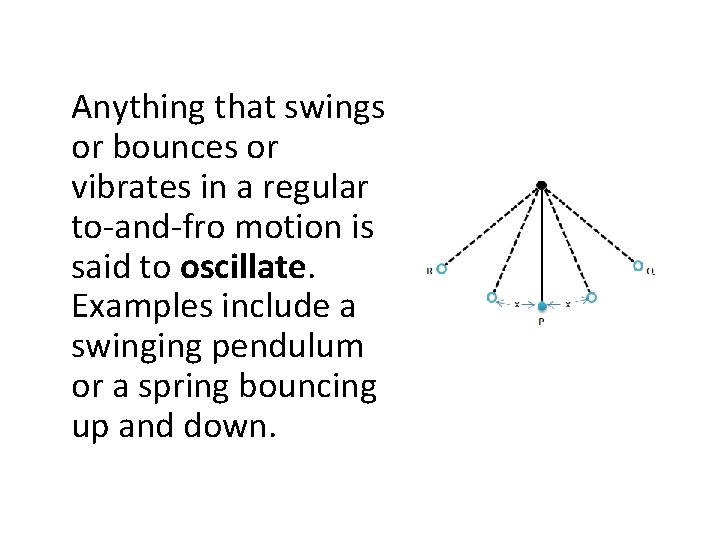
Anything that swings or bounces or vibrates in a regular to-and-fro motion is said to oscillate. Examples include a swinging pendulum or a spring bouncing up and down.
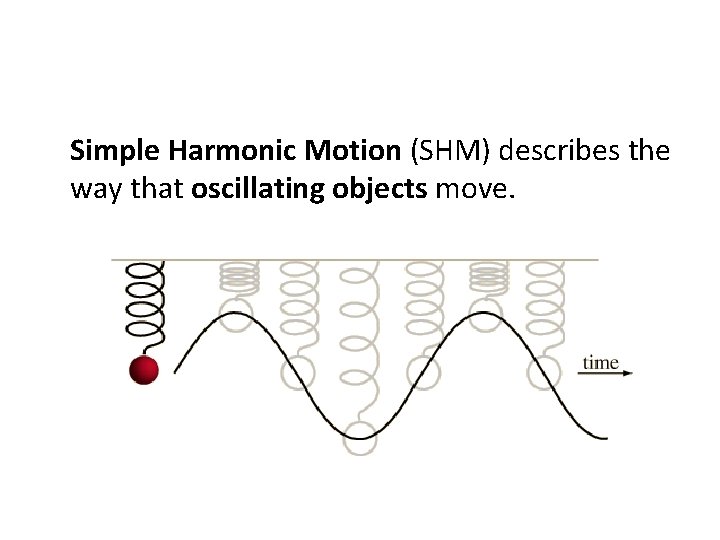
Simple Harmonic Motion (SHM) describes the way that oscillating objects move.
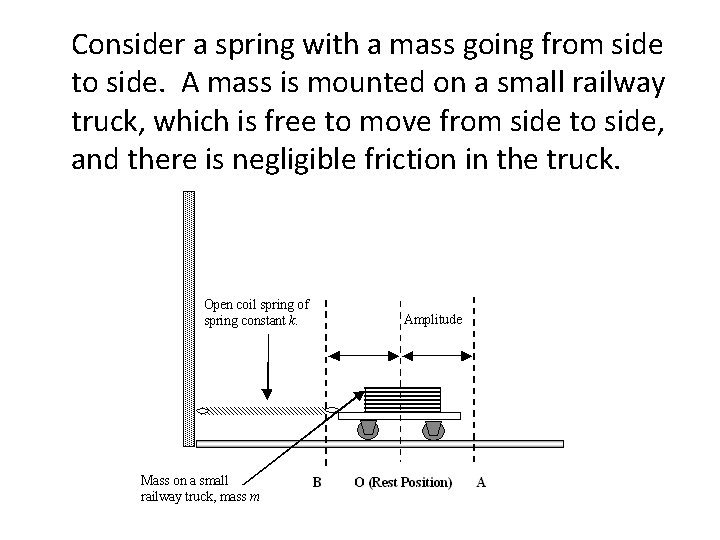
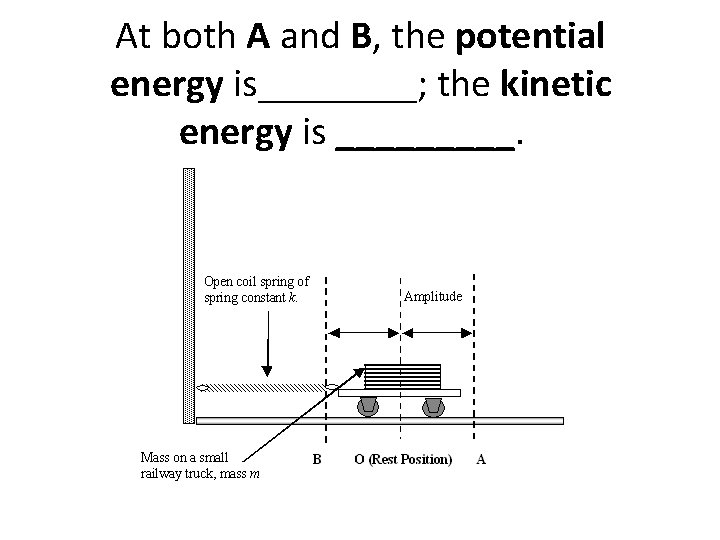
Consider a spring with a mass going from side to side. A mass is mounted on a small railway truck, which is free to move from side to side, and there is negligible friction in the truck.
• Identify the restoring force. • Why is there Acceleration? • In which Direction is the acceleration?
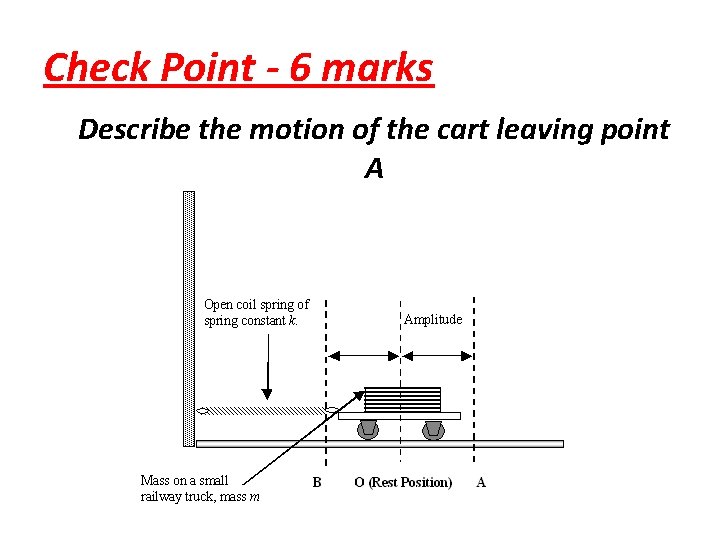
Check Point - 6 marks Describe the motion of the cart leaving point A
Marks • Its velocity to the left increases. • The acceleration decreases as the mass approached the rest position. • Because of inertia, the mass overshoots the rest position. • Then the spring is being compressed, and there is a restoring force to the right. • At B the acceleration is at a maximum, but this time to the right. • (One mark for Coherent explanaiton)
At both A and B, the potential energy is____; the kinetic energy is _____.
Check Point Write down the formulae that describe kinetic energy and the elastic potential energy in a spring.
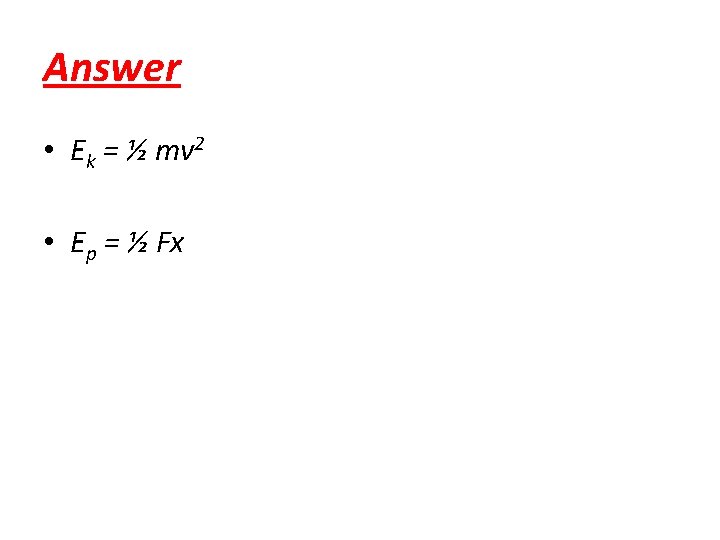
Answer • Ek = ½ mv 2 • Ep = ½ Fx
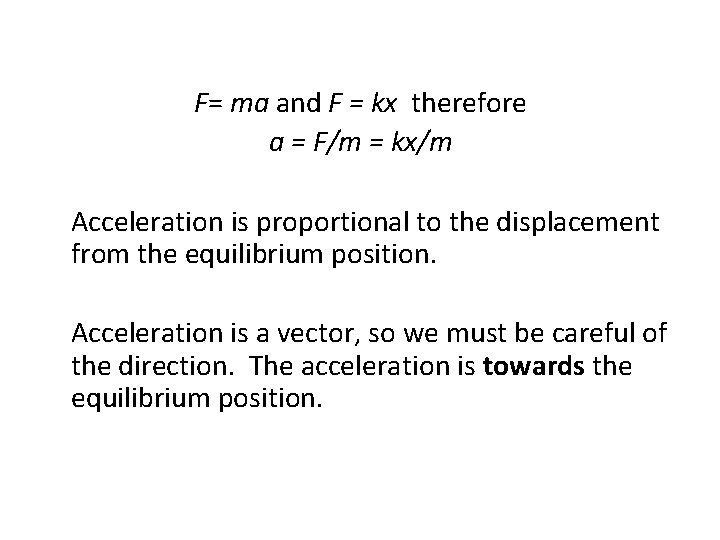
F= ma and F = kx therefore a = F/m = kx/m Acceleration is proportional to the displacement from the equilibrium position. Acceleration is a vector, so we must be careful of the direction. The acceleration is towards the equilibrium position.
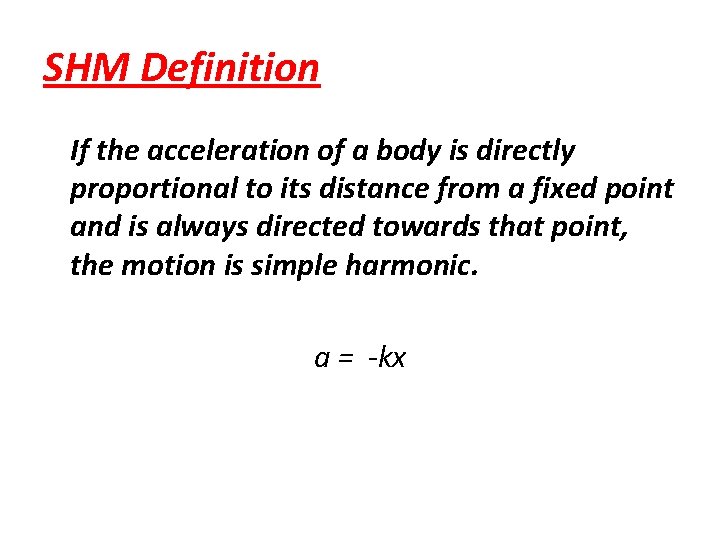
SHM Definition If the acceleration of a body is directly proportional to its distance from a fixed point and is always directed towards that point, the motion is simple harmonic. a = -kx
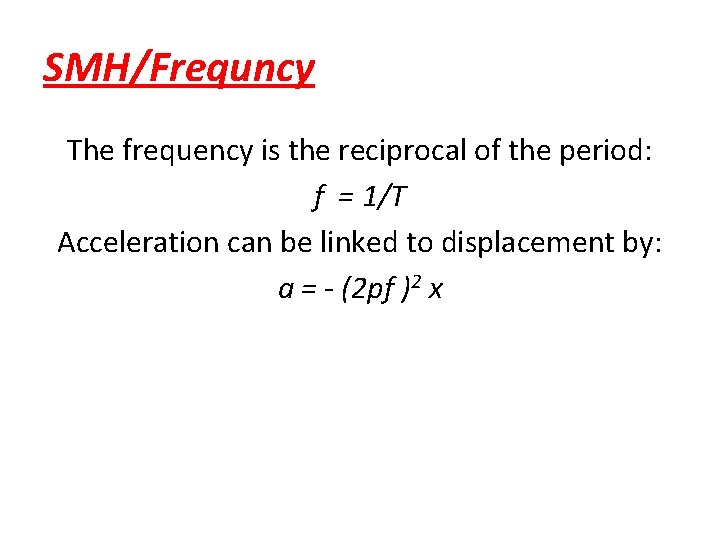
SMH/Frequncy The frequency is the reciprocal of the period: f = 1/T Acceleration can be linked to displacement by: a = - (2 pf )2 x
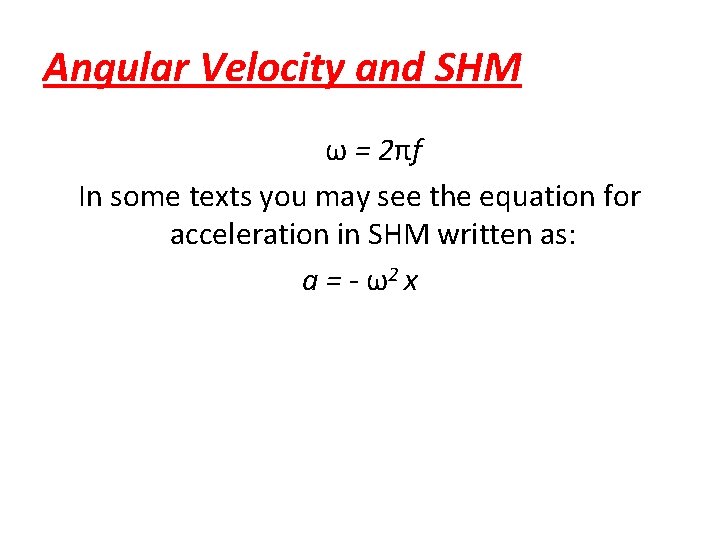
Angular Velocity and SHM ω = 2πf In some texts you may see the equation for acceleration in SHM written as: a = - ω2 x
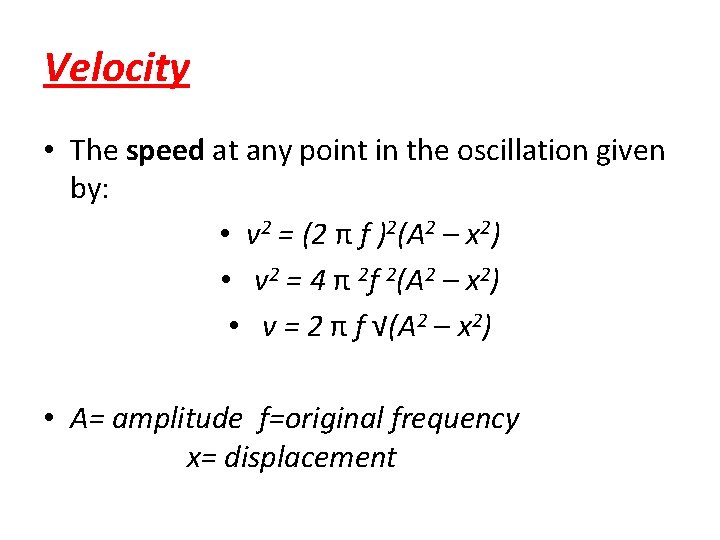
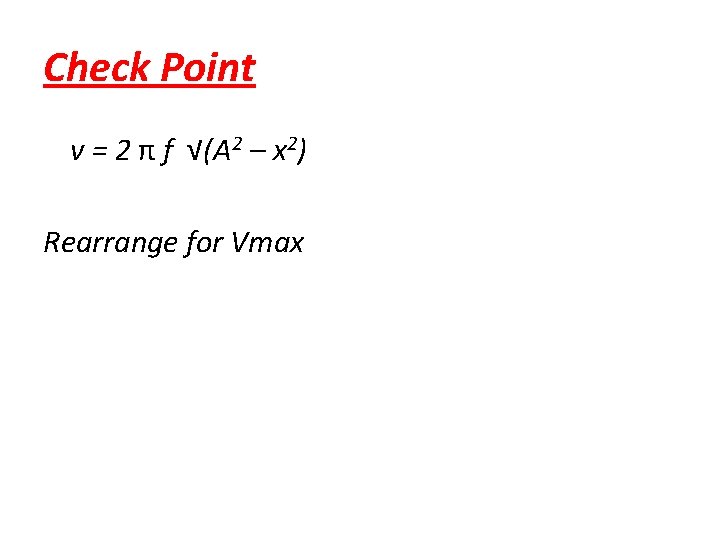
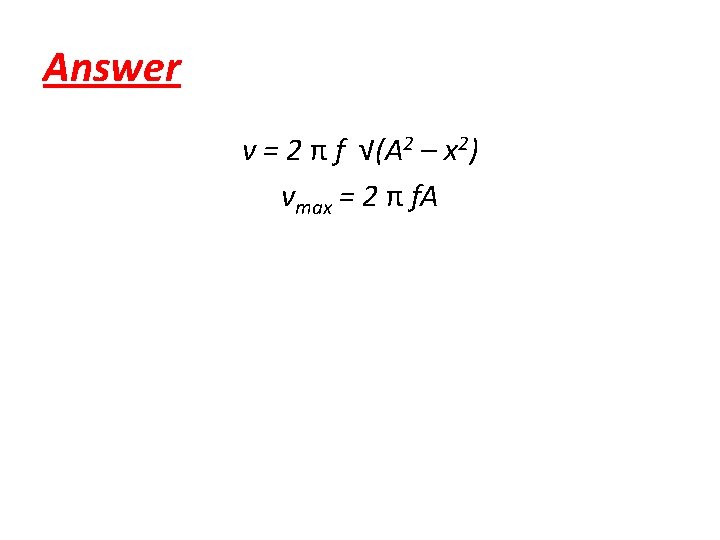
Velocity • The speed at any point in the oscillation given by: • v 2 = (2 π f )2(A 2 – x 2) • v 2 = 4 π 2 f 2(A 2 – x 2) • v = 2 π f √(A 2 – x 2) • A= amplitude f=original frequency x= displacement
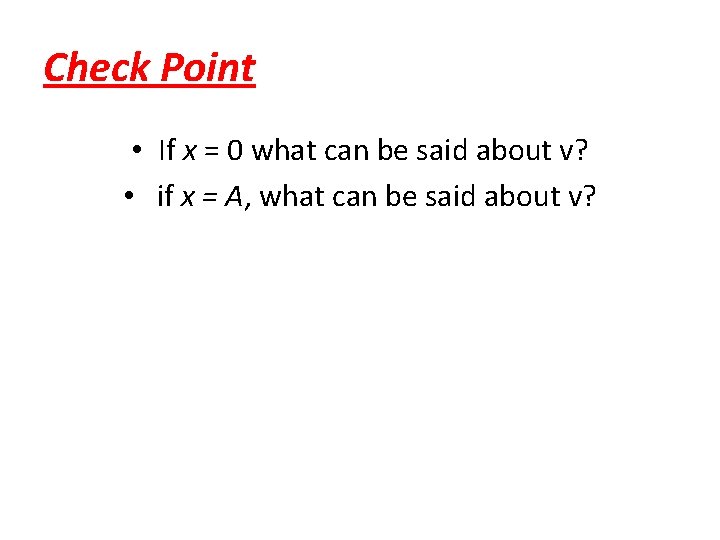
Check Point • If x = 0 what can be said about v? • if x = A, what can be said about v?
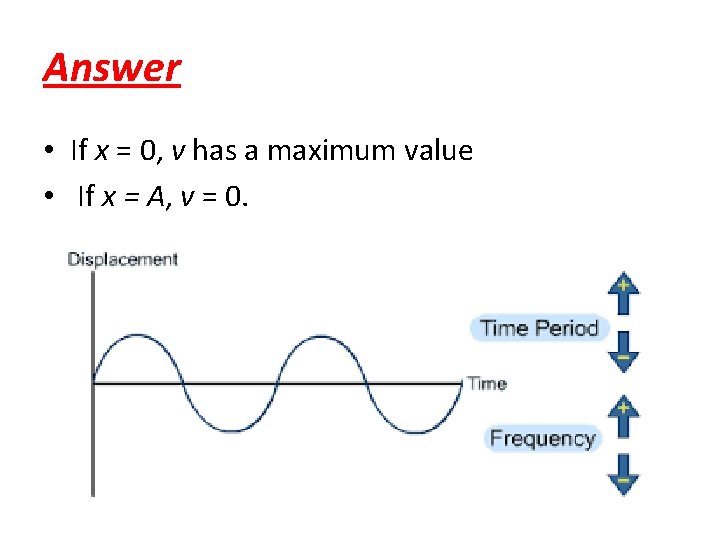
Answer • If x = 0, v has a maximum value • If x = A, v = 0.
Check Point v = 2 π f √(A 2 – x 2) Rearrange for Vmax
Answer v = 2 π f √(A 2 – x 2) vmax = 2 π f. A
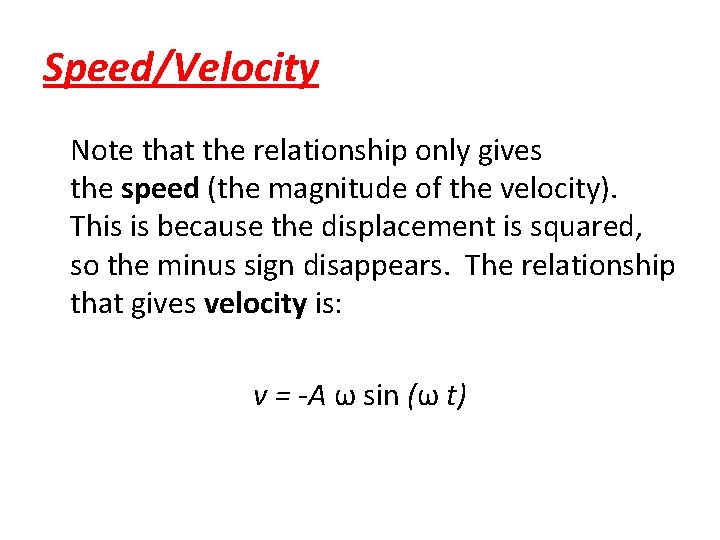
Speed/Velocity Note that the relationship only gives the speed (the magnitude of the velocity). This is because the displacement is squared, so the minus sign disappears. The relationship that gives velocity is: v = -A ω sin (ω t)
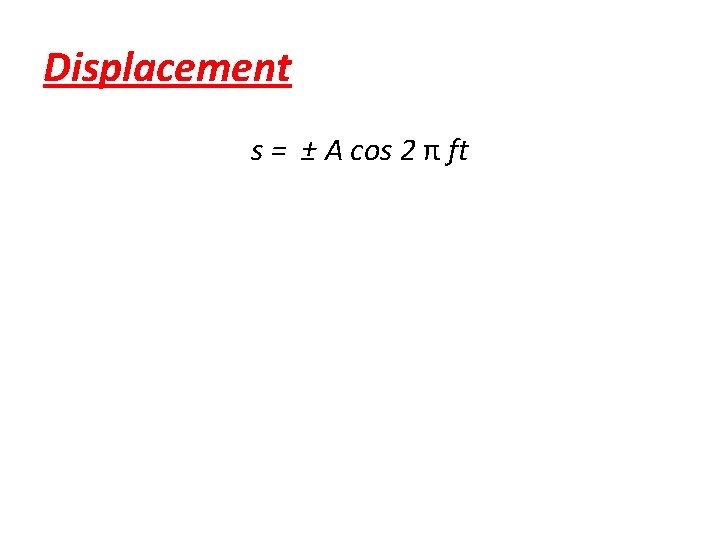
Displacement s = ± A cos 2 π ft
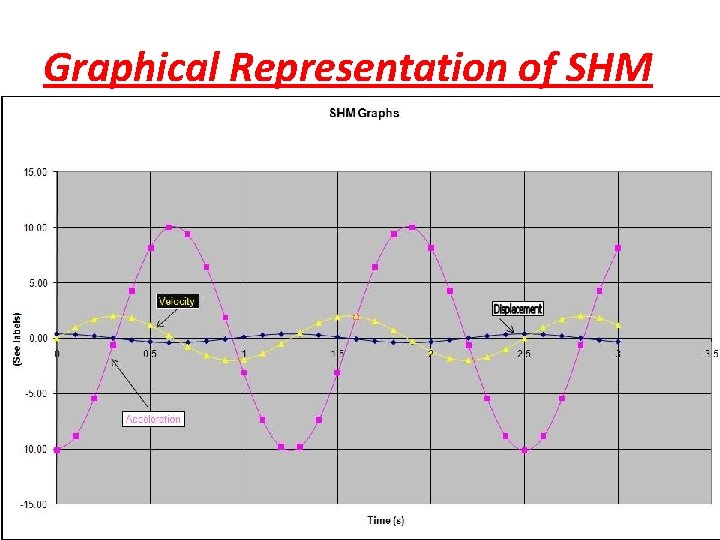
Graphical Representation of SHM