
Simple Harmonic Motion Any regular vibrations or oscillations
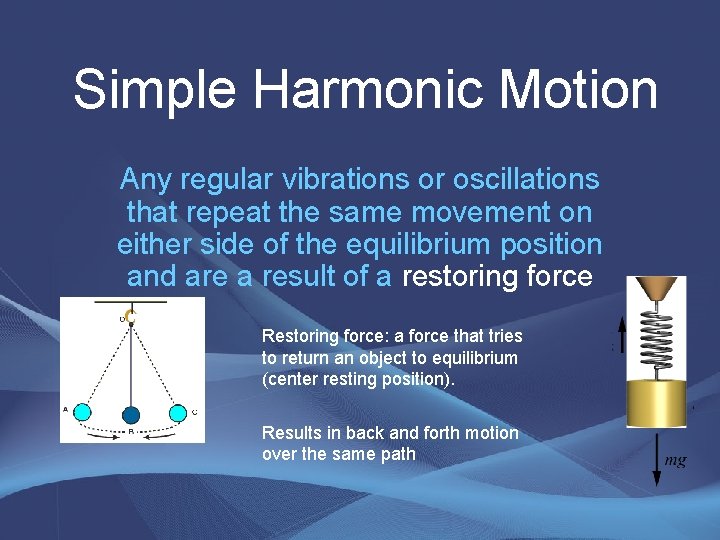
Simple Harmonic Motion Any regular vibrations or oscillations that repeat the same movement on either side of the equilibrium position and are a result of a restoring force Restoring force: a force that tries to return an object to equilibrium (center resting position). Results in back and forth motion over the same path
Amplitude Maximum displacement from equilibrium • Pendulum: measured by the angle between the pendulum’s equilibrium position and its maximum displacement. • Mass-spring system: maximum amount the spring is stretched or compressed from its equilibrium position. • Units: radian (rad) or degrees and the meter (m).
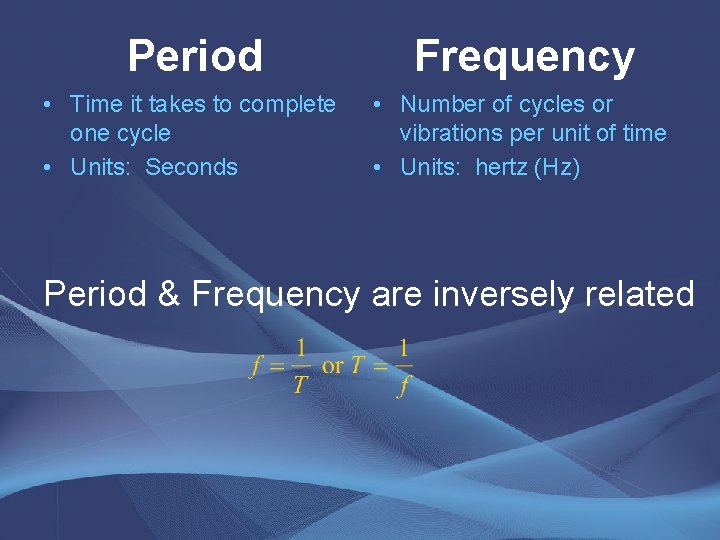
Period Frequency • Time it takes to complete one cycle • Units: Seconds • Number of cycles or vibrations per unit of time • Units: hertz (Hz) Period & Frequency are inversely related
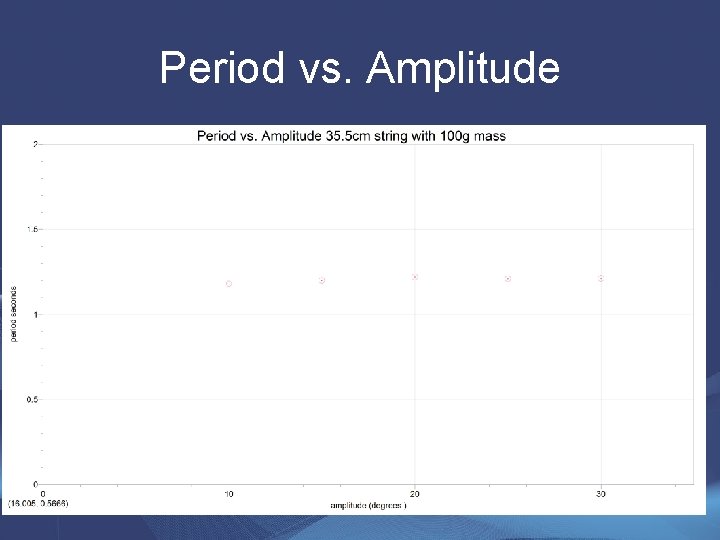
Period vs. Amplitude

Period vs. Mass

Period vs. Length

Period squared vs. Length
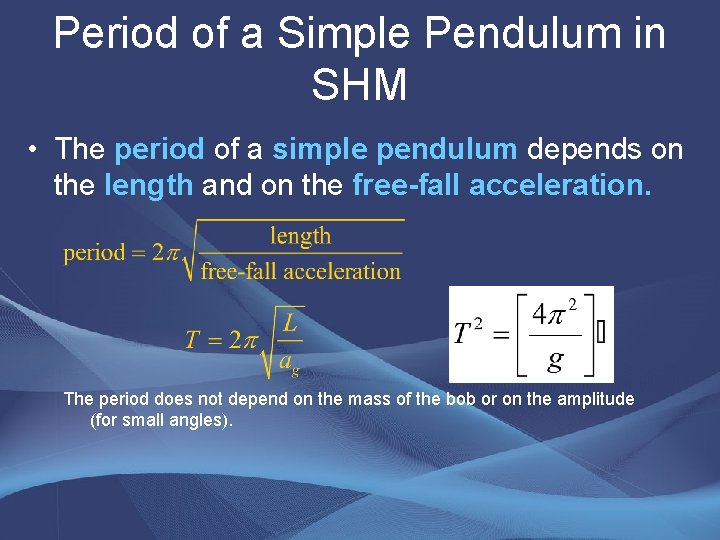
Period of a Simple Pendulum in SHM • The period of a simple pendulum depends on the length and on the free-fall acceleration. The period does not depend on the mass of the bob or on the amplitude (for small angles).
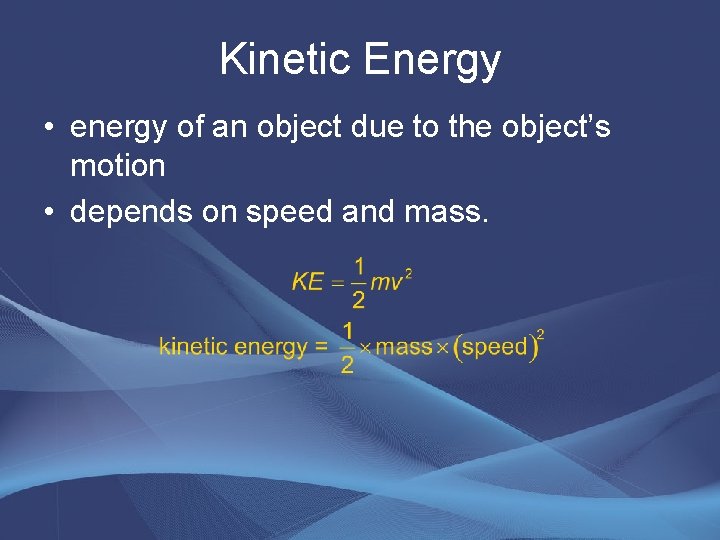
Kinetic Energy • energy of an object due to the object’s motion • depends on speed and mass.
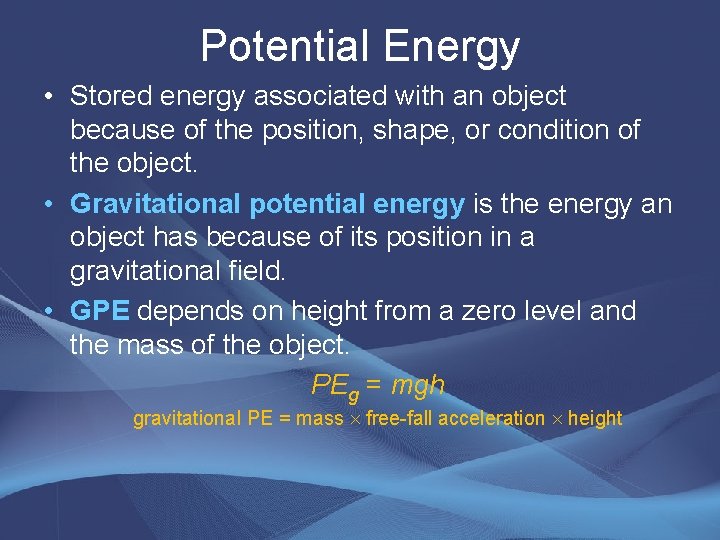
Potential Energy • Stored energy associated with an object because of the position, shape, or condition of the object. • Gravitational potential energy is the energy an object has because of its position in a gravitational field. • GPE depends on height from a zero level and the mass of the object. PEg = mgh gravitational PE = mass free-fall acceleration height
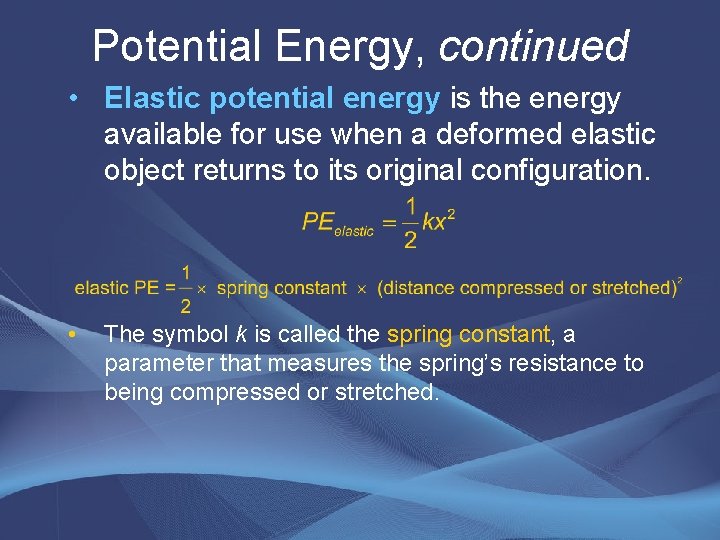
Potential Energy, continued • Elastic potential energy is the energy available for use when a deformed elastic object returns to its original configuration. • The symbol k is called the spring constant, a parameter that measures the spring’s resistance to being compressed or stretched.
Mechanical Energy • The sum of kinetic energy and all forms of potential energy associated with an object or group of objects ME = KE + ∑PE • Is often conserved MEi = MEf initial mechanical energy = final mechanical energy (in the absence of friction)
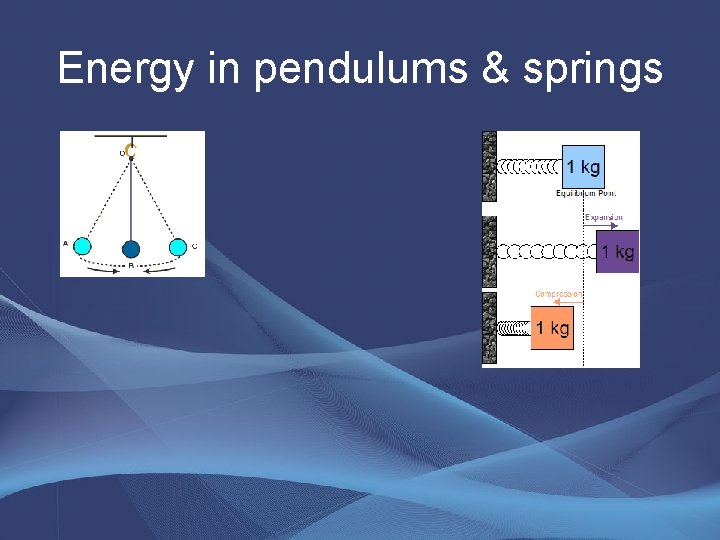
Energy in pendulums & springs
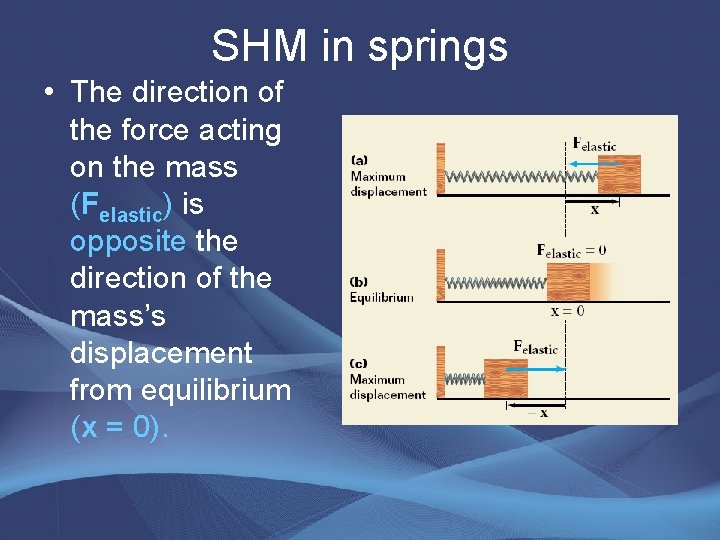
SHM in springs • The direction of the force acting on the mass (Felastic) is opposite the direction of the mass’s displacement from equilibrium (x = 0).
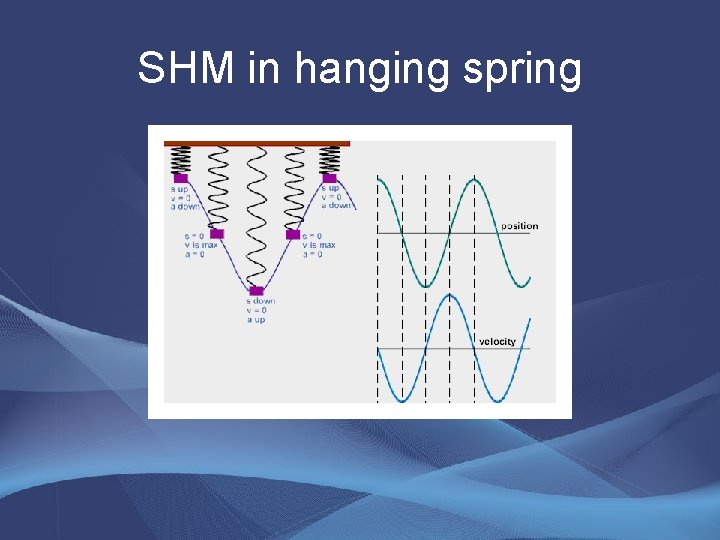
SHM in hanging spring
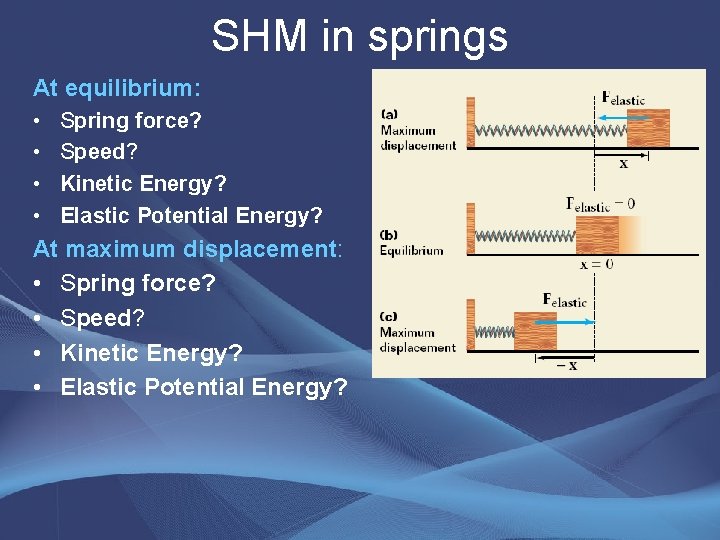
SHM in springs At equilibrium: • • Spring force? Speed? Kinetic Energy? Elastic Potential Energy? At maximum displacement: • Spring force? • Speed? • Kinetic Energy? • Elastic Potential Energy?
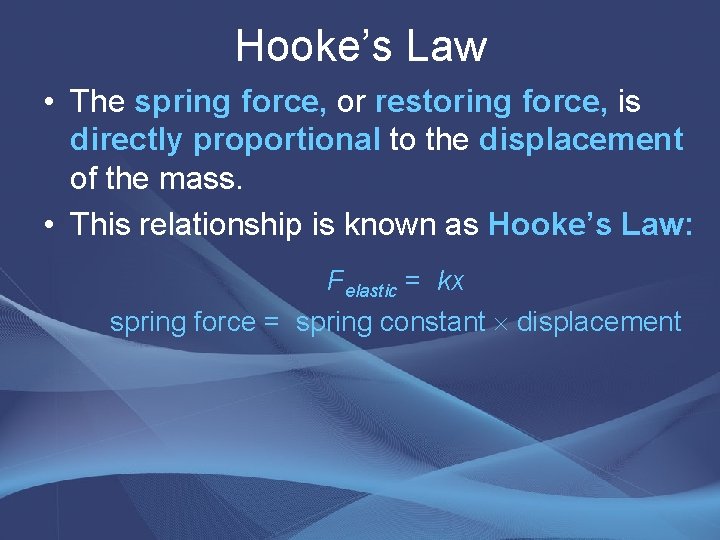
Hooke’s Law • The spring force, or restoring force, is directly proportional to the displacement of the mass. • This relationship is known as Hooke’s Law: Felastic = kx spring force = spring constant displacement
Practice Questions 1. If a mass of 0. 55 kg attached to a vertical spring stretches the spring 2. 0 cm from its original equilibrium position, what is the spring constant? 2. Suppose the spring from above is replaced with a spring that stretches 36 cm from its equilibrium position. • What is the spring constant? • Is this spring stiffer or less stiff? 3. How much force is required to pull a spring 3. 0 cm from its equilibrium position if the spring constant is 2700 N/m?
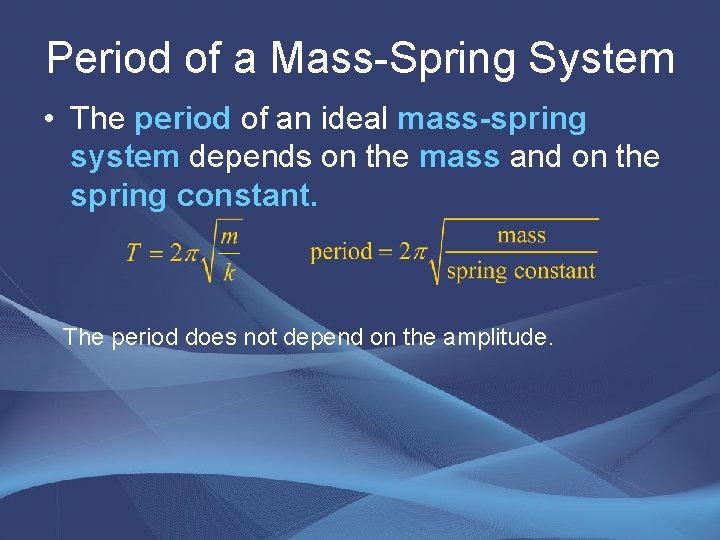
Period of a Mass-Spring System • The period of an ideal mass-spring system depends on the mass and on the spring constant. The period does not depend on the amplitude.
Practice: Mass-Spring System 1) A 125 N object vibrates with a period of 3. 5 s when hanging from a spring. What is the spring constant of the spring? 2) A spring of 30. 0 N/m is attached to different masses, and the system is set in motion. Find the period and frequency of vibration for masses of 2. 3 kg. 3) A child’s toy that is made to shoot ping pong balls consists of a tube, a spring (k = 18 N/m) and a catch for the spring that can be released to shoot the balls. When a ball is loaded into the tube, it compresses the spring 9. 5 cm. If you shoot a ping pong ball straight out of this toy, what is its maximum speed?
Section Review • Which of these periodic motions are simple harmonic? – a child swinging on a playground swing (θ = 45) – a CD rotating in a player – an oscillating clock pendulum (θ = 10) • A pinball machine uses a spring that is compressed 4. 0 cm to launch a ball. If the spring is 13 N/m, what is the force on the ball? • How does the restoring force acting on a pendulum bob change as the bob swings toward the equilibrium position? How do the bob’s acceleration (along the direction of motion) and velocity change?
Section Review • A child swings on a playground swing with a 2. 5 m long chain. – What is the period and frequency of the child in motion • A 0. 75 kg mass attached to a vertical spring stretches the spring 0. 30 m. – What is the spring constant?
- Slides: 22