
Simple guide to CEDV parameters calculation in Math
- Slides: 5
Simple guide to CEDV parameters calculation in Math. Cad
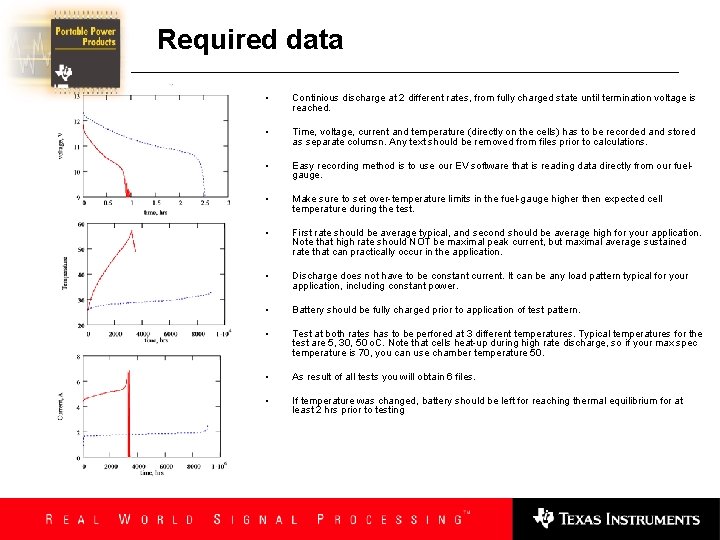
Required data • Continious discharge at 2 different rates, from fully charged state until termination voltage is reached. • Time, voltage, current and temperature (directly on the cells) has to be recorded and stored as separate columsn. Any text should be removed from files prior to calculations. • Easy recording method is to use our EV software that is reading data directly from our fuelgauge. • Make sure to set over-temperature limits in the fuel-gauge higher then expected cell temperature during the test. • First rate should be average typical, and second should be average high for your application. Note that high rate should NOT be maximal peak current, but maximal average sustained rate that can practically occur in the application. • Discharge does not have to be constant current. It can be any load pattern typical for your application, including constant power. • Battery should be fully charged prior to application of test pattern. • Test at both rates has to be perfored at 3 different temperatures. Typical temperatures for the test are 5, 30, 50 o. C. Note that cells heat-up during high rate discharge, so if your max spec temperature is 70, you can use chamber temperature 50. • As result of all tests you will obtain 6 files. • If temperature was changed, battery should be left for reaching thermal equilibrium for at least 2 hrs prior to testing
Short calculation guide (1)
Short calculation guide (2)
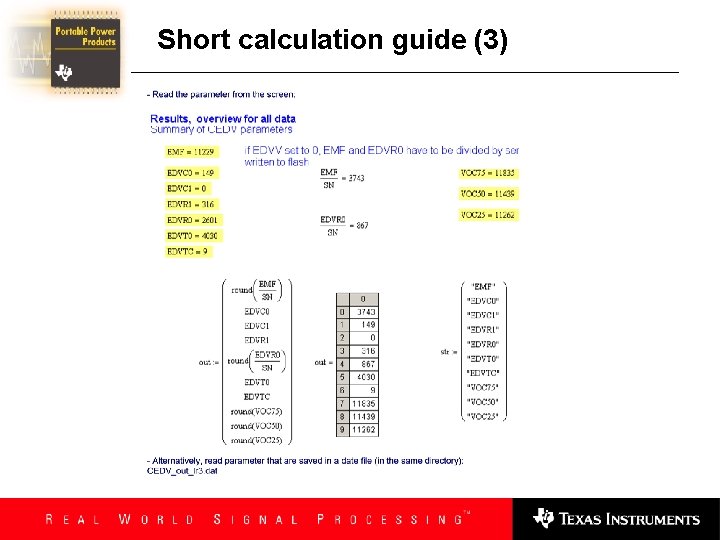
Short calculation guide (3)