
Simple Coordination Simple coordination The coordinated units conjoins
- Slides: 16
Simple Coordination
Simple coordination The coordinated units – conjoins Resulting combination – conjoint The following sentence can be seen in two ways: He won the lottery and spent most of the money on travelling. • 1. elliptical version of clause coordination (with ellipted subject) • 2. a single clause containing two coordinated VP which together constitute the predicate of the clause • •
Coordination of words and phrases • NP+NP: My brother and I are going to Italy. • Adv. P + Adv. P: This way you get the book quickly and easily. • Phrases: We can meet in my office or in front of the refectory (school canteen).
Use of Comma • Usually at the end of the last item • Peter spent his holidays studying basic maths, writing, and reading books. • Also used with But when expressing contrast • This is a nice dress, but very expensive.
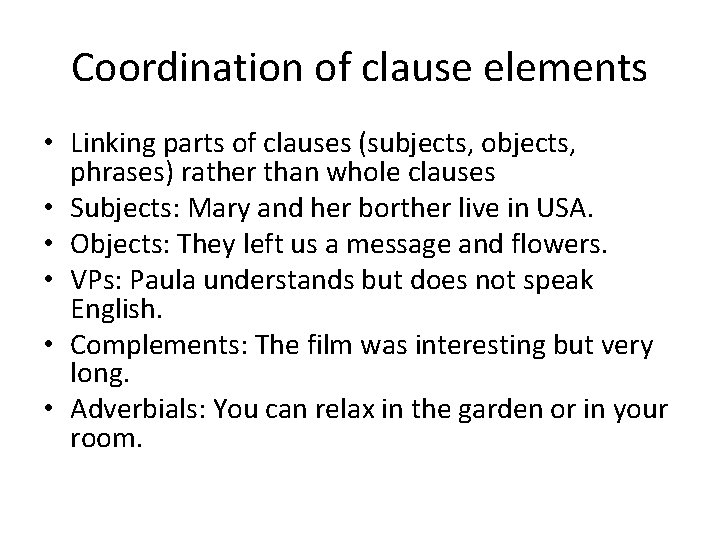
Coordination of clause elements • Linking parts of clauses (subjects, objects, phrases) rather than whole clauses • Subjects: Mary and her borther live in USA. • Objects: They left us a message and flowers. • VPs: Paula understands but does not speak English. • Complements: The film was interesting but very long. • Adverbials: You can relax in the garden or in your room.
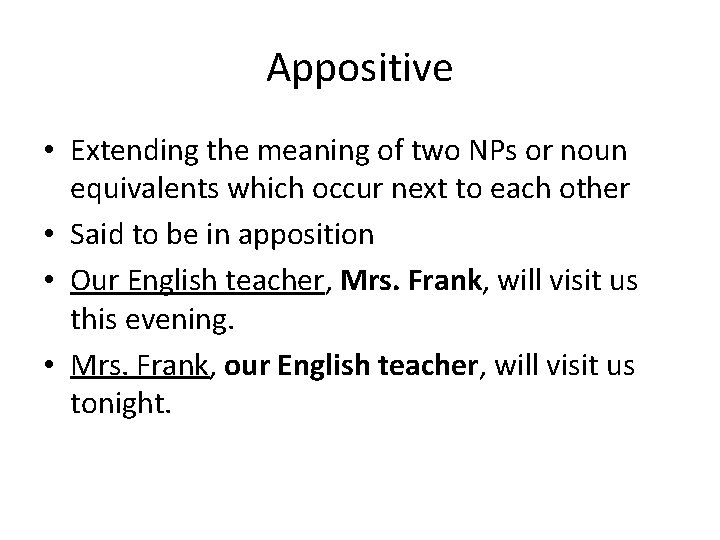
Appositive • Extending the meaning of two NPs or noun equivalents which occur next to each other • Said to be in apposition • Our English teacher, Mrs. Frank, will visit us this evening. • Mrs. Frank, our English teacher, will visit us tonight.
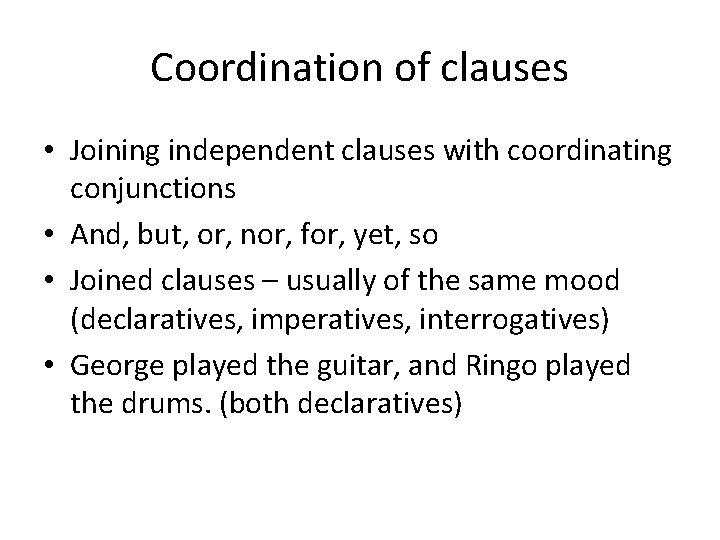
Coordination of clauses • Joining independent clauses with coordinating conjunctions • And, but, or, nor, for, yet, so • Joined clauses – usually of the same mood (declaratives, imperatives, interrogatives) • George played the guitar, and Ringo played the drums. (both declaratives)
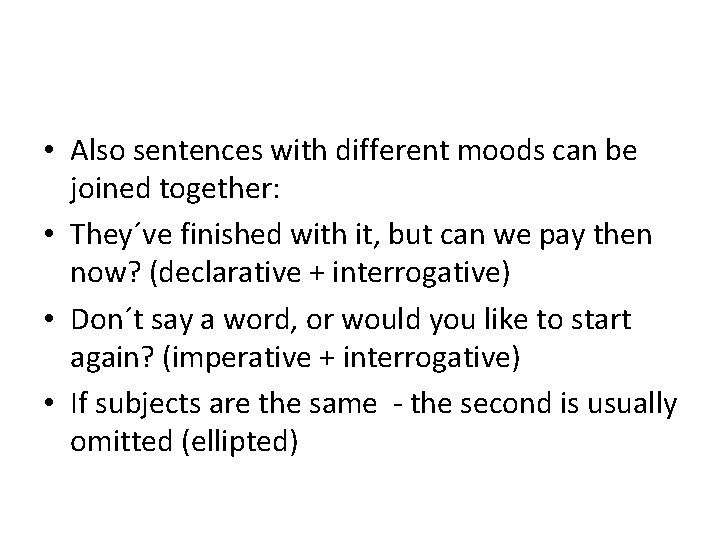
• Also sentences with different moods can be joined together: • They´ve finished with it, but can we pay then now? (declarative + interrogative) • Don´t say a word, or would you like to start again? (imperative + interrogative) • If subjects are the same - the second is usually omitted (ellipted)
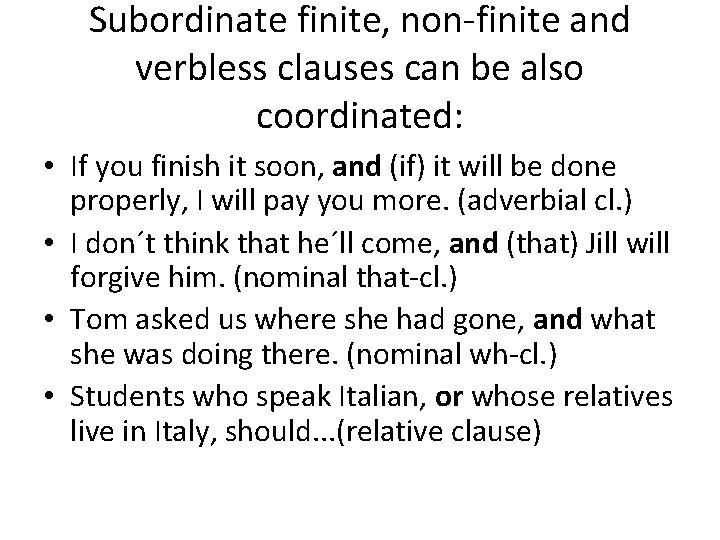
Subordinate finite, non-finite and verbless clauses can be also coordinated: • If you finish it soon, and (if) it will be done properly, I will pay you more. (adverbial cl. ) • I don´t think that he´ll come, and (that) Jill will forgive him. (nominal that-cl. ) • Tom asked us where she had gone, and what she was doing there. (nominal wh-cl. ) • Students who speak Italian, or whose relatives live in Italy, should. . . (relative clause)
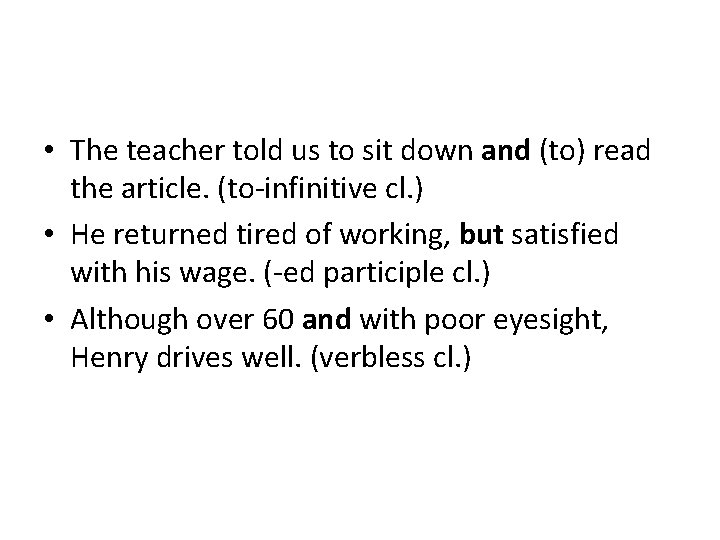
• The teacher told us to sit down and (to) read the article. (to-infinitive cl. ) • He returned tired of working, but satisfied with his wage. (-ed participle cl. ) • Although over 60 and with poor eyesight, Henry drives well. (verbless cl. )
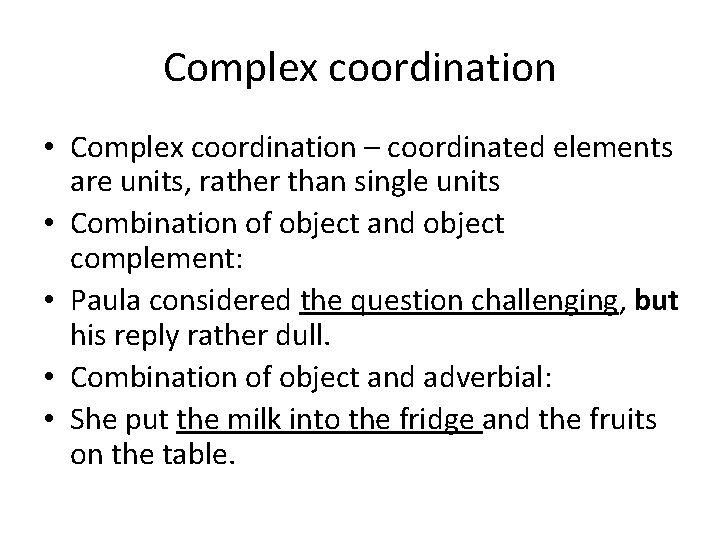
Complex coordination • Complex coordination – coordinated elements are units, rather than single units • Combination of object and object complement: • Paula considered the question challenging, but his reply rather dull. • Combination of object and adverbial: • She put the milk into the fridge and the fruits on the table.
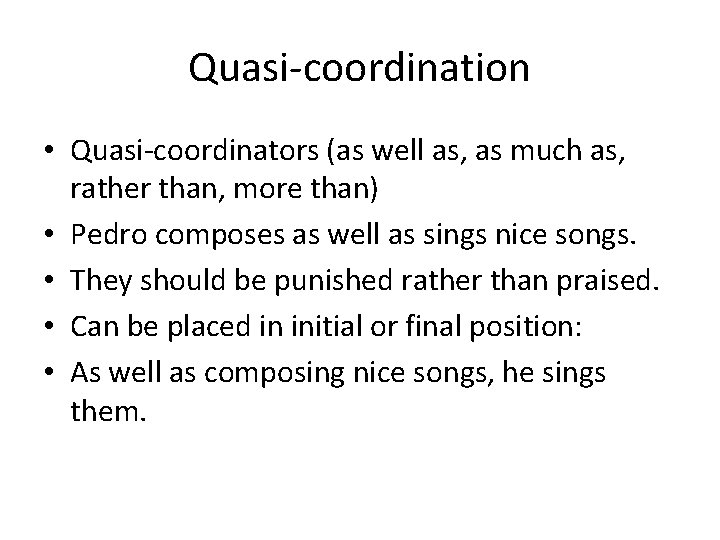
Quasi-coordination • Quasi-coordinators (as well as, as much as, rather than, more than) • Pedro composes as well as sings nice songs. • They should be punished rather than praised. • Can be placed in initial or final position: • As well as composing nice songs, he sings them.
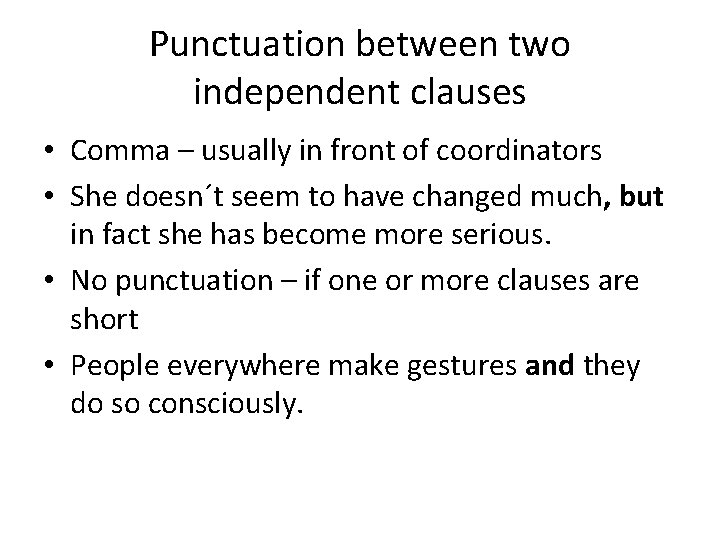
Punctuation between two independent clauses • Comma – usually in front of coordinators • She doesn´t seem to have changed much, but in fact she has become more serious. • No punctuation – if one or more clauses are short • People everywhere make gestures and they do so consciously.
• Use of full stop and semicolon between two coordinated indep. clauses (to emphasize that each clause is a separate unit)
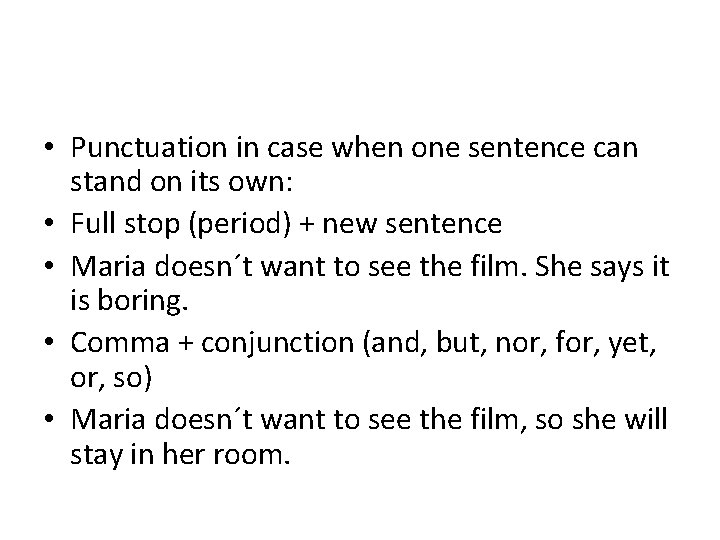
• Punctuation in case when one sentence can stand on its own: • Full stop (period) + new sentence • Maria doesn´t want to see the film. She says it is boring. • Comma + conjunction (and, but, nor, for, yet, or, so) • Maria doesn´t want to see the film, so she will stay in her room.
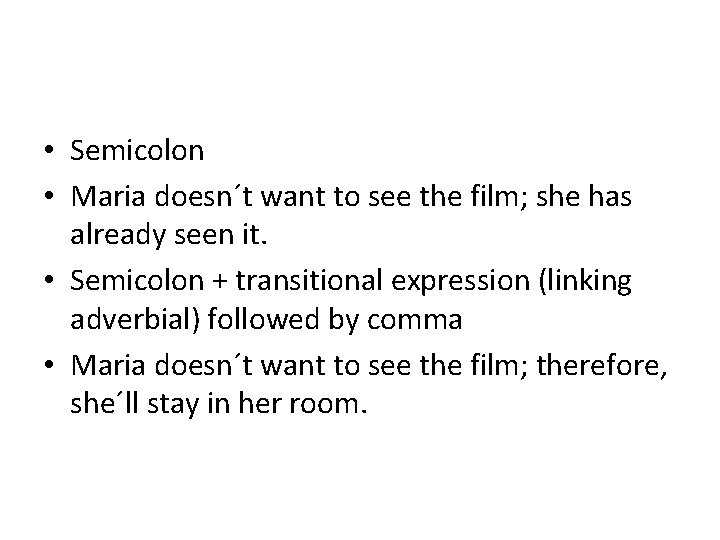
• Semicolon • Maria doesn´t want to see the film; she has already seen it. • Semicolon + transitional expression (linking adverbial) followed by comma • Maria doesn´t want to see the film; therefore, she´ll stay in her room.