
Simple Compound and Complex Sentence Comma rules Ms
- Slides: 40
• Simple, Compound, and Complex Sentence • Comma rules Ms. Green
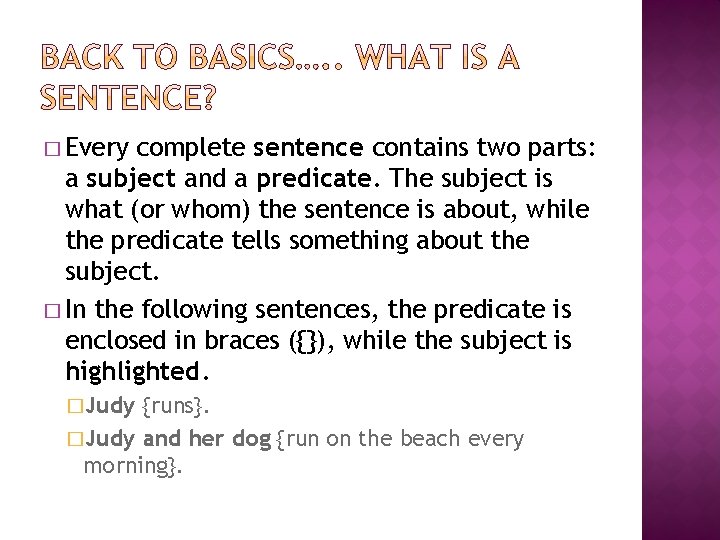
� Every complete sentence contains two parts: a subject and a predicate. The subject is what (or whom) the sentence is about, while the predicate tells something about the subject. � In the following sentences, the predicate is enclosed in braces ({}), while the subject is highlighted. �Judy {runs}. �Judy and her dog {run on the beach every morning}.
� There are three different sentence types that writers employ: �Simple sentences �Compound sentences �Complex sentences
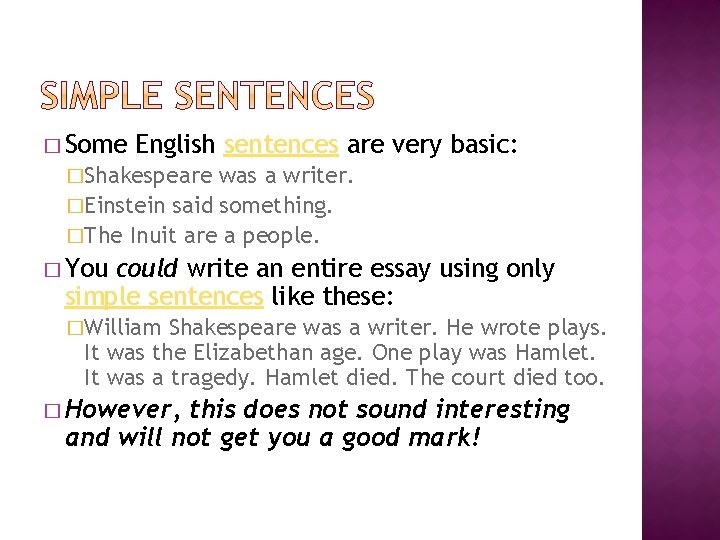
� Some English sentences are very basic: �Shakespeare was a writer. �Einstein said something. �The Inuit are a people. � You could write an entire essay using only simple sentences like these: �William Shakespeare was a writer. He wrote plays. It was the Elizabethan age. One play was Hamlet. It was a tragedy. Hamlet died. The court died too. � However, this does not sound interesting and will not get you a good mark!
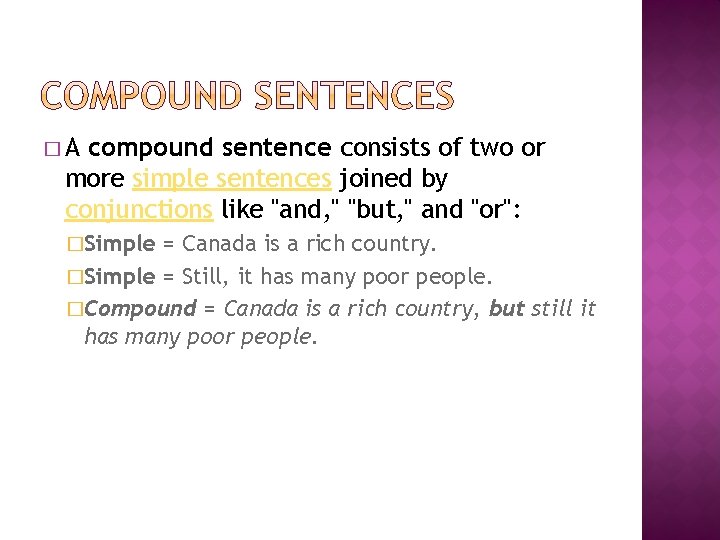
�A compound sentence consists of two or more simple sentences joined by conjunctions like "and, " "but, " and "or": �Simple = Canada is a rich country. �Simple = Still, it has many poor people. �Compound = Canada is a rich country, but still it has many poor people.
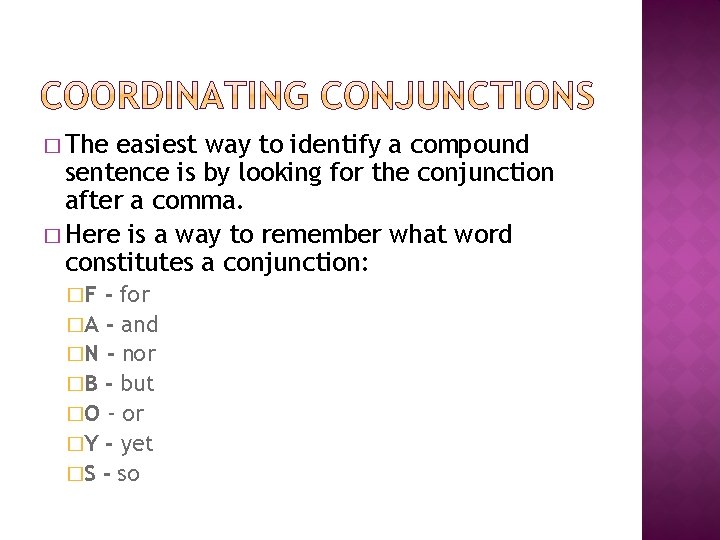
� The easiest way to identify a compound sentence is by looking for the conjunction after a comma. � Here is a way to remember what word constitutes a conjunction: �F - for �A - and �N - nor �B - but �O - or �Y - yet �S - so
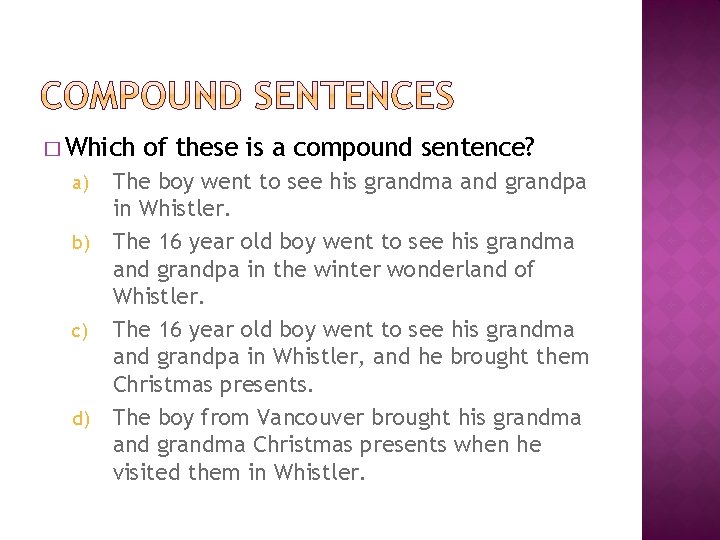
� Which a) b) c) d) of these is a compound sentence? The boy went to see his grandma and grandpa in Whistler. The 16 year old boy went to see his grandma and grandpa in the winter wonderland of Whistler. The 16 year old boy went to see his grandma and grandpa in Whistler, and he brought them Christmas presents. The boy from Vancouver brought his grandma and grandma Christmas presents when he visited them in Whistler.
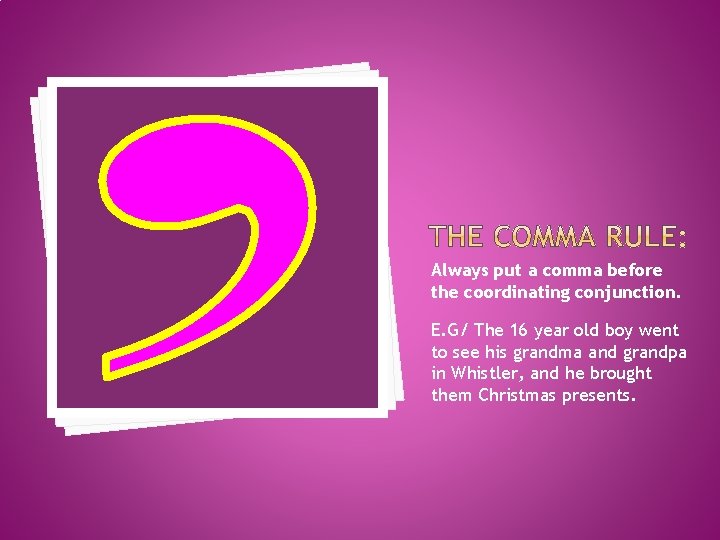
Always put a comma before the coordinating conjunction. E. G/ The 16 year old boy went to see his grandma and grandpa in Whistler, and he brought them Christmas presents.
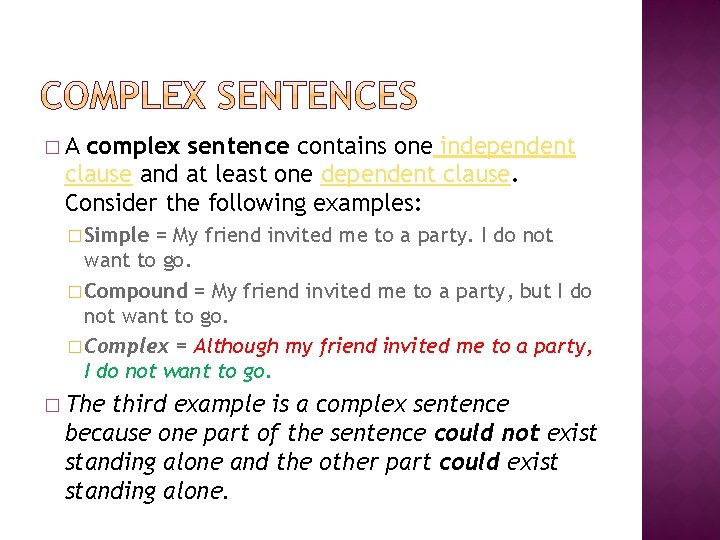
�A complex sentence contains one independent clause and at least one dependent clause. Consider the following examples: � Simple = My friend invited me to a party. I do not want to go. � Compound = My friend invited me to a party, but I do not want to go. � Complex = Although my friend invited me to a party, I do not want to go. � The third example is a complex sentence because one part of the sentence could not exist standing alone and the other part could exist standing alone.
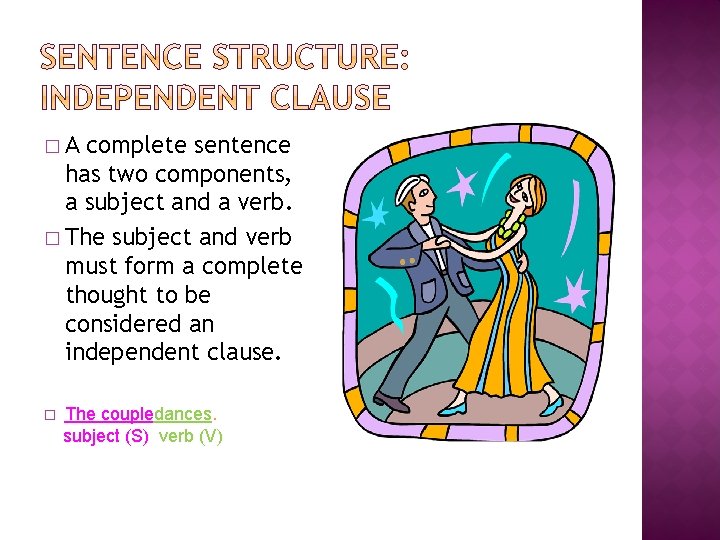
�A complete sentence has two components, a subject and a verb. � The subject and verb must form a complete thought to be considered an independent clause. � The coupledances. subject (S) verb (V)
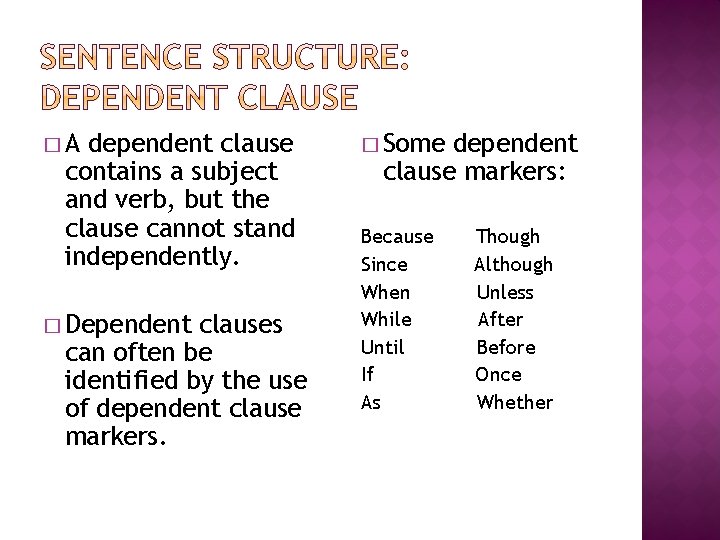
�A dependent clause contains a subject and verb, but the clause cannot stand independently. � Some � Dependent Because Since When While Until If As clauses can often be identified by the use of dependent clause markers: Though Although Unless After Before Once Whether
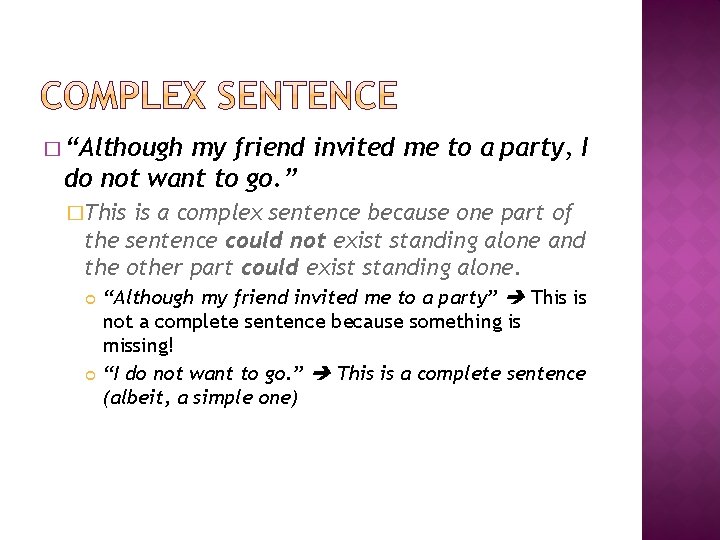
� “Although my friend invited me to a party, I do not want to go. ” �This is a complex sentence because one part of the sentence could not exist standing alone and the other part could exist standing alone. “Although my friend invited me to a party” This is not a complete sentence because something is missing! “I do not want to go. ” This is a complete sentence (albeit, a simple one)
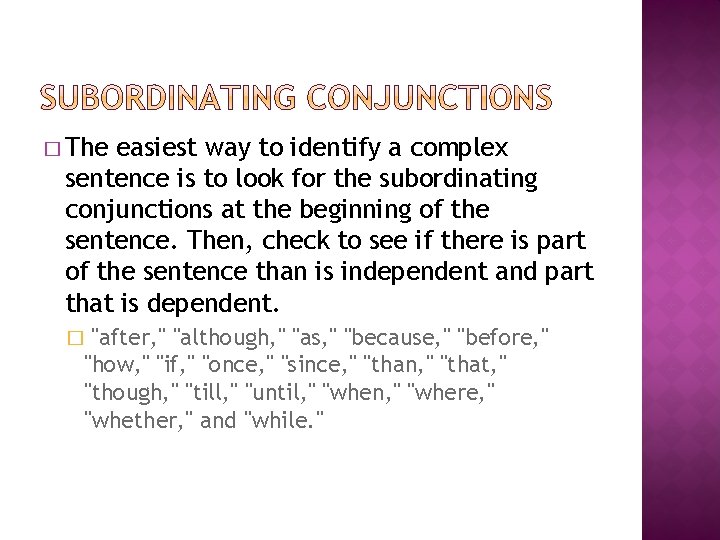
� The easiest way to identify a complex sentence is to look for the subordinating conjunctions at the beginning of the sentence. Then, check to see if there is part of the sentence than is independent and part that is dependent. "after, " "although, " "as, " "because, " "before, " "how, " "if, " "once, " "since, " "than, " "that, " "though, " "till, " "until, " "when, " "where, " "whether, " and "while. " �
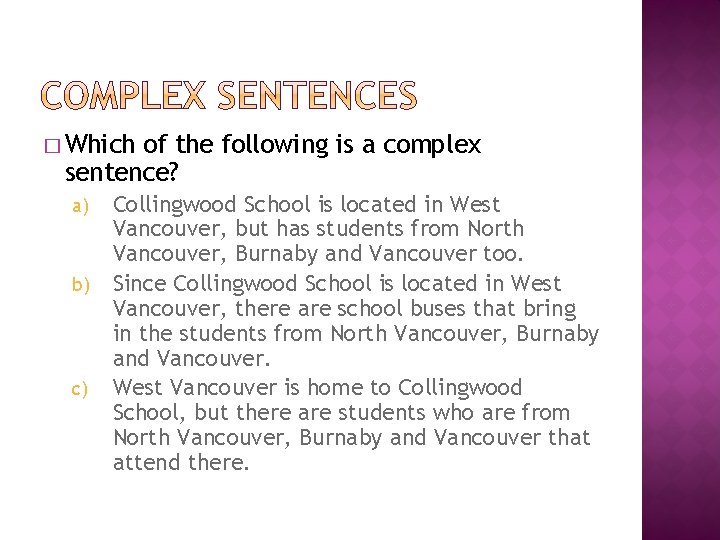
� Which of the following is a complex sentence? a) b) c) Collingwood School is located in West Vancouver, but has students from North Vancouver, Burnaby and Vancouver too. Since Collingwood School is located in West Vancouver, there are school buses that bring in the students from North Vancouver, Burnaby and Vancouver. West Vancouver is home to Collingwood School, but there are students who are from North Vancouver, Burnaby and Vancouver that attend there.
�A SENTENCE FRAGMENT fails to be a sentence in the sense that it cannot stand by itself.
� may locate something in time and place, but lack a subject-verb relationship. � Last Saturday after the ballgame at the ice cream shop.
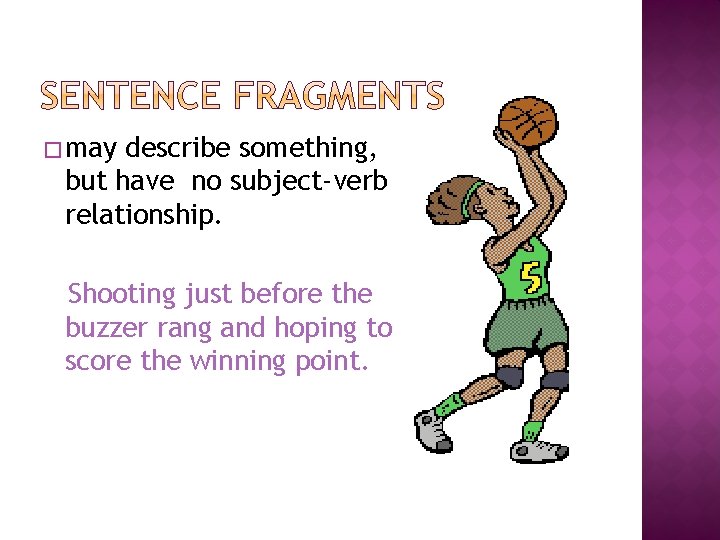
� may describe something, but have no subject-verb relationship. Shooting just before the buzzer rang and hoping to score the winning point.
� may have most of the makings of a sentence but still be missing an important part of a verb string. � Some of the girls going together to the mall.
� may have a subject-verb relationship, but cannot stand by itself. � Even though she was the prettiest girl and had a great talent presentation.
�A RUN-ON SENTENCE (sometimes called a fused sentence) has at least two parts, either one of which can stand by itself, but the two parts have been connected together with one or two words instead of becoming two sentences. The run-on could be corrected with a semi-colon.
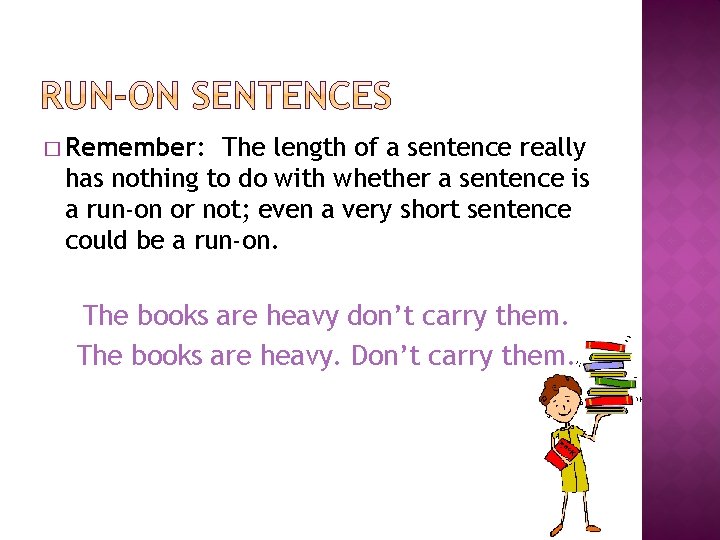
� Remember: The length of a sentence really has nothing to do with whether a sentence is a run-on or not; even a very short sentence could be a run-on. The books are heavy don’t carry them. The books are heavy. Don’t carry them.
� When two clauses are connected by only a comma, they are a run-on sentence that is called a comma-splice. � The books are heavy, don’t carry them.
� when an independent clause gives an order or directive based on what was said in the prior independent clause. � The game is going to be very close you have to play your best.
� When you do not put the comma in the right place in a complex sentence Amanda was happy about her grade but wished she could do better on her final exam and next year. Fix it with a comma: Amanda was happy about her grade, but wished she could do better on her final exam and next year.
� Sentences have to be combined to avoid the boredom that would happen if all sentences were the same length.
Fix: Susan ate dinner.
Note how FANBOYS is used! ANSWER:
FIX: I went to the game.
Note how FANBOYS is used! Answer:
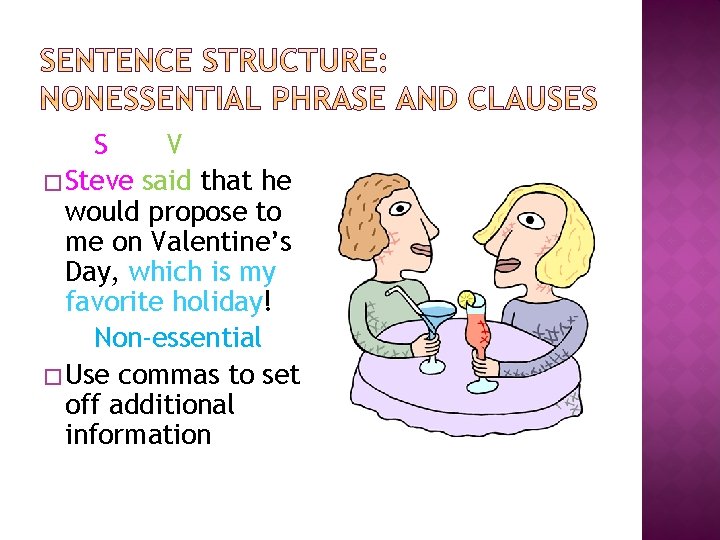
�A nonessential phrase or clause adds extra information to a sentence. � This information can be eliminated from the sentence without jeopardizing the meaning of the sentence. � Always place commas around nonessential phrases and clauses.
The place that I would most like to see is the Eiffel Tower. No comma is needed. The sentence is correct. Pierre, who is one of my business contacts, will meet me at the airport.
� My brother, who lives across town, s non-essential plans to throw a party! V � Even without the phrase the sentence still makes sense: My brother plans to throw a party! Therefore, you do need a comma!
S V � Steve said that he would propose to me on Valentine’s Day, which is my favorite holiday! Non-essential � Use commas to set off additional information
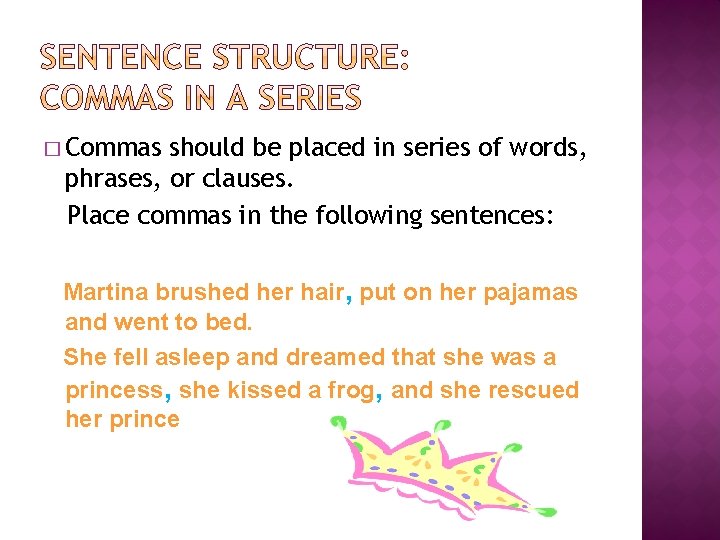
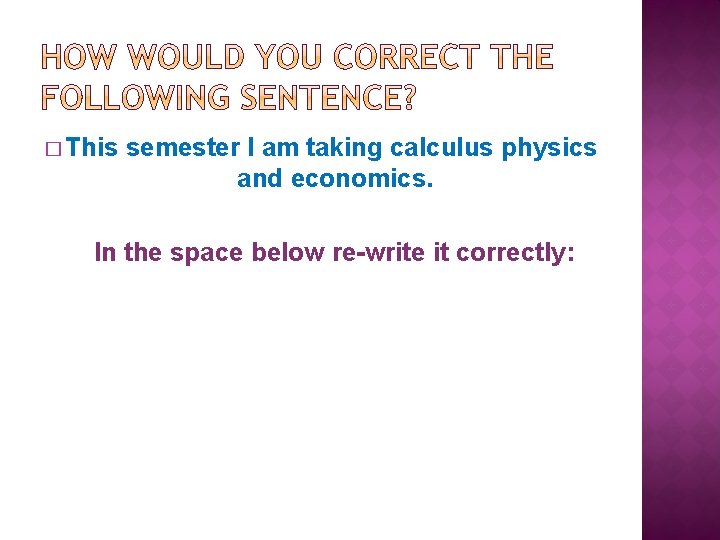
� Commas should be placed in series of words, phrases, or clauses. Place commas in the following sentences: Martina brushed her hair, put on her pajamas and went to bed. She fell asleep and dreamed that she was a princess, she kissed a frog, and she rescued her prince
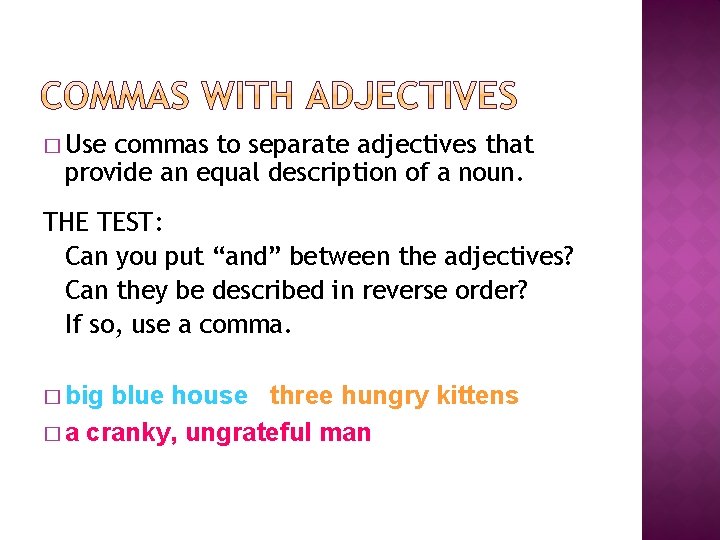
� Use commas to separate adjectives that provide an equal description of a noun. THE TEST: Can you put “and” between the adjectives? Can they be described in reverse order? If so, use a comma. � big blue house three hungry kittens � a cranky, ungrateful man
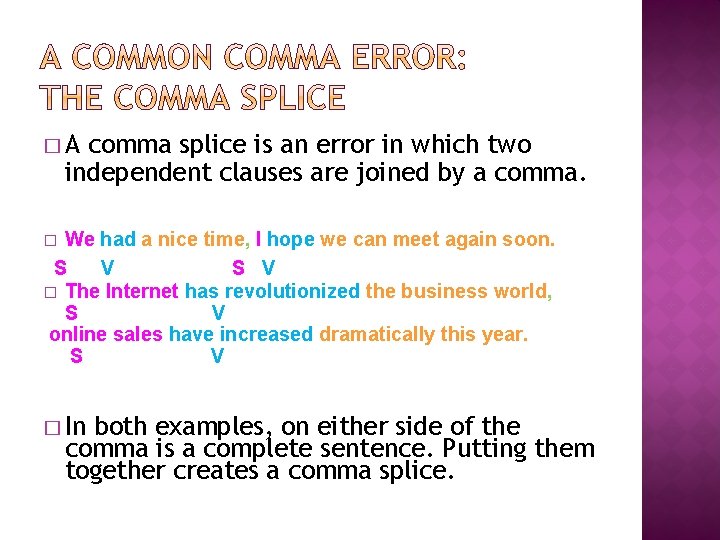
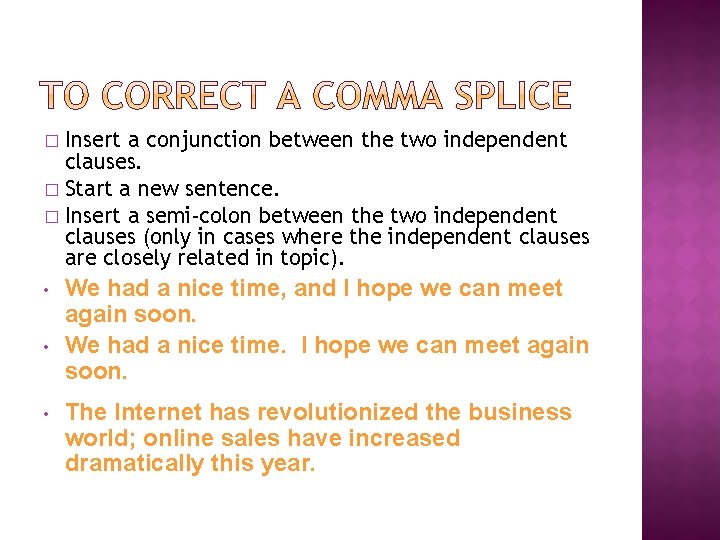
�A comma splice is an error in which two independent clauses are joined by a comma. We had a nice time, I hope we can meet again soon. S V � The Internet has revolutionized the business world, S V online sales have increased dramatically this year. S V � � In both examples, on either side of the comma is a complete sentence. Putting them together creates a comma splice.
Insert a conjunction between the two independent clauses. � Start a new sentence. � Insert a semi-colon between the two independent clauses (only in cases where the independent clauses are closely related in topic). � • • • We had a nice time, and I hope we can meet again soon. We had a nice time. I hope we can meet again soon. The Internet has revolutionized the business world; online sales have increased dramatically this year.
� This semester I am taking calculus physics and economics. In the space below re-write it correctly:
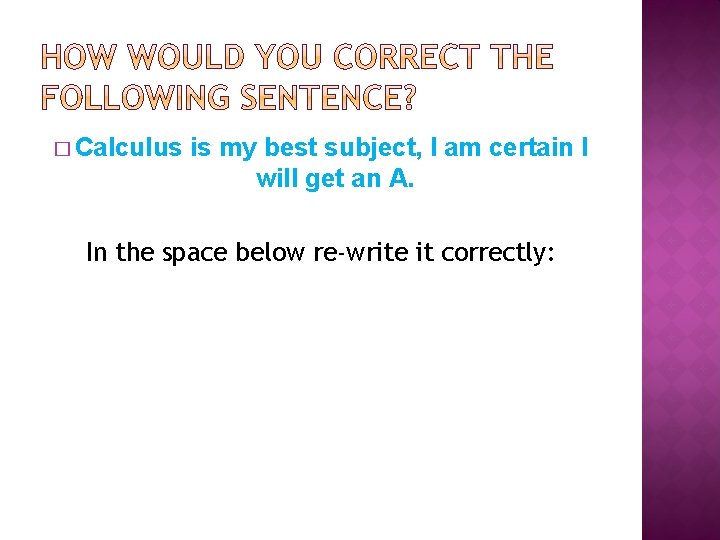
� Calculus is my best subject, I am certain I will get an A. In the space below re-write it correctly:
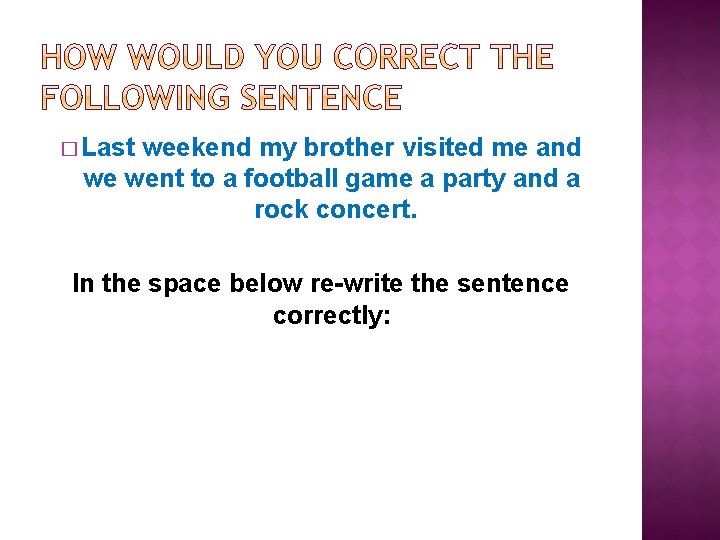
� Last weekend my brother visited me and we went to a football game a party and a rock concert. In the space below re-write the sentence correctly: