
Simple Chaotic Systems and Circuits J C Sprott

- Slides: 30
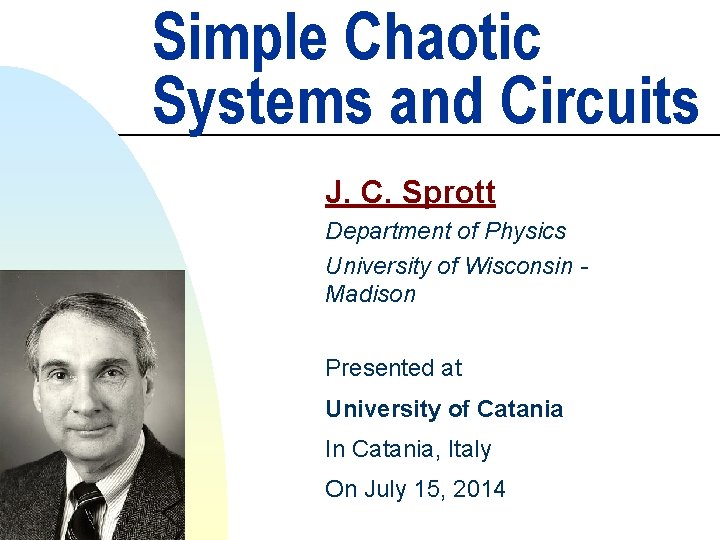
Simple Chaotic Systems and Circuits J. C. Sprott Department of Physics University of Wisconsin Madison Presented at University of Catania In Catania, Italy On July 15, 2014
Outline n Abbreviated History n Chaotic Equations n Chaotic Electrical Circuits
Abbreviated History n Poincaré (1892) n Van der Pol (1927) n Ueda (1961) n Lorenz (1963) n Knuth (1968) n Rössler (1976) n May (1976)
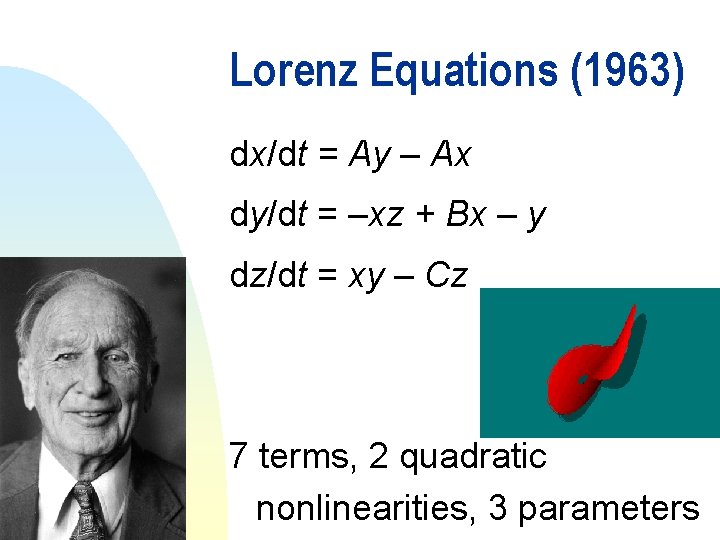
Lorenz Equations (1963) dx/dt = Ay – Ax dy/dt = –xz + Bx – y dz/dt = xy – Cz 7 terms, 2 quadratic nonlinearities, 3 parameters
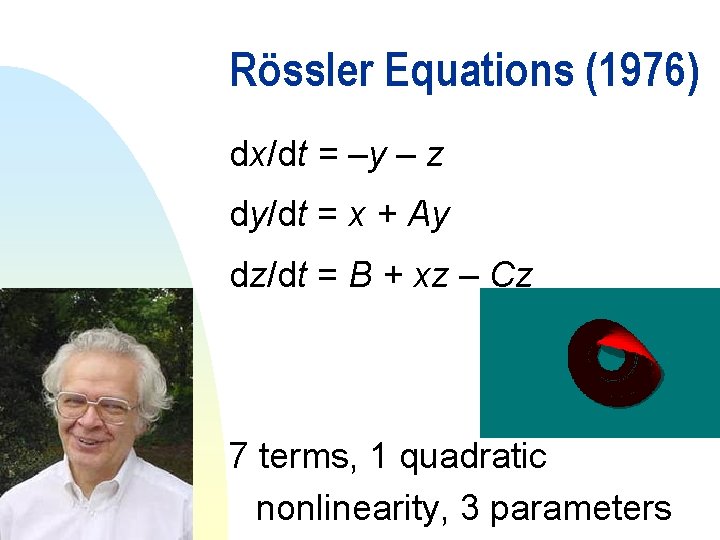
Rössler Equations (1976) dx/dt = –y – z dy/dt = x + Ay dz/dt = B + xz – Cz 7 terms, 1 quadratic nonlinearity, 3 parameters
Lorenz Quote (1993) “One other study left me with mixed feelings. Otto Roessler of the University of Tübingen had formulated a system of three differential equations as a model of a chemical reaction. By this time a number of systems of differential equations with chaotic solutions had been discovered, but I felt I still had the distinction of having found the simplest. Roessler changed things by coming along with an even simpler one. His record still stands. ”
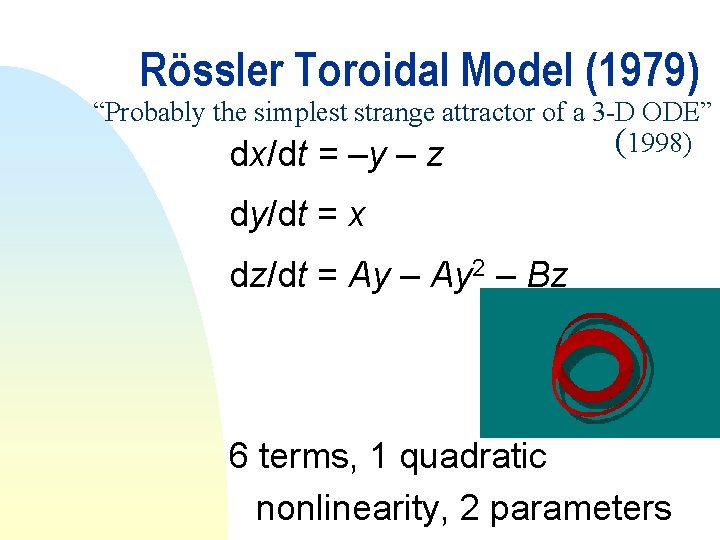
Rössler Toroidal Model (1979) “Probably the simplest strange attractor of a 3 -D ODE” (1998) dx/dt = –y – z dy/dt = x dz/dt = Ay – Ay 2 – Bz 6 terms, 1 quadratic nonlinearity, 2 parameters
Sprott (1994) n J. C. Sprott, Phys. Rev. E 50, R 647 (1994) n 14 additional examples with 6 terms and 1 quadratic nonlinearity 5 examples with 5 terms and 2 quadratic
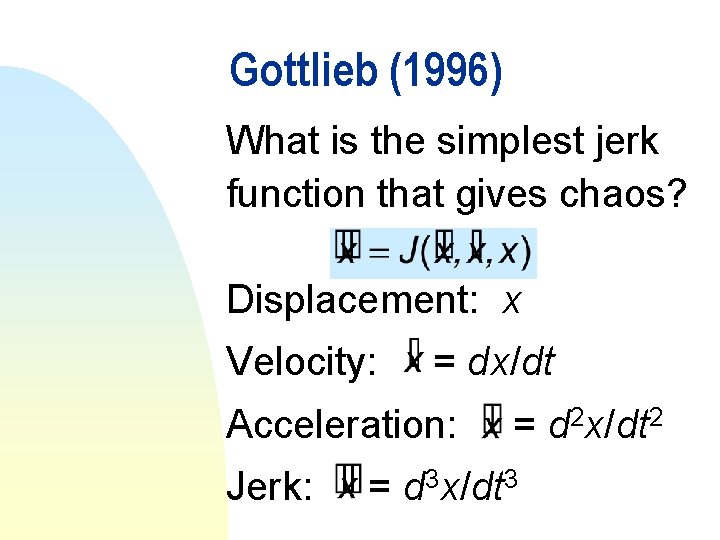
Gottlieb (1996) What is the simplest jerk function that gives chaos? Displacement: x Velocity: = dx/dt Acceleration: Jerk: = d 2 x/dt 2 = d 3 x/dt 3
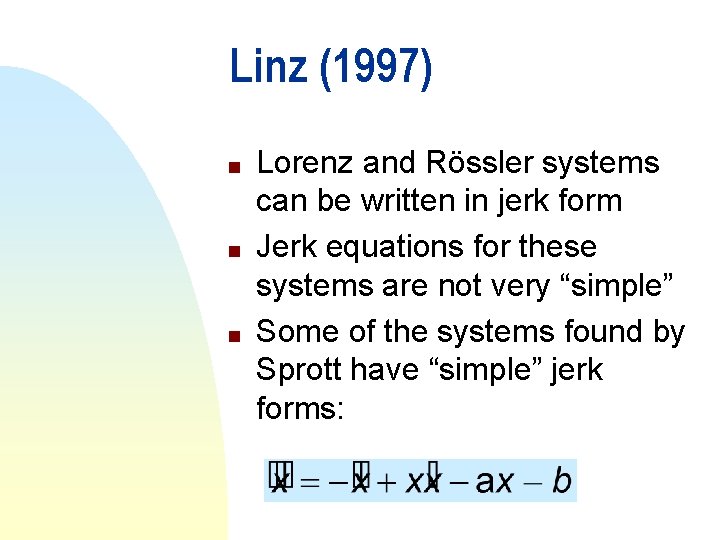
Linz (1997) n n n Lorenz and Rössler systems can be written in jerk form Jerk equations for these systems are not very “simple” Some of the systems found by Sprott have “simple” jerk forms:
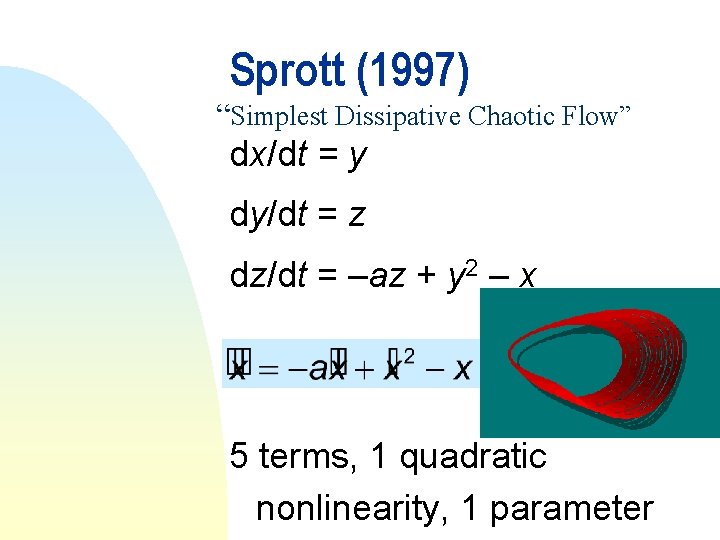
Sprott (1997) “Simplest Dissipative Chaotic Flow” dx/dt = y dy/dt = z dz/dt = –az + y 2 – x 5 terms, 1 quadratic nonlinearity, 1 parameter
Zhang and Heidel (1997) 3 -D quadratic systems with fewer than 5 terms cannot be chaotic. They would have no adjustable parameters.
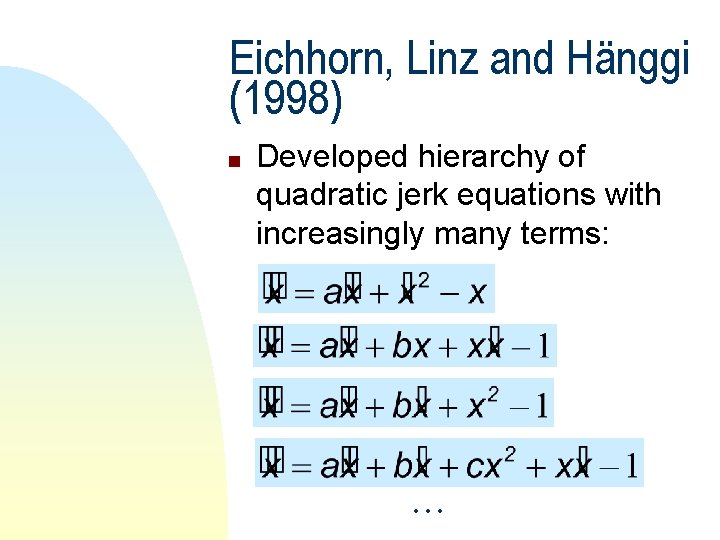
Eichhorn, Linz and Hänggi (1998) n Developed hierarchy of quadratic jerk equations with increasingly many terms: . . .
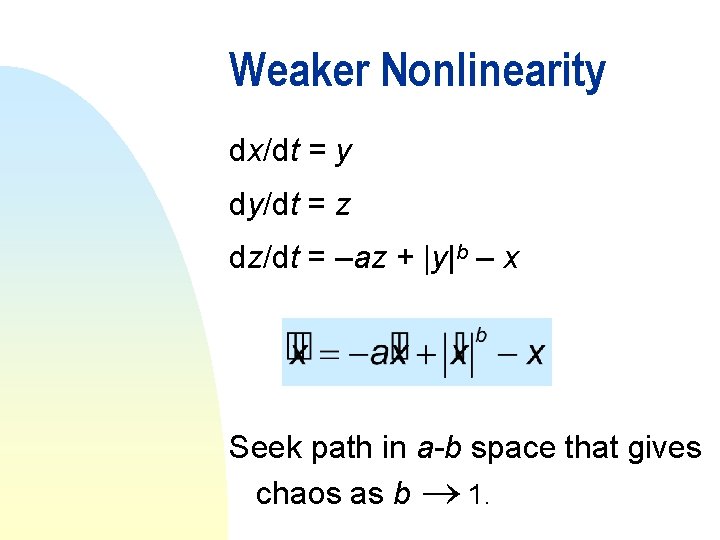
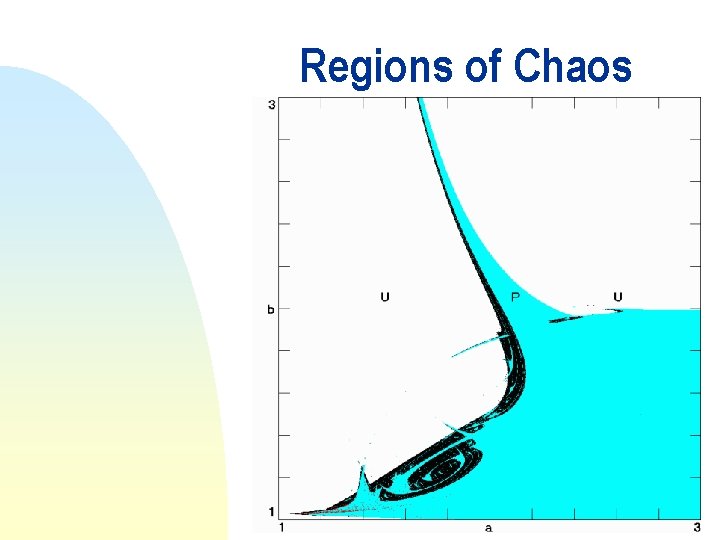
Weaker Nonlinearity dx/dt = y dy/dt = z dz/dt = –az + |y|b – x Seek path in a-b space that gives chaos as b 1.
Regions of Chaos
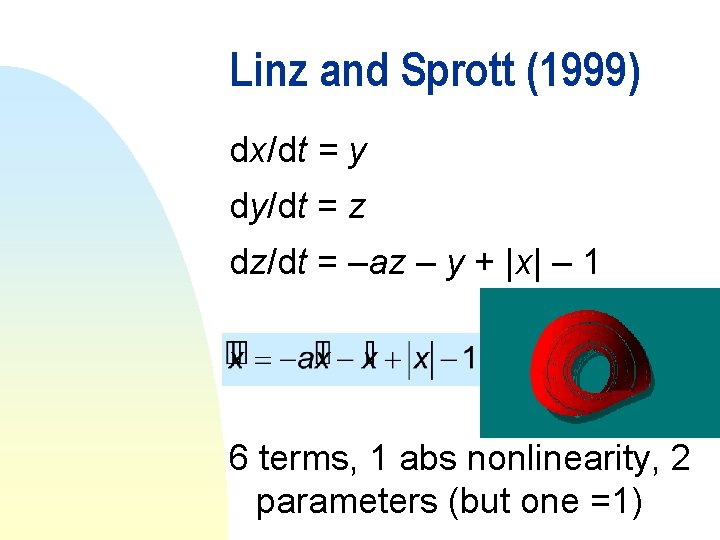
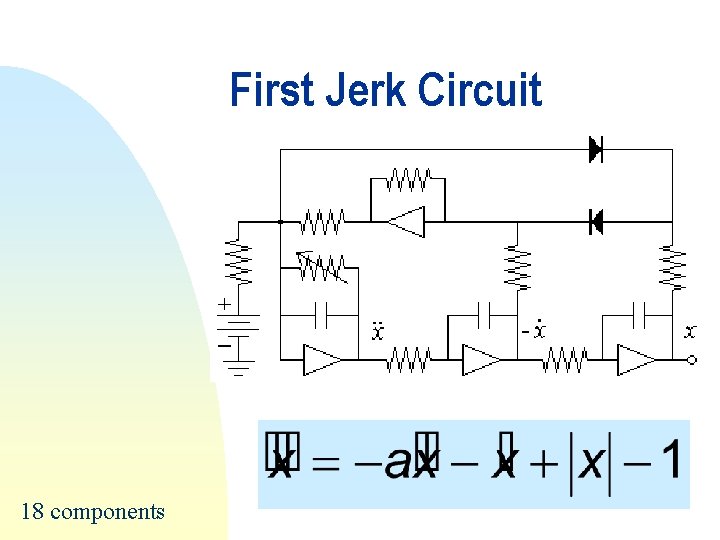
Linz and Sprott (1999) dx/dt = y dy/dt = z dz/dt = –az – y + |x| – 1 6 terms, 1 abs nonlinearity, 2 parameters (but one =1)
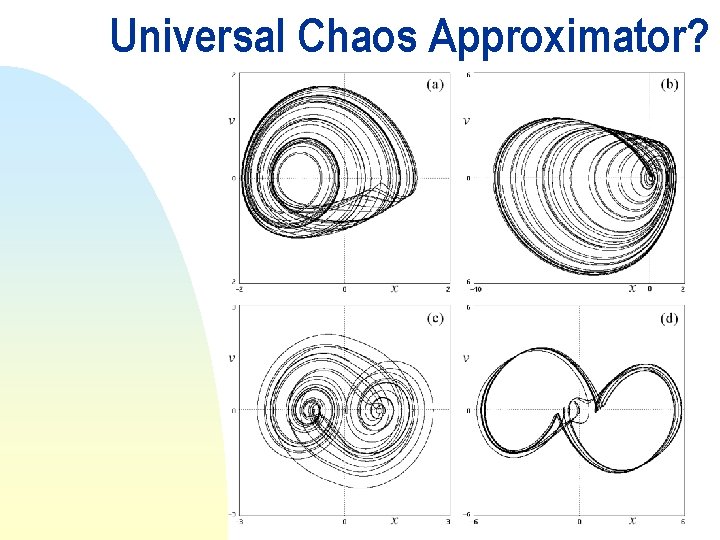
General Form dx/dt = y dy/dt = z dz/dt = – az – y + G(x) = ±(b|x| – c) G(x) = ±b(x 2/c – c) G(x) = –b max(x, 0) + c G(x) = ±(bx – c sgn(x)) etc….
Universal Chaos Approximator?
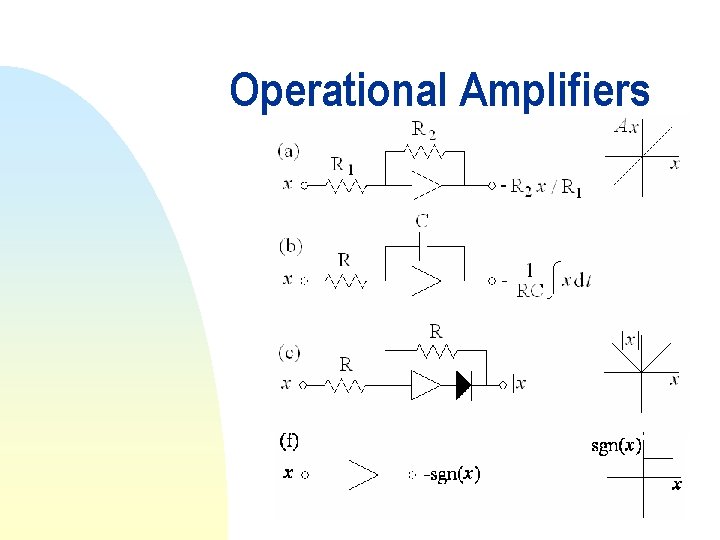
Operational Amplifiers
First Jerk Circuit 18 components
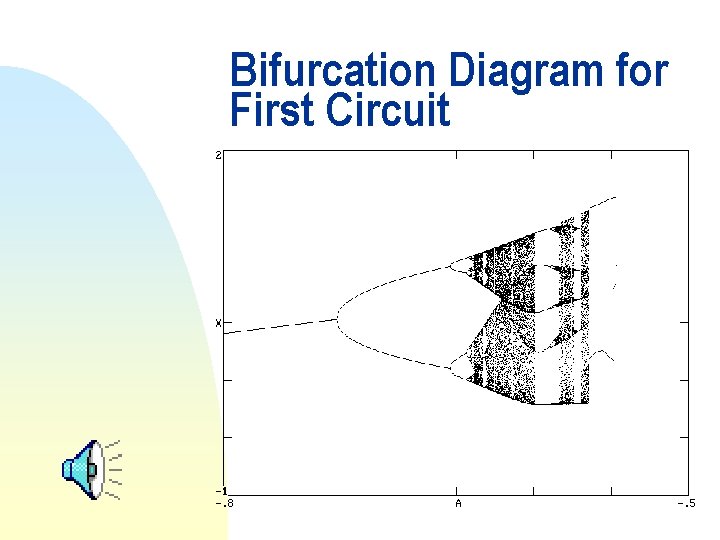
Bifurcation Diagram for First Circuit
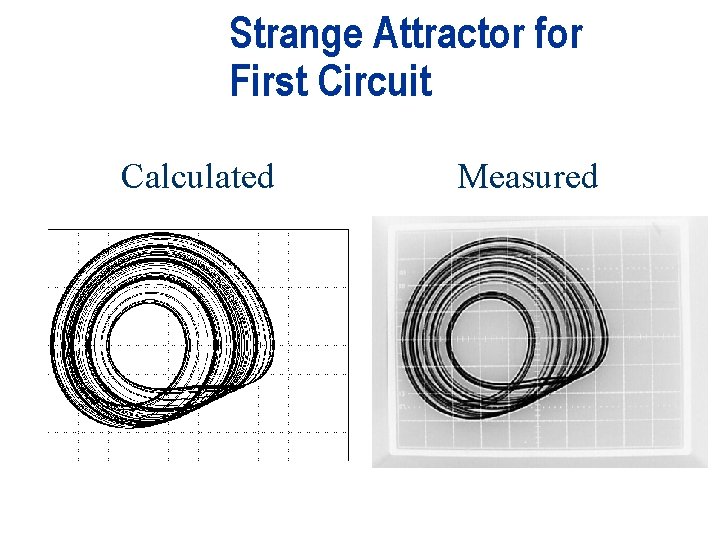
Strange Attractor for First Circuit Calculated Measured
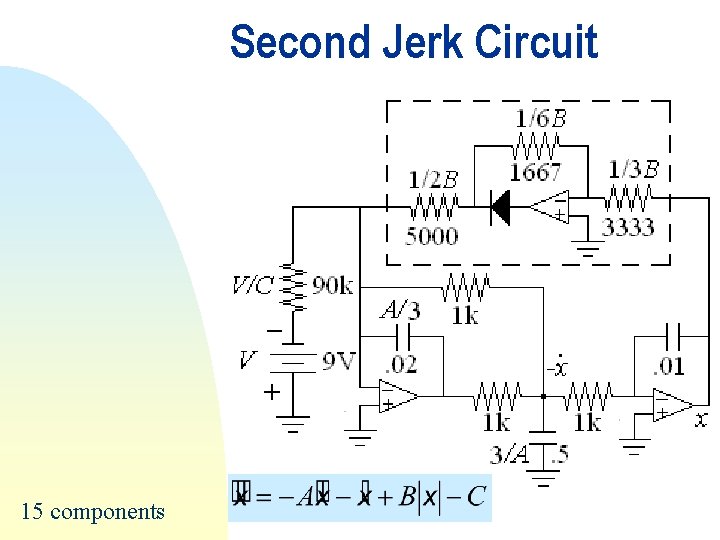
Second Jerk Circuit 15 components
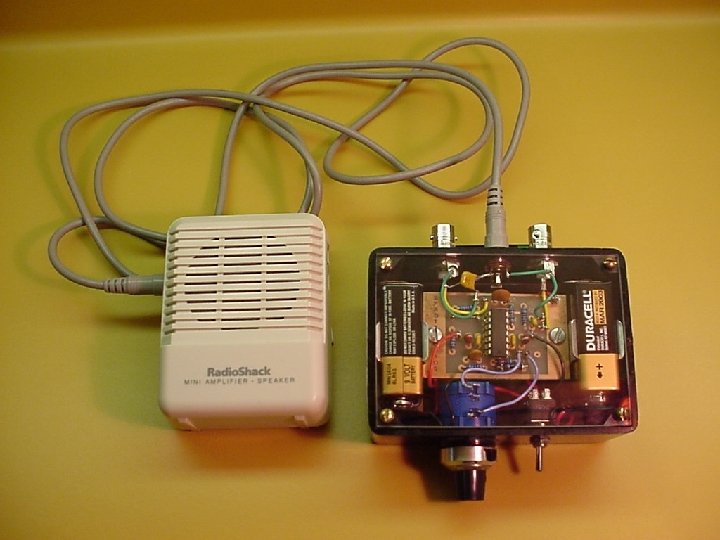
Chaos Circuit
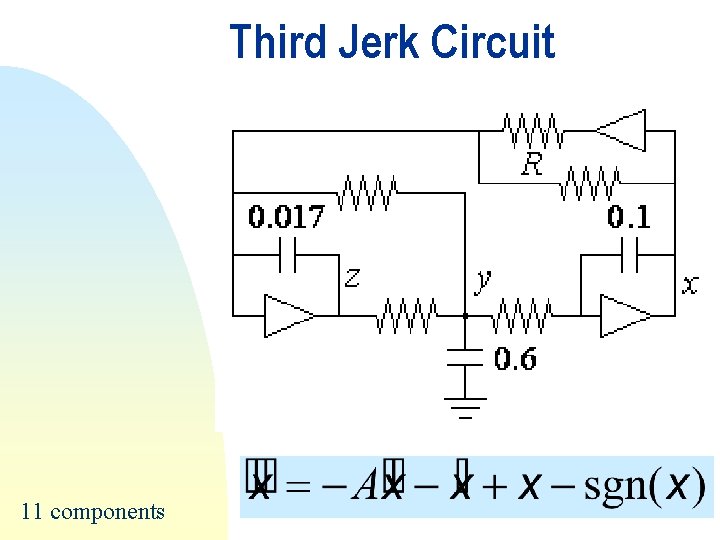
Third Jerk Circuit 11 components
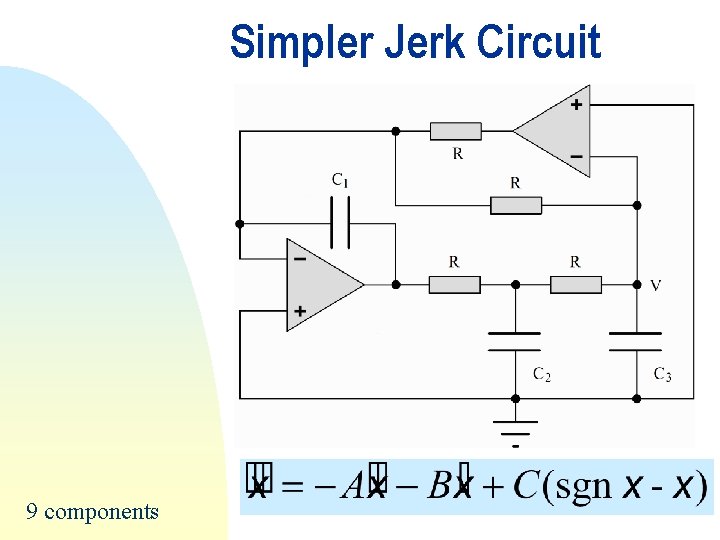
Simpler Jerk Circuit 9 components
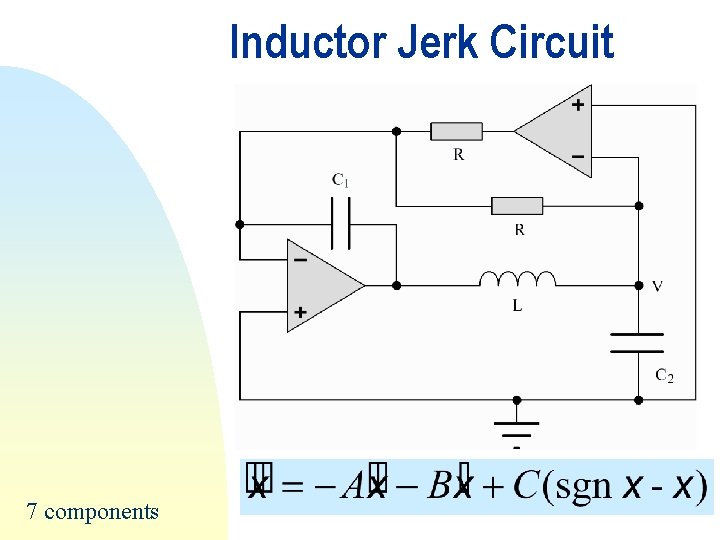
Inductor Jerk Circuit 7 components
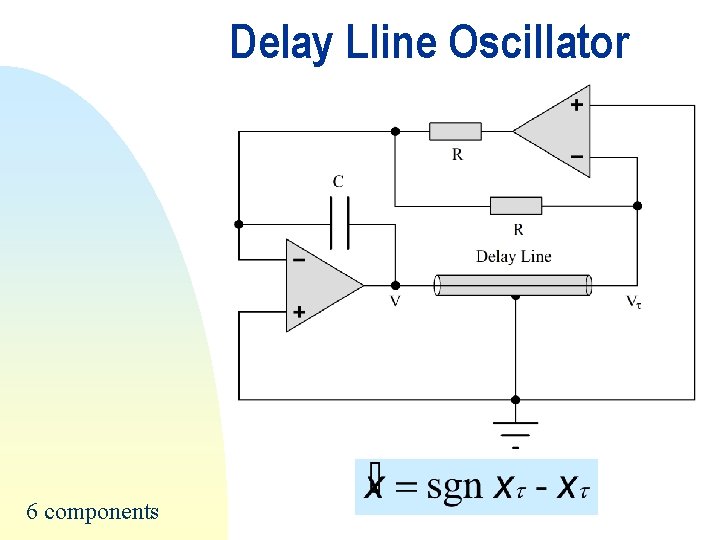
Delay Lline Oscillator 6 components
References n http: //sprott. physics. wisc. edu/ lectures/cktchaos/ (this talk) n http: //sprott. physics. wisc. edu/c haos/abschaos. htm n sprott@physics. wisc. edu