
Simion Modeling for the Design of the Electron
- Slides: 1
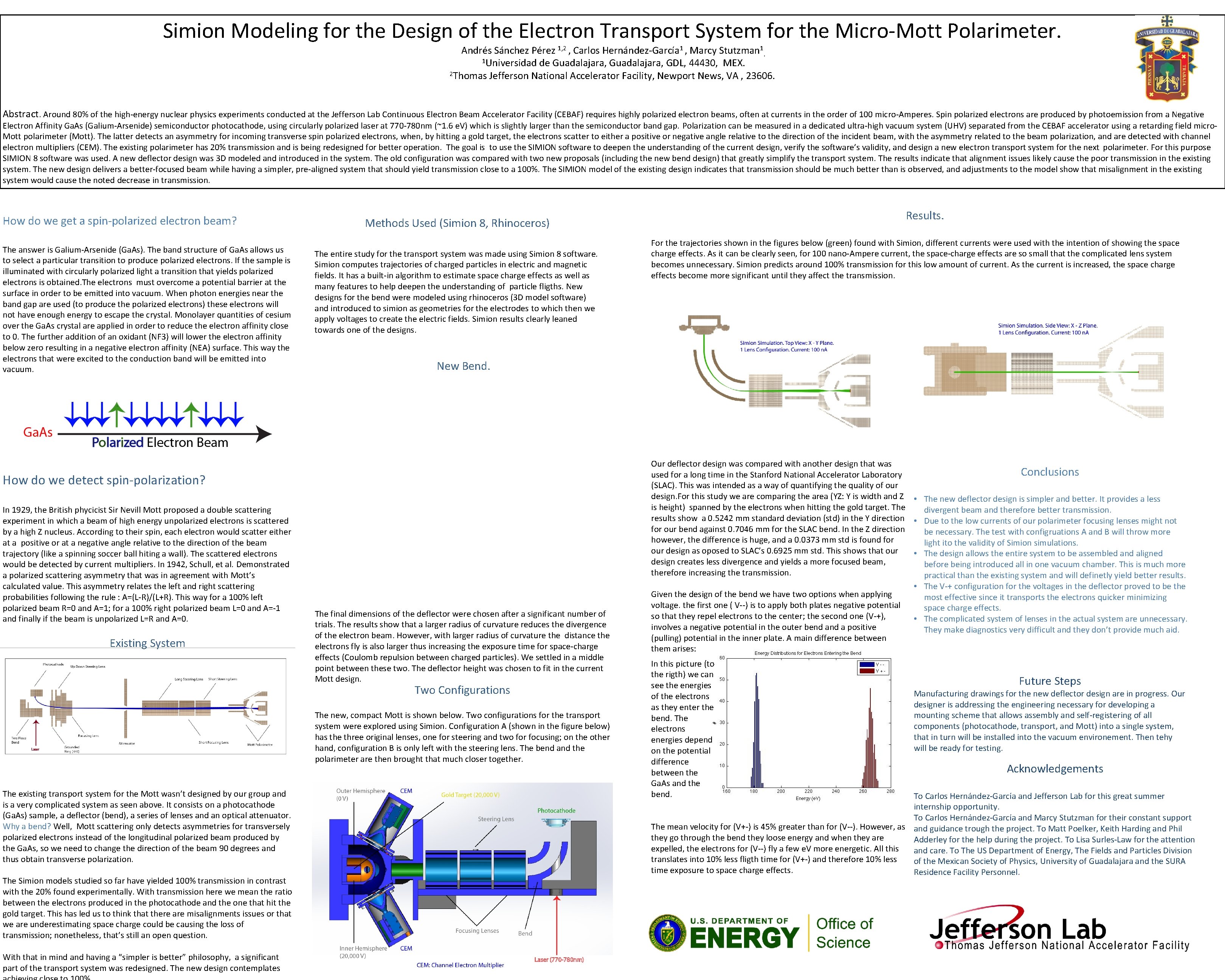
Simion Modeling for the Design of the Electron Transport System for the Micro-Mott Polarimeter. Andrés Sánchez Pérez 1, 2 , Carlos Hernández-García 1 , Marcy Stutzman 1. 1 Universidad de Guadalajara, GDL, 44430, MEX. 2 Thomas Jefferson National Accelerator Facility, Newport News, VA , 23606. Abstract. Around 80% of the high-energy nuclear physics experiments conducted at the Jefferson Lab Continuous Electron Beam Accelerator Facility (CEBAF) requires highly polarized electron beams, often at currents in the order of 100 micro-Amperes. Spin polarized electrons are produced by photoemission from a Negative Electron Affinity Ga. As (Galium-Arsenide) semiconductor photocathode, using circularly polarized laser at 770 -780 nm (~1. 6 e. V) which is slightly larger than the semiconductor band gap. Polarization can be measured in a dedicated ultra-high vacuum system (UHV) separated from the CEBAF accelerator using a retarding field micro. Mott polarimeter (Mott). The latter detects an asymmetry for incoming transverse spin polarized electrons, when, by hitting a gold target, the electrons scatter to either a positive or negative angle relative to the direction of the incident beam, with the asymmetry related to the beam polarization, and are detected with channel electron multipliers (CEM). The existing polarimeter has 20% transmission and is being redesigned for better operation. The goal is to use the SIMION software to deepen the understanding of the current design, verify the software’s validity, and design a new electron transport system for the next polarimeter. For this purpose SIMION 8 software was used. A new deflector design was 3 D modeled and introduced in the system. The old configuration was compared with two new proposals (including the new bend design) that greatly simplify the transport system. The results indicate that alignment issues likely cause the poor transmission in the existing system. The new design delivers a better-focused beam while having a simpler, pre-aligned system that should yield transmission close to a 100%. The SIMION model of the existing design indicates that transmission should be much better than is observed, and adjustments to the model show that misalignment in the existing system would cause the noted decrease in transmission. How do we get a spin-polarized electron beam? The answer is Galium-Arsenide (Ga. As). The band structure of Ga. As allows us to select a particular transition to produce polarized electrons. If the sample is illuminated with circularly polarized light a transition that yields polarized electrons is obtained. The electrons must overcome a potential barrier at the surface in order to be emitted into vacuum. When photon energies near the band gap are used (to produce the polarized electrons) these electrons will not have enough energy to escape the crystal. Monolayer quantities of cesium over the Ga. As crystal are applied in order to reduce the electron affinity close to 0. The further addition of an oxidant (NF 3) will lower the electron affinity below zero resulting in a negative electron affinity (NEA) surface. This way the electrons that were excited to the conduction band will be emitted into vacuum. Methods Used (Simion 8, Rhinoceros) The entire study for the transport system was made using Simion 8 software. Simion computes trajectories of charged particles in electric and magnetic fields. It has a built-in algorithm to estimate space charge effects as well as many features to help deepen the understanding of particle fligths. New designs for the bend were modeled using rhinoceros (3 D model software) and introduced to simion as geometries for the electrodes to which then we apply voltages to create the electric fields. Simion results clearly leaned towards one of the designs. Existing System The final dimensions of the deflector were chosen after a significant number of trials. The results show that a larger radius of curvature reduces the divergence of the electron beam. However, with larger radius of curvature the distance the electrons fly is also larger thus increasing the exposure time for space-charge effects (Coulomb repulsion between charged particles). We settled in a middle point between these two. The deflector height was chosen to fit in the current Mott design. Two Configurations The new, compact Mott is shown below. Two configurations for the transport system were explored using Simion. Configuration A (shown in the figure below) has the three original lenses, one for steering and two for focusing; on the other hand, configuration B is only left with the steering lens. The bend and the polarimeter are then brought that much closer together. The existing transport system for the Mott wasn’t designed by our group and is a very complicated system as seen above. It consists on a photocathode (Ga. As) sample, a deflector (bend), a series of lenses and an optical attenuator. Why a bend? Well, Mott scattering only detects asymmetries for transversely polarized electrons instead of the longitudinal polarized beam produced by the Ga. As, so we need to change the direction of the beam 90 degrees and thus obtain transverse polarization. The Simion models studied so far have yielded 100% transmission in contrast with the 20% found experimentally. With transmission here we mean the ratio between the electrons produced in the photocathode and the one that hit the gold target. This has led us to think that there are misalignments issues or that we are underestimating space charge could be causing the loss of transmission; nonetheless, that’s still an open question. With that in mind and having a “simpler is better” philosophy, a significant part of the transport system was redesigned. The new design contemplates For the trajectories shown in the figures below (green) found with Simion, different currents were used with the intention of showing the space charge effects. As it can be clearly seen, for 100 nano-Ampere current, the space-charge effects are so small that the complicated lens system becomes unnecessary. Simion predicts around 100% transmission for this low amount of current. As the current is increased, the space charge effects become more significant until they affect the transmission. New Bend. How do we detect spin-polarization? In 1929, the British phycicist Sir Nevill Mott proposed a double scattering experiment in which a beam of high energy unpolarized electrons is scattered by a high Z nucleus. According to their spin, each electron would scatter either at a positive or at a negative angle relative to the direction of the beam trajectory (like a spinning soccer ball hiting a wall). The scattered electrons would be detected by current multipliers. In 1942, Schull, et al. Demonstrated a polarized scattering asymmetry that was in agreement with Mott’s calculated value. This asymmetry relates the left and right scattering probabilities following the rule : A=(L-R)/(L+R). This way for a 100% left polarized beam R=0 and A=1; for a 100% right polarized beam L=0 and A=-1 and finally if the beam is unpolarized L=R and A=0. Results. Our deflector design was compared with another design that was Conclusions used for a long time in the Stanford National Accelerator Laboratory (SLAC). This was intended as a way of quantifying the quality of our design. For this study we are comparing the area (YZ: Y is width and Z • The new deflector design is simpler and better. It provides a less is height) spanned by the electrons when hitting the gold target. The divergent beam and therefore better transmission. results show a 0. 5242 mm standard deviation (std) in the Y direction • Due to the low currents of our polarimeter focusing lenses might not for our bend against 0. 7046 mm for the SLAC bend. In the Z direction be necessary. The test with configruations A and B will throw more however, the difference is huge, and a 0. 0373 mm std is found for light ito the validity of Simion simulations. our design as oposed to SLAC’s 0. 6925 mm std. This shows that our • The design allows the entire system to be assembled and aligned design creates less divergence and yields a more focused beam, before being introduced all in one vacuum chamber. This is much more therefore increasing the transmission. practical than the existing system and will definetly yield better results. • The V-+ configuration for the voltages in the deflector proved to be the Given the design of the bend we have two options when applying most effective since it transports the electrons quicker minimizing voltage. the first one ( V--) is to apply both plates negative potential space charge effects. so that they repel electrons to the center; the second one (V-+), • The complicated system of lenses in the actual system are unnecessary. involves a negative potential in the outer bend a positive They make diagnostics very difficult and they don’t provide much aid. (pulling) potential in the inner plate. A main difference between them arises: In this picture (to the rigth) we can see the energies of the electrons as they enter the bend. The electrons energies depend on the potential difference between the Ga. As and the bend. Future Steps Manufacturing drawings for the new deflector design are in progress. Our designer is addressing the engineering necessary for developing a mounting scheme that allows assembly and self-registering of all components (photocathode, transport, and Mott) into a single system, that in turn will be installed into the vacuum environement. Then tehy will be ready for testing. Acknowledgements To Carlos Hernández-García and Jefferson Lab for this great summer internship opportunity. To Carlos Hernández-García and Marcy Stutzman for their constant support The mean velocity for (V+-) is 45% greater than for (V--). However, as and guidance trough the project. To Matt Poelker, Keith Harding and Phil they go through the bend they loose energy and when they are Adderley for the help during the project. To Lisa Surles-Law for the attention expelled, the electrons for (V--) fly a few e. V more energetic. All this and care. To The US Department of Energy, The Fields and Particles Division translates into 10% less fligth time for (V+-) and therefore 10% less of the Mexican Society of Physics, University of Guadalajara and the SURA time exposure to space charge effects. Residence Facility Personnel.