
SIMD NPRG 054 High performance software development 20152016
- Slides: 39
SIMD NPRG 054 High performance software development - 2015/2016 David Bednárek 1
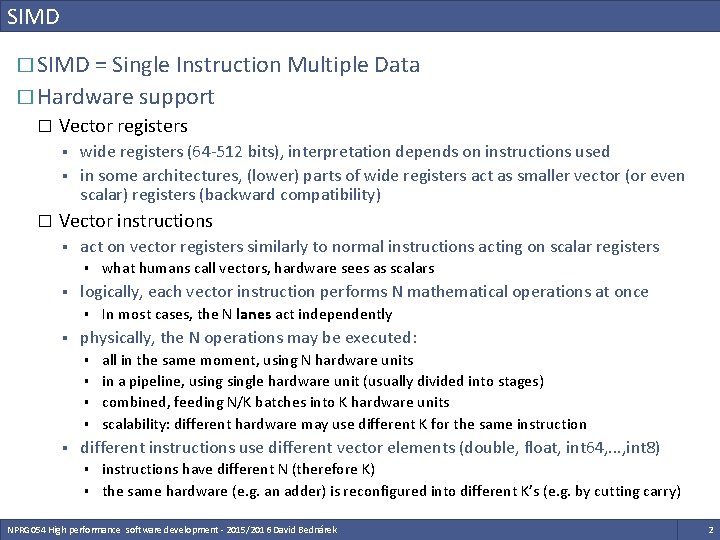
SIMD � SIMD = Single Instruction Multiple Data � Hardware support � Vector registers § § � wide registers (64 -512 bits), interpretation depends on instructions used in some architectures, (lower) parts of wide registers act as smaller vector (or even scalar) registers (backward compatibility) Vector instructions § act on vector registers similarly to normal instructions acting on scalar registers § § logically, each vector instruction performs N mathematical operations at once § § In most cases, the N lanes act independently physically, the N operations may be executed: § § § what humans call vectors, hardware sees as scalars all in the same moment, using N hardware units in a pipeline, usingle hardware unit (usually divided into stages) combined, feeding N/K batches into K hardware units scalability: different hardware may use different K for the same instruction different instructions use different vector elements (double, float, int 64, . . . , int 8) § § instructions have different N (therefore K) the same hardware (e. g. an adder) is reconfigured into different K’s (e. g. by cutting carry) NPRG 054 High performance software development - 2015/2016 David Bednárek 2
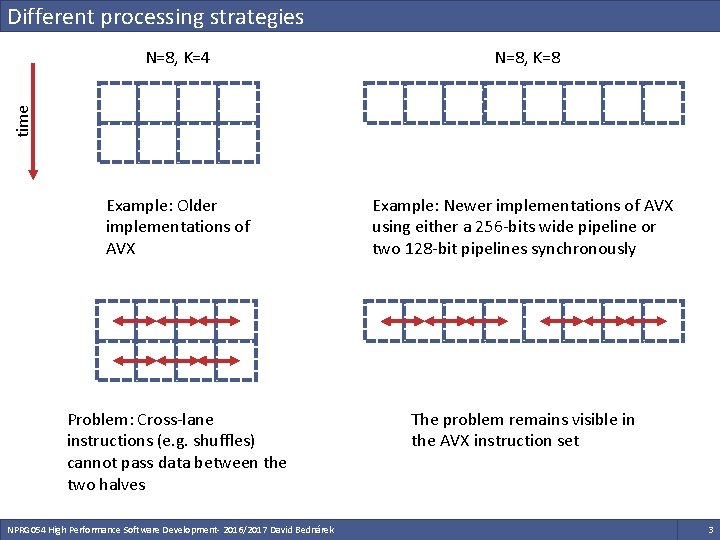
Different processing strategies N=8, K=8 Example: Older implementations of AVX Example: Newer implementations of AVX using either a 256 -bits wide pipeline or two 128 -bit pipelines synchronously Problem: Cross-lane instructions (e. g. shuffles) cannot pass data between the two halves The problem remains visible in the AVX instruction set time N=8, K=4 NPRG 054 High Performance Software Development- 2016/2017 David Bednárek 3
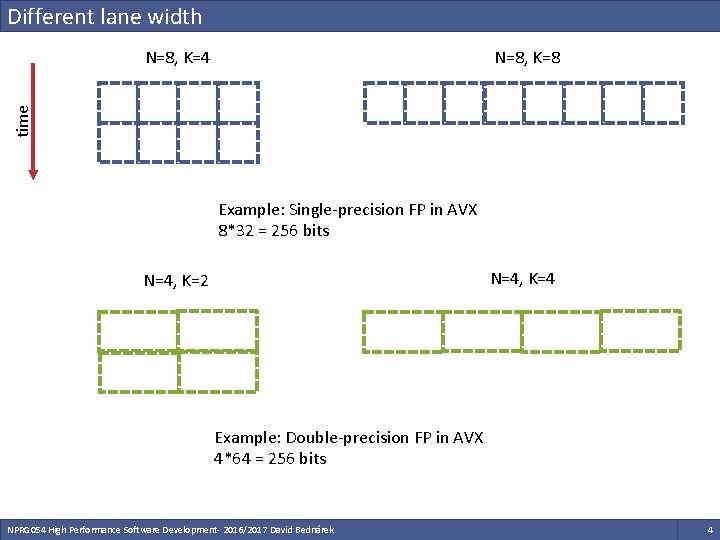
Different lane width N=8, K=8 time N=8, K=4 Example: Single-precision FP in AVX 8*32 = 256 bits N=4, K=4 N=4, K=2 Example: Double-precision FP in AVX 4*64 = 256 bits NPRG 054 High Performance Software Development- 2016/2017 David Bednárek 4
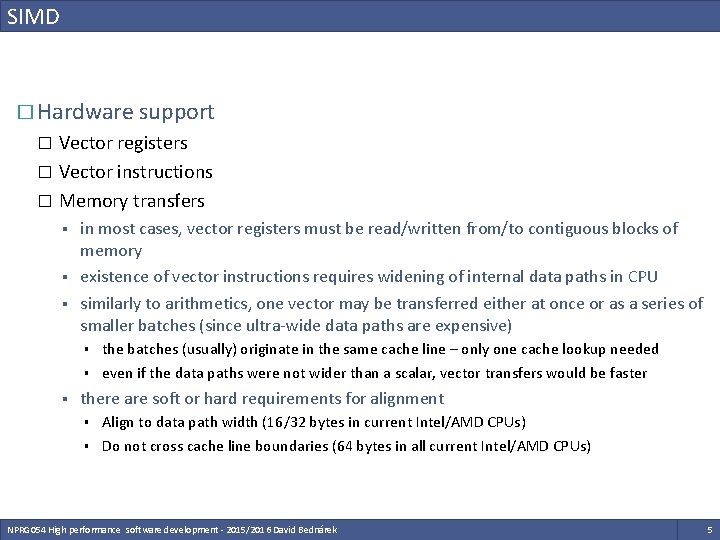
SIMD � Hardware support Vector registers � Vector instructions � Memory transfers � § § § in most cases, vector registers must be read/written from/to contiguous blocks of memory existence of vector instructions requires widening of internal data paths in CPU similarly to arithmetics, one vector may be transferred either at once or as a series of smaller batches (since ultra-wide data paths are expensive) § § § the batches (usually) originate in the same cache line – only one cache lookup needed even if the data paths were not wider than a scalar, vector transfers would be faster there are soft or hard requirements for alignment § § Align to data path width (16/32 bytes in current Intel/AMD CPUs) Do not cross cache line boundaries (64 bytes in all current Intel/AMD CPUs) NPRG 054 High performance software development - 2015/2016 David Bednárek 5
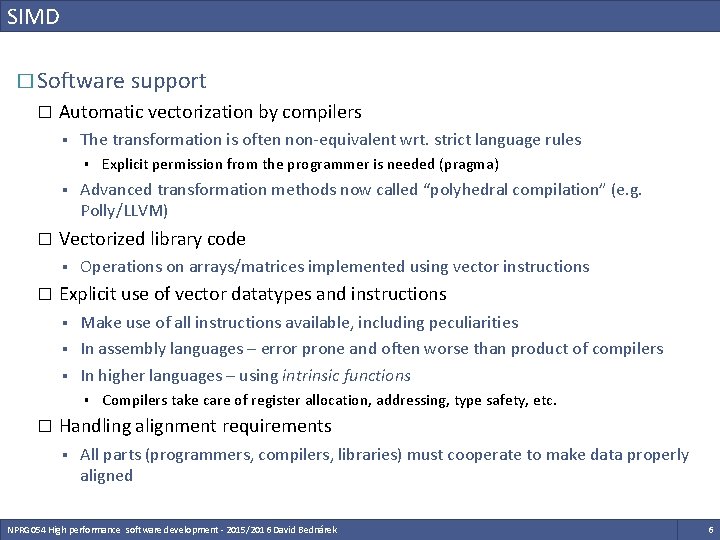
SIMD � Software support � Automatic vectorization by compilers § The transformation is often non-equivalent wrt. strict language rules § § � Advanced transformation methods now called “polyhedral compilation” (e. g. Polly/LLVM) Vectorized library code § � Operations on arrays/matrices implemented using vector instructions Explicit use of vector datatypes and instructions § § § Make use of all instructions available, including peculiarities In assembly languages – error prone and often worse than product of compilers In higher languages – using intrinsic functions § � Explicit permission from the programmer is needed (pragma) Compilers take care of register allocation, addressing, type safety, etc. Handling alignment requirements § All parts (programmers, compilers, libraries) must cooperate to make data properly aligned NPRG 054 High performance software development - 2015/2016 David Bednárek 6
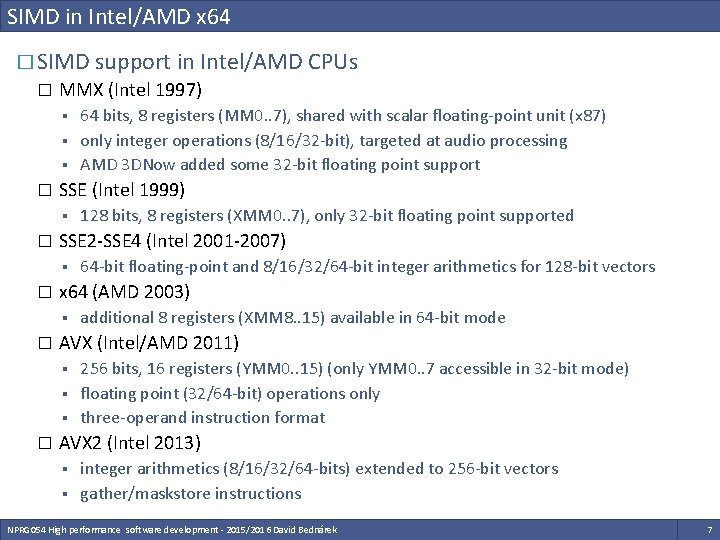
SIMD in Intel/AMD x 64 � SIMD support in Intel/AMD CPUs � MMX (Intel 1997) § § § � SSE (Intel 1999) § � additional 8 registers (XMM 8. . 15) available in 64 -bit mode AVX (Intel/AMD 2011) § § § � 64 -bit floating-point and 8/16/32/64 -bit integer arithmetics for 128 -bit vectors x 64 (AMD 2003) § � 128 bits, 8 registers (XMM 0. . 7), only 32 -bit floating point supported SSE 2 -SSE 4 (Intel 2001 -2007) § � 64 bits, 8 registers (MM 0. . 7), shared with scalar floating-point unit (x 87) only integer operations (8/16/32 -bit), targeted at audio processing AMD 3 DNow added some 32 -bit floating point support 256 bits, 16 registers (YMM 0. . 15) (only YMM 0. . 7 accessible in 32 -bit mode) floating point (32/64 -bit) operations only three-operand instruction format AVX 2 (Intel 2013) § § integer arithmetics (8/16/32/64 -bits) extended to 256 -bit vectors gather/maskstore instructions NPRG 054 High performance software development - 2015/2016 David Bednárek 7
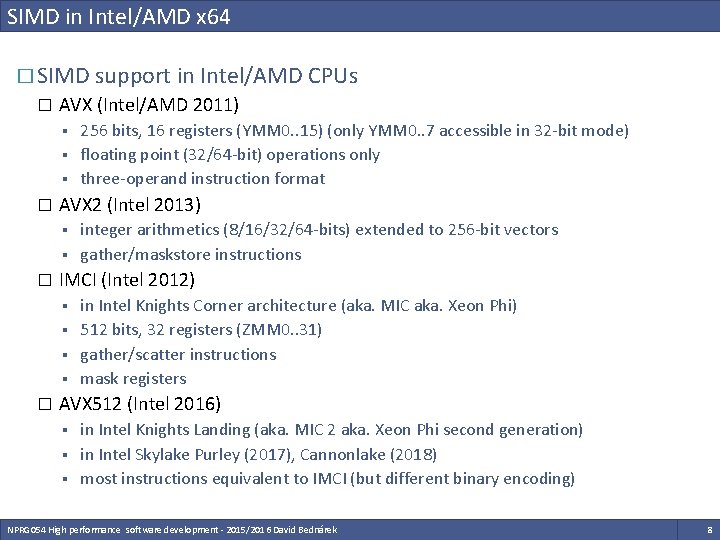
SIMD in Intel/AMD x 64 � SIMD support in Intel/AMD CPUs � AVX (Intel/AMD 2011) § § § � AVX 2 (Intel 2013) § § � integer arithmetics (8/16/32/64 -bits) extended to 256 -bit vectors gather/maskstore instructions IMCI (Intel 2012) § § � 256 bits, 16 registers (YMM 0. . 15) (only YMM 0. . 7 accessible in 32 -bit mode) floating point (32/64 -bit) operations only three-operand instruction format in Intel Knights Corner architecture (aka. MIC aka. Xeon Phi) 512 bits, 32 registers (ZMM 0. . 31) gather/scatter instructions mask registers AVX 512 (Intel 2016) § § § in Intel Knights Landing (aka. MIC 2 aka. Xeon Phi second generation) in Intel Skylake Purley (2017), Cannonlake (2018) most instructions equivalent to IMCI (but different binary encoding) NPRG 054 High performance software development - 2015/2016 David Bednárek 8
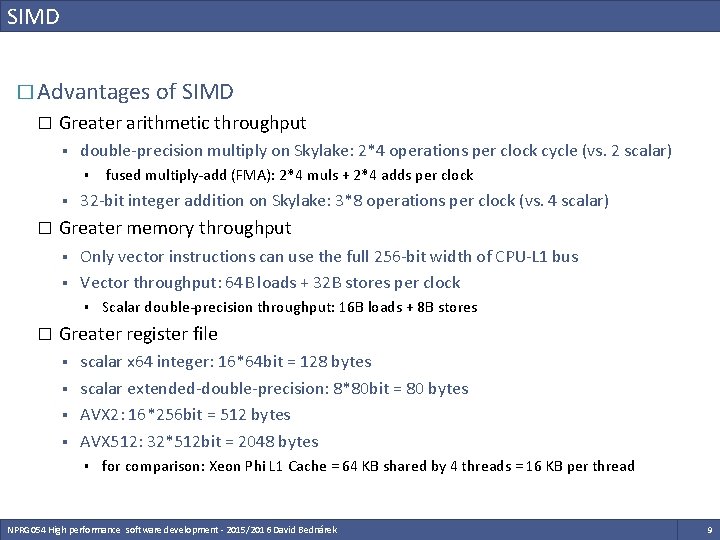
SIMD � Advantages of SIMD � Greater arithmetic throughput § double-precision multiply on Skylake: 2*4 operations per clock cycle (vs. 2 scalar) § § � 32 -bit integer addition on Skylake: 3*8 operations per clock (vs. 4 scalar) Greater memory throughput § § Only vector instructions can use the full 256 -bit width of CPU-L 1 bus Vector throughput: 64 B loads + 32 B stores per clock § � fused multiply-add (FMA): 2*4 muls + 2*4 adds per clock Scalar double-precision throughput: 16 B loads + 8 B stores Greater register file § § scalar x 64 integer: 16*64 bit = 128 bytes scalar extended-double-precision: 8*80 bit = 80 bytes AVX 2: 16*256 bit = 512 bytes AVX 512: 32*512 bit = 2048 bytes § for comparison: Xeon Phi L 1 Cache = 64 KB shared by 4 threads = 16 KB per thread NPRG 054 High performance software development - 2015/2016 David Bednárek 9
Vector data types and registers (MMX/SSE/AVX 512) NPRG 054 High performance software development - 2015/2016 David Bednárek 10
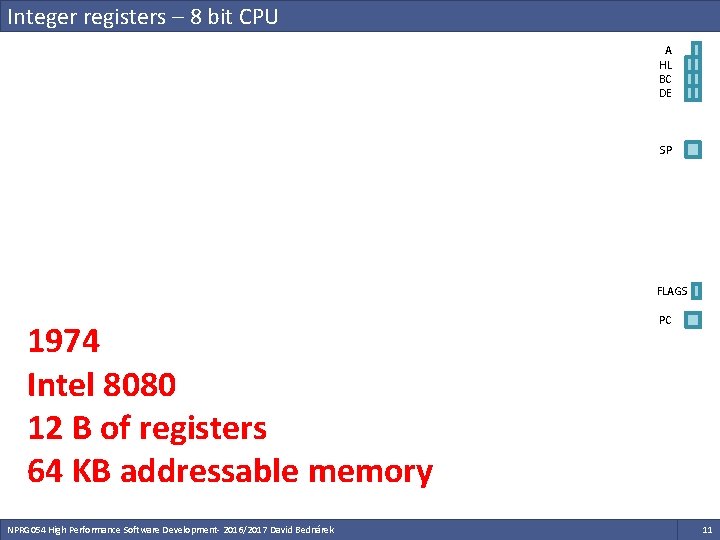
Integer registers – 8 bit CPU A HL BC DE SP FLAGS 1974 Intel 8080 12 B of registers 64 KB addressable memory NPRG 054 High Performance Software Development- 2016/2017 David Bednárek PC 11
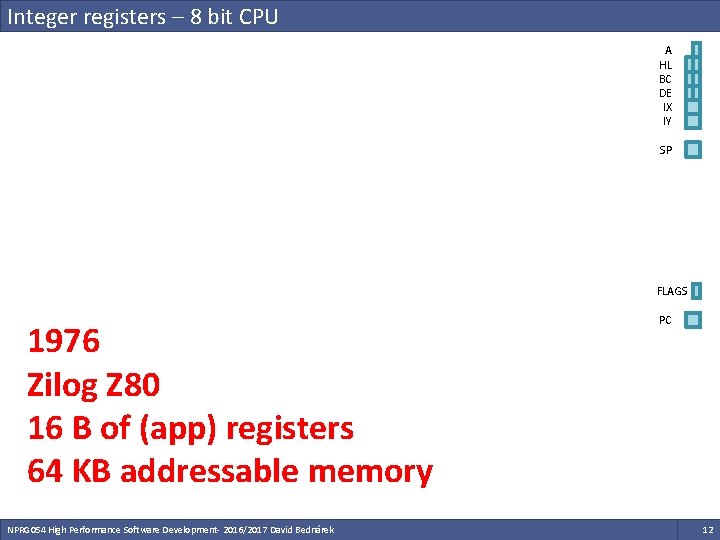
Integer registers – 8 bit CPU A HL BC DE IX IY SP FLAGS 1976 Zilog Z 80 16 B of (app) registers 64 KB addressable memory NPRG 054 High Performance Software Development- 2016/2017 David Bednárek PC 12
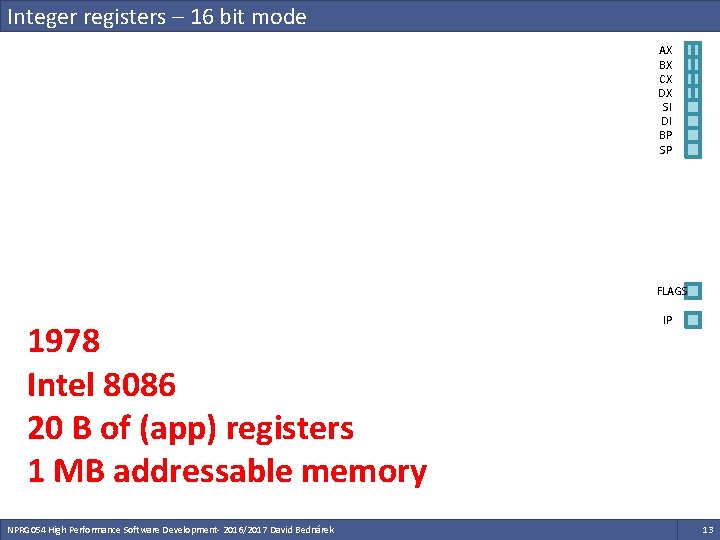
Integer registers – 16 bit mode AX BX CX DX SI DI BP SP FLAGS 1978 Intel 8086 20 B of (app) registers 1 MB addressable memory NPRG 054 High Performance Software Development- 2016/2017 David Bednárek IP 13
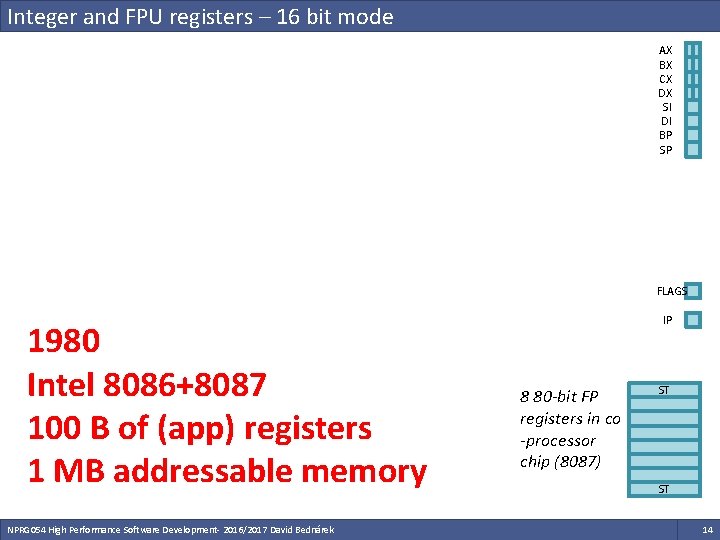
Integer and FPU registers – 16 bit mode AX BX CX DX SI DI BP SP FLAGS 1980 Intel 8086+8087 100 B of (app) registers 1 MB addressable memory NPRG 054 High Performance Software Development- 2016/2017 David Bednárek IP 8 80 -bit FP registers in co -processor chip (8087) ST ST 14
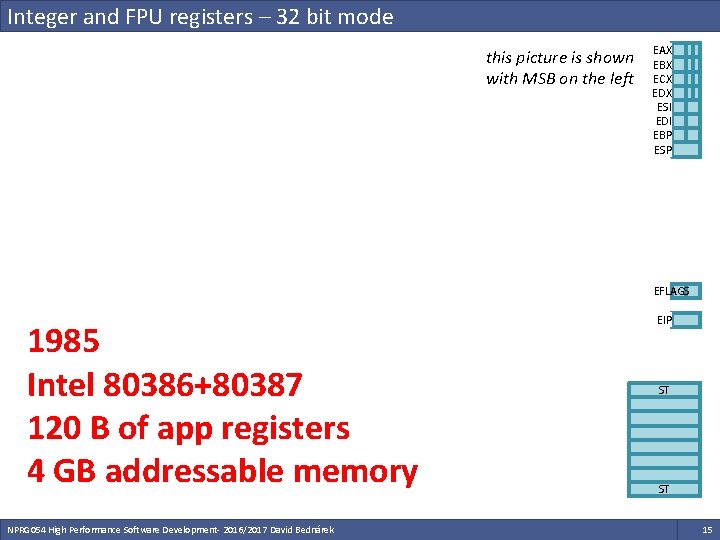
Integer and FPU registers – 32 bit mode this picture is shown with MSB on the left EAX EBX ECX EDX ESI EDI EBP ESP EFLAGS 1985 Intel 80386+80387 120 B of app registers 4 GB addressable memory NPRG 054 High Performance Software Development- 2016/2017 David Bednárek EIP ST ST 15
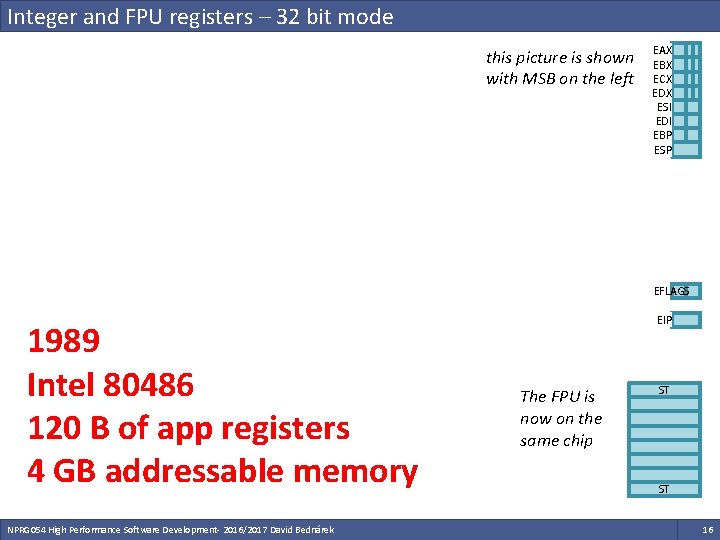
Integer and FPU registers – 32 bit mode this picture is shown with MSB on the left EAX EBX ECX EDX ESI EDI EBP ESP EFLAGS 1989 Intel 80486 120 B of app registers 4 GB addressable memory NPRG 054 High Performance Software Development- 2016/2017 David Bednárek EIP The FPU is now on the same chip ST ST 16
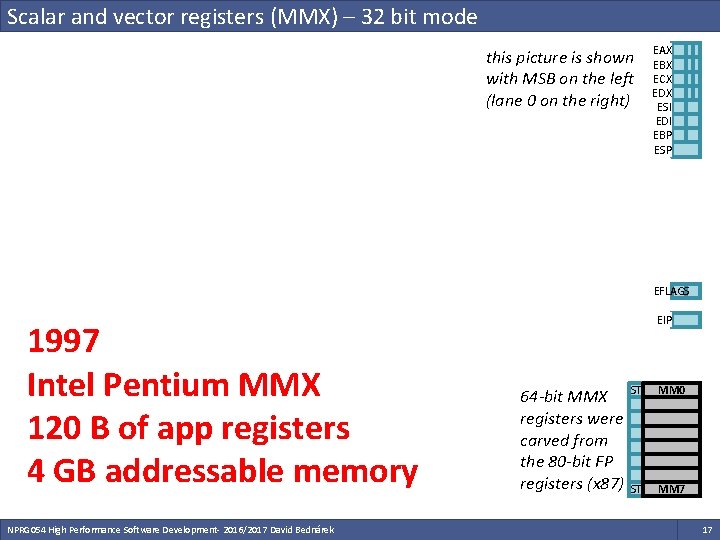
Scalar and vector registers (MMX) – 32 bit mode this picture is shown with MSB on the left (lane 0 on the right) EAX EBX ECX EDX ESI EDI EBP ESP EFLAGS 1997 Intel Pentium MMX 120 B of app registers 4 GB addressable memory NPRG 054 High Performance Software Development- 2016/2017 David Bednárek EIP 64 -bit MMX registers were carved from the 80 -bit FP registers (x 87) ST MM 0 ST MM 7 17
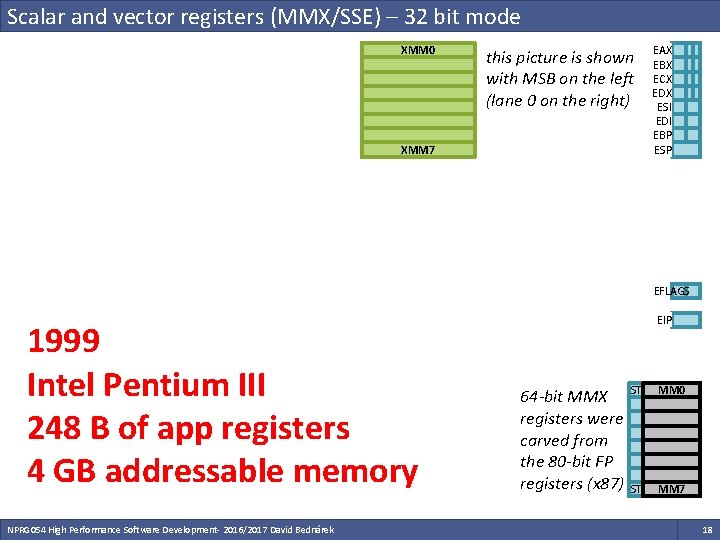
Scalar and vector registers (MMX/SSE) – 32 bit mode XMM 0 this picture is shown with MSB on the left (lane 0 on the right) XMM 7 EAX EBX ECX EDX ESI EDI EBP ESP EFLAGS 1999 Intel Pentium III 248 B of app registers 4 GB addressable memory NPRG 054 High Performance Software Development- 2016/2017 David Bednárek EIP 64 -bit MMX registers were carved from the 80 -bit FP registers (x 87) ST MM 0 ST MM 7 18
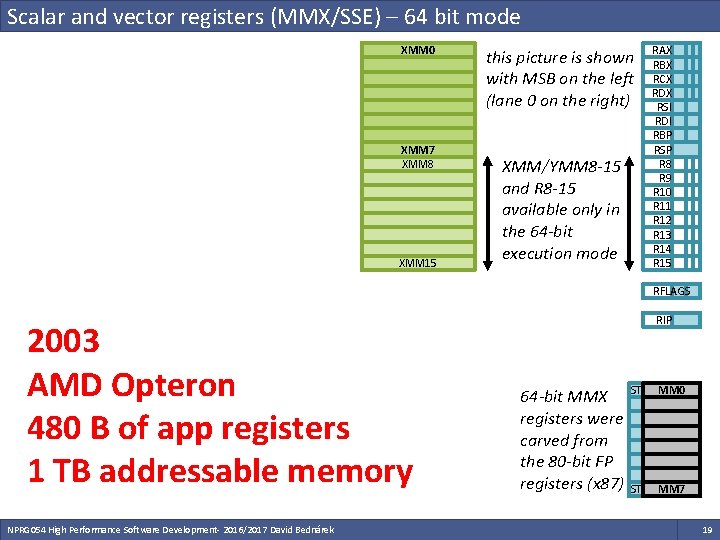
Scalar and vector registers (MMX/SSE) – 64 bit mode XMM 0 XMM 7 XMM 8 XMM 15 this picture is shown with MSB on the left (lane 0 on the right) XMM/YMM 8 -15 and R 8 -15 available only in the 64 -bit execution mode RAX RBX RCX RDX RSI RDI RBP RSP R 8 R 9 R 10 R 11 R 12 R 13 R 14 R 15 RFLAGS 2003 AMD Opteron 480 B of app registers 1 TB addressable memory NPRG 054 High Performance Software Development- 2016/2017 David Bednárek RIP 64 -bit MMX registers were carved from the 80 -bit FP registers (x 87) ST MM 0 ST MM 7 19
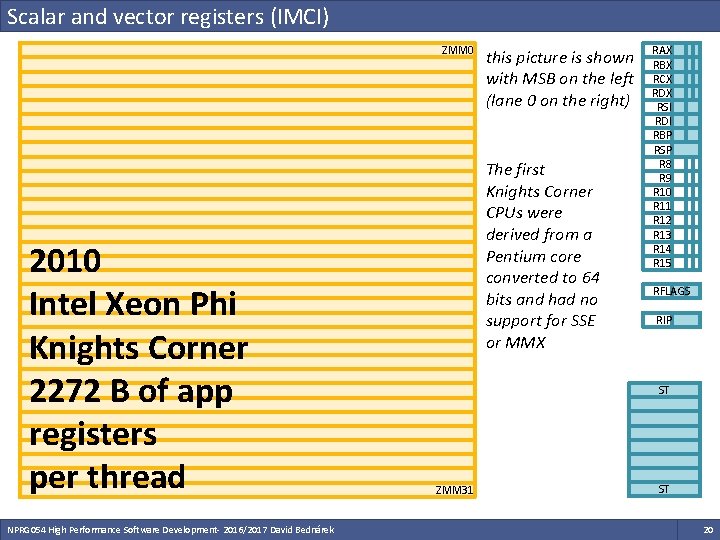
Scalar and vector registers (IMCI) ZMM 0 2010 Intel Xeon Phi Knights Corner 2272 B of app registers per thread NPRG 054 High Performance Software Development- 2016/2017 David Bednárek this picture is shown with MSB on the left (lane 0 on the right) The first Knights Corner CPUs were derived from a Pentium core converted to 64 bits and had no support for SSE or MMX RAX RBX RCX RDX RSI RDI RBP RSP R 8 R 9 R 10 R 11 R 12 R 13 R 14 R 15 RFLAGS RIP ST ZMM 31 ST 20
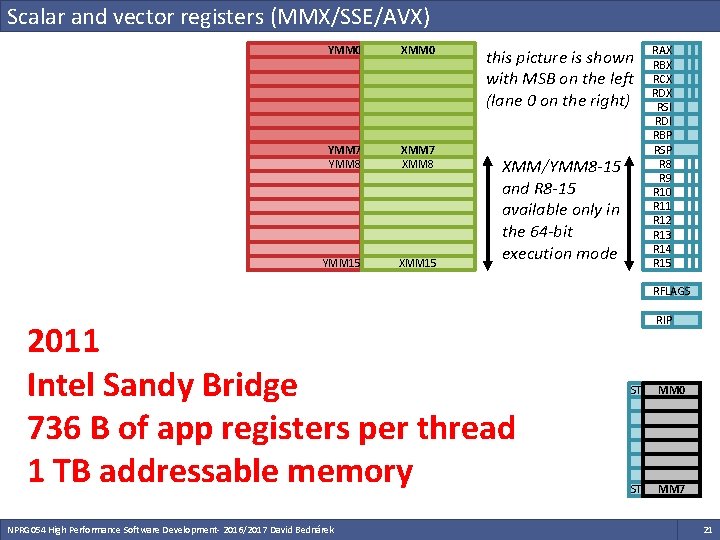
Scalar and vector registers (MMX/SSE/AVX) YMM 0 XMM 0 YMM 7 YMM 8 XMM 7 XMM 8 YMM 15 XMM 15 this picture is shown with MSB on the left (lane 0 on the right) XMM/YMM 8 -15 and R 8 -15 available only in the 64 -bit execution mode RAX RBX RCX RDX RSI RDI RBP RSP R 8 R 9 R 10 R 11 R 12 R 13 R 14 R 15 RFLAGS 2011 Intel Sandy Bridge 736 B of app registers per thread 1 TB addressable memory NPRG 054 High Performance Software Development- 2016/2017 David Bednárek RIP ST MM 0 ST MM 7 21
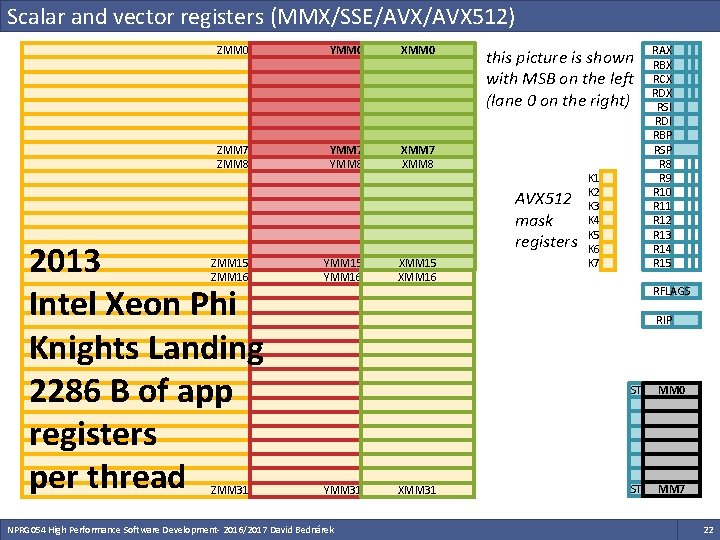
Scalar and vector registers (MMX/SSE/AVX 512) ZMM 0 YMM 0 XMM 0 ZMM 7 ZMM 8 YMM 7 YMM 8 XMM 7 XMM 8 2013 Intel Xeon Phi Knights Landing 2286 B of app registers per thread ZMM 15 ZMM 16 ZMM 31 this picture is shown with MSB on the left (lane 0 on the right) AVX 512 mask registers YMM 15 YMM 16 XMM 15 XMM 16 K 1 K 2 K 3 K 4 K 5 K 6 K 7 RAX RBX RCX RDX RSI RDI RBP RSP R 8 R 9 R 10 R 11 R 12 R 13 R 14 R 15 RFLAGS RIP YMM 31 NPRG 054 High Performance Software Development- 2016/2017 David Bednárek XMM 31 ST MM 0 ST MM 7 22
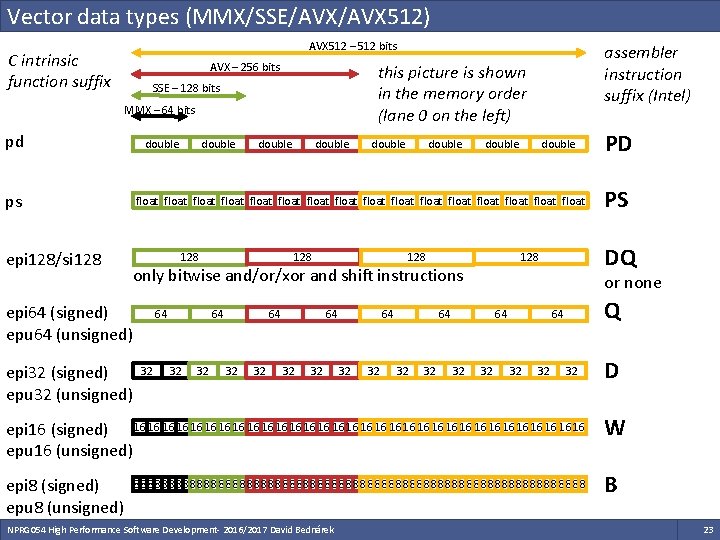
Vector data types (MMX/SSE/AVX 512) AVX 512 – 512 bits C intrinsic function suffix AVX – 256 bits this picture is shown in the memory order (lane 0 on the left) SSE – 128 bits MMX – 64 bits pd double ps epi 128/si 128 double assembler instruction suffix (Intel) double double float float float float 128 only bitwise and/or/xor and shift instructions epi 64 (signed) epu 64 (unsigned) epi 32 (signed) epu 32 (unsigned) 64 32 64 64 32 32 or none 64 64 32 32 32 PS DQ 128 PD 32 Q 64 32 32 32 D epi 16 (signed) 16 16 16 16 16 16 16 16 epu 16 (unsigned) W epi 8 (signed) epu 8 (unsigned) B 8888888888888888 NPRG 054 High Performance Software Development- 2016/2017 David Bednárek 23
Vector instructions (SSE/AVX 512) NPRG 054 High performance software development - 2015/2016 David Bednárek 24
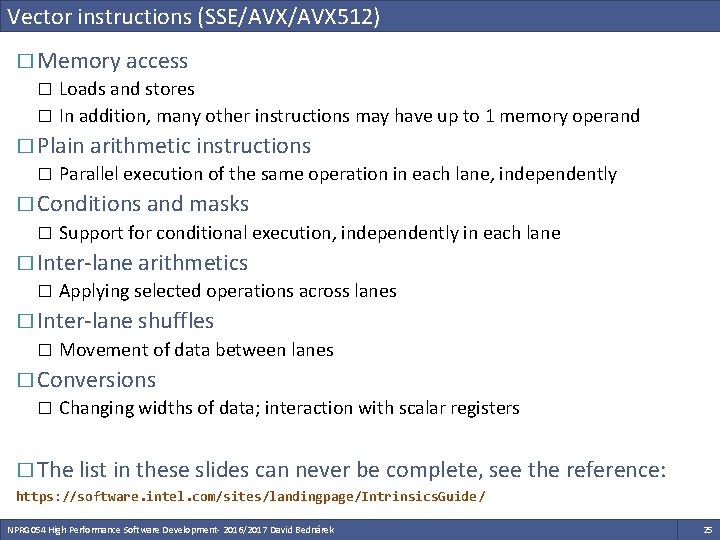
Vector instructions (SSE/AVX 512) � Memory access Loads and stores � In addition, many other instructions may have up to 1 memory operand � � Plain arithmetic instructions � Parallel execution of the same operation in each lane, independently � Conditions and masks � Support for conditional execution, independently in each lane � Inter-lane arithmetics � Applying selected operations across lanes � Inter-lane shuffles � Movement of data between lanes � Conversions � Changing widths of data; interaction with scalar registers � The list in these slides can never be complete, see the reference: https: //software. intel. com/sites/landingpage/Intrinsics. Guide/ NPRG 054 High Performance Software Development- 2016/2017 David Bednárek 25
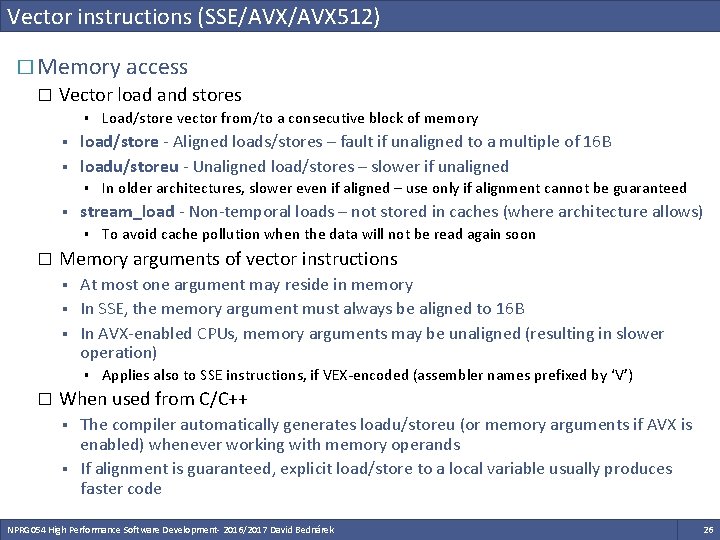
Vector instructions (SSE/AVX 512) � Memory access � Vector load and stores § § § load/store - Aligned loads/stores – fault if unaligned to a multiple of 16 B loadu/storeu - Unaligned load/stores – slower if unaligned § § To avoid cache pollution when the data will not be read again soon Memory arguments of vector instructions § § § At most one argument may reside in memory In SSE, the memory argument must always be aligned to 16 B In AVX-enabled CPUs, memory arguments may be unaligned (resulting in slower operation) § � In older architectures, slower even if aligned – use only if alignment cannot be guaranteed stream_load - Non-temporal loads – not stored in caches (where architecture allows) § � Load/store vector from/to a consecutive block of memory Applies also to SSE instructions, if VEX-encoded (assembler names prefixed by ‘V’) When used from C/C++ § § The compiler automatically generates loadu/storeu (or memory arguments if AVX is enabled) whenever working with memory operands If alignment is guaranteed, explicit load/store to a local variable usually produces faster code NPRG 054 High Performance Software Development- 2016/2017 David Bednárek 26
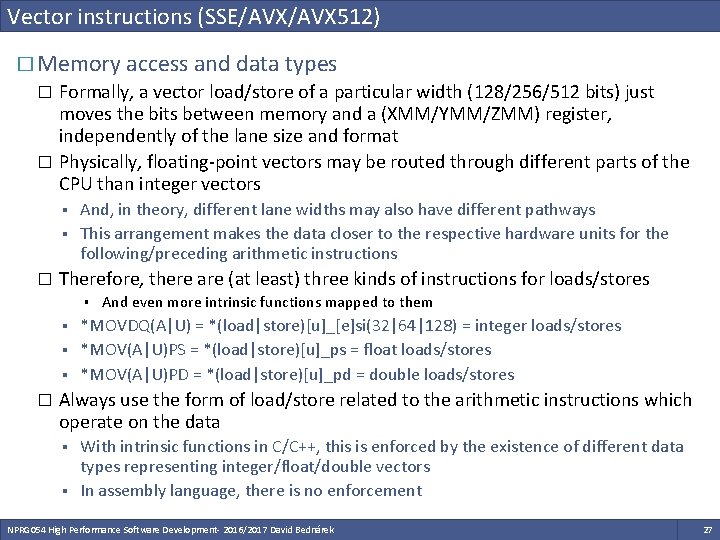
Vector instructions (SSE/AVX 512) � Memory access and data types Formally, a vector load/store of a particular width (128/256/512 bits) just moves the bits between memory and a (XMM/YMM/ZMM) register, independently of the lane size and format � Physically, floating-point vectors may be routed through different parts of the CPU than integer vectors � § § � And, in theory, different lane widths may also have different pathways This arrangement makes the data closer to the respective hardware units for the following/preceding arithmetic instructions Therefore, there are (at least) three kinds of instructions for loads/stores § § � And even more intrinsic functions mapped to them *MOVDQ(A|U) = *(load|store)[u]_[e]si(32|64|128) = integer loads/stores *MOV(A|U)PS = *(load|store)[u]_ps = float loads/stores *MOV(A|U)PD = *(load|store)[u]_pd = double loads/stores Always use the form of load/store related to the arithmetic instructions which operate on the data § § With intrinsic functions in C/C++, this is enforced by the existence of different data types representing integer/float/double vectors In assembly language, there is no enforcement NPRG 054 High Performance Software Development- 2016/2017 David Bednárek 27
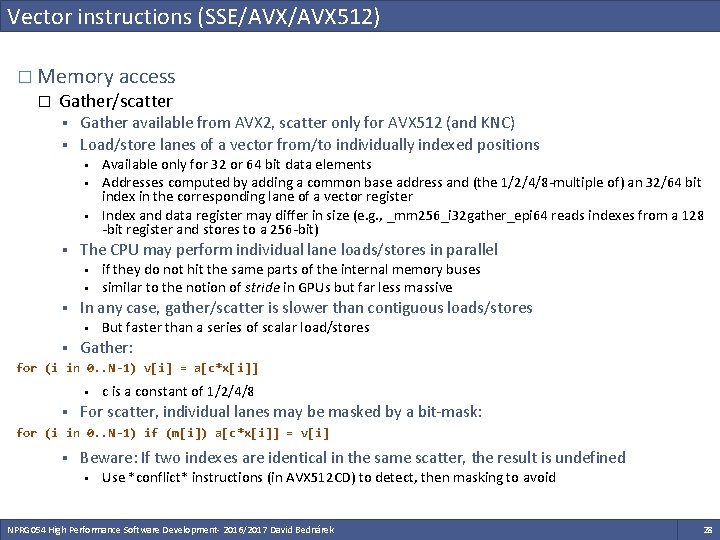
Vector instructions (SSE/AVX 512) � Memory access � Gather/scatter § § Gather available from AVX 2, scatter only for AVX 512 (and KNC) Load/store lanes of a vector from/to individually indexed positions § § The CPU may perform individual lane loads/stores in parallel § § § Available only for 32 or 64 bit data elements Addresses computed by adding a common base address and (the 1/2/4/8 -multiple of) an 32/64 bit index in the corresponding lane of a vector register Index and data register may differ in size (e. g. , _mm 256_i 32 gather_epi 64 reads indexes from a 128 -bit register and stores to a 256 -bit) if they do not hit the same parts of the internal memory buses similar to the notion of stride in GPUs but far less massive In any case, gather/scatter is slower than contiguous loads/stores § But faster than a series of scalar load/stores § Gather: for (i in 0. . N-1) v[i] = a[c*x[i]] § c is a constant of 1/2/4/8 § For scatter, individual lanes may be masked by a bit-mask: for (i in 0. . N-1) if (m[i]) a[c*x[i]] = v[i] § Beware: If two indexes are identical in the same scatter, the result is undefined § Use *conflict* instructions (in AVX 512 CD) to detect, then masking to avoid NPRG 054 High Performance Software Development- 2016/2017 David Bednárek 28
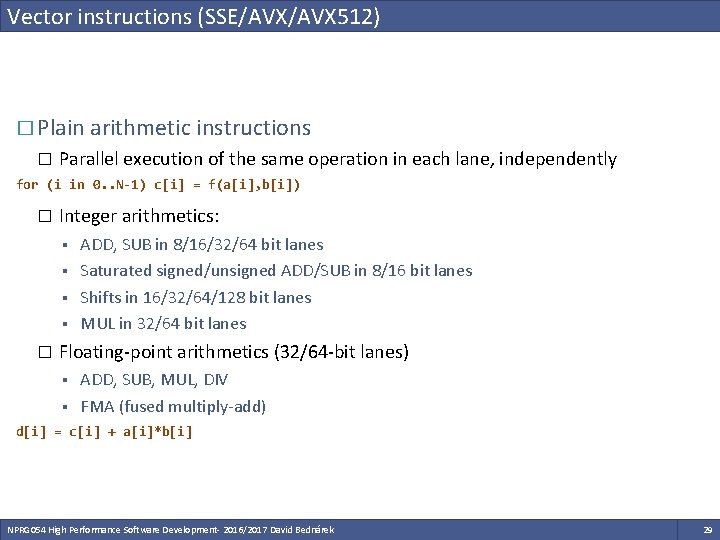
Vector instructions (SSE/AVX 512) � Plain arithmetic instructions � Parallel execution of the same operation in each lane, independently for (i in 0. . N-1) c[i] = f(a[i], b[i]) � Integer arithmetics: § § � ADD, SUB in 8/16/32/64 bit lanes Saturated signed/unsigned ADD/SUB in 8/16 bit lanes Shifts in 16/32/64/128 bit lanes MUL in 32/64 bit lanes Floating-point arithmetics (32/64 -bit lanes) § § ADD, SUB, MUL, DIV FMA (fused multiply-add) d[i] = c[i] + a[i]*b[i] NPRG 054 High Performance Software Development- 2016/2017 David Bednárek 29
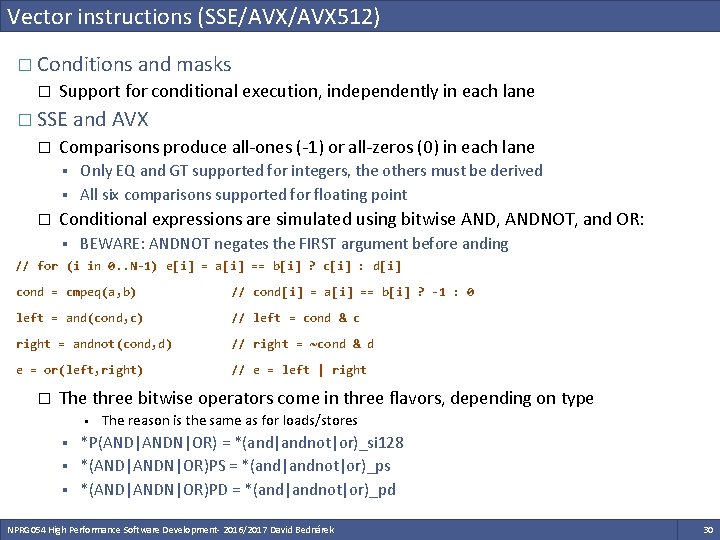
Vector instructions (SSE/AVX 512) � Conditions and masks � Support for conditional execution, independently in each lane � SSE and AVX � Comparisons produce all-ones (-1) or all-zeros (0) in each lane § § � Only EQ and GT supported for integers, the others must be derived All six comparisons supported for floating point Conditional expressions are simulated using bitwise AND, ANDNOT, and OR: § BEWARE: ANDNOT negates the FIRST argument before anding // for (i in 0. . N-1) e[i] = a[i] == b[i] ? c[i] : d[i] cond = cmpeq(a, b) // cond[i] = a[i] == b[i] ? -1 : 0 left = and(cond, c) // left = cond & c right = andnot(cond, d) // right = ~cond & d e = or(left, right) // e = left | right � The three bitwise operators come in three flavors, depending on type § § The reason is the same as for loads/stores *P(AND|ANDN|OR) = *(and|andnot|or)_si 128 *(AND|ANDN|OR)PS = *(and|andnot|or)_ps *(AND|ANDN|OR)PD = *(and|andnot|or)_pd NPRG 054 High Performance Software Development- 2016/2017 David Bednárek 30
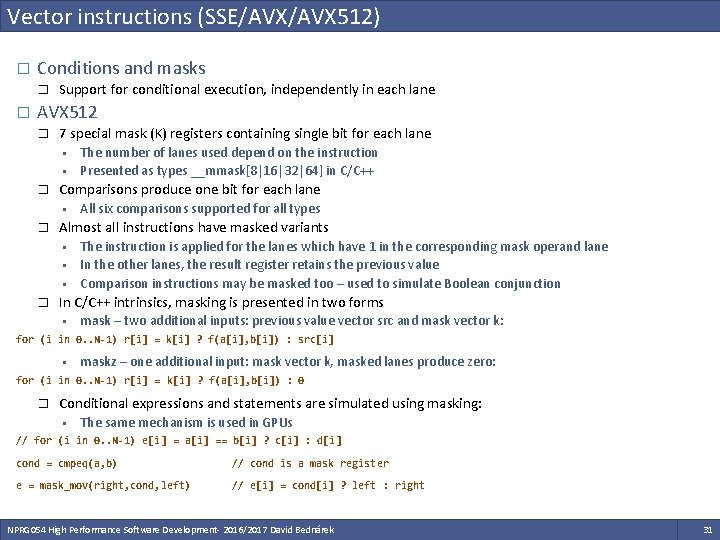
Vector instructions (SSE/AVX 512) � Conditions and masks � � Support for conditional execution, independently in each lane AVX 512 � 7 special mask (K) registers containing single bit for each lane § § � Comparisons produce one bit for each lane § � All six comparisons supported for all types Almost all instructions have masked variants § § § � The number of lanes used depend on the instruction Presented as types __mmask[8|16|32|64] in C/C++ The instruction is applied for the lanes which have 1 in the corresponding mask operand lane In the other lanes, the result register retains the previous value Comparison instructions may be masked too – used to simulate Boolean conjunction In C/C++ intrinsics, masking is presented in two forms § mask – two additional inputs: previous value vector src and mask vector k: for (i in 0. . N-1) r[i] = k[i] ? f(a[i], b[i]) : src[i] § maskz – one additional input: mask vector k, masked lanes produce zero: for (i in 0. . N-1) r[i] = k[i] ? f(a[i], b[i]) : 0 � Conditional expressions and statements are simulated using masking: § The same mechanism is used in GPUs // for (i in 0. . N-1) e[i] = a[i] == b[i] ? c[i] : d[i] cond = cmpeq(a, b) // cond is a mask register e = mask_mov(right, cond, left) // e[i] = cond[i] ? left : right NPRG 054 High Performance Software Development- 2016/2017 David Bednárek 31
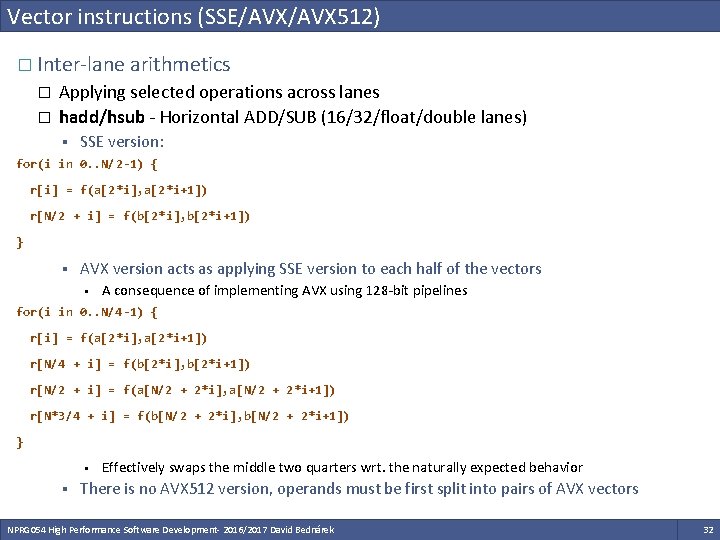
Vector instructions (SSE/AVX 512) � Inter-lane arithmetics � � Applying selected operations across lanes hadd/hsub - Horizontal ADD/SUB (16/32/float/double lanes) § SSE version: for(i in 0. . N/2 -1) { r[i] = f(a[2*i], a[2*i+1]) r[N/2 + i] = f(b[2*i], b[2*i+1]) } § AVX version acts as applying SSE version to each half of the vectors § A consequence of implementing AVX using 128 -bit pipelines for(i in 0. . N/4 -1) { r[i] = f(a[2*i], a[2*i+1]) r[N/4 + i] = f(b[2*i], b[2*i+1]) r[N/2 + i] = f(a[N/2 + 2*i], a[N/2 + 2*i+1]) r[N*3/4 + i] = f(b[N/2 + 2*i], b[N/2 + 2*i+1]) } § § Effectively swaps the middle two quarters wrt. the naturally expected behavior There is no AVX 512 version, operands must be first split into pairs of AVX vectors NPRG 054 High Performance Software Development- 2016/2017 David Bednárek 32
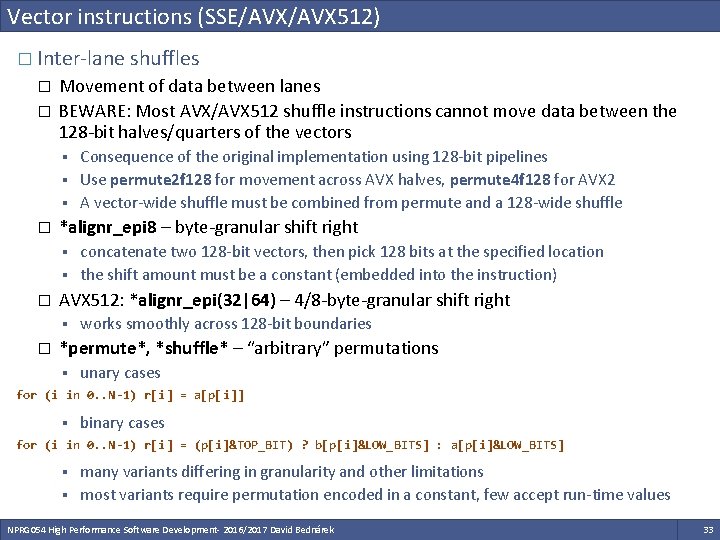
Vector instructions (SSE/AVX 512) � Inter-lane shuffles � � Movement of data between lanes BEWARE: Most AVX/AVX 512 shuffle instructions cannot move data between the 128 -bit halves/quarters of the vectors § § § � *alignr_epi 8 – byte-granular shift right § § � concatenate two 128 -bit vectors, then pick 128 bits at the specified location the shift amount must be a constant (embedded into the instruction) AVX 512: *alignr_epi(32|64) – 4/8 -byte-granular shift right § � Consequence of the original implementation using 128 -bit pipelines Use permute 2 f 128 for movement across AVX halves, permute 4 f 128 for AVX 2 A vector-wide shuffle must be combined from permute and a 128 -wide shuffle works smoothly across 128 -bit boundaries *permute*, *shuffle* – “arbitrary” permutations § unary cases for (i in 0. . N-1) r[i] = a[p[i]] § binary cases for (i in 0. . N-1) r[i] = (p[i]&TOP_BIT) ? b[p[i]&LOW_BITS] : a[p[i]&LOW_BITS] § § many variants differing in granularity and other limitations most variants require permutation encoded in a constant, few accept run-time values NPRG 054 High Performance Software Development- 2016/2017 David Bednárek 33
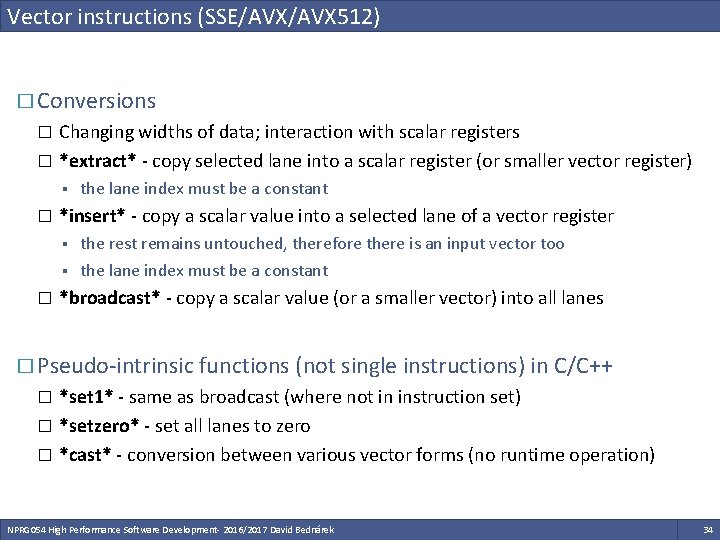
Vector instructions (SSE/AVX 512) � Conversions Changing widths of data; interaction with scalar registers � *extract* - copy selected lane into a scalar register (or smaller vector register) � § � *insert* - copy a scalar value into a selected lane of a vector register § § � the lane index must be a constant the rest remains untouched, therefore there is an input vector too the lane index must be a constant *broadcast* - copy a scalar value (or a smaller vector) into all lanes � Pseudo-intrinsic functions (not single instructions) in C/C++ *set 1* - same as broadcast (where not in instruction set) � *setzero* - set all lanes to zero � *cast* - conversion between various vector forms (no runtime operation) � NPRG 054 High Performance Software Development- 2016/2017 David Bednárek 34
Using MMX/SSE/AVX intrinsics in C/C++ NPRG 054 High performance software development - 2015/2016 David Bednárek 35
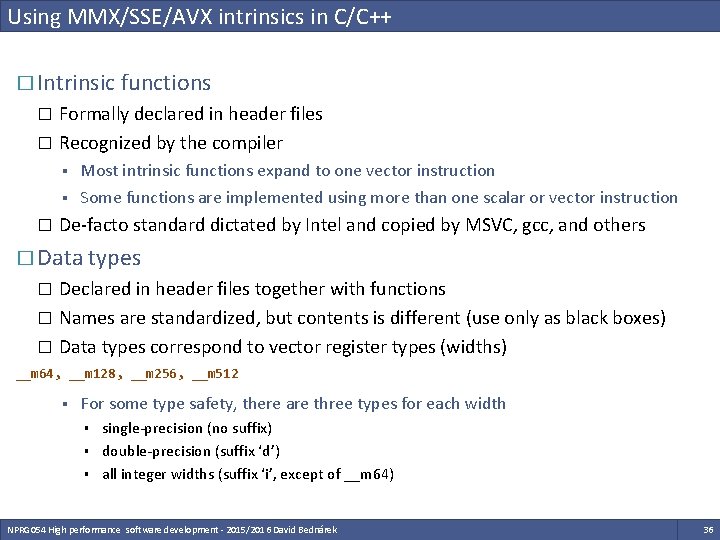
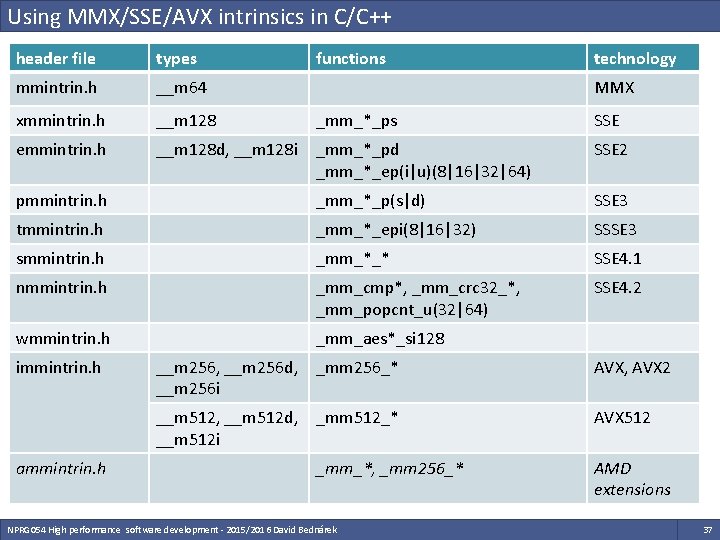
Using MMX/SSE/AVX intrinsics in C/C++ � Intrinsic functions Formally declared in header files � Recognized by the compiler � § § � Most intrinsic functions expand to one vector instruction Some functions are implemented using more than one scalar or vector instruction De-facto standard dictated by Intel and copied by MSVC, gcc, and others � Data types Declared in header files together with functions � Names are standardized, but contents is different (use only as black boxes) � Data types correspond to vector register types (widths) � __m 64, __m 128, __m 256, __m 512 § For some type safety, there are three types for each width § § § single-precision (no suffix) double-precision (suffix ‘d’) all integer widths (suffix ‘i’, except of __m 64) NPRG 054 High performance software development - 2015/2016 David Bednárek 36
Using MMX/SSE/AVX intrinsics in C/C++ header file types mmintrin. h __m 64 xmmintrin. h __m 128 _mm_*_ps SSE emmintrin. h __m 128 d, __m 128 i _mm_*_pd _mm_*_ep(i|u)(8|16|32|64) SSE 2 pmmintrin. h _mm_*_p(s|d) SSE 3 tmmintrin. h _mm_*_epi(8|16|32) SSSE 3 smmintrin. h _mm_*_* SSE 4. 1 nmmintrin. h _mm_cmp*, _mm_crc 32_*, _mm_popcnt_u(32|64) SSE 4. 2 wmmintrin. h _mm_aes*_si 128 immintrin. h ammintrin. h functions technology MMX __m 256, __m 256 d, __m 256 i _mm 256_* AVX, AVX 2 __m 512, __m 512 d, __m 512 i _mm 512_* AVX 512 _mm_*, _mm 256_* AMD extensions NPRG 054 High performance software development - 2015/2016 David Bednárek 37
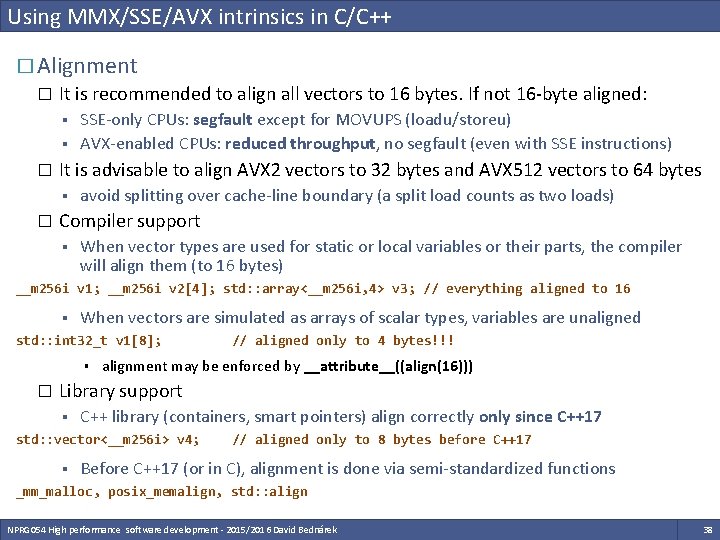
Using MMX/SSE/AVX intrinsics in C/C++ � Alignment � It is recommended to align all vectors to 16 bytes. If not 16 -byte aligned: § § � It is advisable to align AVX 2 vectors to 32 bytes and AVX 512 vectors to 64 bytes § � SSE-only CPUs: segfault except for MOVUPS (loadu/storeu) AVX-enabled CPUs: reduced throughput, no segfault (even with SSE instructions) avoid splitting over cache-line boundary (a split load counts as two loads) Compiler support § When vector types are used for static or local variables or their parts, the compiler will align them (to 16 bytes) __m 256 i v 1; __m 256 i v 2[4]; std: : array<__m 256 i, 4> v 3; // everything aligned to 16 § When vectors are simulated as arrays of scalar types, variables are unaligned std: : int 32_t v 1[8]; § � // aligned only to 4 bytes!!! alignment may be enforced by __attribute__((align(16))) Library support § C++ library (containers, smart pointers) align correctly only since C++17 std: : vector<__m 256 i> v 4; § // aligned only to 8 bytes before C++17 Before C++17 (or in C), alignment is done via semi-standardized functions _mm_malloc, posix_memalign, std: : align NPRG 054 High performance software development - 2015/2016 David Bednárek 38
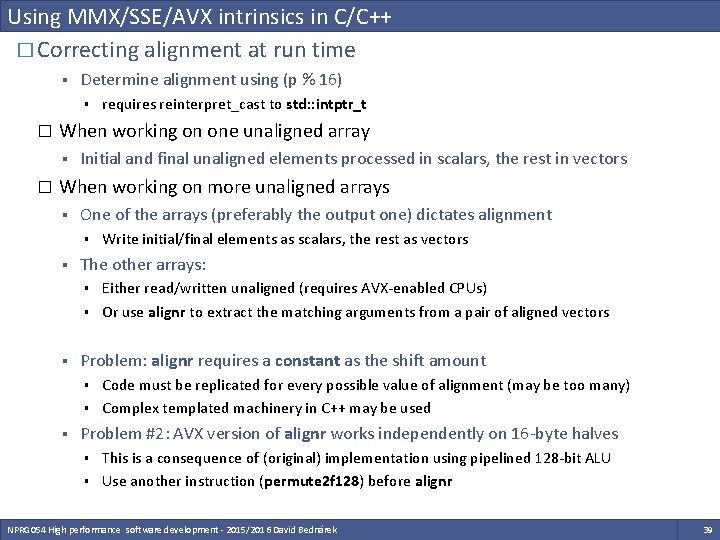
Using MMX/SSE/AVX intrinsics in C/C++ � Correcting alignment at run time § Determine alignment using (p % 16) § � When working on one unaligned array § � requires reinterpret_cast to std: : intptr_t Initial and final unaligned elements processed in scalars, the rest in vectors When working on more unaligned arrays § One of the arrays (preferably the output one) dictates alignment § § The other arrays: § § § Either read/written unaligned (requires AVX-enabled CPUs) Or use alignr to extract the matching arguments from a pair of aligned vectors Problem: alignr requires a constant as the shift amount § § § Write initial/final elements as scalars, the rest as vectors Code must be replicated for every possible value of alignment (may be too many) Complex templated machinery in C++ may be used Problem #2: AVX version of alignr works independently on 16 -byte halves § § This is a consequence of (original) implementation using pipelined 128 -bit ALU Use another instruction (permute 2 f 128) before alignr NPRG 054 High performance software development - 2015/2016 David Bednárek 39