
Silpa M Assistant professor Dept of Pharmacognosy Tannins
- Slides: 17
Silpa M Assistant professor Dept. of Pharmacognosy
� Tannins are naturally occurring complex organic compounds possessing nitrogen free polyphenols of high molecular weight. � They form colloidal solution with water giving acid reactions. They also precipitate proteins and alkaloids. � The astringent in nature of tannins is due to the fact that they can precipitate proteins and render them resistant to enzymatic attack. � When applied on a wound or injury, tannins form a protective coating so as to prevent external irritation and thus promote healing.
�Tannins are freely soluble in water, alcohol, glycerol, acetone and dilute alkalies. �They are sparingly soluble in chloroform, ethyl acetate and other organic solvents. � They have an astringent taste. �They yield purple, violet or black precipitate with iron compounds.
�They are precipitated by number of metallic salts notably potassium dichromate, lead acetate and sub acetate. �They combine with skin and hide to form leather and with gelatin and isinglass to form an insoluble compound. �They combine with alkaloids to form tannates, most of which are insoluble in water.
�Tannins are classified into two types according to their behavior on dry distillation. 1. Hydrolysable tannins 2. Condensed tannins
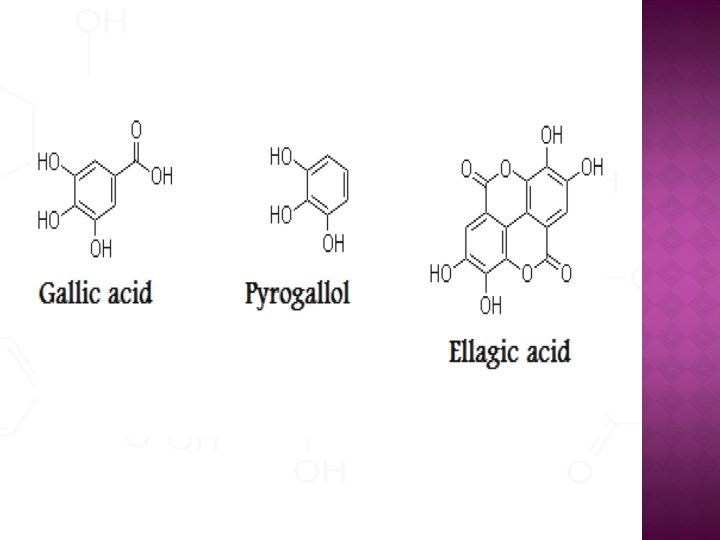
� These tannins are hydrolyzed by acids, or enzyme and produce gallic acid and ellagic acid. � Chemically, these are esters of phenolic acid like gallic acid and ellagic acid. � The tannins derived from gallic acid are known as gallitannins and from that of ellagic acid are known as ellagitannin. � The gallic acid is found in rhubarb, clove and ellagic acid is found in eucalyptus leave and myrobalans and pomegranate bark. � These tannins treated with ferric chloride to produced blue or black colour.
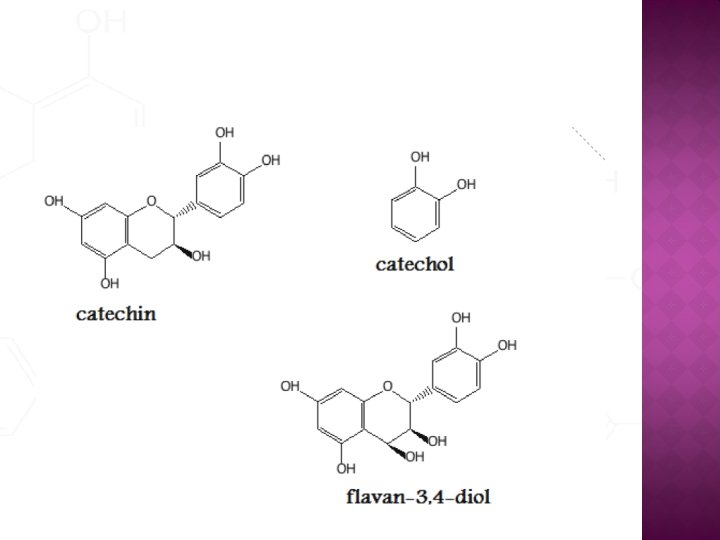
� These tannins are resistant to hydrolysis and they derived from the flavonols, catechins and flavan-3, 4 -diols. � On treatment with acids or enzymes they are decomposed into phlobaphenes. On dry distillation condensed tannin produce catechol. � These tannins are called as catechol tannins. These tannins are found in cinchona bark, male fern, areca seeds, tea leaves and wild cherry bark, bahera fruits, Amla, etc. they produce green colour with ferric chlorides.
� Tannins is a substance which is detected qualitatively by tanning test (The gold beater’s skin test) and quantitatively by its adsorption on standard hide powder. � Depending upon this, tannins are two types Ø True tannins Ø Pseudo tannins
TRUE TANNINS � They are polyhydroxy phenolic compounds and give positive goldbeater’s test are called true tannins. Molecular weight is 1000 -5000
� They are phenolic compounds of lower molecular weight and do not show the goldbeater’s test. They are found in catechu and nux- vomica, etc.
1. Gelatin test: � To a solution of tannin, aqueous solution of gelatin and sodium chloride are added. A white buff coloured precipitate is formed. 2. Goldbeater’s skin test: � A small piece of goldbeater skin (membrane prepared from the intestine of an ox) is soaked in 20% hydrochloric acid, ringed with distilled water and placed in a solution of tannin for 5 minutes. The skin piece is washed with distilled water and kept in a solution of ferrous sulphate. A brown or black colour is produced on the skin due presence of tannins.
3. Phenazone test: � A mixture of aqueous extract of a drug and sodium acid phosphate is heated and cooled and filtered. A solution of phenazone is added to the filtrate. A bulky coloured precipitate is formed. 4. Match stick test (Catechin test): � A match stick is dipped in aqueous plant extract, dried near burner and moistened with concentrated hydrochloric acid. On warming near flame, the matchstick wood turns pink or red due to formation of phloroglucinol.
5. Chlorogenic acid test: � An extract of chlorogenic acid containing drug is treated with aqueous ammonia. A green colour is formed on exposure to air. 6. Vanillin-hydrochloric acid test: � Sample solution and added vanillin- hydrochloric acid reagent (Vanillin 1 gm, alcohol 10 ml, concentrated hydrochloric acid 10 ml). A pink or red colour is formed due to formation of phloroglucinol.
� Depending upon the source of tannins, various modified methods used for extraction. � Methyl alcohol, hot water, acetone and ethyl acetate are the common solvents used for the extraction. � The extract is filtered and dried under vacuum.
THANK YOU