
Silo Speedy Transactions in Multicore InMemory Databases Stephen
Silo: Speedy Transactions in Multicore In-Memory Databases Stephen Tu, Wenting Zheng, Eddie Kohler†, Barbara Liskov, Samuel Madden MIT CSAIL, †Harvard University 1
Goal • Extremely high throughput in-memory relational database. – Fully serializable transactions. – Can recover from crashes. 2
![Multicores to the rescue? txn_commit() { // prepare commit // […] commit_tid = atomic_fetch_and_add(&global_tid);](http://slidetodoc.com/presentation_image/4a3c34ac05d64a7df95de39c6122dd03/image-3.jpg "Multicores to the rescue? txn_commit() { // prepare commit // […] commit_tid = atomic_fetch_and_add(&global_tid);")
Multicores to the rescue? txn_commit() { // prepare commit // […] commit_tid = atomic_fetch_and_add(&global_tid); // quickly serialize transactions a la Hekaton } 3
Why have global TIDs? 4
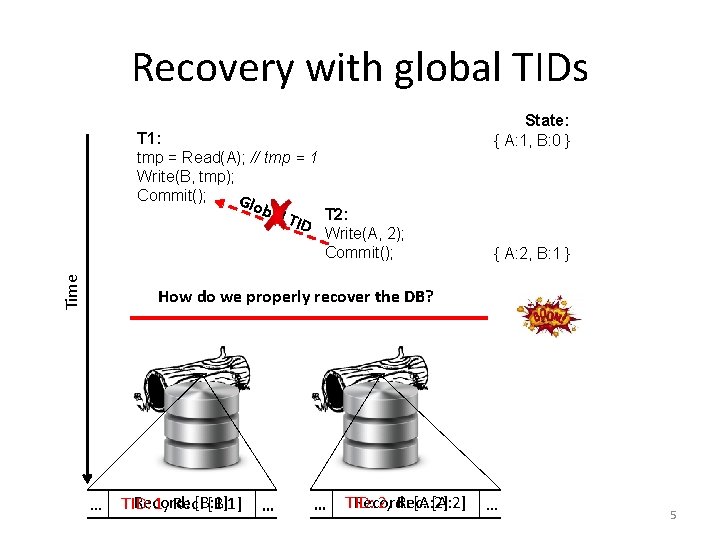
Recovery with global TIDs State: { A: 1, B: 0 } T 1: tmp = Read(A); // tmp = 1 Write(B, tmp); Commit(); G loba l TID T 2: Time Write(A, 2); Commit(); { A: 2, B: 1 } How do we properly recover the DB? … Record: [B: 1] TID: 1, Rec: [B: 1] … … Record: [A: 2] TID: 2, Rec: [A: 2] … 5

6
Silo: transactions for multicores • Near linear scalability on popular database benchmarks. • Raw numbers several factors higher than those reported by existing state-of-the-art transactional systems. 7
Secret sauce • A scalable and serializable transaction commit protocol. – Shared memory contention only occurs when transactions conflict. • Surprisingly hard: preserving scalability while ensuring recoverability. 8
Solution from high above • Use time-based epochs to avoid doing a serialization memory write per transaction. – Assign each txn a sequence number and an epoch. • Seq #s provide serializability during execution. – Insufficient for recovery. • Need both seq #s and epochs for recovery. – Recover entire epochs (all or nothing). 9

Epoch design 10
Epochs • Divide time into epochs. – A single thread advances the current epoch. • Use epoch numbers as recovery boundaries. • Reduces non data driven shared writes to happening very infrequently. • Serialization point is now a memory read of the epoch number! 11
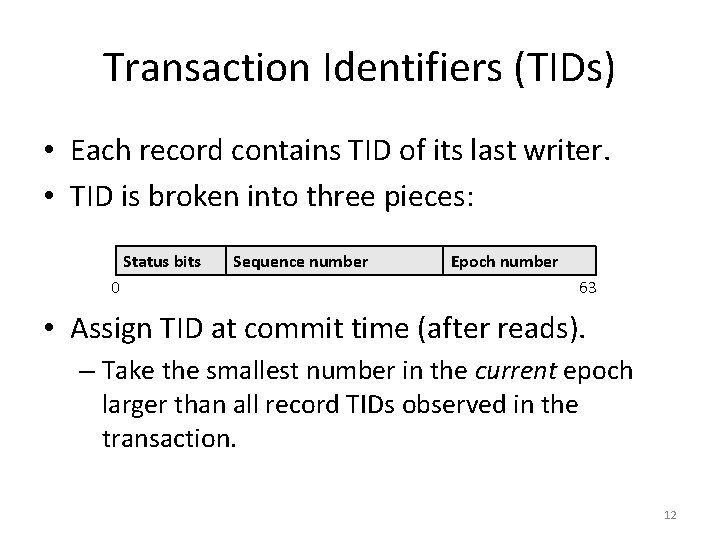
Transaction Identifiers (TIDs) • Each record contains TID of its last writer. • TID is broken into three pieces: Status bits 0 Sequence number Epoch number 63 • Assign TID at commit time (after reads). – Take the smallest number in the current epoch larger than all record TIDs observed in the transaction. 12
Executing/committing transactions 13
Pre-commit execution • Idea: proceed as if records will not be modified – check otherwise at commit time. • To read record A, save the record’s TID in a local read-set, then use the value. • To write record A, store the write in a local write-set. • (Standard optimistic concurrency control) 14
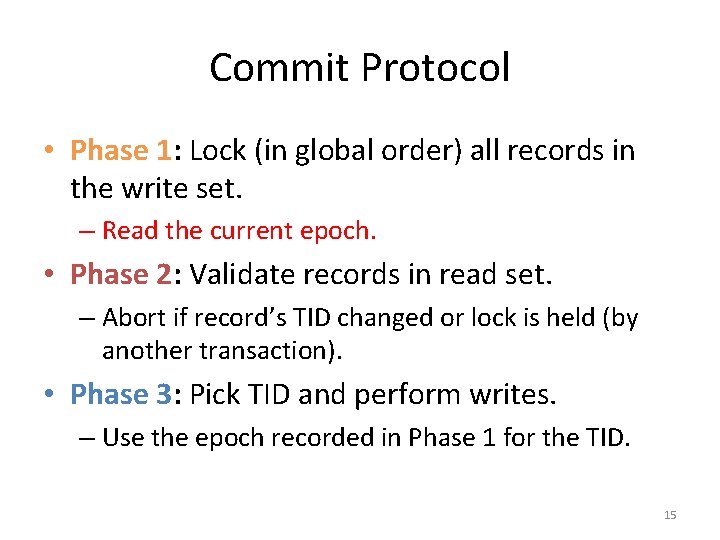
Commit Protocol • Phase 1: Lock (in global order) all records in the write set. – Read the current epoch. • Phase 2: Validate records in read set. – Abort if record’s TID changed or lock is held (by another transaction). • Phase 3: Pick TID and perform writes. – Use the epoch recorded in Phase 1 for the TID. 15
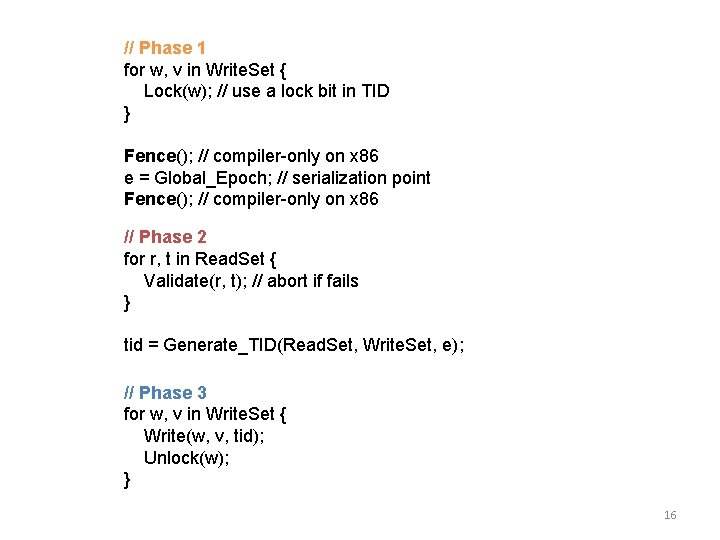
// Phase 1 for w, v in Write. Set { Lock(w); // use a lock bit in TID } Fence(); // compiler-only on x 86 e = Global_Epoch; // serialization point Fence(); // compiler-only on x 86 // Phase 2 for r, t in Read. Set { Validate(r, t); // abort if fails } tid = Generate_TID(Read. Set, Write. Set, e); // Phase 3 for w, v in Write. Set { Write(w, v, tid); Unlock(w); } 16
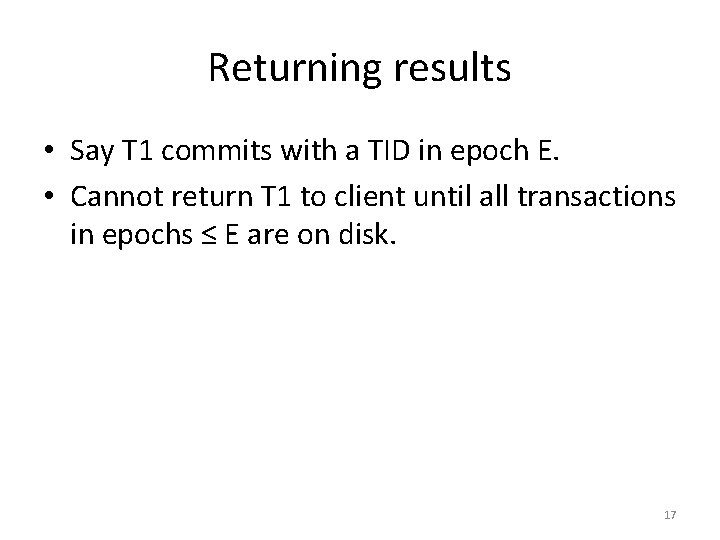
Returning results • Say T 1 commits with a TID in epoch E. • Cannot return T 1 to client until all transactions in epochs ≤ E are on disk. 17

Correctness 18
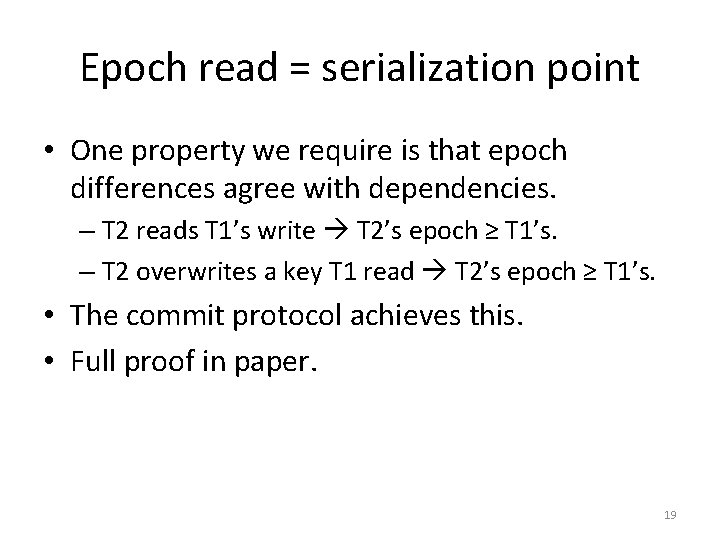
Epoch read = serialization point • One property we require is that epoch differences agree with dependencies. – T 2 reads T 1’s write T 2’s epoch ≥ T 1’s. – T 2 overwrites a key T 1 read T 2’s epoch ≥ T 1’s. • The commit protocol achieves this. • Full proof in paper. 19
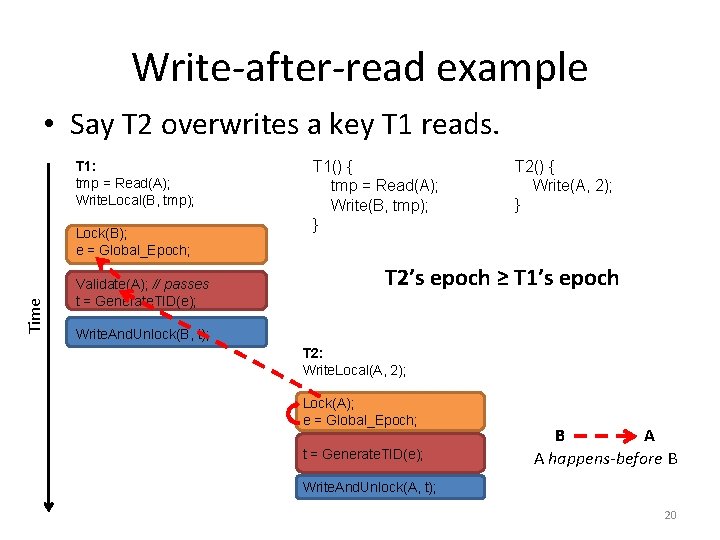
Write-after-read example • Say T 2 overwrites a key T 1 reads. T 1: tmp = Read(A); Write. Local(B, tmp); Time Lock(B); e = Global_Epoch; Validate(A); // passes t = Generate. TID(e); T 1() { tmp = Read(A); Write(B, tmp); } T 2() { Write(A, 2); } T 2’s epoch ≥ T 1’s epoch Write. And. Unlock(B, t); T 2: Write. Local(A, 2); Lock(A); e = Global_Epoch; t = Generate. TID(e); A B A happens-before B Write. And. Unlock(A, t); 20
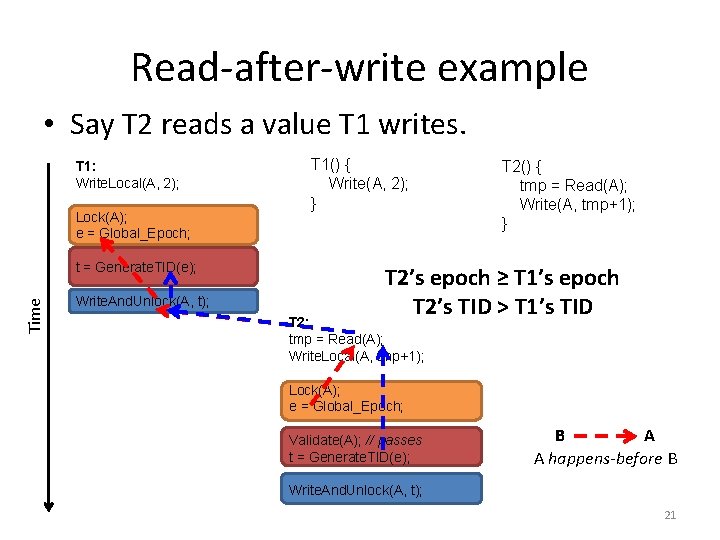
Read-after-write example • Say T 2 reads a value T 1 writes. T 1: Write. Local(A, 2); Lock(A); e = Global_Epoch; Time t = Generate. TID(e); Write. And. Unlock(A, t); T 1() { Write(A, 2); } T 2() { tmp = Read(A); Write(A, tmp+1); } T 2’s epoch ≥ T 1’s epoch T 2’s TID > T 1’s TID T 2: tmp = Read(A); Write. Local(A, tmp+1); Lock(A); e = Global_Epoch; Validate(A); // passes t = Generate. TID(e); A B A happens-before B Write. And. Unlock(A, t); 21
Storing the data 22
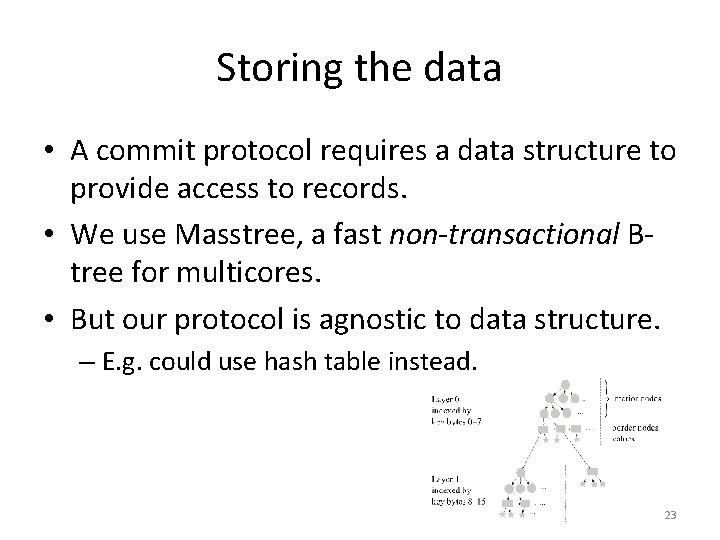
Storing the data • A commit protocol requires a data structure to provide access to records. • We use Masstree, a fast non-transactional Btree for multicores. • But our protocol is agnostic to data structure. – E. g. could use hash table instead. 23
Masstree in Silo • Silo uses a Masstree for each primary/secondary index. • We adopt many parallel programming techniques used in Masstree and elsewhere. – E. g. read-copy-update (RCU), version number validation, software prefetching of cachelines. 24
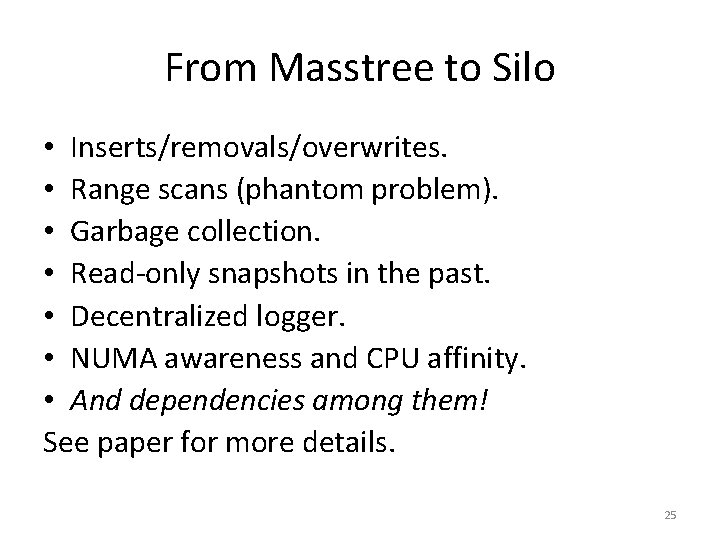
From Masstree to Silo • Inserts/removals/overwrites. • Range scans (phantom problem). • Garbage collection. • Read-only snapshots in the past. • Decentralized logger. • NUMA awareness and CPU affinity. • And dependencies among them! See paper for more details. 25

Evaluation 26
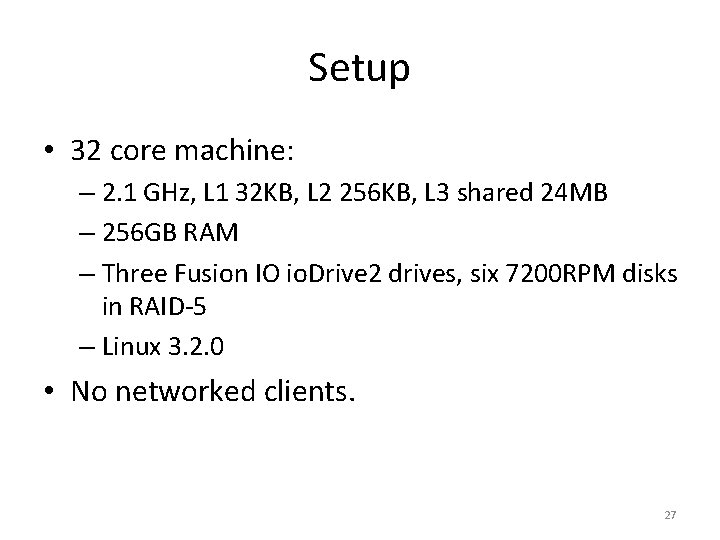
Setup • 32 core machine: – 2. 1 GHz, L 1 32 KB, L 2 256 KB, L 3 shared 24 MB – 256 GB RAM – Three Fusion IO io. Drive 2 drives, six 7200 RPM disks in RAID-5 – Linux 3. 2. 0 • No networked clients. 27
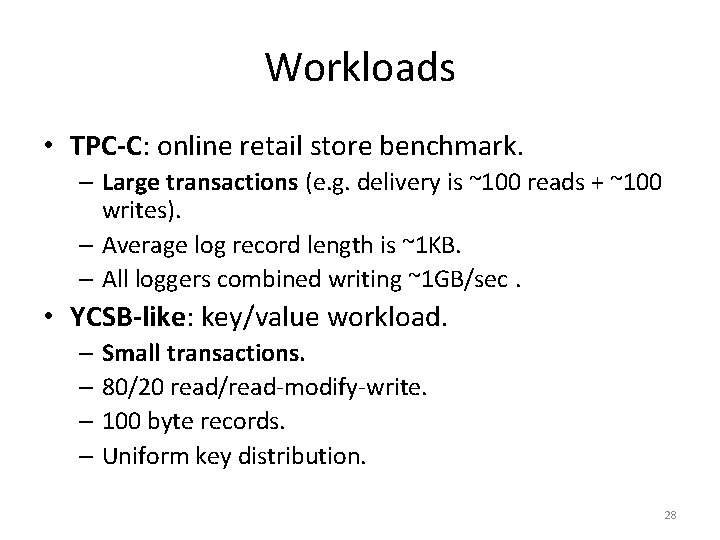
Workloads • TPC-C: online retail store benchmark. – Large transactions (e. g. delivery is ~100 reads + ~100 writes). – Average log record length is ~1 KB. – All loggers combined writing ~1 GB/sec. • YCSB-like: key/value workload. – Small transactions. – 80/20 read/read-modify-write. – 100 byte records. – Uniform key distribution. 28
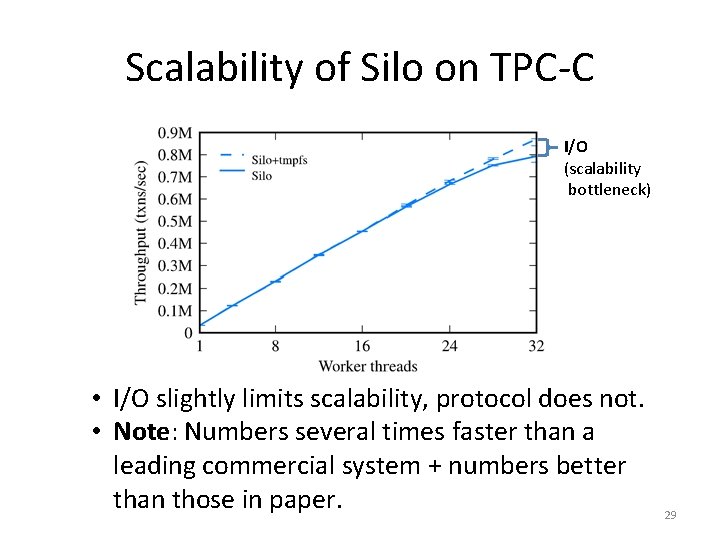
Scalability of Silo on TPC-C I/O (scalability bottleneck) • I/O slightly limits scalability, protocol does not. • Note: Numbers several times faster than a leading commercial system + numbers better than those in paper. 29
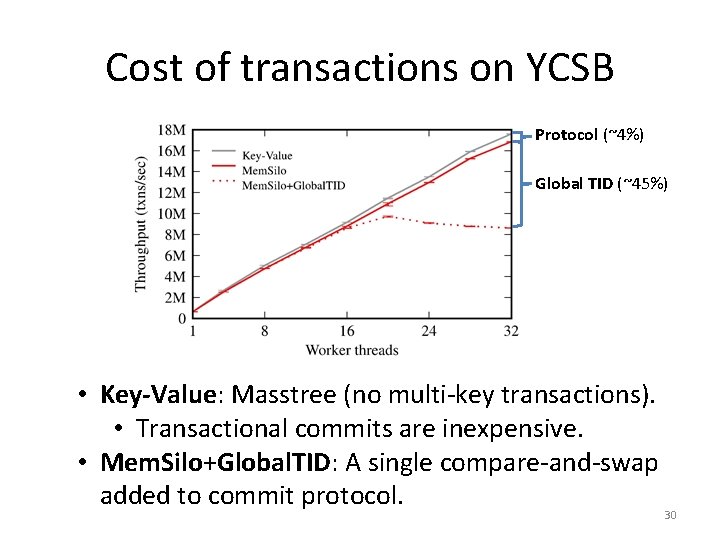
Cost of transactions on YCSB Protocol (~4%) Global TID (~45%) • Key-Value: Masstree (no multi-key transactions). • Transactional commits are inexpensive. • Mem. Silo+Global. TID: A single compare-and-swap added to commit protocol. 30
Related work 31
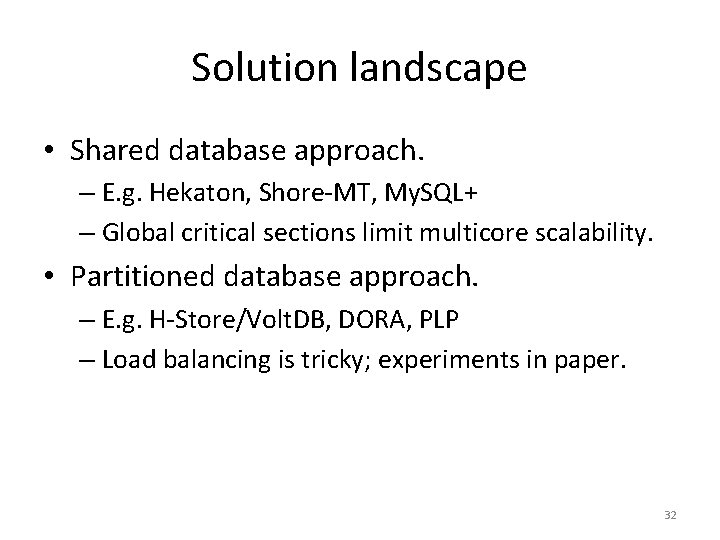
Solution landscape • Shared database approach. – E. g. Hekaton, Shore-MT, My. SQL+ – Global critical sections limit multicore scalability. • Partitioned database approach. – E. g. H-Store/Volt. DB, DORA, PLP – Load balancing is tricky; experiments in paper. 32
Conclusion • Silo is a new in memory database designed for transactions on modern multicores. • Key contribution: a scalable and serializable commit protocol. • Great performance on popular benchmarks. • Fork us on github: https: //github. com/stephentu/silo 33
- Slides: 33