
SILKWORM DISEASES Bacterial Viral and Fungal and microsporidian
SILKWORM DISEASES Bacterial, Viral and Fungal and microsporidian diseases of silkworm Bombyx mori L. Shahid Bin Zeya

SILKWORM DISEASES Common diseases : 1. Grasserie : Viral disease 2. Flacherie : caused by either virus or bacteria or in association of both 3. Muscardine: caused by fungus Non-common diseases : 1. Pebrin: Microsporidian disease
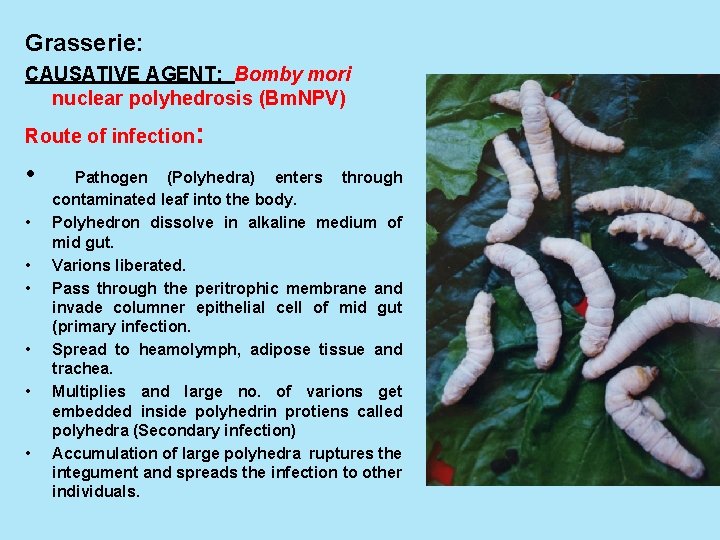
Grasserie: CAUSATIVE AGENT: Bomby mori nuclear polyhedrosis (Bm. NPV) Route of infection: • • Pathogen (Polyhedra) enters through contaminated leaf into the body. Polyhedron dissolve in alkaline medium of mid gut. Varions liberated. Pass through the peritrophic membrane and invade columner epithelial cell of mid gut (primary infection. Spread to heamolymph, adipose tissue and trachea. Multiplies and large no. of varions get embedded inside polyhedrin protiens called polyhedra (Secondary infection) Accumulation of large polyhedra ruptures the integument and spreads the infection to other individuals.
SYMPTOMS • Swollen inter segmental region. • Sizing of worms • Shining skin • Do not settle for moult. • Presence of polyhedral in hemolymph • Skin fragile and breaks easily. • Oozing of turbid white fluid containing polyhedra The infected larvae die in 05 – 07 days due to the disease. (Incubation period is 04 -06 days) Loss : 33 -55% Predisposing factors: High temperature and high humidity, overcrowding and starvation and bad quality of leaves.

FLACHERIE CAUSATIVE AGENT Various types of bacteria, Staphylococcus, Streptococcus, Bacillus sp. , and Bombyx mori infectious flacherie virus (Bm. IFV), Bm. CPV and in association of both virus and bacteria. Crop loss: 57. 22%
ROUT OF INFECTION : Pathogen enters generally with contaminated leaf through per os, also through open wound. Symptoms: • Stunned growth and flaccid. • Putrefy on death and emit foul smell. Three types of bacterial flacherie diseases are found in silkworm: 1. Bacterial diseases of digestive tract. Site of infection is mid gut: Multiplies and causing the peritrophic membrane to be cut into the pieces. Hence, faeces become beaded like structure. Cephalothoracic region of larvae will be translucent, exhibit vomitting and diarrhoea. Death occurs in 10 -12 days. 2. Bacterial septicaemia. (Septic) • Larval body will be straight with swollen thoracic region and the bacteria Serratia sp. get enters through wounds and multiply only in haemolymph. • Death occurs in 06 -07 days • Predisposing factors: Fluctuation of temperature and relative humidity and poor quality of leaves, improper chawkei rearing and bad ventilation of rearing house.
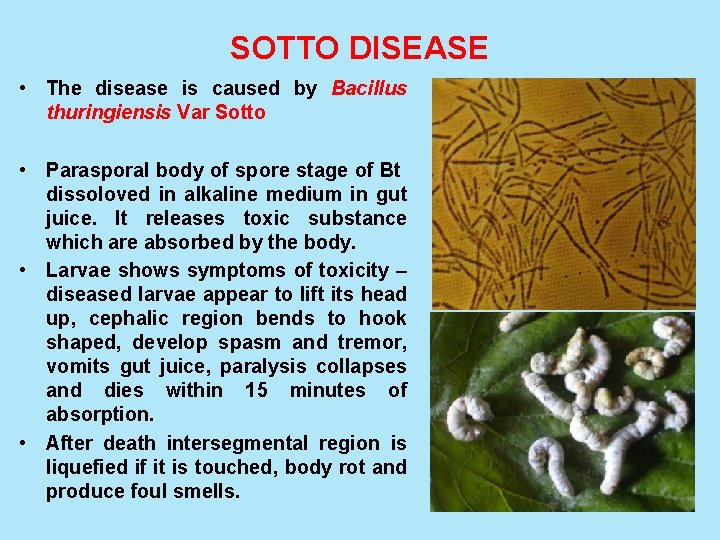
SOTTO DISEASE • The disease is caused by Bacillus thuringiensis Var Sotto • Parasporal body of spore stage of Bt dissoloved in alkaline medium in gut juice. It releases toxic substance which are absorbed by the body. • Larvae shows symptoms of toxicity – diseased larvae appear to lift its head up, cephalic region bends to hook shaped, develop spasm and tremor, vomits gut juice, paralysis collapses and dies within 15 minutes of absorption. • After death intersegmental region is liquefied if it is touched, body rot and produce foul smells.
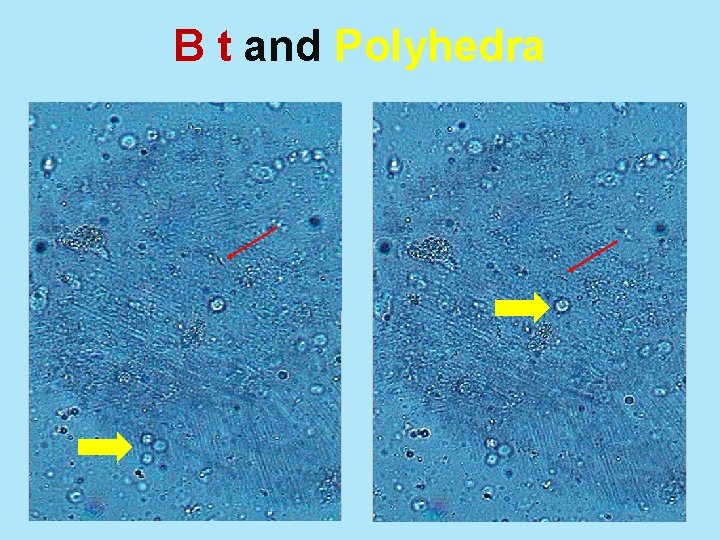
B t and Polyhedra
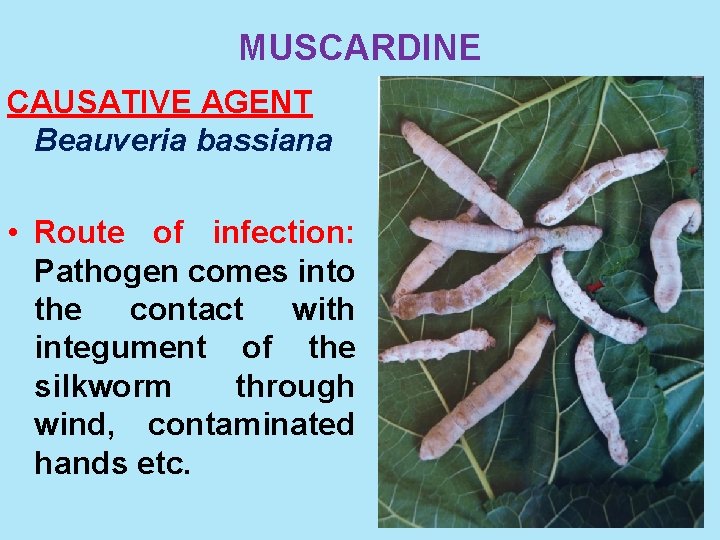
MUSCARDINE CAUSATIVE AGENT Beauveria bassiana • Route of infection: Pathogen comes into the contact with integument of the silkworm through wind, contaminated hands etc.
SYMPTOMS Oil stain like marks on body surface. Dead larvae are hardened and change into white colour. Grew highly infectious conidia on their body surface. If pupae infected becomes hard, lighter and mummifies.
SOURCE OF INFECTION AND DEVELOPMENT OF DISEASE Ø The infectious conidia grow on the surface of larva on coming in contact with host integument under congenital conditions and enter into the host body cavity to infect the larva. Ø The infection spread to all over the body. The dead larvae due to white muscardine initially appear flaccid, gradually harden and mummifies in 3 -4 days. Ø Mummified / diseased silkworm contaminates the rearing house and its appliances and several agriculture pests / alternate host form the source of pathogen. ØCrop loss-19%
Non-common diseases : 1. Pebrin: Microsporidian disease: • • Highly devastating in nature. Chronic and can not be prevented. Whole industry may collapse. Therefore disease free laying (dfls) must be ensured in order to conduct successful rearing
Transmission of Disease These diseases are transmitted either horizontally (individual to individual) or through vertical transmission (parent to offspring). • Muscardine, Flacherie and Grasserie diseases are transmitted only by horizontal transmission but Pebrine is transmitted both horizontally as well as vertically. • Horizontal transmission of such diseases can be checked through proper disinfection while as, in case of vertical transmission disease monitoring at particular stages is must to avoid further multiplication of pathogen. Egg stage: Silkworm egg surface should be disinfected by soaking eggs in 2 % formalin for 10 minutes and wash with clean water. Dry them in shade and incubate. The eggs should be monitored for presence of pebrine disease by way of microscopic examination.
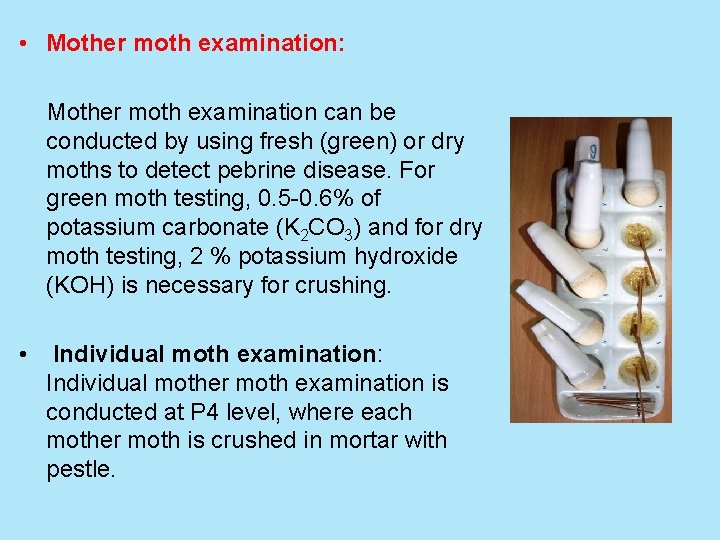
• Mother moth examination: Mother moth examination can be conducted by using fresh (green) or dry moths to detect pebrine disease. For green moth testing, 0. 5 -0. 6% of potassium carbonate (K 2 CO 3) and for dry moth testing, 2 % potassium hydroxide (KOH) is necessary for crushing. • Individual moth examination: Individual mother moth examination is conducted at P 4 level, where each mother moth is crushed in mortar with pestle.
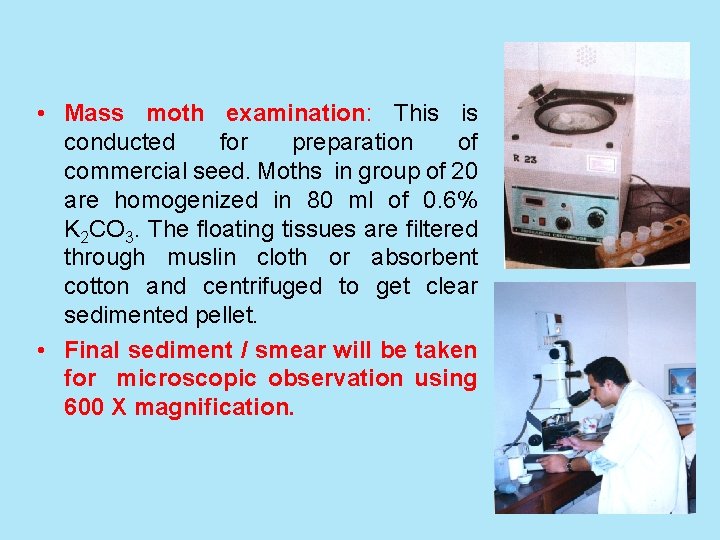
• Mass moth examination: This is conducted for preparation of commercial seed. Moths in group of 20 are homogenized in 80 ml of 0. 6% K 2 CO 3. The floating tissues are filtered through muslin cloth or absorbent cotton and centrifuged to get clear sedimented pellet. • Final sediment / smear will be taken for microscopic observation using 600 X magnification.

Identification of pebrine spore: Pebrine disease is a chronic silkworm disease which is caused by a microsporidian pathogen Nosema bombycis. Pebrine is detected by presence of oval or ovocylindrical and highly refractive spore. The spore measures 3. 8 µm in length and 2. 6 µm width and exhibit characteristic Brownian movement. Symptoms: Pebrine disease symptoms are morphological and anatomical. The morphological symptoms are atypical and are recorded in egg, larva, pupa and adult stage.
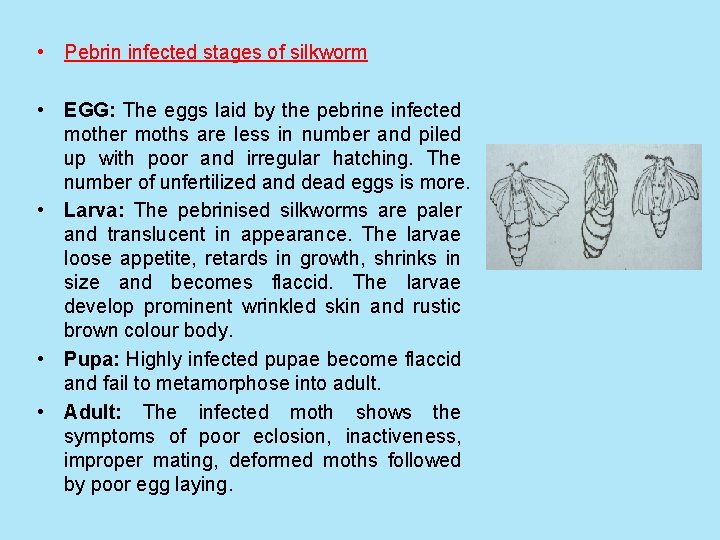
• Pebrin infected stages of silkworm • EGG: The eggs laid by the pebrine infected mother moths are less in number and piled up with poor and irregular hatching. The number of unfertilized and dead eggs is more. • Larva: The pebrinised silkworms are paler and translucent in appearance. The larvae loose appetite, retards in growth, shrinks in size and becomes flaccid. The larvae develop prominent wrinkled skin and rustic brown colour body. • Pupa: Highly infected pupae become flaccid and fail to metamorphose into adult. • Adult: The infected moth shows the symptoms of poor eclosion, inactiveness, improper mating, deformed moths followed by poor egg laying.

- Slides: 18