
Silica Safety Training Construction Education Foundation Disclaimer This

- Slides: 61
Silica Safety Training Construction Education Foundation
Disclaimer This material was produced under grant number 46 CO-HT 04 from the Occupational Safety and Health Administration, U. S. Department of Labor. It does not necessarily reflect the views or policies of the U. S. Department of Labor, nor does mention of trade names, commercial products, or organizations imply endorsement by the U. S. Government.
Class Introduction l Name l Place of employment l Occupation l Number of years experience l Expectations for the training session
Course Overview Introduction to Silica Safety l Subpart C: General Safety and Health Provisions l Subpart D: Occupational Health and Environmental Control l Subpart E: Personal Protective and Life Saving Equipment l
Introduction to Silica Safety
Objectives l Define and describe silica l Describe the effect of silicosis l Identify potentially hazardous situations involving silica exposure l Identify methods for minimizing silica exposure l Locate relevant information in – Subpart C – Subpart D – Subpart E
Silica
What is Silica? l. A group of minerals containing silicon and oxygen in chemical combination l General formula Si. O 2 – Free silica is only Si. O 2 – Combined silica is Si. O 2 chemically combined with some other atom or molecule l Free silica creates problems for humans
Types of Free Silica l Crystalline free silica – Beach or bank sands – Fused silica – Cristobalite – Tridymite l Quartz
Occupational Exposure in Construction l Common sand l Concrete and masonry products l Many other ways to be exposed at a construction site (see next slide)
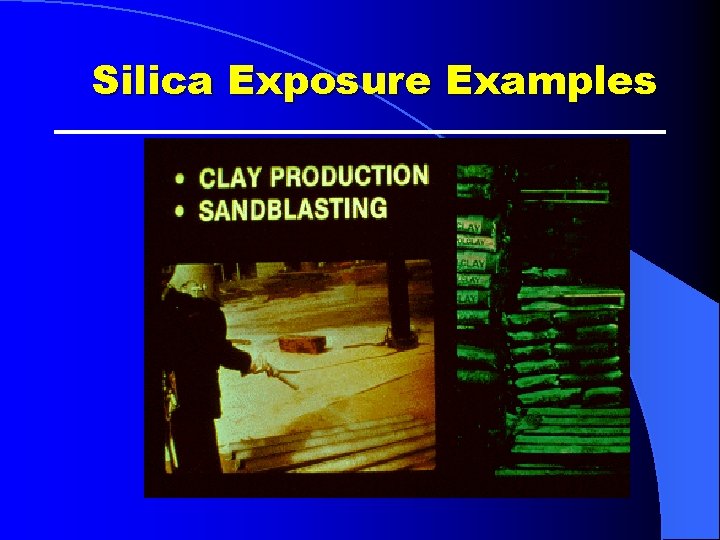
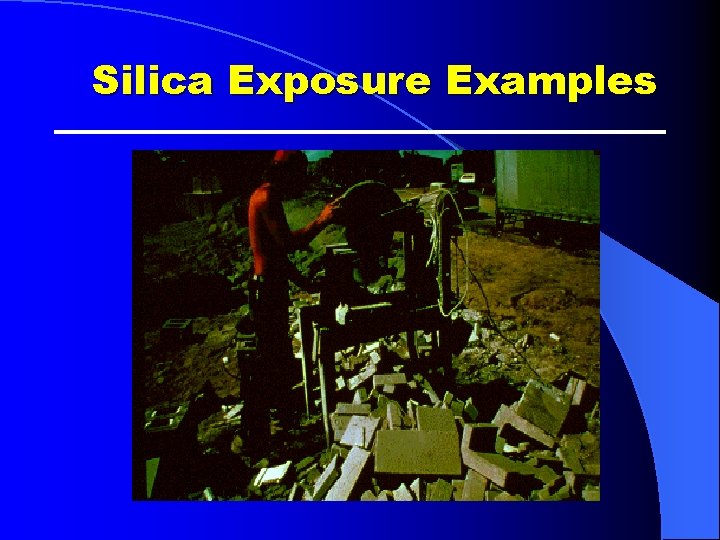
Silica Exposure in Construction Areas l Chipping, hammering, and drilling in rock or concrete or brick l Crushing, loading, hauling, and dumping of rock and concrete l Abrasive blasting using silica sand or from the materials being blasted (concrete) l Sawing, hammering, drilling, grinding, and/or chipping on masonry or concrete (continued)
Silica Exposure in Construction Areas l Demolition of brick, concrete, or masonry l Dry sweeping concrete, sand, or rock dust l Trenching and excavation l Tile and grout work l Tunneling l Metal foundries
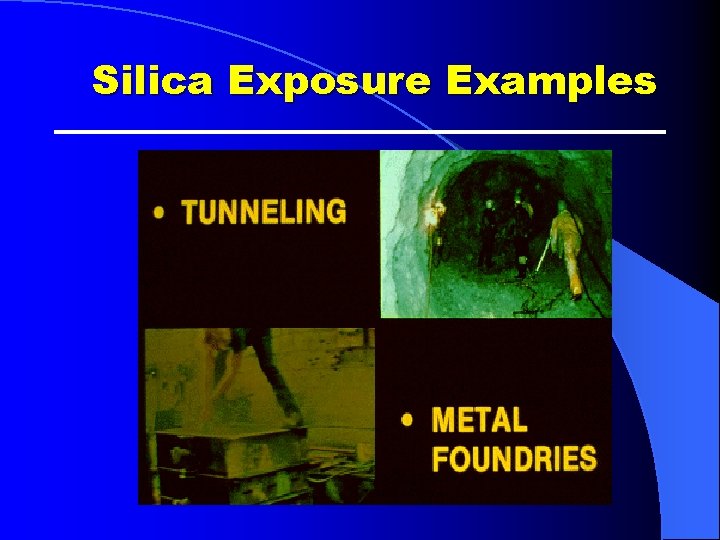
Silica Exposure Examples
Silica Exposure Examples
Silica Exposure Examples
Silicosis
What Is Silicosis? l Permanent lung damage l Caused by breathing dust containing extremely fine particles of crystalline free silica l It can be totally disabling and lead to death
Types of Silicosis l Chronic silicosis: after ten or more years of exposure to crystalline silica at relatively low concentrations l Accelerated silicosis: after five to ten years of exposure to high concentrations l Acute silicosis: within a few weeks to four or five years after the initial exposure to the highest concentrations
Symptoms of Silicosis l Initially there may be no symptoms l Later there may be difficulty in breathing and cough may be present l Other symptoms may include fever, weight loss, and night sweats * See a physician if you experience these symptoms and suspect that you are exposed to crystalline silica. All workers breathing crystalline silica dust should have a medical examination.
How Is Silicosis Prevented? l Prevent dust from being in the air Example: a water hose used to wet dust down at the point of generation
Steps to Protect Yourself l Always use the dust control system and keep it in good maintenance. l When sawing concrete of masonry use saws that provide water to the blade. l During rock drilling use water through the drill stem to reduce the amount of dust in the air. (continued)
Steps to Protect Yourself l Use dust collection systems which are available for many types of dust generating equipment. l Use local exhaust ventilation to prevent dust from being released into the air. (continued)
Steps to Protect Yourself l Minimize exposures to nearby workers by using good work practices. l Use abrasive containing less than 1% crystalline silica during abrasive blasting to prevent harmful quartz dust from being released into the air. l Measure dust levels in the air.
Note on Respirators l Should only be used until adequate dust controls are in place l Should not be the primary method of protection l Should be kept fit for use through continual maintenance l When used, OSHA requires employers to establish a comprehensive respiratory protection program
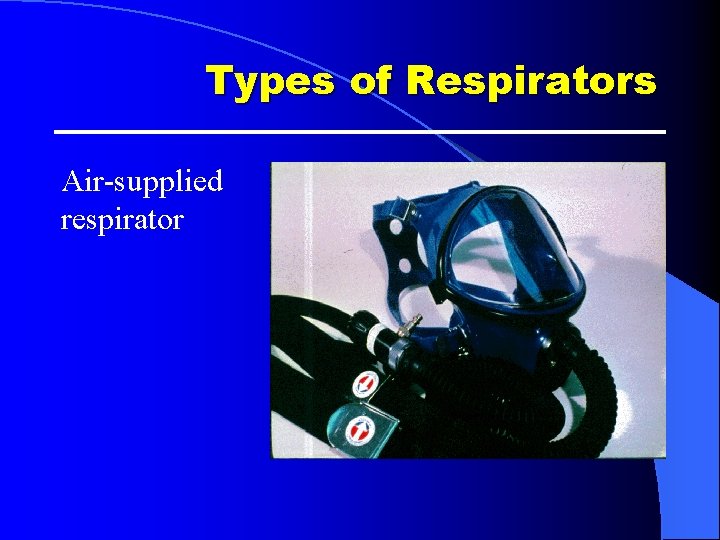
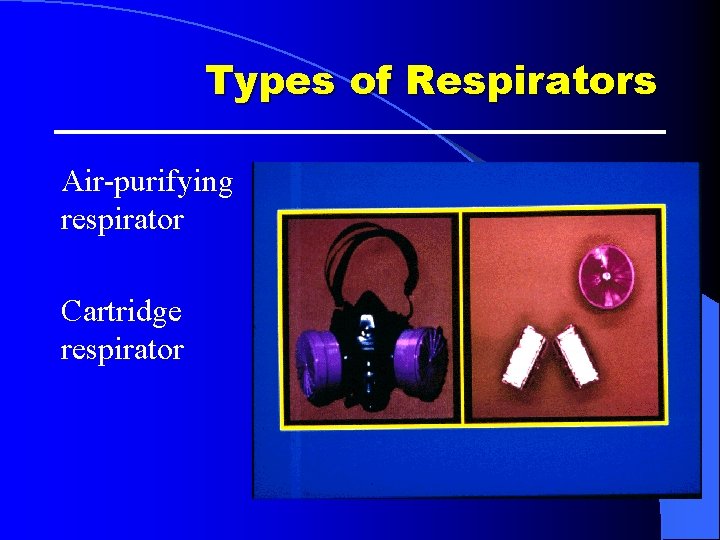
Types of Respirators Air-supplied respirator
Types of Respirators Air-purifying respirator Cartridge respirator
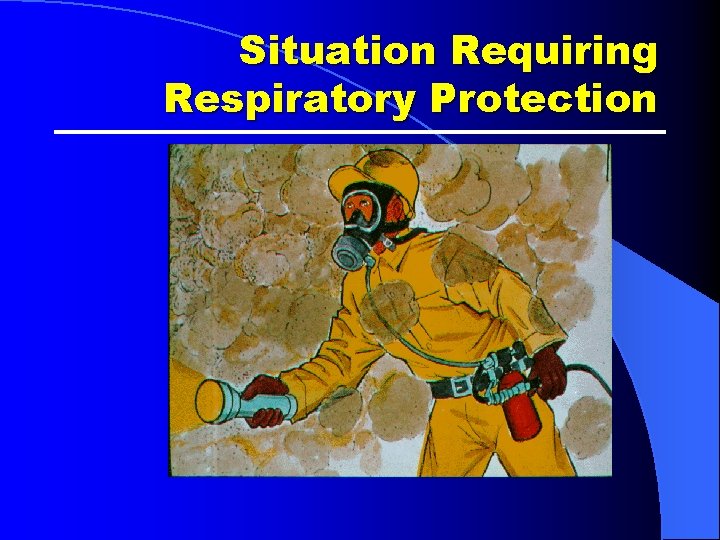
Situation Requiring Respiratory Protection
Case Studies
Case Studies l Sandblaster l Tile installer l Brick mason l Rock driller l Tunnel worker l Building renovation mason l Construction sandblasters
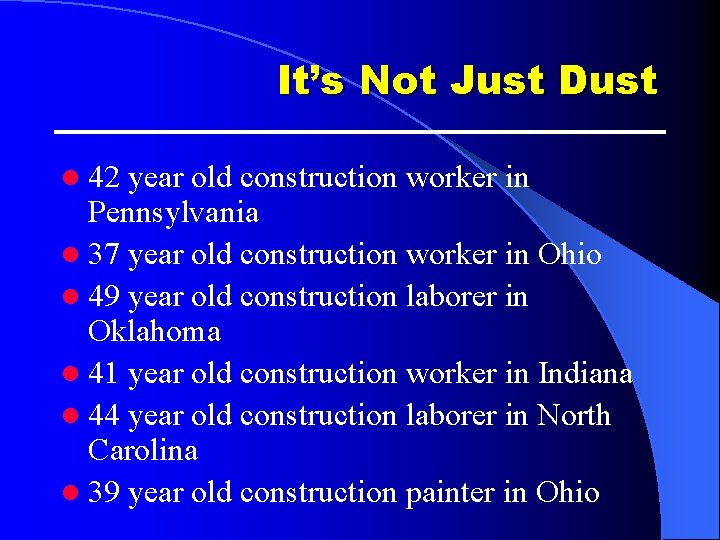
It’s Not Just Dust l 42 year old construction worker in Pennsylvania l 37 year old construction worker in Ohio l 49 year old construction laborer in Oklahoma l 41 year old construction worker in Indiana l 44 year old construction laborer in North Carolina l 39 year old construction painter in Ohio
What OSHA Says
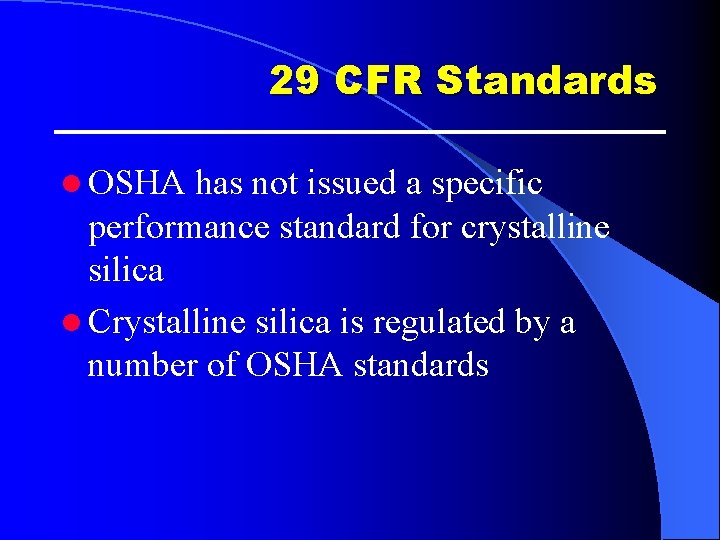
29 CFR Standards l OSHA has not issued a specific performance standard for crystalline silica l Crystalline silica is regulated by a number of OSHA standards
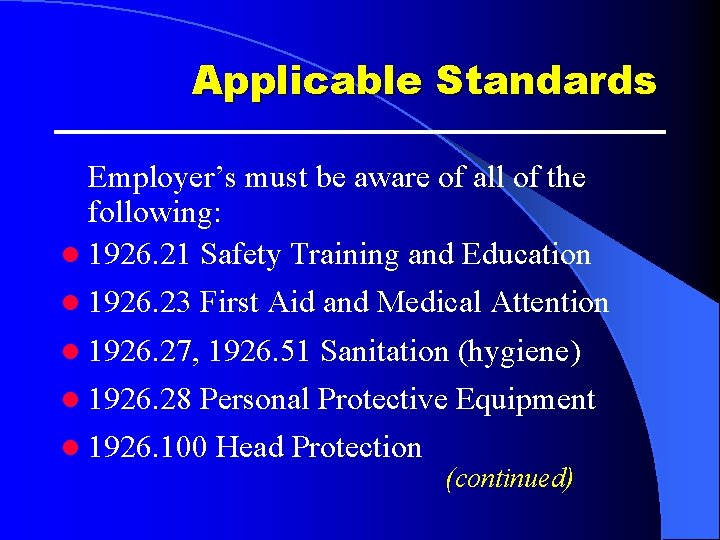
Applicable Standards Employer’s must be aware of all of the following: l 1926. 21 Safety Training and Education l 1926. 23 First Aid and Medical Attention l 1926. 27, l 1926. 28 1926. 51 Sanitation (hygiene) Personal Protective Equipment l 1926. 100 Head Protection (continued)
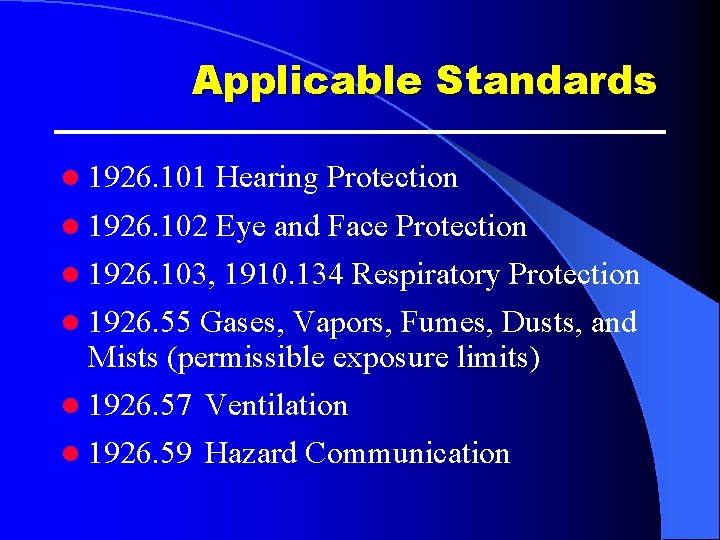
Applicable Standards l 1926. 101 Hearing Protection l 1926. 102 Eye and Face Protection l 1926. 103, 1910. 134 Respiratory Protection l 1926. 55 Gases, Vapors, Fumes, Dusts, and Mists (permissible exposure limits) l 1926. 57 Ventilation l 1926. 59 Hazard Communication
Permissible Exposure Limits (PEL) The permissible exposure limits for mineral dusts—including crystalline silica—in the construction industry (29 CFR 1926. 55) depends on the percent of silica in the sand.
Crystalline Silica Worker Protection Program Employer must first l Implement engineering controls l Implement administrative controls Then, the employer shall use l Protective equipment l Protective measures (e. g. , respiratory protection)
Crystalline Silica Health and Safety Program
Elements of an Effective Silica Safety Program l Air monitoring l Personal hygiene facilities and practices l Personal protective equipment l Respiratory protection l Medical surveillance l Employee training l Housekeeping
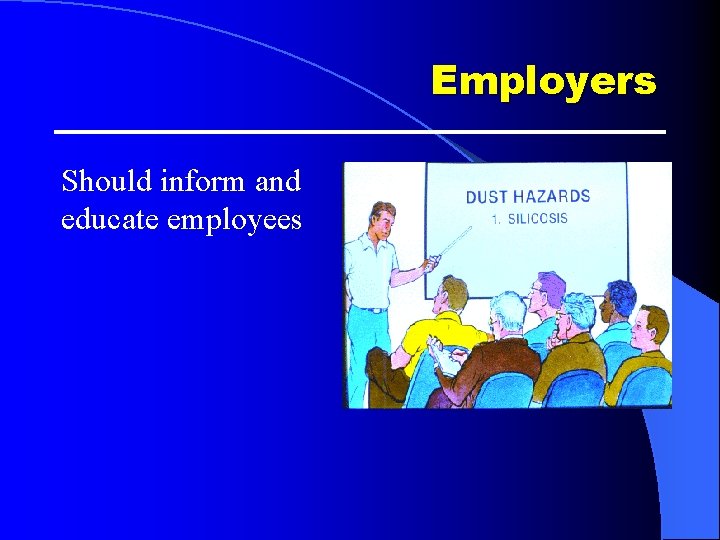
Employers Should inform and educate employees
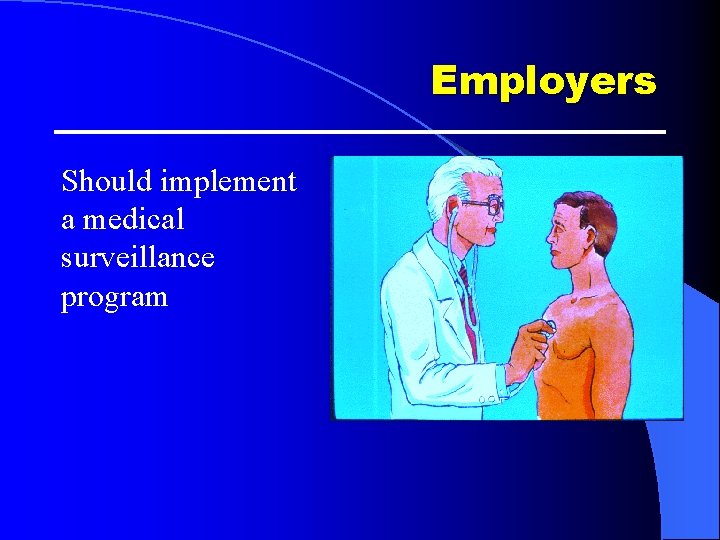
Employers Should implement a medical surveillance program
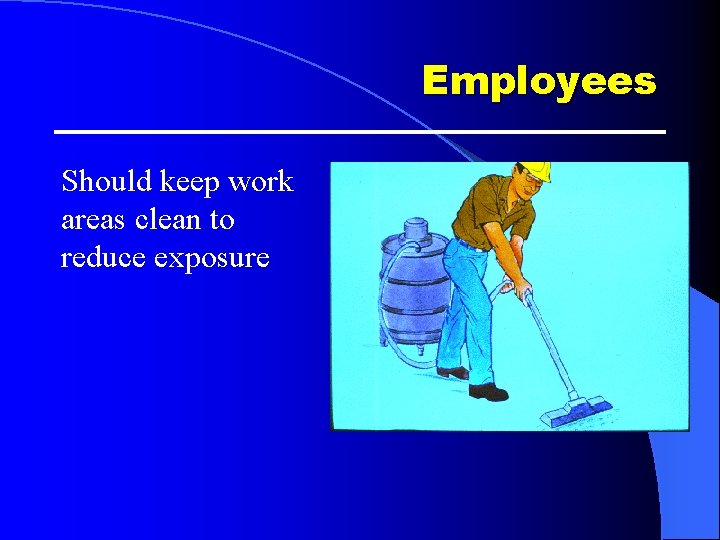
Employees Should keep work areas clean to reduce exposure
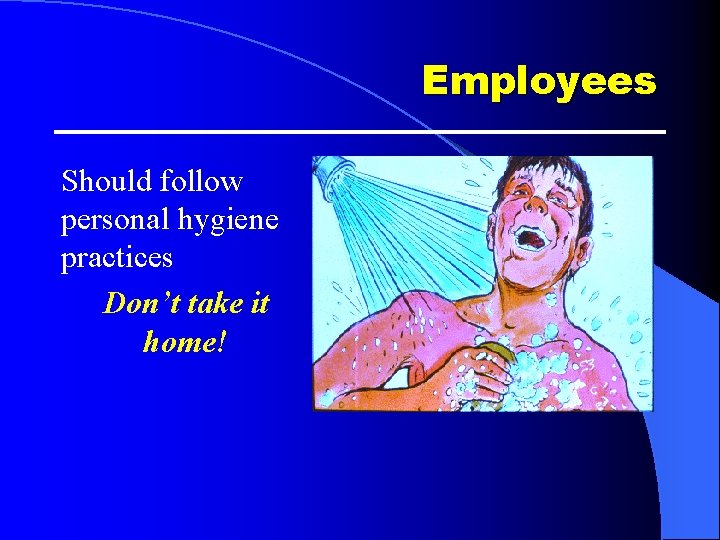
Employees Should follow personal hygiene practices Don’t take it home!
OSHA Assessment
Current Permissible Exposure Limits l Over 30 percent of OSHA-collected silica samples from 1982 through 1991 exceeded the current PEL limit l The limit is derived from a calculation that takes into account the percentage of quartz, cristobalite, tridymite, and respirable dust specific to your particular worksite
Current Permissible Exposure Limits For extensive information and calculations, visit the OSHA Web site http: //www. osha. gov/SLTC/silica_advisor
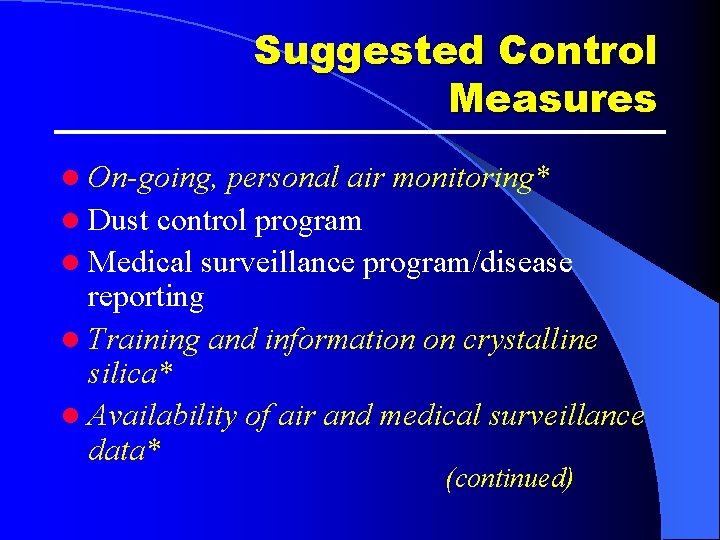
Suggested Control Measures l On-going, personal air monitoring* l Dust control program l Medical surveillance program/disease reporting l Training and information on crystalline silica* l Availability of air and medical surveillance data* (continued)
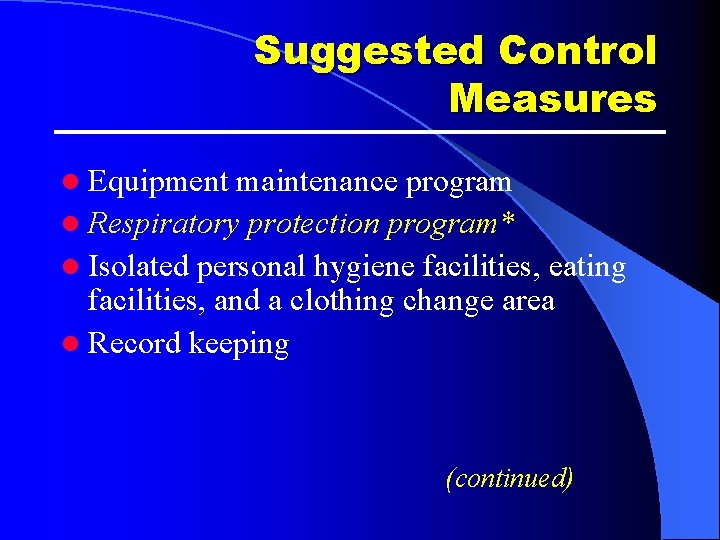
Suggested Control Measures l Equipment maintenance program l Respiratory protection program* l Isolated personal hygiene facilities, eating facilities, and a clothing change area l Record keeping (continued)
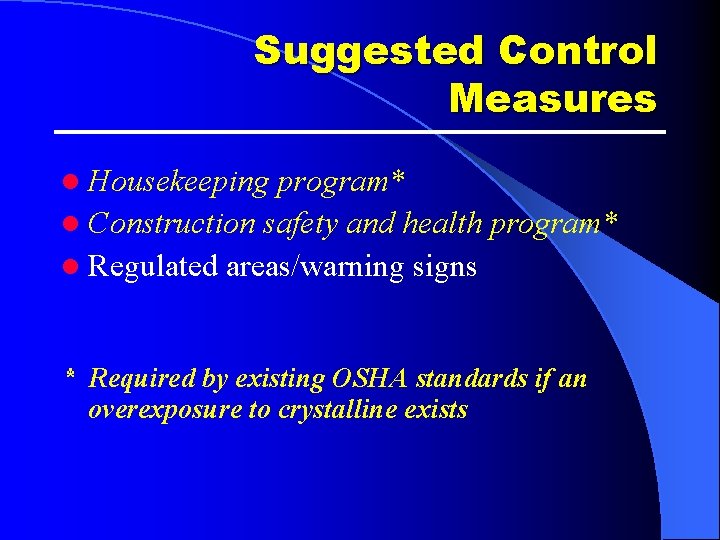
Suggested Control Measures l Housekeeping program* l Construction safety and health program* l Regulated areas/warning signs * Required by existing OSHA standards if an overexposure to crystalline exists
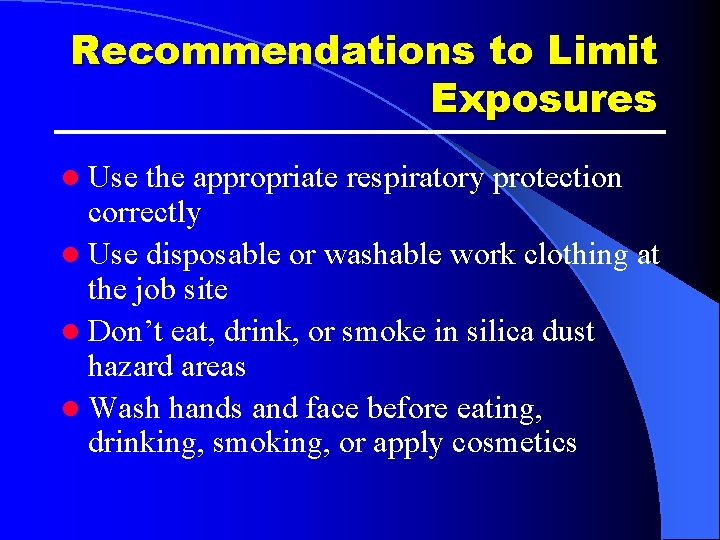
Recommendations to Limit Exposures l Use the appropriate respiratory protection correctly l Use disposable or washable work clothing at the job site l Don’t eat, drink, or smoke in silica dust hazard areas l Wash hands and face before eating, drinking, smoking, or apply cosmetics
General Suggestions l Provide training and information about health effects, work practices, and protective equipment l Recognize where silica dust may be generated and plan ahead l Use control and containment methods l Routinely maintain dust control systems (continued)
General Suggestions l Conduct air monitoring to measure worker exposure and ensure that controls are adequate l Use adequate respiratory protection when source cannot keep silica exposures below the PEL l Post warning signs
Three Current OSHA Cases l New England—employer using Black Beauty to blast concrete l On another construction site—workers doing abrasive blasting were exposed to up to 90% silica and were found to be 80 times the permissible exposure limit (PEL) l Region V-Cleveland—willful violations for silica used in abrasive blasting
OSHA Enforcement Information for Construction l From 1985 through 1990, 11% of the workplace deaths due to silicosis where silicosis was identified on the death certificates was in the construction industry l 26% of all OSHA sample collected in Construction for crystalline silica exceed the OSHA PEL in 1993 and 1994
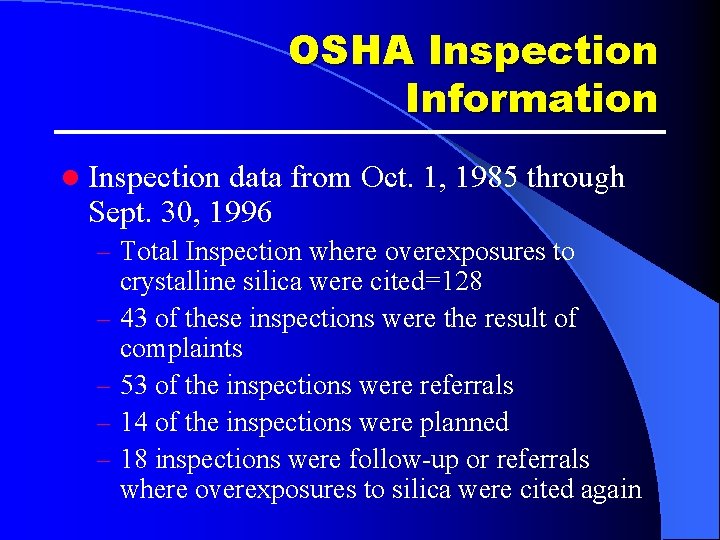
OSHA Inspection Information l Inspection data from Oct. 1, 1985 through Sept. 30, 1996 – Total Inspection where overexposures to – – crystalline silica were cited=128 43 of these inspections were the result of complaints 53 of the inspections were referrals 14 of the inspections were planned 18 inspections were follow-up or referrals where overexposures to silica were cited again
Subpart C: General Safety and Health Provisions
Subpart C OSHA’s provisions for general safety and health—the individual standards address topics such as l Training and education l First aid and medical attention l Sanitation l PPE
Subpart D: Occupational Health and Environmental Controls
Subpart D OSHA’s provisions for occupational health and environmental controls—the individual standards address topics such as l Sanitation l Gases, vapors, fumes, dusts, and mists l Ventilation l Hazard communication
Subpart E: Personal Protective and Life-Saving Equipment
Subpart E OSHA’s standards for selection and use of personal protective and life saving equipment for l Head l Hearing l Eye and face l Repiratory
Thank You for Your Participation l The Construction Education Foundation l 1300 N. 17 th Street • Rosslyn, VA 22209 l Materials created by Red Sled Productions, LLC l 601 Kristin Court, SE • Suite 2000 • Leesburg, VA 20175