
Silent Voices Exploring Minority Student Experiences Maisha Islam


- Slides: 26
'Silent Voices' - Exploring Minority Student Experiences Maisha Islam Carol Shepherd sparqs Conference 2019
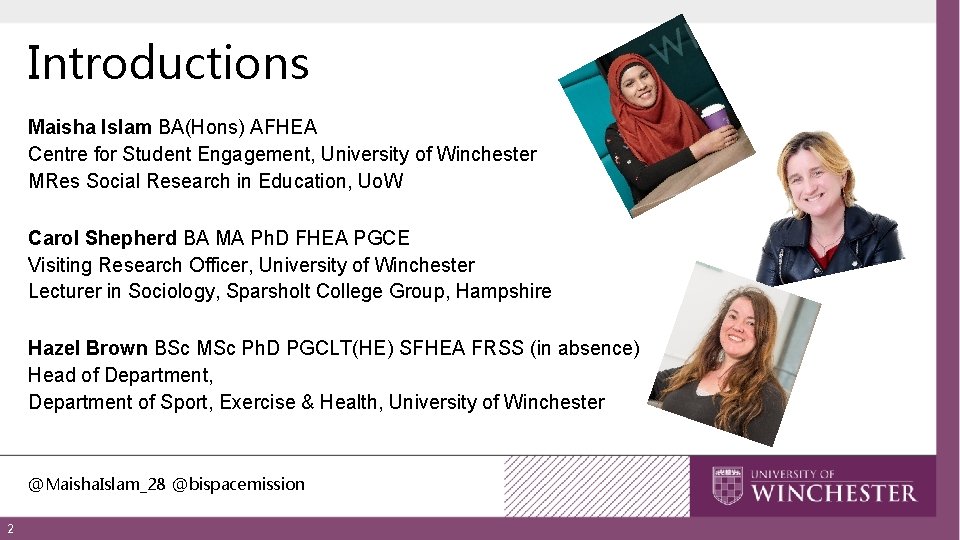
Introductions Maisha Islam BA(Hons) AFHEA Centre for Student Engagement, University of Winchester MRes Social Research in Education, Uo. W Carol Shepherd BA MA Ph. D FHEA PGCE Visiting Research Officer, University of Winchester Lecturer in Sociology, Sparsholt College Group, Hampshire Hazel Brown BSc MSc Ph. D PGCLT(HE) SFHEA FRSS (in absence) Head of Department, Department of Sport, Exercise & Health, University of Winchester @Maisha. Islam_28 @bispacemission 2
Project Inception
The context • Browne Review (2010) – HEIs in England permitted to triple annual tuition fees. • 2015/16 – removal of cap on student numbers under coalition government. • Students and universities now under Consumer Rights Act (2015) = pressure on UK HEIs under marketized conditions (competitiveness, efficiency and satisfaction) (Brown & Carasso, 2013). = student feedback, experience and engagement introduced and emphasised in a number of ways (e. g. National Student Survey). @Maisha. Islam_28 @bispacemission 4
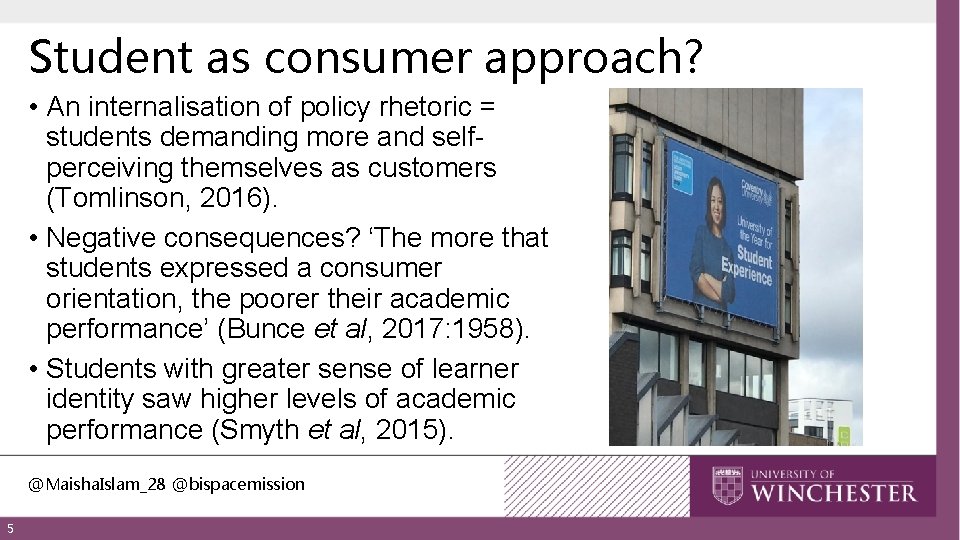
Student as consumer approach? • An internalisation of policy rhetoric = students demanding more and selfperceiving themselves as customers (Tomlinson, 2016). • Negative consequences? ‘The more that students expressed a consumer orientation, the poorer their academic performance’ (Bunce et al, 2017: 1958). • Students with greater sense of learner identity saw higher levels of academic performance (Smyth et al, 2015). @Maisha. Islam_28 @bispacemission 5
A gap in the literature? • ‘Relatively small body of pedagogic research into the general BME student experience…paucity of qualitative study in this particular area’ (Davies & Garrett, 2012). • Experience of religious students in HE remains neglected and under-developed (Aune & Stevenson, 2017). • ‘There have been relatively few studies of the experiences of ‘student-parents’ within HE’ (Brooks, 2012). 6
Voice in research • ‘Student voice…calls for a cultural shift that opens up spaces and minds not only to the sound but also to the presence and power of students’ (Cook-Sather, 2006: 363), where often the loud tones of the middle class dominate the conversation (Fielding, 2004). • The myth of ‘hygienic research’ (Oakley, 2005: 230). • ‘The informed researcher’s voice no longer provides an authoritarian monologue but contributes a part to dialogue’ (Mitchell, 1993: 55).
Research Method • Semi-structured interviews, transcribed and coded for thematic analysis • Participants to identify with 1 or more designated protected characteristics, largely but not exclusively based on Equality Act 2010 • 14 participant interviews analysed so far • Intersectional identities a key feature • Minority stress (Meyer, 2003) and cumulative micro aggressions very much in evidence @Maisha. Islam_28 @bispacemission 8
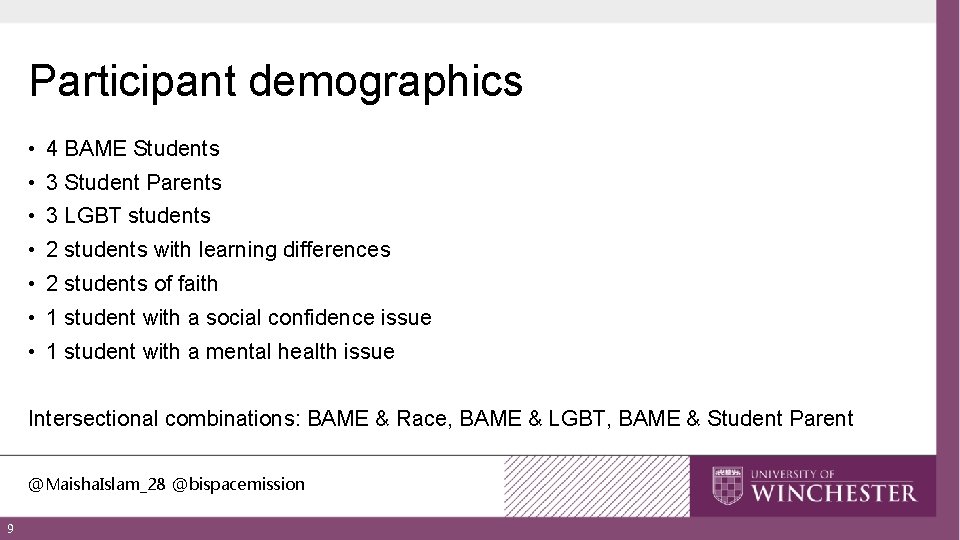
Participant demographics • 4 BAME Students • 3 Student Parents • 3 LGBT students • 2 students with learning differences • 2 students of faith • 1 student with a social confidence issue • 1 student with a mental health issue Intersectional combinations: BAME & Race, BAME & LGBT, BAME & Student Parent @Maisha. Islam_28 @bispacemission 9
Issues faced by BAME Students 1. Judged by different standards (& preparation for this) – ‘pattern yourself’ ‘…But sometimes our teachers would… like if you were acting too mad and, especially for the different fields that you would want to go to, they would have conversations with you like you need to know how the real world works…we just really had to watch the way, we spoke and just how we behaved compared to them [White pupils]. ’ (Liz) ‘I have to make sure to sort of rein in the way I am behaving …my behaviour and the way that I act and try not to draw attention to myself… I have to not try and play up to the stereotype of my race when I am in certain situations’ (Liz) 10
2. Identity work – ‘doubling up’ ‘…whenever I do stuff with Theatre places it’s always a bunch of posh kids and so I don’t want them leaving and thinking this one person from South London, because they will see me as representative of someone from South London or the representative black girl, and I don’t want them to have this impression of all black people or people from South London. ’ (Liz) ‘…but sometimes being a black and ethnic minority group’s student, even speaking with my friends too, we sort of go the extra mile so we are not seen as complaining…Like working extra hours, taking extra cases… so we call it double up so we have to work twice as hard as everyone else…’ (Chloe)
3. Disengagement in the formal and informal spaces of learning and teaching: ‘…being somewhere else with an accent and everything you can be saying some words and then you see people eye-ing at each other like you know you are not pronouncing something or maybe they can decide to say that they don’t understand you. ’ (Sophie) ‘…we always make an effort of removing that barrier between us…Like in class if there’s a group of us, do you want to come with us or we can come to you that sort of thing’. (Chloe) ‘…we know our group and everyone usually talks but everyone went dead silent…’ (Liz)
Pedagogic Recommendations 1. An active role from teaching staff ‘…she has noticed that there are divisions, so she will say ‘you go and sit there, you're not going to be working with your friends’, so everyone learns to work together. ’ (Chloe) ‘. . if you are a black person and you address something on race you are always seen as playing the race card. ’ (Chloe) ‘the one thing I like about my teacher, who is also black, there are times where he is about to ask a racial question and he will specifically direct it towards someone else… Yeah, I appreciated that because after 30 minutes of speaking I'm like “other people have opinions, I would like to hear those opinions. ”’ (Liz)
2. Increasing recruitment of BAME academics ‘I think with recruitment, when you are recruiting tutors, it would be good for them to increase lecturers from ethnic minority backgrounds as well. ’ (Chloe) ‘…for other students who may be biased, if they see someone from a different race teaching people I think that would be good as well, to know that we are not just only students we can be teachers as well, lecturers as well. ’ (Chloe)
3. Increased exposure in the curriculum ‘Our lectures brought up that over the years the majority of English literature study canon has been straight white men, but the thing is though they bring it up and say it's a bad thing and they talk about how there should be change, but then we open up our module handbook and it's straight, White men. ’ ‘…although they filter in a couple of Zadie Smiths and some other people in there, it's for that one week… ‘…even if we are talking about feminism, why can't the feminist writer be Asian? Why can't the feminist writer be black or something? ’ (Liz)
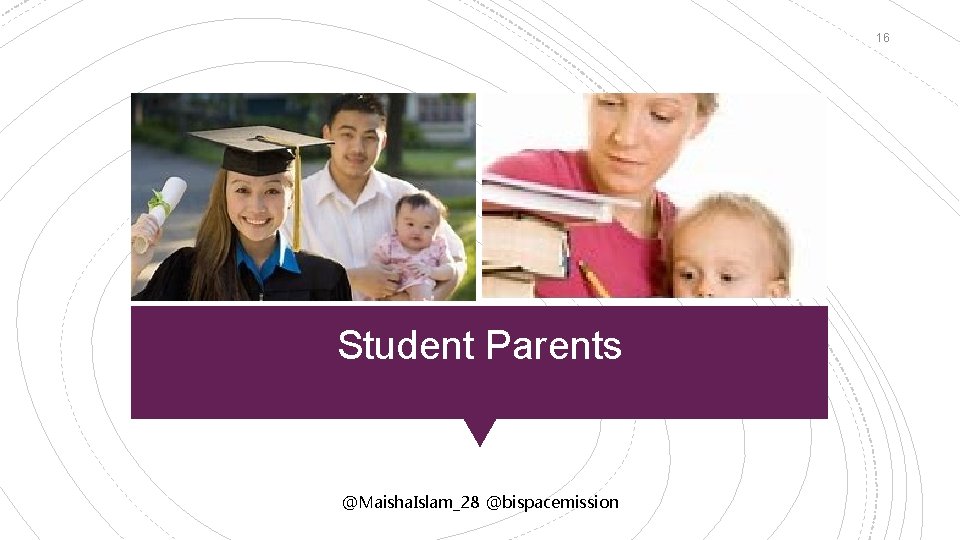
16 Student Parents @Maisha. Islam_28 @bispacemission
Thematic Analysis – Student Parents • Three of those interviewed were student parents • Common to all were timetabling and logistical issues; lack of information; misinformation; widespread ignorance of issues faced by student parents; ostracism by younger peers; financial challenges • BAME parents faced additional issues relating to intersectional identities • Some of these issues will be detailed in the following slides. @Maisha. Islam_28 @bispacemission 17
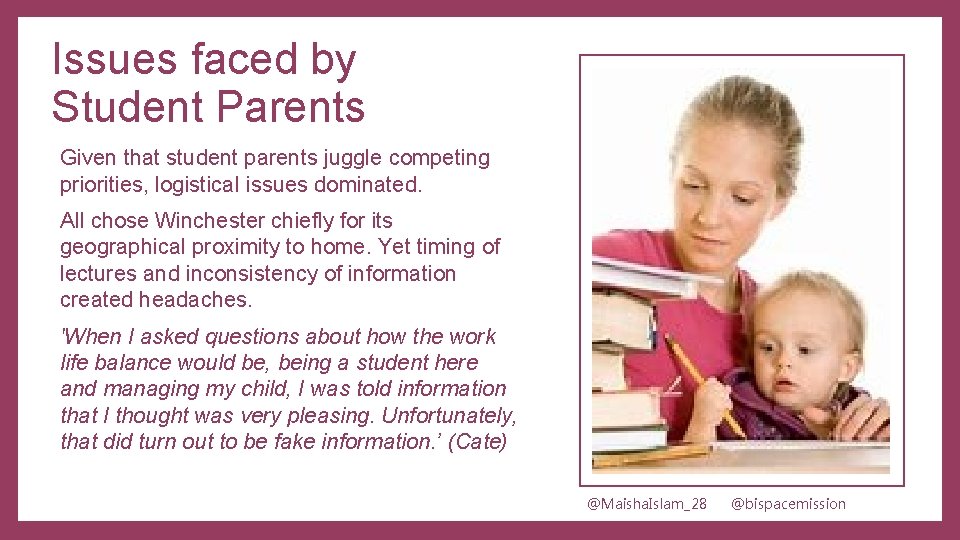
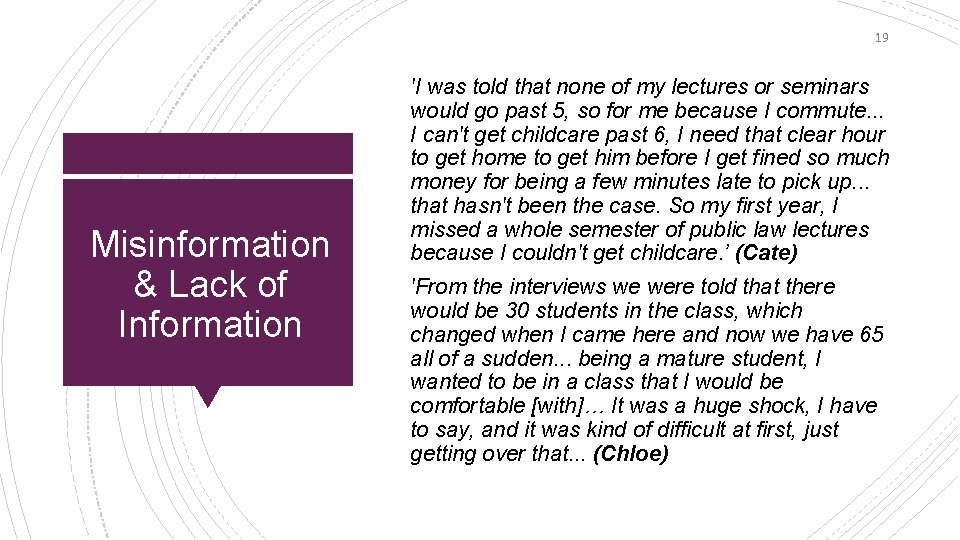
Issues faced by Student Parents Given that student parents juggle competing priorities, logistical issues dominated. All chose Winchester chiefly for its geographical proximity to home. Yet timing of lectures and inconsistency of information created headaches. 'When I asked questions about how the work life balance would be, being a student here and managing my child, I was told information that I thought was very pleasing. Unfortunately, that did turn out to be fake information. ’ (Cate) @Maisha. Islam_28 @bispacemission
19 Misinformation & Lack of Information 'I was told that none of my lectures or seminars would go past 5, so for me because I commute. . . I can't get childcare past 6, I need that clear hour to get home to get him before I get fined so much money for being a few minutes late to pick up. . . that hasn't been the case. So my first year, I missed a whole semester of public law lectures because I couldn't get childcare. ’ (Cate) 'From the interviews we were told that there would be 30 students in the class, which changed when I came here and now we have 65 all of a sudden. . . being a mature student, I wanted to be in a class that I would be comfortable [with]… It was a huge shock, I have to say, and it was kind of difficult at first, just getting over that. . . (Chloe)
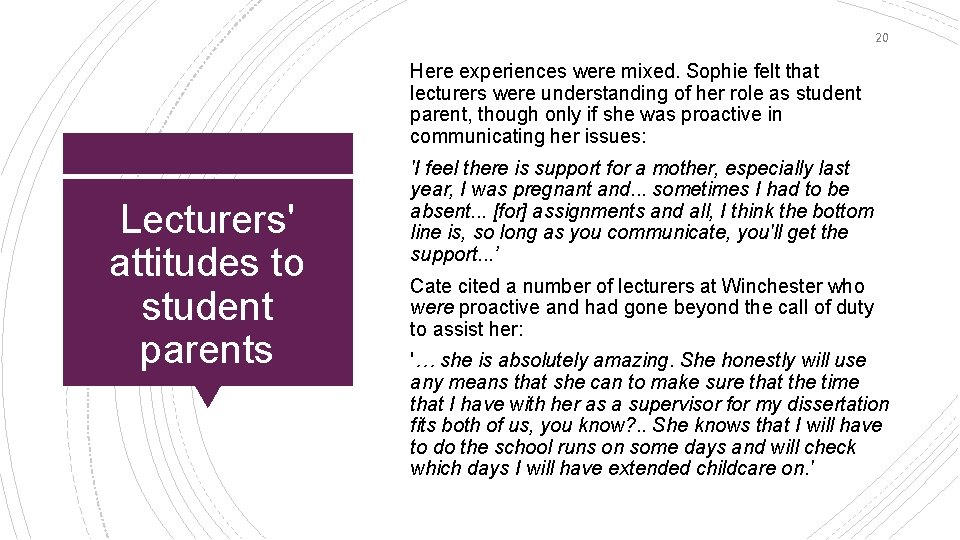
20 Here experiences were mixed. Sophie felt that lecturers were understanding of her role as student parent, though only if she was proactive in communicating her issues: Lecturers' attitudes to student parents 'I feel there is support for a mother, especially last year, I was pregnant and. . . sometimes I had to be absent. . . [for] assignments and all, I think the bottom line is, so long as you communicate, you'll get the support. . . ’ Cate cited a number of lecturers at Winchester who were proactive and had gone beyond the call of duty to assist her: '… she is absolutely amazing. She honestly will use any means that she can to make sure that the time that I have with her as a supervisor for my dissertation fits both of us, you know? . . She knows that I will have to do the school runs on some days and will check which days I will have extended childcare on. '
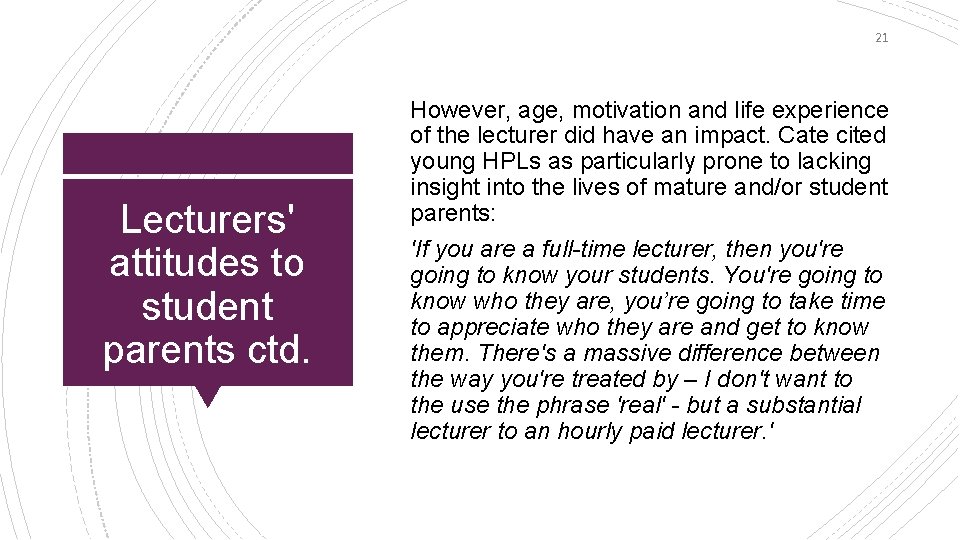
21 Lecturers' attitudes to student parents ctd. However, age, motivation and life experience of the lecturer did have an impact. Cate cited young HPLs as particularly prone to lacking insight into the lives of mature and/or student parents: 'If you are a full-time lecturer, then you're going to know your students. You're going to know who they are, you’re going to take time to appreciate who they are and get to know them. There's a massive difference between the way you're treated by – I don't want to the use the phrase 'real' - but a substantial lecturer to an hourly paid lecturer. '
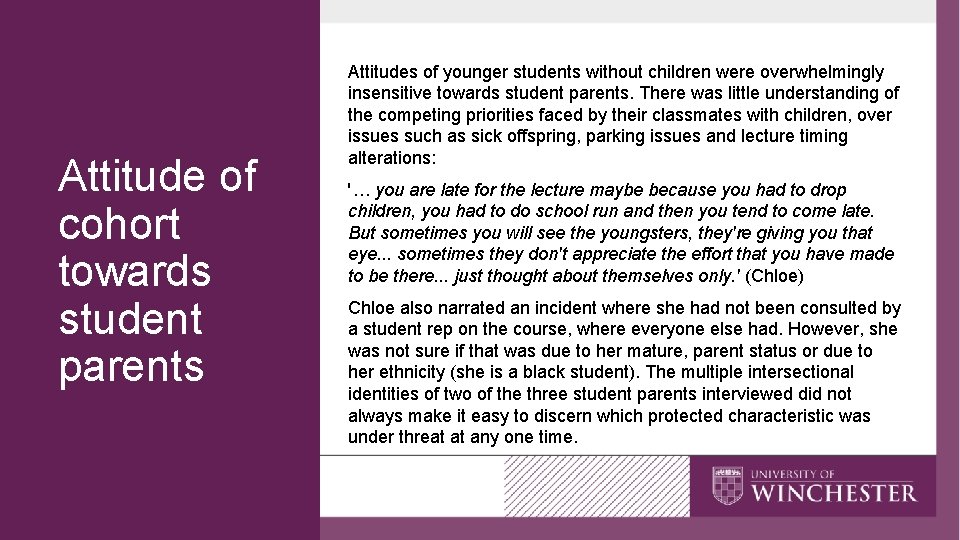
Attitude of cohort towards student parents Attitudes of younger students without children were overwhelmingly insensitive towards student parents. There was little understanding of the competing priorities faced by their classmates with children, over issues such as sick offspring, parking issues and lecture timing alterations: '… you are late for the lecture maybe because you had to drop children, you had to do school run and then you tend to come late. But sometimes you will see the youngsters, they're giving you that eye. . . sometimes they don't appreciate the effort that you have made to be there. . . just thought about themselves only. ' (Chloe) Chloe also narrated an incident where she had not been consulted by a student rep on the course, where everyone else had. However, she was not sure if that was due to her mature, parent status or due to her ethnicity (she is a black student). The multiple intersectional identities of two of the three student parents interviewed did not always make it easy to discern which protected characteristic was under threat at any one time.
Pedagogical Recommendations • Anticipate the issues before they materialise • Manage student expectations (parent and non-parent) • Timetable issues • Childcare provision and waiting lists • Parking provision @Maisha. Islam_28 @bispacemission
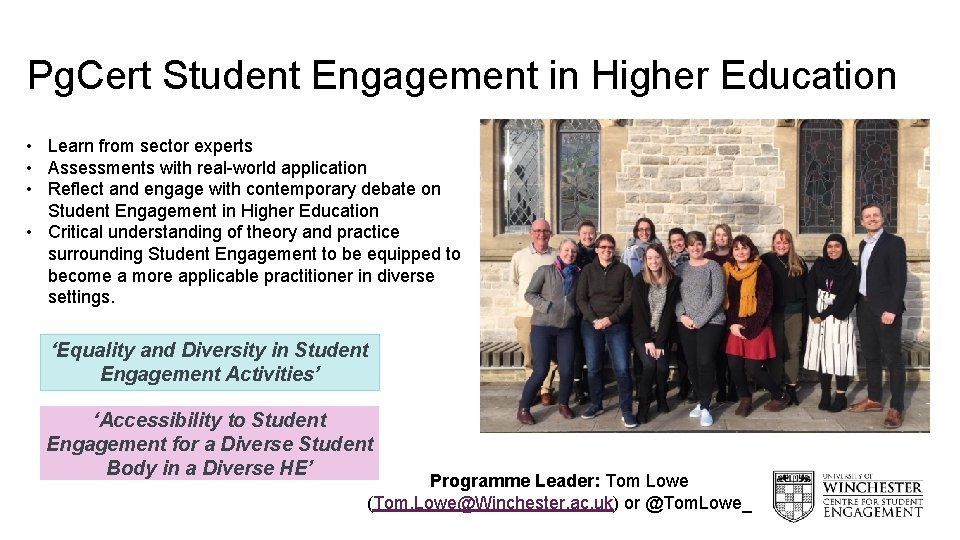
Pg. Cert Student Engagement in Higher Education • Learn from sector experts • Assessments with real-world application • Reflect and engage with contemporary debate on Student Engagement in Higher Education • Critical understanding of theory and practice surrounding Student Engagement to be equipped to become a more applicable practitioner in diverse settings. ‘Equality and Diversity in Student Engagement Activities’ ‘Accessibility to Student Engagement for a Diverse Student Body in a Diverse HE’ Programme Leader: Tom Lowe (Tom. Lowe@Winchester. ac. uk) or @Tom. Lowe_ 24
Thank you for attending our talk and please feel free to ask any questions! @Maisha. Islam_28 @bispacemission
References • Brown, R. and Carasso, H. (2013) Everything for sale? : the marketisation of UK higher education , New York and London: Routledge. • Tomlinson, M. (2016). Student perceptions of themselves as ‘consumers’ of higher education. British Journal of Sociology of Education, 38(4), pp. 450 -467. • Bunce, L. , Baird, A. and Jones, S. (2016). The student-as-consumer approach in higher education and its effects on academic performance. Studies in Higher Education, 42(11), pp. 1958 -1978. • Smyth, L. , K. Mavor, M. Platow, D. Grace, and K. Reynolds. 2015. Discipline Social Identification, Study Norms and Learning Approach in University Students. Educational Psychology, 35 (1), pp. 53– 72. • Davies, C. , & Garrett, M. (2013). The BME Student Experience At A Small Northern University: An Examination Of The Experiences Of Minority Ethnic Students Undertaking Undergraduate Study Within A Small Northern University. Compass: Journal of Learning and Teaching, 3(5). • Aune, K. & Stevenson, J. (Eds) (2017). Religion and Higher Education in Europe and North America. Oxford: Routledge. • Brooks, R. (2012) Student-parents and higher education: a cross-national comparison. Journal of Education Policy, 27 (3), pp. 423439. • Cook-Sather, A. (2006) Sound, Presence, and Power: 'Student Voice' in Educational Research and Reform. Curriculum Inquiry, 36, pp. 359 -390. • Fielding, M. (2004). ‘New wave’ student voice and the renewal of civic society. London Review of Education, 2(3), pp. 197 -217. • Mitchell, R. (1993). Secrecy and fieldwork. Newbury Park: Sage. • Oakley, A. (2005). The Ann Oakley Reader: Gender, Women and Social Science. Bristol: Policy Press. 26