
Silencing Student Voices PRESS SPEECH AND PETITION ISSUES



- Slides: 23
Silencing Student Voices PRESS, SPEECH AND PETITION ISSUES
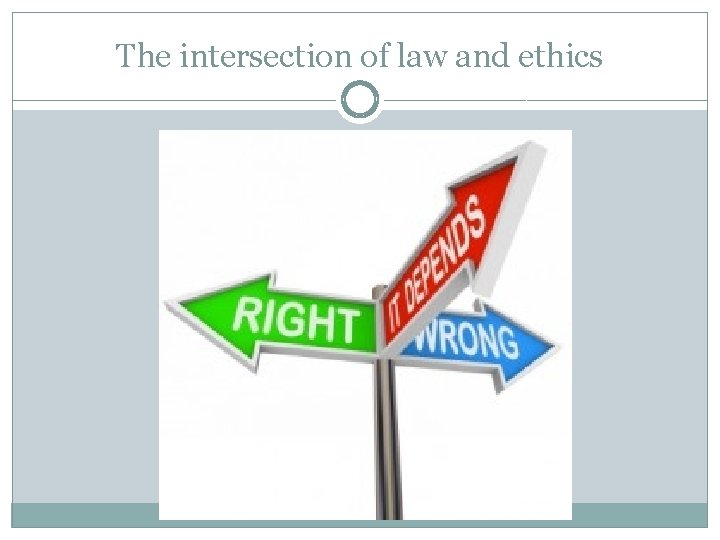
The intersection of law and ethics
Student Press/Speech Issues Can the rights extended to adults extend to minors when we talk about the 1 st Amendment? Are responsibilities and awareness equal? Is student press considered “preprofessional” and if so, at what point?
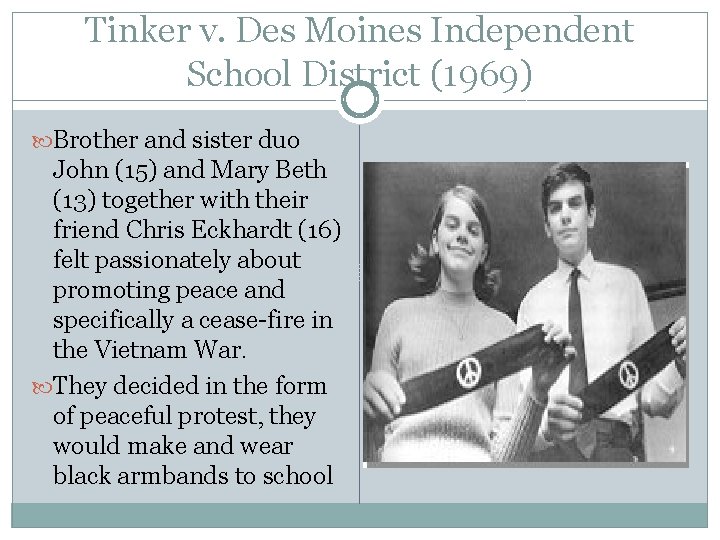
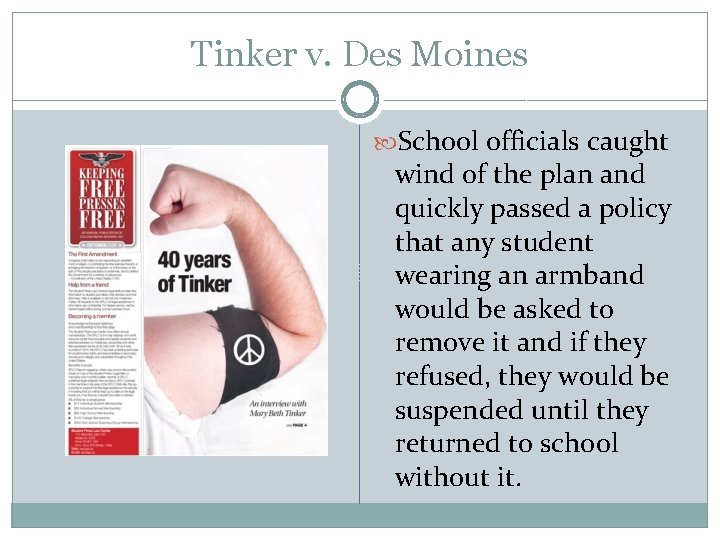
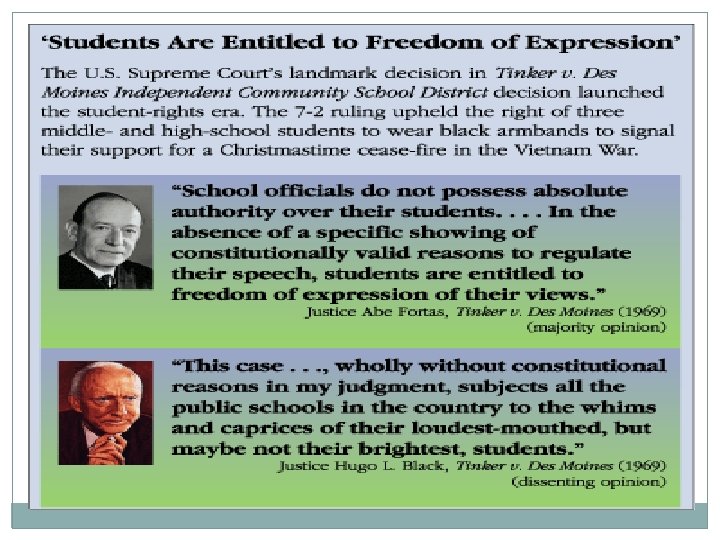
Tinker v. Des Moines Independent School District (1969) Brother and sister duo John (15) and Mary Beth (13) together with their friend Chris Eckhardt (16) felt passionately about promoting peace and specifically a cease-fire in the Vietnam War. They decided in the form of peaceful protest, they would make and wear black armbands to school
Tinker v. Des Moines School officials caught wind of the plan and quickly passed a policy that any student wearing an armband would be asked to remove it and if they refused, they would be suspended until they returned to school without it.
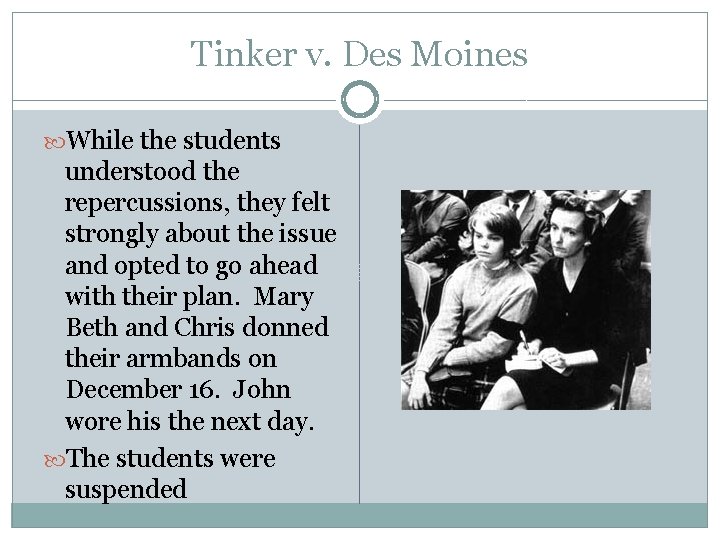
Tinker v. Des Moines While the students understood the repercussions, they felt strongly about the issue and opted to go ahead with their plan. Mary Beth and Chris donned their armbands on December 16. John wore his the next day. The students were suspended
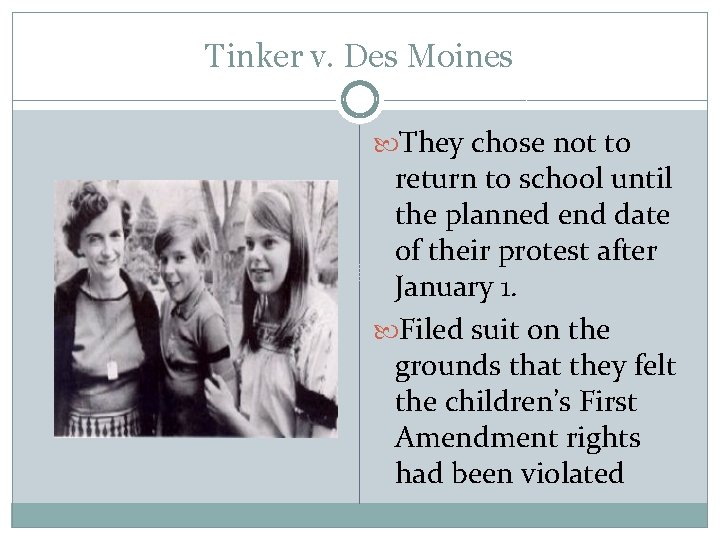
Tinker v. Des Moines They chose not to return to school until the planned end date of their protest after January 1. Filed suit on the grounds that they felt the children’s First Amendment rights had been violated
Tinker v. Des Moines First stop: District Court dismissed, holding that the Board had the power to create such a regulation Second stop: Court of Appeals affirmed first ruling, though was divided Last stop: Supreme Court reversed and found in favor of the Tinkers
Tinker v. Des Moines “It can hardly be argued that either students or teachers shed their constitutional rights to freedom of speech or expression at the schoolhouse gate…. [The students] neither interrupted school activities nor sought to intrude in the school affairs or the lives of others. They caused discussion outside of the classrooms, but no interference with work and no disorder. In the circumstances, our Constitution does not permit officials of the State to deny their form of expression. ” —Justice Abe Fortas, writing for the majority
Tinker v. Des Moines “…the crucial remaining questions are whether students and teachers may use the schools at their whim as a platform for the exercise of free speech--"symbolic" or "pure"--and whether the courts will allocate to themselves the function of deciding how the pupils' school day will be spent. While I have always believed that under the First and Fourteenth Amendments neither the State nor the Federal Government has any authority to regulate or censor the content of speech, I have never believed that any person has a right to give speeches or engage in demonstrations where he pleases and when he pleases. This Court has already rejected such a notion. ” —Justice Hugo Black, writing for the dissent
Time, Place and Manner Rule A doctrine that empowers government to regulate speech (as a means of protecting the wider community from its harmful effects) as long as: 1. Governing body is neutral regarding the content of expression (meaning that it cannot be motivated by political or other objections to the speech). Must be “viewpoint neutral”. 2. The flow of ideas is not substantially altered
Hazelwood School Dist. V. Kuhlmeier (1988) At issue: Hazelwood principal, Robert Reynolds, regularly had prior review over newspaper (produced by journalism class) He deleted two major stories written by students —one on teen pregnancy and another on how students respond to divorce—citing the subject matter as “inappropriate”
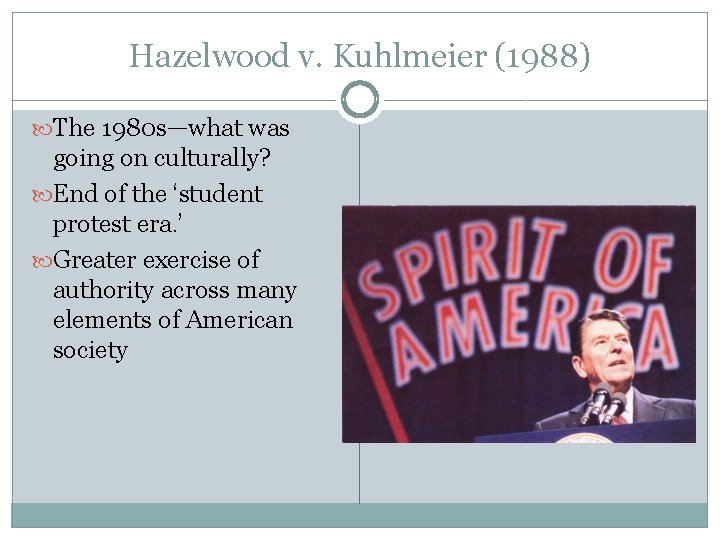
Hazelwood v. Kuhlmeier (1988) The 1980 s—what was going on culturally? End of the ‘student protest era. ’ Greater exercise of authority across many elements of American society
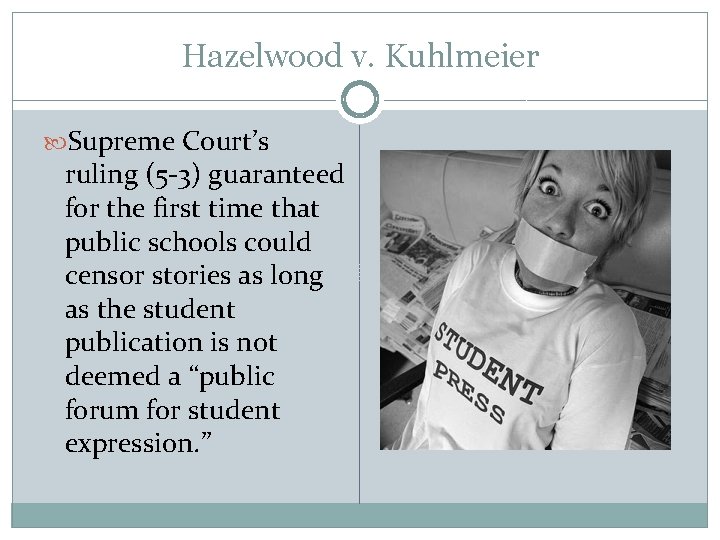
Hazelwood v. Kuhlmeier Supreme Court’s ruling (5 -3) guaranteed for the first time that public schools could censor stories as long as the student publication is not deemed a “public forum for student expression. ”
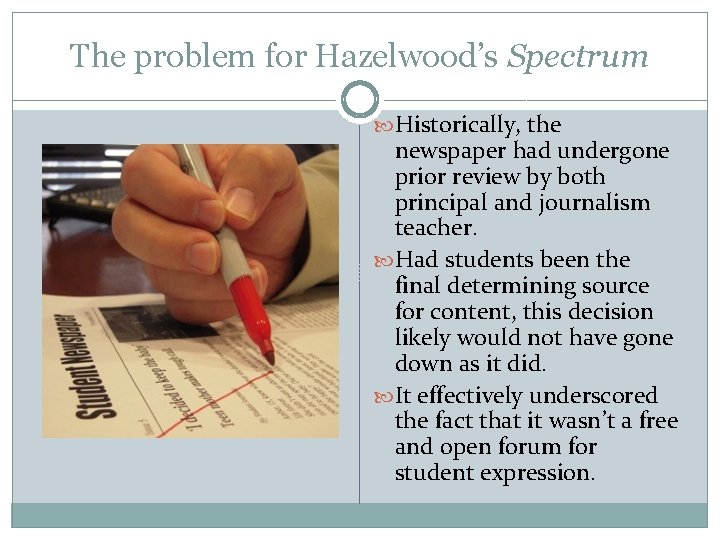
The problem for Hazelwood’s Spectrum Historically, the newspaper had undergone prior review by both principal and journalism teacher. Had students been the final determining source for content, this decision likely would not have gone down as it did. It effectively underscored the fact that it wasn’t a free and open forum for student expression.
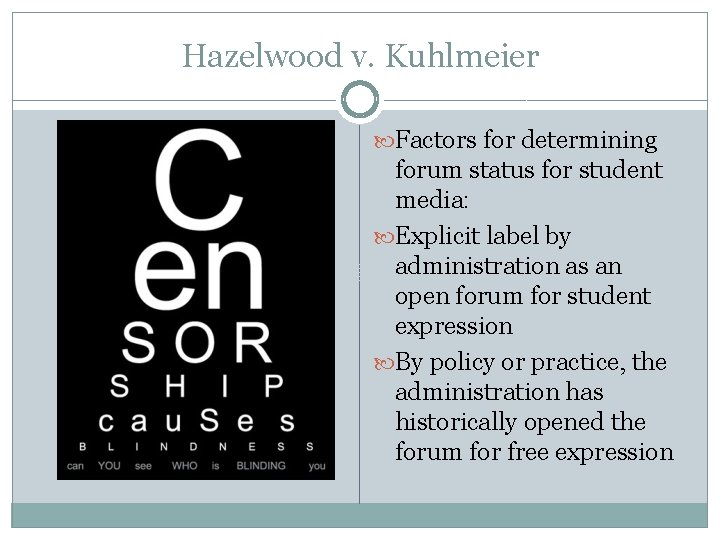
Hazelwood v. Kuhlmeier Factors for determining forum status for student media: Explicit label by administration as an open forum for student expression By policy or practice, the administration has historically opened the forum for free expression
Hosty v. Carter (2005) At issue: Governor State University student journalists sued Dean Patricia Carter after she called newspaper printer to shut down the presses until a school official had given prior approval. The newspaper at the public institution had published news and editorials critical of the administration.
Hosty v. Carter Supreme Court applied Hazelwood precedent to public colleges While they didn’t necessarily believe that the forums were co-equal (high school and college), they did affirm that Carter had “qualified immunity. ”
Hosty v. Carter’s Qualified Immunity: [She] was entitled to qualified immunity from damages for infringing the students' rights because she could not have reasonably known that the limitations of the Hazelwood decision did not apply to college and university student publications. ” ---Student Press Law Center analysis
Morse v. Frederick (2007) Principal Deb Morse suspended Joseph Frederick for refusing to put away a banner he made and unfurled at a public event across the street from the school The banner read “Bong Hits 4 Jesus”
Morse v. Frederick The Supreme Court ruled 5 -4 that Frederick’s rights were not violated when he was suspended because: 1) it was considered “school speech” 2) it was reasonable viewed as supporting illegal drug use 3) A principal may legally restrict speech when the community wellness is at stake.