
Signs someone may be unwell and what should
Signs someone may be unwell and what should I do? Training for ‘Super Trainers’ Date: 2 nd Feb 2021 National Patient Safety Improvement Programmes
Our plan for the session • By the end of the session you will be able to: • Spot when someone may be unwell or getting worse (“deteriorating”) using soft signs; • Tell someone that you are worried in order to get the right help using SBARD (situation, background, assessment, recommendation, decision); • Train others to do the same using the RESTORE 2 mini tool.
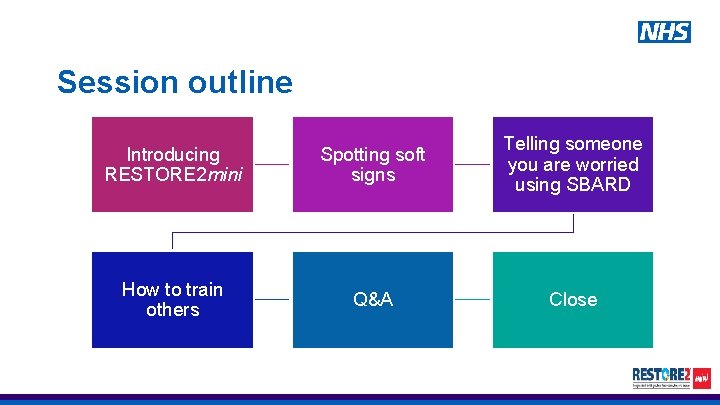
Session outline Introducing RESTORE 2 mini Spotting soft signs Telling someone you are worried using SBARD How to train others Q&A Close
After the session we will send you… • The slides we have used today • Links to the videos used in the training • Link to a recorded session for your reference • A certificate of attendance • Information on how to give feedback, get involved in the research • Details on how to let us know who you have trained
How are you today?
Activity 1: sharing experience Think of a time when you or someone you know was unwell. q. How did you know the person was unwell? (what did you see, hear, feel etc. ) q. What happened to get them help? q. What went well with that call for help? q. What could have been done better? q. How did this make you feel?
Why is this important? We know that people with a learning disability: q Have poor health outcomes and carers may find it difficult to communicate with GPs q May have health problems which make them more vulnerable to infection q May have difficulty saying when they are unwell, so we want to help families and carers be ‘their voice’. q Statistically die from COVID-19 are much younger than in the general population q. Are greatly impacted by COVID-19, so carers will benefit from understanding the signs which will really make a difference in this pandemic.
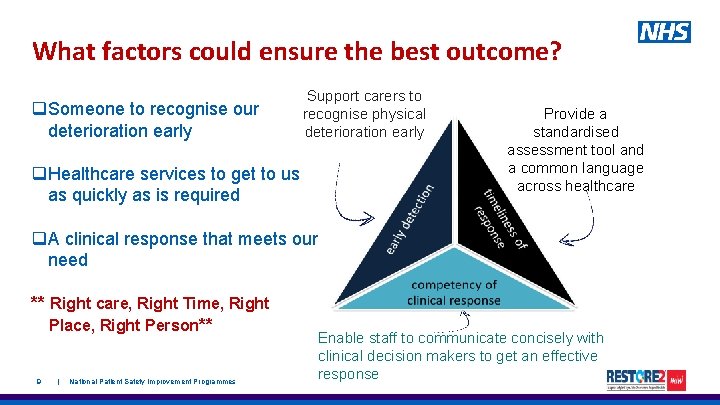
What factors could ensure the best outcome? Support carers to recognise physical deterioration early q. Healthcare services to get to us as quickly as is required q. A clinical response that meets our need ** Right care, Right Time, Right Place, Right Person** 9 | National Patient Safety Improvement Programmes e de arly tec tio n q. Someone to recognise our deterioration early Provide a standardised assessment tool and a common language across healthcare Enable staff to communicate concisely with clinical decision makers to get an effective response


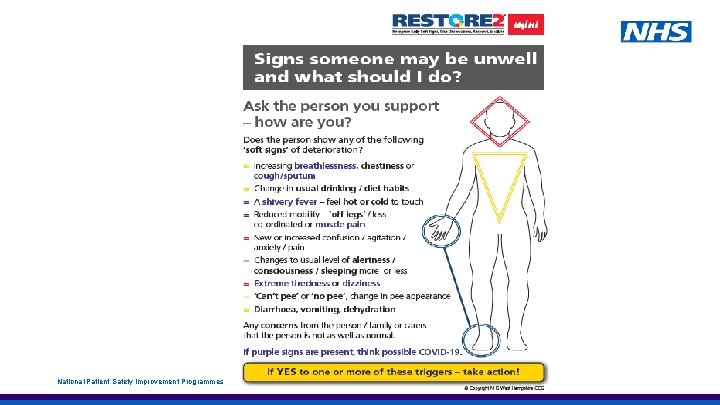
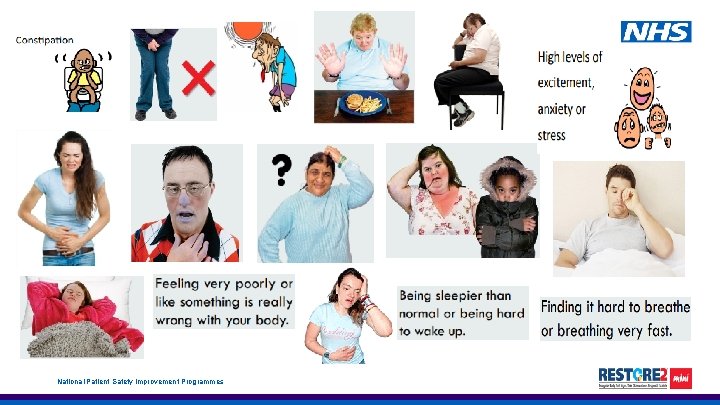
What are “Soft Signs” of deterioration q They are the early indicators that someone may be becoming unwell q Sometimes it can be obvious that someone is unwell, but at other times it might be much harder to spot. q Often families and friends will pick up on the subtle changes in a person’s behaviour, manner or appearance. Therefore family concerns should always be taken seriously, even if you think the person is fine. **It’s important to understand what is normal for the person** National Patient Safety Improvement Programmes

Examples of “Soft Signs” Soft Signs can be related to many things including: Changes in physical presentations Changes in behaviour or ability v v v v being short of breath not passing much urine being hot, cold or clammy to touch being unsteady while walking increased tiredness altered sleep pattern reduced inhibitions Being very restless or hyperactive Changes in mental state v having new or worse confusion v feeling more anxious or agitated v Being more withdrawn than normal National Patient Safety Improvement Programmes
National Patient Safety Improvement Programmes
National Patient Safety Improvement Programmes
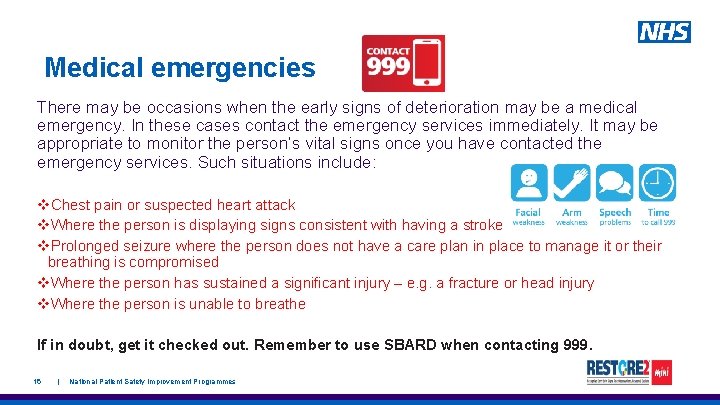
Medical emergencies There may be occasions when the early signs of deterioration may be a medical emergency. In these cases contact the emergency services immediately. It may be appropriate to monitor the person’s vital signs once you have contacted the emergency services. Such situations include: v. Chest pain or suspected heart attack v. Where the person is displaying signs consistent with having a stroke v. Prolonged seizure where the person does not have a care plan in place to manage it or their breathing is compromised v. Where the person has sustained a significant injury – e. g. a fracture or head injury v. Where the person is unable to breathe If in doubt, get it checked out. Remember to use SBARD when contacting 999. 16 | National Patient Safety Improvement Programmes
Activity 2: ‘Soft Signs’ Scenario Small group discussions in breakout rooms, followed by feedback from each breakout room to the whole group. Scenario is posted in the chat in each breakout room. National Patient Safety Improvement Programmes
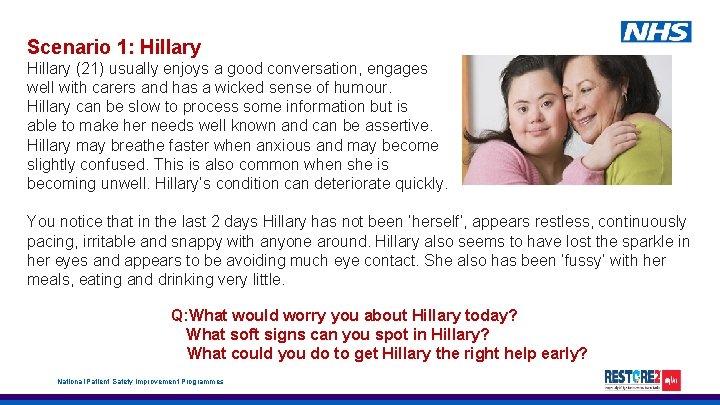
Scenario 1: Hillary (21) usually enjoys a good conversation, engages well with carers and has a wicked sense of humour. Hillary can be slow to process some information but is able to make her needs well known and can be assertive. Hillary may breathe faster when anxious and may become slightly confused. This is also common when she is becoming unwell. Hillary’s condition can deteriorate quickly. You notice that in the last 2 days Hillary has not been ‘herself’, appears restless, continuously pacing, irritable and snappy with anyone around. Hillary also seems to have lost the sparkle in her eyes and appears to be avoiding much eye contact. She also has been ‘fussy’ with her meals, eating and drinking very little. Q: What would worry you about Hillary today? What soft signs can you spot in Hillary? What could you do to get Hillary the right help early? National Patient Safety Improvement Programmes
Scenario 2: Shanna is a 40 yr old lady who lives alone in a 2 bedroom flat with support from carers. She is known to be prone to chest infections and often has antibiotics for it. Last night Shanna looked more tired, less interactive and tearful. She has remained asleep for most of this morning and was reluctant to get up to eat, wash or do any of her usual daily activities. On occasions you felt she was drifting back to sleep mid conversation and was difficult to arouse. You also noticed she was slightly wheezy but has refused the offer of medication. You contacted the GP who prescribed antibiotics as in previous episodes. However Shanna was not keen to take them, choosing to remain asleep. By the evening Shanna had developed a fever and beginning to loose colour. Q: What would worry you about Shanna today? What soft signs can you spot in Shanna? What could you do to get Shanna the right help early?
Scenario 3: Tom is a 32 yrs old man with a learning disability and additional health needs. Tom lives in a residential home but visits his family every other weekend. Tom has some visual impairment but loves to jump especially when excited. Tom communicates non-verbally and usually responds by smiling or flickering his eyes and making high-pitched vocalisations. Tom loves his food and never misses an opportunity for a pudding. Carers who finished the day shift reported that Tom has been hyperactive; jumping, burping and slapping his chest repeatedly. They also noted he refused dinner and didn’t drink much. The records and information from family shows that Tom often gets cold sores and may display certain behaviours when unwell. Q: What would worry you about Tom today? What ‘soft signs’ can you spot in Tom? What could you do to get Tom the right help early? National Patient Safety Improvement Programmes
Scenario 4: Charlie A 67 yrs old gentleman who moved to his supported living flat 3 months ago. Charlie is generally fit and well, has full capacity but reduced mobility. He is on medication for hypertension only and has not required medication review since moving to the flat. One morning you notice that Charlie is reluctant to eat his breakfast and feels he needs to go back to bed for a rest. When you check on Charlie an hour later you feel his hands are colder than normal and he is beginning to shiver. Charlie has also informed you he does not feel very well. Q: What would worry you about Charlie today? What ‘soft signs’ can you spot in Charlie? What could you do to get Charlie the right help early? National Patient Safety Improvement Programmes
Scenario 5: Jerry 29 yr old Jerry lives at home with support from family and carers (on occasions). He is fond of the outdoors and loves to go on long car drives, especially to the country side. Although Jerry has on occasions been observed to display certain behaviours (for example smearing faeces) which can be slightly challenging to deal with, however his family and carers are often able to distract and redirect him to more positive behaviours. You notice that in the last week, Jerry has increasingly attempted to smear faeces on his bedroom wall and the usual distraction techniques have not be effective to manage the behaviour. He has also been running in and out of the bathroom and kitchen and leaving the tap running. Jerry’s anxiety levels appears to be rising and tonight he attempted to smear the carers with faeces. Jerry appears distressed and unsettled. Q: What would worry you about Jerry today? What ‘Soft sign’ can you spot in Jerry What could you do to get Jerry the right help early?

Screen / comfort break (time for a stretch!!!!!) 23 | National Patient Safety Improvement Programmes
Do you know who to tell if you are worried about someone you care for? Telling someone you are worried (SBARD) - You. Tube National Patient Safety Improvement Programmes
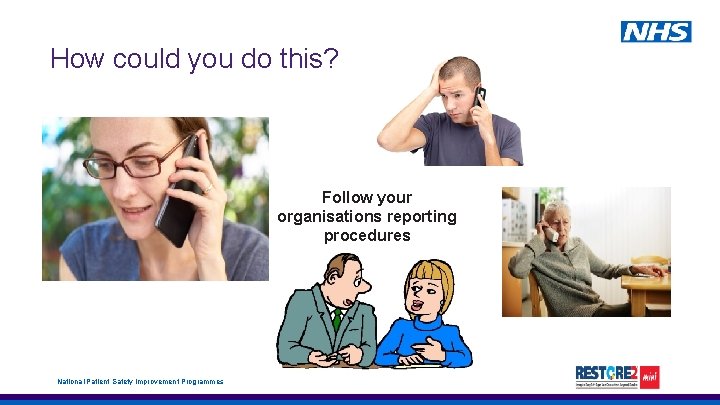
How could you do this? Follow your organisations reporting procedures National Patient Safety Improvement Programmes
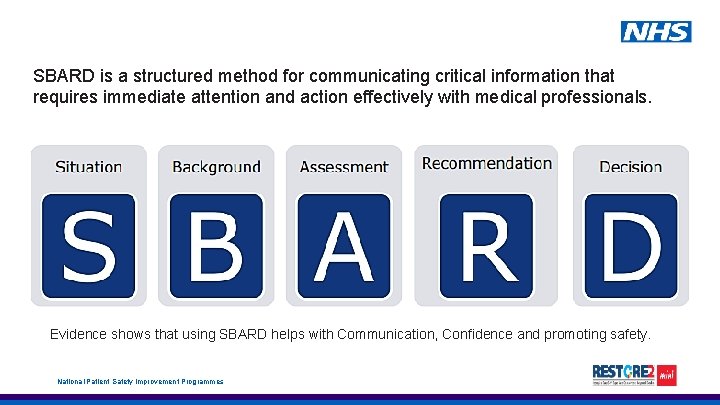
SBARD is a structured method for communicating critical information that requires immediate attention and action effectively with medical professionals. Evidence shows that using SBARD helps with Communication, Confidence and promoting safety. National Patient Safety Improvement Programmes
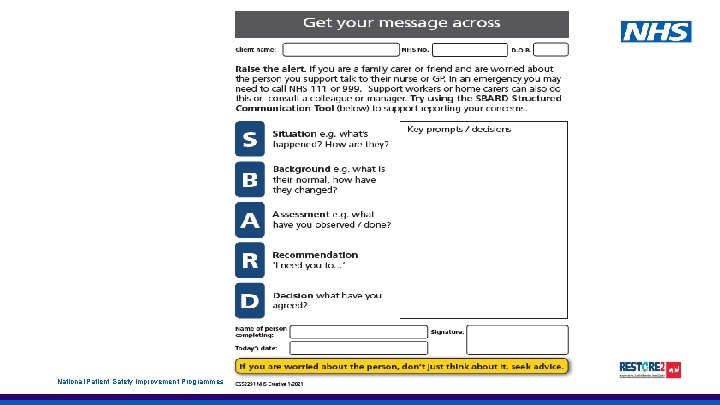
National Patient Safety Improvement Programmes
Telling someone you are worried Thinking about a SBARD form: q Could it be worth collecting the information so you know where it is when needed? q Do you know who to call if you are worried? How about finding the telephone numbers and keeping them near the SBARD form. q Keep the information in one place and tell people where it is – it might be with other important documents such as on the fridge door or even in your mobile phone. Now let’s use the Soft signs scenarios to practice using the SBARD. National Patient Safety Improvement Programmes
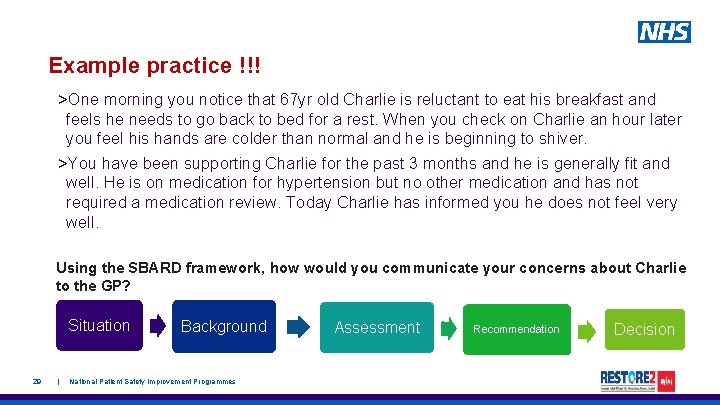
Example practice !!! >One morning you notice that 67 yr old Charlie is reluctant to eat his breakfast and feels he needs to go back to bed for a rest. When you check on Charlie an hour later you feel his hands are colder than normal and he is beginning to shiver. >You have been supporting Charlie for the past 3 months and he is generally fit and well. He is on medication for hypertension but no other medication and has not required a medication review. Today Charlie has informed you he does not feel very well. Using the SBARD framework, how would you communicate your concerns about Charlie to the GP? Situation 29 | Background National Patient Safety Improvement Programmes Assessment Recommendation Decision
Feedback- SBARD (Charlie) • Situation I am ringing because I am worried about a person I am a carer for. We have been supporting Charlie for past 3 months and he is generally fit and well. I became concerned as he is off his food, unusually lethargic, cold and shivering and is complaining of feeling unwell. • Background Charlie is 67 yrs old and alert with full capacity He is on medication for hypertension but no other medication He has not required medical review since we met him.
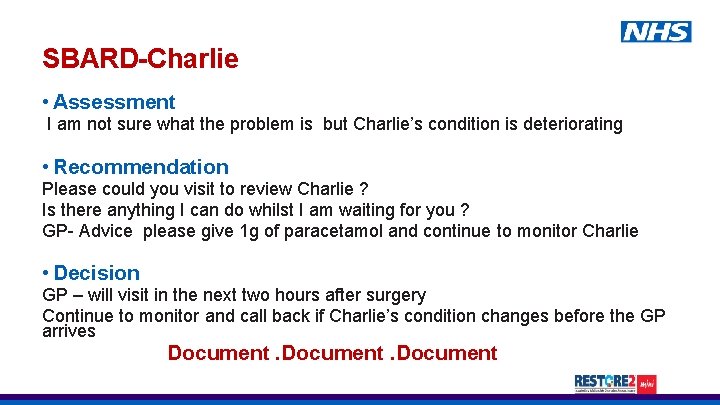
SBARD-Charlie • Assessment I am not sure what the problem is but Charlie’s condition is deteriorating • Recommendation Please could you visit to review Charlie ? Is there anything I can do whilst I am waiting for you ? GP- Advice please give 1 g of paracetamol and continue to monitor Charlie • Decision GP – will visit in the next two hours after surgery Continue to monitor and call back if Charlie’s condition changes before the GP arrives Document
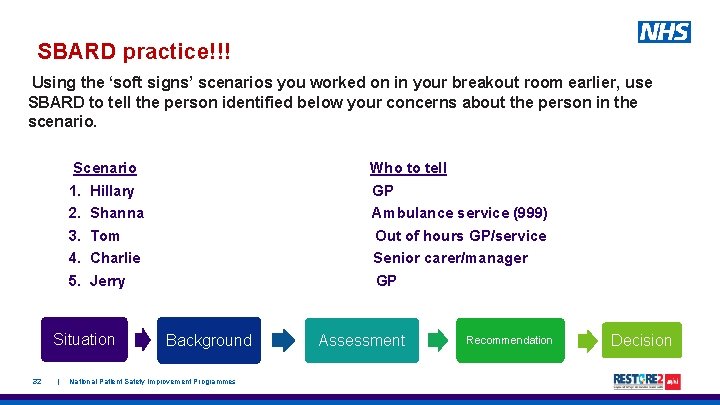
SBARD practice!!! Using the ‘soft signs’ scenarios you worked on in your breakout room earlier, use SBARD to tell the person identified below your concerns about the person in the scenario. Scenario 1. Hillary Who to tell GP 2. 3. 4. 5. Ambulance service (999) Out of hours GP/service Senior carer/manager GP Shanna Tom Charlie Jerry Situation 32 | Background National Patient Safety Improvement Programmes Assessment Recommendation Decision
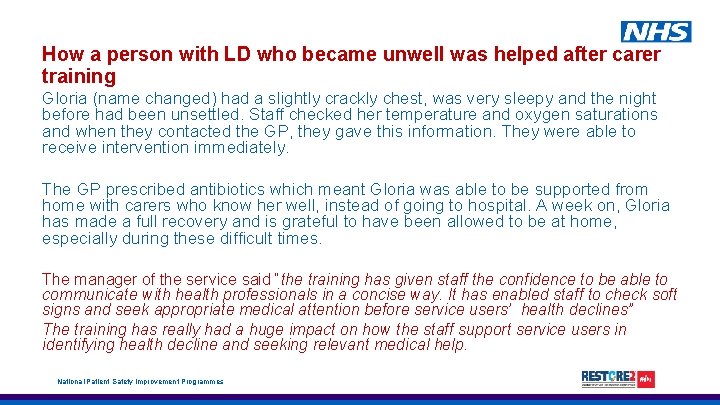
How a person with LD who became unwell was helped after carer training Gloria (name changed) had a slightly crackly chest, was very sleepy and the night before had been unsettled. Staff checked her temperature and oxygen saturations and when they contacted the GP, they gave this information. They were able to receive intervention immediately. The GP prescribed antibiotics which meant Gloria was able to be supported from home with carers who know her well, instead of going to hospital. A week on, Gloria has made a full recovery and is grateful to have been allowed to be at home, especially during these difficult times. The manager of the service said “the training has given staff the confidence to be able to communicate with health professionals in a concise way. It has enabled staff to check soft signs and seek appropriate medical attention before service users’ health declines” The training has really had a huge impact on how the staff support service users in identifying health decline and seeking relevant medical help. National Patient Safety Improvement Programmes

Training other carers What challenges, if any, could make it difficult for you to train other carers. National Patient Safety Improvement Programmes
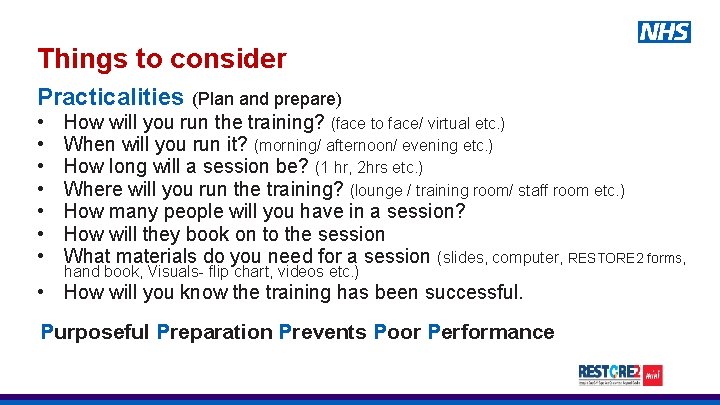
Things to consider Practicalities (Plan and prepare) • • How will you run the training? (face to face/ virtual etc. ) When will you run it? (morning/ afternoon/ evening etc. ) How long will a session be? (1 hr, 2 hrs etc. ) Where will you run the training? (lounge / training room/ staff room etc. ) How many people will you have in a session? How will they book on to the session What materials do you need for a session (slides, computer, RESTORE 2 forms, hand book, Visuals- flip chart, videos etc. ) • How will you know the training has been successful. Purposeful Preparation Prevents Poor Performance
Content delivery: q. Familiarity with subject -key components of RESTORE 2 Mini tool i. e. Soft signs; SBARD (telling someone you are worried) q. Be mindful of different learning styles i. e. Visual (seeing); Auditory (listening and speaking); Verbal (reading & writing); Kinaesthetic (touching and doing) q. Facilitation skills (Active listening, managing group dynamics, encouraging participation, managing time, arranging room to facilitate interactive learning etc. ) q. Practice using tool in to consolidate learning.
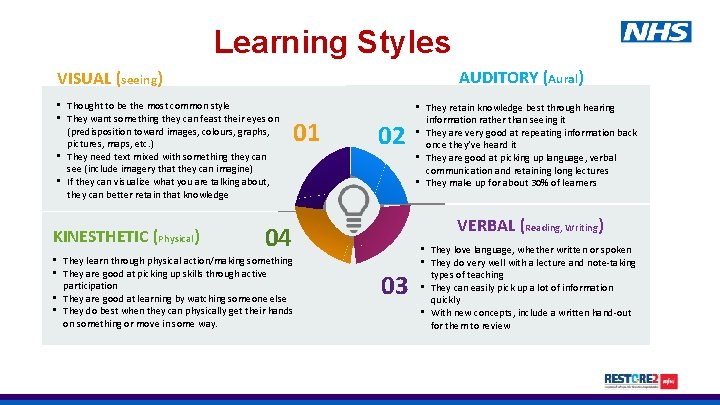
Learning Styles AUDITORY (Aural) VISUAL (seeing) • Thought to be the most common style • They want something they can feast their eyes on (predisposition toward images, colours, graphs, pictures, maps, etc. ) • They need text mixed with something they can see (include imagery that they can imagine) • If they can visualize what you are talking about, they can better retain that knowledge KINESTHETIC (Physical) 01 02 VERBAL (Reading, Writing) 04 • They learn through physical action/making something • They are good at picking up skills through active participation • They are good at learning by watching someone else • They do best when they can physically get their hands on something or move in some way. • They retain knowledge best through hearing information rather than seeing it • They are very good at repeating information back once they’ve heard it • They are good at picking up language, verbal communication and retaining long lectures • They make up for about 30% of learners 03 • They love language, whether written or spoken • They do very well with a lecture and note-taking types of teaching • They can easily pick up a lot of information quickly • With new concepts, include a written hand-out for them to review
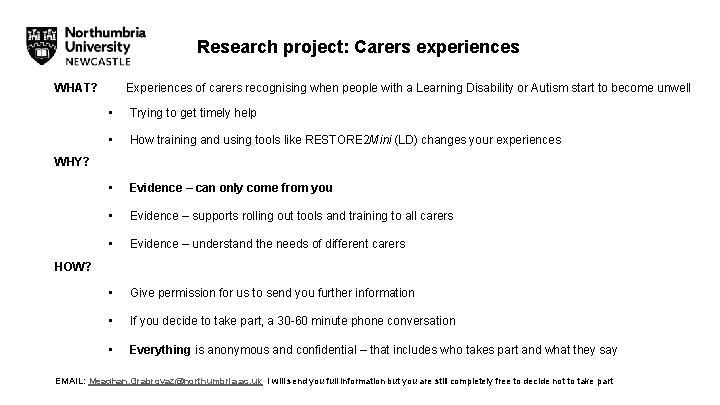
Research project: Carers experiences WHAT? Experiences of carers recognising when people with a Learning Disability or Autism start to become unwell • Trying to get timely help • How training and using tools like RESTORE 2 Mini (LD) changes your experiences • Evidence – can only come from you • Evidence – supports rolling out tools and training to all carers • Evidence – understand the needs of different carers • Give permission for us to send you further information • If you decide to take part, a 30 -60 minute phone conversation • Everything is anonymous and confidential – that includes who takes part and what they say WHY? HOW? EMAIL: Meaghan. Grabrovaz@northumbria. ac. uk I will send you full information but you are still completely free to decide not to take part
Our plan for the session • By the end of the session you will be able to: • Spot when someone may be unwell or getting worse (“deteriorating”) using soft signs; • Tell someone that you are worried in order to get the right help using SBARD (situation, background, assessment, recommendation, decision); • Train others to do the same using the RESTORE 2 mini tool.
Summary • You are often the expert on the person you look after and you know when something is not right. • Think about soft signs for that person, and share them with other people. • Think about how to tell others when you are worried. • Remember, if you are worried about someone, don’t just think about it, seek advice.
After the session we will send you… • The slides we have used today • Links to the videos used in the training • Link to a recorded session for your reference • A certificate of attendance • Information on how to give feedback, get involved in the research • Details on how to let us know who you have trained
Thank you! Do you have any questions?
- Slides: 40