
SIGNS OF CEREBELLAR CEREBRAL DISEASES Presenters Fatoumata Sillah
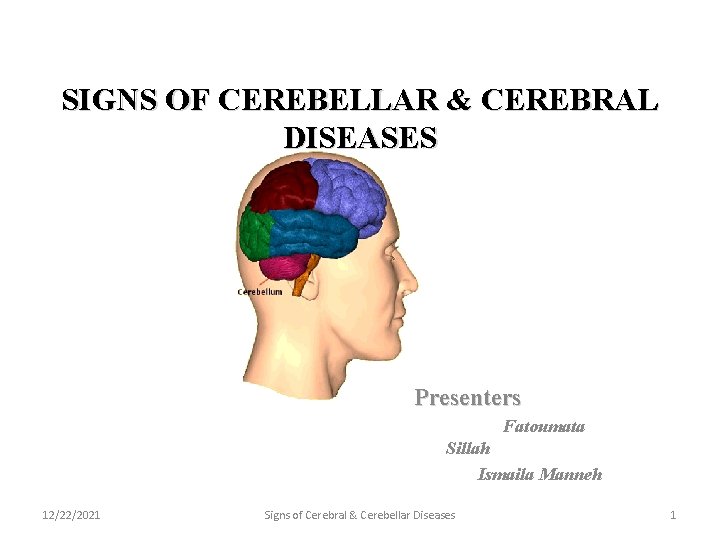
SIGNS OF CEREBELLAR & CEREBRAL DISEASES Presenters Fatoumata Sillah Ismaila Manneh 12/22/2021 Signs of Cerebral & Cerebellar Diseases 1
SIGNS OF CEREBELLAR DISEASES 12/22/2021 Signs of Cerebral & Cerebellar Diseases 2
Outline • • Anatomy of the cerebellum Function of the cerebellum Causes of cerebellar diseases Sings of cerebellar diseases 12/22/2021 Signs of Cerebral & Cerebellar Diseases 3

Anatomy of the cerebellum 12/22/2021 Signs of Cerebral & Cerebellar Diseases 4
Anatomy of the cerebellum • The cerebellum is part of the brain • It is divided into 3 lobes by 2 deep fissures 1. The anterior lobe 2. The posterior lobe 3. The flocculonodular lobe • It has 1. Cortex 2. Deeper nuclei groups (e. g. dentate, interposed & fastigial nuclei) 12/22/2021 Signs of Cerebral & Cerebellar Diseases 5
Function of the cerebellum • The cerebellum is largely involved in "coordination" as in; 1. Timing of motor activities 2. Rapid & smooth progression from one movement to the next 3. Control intensity of muscle contractions 4. Control the interplay between the agonist & antagonist muscle groups • The cerebellum always functions in association with other systems of motor control such as the cerebral cortex & basal ganglia • Persons whose cerebellum doesn't work well are 12/22/2021 of Cerebral & Cerebellar Diseases 6 generally clumsy Signs and unsteady (like drunkers)
Causes of Cerebellar Diseases • Tumours 1. 2. 3. 4. • Infection Haemangioblastoma Medulloblastoma Secondary neoplasm Compression by acoustic neuroma • Vascular lesions 1. Haemorrhage 2. Infaction 3. Arteriovenous malform 12/22/2021 1. Abscess 2. HIV 3. Kuru • Developmental 1. Arnold-chiari malform 2. Basilar invagination 3. Cerebral palsy Signs of Cerebral & Cerebellar Diseases 7
Causes of Cerebellar Diseases • Toxic & metabolic 1. 2. 3. 4. 5. Anticonvulsant drugs Chronic alcohol abuse CO poisoning Lead poisonong Solvent abuse • Inherited 1. Ataxia telangiectasia 2. Essential tremor 12/22/2021 • Miscellaneous 1. Multiple sclerosis 2. Hydrocephalus 3. Postinfective cerebellar syndrome of chilhood 4. Hypothyroidism 5. Non-metastatic manifestation of malignancy 6. Cerebral oedema of chronic hypoxia Signs of Cerebral & Cerebellar Diseases 8
Signs of cerebellar diseases • The main clinical features are 1. 2. 3. 4. 5. Cerebellar ataxai Intention tremor Nystagmus Past-pointing Impaired movement • There are two distinguishable cerebellar syndromes; 1. Midline cerebellar lesions 2. Hemispheric /lateral cerebellar lesions 12/22/2021 Signs of Cerebral & Cerebellar Diseases 9

Signs of cerebellar diseases • Ataxia: impaired coordination Coordination test in upper limbs 1. The finger-nose test: impaired 2. Dysdiadochokinesis: impaired ability to perform rapid repeated movements 12/22/2021 Signs of Cerebral & Cerebellar Diseases 10
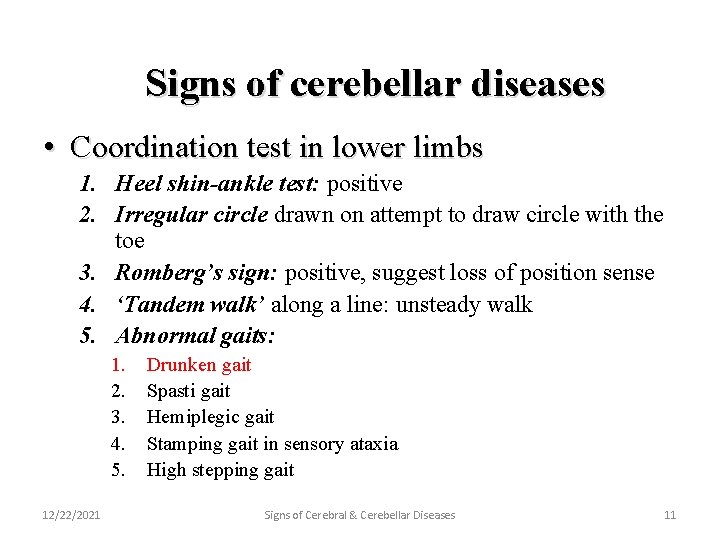
Signs of cerebellar diseases • Coordination test in lower limbs 1. Heel shin-ankle test: positive 2. Irregular circle drawn on attempt to draw circle with the toe 3. Romberg’s sign: positive, suggest loss of position sense 4. ‘Tandem walk’ along a line: unsteady walk 5. Abnormal gaits: 1. 2. 3. 4. 5. 12/22/2021 Drunken gait Spasti gait Hemiplegic gait Stamping gait in sensory ataxia High stepping gait Signs of Cerebral & Cerebellar Diseases 11
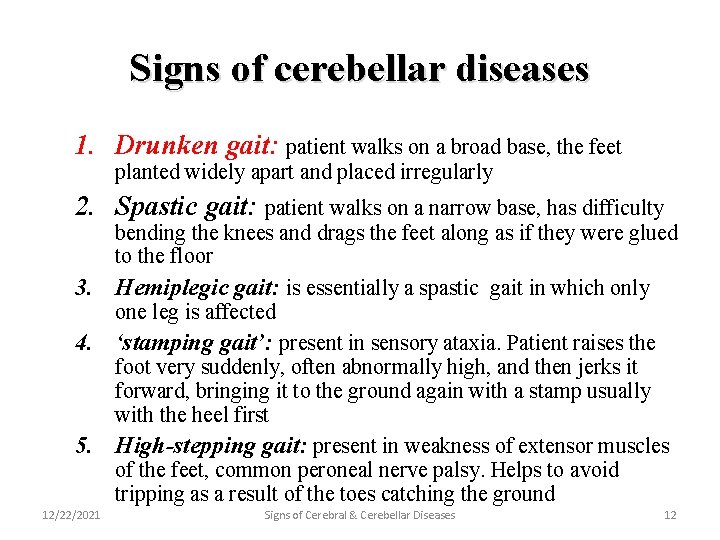
Signs of cerebellar diseases 1. Drunken gait: patient walks on a broad base, the feet planted widely apart and placed irregularly 2. Spastic gait: patient walks on a narrow base, has difficulty 3. 4. 5. 12/22/2021 bending the knees and drags the feet along as if they were glued to the floor Hemiplegic gait: is essentially a spastic gait in which only one leg is affected ‘stamping gait’: present in sensory ataxia. Patient raises the foot very suddenly, often abnormally high, and then jerks it forward, bringing it to the ground again with a stamp usually with the heel first High-stepping gait: present in weakness of extensor muscles of the feet, common peroneal nerve palsy. Helps to avoid tripping as a result of the toes catching the ground Signs of Cerebral & Cerebellar Diseases 12
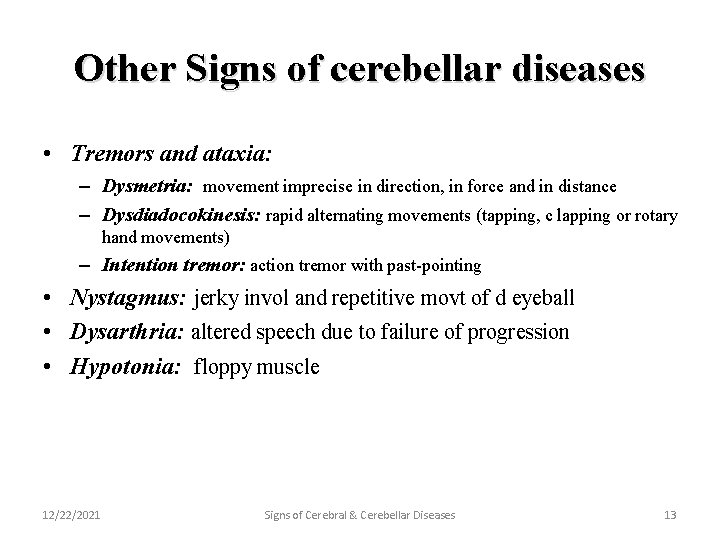
Other Signs of cerebellar diseases • Tremors and ataxia: – Dysmetria: movement imprecise in direction, in force and in distance – Dysdiadocokinesis: rapid alternating movements (tapping, c lapping or rotary hand movements) – Intention tremor: action tremor with past-pointing • Nystagmus: jerky invol and repetitive movt of d eyeball • Dysarthria: altered speech due to failure of progression • Hypotonia: floppy muscle 12/22/2021 Signs of Cerebral & Cerebellar Diseases 13
Diagnosis • Usually done by a neurologist • Investigations – Skull xray – CT Scan – Magnetic resonant imaging 12/22/2021 Signs of Cerebral & Cerebellar Diseases 14
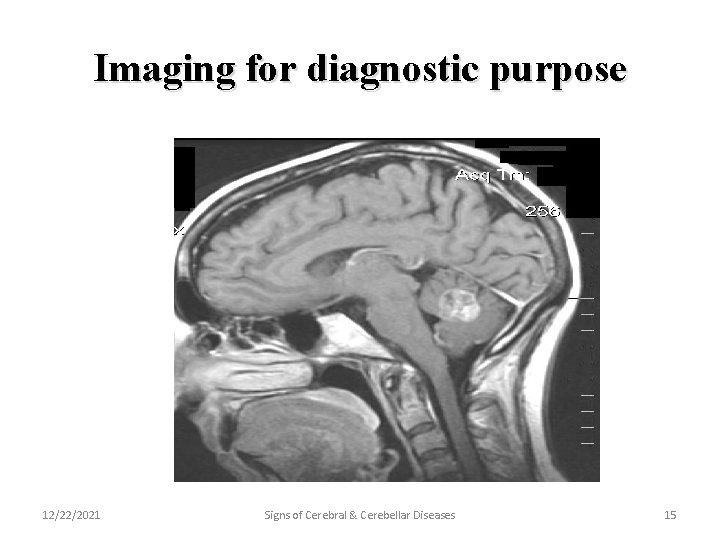
Imaging for diagnostic purpose 12/22/2021 Signs of Cerebral & Cerebellar Diseases 15
References 1. 2. 3. 4. Hutchisons Kumar & Clerk Guyton’s physiology Symptoms & signs of clinical medicine 12/22/2021 Signs of Cerebral & Cerebellar Diseases 16
THANK U 12/22/2021 Signs of Cerebral & Cerebellar Diseases 17
- Slides: 17