
Signs and Symptoms of Knee Injuries Introduction Bell
Signs and Symptoms of Knee Injuries
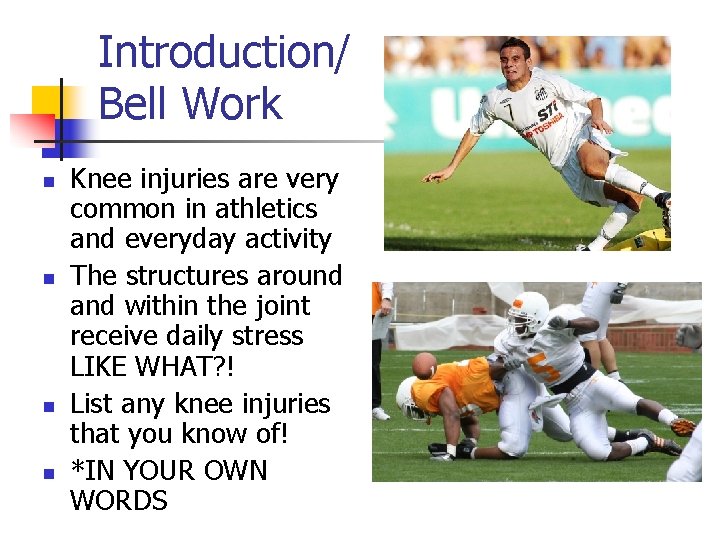
Introduction/ Bell Work n n Knee injuries are very common in athletics and everyday activity The structures around and within the joint receive daily stress LIKE WHAT? ! List any knee injuries that you know of! *IN YOUR OWN WORDS

Objective n n n Recognize signs and symptoms of frequent knee injuries Recognize the treatments that assist in the healing process Formalize a rehab protocol for knee injuries
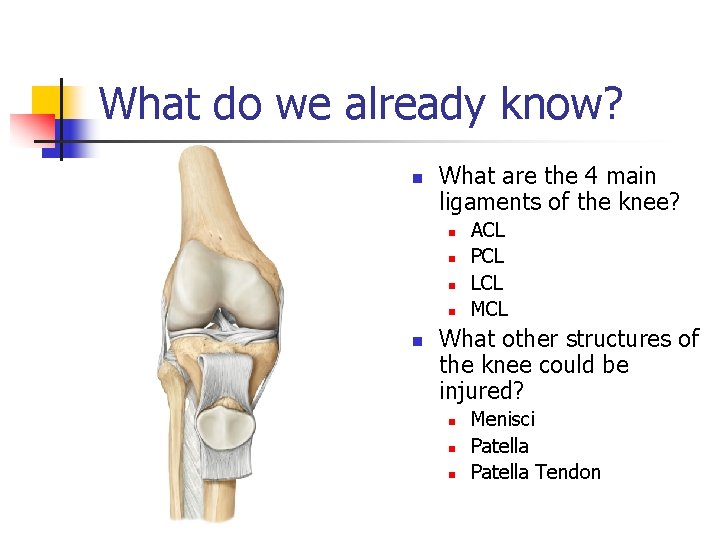
What do we already know? n What are the 4 main ligaments of the knee? n n n ACL PCL LCL MCL What other structures of the knee could be injured? n n n Menisci Patella Tendon
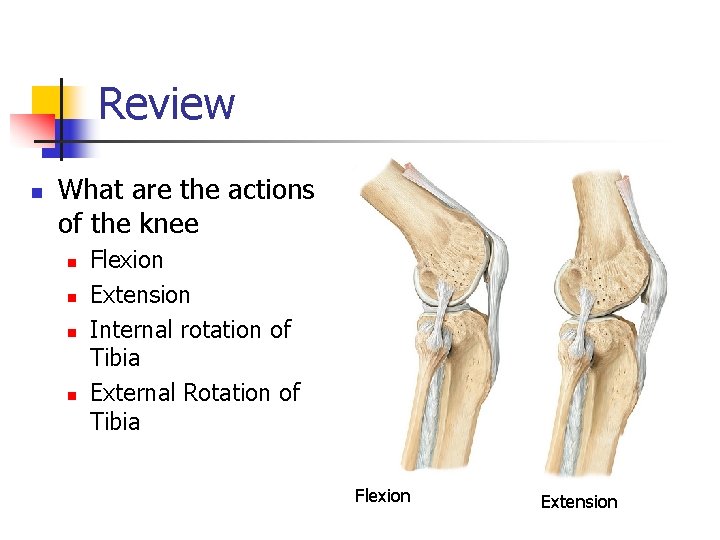
Review n What are the actions of the knee n n Flexion Extension Internal rotation of Tibia External Rotation of Tibia Flexion Extension

Medial Collateral Lig. Sprain n Mechanism n Direct hit to the Lateral side of knee n n n VALGUS FORCE Very common injury S/S n Grade 1 - A few torn fibers n n Grade 2 – Partially torn n n Pain, slight swelling, limp As above AND unable to put heel on ground, PROM, weakness Grade 3 – Ruptured Ligament n As above AND complete loss of medial stability, severe pain to dull ache, loss of ROM

Lateral Collateral Lig. Sprain n Mechanism n Medial force with internal rotation of tibia n n n VARUS FORCE Not as common S/S n n n Grade 1 – Slight pain and tenderness over LCL Grade 2 – Slight laxity in ligament with stress test Grade 3 – Severe pain then dull, weakness, ROM

Posterior Cruciate Lig. Sprain n Mechanism n n n PCL is at most risk when knee is @ 90° Falling onto anterior knee and pushing tibia posteriorly S/S n n Athlete will report a “pop” in back of knee Tenderness with little swelling
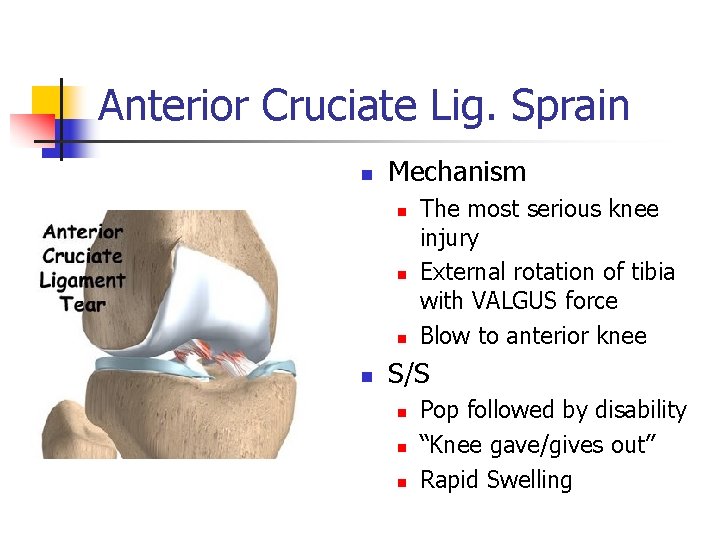
Anterior Cruciate Lig. Sprain n Mechanism n n The most serious knee injury External rotation of tibia with VALGUS force Blow to anterior knee S/S n n n Pop followed by disability “Knee gave/gives out” Rapid Swelling
General Treatment & Rehab n Treatment n n Grade I-II – POLICE for pain, ACE wrap to prevent swelling, crutches if needed. Possible antiinflammatories Grade III – Refer to ortho for evaluation & possible imaging n Rehabilitation n n DEPENDS ON THE INJURY! Stretch & mobilize any scar tissue Strengthen prime mover & synergist muscles Regain balance & proprioception Progress to sportsspecific exercises

Knee Sprain Treatments

Meniscus Tears n Mechanism n n Weight bearing force with rotational force when knee is flexed or extended S/S n n n Swelling in joint line Felt a “pop” at TOI Pain with squatting Knee locks out Loss of motion
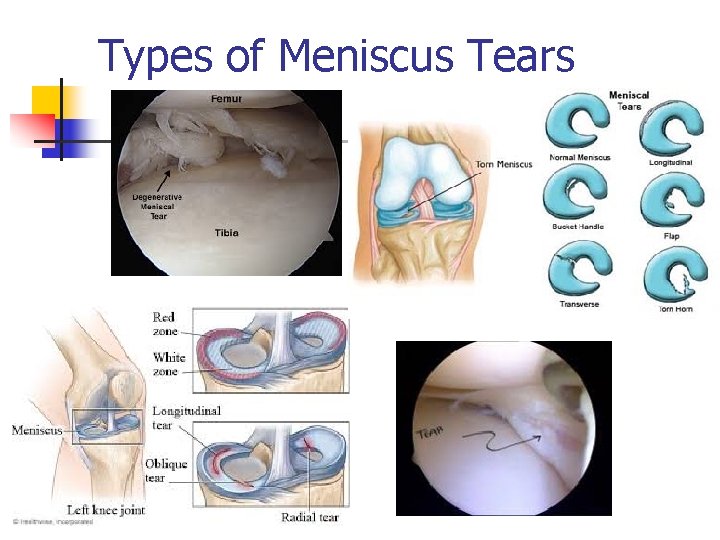
Types of Meniscus Tears
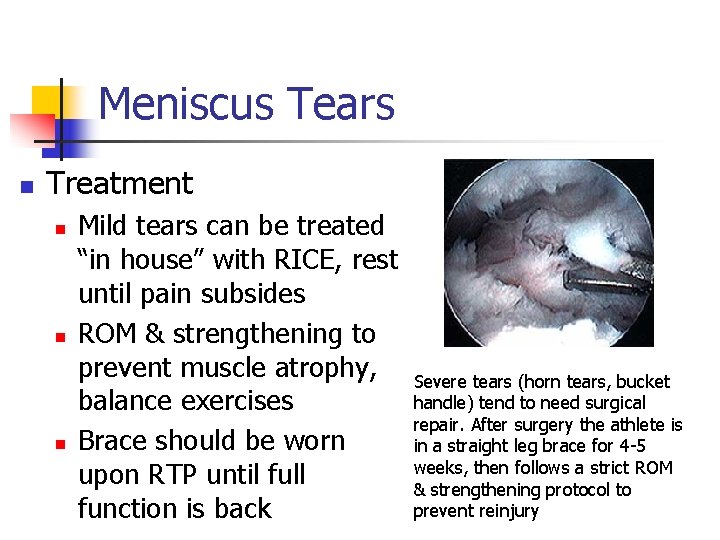
Meniscus Tears n Treatment n n n Mild tears can be treated “in house” with RICE, rest until pain subsides ROM & strengthening to prevent muscle atrophy, balance exercises Brace should be worn upon RTP until full function is back Severe tears (horn tears, bucket handle) tend to need surgical repair. After surgery the athlete is in a straight leg brace for 4 -5 weeks, then follows a strict ROM & strengthening protocol to prevent reinjury
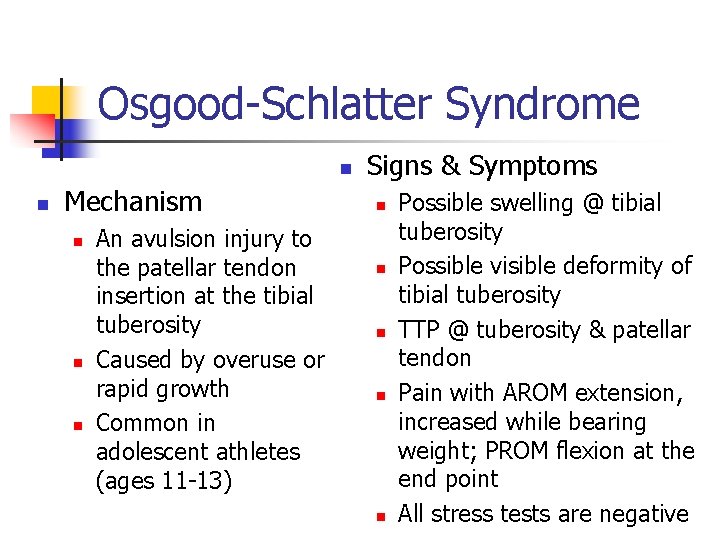
Osgood-Schlatter Syndrome n n Mechanism n n n An avulsion injury to the patellar tendon insertion at the tibial tuberosity Caused by overuse or rapid growth Common in adolescent athletes (ages 11 -13) Signs & Symptoms n n n Possible swelling @ tibial tuberosity Possible visible deformity of tibial tuberosity TTP @ tuberosity & patellar tendon Pain with AROM extension, increased while bearing weight; PROM flexion at the end point All stress tests are negative
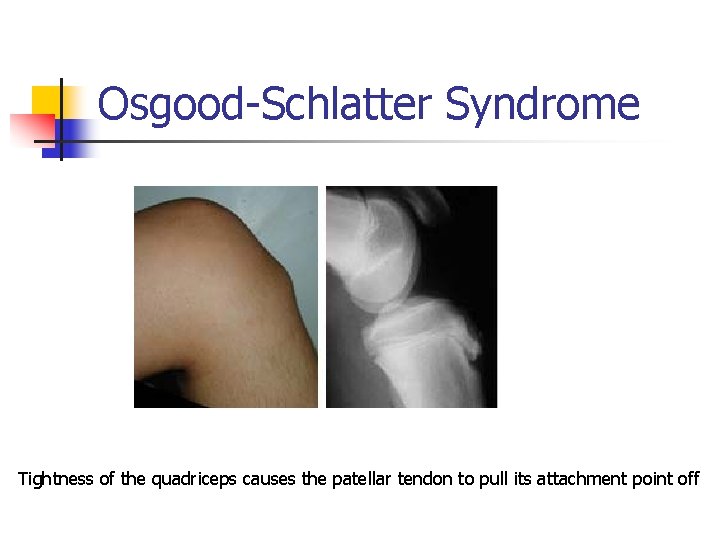
Osgood-Schlatter Syndrome Tightness of the quadriceps causes the patellar tendon to pull its attachment point off
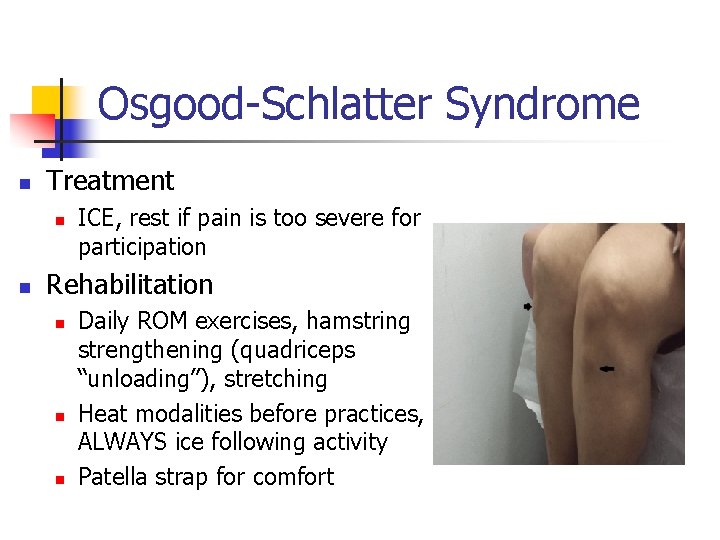
Osgood-Schlatter Syndrome n Treatment n n ICE, rest if pain is too severe for participation Rehabilitation n Daily ROM exercises, hamstring strengthening (quadriceps “unloading”), stretching Heat modalities before practices, ALWAYS ice following activity Patella strap for comfort
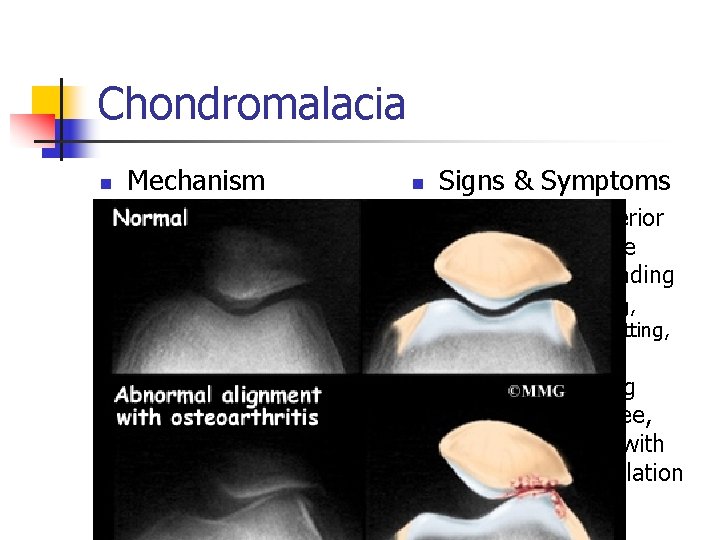
Chondromalacia n Mechanism n Overuse of the patella & quadriceps muscles n n n Signs & Symptoms n Running, walking, jumping, sprinting, etc May be the result of bad patella tracking in the femoral groove Persistent anterior knee pain while flexing & extending n n Stairs, walking, running, squatting, etc Diffuse swelling around the knee, crepitus, pain with patella manipulation
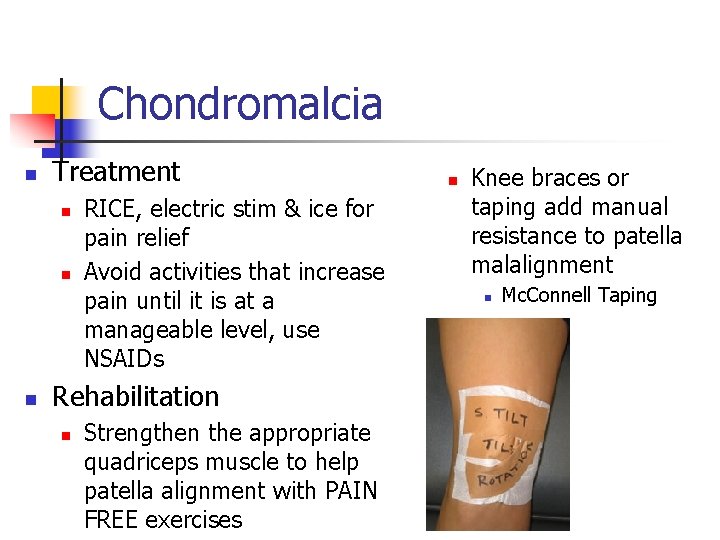
Chondromalcia n Treatment n n n RICE, electric stim & ice for pain relief Avoid activities that increase pain until it is at a manageable level, use NSAIDs Rehabilitation n Strengthen the appropriate quadriceps muscle to help patella alignment with PAIN FREE exercises n Knee braces or taping add manual resistance to patella malalignment n Mc. Connell Taping
Patellar Tendinitis n Mechanism n n AKA: Jumper’s knee Usually due to overuse of the knee leading to chronic inflammation of the patellar tendon (or quadriceps tendon!) n n Typically in sports involving a lot of acceleration/deceleration *Can be acute or chronic! n Signs & Symptoms n TTP at the patellar tendon n n Dull, aching pain around the patella after activity n n n Tendon may FEEL thicker Gets better with rest, but returns with activity Difficulty going up & down stairs, squatting, knee may “give out” ALL LIGAMEMT TESTING IS INTACT!
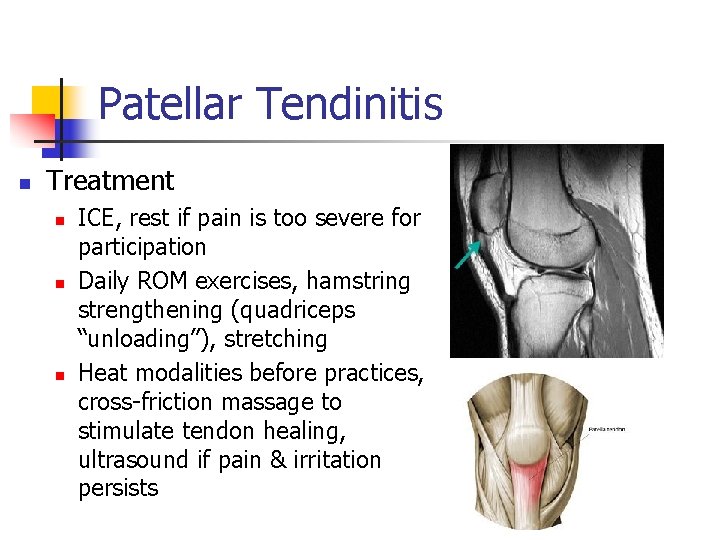
Patellar Tendinitis n Treatment n n n ICE, rest if pain is too severe for participation Daily ROM exercises, hamstring strengthening (quadriceps “unloading”), stretching Heat modalities before practices, cross-friction massage to stimulate tendon healing, ultrasound if pain & irritation persists
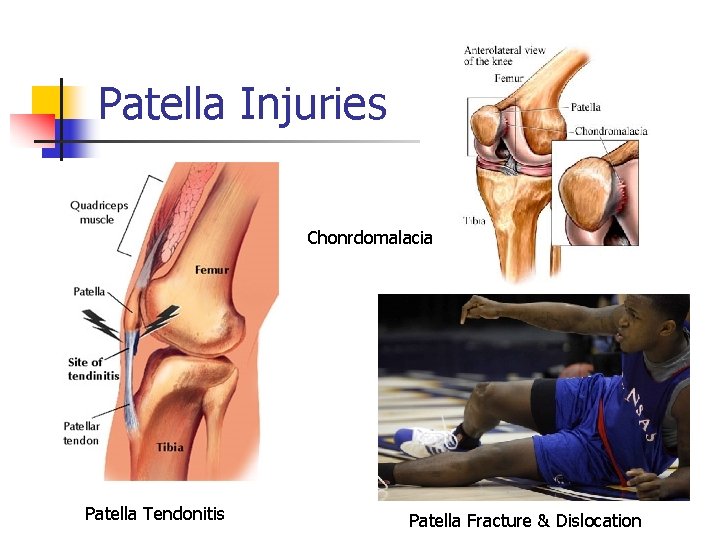
Patella Injuries Chonrdomalacia Patella Tendonitis Patella Fracture & Dislocation
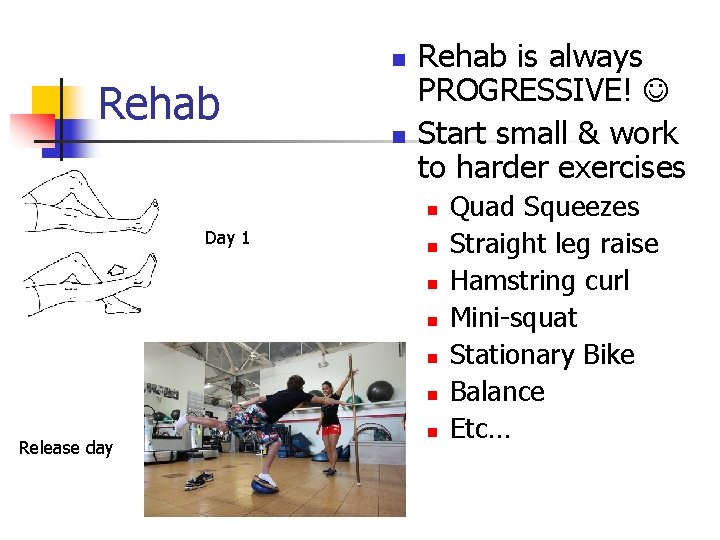
n Rehab is always PROGRESSIVE! Start small & work to harder exercises n Day 1 n n n Release day n Quad Squeezes Straight leg raise Hamstring curl Mini-squat Stationary Bike Balance Etc…
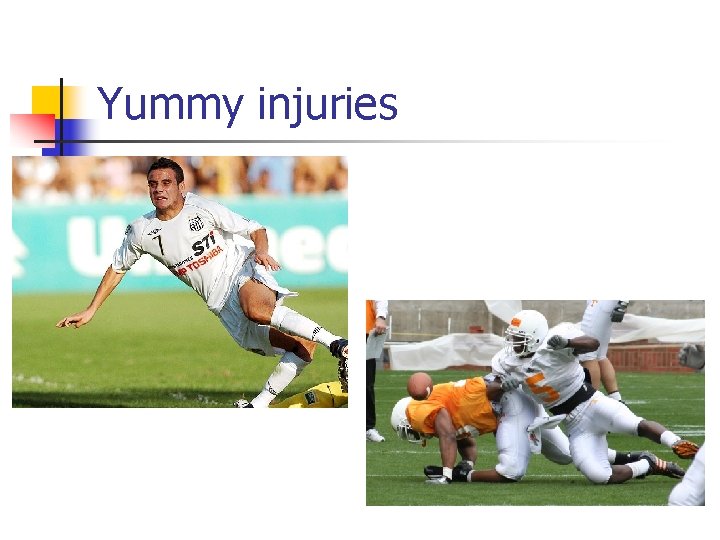
Yummy injuries
- Slides: 26