
Significant Digits Copyrighted by T Darrel Westbrook Significant
Significant Digits Copyrighted © by T. Darrel Westbrook
Significant Digits There are two parts to dealing with uncertainty in science. The first part is covered in this presentation, Significant Digits, and the second part covers error propagation in the presentation Propagation of Uncertainty It is recommended you view Significant Digits presentation first. Significant. Digits. ppt Copyrighted © T. Darrel Westbrook 2
Significant Digits What You Will Learn: – About Accuracy and Precision – About Types of Errors – About Significant Digits (also called Significant Figures) Significant. Digits. ppt Copyrighted © T. Darrel Westbrook 3
Significant Digits Definition: Certainty – is perfect knowledge that has total security from error. Definition: Uncertainty – The lack of certainty. A state of limited knowledge where it is impossible to exactly describe existing state or future outcome from more than one possible outcome. Significant. Digits. ppt Copyrighted © T. Darrel Westbrook 5
Significant Digits We begin our study of significant digits (also called significant figures) with some definitions. Digit: one of the numbers 1, 2, 3, 4, 4, 5, 6, 7, 8, 9, and 0. Significant. Digits. ppt Copyrighted © T. Darrel Westbrook 6
Significant Digits Accuracy: the degree of closeness of a measure to its actual value. Precision: is the degree of reproducibility of a measure or the claimed / implied closeness of a measure. “The results of calculations or a measurement can be accurate but not precise, precise but not accurate, neither, or both. A measurement system or computational method is called valid if it is both accurate and precise. ” Wikipedia Significant. Digits. ppt Copyrighted © T. Darrel Westbrook 7
Significant Digits We are trying to measure as precise as we can, and we do this by making our measurements as consistently accurate as we can. Significant. Digits. ppt Copyrighted © T. Darrel Westbrook 8
Significant Digits Measurement Accuracy: describes how close a measured value is to the true value of the quantity being measured. Measurement Precision: refers to the degree of exactness with which a measurement is made and stated. Significant. Digits. ppt Copyrighted © T. Darrel Westbrook 9
Significant Digits ERRORS Method Error: using different methods to measure the same variable. This can be reduced by standardizing the method. Parallax Error: the error of sight that occurs when not reading a scale perpendicular to the scale. Instrument Error: caused by the devices used to measure experiments. Significant. Digits. ppt Copyrighted © T. Darrel Westbrook 14
Significant Digits When we measure things, the accuracy of our measurements are known within limits of our measuring equipment, our skills of using the equipment, and the number of measurements we take. These all contribute to the uncertainty of our measurements and their use in calculations. We do not want to claim any more accuracy than we are capable of producing. Significant. Digits. ppt Copyrighted © T. Darrel Westbrook 15
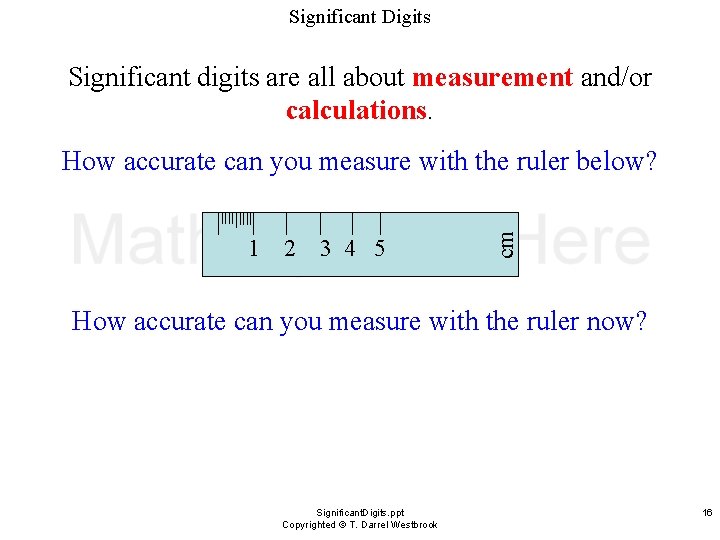
Significant Digits Significant digits are all about measurement and/or calculations. 1 2 3 4 5 cm How accurate can you measure with the ruler below? How accurate can you measure with the ruler now? Significant. Digits. ppt Copyrighted © T. Darrel Westbrook 16
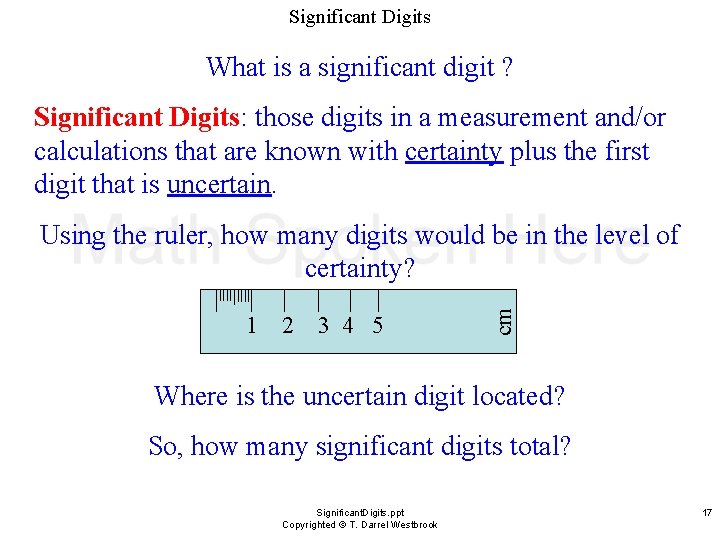
Significant Digits What is a significant digit ? Significant Digits: those digits in a measurement and/or calculations that are known with certainty plus the first digit that is uncertain. 1 2 3 4 5 cm Using the ruler, how many digits would be in the level of certainty? Where is the uncertain digit located? So, how many significant digits total? Significant. Digits. ppt Copyrighted © T. Darrel Westbrook 17
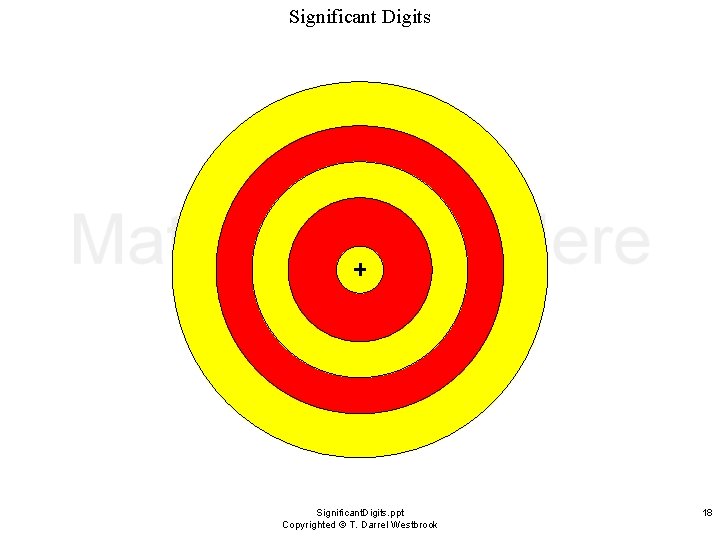
Significant Digits Significant. Digits. ppt Copyrighted © T. Darrel Westbrook 18
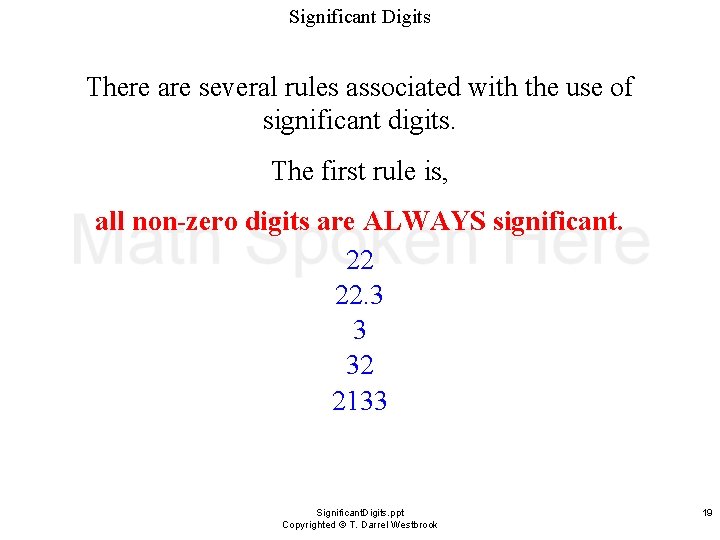
Significant Digits There are several rules associated with the use of significant digits. The first rule is, all non-zero digits are ALWAYS significant. 22 22. 3 3 32 2133 Significant. Digits. ppt Copyrighted © T. Darrel Westbrook 19
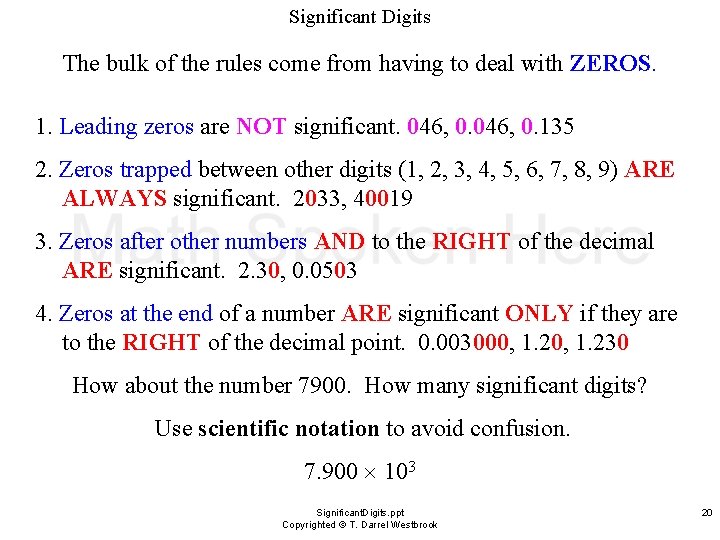
Significant Digits The bulk of the rules come from having to deal with ZEROS. 1. Leading zeros are NOT significant. 046, 0. 135 2. Zeros trapped between other digits (1, 2, 3, 4, 5, 6, 7, 8, 9) ARE ALWAYS significant. 2033, 40019 3. Zeros after other numbers AND to the RIGHT of the decimal ARE significant. 2. 30, 0. 0503 4. Zeros at the end of a number ARE significant ONLY if they are to the RIGHT of the decimal point. 0. 003000, 1. 230 How about the number 7900. How many significant digits? Use scientific notation to avoid confusion. 7. 900 103 Significant. Digits. ppt Copyrighted © T. Darrel Westbrook 20
Significant Digits Calculations Significant. Digits. ppt Copyrighted © T. Darrel Westbrook 21
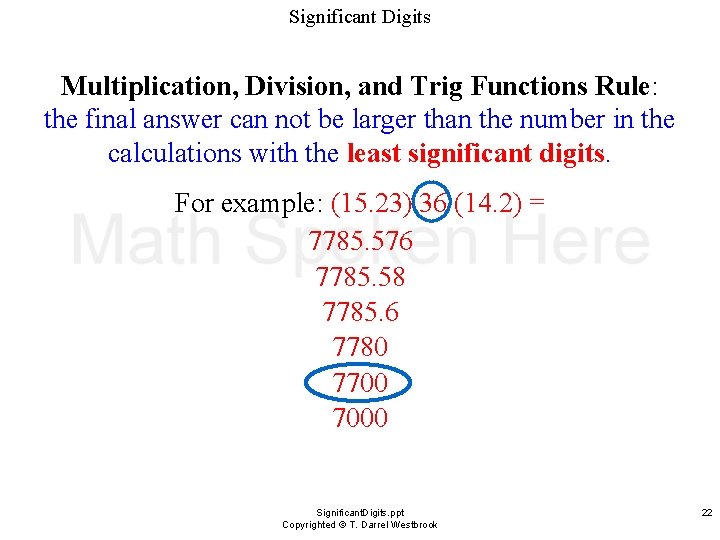
Significant Digits Multiplication, Division, and Trig Functions Rule: the final answer can not be larger than the number in the calculations with the least significant digits. For example: (15. 23) 36 (14. 2) = 7785. 576 7785. 58 7785. 6 7780 7700 7000 Significant. Digits. ppt Copyrighted © T. Darrel Westbrook 22
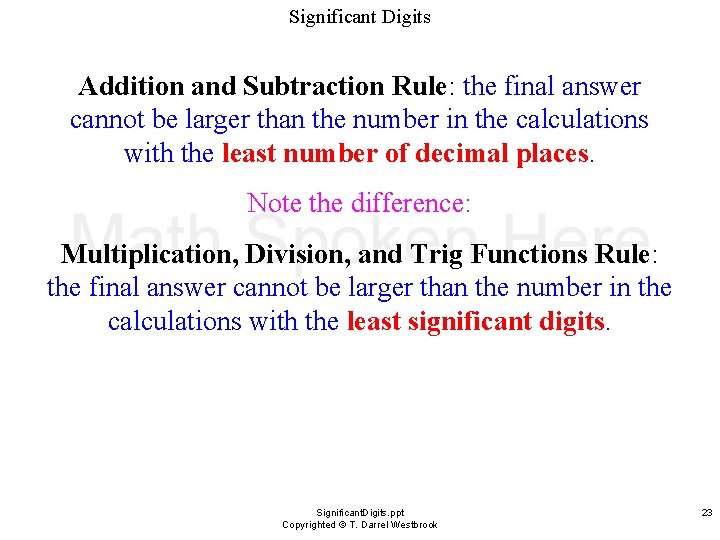
Significant Digits Addition and Subtraction Rule: the final answer cannot be larger than the number in the calculations with the least number of decimal places. Note the difference: Multiplication, Division, and Trig Functions Rule: the final answer cannot be larger than the number in the calculations with the least significant digits. Significant. Digits. ppt Copyrighted © T. Darrel Westbrook 23
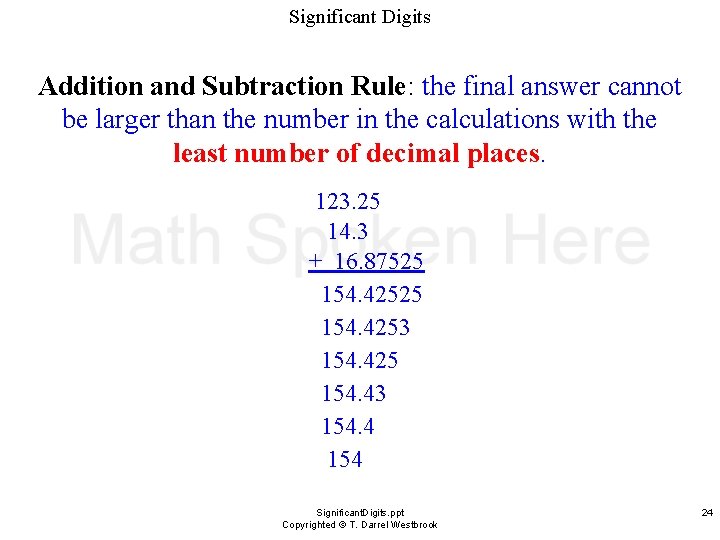
Significant Digits Addition and Subtraction Rule: the final answer cannot be larger than the number in the calculations with the least number of decimal places. 123. 25 14. 3 + 16. 87525 154. 4253 154. 425 154. 43 154. 4 154 Significant. Digits. ppt Copyrighted © T. Darrel Westbrook 24
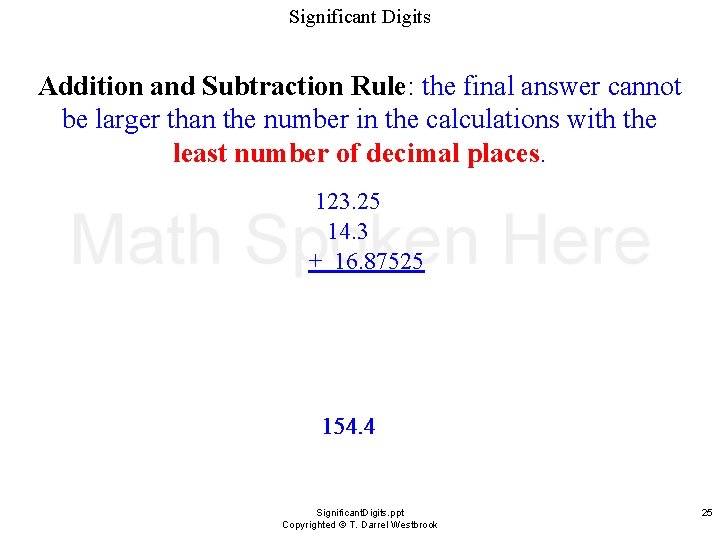
Significant Digits Addition and Subtraction Rule: the final answer cannot be larger than the number in the calculations with the least number of decimal places. 123. 25 14. 3 + 16. 87525 154. 4 Significant. Digits. ppt Copyrighted © T. Darrel Westbrook 25
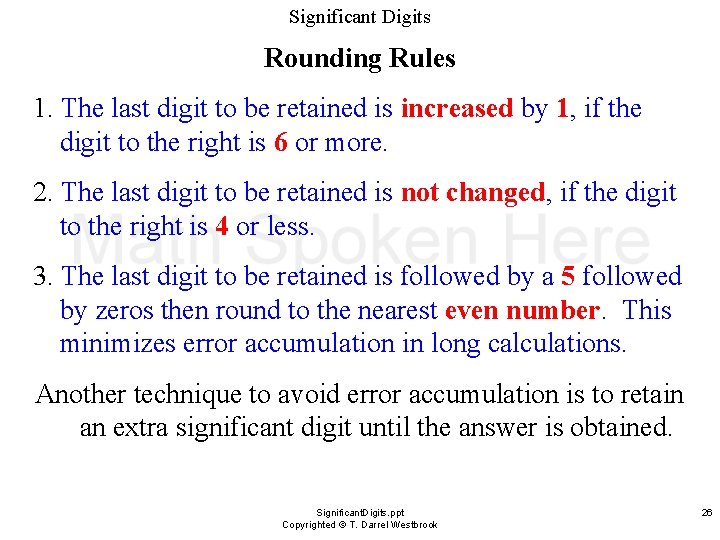
Significant Digits Rounding Rules 1. The last digit to be retained is increased by 1, if the digit to the right is 6 or more. 2. The last digit to be retained is not changed, if the digit to the right is 4 or less. 3. The last digit to be retained is followed by a 5 followed by zeros then round to the nearest even number. This minimizes error accumulation in long calculations. Another technique to avoid error accumulation is to retain an extra significant digit until the answer is obtained. Significant. Digits. ppt Copyrighted © T. Darrel Westbrook 26
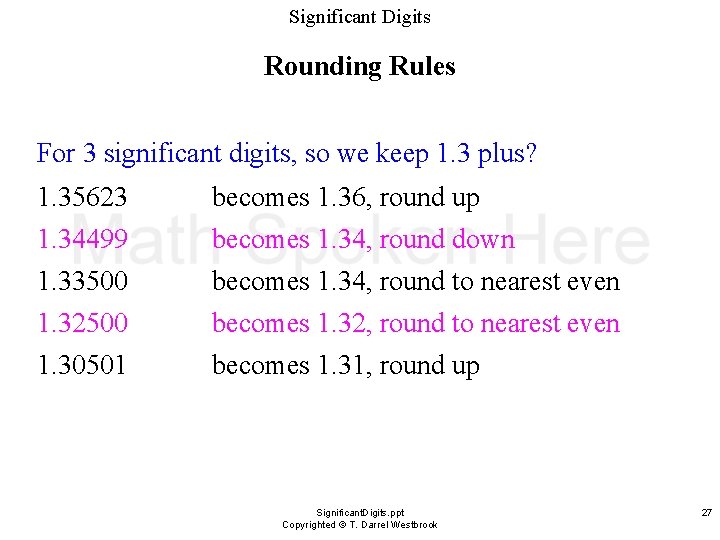
Significant Digits Rounding Rules For 3 significant digits, so we keep 1. 3 plus? 1. 35623 becomes 1. 36, round up 1. 34499 becomes 1. 34, round down 1. 33500 becomes 1. 34, round to nearest even becomes 1. 32, round to nearest even becomes 1. 31, round up 1. 32500 1. 30501 Significant. Digits. ppt Copyrighted © T. Darrel Westbrook 27
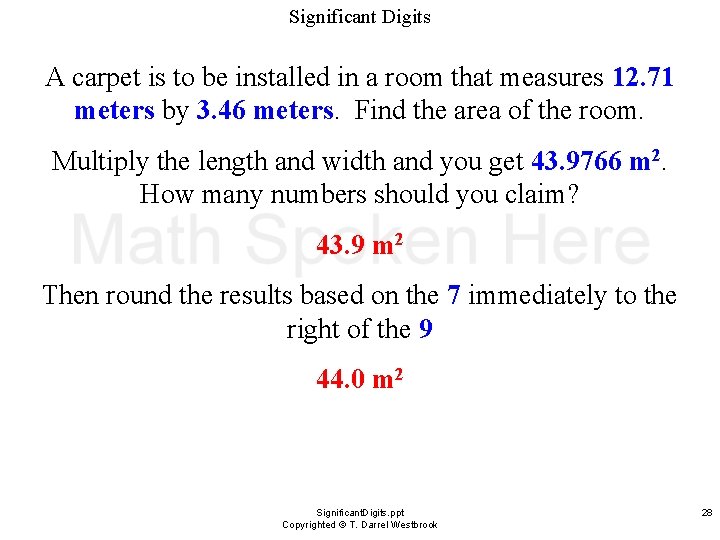
Significant Digits A carpet is to be installed in a room that measures 12. 71 meters by 3. 46 meters. Find the area of the room. Multiply the length and width and you get 43. 9766 m 2. How many numbers should you claim? 43. 9 m 2 Then round the results based on the 7 immediately to the right of the 9 44. 0 m 2 Significant. Digits. ppt Copyrighted © T. Darrel Westbrook 28
Significant Digits What You Have Learned: – About Accuracy and Precision – About Types of Errors – About Significant Digits Significant. Digits. ppt Copyrighted © T. Darrel Westbrook 29
Significant Digits Study Guide Significant. Digits. ppt Copyrighted © T. Darrel Westbrook 30
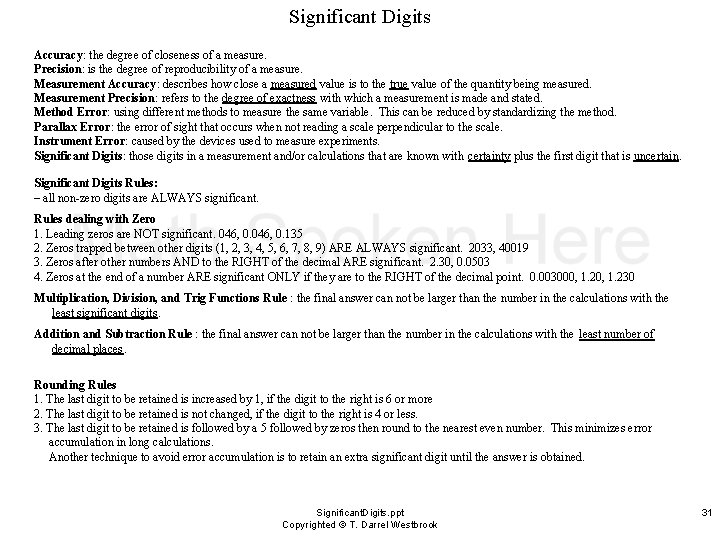
Significant Digits Accuracy: the degree of closeness of a measure. Precision: is the degree of reproducibility of a measure. Measurement Accuracy: describes how close a measured value is to the true value of the quantity being measured. Measurement Precision: refers to the degree of exactness with which a measurement is made and stated. Method Error: using different methods to measure the same variable. This can be reduced by standardizing the method. Parallax Error: the error of sight that occurs when not reading a scale perpendicular to the scale. Instrument Error: caused by the devices used to measure experiments. Significant Digits: those digits in a measurement and/or calculations that are known with certainty plus the first digit that is uncertain. Significant Digits Rules: – all non-zero digits are ALWAYS significant. Rules dealing with Zero 1. Leading zeros are NOT significant. 046, 0. 135 2. Zeros trapped between other digits (1, 2, 3, 4, 5, 6, 7, 8, 9) ARE ALWAYS significant. 2033, 40019 3. Zeros after other numbers AND to the RIGHT of the decimal ARE significant. 2. 30, 0. 0503 4. Zeros at the end of a number ARE significant ONLY if they are to the RIGHT of the decimal point. 0. 003000, 1. 230 Multiplication, Division, and Trig Functions Rule : the final answer can not be larger than the number in the calculations with the least significant digits. Addition and Subtraction Rule : the final answer can not be larger than the number in the calculations with the least number of decimal places. Rounding Rules 1. The last digit to be retained is increased by 1, if the digit to the right is 6 or more 2. The last digit to be retained is not changed, if the digit to the right is 4 or less. 3. The last digit to be retained is followed by a 5 followed by zeros then round to the nearest even number. This minimizes error accumulation in long calculations. Another technique to avoid error accumulation is to retain an extra significant digit until the answer is obtained. Significant. Digits. ppt Copyrighted © T. Darrel Westbrook 31
Significant Digits End of Line Significant. Digits. ppt Copyrighted © T. Darrel Westbrook 32
- Slides: 27