
SIGNATURE SELLING METHOD SALES AIDS SMBWebsite Management Purpose
® SIGNATURE SELLING METHOD SALES AIDS SMB-Website Management
Purpose To introduce the IBM Business Partners with the Sales Aids for the IBM Signature Selling Method for Website Management. IBM Signature Selling Method • IBM Corporation © 2000
IBM High Performance Selling. . . become the premier marketing and sales company in our industry High Performance Selling Objectives: n. Move from mind share to much more market share n. Generate more revenue from existing customers n. Create new customers and new workloads n. Leverage key components: hiring, incentive plans, professional training, SSM. . . Signature Selling Method Objective: n. Create customer value at every stage in the buying process n. Create and leverage the synergy of Team IBM n. Improve the speed, quality, and volume of our opportunity pipeline What it means to IBM sellers: nshorter sell cycles nimproved win rates nmore and larger-sized opportunities IBM Signature Selling Method • IBM Corporation © 2000
The IBM Signature Selling Method Design Principles n. Customer focused n. Leverages IBM e-business strategy n. Tightly integrated with sales management n. Drives a disciplined, common approach to selling, for both complex and transactional sales ncommon language ncommon outcome and sell cycles ncommon IBM sales culture nlinked to other IBM processes (e. g. CRM) n. Defined, measurable, predictable, repeatable and "user friendly" n. Rich, help-oriented sales aids n. Universal and scalable IBM Signature Selling Method • IBM Corporation © 2000
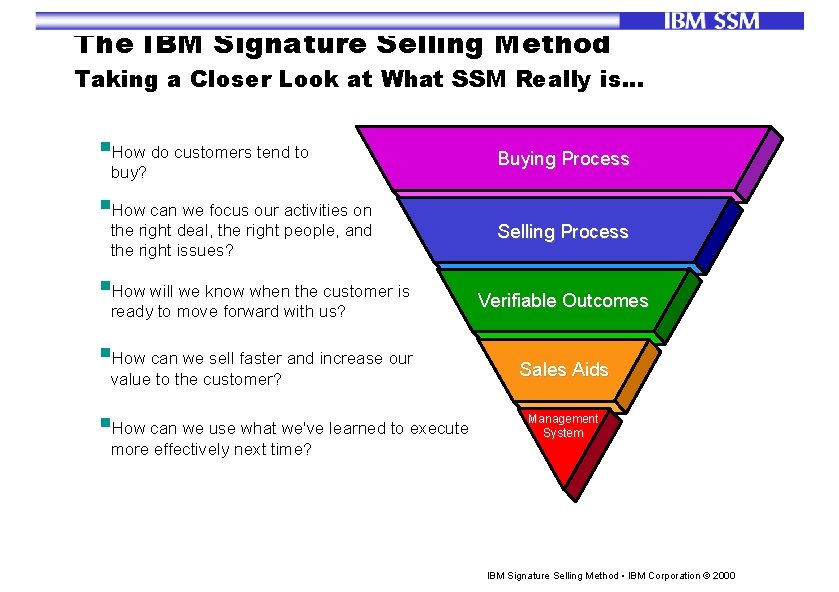
The IBM Signature Selling Method Taking a Closer Look at What SSM Really is. . . §How do customers tend to buy? §How can we focus our activities on the right deal, the right people, and the right issues? §How will we know when the customer is ready to move forward with us? §How can we sell faster and increase our value to the customer? §How can we use what we've learned to execute more effectively next time? Buying Process Selling Process Verifiable Outcomes Sales Aids Management System IBM Signature Selling Method • IBM Corporation © 2000
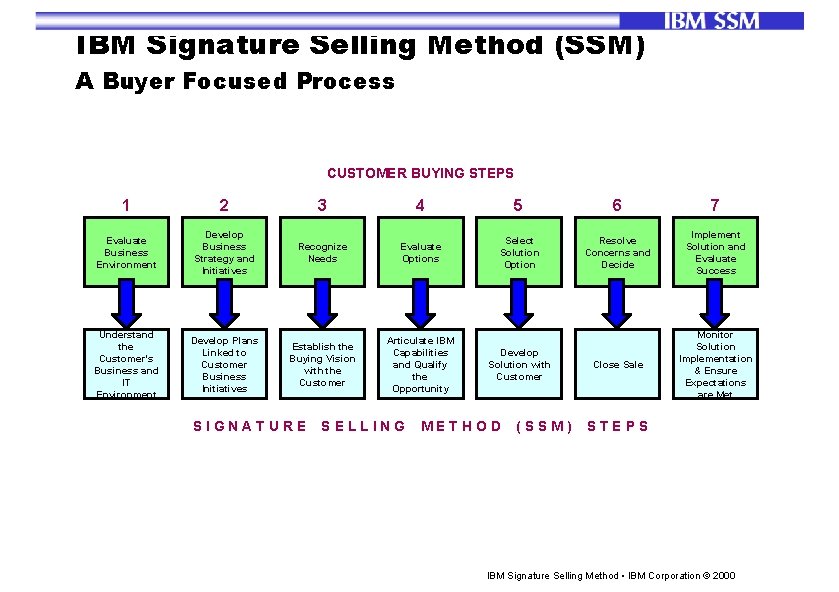
IBM Signature Selling Method (SSM) A Buyer Focused Process CUSTOMER BUYING STEPS 1 2 3 4 5 6 7 Evaluate Business Environment Develop Business Strategy and Initiatives Recognize Needs Evaluate Options Select Solution Option Resolve Concerns and Decide Implement Solution and Evaluate Success Understand the Customer's Business and IT Environment Develop Plans Linked to Customer Business Initiatives Establish the Buying Vision with the Customer Articulate IBM Capabilities and Qualify the Opportunity Close Sale Monitor Solution Implementation & Ensure Expectations are Met SIGNATURE SELLING Develop Solution with Customer METHOD (SSM) STEPS IBM Signature Selling Method • IBM Corporation © 2000

IBM SSM: Sales Aids to help achieve verifiable outcomes CUSTOMER Evaluate Business Environment Develop Business Strategy and Initiatives Recognize Needs SIGNATURE Understand the Customer's Business and IT Environment Develop Plans Linked to Customer Business Initiatives BUYING Evaluate Options SELLING Establish the Buying Vision with the Customer STEPS Select Solution Option METHOD Articulate IBM Capabilities and Qualify the Opportunity (SSM) Develop Solution with Customer Resolve Concerns and Decide Implement Solution and Evaluate Success STEPS Close Sale Monitor Solution Implementation & Ensure Expectations are Met SELL CYCLE CODES Identify Validate Qualify Propose Won SSM SALES AIDS §Business Initiatives §Pain Chain §Key Players List §Business Development Prompter §Reference Story §Value Statement §Pain Sheet §Sponsor Letter §Power Sponsor Letter §Evaluation Plan §Integrated Solution Concept §Refined Value Statement §Pain Chain §Measure Benefits §Value Proposition §Preliminary Solution §Value Proposition IBM Signature Selling Method • IBM Corporation © 2000
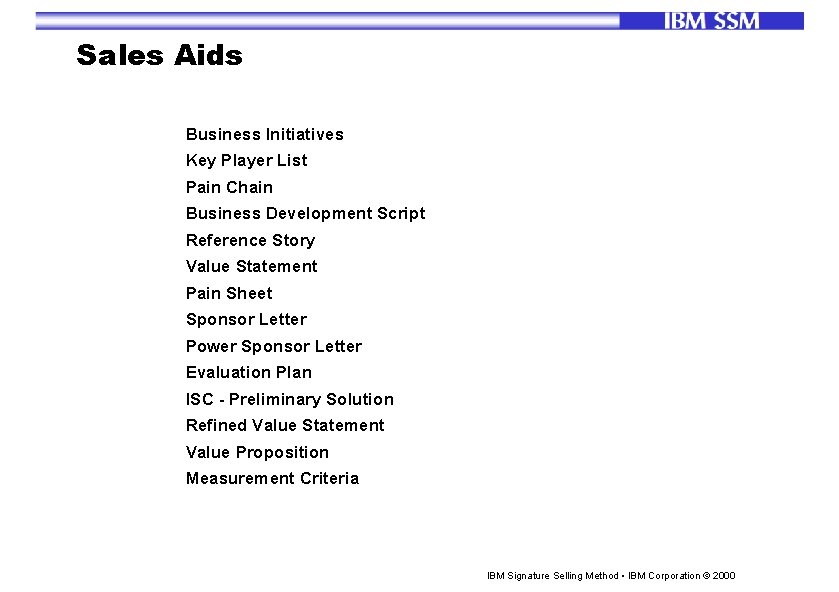
Sales Aids Business Initiatives Key Player List Pain Chain Business Development Script Reference Story Value Statement Pain Sheet Sponsor Letter Power Sponsor Letter Evaluation Plan ISC - Preliminary Solution Refined Value Statement Value Proposition Measurement Criteria IBM Signature Selling Method • IBM Corporation © 2000
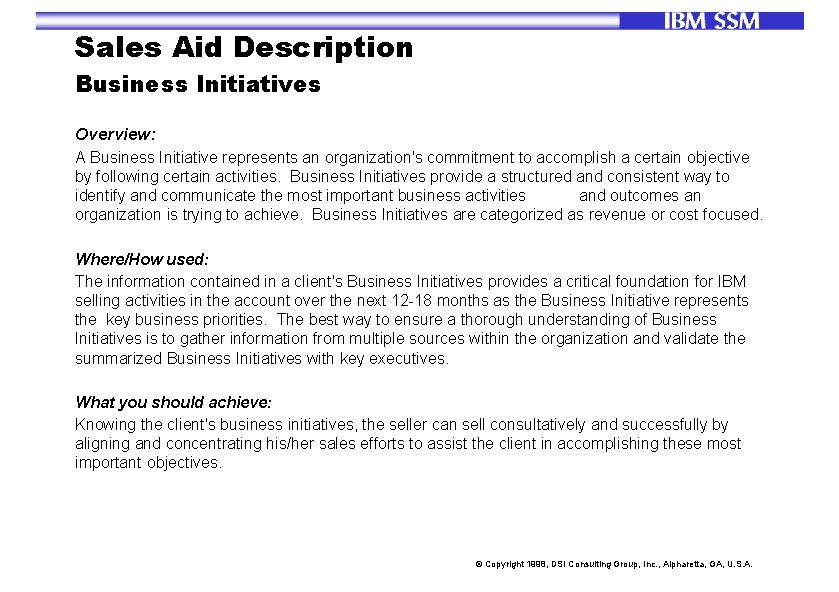
Sales Aid Description Business Initiatives Overview: A Business Initiative represents an organization's commitment to accomplish a certain objective by following certain activities. Business Initiatives provide a structured and consistent way to identify and communicate the most important business activities and outcomes an organization is trying to achieve. Business Initiatives are categorized as revenue or cost focused. Where/How used: The information contained in a client's Business Initiatives provides a critical foundation for IBM selling activities in the account over the next 12 -18 months as the Business Initiative represents the key business priorities. The best way to ensure a thorough understanding of Business Initiatives is to gather information from multiple sources within the organization and validate the summarized Business Initiatives with key executives. What you should achieve: Knowing the client's business initiatives, the seller can sell consultatively and successfully by aligning and concentrating his/her sales efforts to assist the client in accomplishing these most important objectives. © Copyright 1998, DSI Consulting Group, Inc. , Alpharetta, GA, U. S. A.
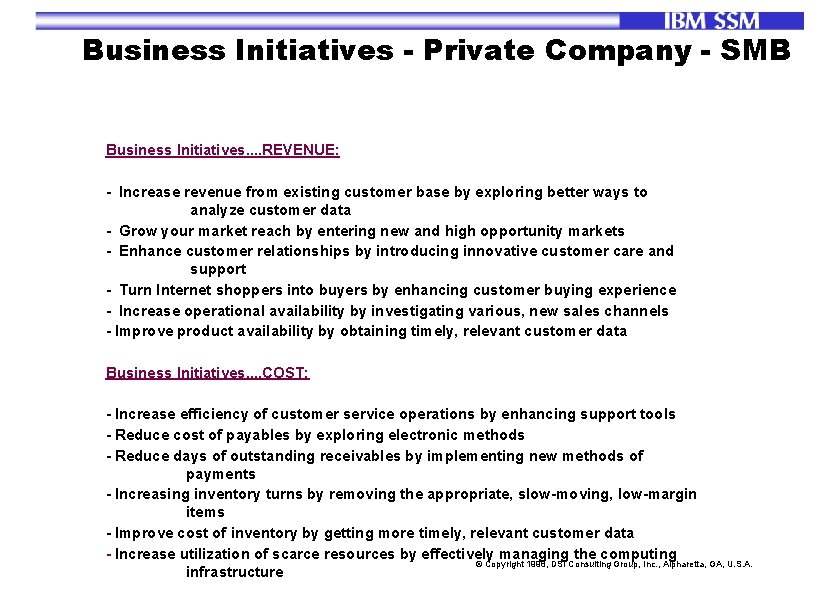
Business Initiatives - Private Company - SMB Business Initiatives. . REVENUE: - Increase revenue from existing customer base by exploring better ways to analyze customer data - Grow your market reach by entering new and high opportunity markets - Enhance customer relationships by introducing innovative customer care and support - Turn Internet shoppers into buyers by enhancing customer buying experience - Increase operational availability by investigating various, new sales channels - Improve product availability by obtaining timely, relevant customer data Business Initiatives. . COST: - Increase efficiency of customer service operations by enhancing support tools - Reduce cost of payables by exploring electronic methods - Reduce days of outstanding receivables by implementing new methods of payments - Increasing inventory turns by removing the appropriate, slow-moving, low-margin items - Improve cost of inventory by getting more timely, relevant customer data - Increase utilization of scarce resources by effectively managing the computing © Copyright 1998, DSI Consulting Group, Inc. , Alpharetta, GA, U. S. A. infrastructure
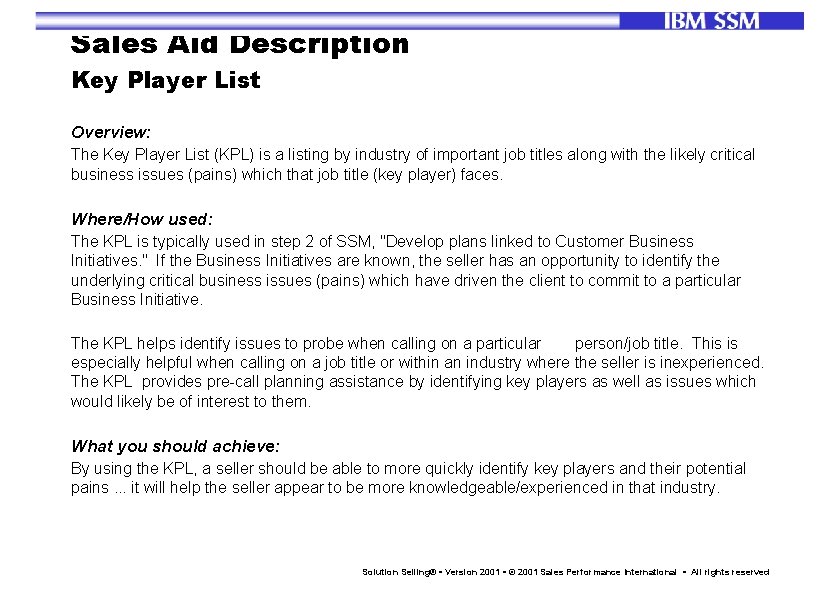
Sales Aid Description Key Player List Overview: The Key Player List (KPL) is a listing by industry of important job titles along with the likely critical business issues (pains) which that job title (key player) faces. Where/How used: The KPL is typically used in step 2 of SSM, "Develop plans linked to Customer Business Initiatives. " If the Business Initiatives are known, the seller has an opportunity to identify the underlying critical business issues (pains) which have driven the client to commit to a particular Business Initiative. The KPL helps identify issues to probe when calling on a particular person/job title. This is especially helpful when calling on a job title or within an industry where the seller is inexperienced. The KPL provides pre-call planning assistance by identifying key players as well as issues which would likely be of interest to them. What you should achieve: By using the KPL, a seller should be able to more quickly identify key players and their potential pains. . . it will help the seller appear to be more knowledgeable/experienced in that industry. Solution Selling® • Version 2001 • © 2001 Sales Performance International • All rights reserved
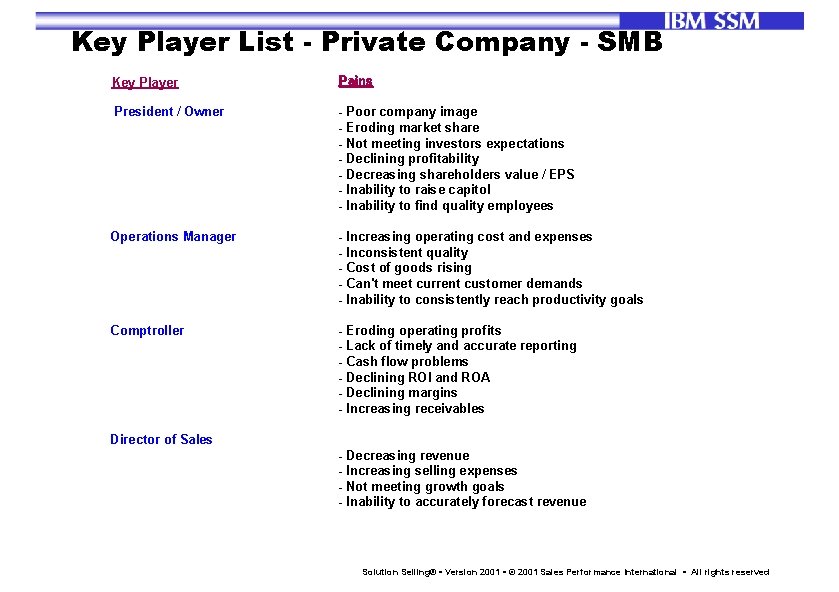
Key Player List - Private Company - SMB Key Player Pains President / Owner - Poor company image - Eroding market share - Not meeting investors expectations - Declining profitability - Decreasing shareholders value / EPS - Inability to raise capitol - Inability to find quality employees Operations Manager - Increasing operating cost and expenses - Inconsistent quality - Cost of goods rising - Can't meet current customer demands - Inability to consistently reach productivity goals Comptroller - Eroding operating profits - Lack of timely and accurate reporting - Cash flow problems - Declining ROI and ROA - Declining margins - Increasing receivables Director of Sales - Decreasing revenue - Increasing selling expenses - Not meeting growth goals - Inability to accurately forecast revenue Solution Selling® • Version 2001 • © 2001 Sales Performance International • All rights reserved
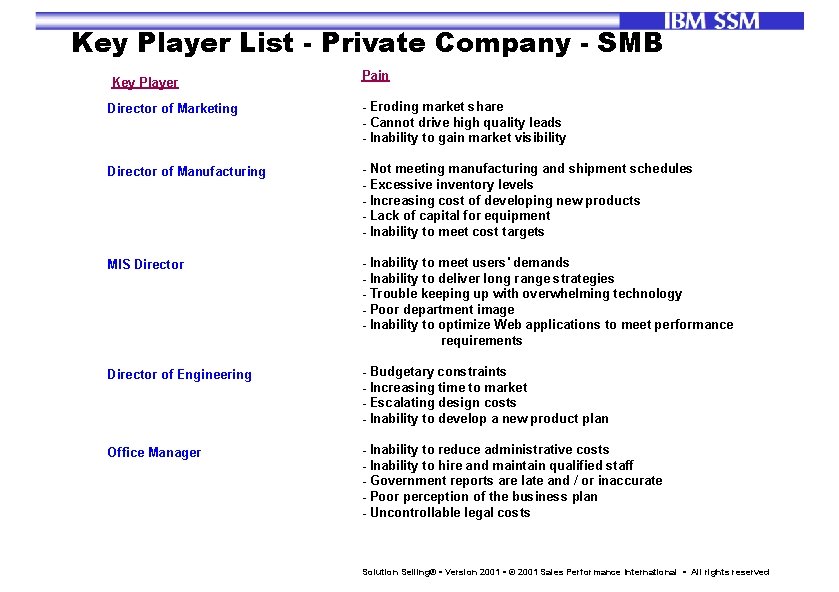
Key Player List - Private Company - SMB Key Player Pain Director of Marketing - Eroding market share - Cannot drive high quality leads - Inability to gain market visibility Director of Manufacturing - Not meeting manufacturing and shipment schedules - Excessive inventory levels - Increasing cost of developing new products - Lack of capital for equipment - Inability to meet cost targets MIS Director - Inability to meet users' demands - Inability to deliver long range strategies - Trouble keeping up with overwhelming technology - Poor department image - Inability to optimize Web applications to meet performance requirements Director of Engineering - Budgetary constraints - Increasing time to market - Escalating design costs - Inability to develop a new product plan Office Manager - Inability to reduce administrative costs - Inability to hire and maintain qualified staff - Government reports are late and / or inaccurate - Poor perception of the business plan - Uncontrollable legal costs Solution Selling® • Version 2001 • © 2001 Sales Performance International • All rights reserved
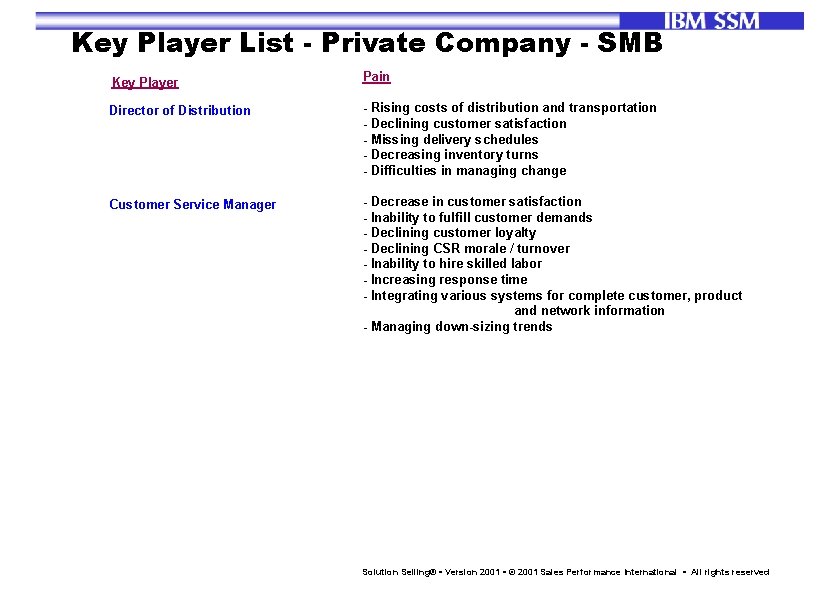
Key Player List - Private Company - SMB Key Player Pain Director of Distribution - Rising costs of distribution and transportation - Declining customer satisfaction - Missing delivery schedules - Decreasing inventory turns - Difficulties in managing change Customer Service Manager - Decrease in customer satisfaction - Inability to fulfill customer demands - Declining customer loyalty - Declining CSR morale / turnover - Inability to hire skilled labor - Increasing response time - Integrating various systems for complete customer, product and network information - Managing down-sizing trends Solution Selling® • Version 2001 • © 2001 Sales Performance International • All rights reserved
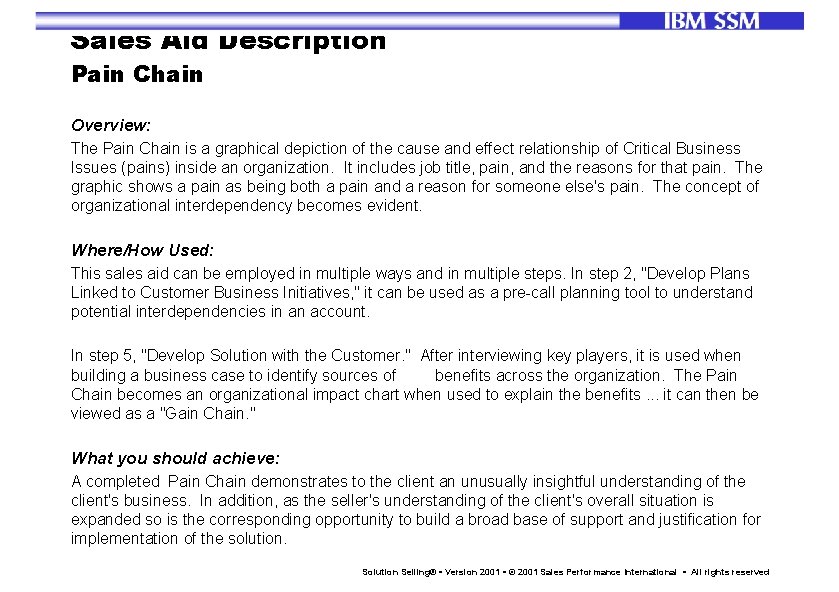
Sales Aid Description Pain Chain Overview: The Pain Chain is a graphical depiction of the cause and effect relationship of Critical Business Issues (pains) inside an organization. It includes job title, pain, and the reasons for that pain. The graphic shows a pain as being both a pain and a reason for someone else's pain. The concept of organizational interdependency becomes evident. Where/How Used: This sales aid can be employed in multiple ways and in multiple steps. In step 2, "Develop Plans Linked to Customer Business Initiatives, " it can be used as a pre-call planning tool to understand potential interdependencies in an account. In step 5, "Develop Solution with the Customer. " After interviewing key players, it is used when building a business case to identify sources of benefits across the organization. The Pain Chain becomes an organizational impact chart when used to explain the benefits. . . it can then be viewed as a "Gain Chain. " What you should achieve: A completed Pain Chain demonstrates to the client an unusually insightful understanding of the client's business. In addition, as the seller's understanding of the client's overall situation is expanded so is the corresponding opportunity to build a broad base of support and justification for implementation of the solution. Solution Selling® • Version 2001 • © 2001 Sales Performance International • All rights reserved
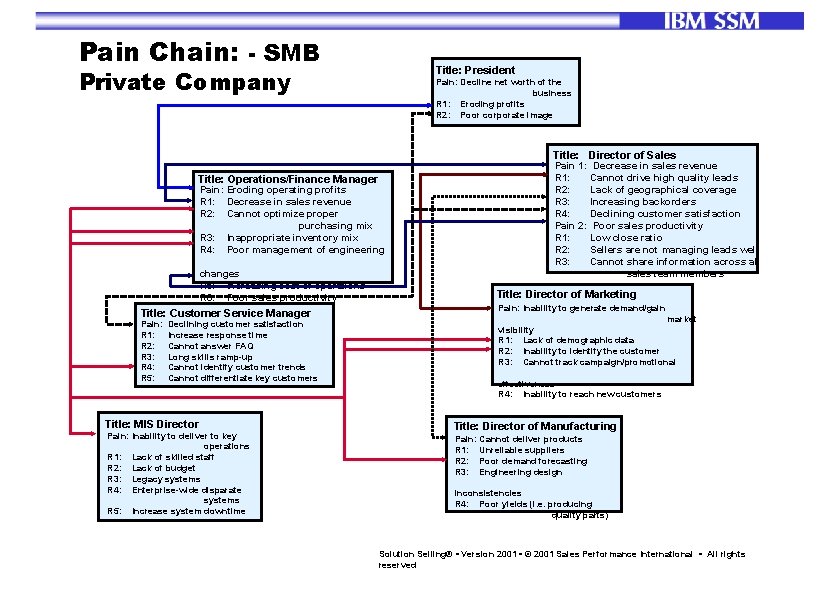
Pain Chain: - SMB Title: President Private Company Pain: Decline net worth of the business R 1: Eroding profits R 2: Poor corporate image Title: Director of Sales Title: Operations/Finance Manager Pain: Eroding operating profits R 1: Decrease in sales revenue R 2: Cannot optimize proper purchasing mix R 3: Inappropriate inventory mix R 4: Poor management of engineering changes R 5: Increasing cost of operations R 6: Poor sales productivity Title: Customer Service Manager Pain: R 1: R 2: R 3: R 4: R 5: Declining customer satisfaction Increase response time Cannot answer FAQ Long skills ramp-up Cannot identify customer trends Cannot differentiate key customers Title: MIS Director Pain: Inability to deliver to key operations R 1: Lack of skilled staff R 2: Lack of budget R 3: Legacy systems R 4: Enterprise-wide disparate systems R 5: Increase system downtime Pain 1: Decrease in sales revenue R 1: Cannot drive high quality leads R 2: Lack of geographical coverage R 3: Increasing backorders R 4: Declining customer satisfaction Pain 2: Poor sales productivity R 1: Low close ratio R 2: Sellers are not managing leads well R 3: Cannot share information across all sales team members Title: Director of Marketing Pain: Inability to generate demand/gain market visibility R 1: Lack of demographic data R 2: Inability to identify the customer R 3: Cannot track campaign/promotional effectiveness R 4: Inability to reach new customers Title: Director of Manufacturing Pain: Cannot deliver products R 1: Unreliable suppliers R 2: Poor demand forecasting R 3: Engineering design inconsistencies R 4: Poor yields (i. e. producing quality parts) Solution Selling® • Version 2001 • © 2001 Sales Performance International • All rights reserved
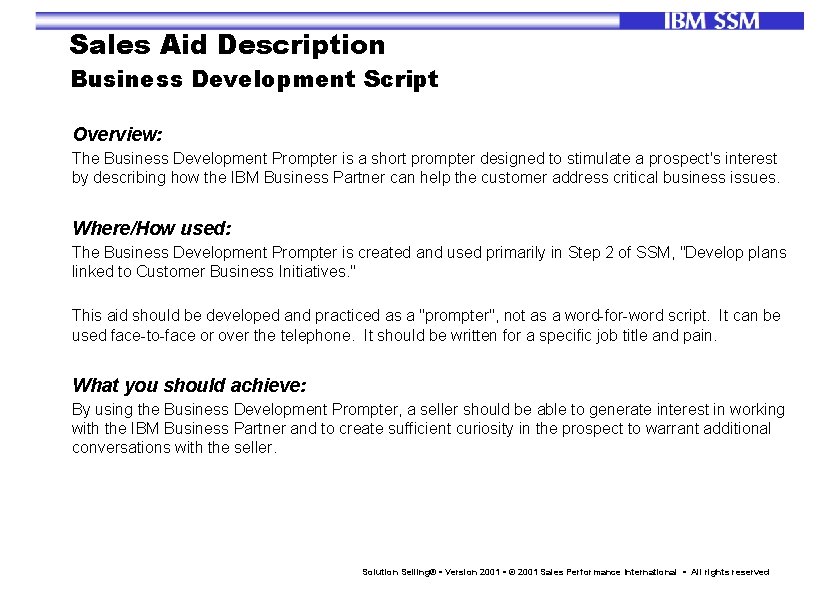
Sales Aid Description Business Development Script Overview: The Business Development Prompter is a short prompter designed to stimulate a prospect's interest by describing how the IBM Business Partner can help the customer address critical business issues. Where/How used: The Business Development Prompter is created and used primarily in Step 2 of SSM, "Develop plans linked to Customer Business Initiatives. " This aid should be developed and practiced as a "prompter", not as a word-for-word script. It can be used face-to-face or over the telephone. It should be written for a specific job title and pain. What you should achieve: By using the Business Development Prompter, a seller should be able to generate interest in working with the IBM Business Partner and to create sufficient curiosity in the prospect to warrant additional conversations with the seller. Solution Selling® • Version 2001 • © 2001 Sales Performance International • All rights reserved
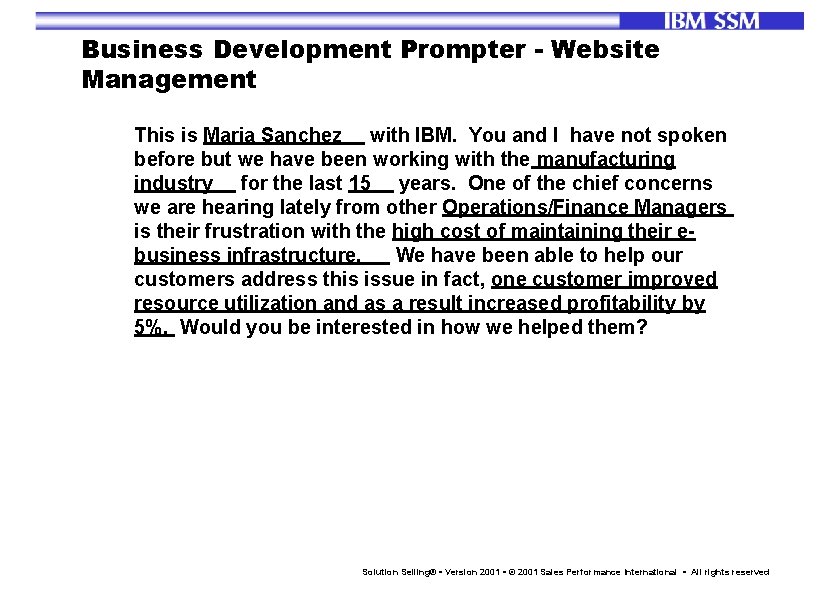
Business Development Prompter - Website Management This is Maria Sanchez with IBM. You and I have not spoken before but we have been working with the manufacturing industry for the last 15 years. One of the chief concerns we are hearing lately from other Operations/Finance Managers is their frustration with the high cost of maintaining their ebusiness infrastructure. We have been able to help our customers address this issue in fact, one customer improved resource utilization and as a result increased profitability by 5%. Would you be interested in how we helped them? Solution Selling® • Version 2001 • © 2001 Sales Performance International • All rights reserved
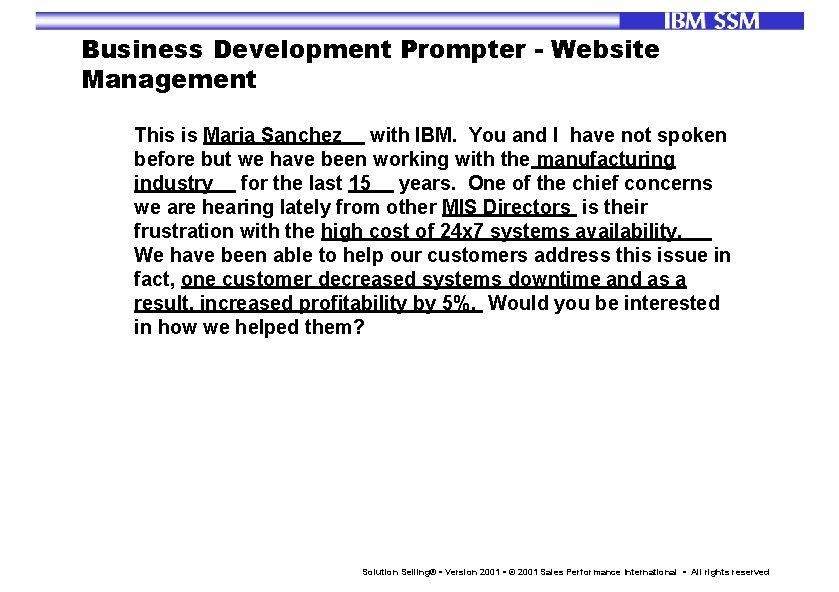
Business Development Prompter - Website Management This is Maria Sanchez with IBM. You and I have not spoken before but we have been working with the manufacturing industry for the last 15 years. One of the chief concerns we are hearing lately from other MIS Directors is their frustration with the high cost of 24 x 7 systems availability. We have been able to help our customers address this issue in fact, one customer decreased systems downtime and as a result, increased profitability by 5%. Would you be interested in how we helped them? Solution Selling® • Version 2001 • © 2001 Sales Performance International • All rights reserved
Sales Aid Description Reference Story Overview: This sales aid provides a seller with a dialogue prompter to help build credibility to help a client begin discussing their critical issues (pain). It gives the seller an opportunity to share situationally specific examples of how the prospect's peers have been helped by implementing capabilities provided by IBM. It also helps in the seller. Where/How Used: It is used as a prompter. . . not a script. This sales aid is typically part of Step 2, "Develop Plans Linked to Customer Business Initiatives. " but can be used effective in other steps to assist in building credibility or getting pain admitted. What you should achieve: When used successfully, the prospect will either admit pain, or the seller will discover that the prospect already has a vision of a solution. The conversation could then continue further by vision processing (creation or reengineering) Solution Selling® • Version 2001 • © 2001 Sales Performance International • All rights reserved
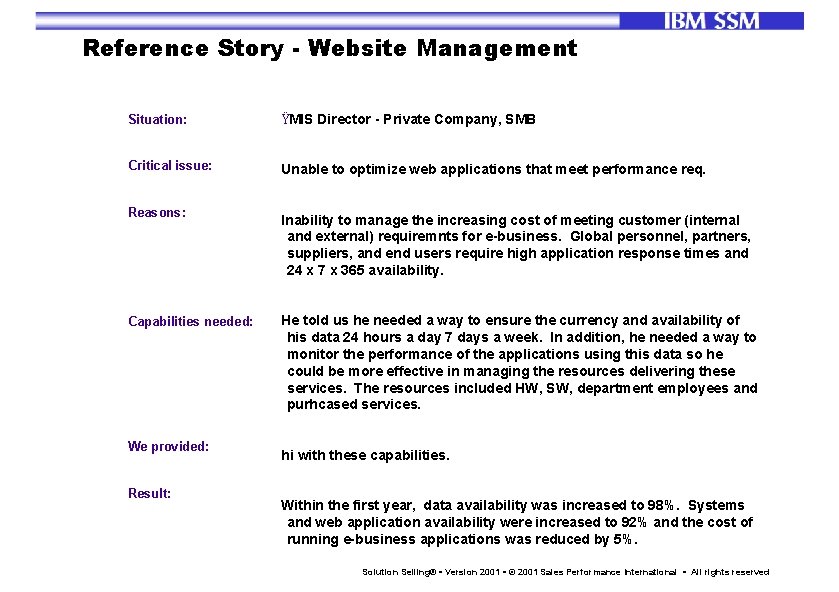
Reference Story - Website Management Situation: ŸMIS Director - Private Company, SMB Critical issue: Unable to optimize web applications that meet performance req. Reasons: Capabilities needed: We provided: Result: Inability to manage the increasing cost of meeting customer (internal and external) requiremnts for e-business. Global personnel, partners, suppliers, and end users require high application response times and 24 x 7 x 365 availability. He told us he needed a way to ensure the currency and availability of his data 24 hours a day 7 days a week. In addition, he needed a way to monitor the performance of the applications using this data so he could be more effective in managing the resources delivering these services. The resources included HW, SW, department employees and purhcased services. hi with these capabilities. Within the first year, data availability was increased to 98%. Systems and web application availability were increased to 92% and the cost of running e-business applications was reduced by 5%. Solution Selling® • Version 2001 • © 2001 Sales Performance International • All rights reserved
Sales Aid Description Value Statement Overview: A statement which projects the potential quantified benefit (value) a client could realize through the implementation of a specific capability or solution provided by IBM. It is intended to create curiosity and serve as the catalyst to start a sales cycle. Where/How used: The projected quantified benefits are extrapolated from a previous successful IBM implementation or engagement and mapped to the prospective client. The primary use is to stimulate interest in what IBM may have to offer. If interest is generated, the Value Statement will be refined during the sell cycle and will eventually evolve to become the Value Proposition. What you should achieve: The Value Statement should stimulate interest with the client (or prospect) and commence a sell cycle for IBM. Solution Selling® • Version 2001 • © 2001 Sales Performance International • All rights reserved
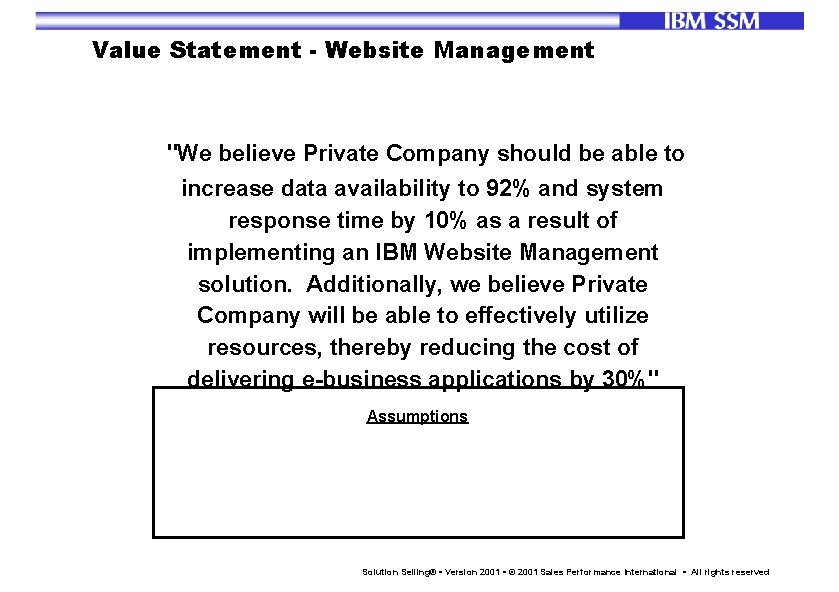
Value Statement - Website Management "We believe Private Company should be able to increase data availability to 92% and system response time by 10% as a result of implementing an IBM Website Management solution. Additionally, we believe Private Company will be able to effectively utilize resources, thereby reducing the cost of delivering e-business applications by 30%" Assumptions Solution Selling® • Version 2001 • © 2001 Sales Performance International • All rights reserved
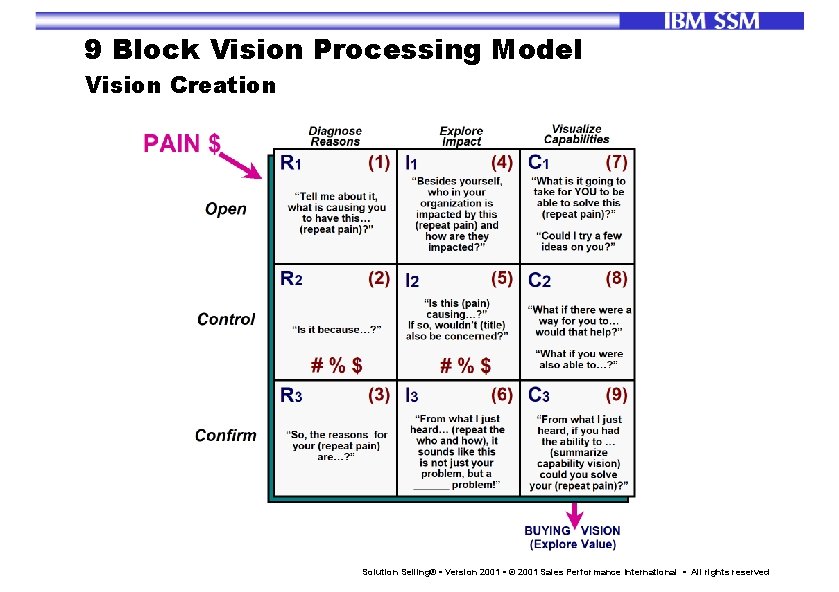
9 Block Vision Processing Model Vision Creation Solution Selling® • Version 2001 • © 2001 Sales Performance International • All rights reserved
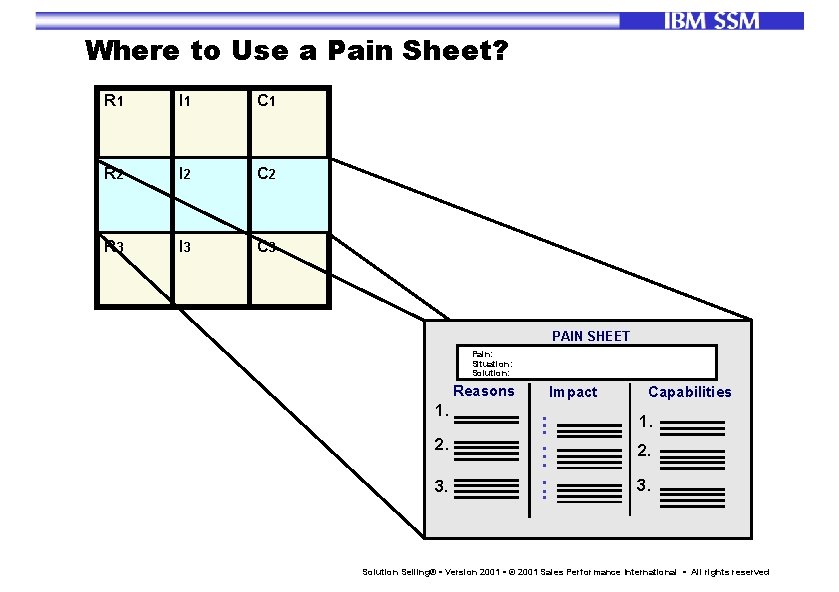
Where to Use a Pain Sheet? R 1 I 1 C 1 R 2 I 2 C 2 R 3 I 3 C 3 PAIN SHEET Pain: Situation: Solution: Reasons 1. Impact 2. • • • 3. • • • Capabilities 1. 2. 3. Solution Selling® • Version 2001 • © 2001 Sales Performance International • All rights reserved
Sales Aid Description Pain Sheet Overview: A Pain Sheet is a prompter used with the 9 Block Diagnostic Model. It provides a set of questions to help diagnose a business issue (pain), identify the impacts of that pain in the rest of the organization, and describe the capabilities IBM could provide to address the pain. It is an integral aid to creating (or reengineering) visions biased to IBM offerings/solutions. Where/How used: It is used with the 9 Block Diagnostic Model for creating (or reengineering) visions of solutions (during step 3 and step 4 of SSM) biased toward IBM offerings/solutions. What you should achieve: The use of the Pain Sheet with the 9 Block Diagnostic Model will help bring the buyer to a vision of how he/she will be able to address their critical business issue (pain) as well as quantifying the value to them and understanding the impact their pain has across the organization. Solution Selling® • Version 2001 • © 2001 Sales Performance International • All rights reserved
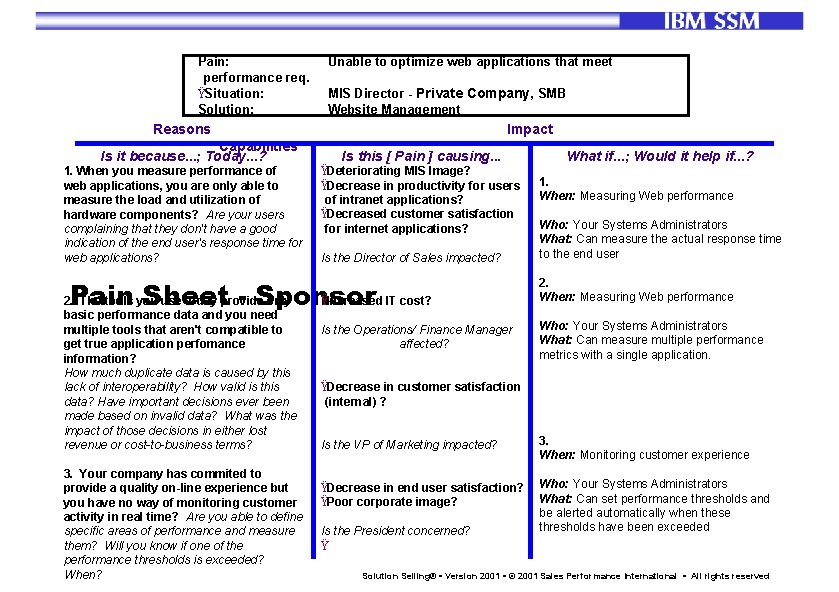
Pain: performance req. ŸSituation: Solution: Unable to optimize web applications that meet MIS Director - Private Company, SMB Website Management Reasons Capabilities Is it because. . . ; Today. . . ? 1. When you measure performance of web applications, you are only able to measure the load and utilization of hardware components? Are your users complaining that they don't have a good indication of the end user's response time for web applications? Impact Is this [ Pain ] causing. . . ŸDeteriorating MIS Image? ŸDecrease in productivity for users of intranet applications? ŸDecreased customer satisfaction for internet applications? Is the Director of Sales impacted? ŸIncreased IT cost? Pain Sheet - Sponsor 2. The tools you use today provide only basic performance data and you need multiple tools that aren't compatible to get true application perfomance information? How much duplicate data is caused by this lack of interoperability? How valid is this data? Have important decisions ever been made based on invalid data? What was the impact of those decisions in either lost revenue or cost-to-business terms? 3. Your company has commited to provide a quality on-line experience but you have no way of monitoring customer activity in real time? Are you able to define specific areas of performance and measure them? Will you know if one of the performance thresholds is exceeded? When? Is the Operations/ Finance Manager affected? What if. . . ; Would it help if. . . ? 1. When: Measuring Web performance Who: Your Systems Administrators What: Can measure the actual response time to the end user 2. When: Measuring Web performance Who: Your Systems Administrators What: Can measure multiple performance metrics with a single application. ŸDecrease in customer satisfaction (internal) ? Is the VP of Marketing impacted? 3. When: Monitoring customer experience ŸDecrease in end user satisfaction? ŸPoor corporate image? Who: Your Systems Administrators What: Can set performance thresholds and be alerted automatically when these thresholds have been exceeded Is the President concerned? Ÿ Solution Selling® • Version 2001 • © 2001 Sales Performance International • All rights reserved
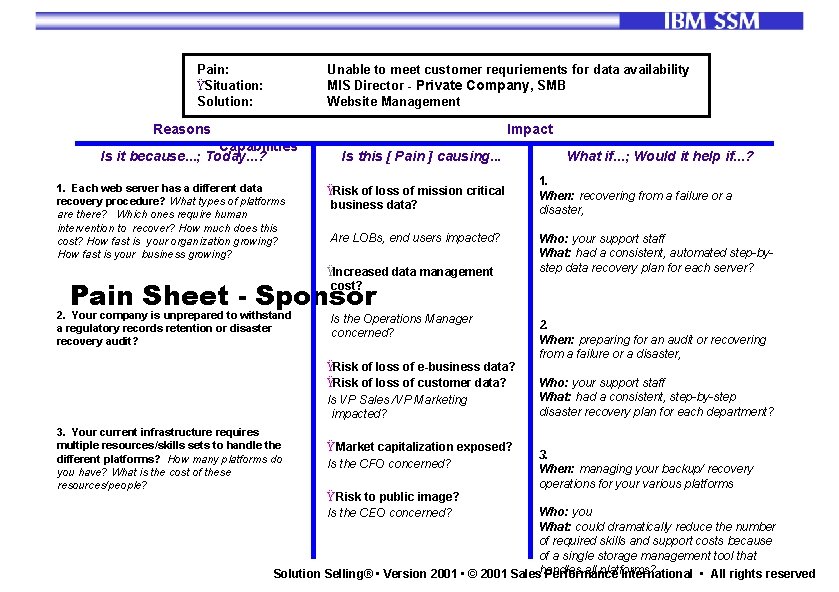
Pain: ŸSituation: Solution: Unable to meet customer requriements for data availability MIS Director - Private Company, SMB Website Management Reasons Impact Capabilities Is it because. . . ; Today. . . ? 1. Each web server has a different data recovery procedure? What types of platforms are there? Which ones require human intervention to recover? How much does this cost? How fast is your organization growing? How fast is your business growing? Is this [ Pain ] causing. . . ŸRisk of loss of mission critical business data? Are LOBs, end users impacted? ŸIncreased data management cost? What if. . . ; Would it help if. . . ? 1. When: recovering from a failure or a disaster, Who: your support staff What: had a consistent, automated step-bystep data recovery plan for each server? Pain Sheet - Sponsor 2. Your company is unprepared to withstand a regulatory records retention or disaster recovery audit? Is the Operations Manager concerned? ŸRisk of loss of e-business data? ŸRisk of loss of customer data? Is VP Sales /VP Marketing impacted? 3. Your current infrastructure requires multiple resources/skills sets to handle the different platforms? How many platforms do you have? What is the cost of these resources/people? Ÿ Market capitalization exposed? Is the CFO concerned? Ÿ Risk to public image? Is the CEO concerned? 2. When: preparing for an audit or recovering from a failure or a disaster, Who: your support staff What: had a consistent, step-by-step disaster recovery plan for each department? 3. When: managing your backup/ recovery operations for your various platforms Who: you What: could dramatically reduce the number of required skills and support costs because of a single storage management tool that all platforms? Solution Selling® • Version 2001 • © 2001 Saleshandles Performance International • All rights reserved
Sales Aid Description Sponsor Letter Overview: The Sponsor Letter is a letter sent by the seller which documents and confirms visions created by the seller. . . with a potential "sponsor. " The letter further confirms the buyer's intention to introduce the seller to "power. " Where/How used: The Sponsor Letter contains six key elements from discussions with the sponsor summarized in the words of the seller. They are: 1) business initiative/pain, 2) reasons, 3) buying vision, 4) agreement to explore, 5) access to power, 6) proof step. The proof step is what the seller offers in return for access to "power. " The Sponsor Letter can be sent by mail, fax, or e-mail. It is typically used in step 3 of SSM. What you should achieve: As a result of sending the Sponsor Letter, several things should be accomplished. First, the Sponsor Letter provides a mutual understanding of what was discussed in prior meetings If the sponsor does not agree with the 6 elements of the letter, it is better to find that out sooner than later. Second, the sponsor is likely to perceive the seller as thorough and organized. Thirdly, you have provided the sponsor with a document to use as a basis of discussion with others. . . including "power. " Finally, the Sponsor Letter will confirm access to power. Once the proof step is completed, it is the Sponsor's responsibility to introduce the seller to "power. " Solution Selling® • Version 2001 • © 2001 Sales Performance International • All rights reserved
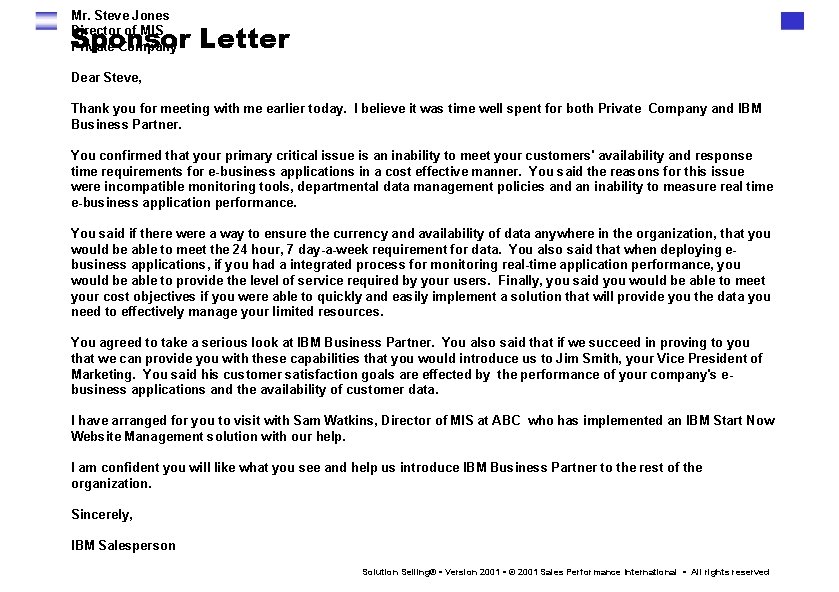
Mr. Steve Jones Director of MIS Private Company Sponsor Letter Dear Steve, Thank you for meeting with me earlier today. I believe it was time well spent for both Private Company and IBM Business Partner. You confirmed that your primary critical issue is an inability to meet your customers' availability and response time requirements for e-business applications in a cost effective manner. You said the reasons for this issue were incompatible monitoring tools, departmental data management policies and an inability to measure real time e-business application performance. You said if there were a way to ensure the currency and availability of data anywhere in the organization, that you would be able to meet the 24 hour, 7 day-a-week requirement for data. You also said that when deploying ebusiness applications, if you had a integrated process for monitoring real-time application performance, you would be able to provide the level of service required by your users. Finally, you said you would be able to meet your cost objectives if you were able to quickly and easily implement a solution that will provide you the data you need to effectively manage your limited resources. You agreed to take a serious look at IBM Business Partner. You also said that if we succeed in proving to you that we can provide you with these capabilities that you would introduce us to Jim Smith, your Vice President of Marketing. You said his customer satisfaction goals are effected by the performance of your company's ebusiness applications and the availability of customer data. I have arranged for you to visit with Sam Watkins, Director of MIS at ABC who has implemented an IBM Start Now Website Management solution with our help. I am confident you will like what you see and help us introduce IBM Business Partner to the rest of the organization. Sincerely, IBM Salesperson Solution Selling® • Version 2001 • © 2001 Sales Performance International • All rights reserved
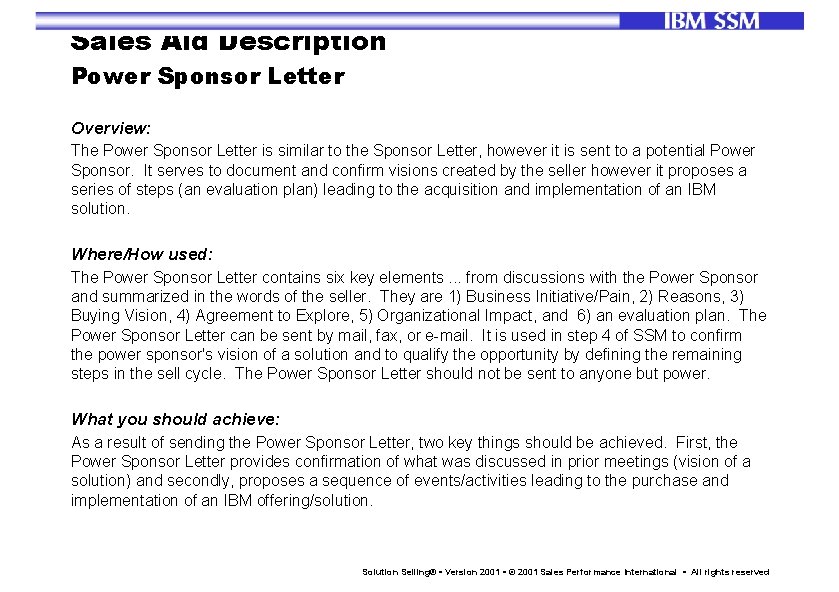
Sales Aid Description Power Sponsor Letter Overview: The Power Sponsor Letter is similar to the Sponsor Letter, however it is sent to a potential Power Sponsor. It serves to document and confirm visions created by the seller however it proposes a series of steps (an evaluation plan) leading to the acquisition and implementation of an IBM solution. Where/How used: The Power Sponsor Letter contains six key elements. . . from discussions with the Power Sponsor and summarized in the words of the seller. They are 1) Business Initiative/Pain, 2) Reasons, 3) Buying Vision, 4) Agreement to Explore, 5) Organizational Impact, and 6) an evaluation plan. The Power Sponsor Letter can be sent by mail, fax, or e-mail. It is used in step 4 of SSM to confirm the power sponsor's vision of a solution and to qualify the opportunity by defining the remaining steps in the sell cycle. The Power Sponsor Letter should not be sent to anyone but power. What you should achieve: As a result of sending the Power Sponsor Letter, two key things should be achieved. First, the Power Sponsor Letter provides confirmation of what was discussed in prior meetings (vision of a solution) and secondly, proposes a sequence of events/activities leading to the purchase and implementation of an IBM offering/solution. Solution Selling® • Version 2001 • © 2001 Sales Performance International • All rights reserved
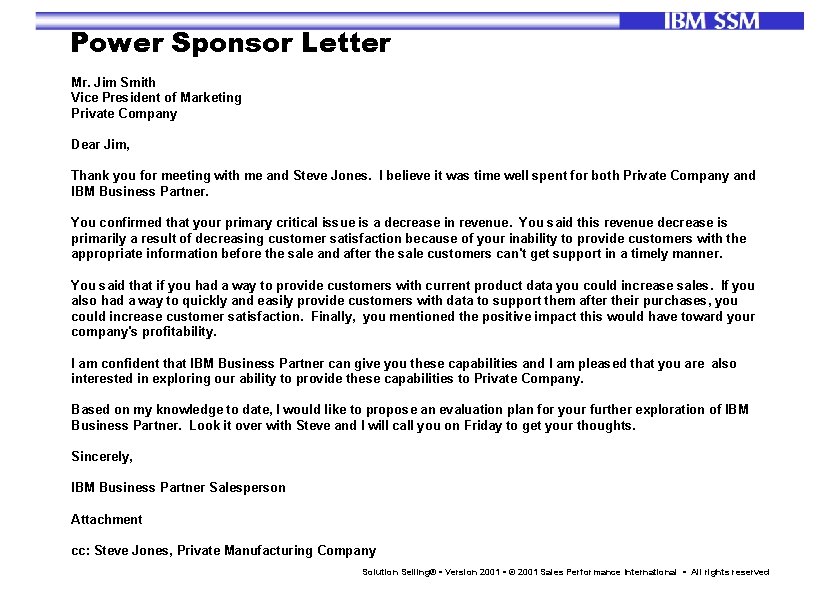
Power Sponsor Letter Mr. Jim Smith Vice President of Marketing Private Company Dear Jim, Thank you for meeting with me and Steve Jones. I believe it was time well spent for both Private Company and IBM Business Partner. You confirmed that your primary critical issue is a decrease in revenue. You said this revenue decrease is primarily a result of decreasing customer satisfaction because of your inability to provide customers with the appropriate information before the sale and after the sale customers can't get support in a timely manner. You said that if you had a way to provide customers with current product data you could increase sales. If you also had a way to quickly and easily provide customers with data to support them after their purchases, you could increase customer satisfaction. Finally, you mentioned the positive impact this would have toward your company's profitability. I am confident that IBM Business Partner can give you these capabilities and I am pleased that you are also interested in exploring our ability to provide these capabilities to Private Company. Based on my knowledge to date, I would like to propose an evaluation plan for your further exploration of IBM Business Partner. Look it over with Steve and I will call you on Friday to get your thoughts. Sincerely, IBM Business Partner Salesperson Attachment cc: Steve Jones, Private Manufacturing Company Solution Selling® • Version 2001 • © 2001 Sales Performance International • All rights reserved
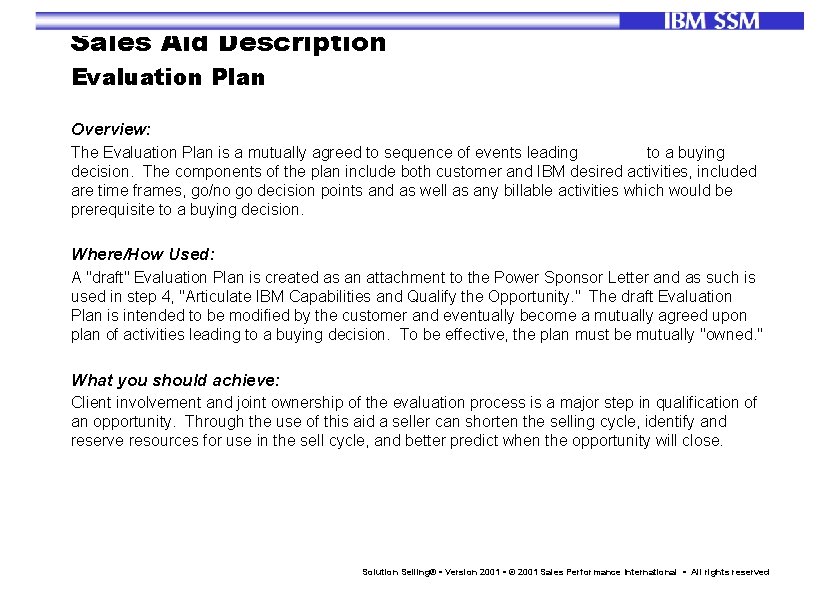
Sales Aid Description Evaluation Plan Overview: The Evaluation Plan is a mutually agreed to sequence of events leading to a buying decision. The components of the plan include both customer and IBM desired activities, included are time frames, go/no go decision points and as well as any billable activities which would be prerequisite to a buying decision. Where/How Used: A "draft" Evaluation Plan is created as an attachment to the Power Sponsor Letter and as such is used in step 4, "Articulate IBM Capabilities and Qualify the Opportunity. " The draft Evaluation Plan is intended to be modified by the customer and eventually become a mutually agreed upon plan of activities leading to a buying decision. To be effective, the plan must be mutually "owned. " What you should achieve: Client involvement and joint ownership of the evaluation process is a major step in qualification of an opportunity. Through the use of this aid a seller can shorten the selling cycle, identify and reserve resources for use in the sell cycle, and better predict when the opportunity will close. Solution Selling® • Version 2001 • © 2001 Sales Performance International • All rights reserved
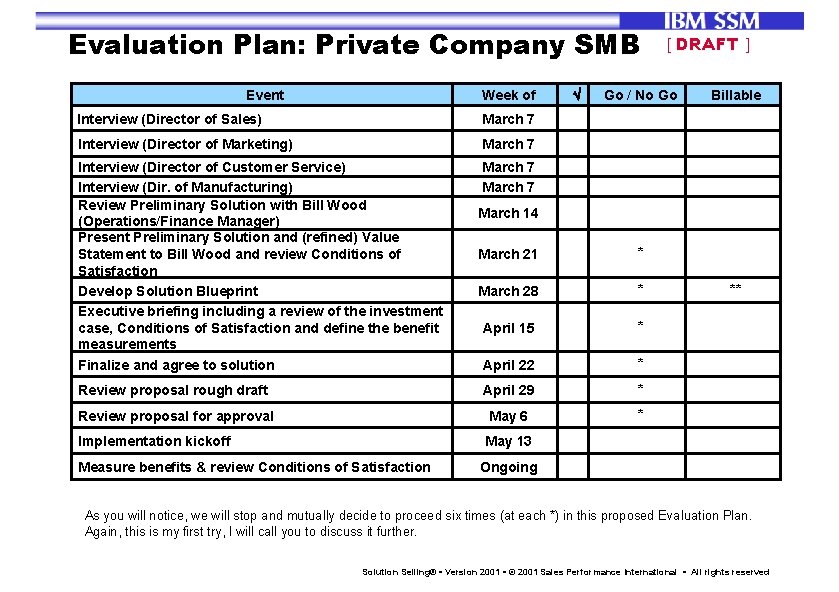
Evaluation Plan: Private Company SMB Event Week of Interview (Director of Sales) March 7 Interview (Director of Marketing) March 7 Interview (Director of Customer Service) Interview (Dir. of Manufacturing) Review Preliminary Solution with Bill Wood (Operations/Finance Manager) Present Preliminary Solution and (refined) Value Statement to Bill Wood and review Conditions of Satisfaction Develop Solution Blueprint Executive briefing including a review of the investment case, Conditions of Satisfaction and define the benefit measurements Finalize and agree to solution March 7 Ö Go / No Go Billable March 14 March 21 * March 28 * April 15 * April 22 * Review proposal rough draft April 29 * Review proposal for approval May 6 * Implementation kickoff May 13 Measure benefits & review Conditions of Satisfaction [ DRAFT ] ** Ongoing As you will notice, we will stop and mutually decide to proceed six times (at each *) in this proposed Evaluation Plan. Again, this is my first try, I will call you to discuss it further. Solution Selling® • Version 2001 • © 2001 Sales Performance International • All rights reserved
Sales Aid Description Integrated Solution Concept ((ISC))) / Preliminary Solution Overview: The ISC is a model designed to highlight IBM's ability to offer "total solutions" and directly support cross-matrix selling within Team IBM. The ISC organizes total solution components into four categories: Application (Functionality), Systems and Network, Systems Management, and Consulting and Services. It emphasizes IBM's "total solution" capabilities. Where/How Used: The ISC is used typically during Step 4 of the SSM process, "Articulate IBM capabilities and qualify the opportunity. " As stated above, the sales aid organizes information into four key areas of a total solution. After confirmation of the information, a Seller uses a "bridging" technique to craft the Preliminary Solution. This sales aid lists specific products in the four categories and defines the ranges of potential value, investment and time frame. What you should achieve: Construction of a preliminary solution using the ISC typically expands the client's perception of the solution and strongly positions IBM as a total solution provider. It can serve to differentiate IBM from competitors who only offer solution components. Solution Selling® • Version 2001 • © 2001 Sales Performance International • All rights reserved
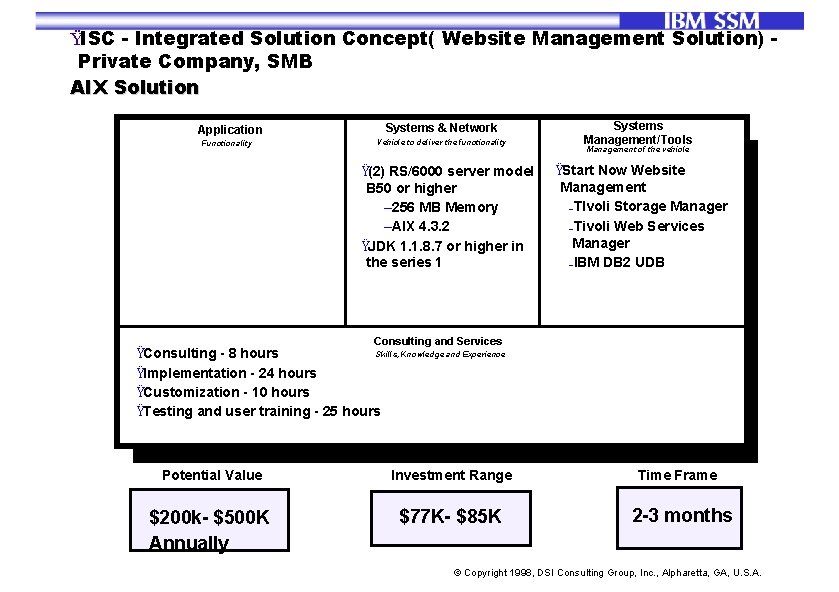
ŸISC - Integrated Solution Concept( Website Management Solution) Private Company, SMB AIX Solution Application Functionality Systems & Network Vehicle to deliver the functionality Ÿ(2) RS/6000 server model B 50 or higher – 256 MB Memory –AIX 4. 3. 2 ŸJDK 1. 1. 8. 7 or higher in the series 1 Systems Management/Tools Management of the vehicle ŸStart Now Website Management –TIvoli Storage Manager –Tivoli Web Services Manager –IBM DB 2 UDB Consulting and Services Skills, Knowledge and Experience ŸConsulting - 8 hours ŸImplementation - 24 hours ŸCustomization - 10 hours ŸTesting and user training - 25 hours Potential Value Investment Range $200 k- $500 K Annually $77 K- $85 K Time Frame 2 -3 months © Copyright 1998, DSI Consulting Group, Inc. , Alpharetta, GA, U. S. A.
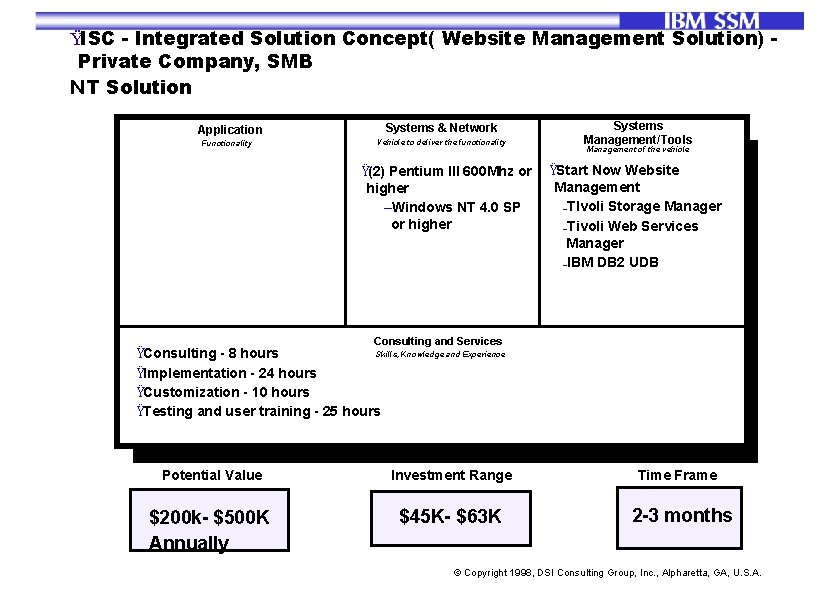
ŸISC - Integrated Solution Concept( Website Management Solution) Private Company, SMB NT Solution Application Functionality Systems & Network Vehicle to deliver the functionality Ÿ(2) Pentium III 600 Mhz or higher –Windows NT 4. 0 SP or higher Systems Management/Tools Management of the vehicle ŸStart Now Website Management –TIvoli Storage Manager –Tivoli Web Services Manager –IBM DB 2 UDB Consulting and Services Skills, Knowledge and Experience ŸConsulting - 8 hours ŸImplementation - 24 hours ŸCustomization - 10 hours ŸTesting and user training - 25 hours Potential Value Investment Range $200 k- $500 K Annually $45 K- $63 K Time Frame 2 -3 months © Copyright 1998, DSI Consulting Group, Inc. , Alpharetta, GA, U. S. A.
Sales Aid Description Refined Value Statement Overview: A statement which projects, from the buyer's perspective, a range of potential benefits (value) of implementation of a specific capability or solution provided by the IBM Business Partner, as well as an initial estimate of the costs of that solution, also within a range. Where/How used: Value quantification is obtained during the vision creation/reengineering process, using drill-down questioning. By combining this information with the seller's initial estimate of implementation costs, the Refined Value Statement can be created. It is typically used in Step 5 of SSM, Develop the Solution with the Customer. It is the second step in the Value Continuum, refining the original Value Statement and ultimately leading to the Value Proposition/ROI. What you should achieve: The customer should begin to take ownership of the value of the proposed solution. The Refined Value Statement can help to further qualify the opportunity and determine whether the seller is, in fact, at power. Solution Selling® • Version 2001 • © 2001 Sales Performance International • All rights reserved
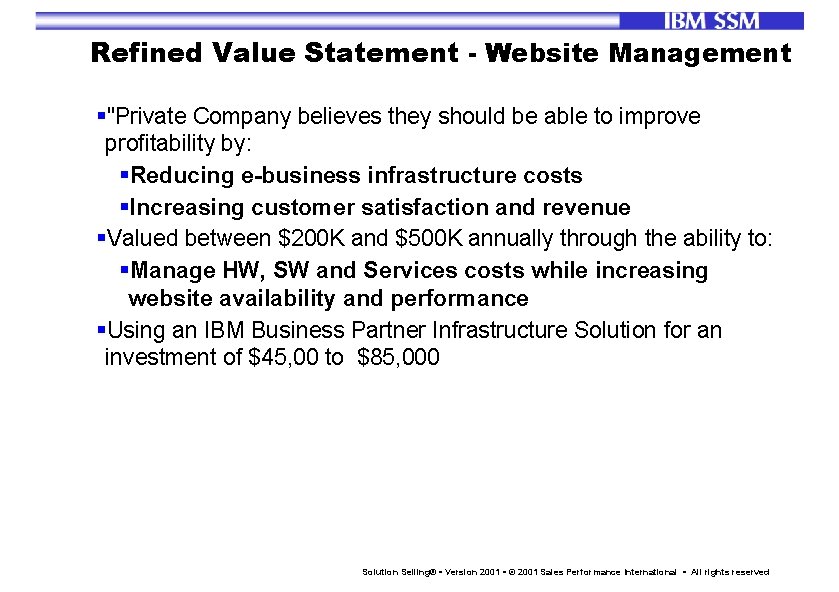
Refined Value Statement - Website Management §"Private Company believes they should be able to improve profitability by: §Reducing e-business infrastructure costs §Increasing customer satisfaction and revenue §Valued between $200 K and $500 K annually through the ability to: §Manage HW, SW and Services costs while increasing website availability and performance §Using an IBM Business Partner Infrastructure Solution for an investment of $45, 00 to $85, 000 Solution Selling® • Version 2001 • © 2001 Sales Performance International • All rights reserved
Sales Aid Description Value Proposition Overview: The Value Proposition is a financial projection of the proposed solution intended to provide the compelling reason (value) for the buyer to move forward with IBM. The Value Proposition projects the ROI, based on the client's benefit projections (both revenue and expense) as well as the solution costs. . . i. e. all costs required to implement the solution. Where/How used: Benefit information is typically obtained during the vision creation/reengineering process. . . specifically through the drill down questioning. By combining this information with the total costs of implementation, an ROI can be calculated (Step 5 in SSM). The Value Proposition will often serve as the culmination of a seller's 3 -step employment of value. . . starting with a Value Statement. . . followed by a Refined Value Statement. . and ending in the Value Proposition. What you should achieve: The Value Proposition should provide the compelling reason (value) for the client to make an investment with IBM. Knowledge of the value and ROI is typically the seller's best weapon to fend the client's pressure to discount. Solution Selling® • Version 2001 • © 2001 Sales Performance International • All rights reserved
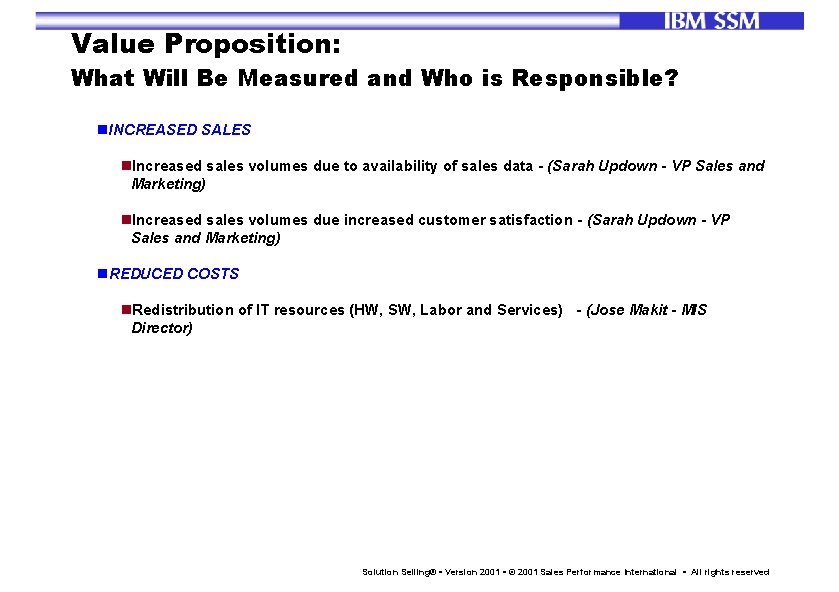
Value Proposition: What Will Be Measured and Who is Responsible? n. INCREASED SALES n. Increased sales volumes due to availability of sales data - (Sarah Updown - VP Sales and Marketing) n. Increased sales volumes due increased customer satisfaction - (Sarah Updown - VP Sales and Marketing) n. REDUCED COSTS n. Redistribution of IT resources (HW, SW, Labor and Services) - (Jose Makit - MIS Director) Solution Selling® • Version 2001 • © 2001 Sales Performance International • All rights reserved
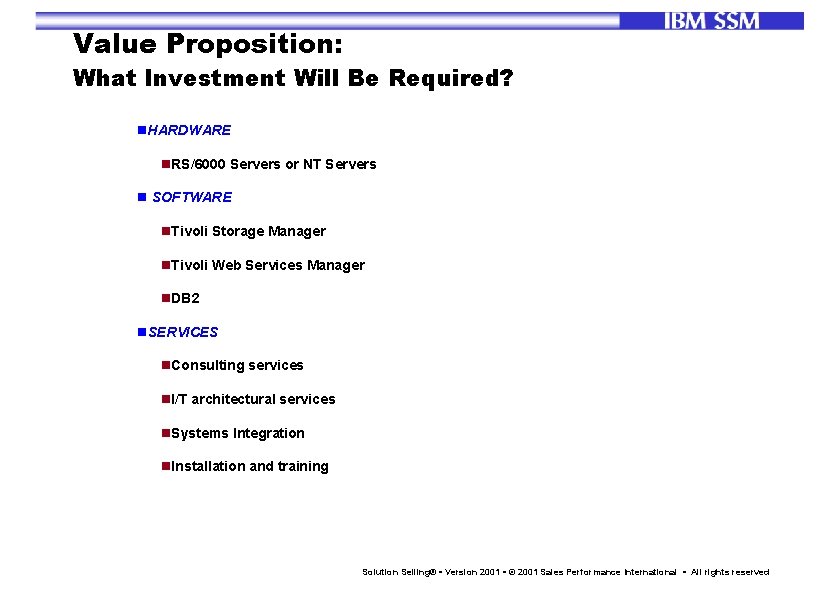
Value Proposition: What Investment Will Be Required? n. HARDWARE n. RS/6000 Servers or NT Servers n SOFTWARE n. Tivoli Storage Manager n. Tivoli Web Services Manager n. DB 2 n. SERVICES n. Consulting services n. I/T architectural services n. Systems Integration n. Installation and training Solution Selling® • Version 2001 • © 2001 Sales Performance International • All rights reserved
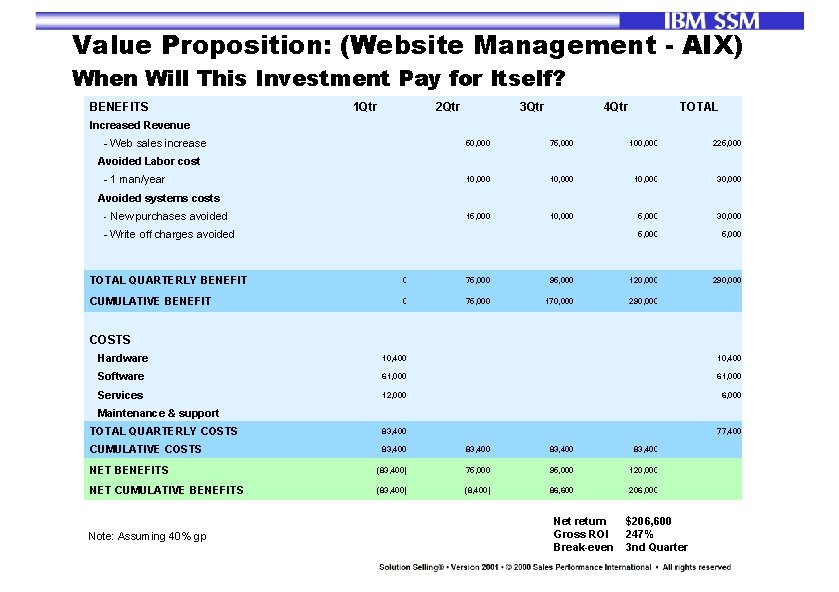
Value Proposition: (Website Management - AIX) When Will This Investment Pay for Itself? BENEFITS 1 Qtr 2 Qtr 3 Qtr 4 Qtr TOTAL Increased Revenue - Web sales increase 50, 000 75, 000 100, 000 225, 000 10, 000 30, 000 15, 000 10, 000 5, 000 30, 000 5, 000 290, 000 Avoided Labor cost - 1 man/year Avoided systems costs - New purchases avoided - Write off charges avoided TOTAL QUARTERLY BENEFIT 0 75, 000 95, 000 120, 000 CUMULATIVE BENEFIT 0 75, 000 170, 000 290, 000 COSTS Hardware 10, 400 Software 61, 000 Services 12, 000 6, 000 TOTAL QUARTERLY COSTS 83, 400 77, 400 CUMULATIVE COSTS 83, 400 NET BENEFITS (83, 400) 75, 000 95, 000 120, 000 NET CUMULATIVE BENEFITS (83, 400) (8, 400) 86, 600 206, 000 Maintenance & support Note: Assuming 40% gp Net return Gross ROI Break-even $206, 600 247% 3 nd Quarter
Sales Aid Description Measure Benefits Overview: This Sales Aid serves as a tracking device to ensure that the client's expected benefits are realized. The elements tracked should be those found in the Value Proposition and the tracking should be across the same time frames as employed in the Value Proposition. Use of this sales aid sends a powerful message to the client that IBM is interested in the client's realizing the expected benefits. . . not just making the sale. Where/How used: The information tracked will help ensure that the value anticipated is realized. Using the sales aid will identify implementation challenges and help the seller intervene with appropriate corrective action if required. The tracked information can be used to take advantage of new selling opportunities with this client as well as serve as reference information for other account opportunities. What you should achieve: The seller should achieve significant levels of client satisfaction, additional selling opportunities with this client, and a bevy of reference stories to employ in other selling situations. Solution Selling® • Version 2001 • © 2001 Sales Performance International • All rights reserved
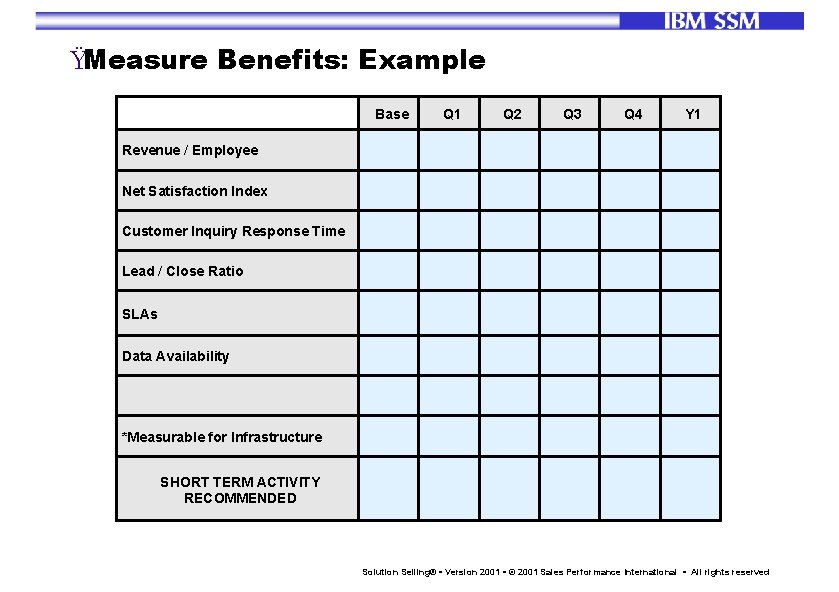
ŸMeasure Benefits: Example Base Q 1 Q 2 Q 3 Q 4 Y 1 Revenue / Employee Net Satisfaction Index Customer Inquiry Response Time Lead / Close Ratio SLAs Data Availability *Measurable for Infrastructure SHORT TERM ACTIVITY RECOMMENDED Solution Selling® • Version 2001 • © 2001 Sales Performance International • All rights reserved
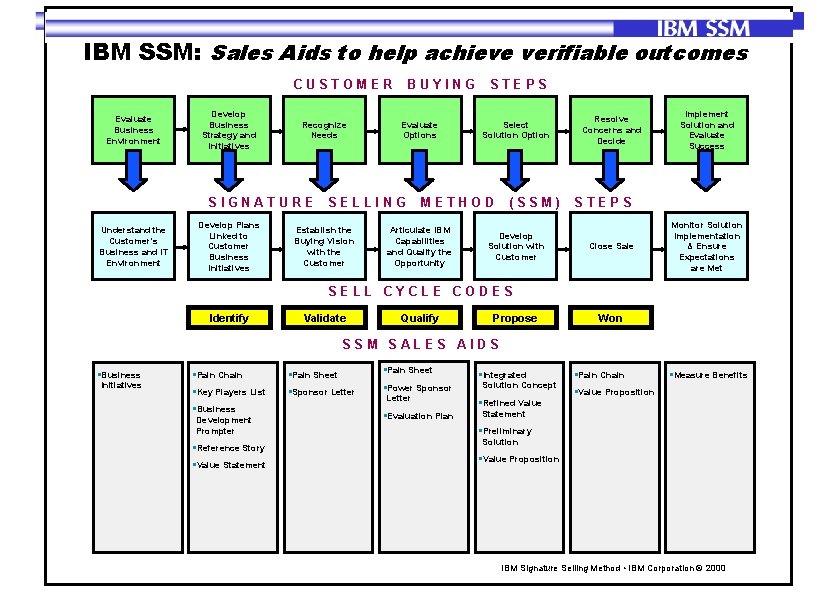
IBM SSM: Sales Aids to help achieve verifiable outcomes CUSTOMER Evaluate Business Environment Develop Business Strategy and Initiatives Recognize Needs SIGNATURE Understand the Customer's Business and IT Environment Develop Plans Linked to Customer Business Initiatives BUYING Evaluate Options SELLING Establish the Buying Vision with the Customer STEPS Select Solution Option METHOD Articulate IBM Capabilities and Qualify the Opportunity (SSM) Develop Solution with Customer Resolve Concerns and Decide Implement Solution and Evaluate Success STEPS Close Sale Monitor Solution Implementation & Ensure Expectations are Met SELL CYCLE CODES Identify Validate Qualify Propose Won SSM SALES AIDS §Business Initiatives §Pain Chain §Key Players List §Business Development Prompter §Reference Story §Value Statement §Pain Sheet §Sponsor Letter §Power Sponsor Letter §Evaluation Plan §Integrated Solution Concept §Pain Chain §Measure Benefits §Value Proposition §Refined Value Statement §Preliminary Solution §Value Proposition IBM Signature Selling Method • IBM Corporation © 2000
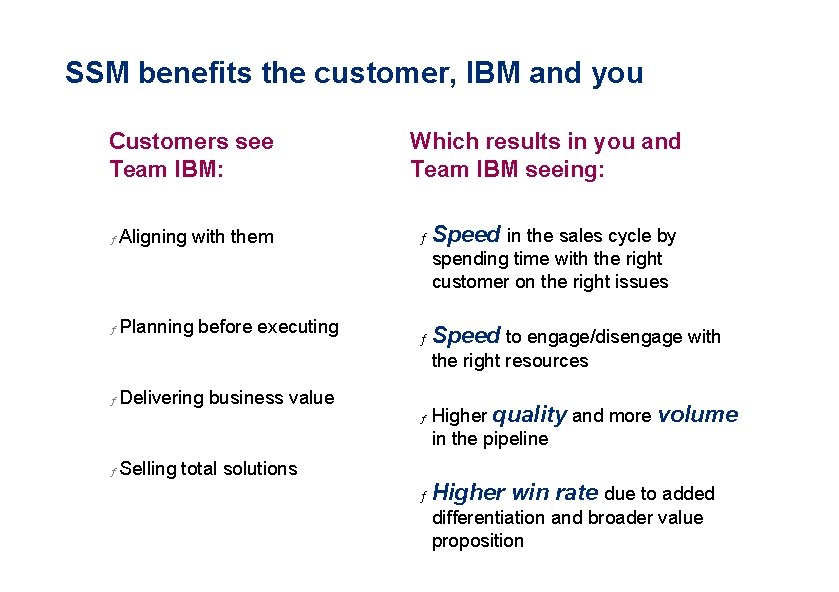
SSM benefits the customer, IBM and you Customers see Team IBM: ƒ Aligning with them Which results in you and Team IBM seeing: ƒ Speed in the sales cycle by spending time with the right customer on the right issues ƒ Planning before executing ƒ Speed to engage/disengage with the right resources ƒ Delivering business value ƒ ƒ Higher quality and more volume in the pipeline Selling total solutions ƒ Higher win rate due to added differentiation and broader value proposition
- Slides: 47