
Signals COS 217 1 Goals of Todays Lecture
- Slides: 34
Signals COS 217 1
Goals of Today’s Lecture • Overview of signals o. Notifications sent to a process o. UNIX signal names and numbers o. Ways to generate signals • Signal handling o. Installing signal handlers o. Ignoring vs. blocking signals o. Avoiding race conditions • Keeping track of the passage of time o. Interval timers o. Real time vs. CPU time 2
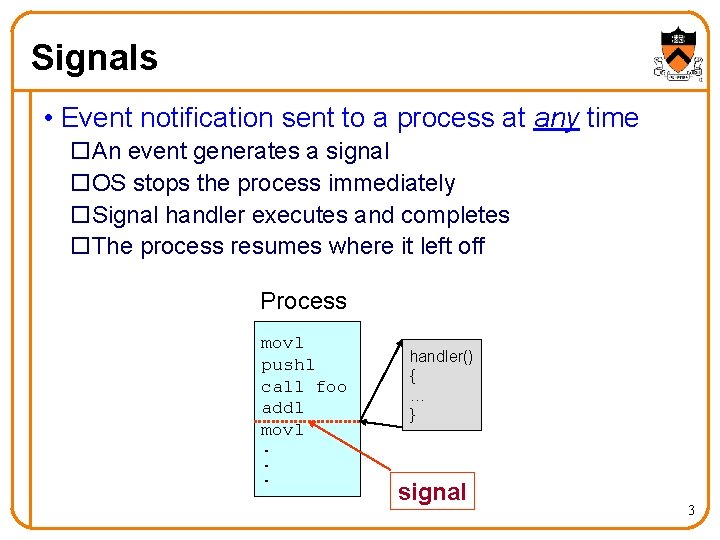
Signals • Event notification sent to a process at any time o. An event generates a signal o. OS stops the process immediately o. Signal handler executes and completes o. The process resumes where it left off Process movl pushl call foo addl movl. . . handler() { … } signal 3
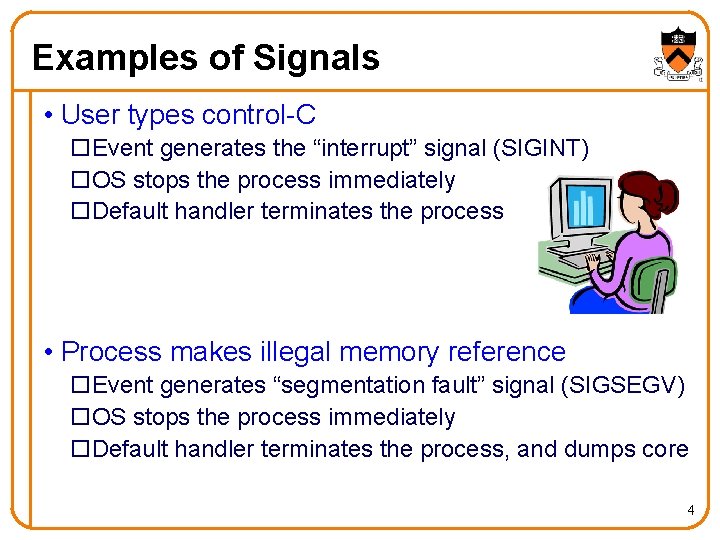
Examples of Signals • User types control-C o. Event generates the “interrupt” signal (SIGINT) o. OS stops the process immediately o. Default handler terminates the process • Process makes illegal memory reference o. Event generates “segmentation fault” signal (SIGSEGV) o. OS stops the process immediately o. Default handler terminates the process, and dumps core 4
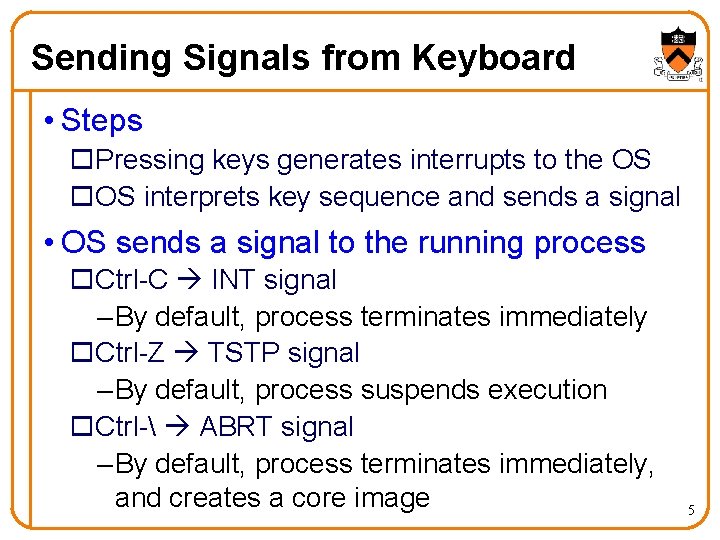
Sending Signals from Keyboard • Steps o. Pressing keys generates interrupts to the OS o. OS interprets key sequence and sends a signal • OS sends a signal to the running process o. Ctrl-C INT signal – By default, process terminates immediately o. Ctrl-Z TSTP signal – By default, process suspends execution o. Ctrl- ABRT signal – By default, process terminates immediately, and creates a core image 5
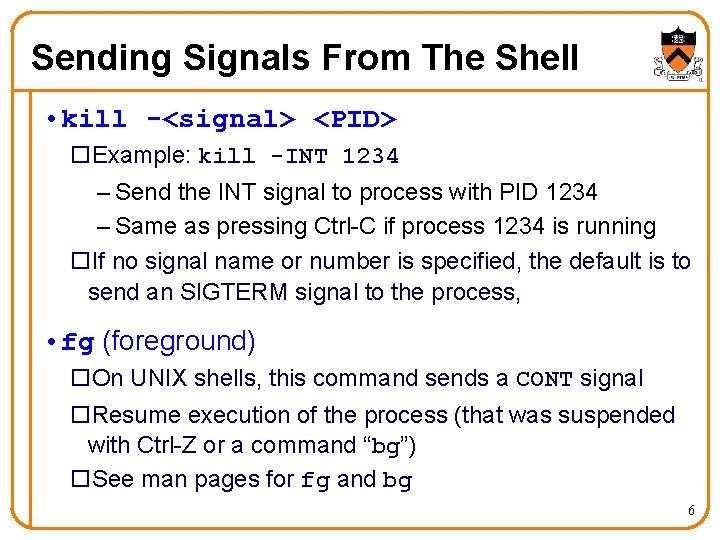
Sending Signals From The Shell • kill -<signal> <PID> o. Example: kill -INT 1234 – Send the INT signal to process with PID 1234 – Same as pressing Ctrl-C if process 1234 is running o. If no signal name or number is specified, the default is to send an SIGTERM signal to the process, • fg (foreground) o. On UNIX shells, this command sends a CONT signal o. Resume execution of the process (that was suspended with Ctrl-Z or a command “bg”) o. See man pages for fg and bg 6
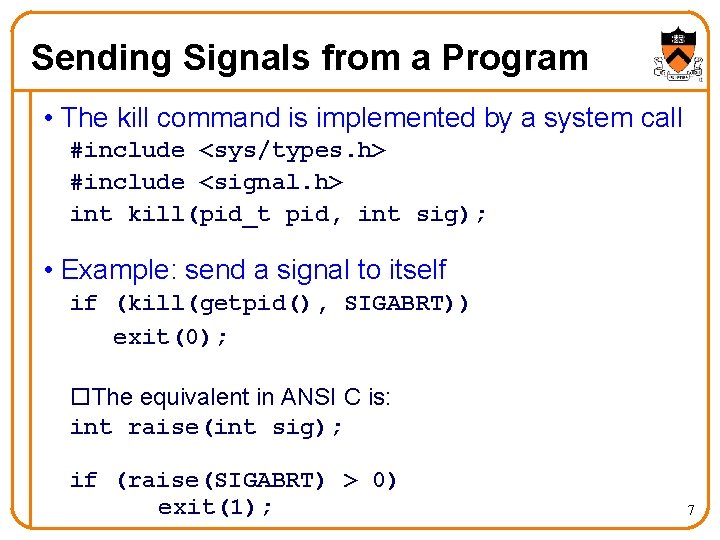
Sending Signals from a Program • The kill command is implemented by a system call #include <sys/types. h> #include <signal. h> int kill(pid_t pid, int sig); • Example: send a signal to itself if (kill(getpid(), SIGABRT)) exit(0); o. The equivalent in ANSI C is: int raise(int sig); if (raise(SIGABRT) > 0) exit(1); 7
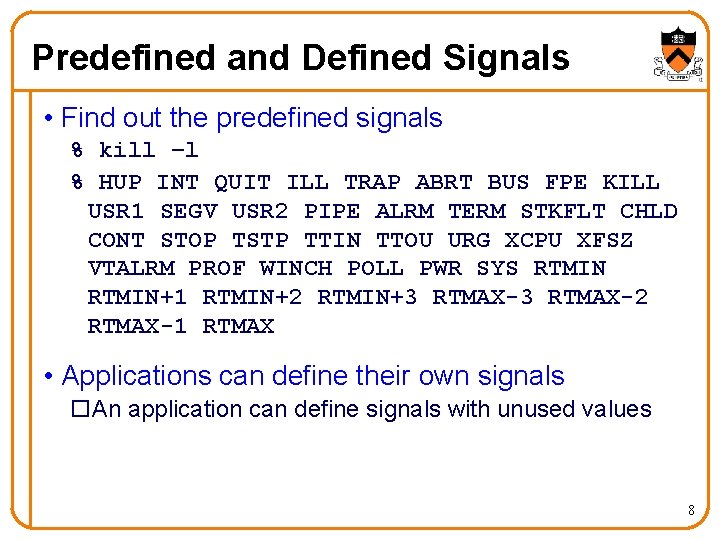
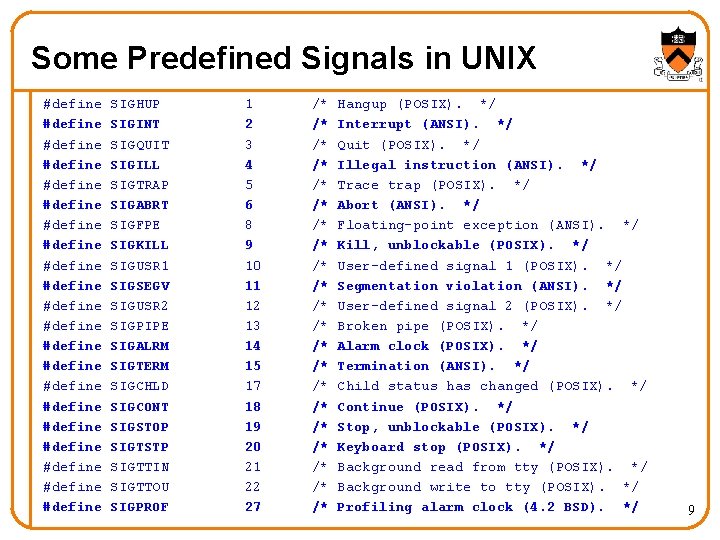
Predefined and Defined Signals • Find out the predefined signals % kill –l % HUP INT QUIT ILL TRAP ABRT BUS FPE KILL USR 1 SEGV USR 2 PIPE ALRM TERM STKFLT CHLD CONT STOP TSTP TTIN TTOU URG XCPU XFSZ VTALRM PROF WINCH POLL PWR SYS RTMIN+1 RTMIN+2 RTMIN+3 RTMAX-2 RTMAX-1 RTMAX • Applications can define their own signals o. An application can define signals with unused values 8
Some Predefined Signals in UNIX #define #define #define #define #define #define SIGHUP SIGINT SIGQUIT SIGILL SIGTRAP SIGABRT SIGFPE SIGKILL SIGUSR 1 SIGSEGV SIGUSR 2 SIGPIPE SIGALRM SIGTERM SIGCHLD SIGCONT SIGSTOP SIGTSTP SIGTTIN SIGTTOU SIGPROF 1 2 3 4 5 6 8 9 10 11 12 13 14 15 17 18 19 20 21 22 27 /* /* /* /* /* /* Hangup (POSIX). */ Interrupt (ANSI). */ Quit (POSIX). */ Illegal instruction (ANSI). */ Trace trap (POSIX). */ Abort (ANSI). */ Floating-point exception (ANSI). */ Kill, unblockable (POSIX). */ User-defined signal 1 (POSIX). */ Segmentation violation (ANSI). */ User-defined signal 2 (POSIX). */ Broken pipe (POSIX). */ Alarm clock (POSIX). */ Termination (ANSI). */ Child status has changed (POSIX). */ Continue (POSIX). */ Stop, unblockable (POSIX). */ Keyboard stop (POSIX). */ Background read from tty (POSIX). */ Background write to tty (POSIX). */ Profiling alarm clock (4. 2 BSD). */ 9
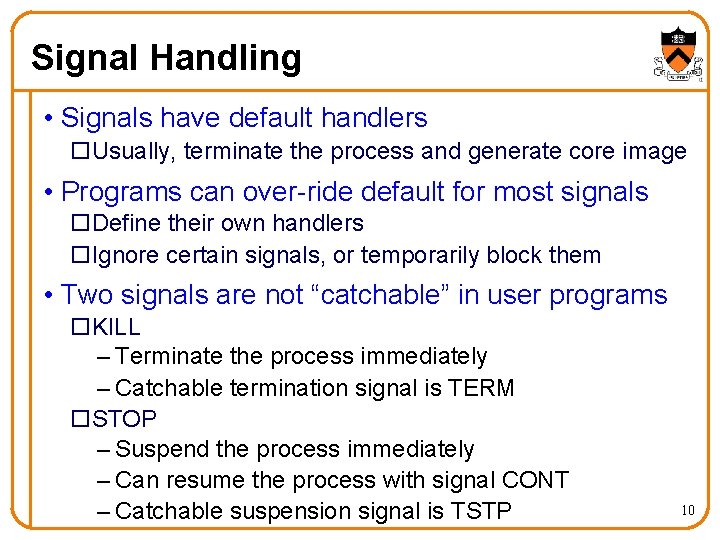
Signal Handling • Signals have default handlers o. Usually, terminate the process and generate core image • Programs can over-ride default for most signals o. Define their own handlers o. Ignore certain signals, or temporarily block them • Two signals are not “catchable” in user programs o. KILL – Terminate the process immediately – Catchable termination signal is TERM o. STOP – Suspend the process immediately – Can resume the process with signal CONT – Catchable suspension signal is TSTP 10
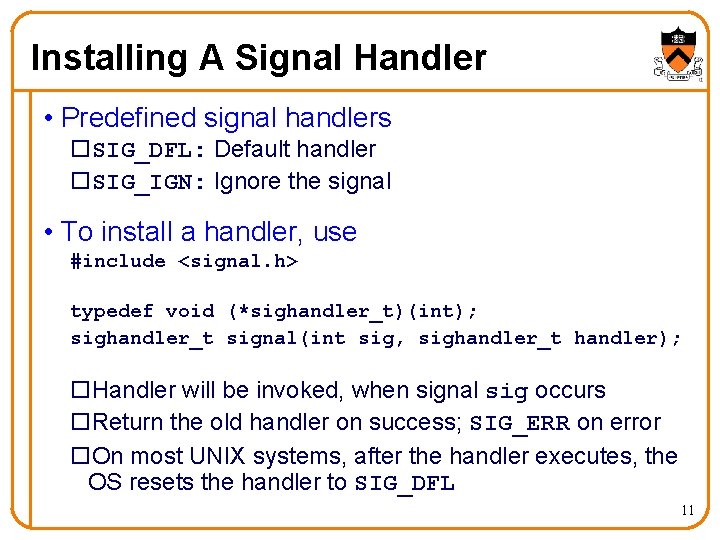
Installing A Signal Handler • Predefined signal handlers o. SIG_DFL: Default handler o. SIG_IGN: Ignore the signal • To install a handler, use #include <signal. h> typedef void (*sighandler_t)(int); sighandler_t signal(int sig, sighandler_t handler); o. Handler will be invoked, when signal sig occurs o. Return the old handler on success; SIG_ERR on error o. On most UNIX systems, after the handler executes, the OS resets the handler to SIG_DFL 11
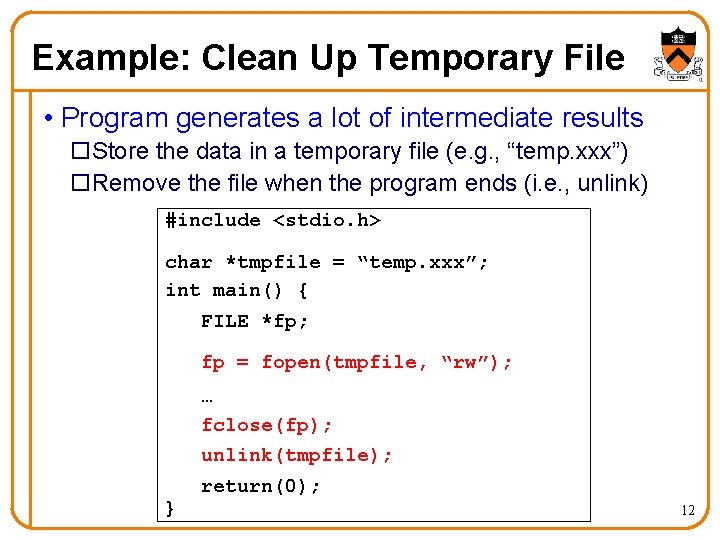
Example: Clean Up Temporary File • Program generates a lot of intermediate results o. Store the data in a temporary file (e. g. , “temp. xxx”) o. Remove the file when the program ends (i. e. , unlink) #include <stdio. h> char *tmpfile = “temp. xxx”; int main() { FILE *fp; fp = fopen(tmpfile, “rw”); … fclose(fp); unlink(tmpfile); } return(0); 12
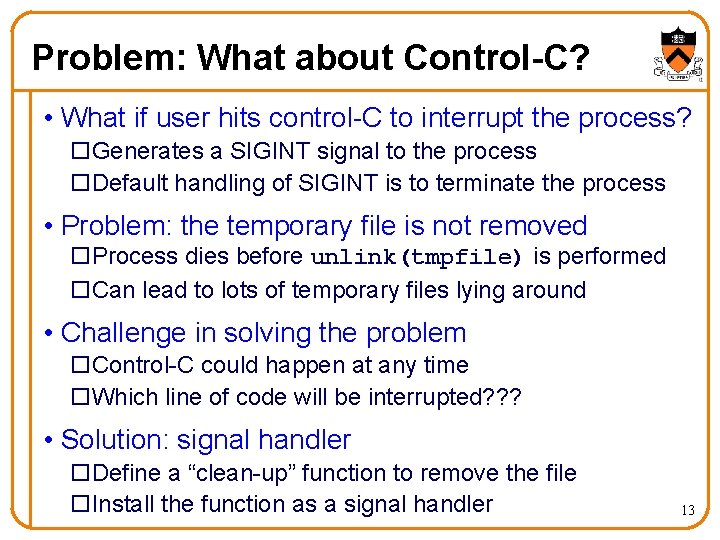
Problem: What about Control-C? • What if user hits control-C to interrupt the process? o. Generates a SIGINT signal to the process o. Default handling of SIGINT is to terminate the process • Problem: the temporary file is not removed o. Process dies before unlink(tmpfile) is performed o. Can lead to lots of temporary files lying around • Challenge in solving the problem o. Control-C could happen at any time o. Which line of code will be interrupted? ? ? • Solution: signal handler o. Define a “clean-up” function to remove the file o. Install the function as a signal handler 13
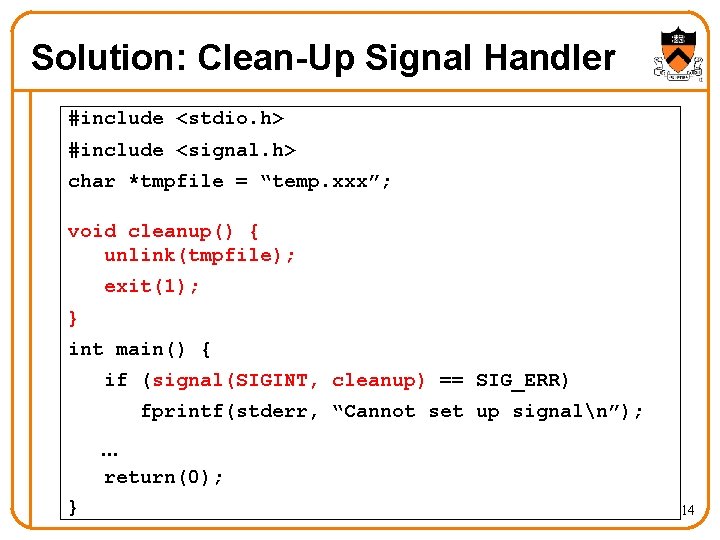
Solution: Clean-Up Signal Handler #include <stdio. h> #include <signal. h> char *tmpfile = “temp. xxx”; void cleanup() { unlink(tmpfile); exit(1); } int main() { if (signal(SIGINT, cleanup) == SIG_ERR) fprintf(stderr, “Cannot set up signaln”); … return(0); } 14
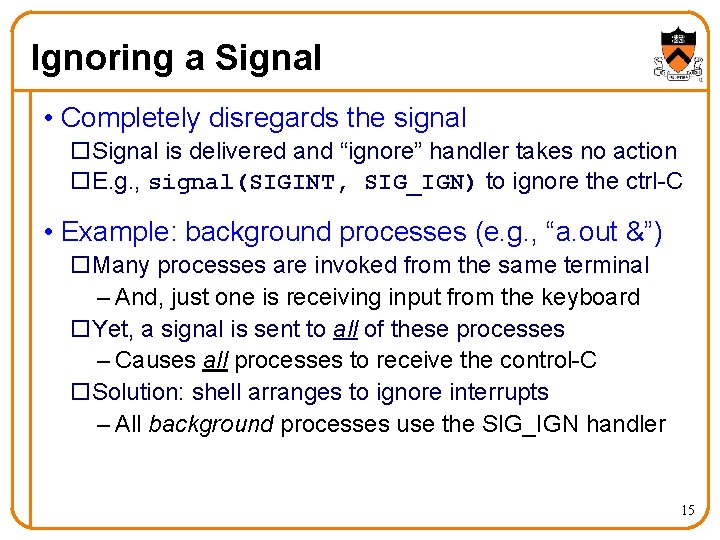
Ignoring a Signal • Completely disregards the signal o. Signal is delivered and “ignore” handler takes no action o. E. g. , signal(SIGINT, SIG_IGN) to ignore the ctrl-C • Example: background processes (e. g. , “a. out &”) o. Many processes are invoked from the same terminal – And, just one is receiving input from the keyboard o. Yet, a signal is sent to all of these processes – Causes all processes to receive the control-C o. Solution: shell arranges to ignore interrupts – All background processes use the SIG_IGN handler 15
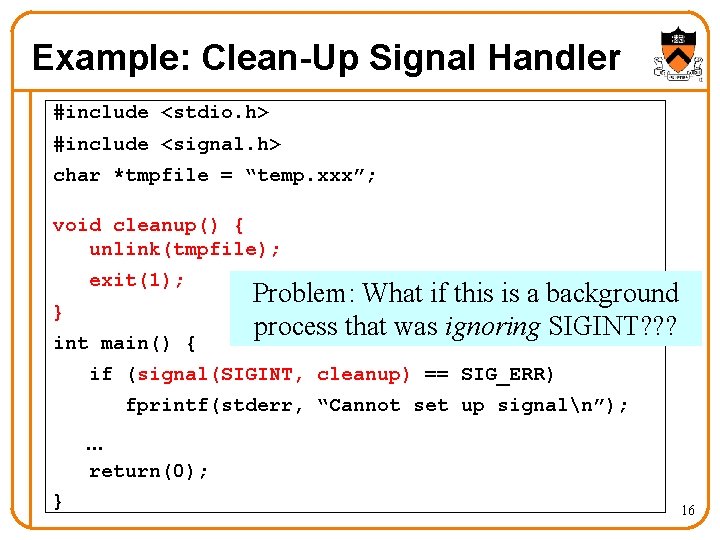
Example: Clean-Up Signal Handler #include <stdio. h> #include <signal. h> char *tmpfile = “temp. xxx”; void cleanup() { unlink(tmpfile); exit(1); } int main() { Problem: What if this is a background process that was ignoring SIGINT? ? ? if (signal(SIGINT, cleanup) == SIG_ERR) fprintf(stderr, “Cannot set up signaln”); … return(0); } 16
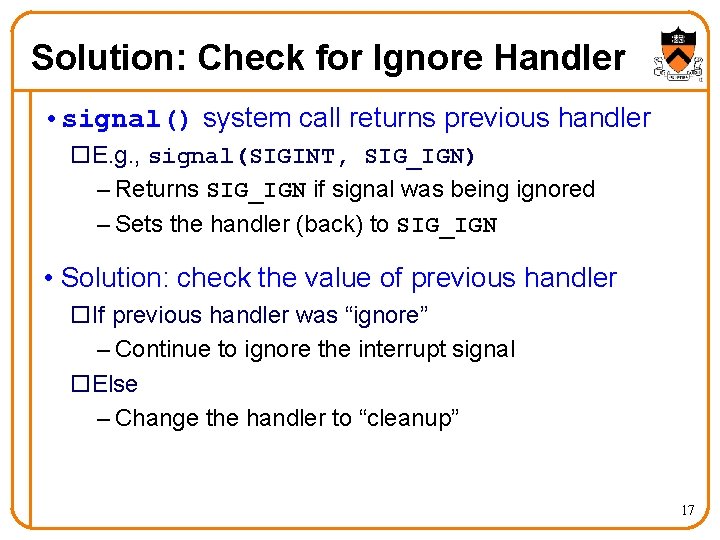
Solution: Check for Ignore Handler • signal() system call returns previous handler o. E. g. , signal(SIGINT, SIG_IGN) – Returns SIG_IGN if signal was being ignored – Sets the handler (back) to SIG_IGN • Solution: check the value of previous handler o. If previous handler was “ignore” – Continue to ignore the interrupt signal o. Else – Change the handler to “cleanup” 17
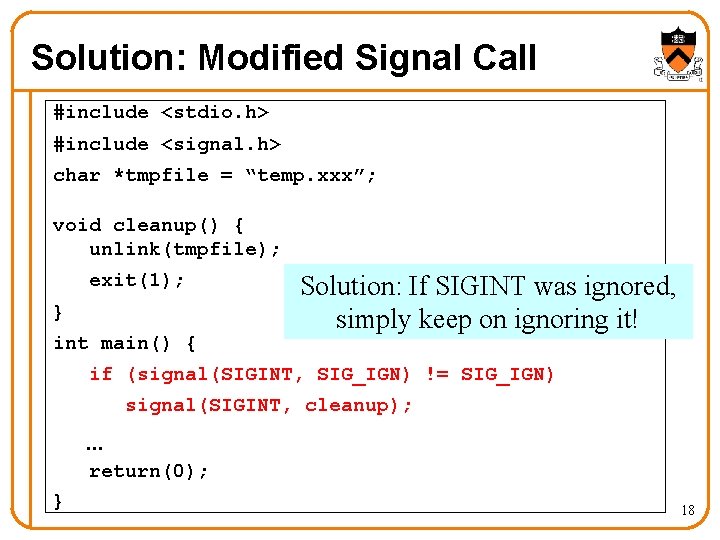
Solution: Modified Signal Call #include <stdio. h> #include <signal. h> char *tmpfile = “temp. xxx”; void cleanup() { unlink(tmpfile); exit(1); } int main() { Solution: If SIGINT was ignored, simply keep on ignoring it! if (signal(SIGINT, SIG_IGN) != SIG_IGN) signal(SIGINT, cleanup); … return(0); } 18
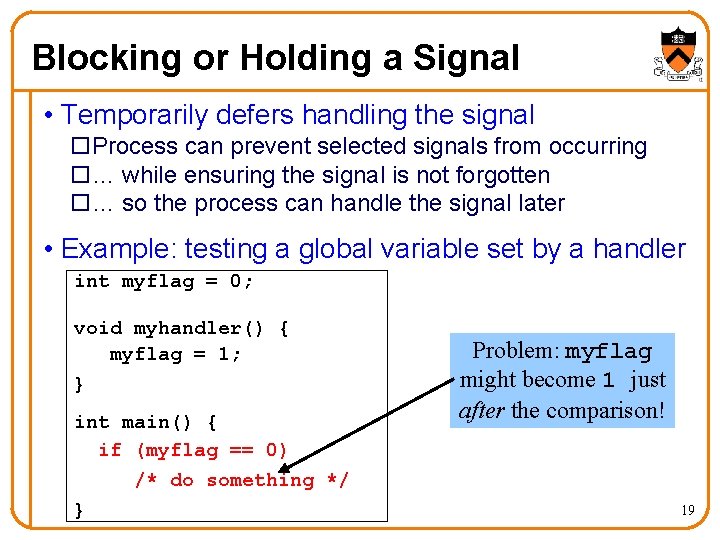
Blocking or Holding a Signal • Temporarily defers handling the signal o. Process can prevent selected signals from occurring o… while ensuring the signal is not forgotten o… so the process can handle the signal later • Example: testing a global variable set by a handler int myflag = 0; void myhandler() { myflag = 1; } int main() { if (myflag == 0) /* do something */ } Problem: myflag might become 1 just after the comparison! 19
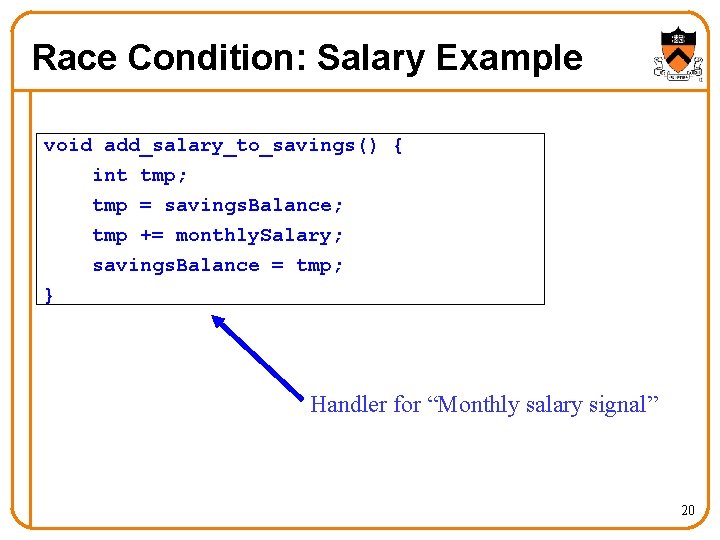
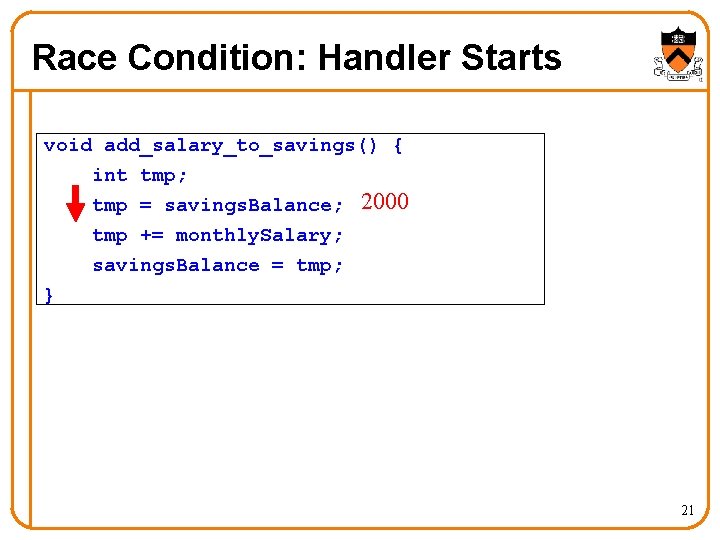
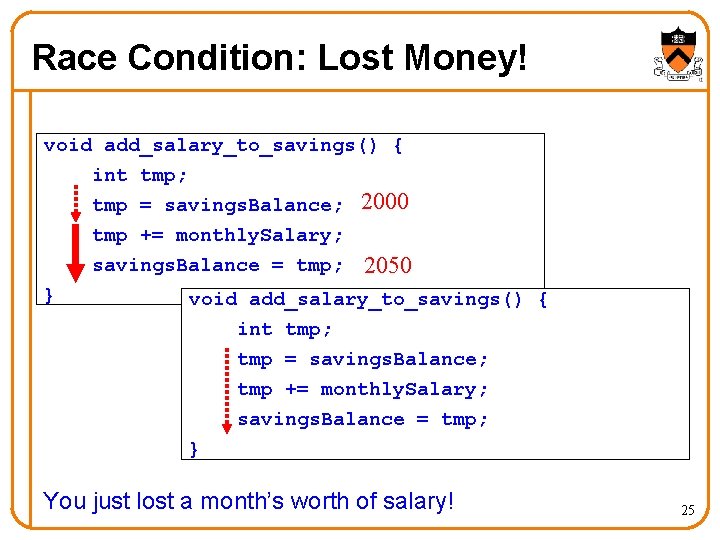
Race Condition: Salary Example void add_salary_to_savings() { int tmp; tmp = savings. Balance; tmp += monthly. Salary; savings. Balance = tmp; } Handler for “Monthly salary signal” 20
Race Condition: Handler Starts void add_salary_to_savings() { int tmp; tmp = savings. Balance; 2000 tmp += monthly. Salary; savings. Balance = tmp; } 21
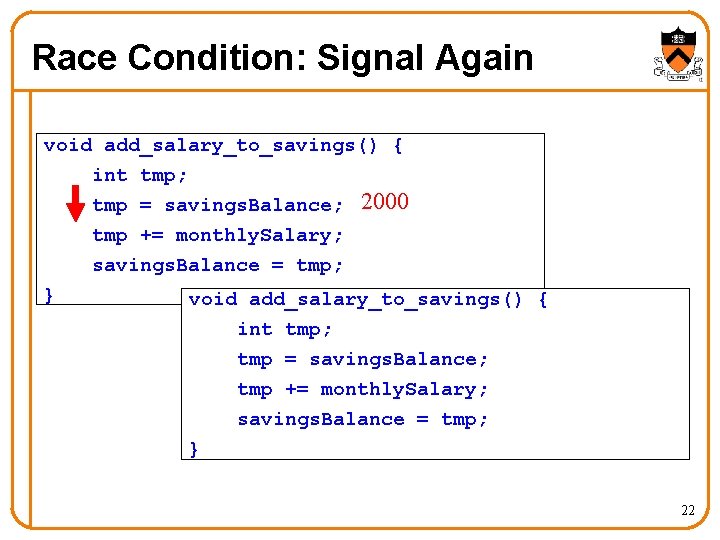
Race Condition: Signal Again void add_salary_to_savings() { int tmp; tmp = savings. Balance; 2000 tmp += monthly. Salary; savings. Balance = tmp; } void add_salary_to_savings() { int tmp; tmp = savings. Balance; tmp += monthly. Salary; savings. Balance = tmp; } 22
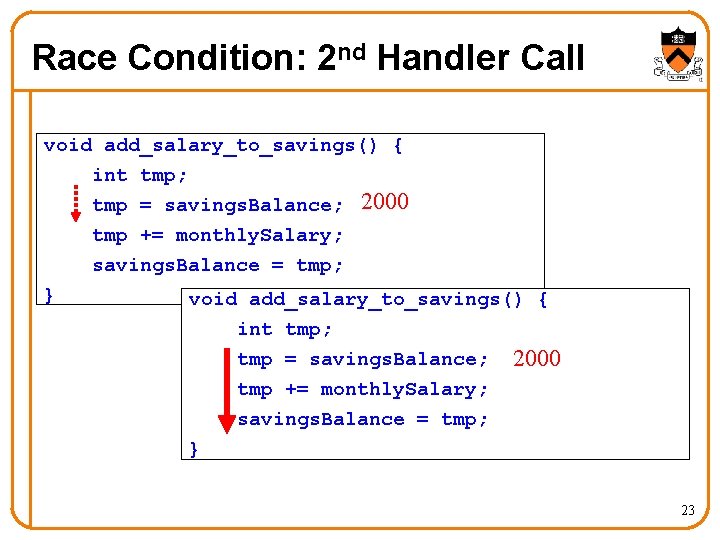
Race Condition: 2 nd Handler Call void add_salary_to_savings() { int tmp; tmp = savings. Balance; 2000 tmp += monthly. Salary; savings. Balance = tmp; } 23
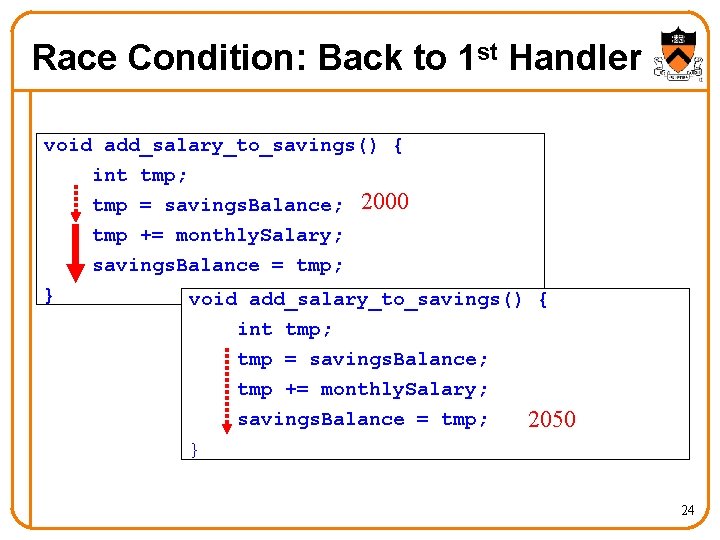
Race Condition: Back to 1 st Handler void add_salary_to_savings() { int tmp; tmp = savings. Balance; 2000 tmp += monthly. Salary; savings. Balance = tmp; } void add_salary_to_savings() { int tmp; tmp = savings. Balance; tmp += monthly. Salary; savings. Balance = tmp; 2050 } 24
Race Condition: Lost Money! void add_salary_to_savings() { int tmp; tmp = savings. Balance; 2000 tmp += monthly. Salary; savings. Balance = tmp; } 2050 void add_salary_to_savings() { int tmp; tmp = savings. Balance; tmp += monthly. Salary; savings. Balance = tmp; } You just lost a month’s worth of salary! 25
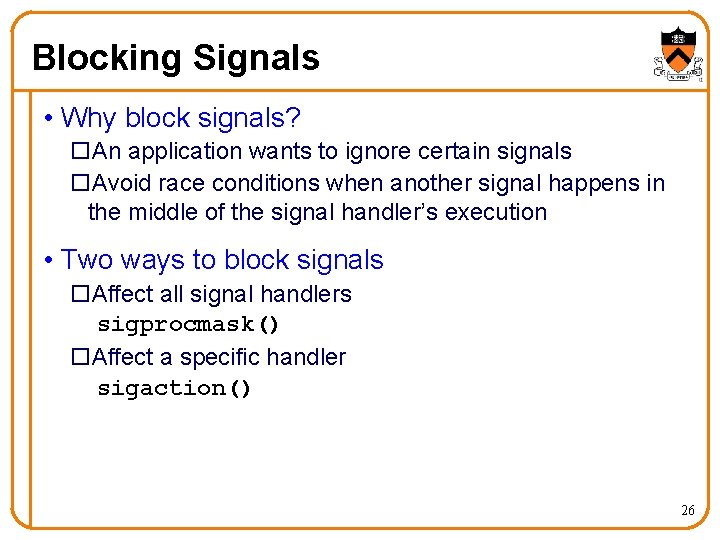
Blocking Signals • Why block signals? o. An application wants to ignore certain signals o. Avoid race conditions when another signal happens in the middle of the signal handler’s execution • Two ways to block signals o. Affect all signal handlers sigprocmask() o. Affect a specific handler sigaction() 26
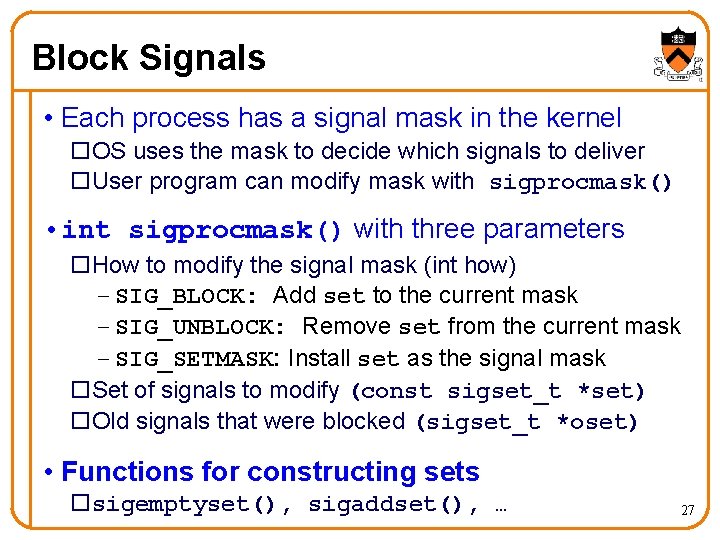
Block Signals • Each process has a signal mask in the kernel o. OS uses the mask to decide which signals to deliver o. User program can modify mask with sigprocmask() • int sigprocmask() with three parameters o. How to modify the signal mask (int how) – SIG_BLOCK: Add set to the current mask – SIG_UNBLOCK: Remove set from the current mask – SIG_SETMASK: Install set as the signal mask o. Set of signals to modify (const sigset_t *set) o. Old signals that were blocked (sigset_t *oset) • Functions for constructing sets osigemptyset(), sigaddset(), … 27
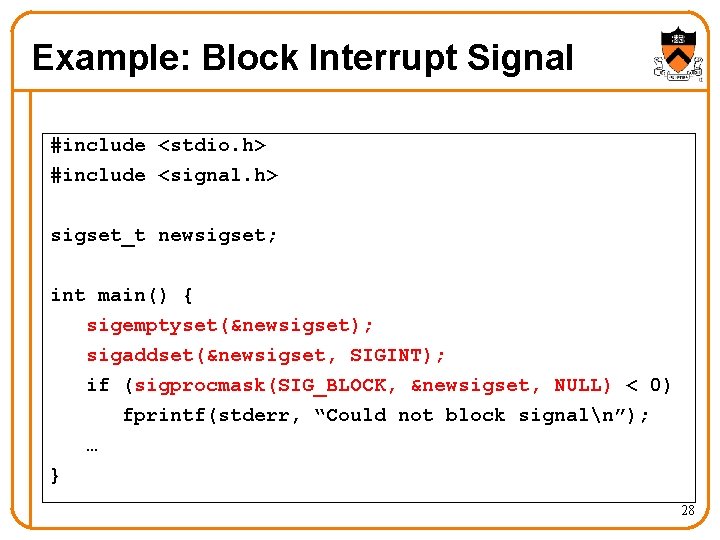
Example: Block Interrupt Signal #include <stdio. h> #include <signal. h> sigset_t newsigset; int main() { sigemptyset(&newsigset); sigaddset(&newsigset, SIGINT); if (sigprocmask(SIG_BLOCK, &newsigset, NULL) < 0) fprintf(stderr, “Could not block signaln”); … } 28
Problem: Blocking Signals in Handler • Goal: block certain signals within a handler o. Another signal might arrive at the start of the handler o… before calling the system call to block signals • Solution: install handler and the mask together o. Sigaction() system call, with three parameters – Signal number (int signum) – Set new signal action (const struct sigaction *) – Examine old signal action (struct sigaction *) o. Sigaction data structure – Handler for the signal – Mask of additional signals to block during the handler – Flags controlling delivery of the signal 29
Sigaction() vs. Signal() • Benefits of sigaction() over signal() o. Set the mask and handler together o. Examine the existing handler without reassigning it o. Provide handler with information about process state • You should not mix the two system calls o. They interact in strange ways o. In Assignment #7, we recommend using sigaction() 30
Keeping Track of Passage of Time • Interval timers o. Generate a signal after a specific time interval • Real time (or wall-clock time) o. Elapsed time, independent of activity o. Not an accurate measure of execution time o. Timer generates a SIGALRM signal • Virtual time (or CPU time) o. Time the process spends running o. Doesn’t include spent by other processes o. Timer generates a SIGPROF signal 31
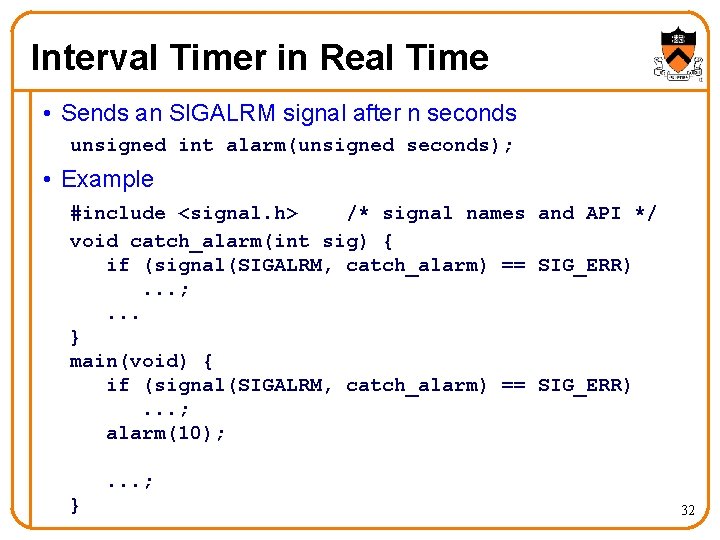
Interval Timer in Real Time • Sends an SIGALRM signal after n seconds unsigned int alarm(unsigned seconds); • Example #include <signal. h> /* signal names and API */ void catch_alarm(int sig) { if (signal(SIGALRM, catch_alarm) == SIG_ERR). . . ; . . . } main(void) { if (signal(SIGALRM, catch_alarm) == SIG_ERR). . . ; alarm(10); . . . ; } 32
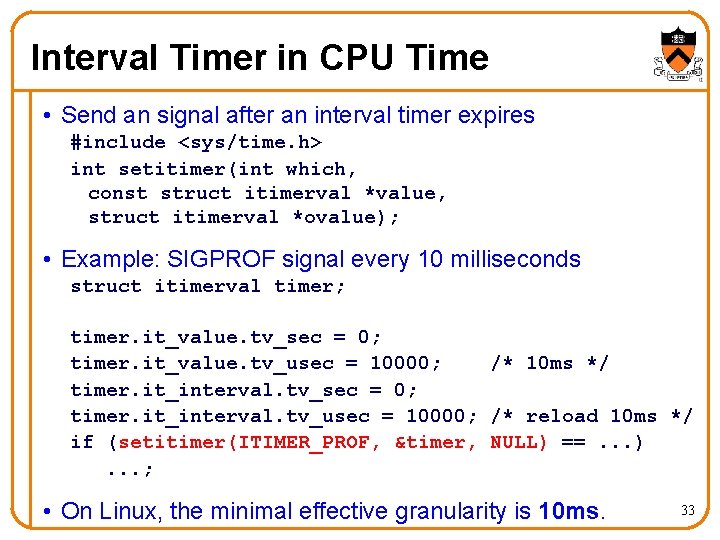
Interval Timer in CPU Time • Send an signal after an interval timer expires #include <sys/time. h> int setitimer(int which, const struct itimerval *value, struct itimerval *ovalue); • Example: SIGPROF signal every 10 milliseconds struct itimerval timer; timer. it_value. tv_sec = 0; timer. it_value. tv_usec = 10000; /* 10 ms */ timer. it_interval. tv_sec = 0; timer. it_interval. tv_usec = 10000; /* reload 10 ms */ if (setitimer(ITIMER_PROF, &timer, NULL) ==. . . ). . . ; • On Linux, the minimal effective granularity is 10 ms. 33
Conclusions • Signals o. An asynchronous event mechanism o. Use sigaction() and blocking to avoid race conditions o. Signal handlers should be simple and short o. Most predefined signals are “catchable” • Interval timers o. Real time (SIGALRM) or CPU time (SIGPROF) o. Linux imposes 10 ms as the minimal granularity 34