
Signals and Systems Lecture 10 Fourier Analysis of
- Slides: 14
Signals and Systems Lecture 10: Fourier Analysis of Periodic Signals
Today's lecture − Fourier Analysis of Triangular Wave − Convergence of Fourier Synthesis − Frequency Modulation 2
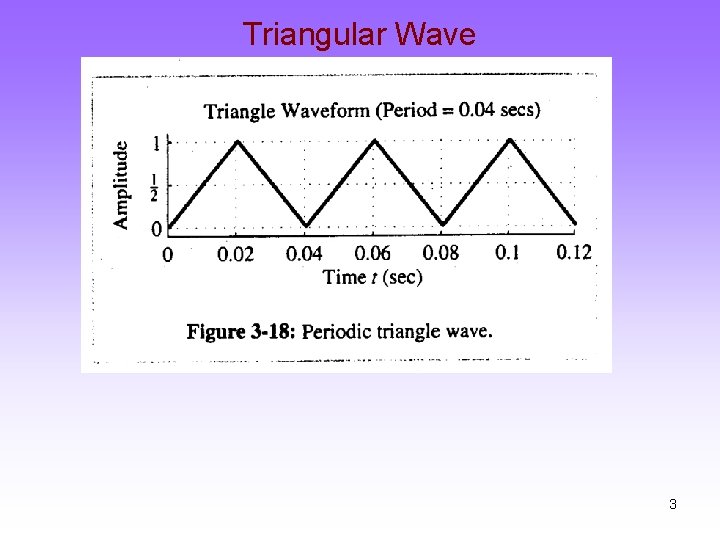
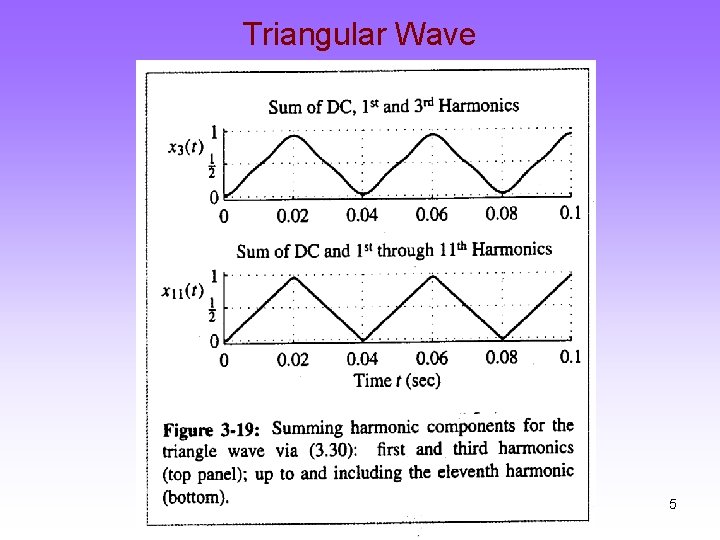
Triangular Wave 3
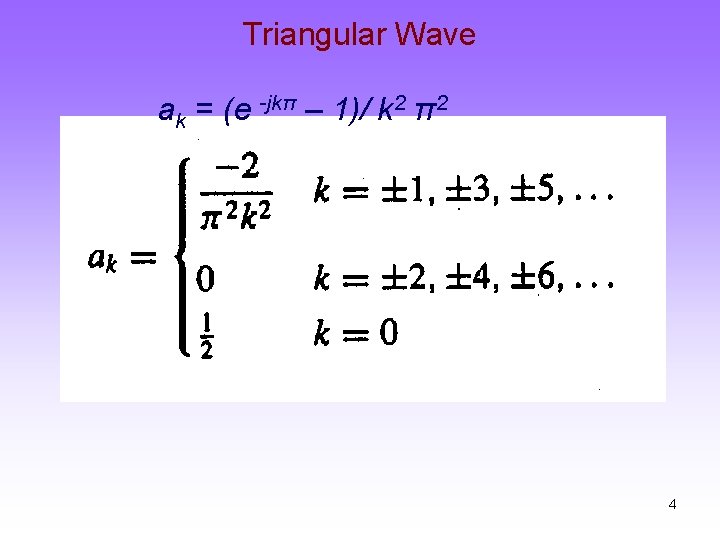
Triangular Wave ak = (e -jkπ – 1)/ k 2 π2 4
Triangular Wave 5
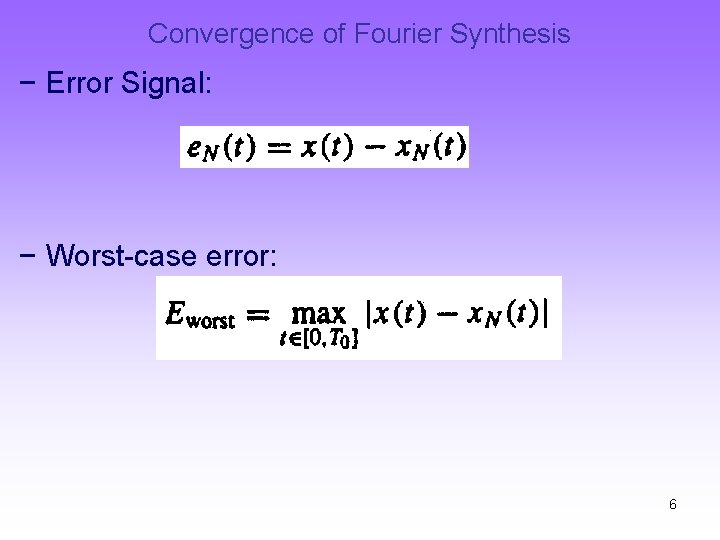
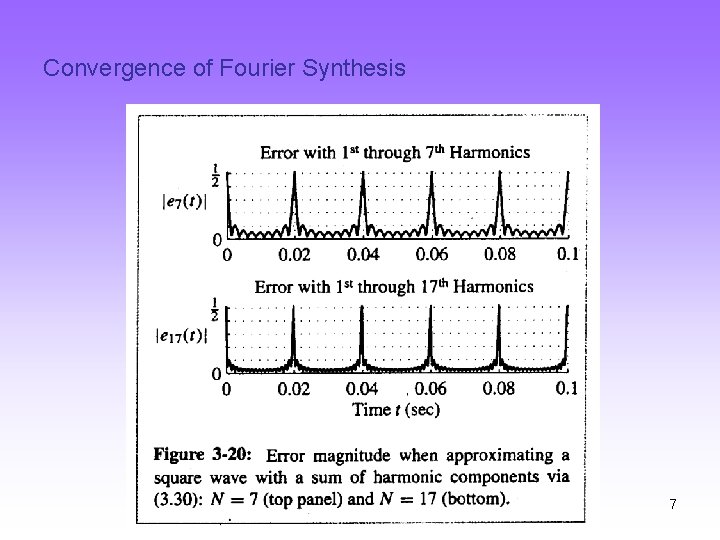
Convergence of Fourier Synthesis − Error Signal: − Worst-case error: 6
Convergence of Fourier Synthesis 7
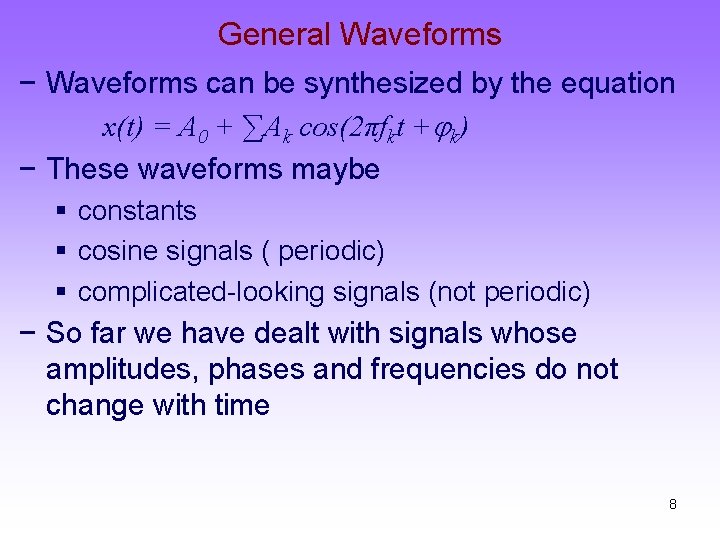
General Waveforms − Waveforms can be synthesized by the equation x(t) = A 0 + ∑Ak cos(2πfkt + k) − These waveforms maybe § constants § cosine signals ( periodic) § complicated-looking signals (not periodic) − So far we have dealt with signals whose amplitudes, phases and frequencies do not change with time 8
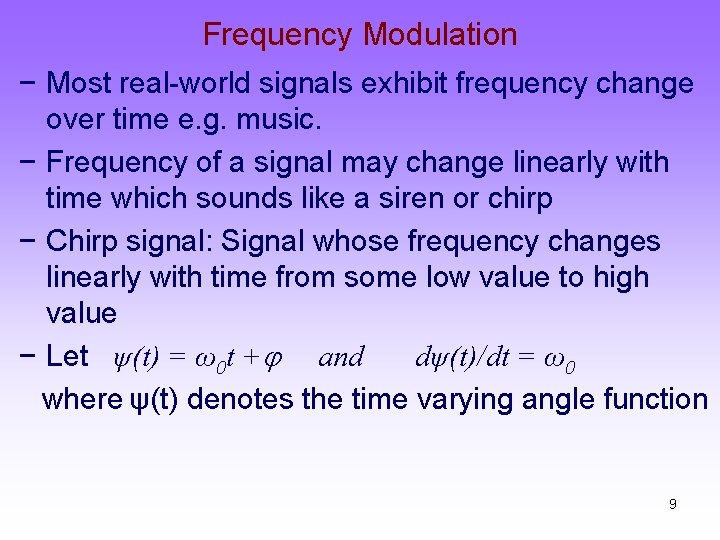
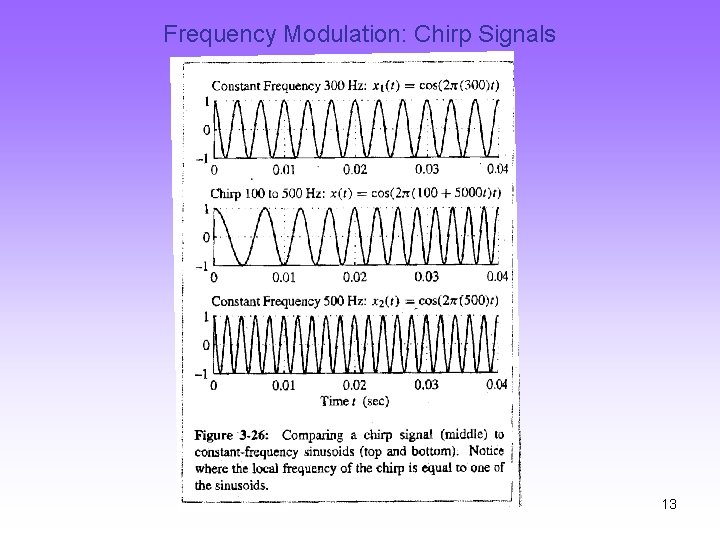
Frequency Modulation − Most real-world signals exhibit frequency change over time e. g. music. − Frequency of a signal may change linearly with time which sounds like a siren or chirp − Chirp signal: Signal whose frequency changes linearly with time from some low value to high value − Let ψ(t) = ω0 t + and dψ(t)/dt = ω0 where ψ(t) denotes the time varying angle function 9
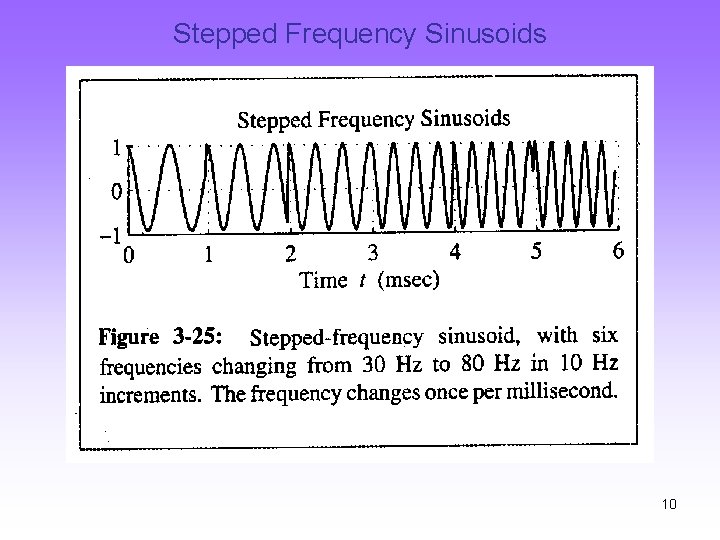
Stepped Frequency Sinusoids 10
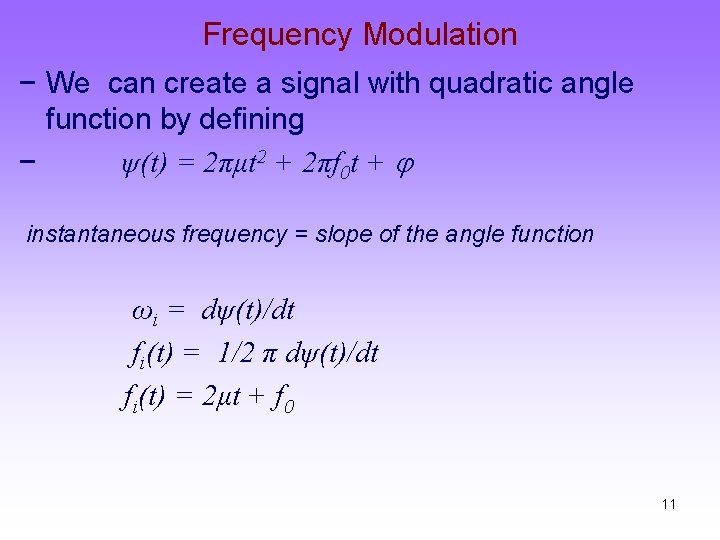
Frequency Modulation − We can create a signal with quadratic angle function by defining − ψ(t) = 2πμt 2 + 2πf 0 t + instantaneous frequency = slope of the angle function ωi = dψ(t)/dt fi(t) = 1/2 π dψ(t)/dt fi(t) = 2μt + f 0 11
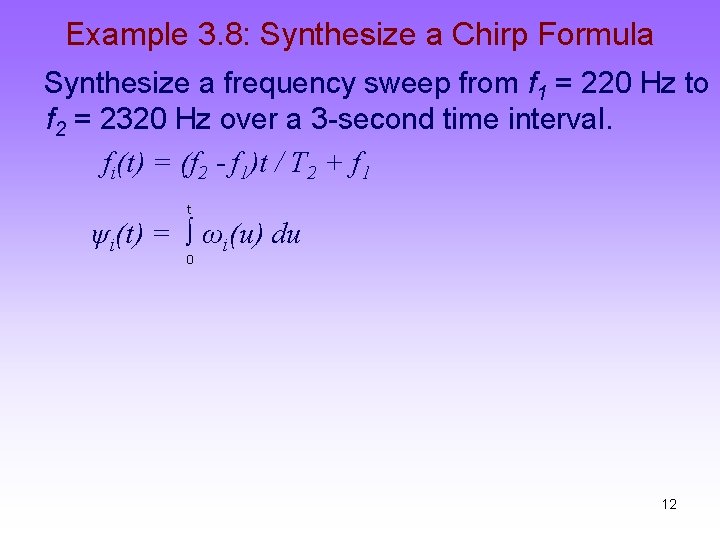
Example 3. 8: Synthesize a Chirp Formula Synthesize a frequency sweep from f 1 = 220 Hz to f 2 = 2320 Hz over a 3 -second time interval. fi(t) = (f 2 - f 1)t / T 2 + f 1 t ψi(t) = ∫ ωi(u) du 0 12
Frequency Modulation: Chirp Signals 13
Assignment #2 − − − − End Chapter Problems P- 3. 8 P- 3. 10 P- 3. 12 P- 3. 14 P- 3. 15 Due on Tuesday 3 rd March 2009 14