
Signals and Systems Fall 2019 DiscreteTime Convolution Examples
![Discrete Time Convolution Example: Method 1: Running Finite Convolution Sum x[n] h[n] y[n] h[n]](https://slidetodoc.com/presentation_image_h2/47ff9a8dc47595bc97fda37e80e19b13/image-2.jpg "Discrete Time Convolution Example: Method 1: Running Finite Convolution Sum x[n] h[n] y[n] h[n]")
![n -3 -2 -1 0 1 2 3 x[n] 0 0 1 2 1](https://slidetodoc.com/presentation_image_h2/47ff9a8dc47595bc97fda37e80e19b13/image-3.jpg "n -3 -2 -1 0 1 2 3 x[n] 0 0 1 2 1")
![Method 2: Flip and Shift Step 2: For non-zero overlapping values of h[m] and](https://slidetodoc.com/presentation_image_h2/47ff9a8dc47595bc97fda37e80e19b13/image-5.jpg "Method 2: Flip and Shift Step 2: For non-zero overlapping values of h[m] and")
![Method 3: Convolution by Impuls Property 1) n-m=0 m=n 2) örnek h[n] 1/2 x[n]](https://slidetodoc.com/presentation_image_h2/47ff9a8dc47595bc97fda37e80e19b13/image-6.jpg "Method 3: Convolution by Impuls Property 1) n-m=0 m=n 2) örnek h[n] 1/2 x[n]")
- Slides: 7
Signals and Systems Fall 2019 Discrete-Time Convolution Examples Prof. Dr. Adnan Kavak Computer Engineering Kocaeli University Textbook: Linear Systems and Signals, B. P. Lathi These example slides are initially prepared by Nabat Hangeldiyeva using the class notes of Prof. Dr. Adnan Kavak
Discrete Time Convolution Example: Method 1: Running Finite Convolution Sum x[n] h[n] y[n] h[n] is finite valued between 0 and M. Other values of h[n] are zero h[n] x[n] 3 2 1 -3 -2 -1 0 1 2 3 4 5 1/2 n 1/2 -3 -2 -1 0 1 2 3 4 5 Averaging FIR Filter n
n -3 -2 -1 0 1 2 3 x[n] 0 0 1 2 1 0 0 h[n] 0 0 0 1/2 0 0 x[n-1] 0 0 0 1 2 1 0 h[0] x[n] 0 0 1/2 1 1/2 0 0 h[1] x[n-1] 0 0 0 1/2 1 1/2 0 y[n] 0 0 1/2 3/2 1/2 0 y[n] 3/2 1/2 -3 -2 -1 0 1 2 3 4 4 -3 n
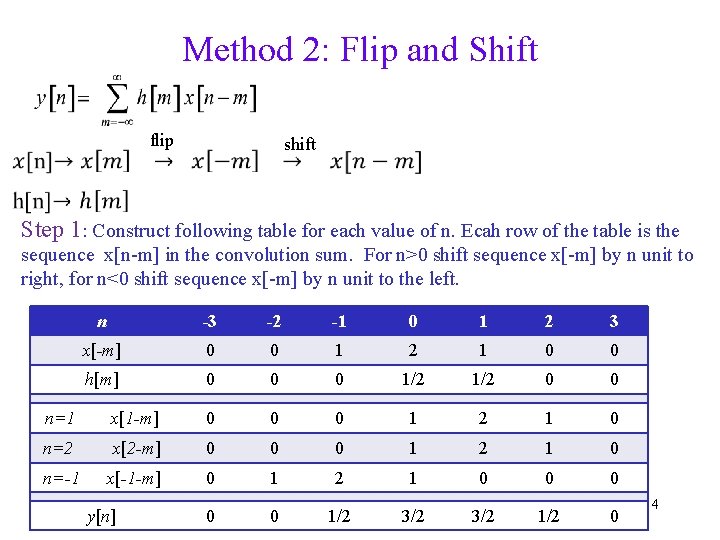
Method 2: Flip and Shift flip shift Step 1: Construct following table for each value of n. Ecah row of the table is the sequence x[n-m] in the convolution sum. For n>0 shift sequence x[-m] by n unit to right, for n<0 shift sequence x[-m] by n unit to the left. n -3 -2 -1 0 1 2 3 x[-m] 0 0 1 2 1 0 0 h[m] 0 0 0 1/2 0 0 n=1 x[1 -m] 0 0 0 1 2 1 0 n=2 x[2 -m] 0 0 0 1 2 1 0 n=-1 x[-1 -m] 0 1 2 1 0 0 0 1/2 3/2 1/2 0 y[n] 4 -4
Method 2: Flip and Shift Step 2: For non-zero overlapping values of h[m] and x[n-m] , calculate convolution. n=0 n=1 n=2 n=-1 y[n] y[-1]=1/2 3/2 1/2 -3 -2 -1 0 1 2 3 4 n 4 -5
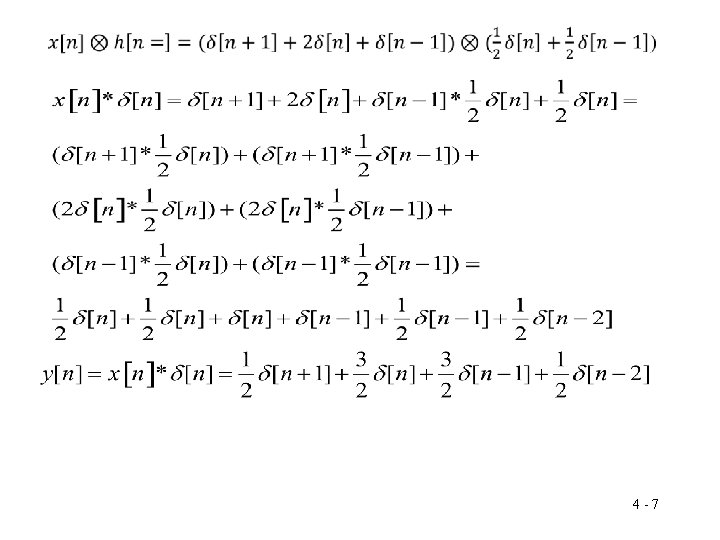
Method 3: Convolution by Impuls Property 1) n-m=0 m=n 2) örnek h[n] 1/2 x[n] 3 2 1 -3 -2 -1 0 1 2 3 4 5 1/2 -3 -2 -1 0 1 2 3 4 5 n n 4 -6
4 -7