
Signals and Systems Chapter 2 Biomedical Engineering Dr

Signals and Systems Chapter 2 Biomedical Engineering Dr. Mohamed Bingabr University of Central Oklahoma
Outline • Signals • Systems • The Fourier Transform • Properties of the Fourier Transform • Transfer Function • Circular Symmetry and the Hankel Transform
Introduction Signal Type - Continuous Signal: x-ray attenuation - Discrete Signal: times of arrival of photons in a radioactive decay process in PET - Mixed signal: CT scan signal g(l, θk) System Type - Continuous-continuous system - Continuous input Continuous output - Continuous-discrete system - Continuous input Discrete output
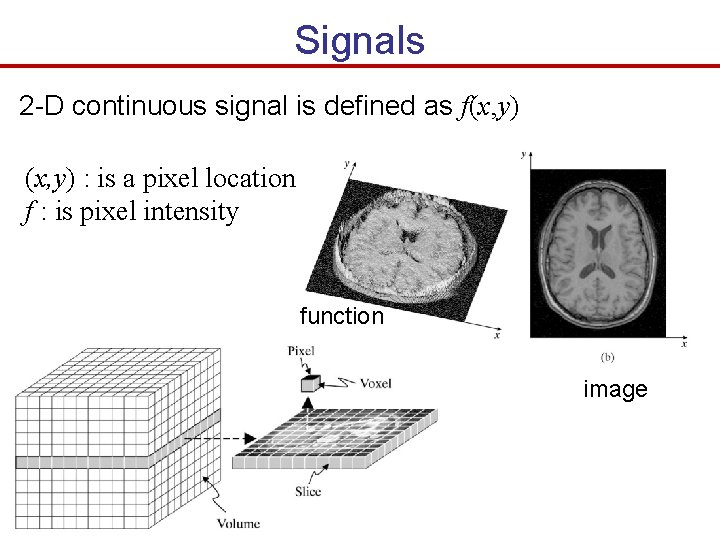
Signals 2 -D continuous signal is defined as f(x, y) : is a pixel location f : is pixel intensity function image
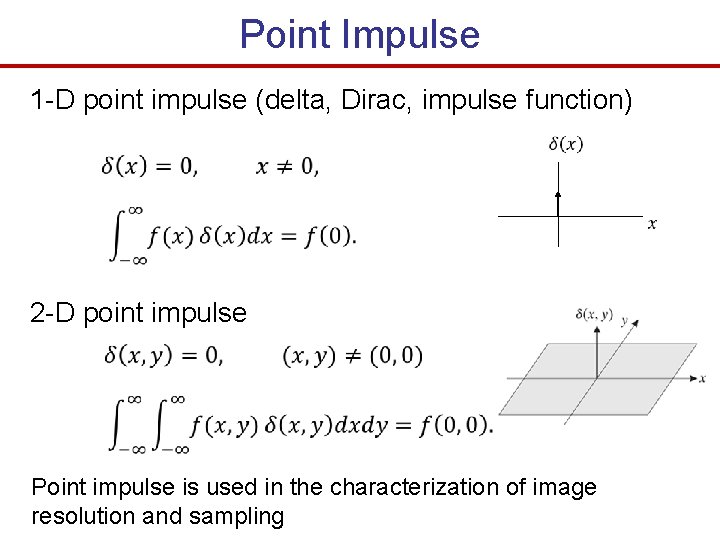
Point Impulse 1 -D point impulse (delta, Dirac, impulse function) 2 -D point impulse Point impulse is used in the characterization of image resolution and sampling

Point Impulse Properties 1 - Sifting property We can interpret the product of a function with a point impulse as another point impulse whose volume is equal to the value of the function at the location of the point impulse. 2 - Scaling property 2 - Even function
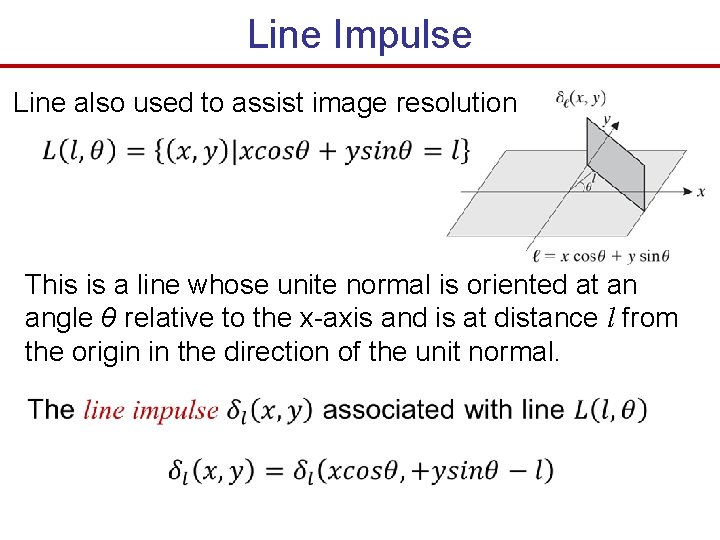
Line Impulse Line also used to assist image resolution This is a line whose unite normal is oriented at an angle θ relative to the x-axis and is at distance l from the origin in the direction of the unit normal.
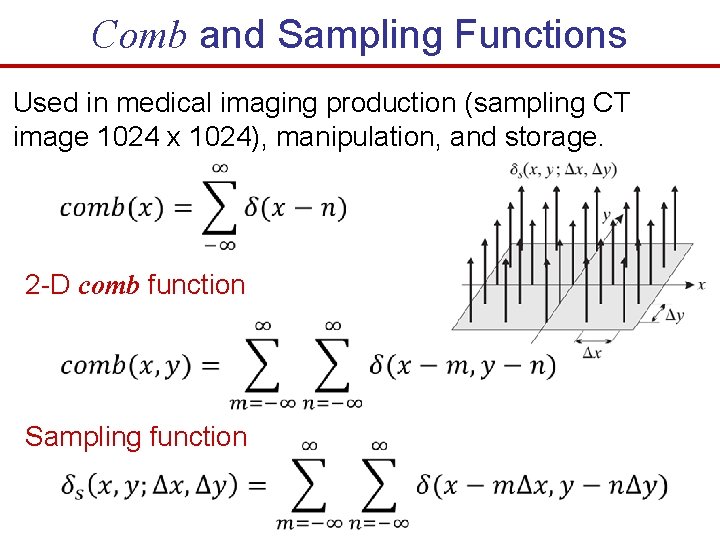
Comb and Sampling Functions Used in medical imaging production (sampling CT image 1024 x 1024), manipulation, and storage. 2 -D comb function Sampling function
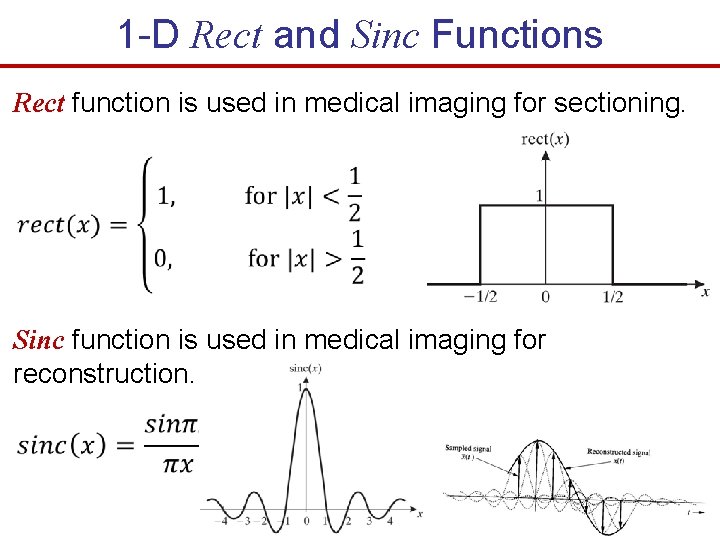
1 -D Rect and Sinc Functions Rect function is used in medical imaging for sectioning. Sinc function is used in medical imaging for reconstruction.
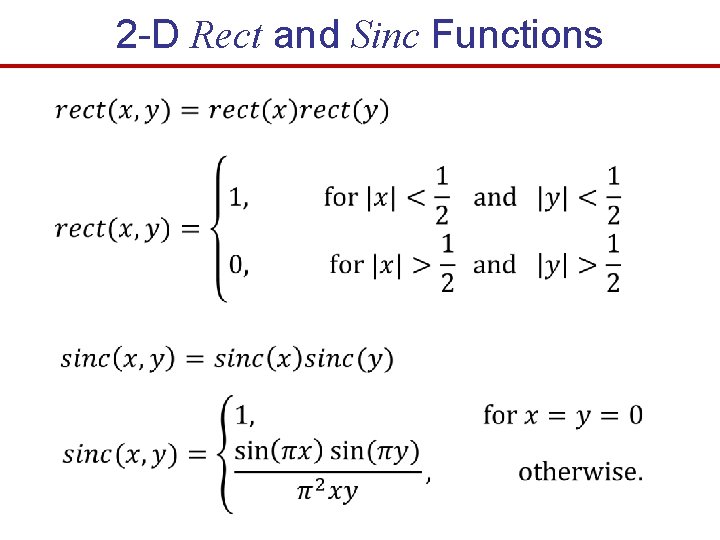
2 -D Rect and Sinc Functions
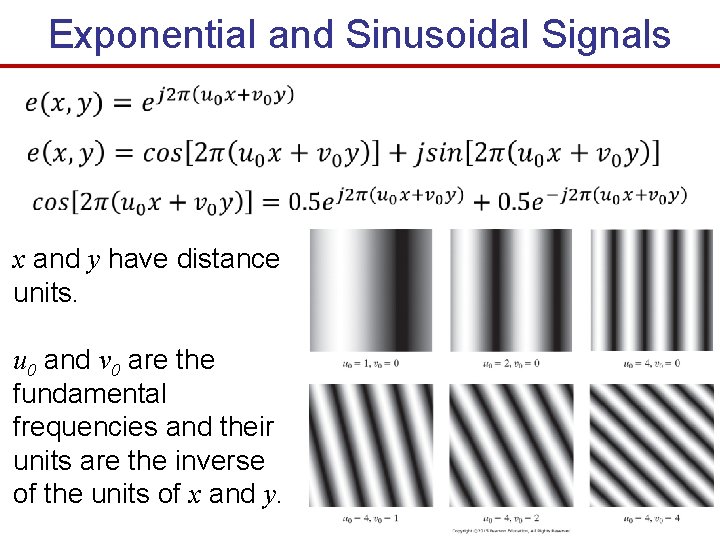
Exponential and Sinusoidal Signals x and y have distance units. u 0 and v 0 are the fundamental frequencies and their units are the inverse of the units of x and y.
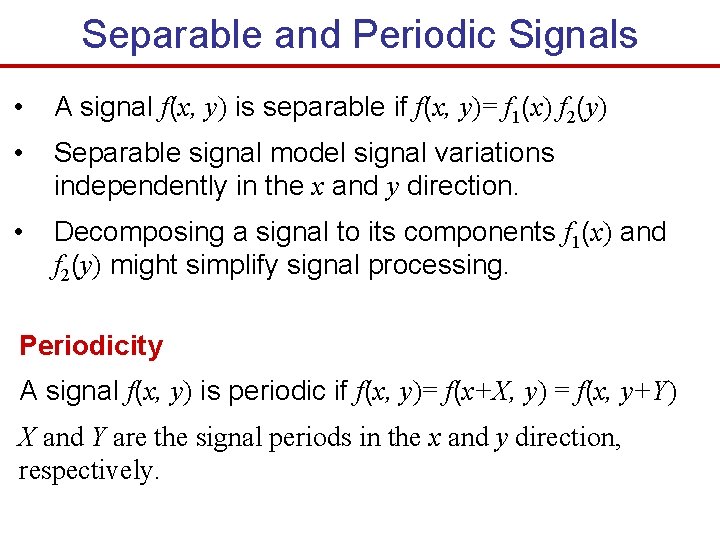
Separable and Periodic Signals • A signal f(x, y) is separable if f(x, y)= f 1(x) f 2(y) • Separable signal model signal variations independently in the x and y direction. • Decomposing a signal to its components f 1(x) and f 2(y) might simplify signal processing. Periodicity A signal f(x, y) is periodic if f(x, y)= f(x+X, y) = f(x, y+Y) X and Y are the signal periods in the x and y direction, respectively.
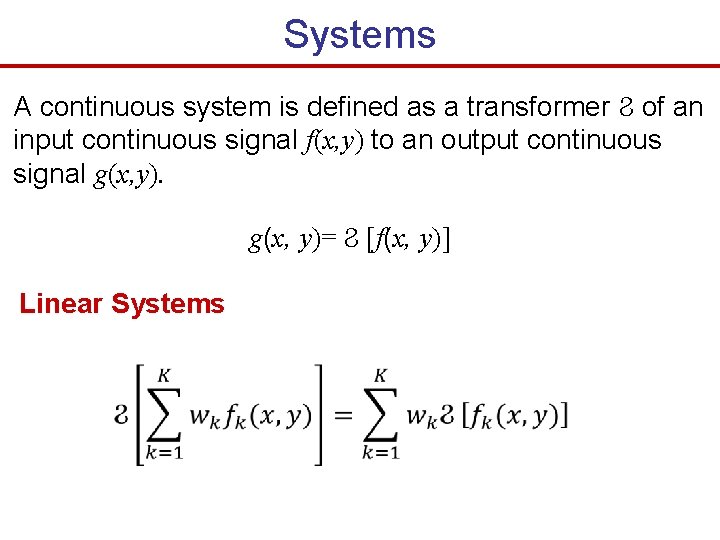
Systems A continuous system is defined as a transformer Ϩ of an input continuous signal f(x, y) to an output continuous signal g(x, y)= Ϩ [f(x, y)] Linear Systems
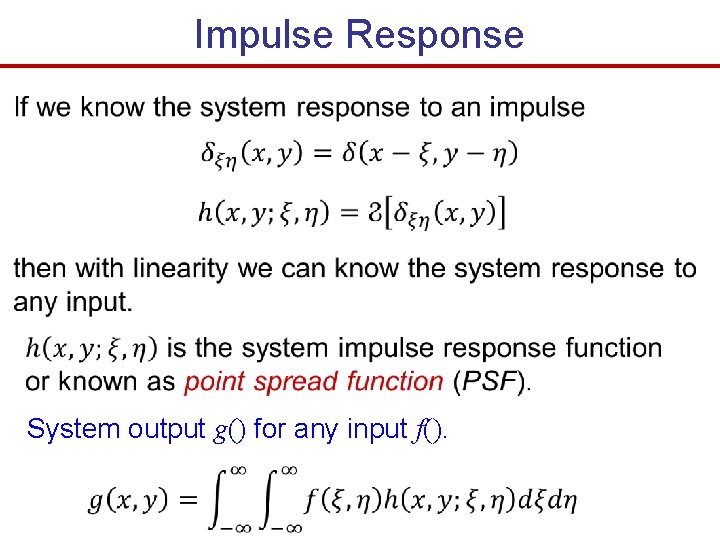
Impulse Response System output g() for any input f().
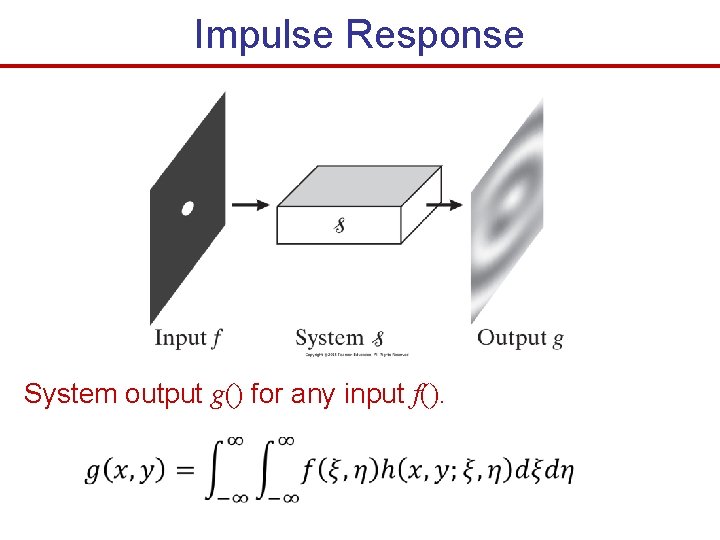
Impulse Response System output g() for any input f().
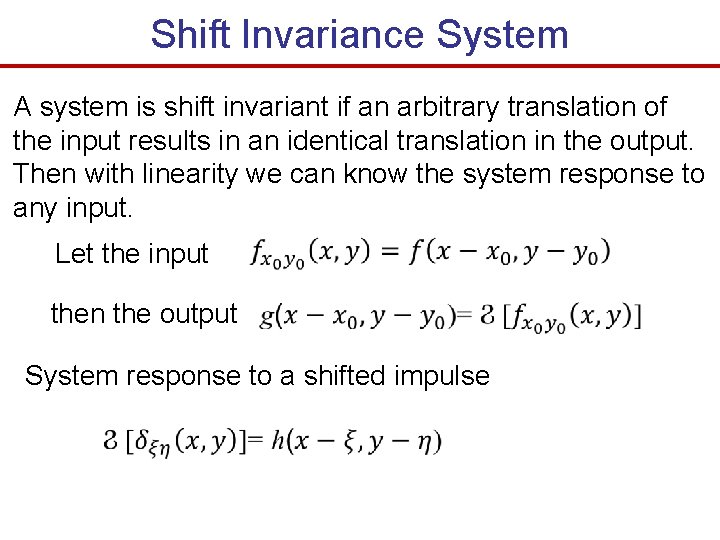
Shift Invariance System A system is shift invariant if an arbitrary translation of the input results in an identical translation in the output. Then with linearity we can know the system response to any input. Let the input then the output System response to a shifted impulse
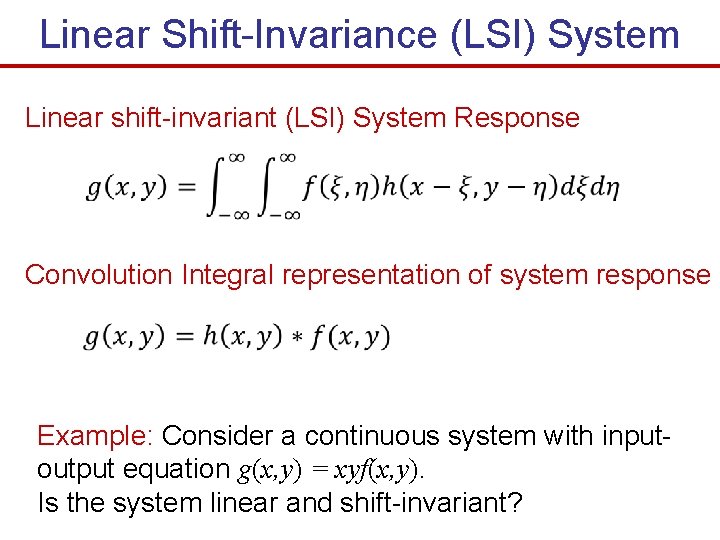
Linear Shift-Invariance (LSI) System Linear shift-invariant (LSI) System Response Convolution Integral representation of system response Example: Consider a continuous system with inputoutput equation g(x, y) = xyf(x, y). Is the system linear and shift-invariant?
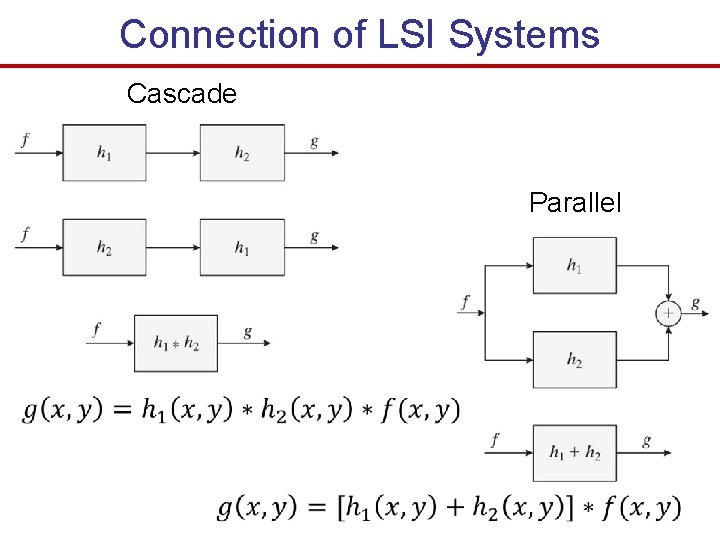
Connection of LSI Systems Cascade Parallel
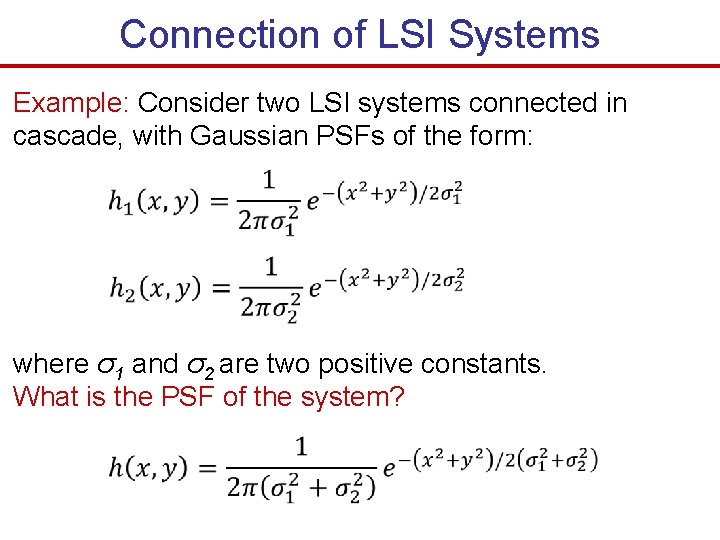
Connection of LSI Systems Example: Consider two LSI systems connected in cascade, with Gaussian PSFs of the form: where σ1 and σ2 are two positive constants. What is the PSF of the system?
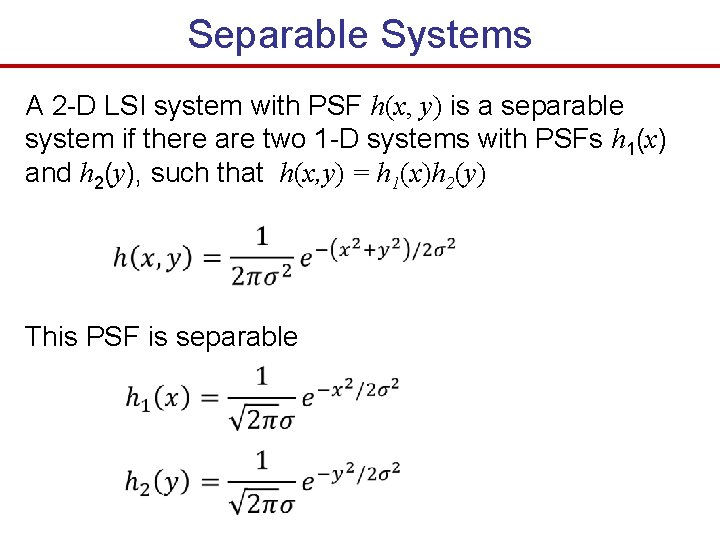
Separable Systems A 2 -D LSI system with PSF h(x, y) is a separable system if there are two 1 -D systems with PSFs h 1(x) and h 2(y), such that h(x, y) = h 1(x)h 2(y) This PSF is separable
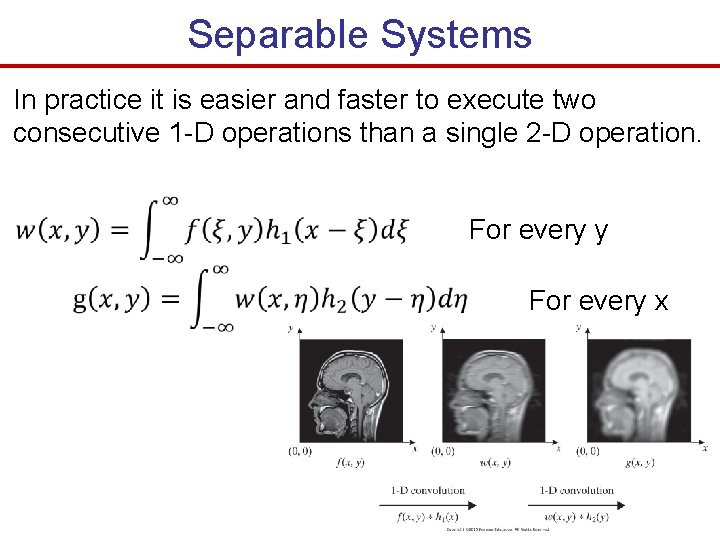
Separable Systems In practice it is easier and faster to execute two consecutive 1 -D operations than a single 2 -D operation. For every y For every x
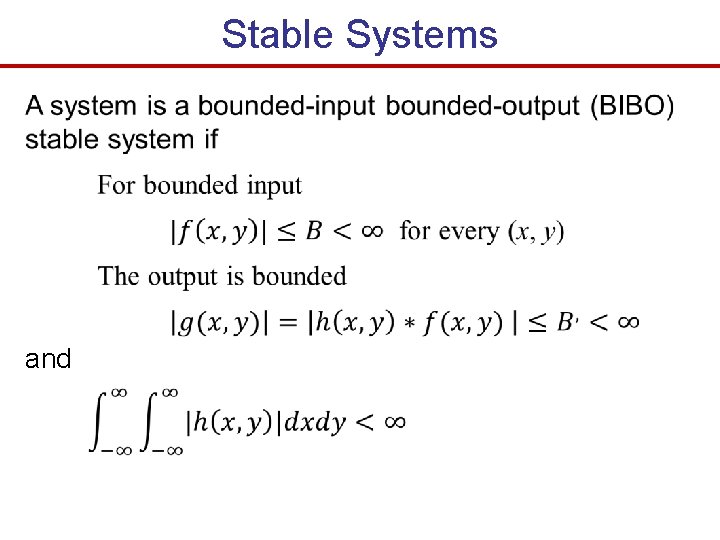
Stable Systems and
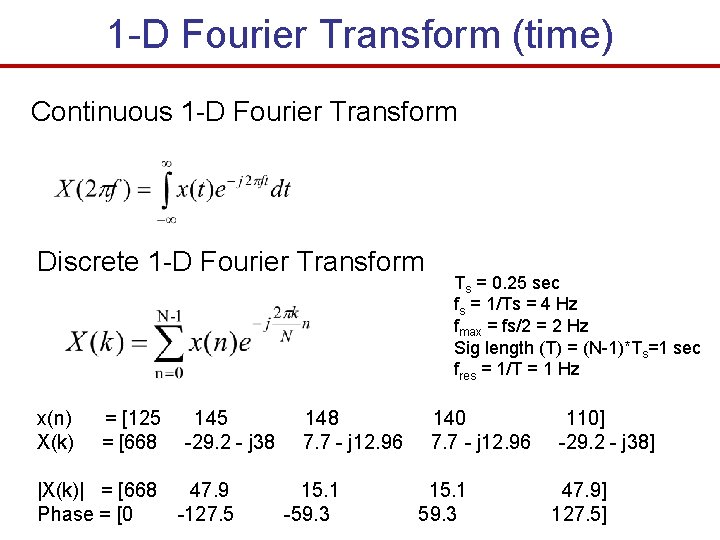
1 -D Fourier Transform (time) Continuous 1 -D Fourier Transform Discrete 1 -D Fourier Transform x(n) X(k) = [125 = [668 |X(k)| = [668 Phase = [0 145 -29. 2 - j 38 47. 9 -127. 5 148 7. 7 - j 12. 96 15. 1 -59. 3 Ts = 0. 25 sec fs = 1/Ts = 4 Hz fmax = fs/2 = 2 Hz Sig length (T) = (N-1)*Ts=1 sec fres = 1/T = 1 Hz 140 7. 7 - j 12. 96 15. 1 59. 3 110] -29. 2 - j 38] 47. 9] 127. 5]
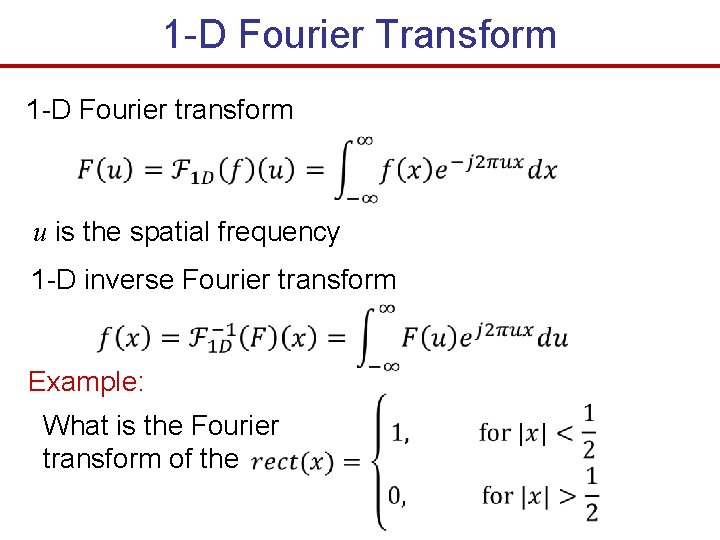
1 -D Fourier Transform 1 -D Fourier transform u is the spatial frequency 1 -D inverse Fourier transform Example: What is the Fourier transform of the
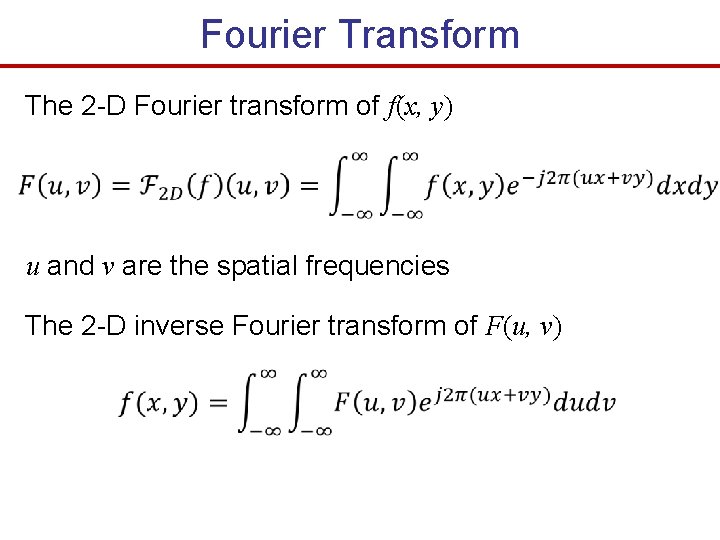
Fourier Transform The 2 -D Fourier transform of f(x, y) u and v are the spatial frequencies The 2 -D inverse Fourier transform of F(u, v)
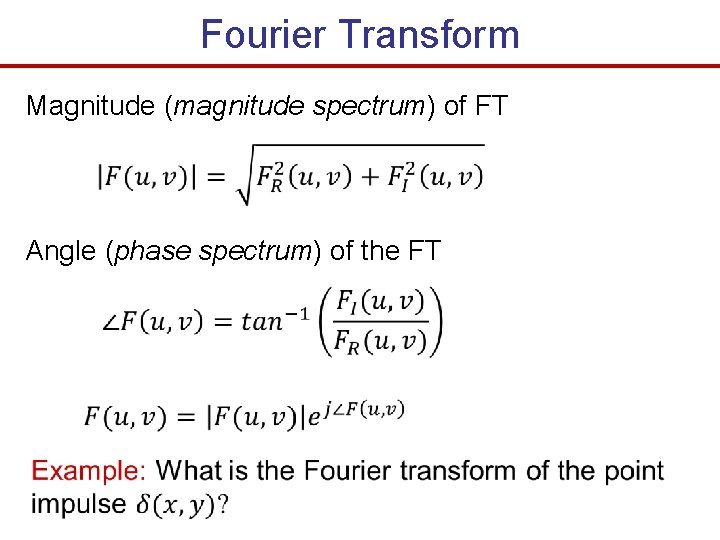
Fourier Transform Magnitude (magnitude spectrum) of FT Angle (phase spectrum) of the FT
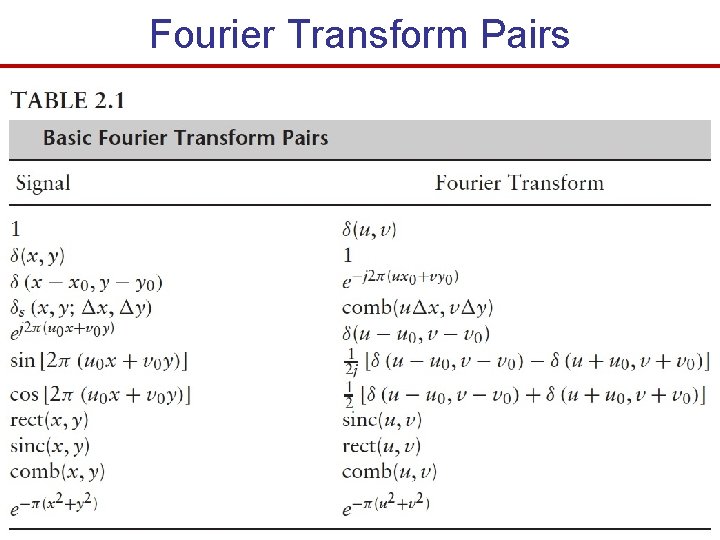
Fourier Transform Pairs
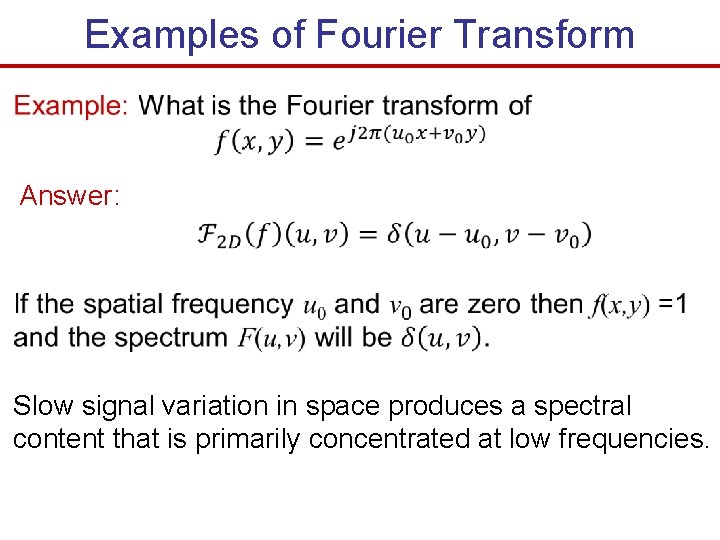
Examples of Fourier Transform Answer: Slow signal variation in space produces a spectral content that is primarily concentrated at low frequencies.
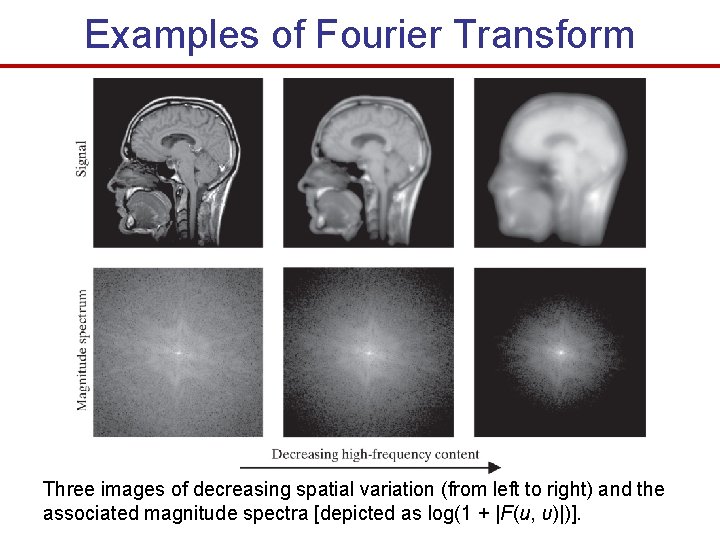
Examples of Fourier Transform Three images of decreasing spatial variation (from left to right) and the associated magnitude spectra [depicted as log(1 + |F(u, υ)|)].
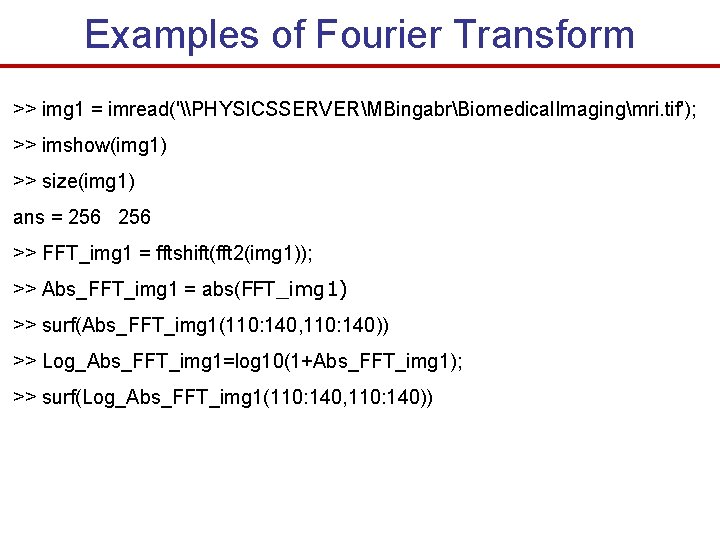
Examples of Fourier Transform >> img 1 = imread('\PHYSICSSERVERMBingabrBiomedical. Imagingmri. tif'); >> imshow(img 1) >> size(img 1) ans = 256 >> FFT_img 1 = fftshift(fft 2(img 1)); >> Abs_FFT_img 1 = abs(FFT_img 1) >> surf(Abs_FFT_img 1(110: 140, 110: 140)) >> Log_Abs_FFT_img 1=log 10(1+Abs_FFT_img 1); >> surf(Log_Abs_FFT_img 1(110: 140, 110: 140))
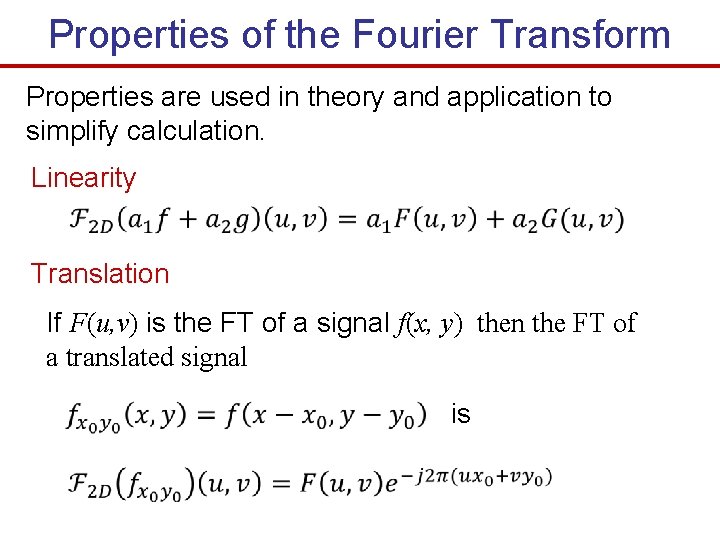
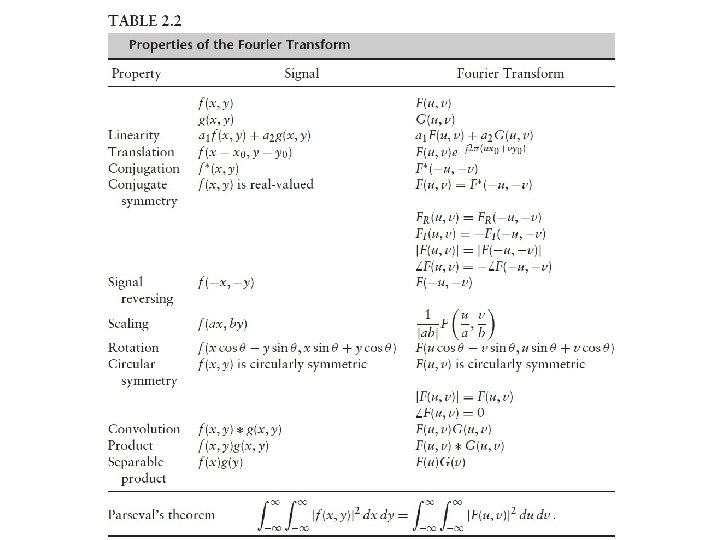
Properties of the Fourier Transform Properties are used in theory and application to simplify calculation. Linearity Translation If F(u, v) is the FT of a signal f(x, y) then the FT of a translated signal is
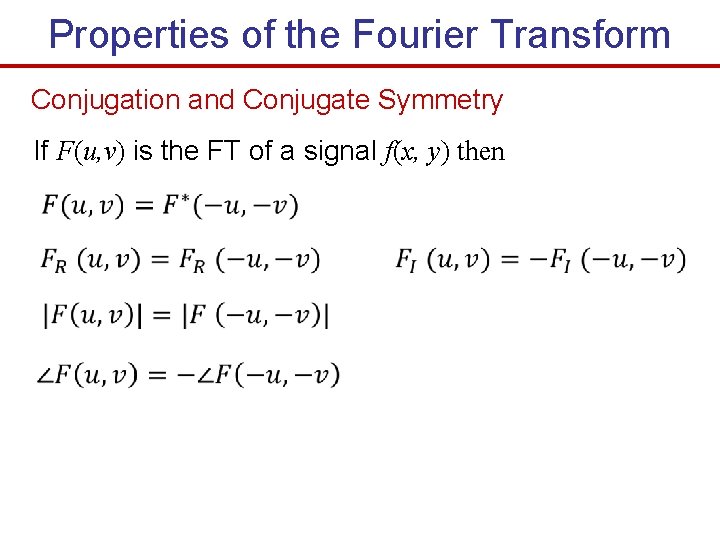
Properties of the Fourier Transform Conjugation and Conjugate Symmetry If F(u, v) is the FT of a signal f(x, y) then
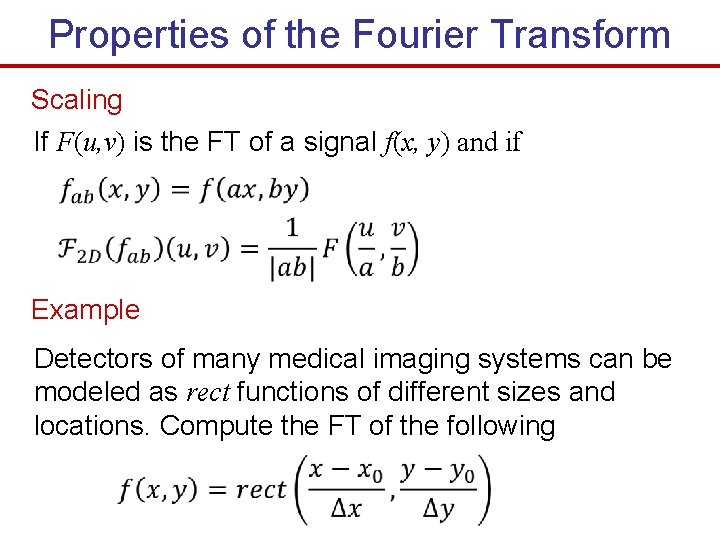
Properties of the Fourier Transform Scaling If F(u, v) is the FT of a signal f(x, y) and if Example Detectors of many medical imaging systems can be modeled as rect functions of different sizes and locations. Compute the FT of the following
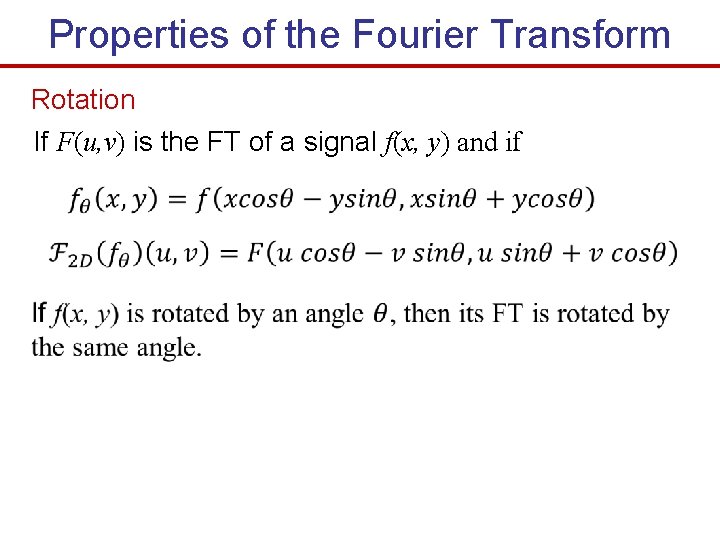
Properties of the Fourier Transform Rotation If F(u, v) is the FT of a signal f(x, y) and if
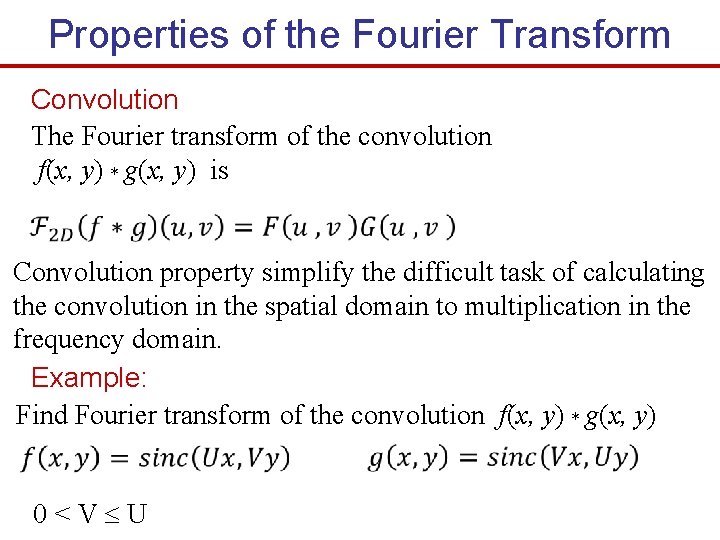
Properties of the Fourier Transform Convolution The Fourier transform of the convolution f(x, y) * g(x, y) is Convolution property simplify the difficult task of calculating the convolution in the spatial domain to multiplication in the frequency domain. Example: Find Fourier transform of the convolution f(x, y) * g(x, y) 0<V U
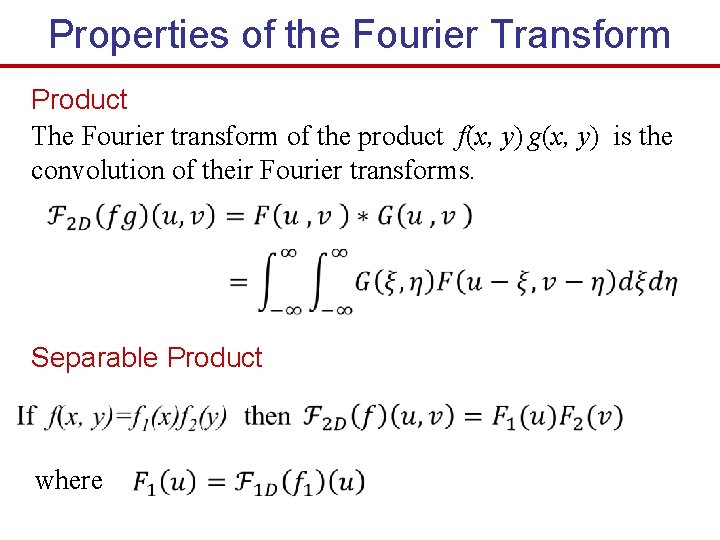
Properties of the Fourier Transform Product The Fourier transform of the product f(x, y) g(x, y) is the convolution of their Fourier transforms. Separable Product where
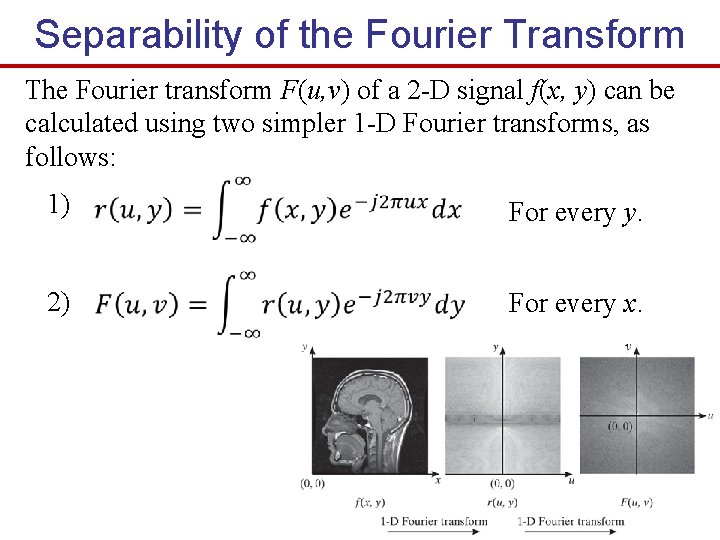
Separability of the Fourier Transform The Fourier transform F(u, v) of a 2 -D signal f(x, y) can be calculated using two simpler 1 -D Fourier transforms, as follows: 1) For every y. 2) For every x.
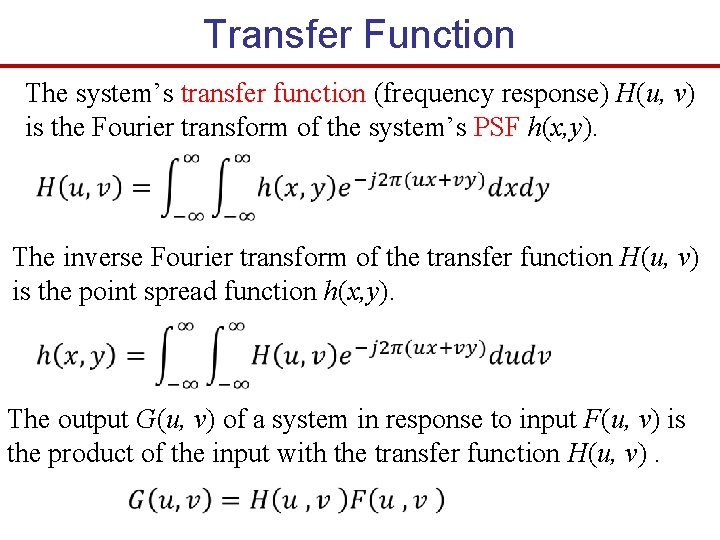
Transfer Function The system’s transfer function (frequency response) H(u, v) is the Fourier transform of the system’s PSF h(x, y). The inverse Fourier transform of the transfer function H(u, v) is the point spread function h(x, y). The output G(u, v) of a system in response to input F(u, v) is the product of the input with the transfer function H(u, v).
Transfer Function Example: Consider an idealized system whose PSF is h(x, y) = (x-x 0, y-y 0). What is the transfer function H(u, v) of the system, and what is the system output g(x, y) to an input signal f(x, y).
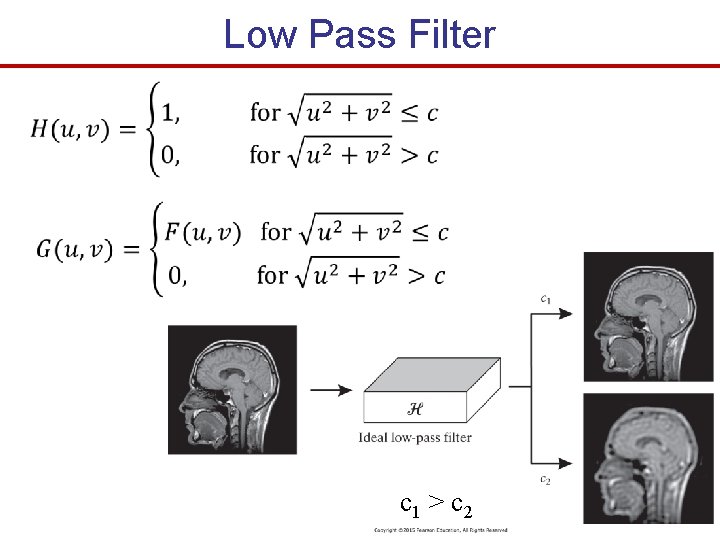
Low Pass Filter c 1 > c 2
Circular Symmetry Often, the performance of a medical imaging system does not depend on the orientation of the patient with respect to the system. The independence arises from the circular symmetry of the PSF. A 2 -D signal f(x, y) is circularly symmetric if fθ(x, y) = f(x, y) for every θ.
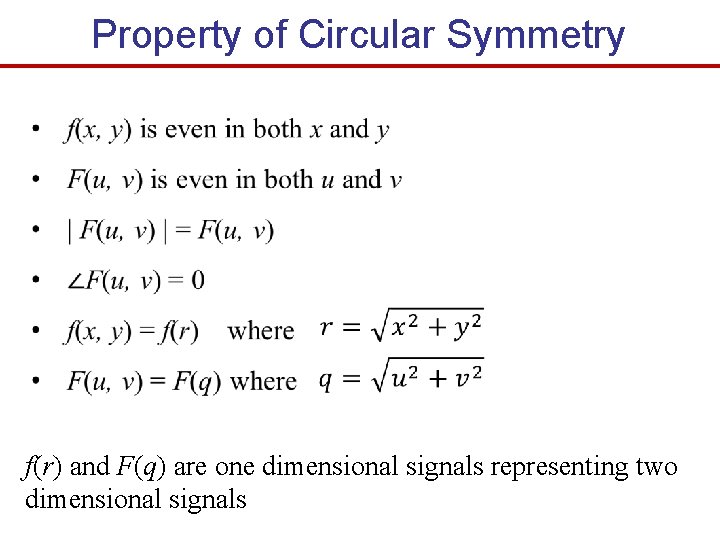
Property of Circular Symmetry f(r) and F(q) are one dimensional signals representing two dimensional signals
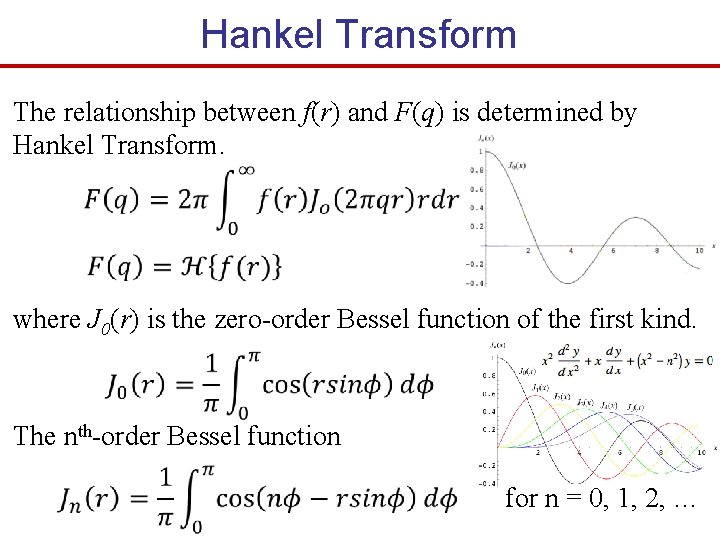
Hankel Transform The relationship between f(r) and F(q) is determined by Hankel Transform. where J 0(r) is the zero-order Bessel function of the first kind. The nth-order Bessel function for n = 0, 1, 2, …
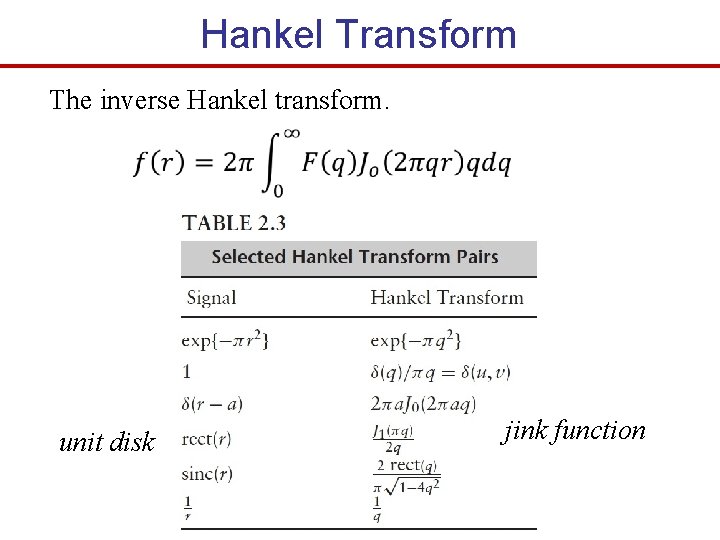
Hankel Transform The inverse Hankel transform. unit disk jink function
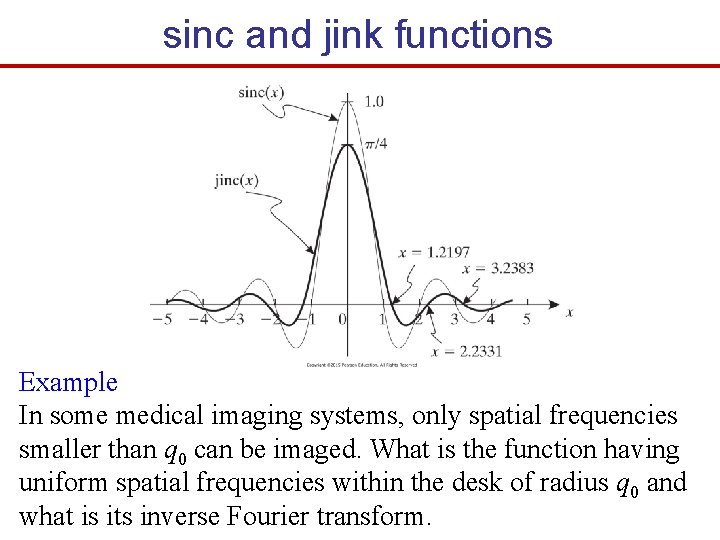
sinc and jink functions Example In some medical imaging systems, only spatial frequencies smaller than q 0 can be imaged. What is the function having uniform spatial frequencies within the desk of radius q 0 and what is its inverse Fourier transform.
- Slides: 46