
Signalized Intersection Delay Monitoring for Signal Retiming Safe
- Slides: 20
Signalized Intersection Delay Monitoring for Signal Retiming Safe. Trip-21 Safe and Efficient Travel through Innovation and Partnership in the 21 st Century Sudhir Murthy, PE, PTOE President Traf. Info Communications, Inc. Lexington, MA
Presentation Outline • • System Objectives Methodology Technology Test Site – Equipment Installation – Data Collected • Results • Concluding Remarks
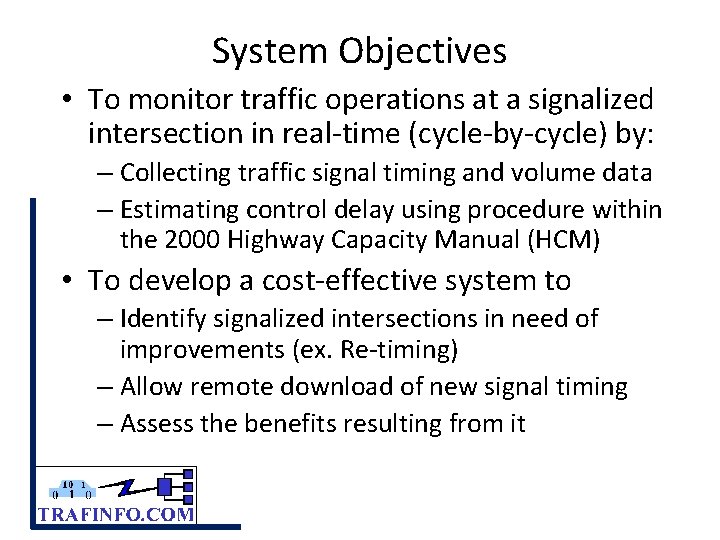
System Objectives • To monitor traffic operations at a signalized intersection in real-time (cycle-by-cycle) by: – Collecting traffic signal timing and volume data – Estimating control delay using procedure within the 2000 Highway Capacity Manual (HCM) • To develop a cost-effective system to – Identify signalized intersections in need of improvements (ex. Re-timing) – Allow remote download of new signal timing – Assess the benefits resulting from it
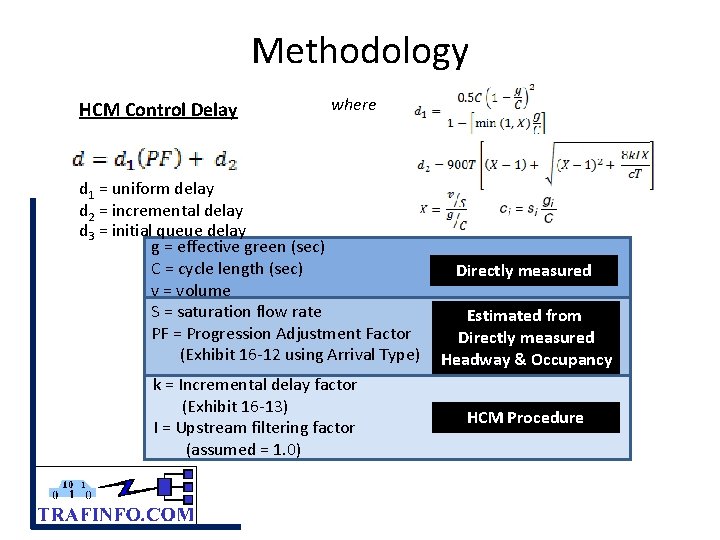
Methodology HCM Control Delay where d 1 = uniform delay d 2 = incremental delay d 3 = initial queue delay g = effective green (sec) C = cycle length (sec) v = volume S = saturation flow rate PF = Progression Adjustment Factor (Exhibit 16 -12 using Arrival Type) k = Incremental delay factor (Exhibit 16 -13) I = Upstream filtering factor (assumed = 1. 0) Directly measured Estimated from Directly measured Headway & Occupancy HCM Procedure
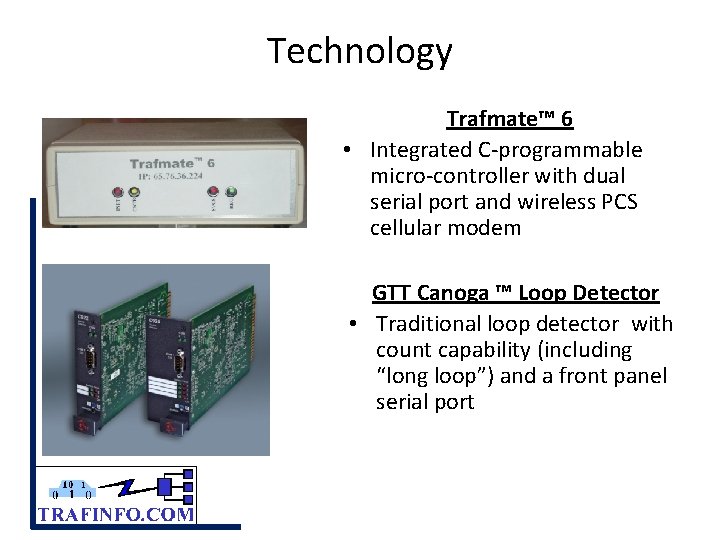
Technology Trafmate™ 6 • Integrated C-programmable micro-controller with dual serial port and wireless PCS cellular modem GTT Canoga ™ Loop Detector • Traditional loop detector with count capability (including “long loop”) and a front panel serial port
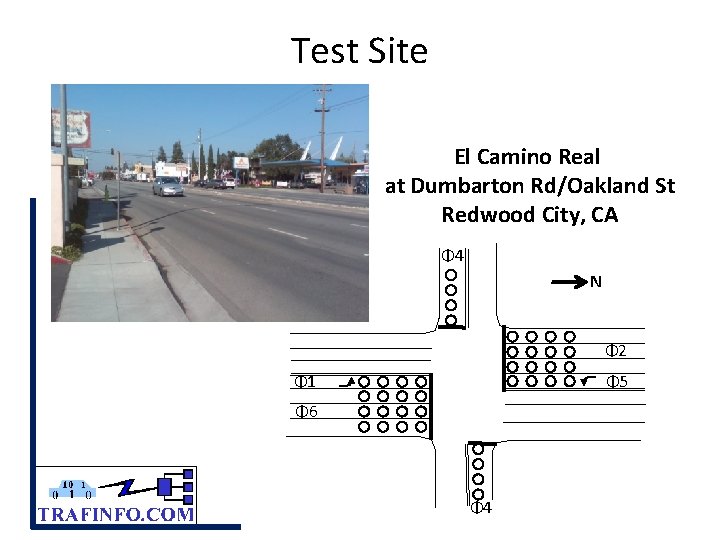
Test Site El Camino Real at Dumbarton Rd/Oakland St Redwood City, CA Φ 4 N Φ 2 Φ 1 Φ 5 Φ 6 Φ 4
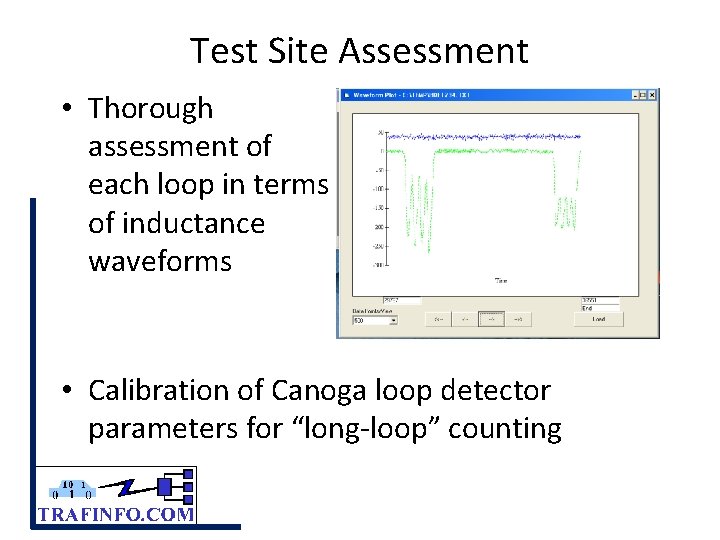
Test Site Assessment • Thorough assessment of each loop in terms of inductance waveforms • Calibration of Canoga loop detector parameters for “long-loop” counting
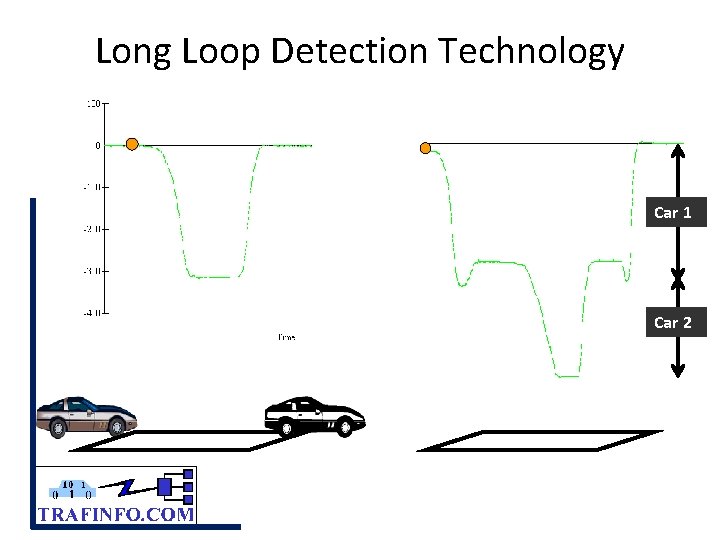
Long Loop Detection Technology Car 1 Car 2
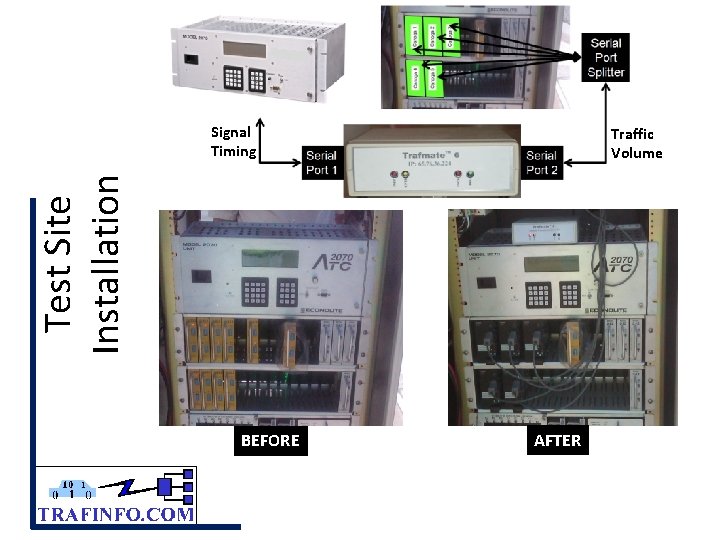
Signal Timing Test Site Installation Traffic Volume BEFORE AFTER
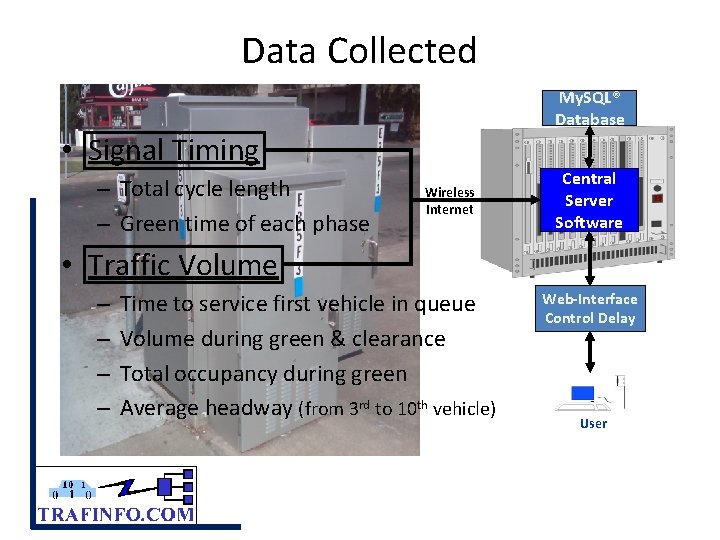
Data Collected My. SQL® Database • Signal Timing – Total cycle length – Green time of each phase Wireless Internet Central Server Software • Traffic Volume – – Time to service first vehicle in queue Volume during green & clearance Total occupancy during green Average headway (from 3 rd to 10 th vehicle) Web-Interface Control Delay User
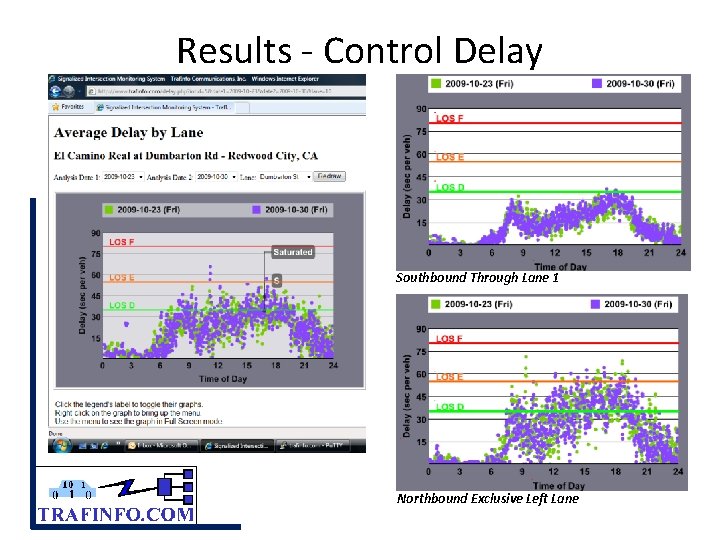
Results - Control Delay Southbound Through Lane 1 Northbound Exclusive Left Lane
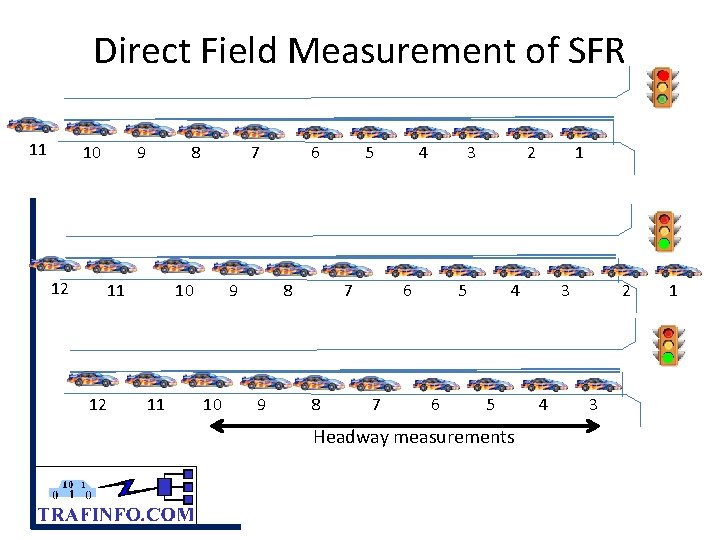
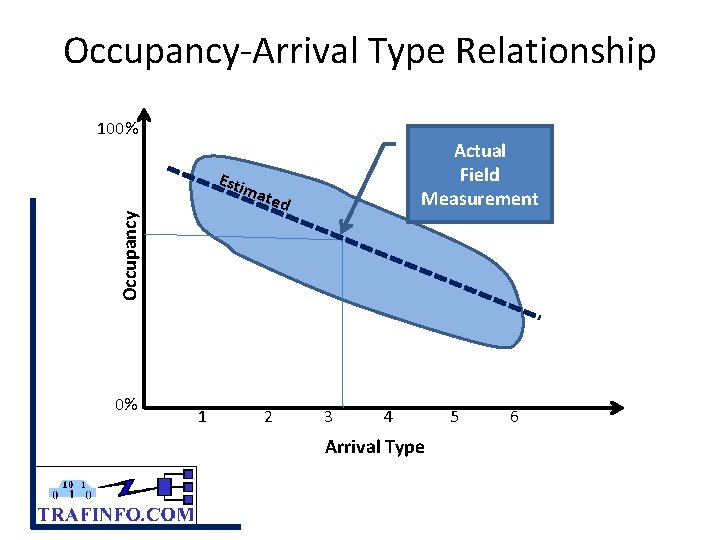
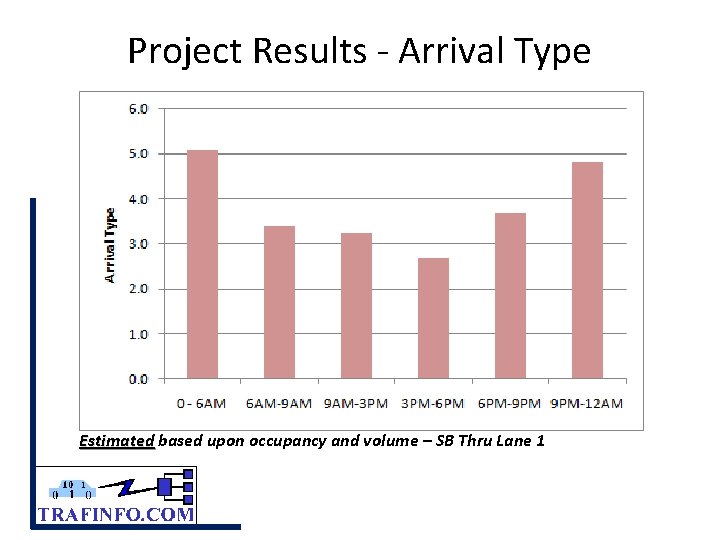
Unique Aspects of System • Estimation of Saturation Flow Rate of each cycle from headway measurements • Estimation of Arrival Type using occupancy and volume measurements
Direct Field Measurement of SFR 11 10 12 9 8 11 12 7 10 11 9 10 6 8 9 5 7 8 4 3 6 7 2 5 6 1 4 5 Headway measurements 3 4 2 3 1
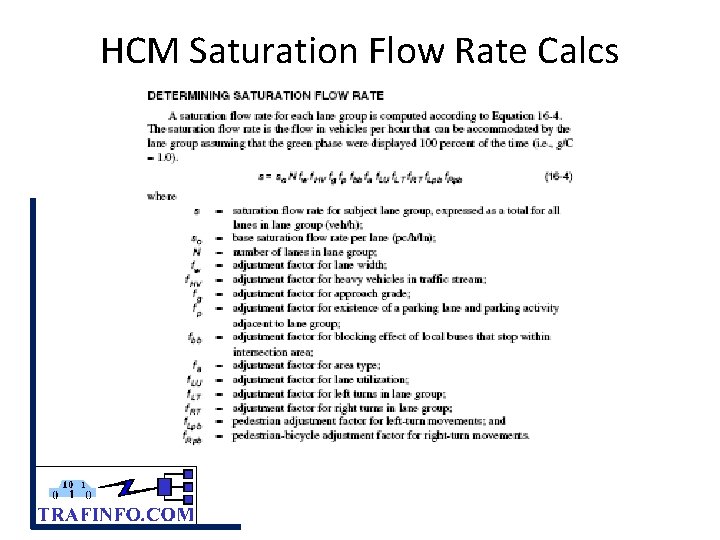
HCM Saturation Flow Rate Calcs
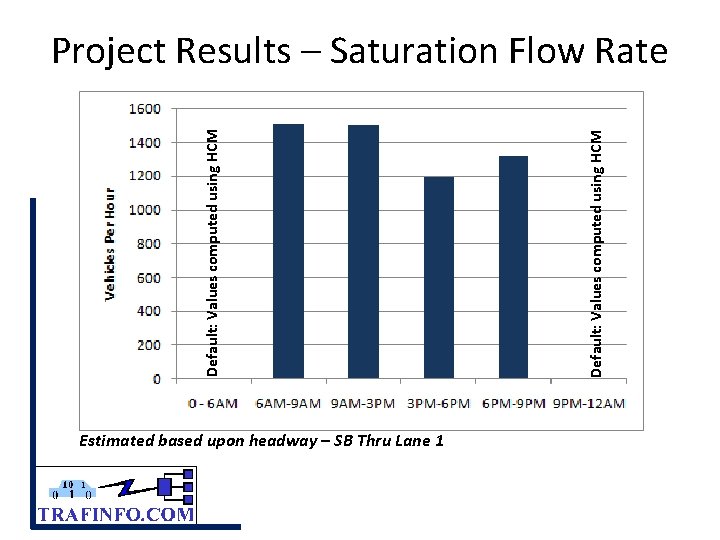
Estimated based upon headway – SB Thru Lane 1 Default: Values computed using HCM Project Results – Saturation Flow Rate
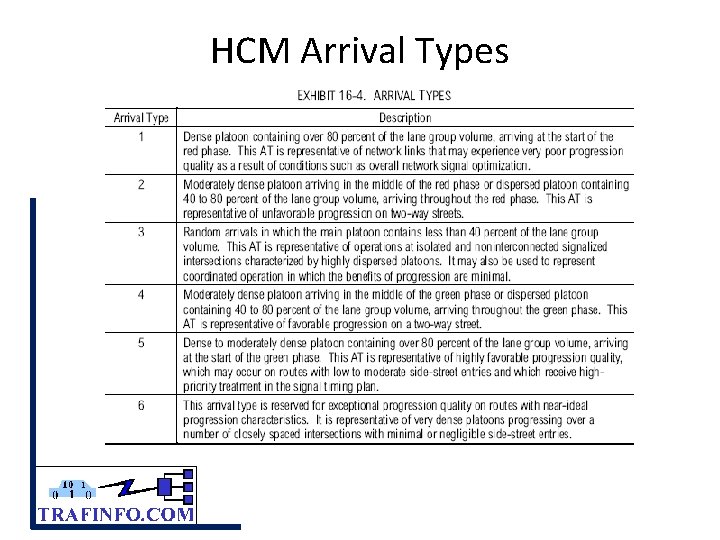
HCM Arrival Types
Occupancy-Arrival Type Relationship 100% Esti Actual Field Measurement Occupancy mat 0% 1 ed 2 3 4 Arrival Type 5 6
Project Results - Arrival Type Estimated based upon occupancy and volume – SB Thru Lane 1
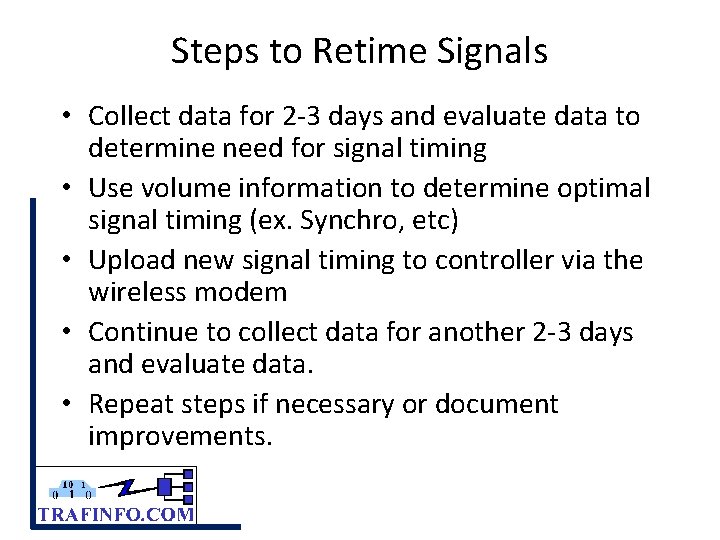
Steps to Retime Signals • Collect data for 2 -3 days and evaluate data to determine need for signal timing • Use volume information to determine optimal signal timing (ex. Synchro, etc) • Upload new signal timing to controller via the wireless modem • Continue to collect data for another 2 -3 days and evaluate data. • Repeat steps if necessary or document improvements.
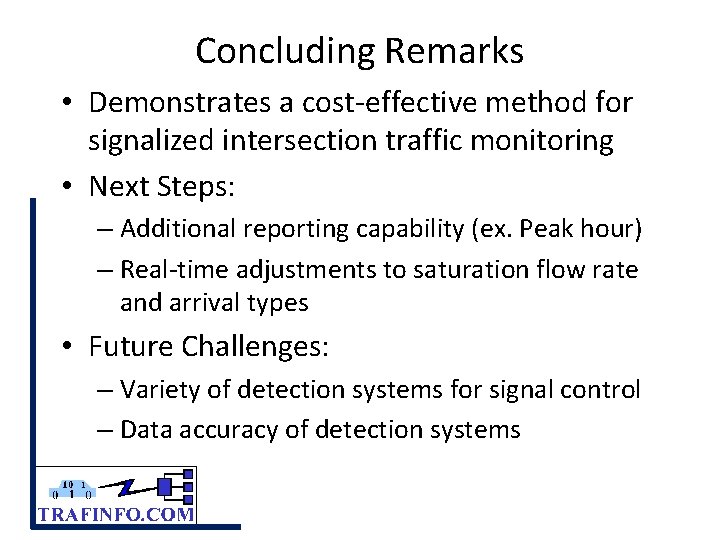
Concluding Remarks • Demonstrates a cost-effective method for signalized intersection traffic monitoring • Next Steps: – Additional reporting capability (ex. Peak hour) – Real-time adjustments to saturation flow rate and arrival types • Future Challenges: – Variety of detection systems for signal control – Data accuracy of detection systems