
SIGNALING GAMES AND ACCOUNTABILITY Mario Gilli Department of
SIGNALING GAMES AND ACCOUNTABILITY Mario Gilli Department of Economics University of Milano-Bicocca
• Introduction • In the past twenty years game theoretic models have become a common paradigm in political economics. • Political phenomena have been explained as a consequence of equilibrium behavior related to individual incentives inherent in a political system. • Two are the crucial issues at the core of this literature: 1. To select congruent agent as rulers 2. To find the correct mechanism to incentivize congruent political behavior
• Signalling games have proved to be an effective means to model both issues, and their interaction. • The aim of this paper is 1. to show the effectiveness of this approach providing a general structure applied to different political issues related to the interaction between politicians' incentivation and selection 2. To show the crucial role played by the assumptions on the players’ beliefs to select different equilibria, i. e. different properties of political regimes. • The main focus of the paper will be on the role of beliefs on the equilibrium properties of game theoretic models of accountability in political economics.
• The precise models analyzed in this paper vary widely, we select the models that have a common structure: 1. models that can be represented as signaling games 2. beliefs’ updating out of equilibrium is crucial, • Signaling games are specific incomplete information games where the informed player moves first and in this way might convey information on its private information
The general structure of Signaling Games • THE SIMPLEST POSSIBLE STRUCTURE • Two players: a Sender (S) and a Receiver (R). • The timing of the game is: – (1) nature draws a type for S, denoted t T, according to the commonly known probability distribution p(t); – (2) S privately observes the type t and then sends the message m M to R; and – (3) R observes m and then takes the action a A. • SIMPLIFICATION: T, M, and A are all finite. • Payoffs are US(t, m, a) and UR(t, m, a). • Everything but t, is common knowledge.
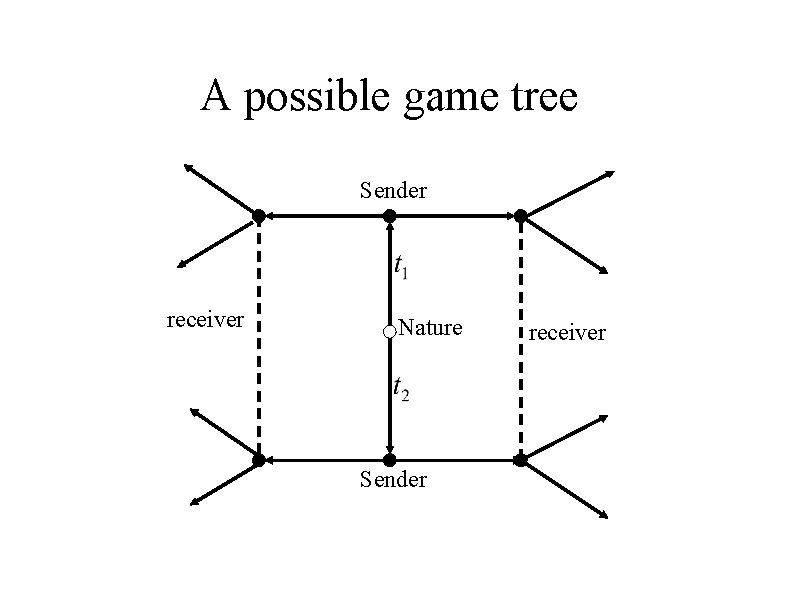
A possible game tree Sender receiver Nature Sender receiver
Sequential Rationality in Extensive Form Games • After the Harsanyi transformation, signaling games are just a specific class of extensive form games with imperfect information. • A well known problem of equilibrium behavior in extensive form games is that choices out of the equilibrium path are unrestricted by expected utility maximization, since they are conditioned to zero probability event. • The fact is that in a Nash Equilibrium each player must act optimally given the other players' strategies • However, this means that optimality condition is imposed at the beginning of the game only. • Entry game as example.
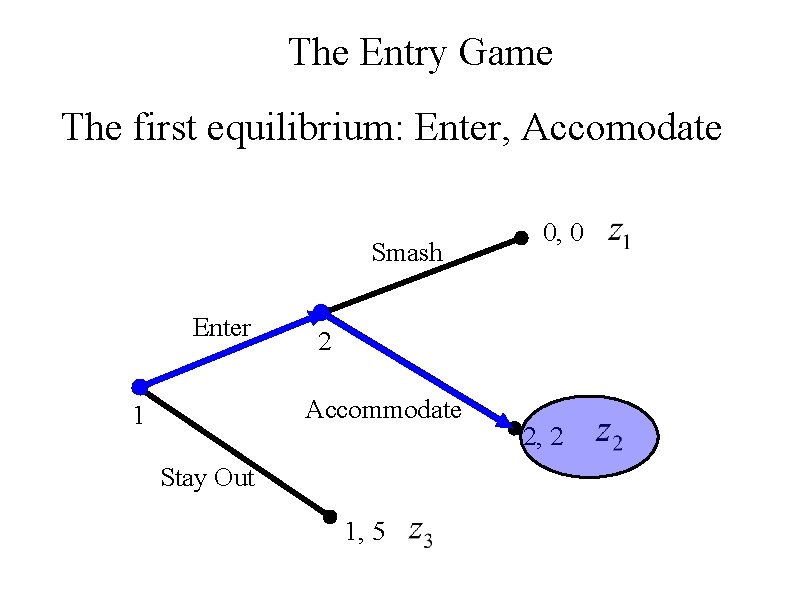
The Entry Game The first equilibrium: Enter, Accomodate Smash Enter 2 Accommodate 1 0, 0 Stay Out 1, 5 2, 2
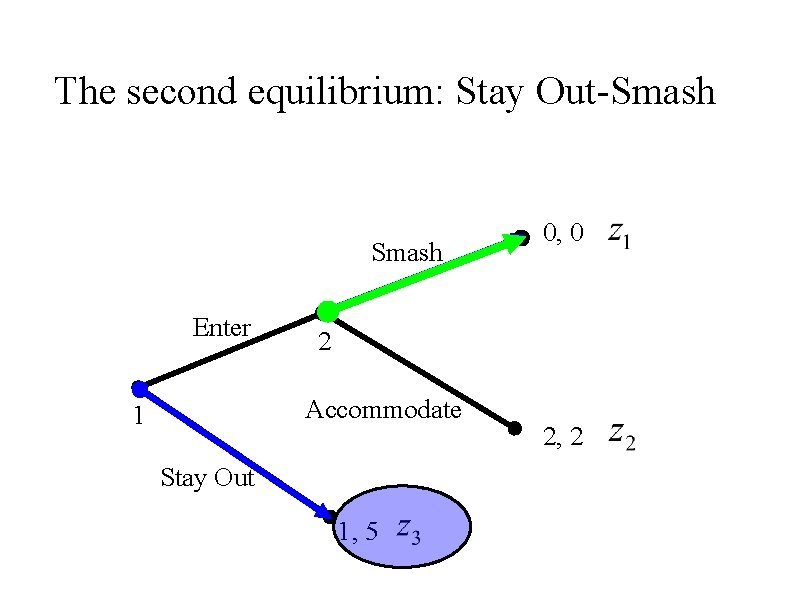
The second equilibrium: Stay Out-Smash Enter 2 Accommodate 1 0, 0 Stay Out 1, 5 2, 2
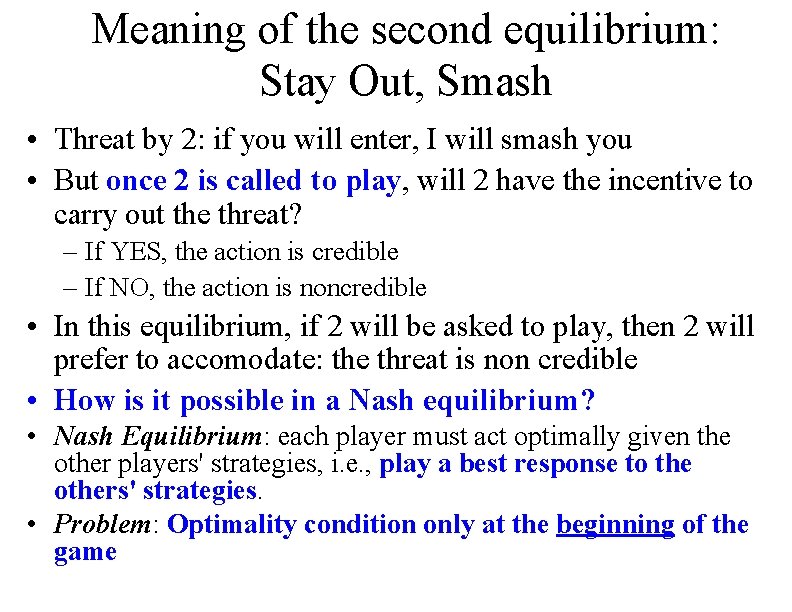
Meaning of the second equilibrium: Stay Out, Smash • Threat by 2: if you will enter, I will smash you • But once 2 is called to play, will 2 have the incentive to carry out the threat? – If YES, the action is credible – If NO, the action is noncredible • In this equilibrium, if 2 will be asked to play, then 2 will prefer to accomodate: the threat is non credible • How is it possible in a Nash equilibrium? • Nash Equilibrium: each player must act optimally given the other players' strategies, i. e. , play a best response to the others' strategies. • Problem: Optimality condition only at the beginning of the game
Out of equilibrium information sets • In dynamic games there are equilibrium paths that do not reach some information sets: these are the out-ofequilibrium information sets • The optimality conditions of Nash equilibria does not constrain behavior at these nodes, but • these information sets are out-of-equilibrium because of the actions the players are supposed to play at these nodes • In other words, reaching these nodes in equilibrium is a zero probability event, but this probability is endogeneous, because is derived from the players’ equilibrium behavior.
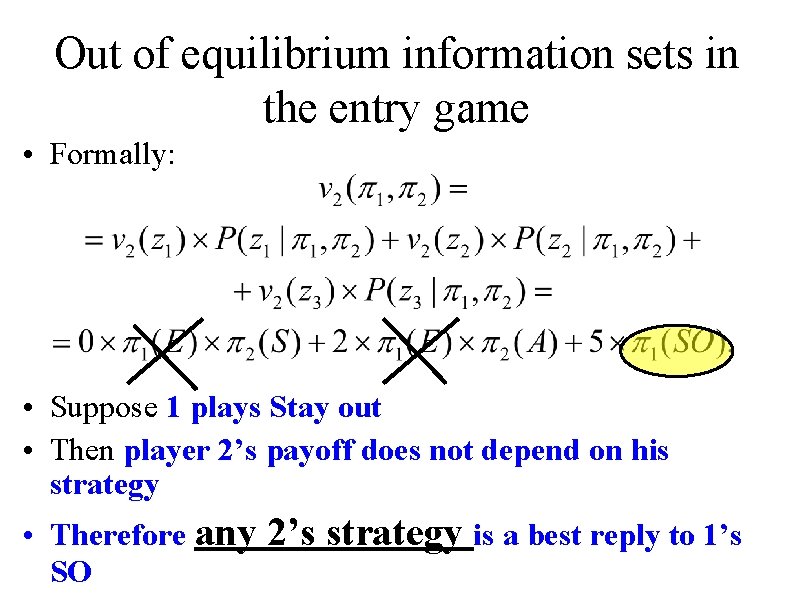
Out of equilibrium information sets in the entry game • Formally: • Suppose 1 plays Stay out • Then player 2’s payoff does not depend on his strategy • Therefore any SO 2’s strategy is a best reply to 1’s
Sequential Rationality • An optimal strategy for a player should maximize his or her payoff, conditional on every information set at which this player has the move • In other words, player i’s strategy should specify an “optimal” action at each of player i’s information sets, even those that have zero endogenous probability to be reached THUS • Apply some notion of rational behavior any time you face a well defined decision situation. • This implies that players takes action that they do have an incentive (according to that notion of rational behavior) to carry out, once the information set is reached, even if it had ex ante zero probability.
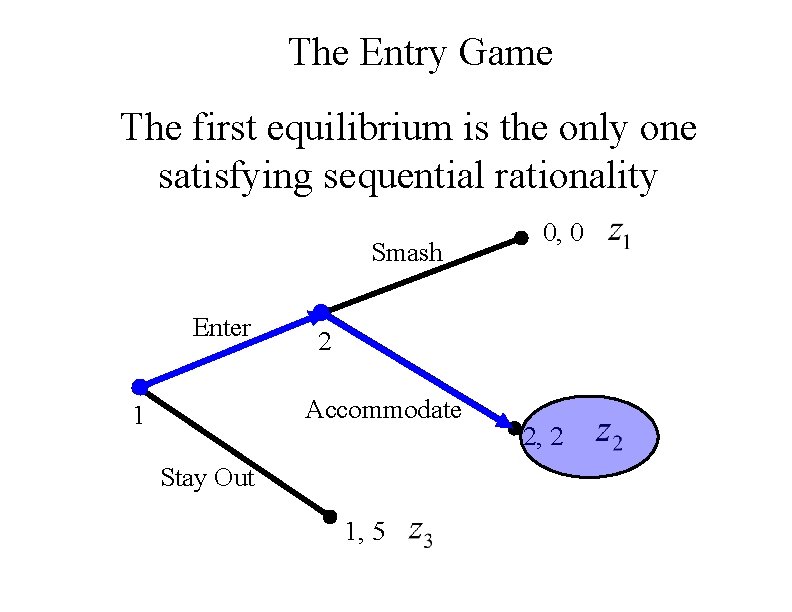
The Entry Game The first equilibrium is the only one satisfying sequential rationality Smash Enter 2 Accommodate 1 0, 0 Stay Out 1, 5 2, 2
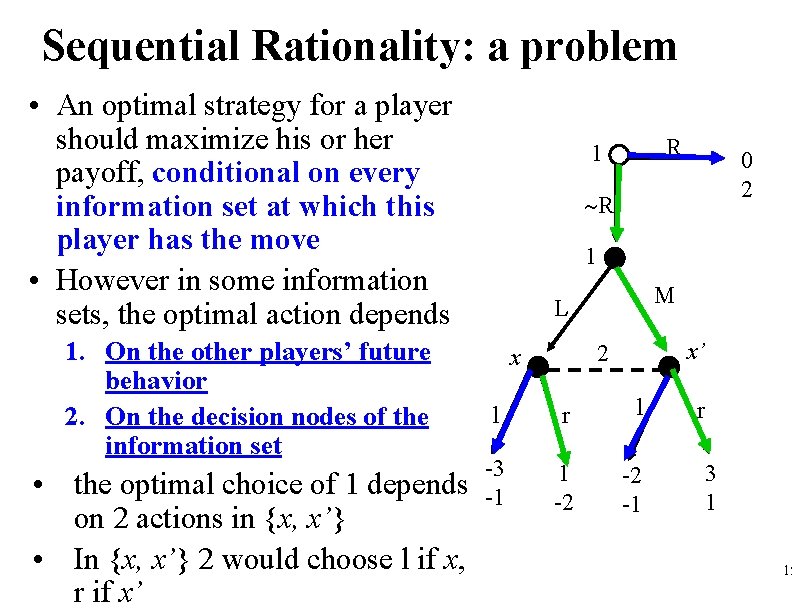
Sequential Rationality: a problem • An optimal strategy for a player should maximize his or her payoff, conditional on every information set at which this player has the move • However in some information sets, the optimal action depends 1. On the other players’ future behavior 2. On the decision nodes of the information set • the optimal choice of 1 depends on 2 actions in {x, x’} • In {x, x’} 2 would choose l if x, r if x’ R 1 0 2 R 1 M L x’ 2 x l r l -3 -1 1 -2 -2 -1 r 3 1 15
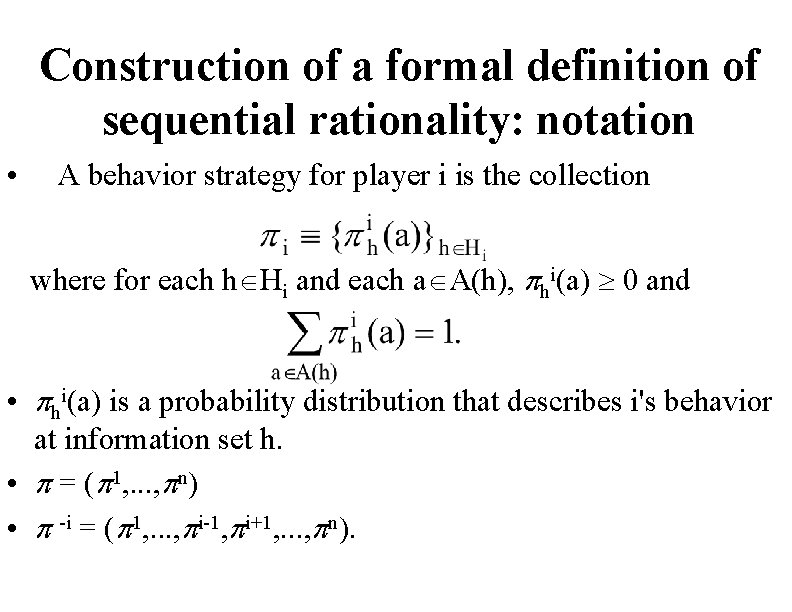
Construction of a formal definition of sequential rationality: notation • A behavior strategy for player i is the collection where for each h Hi and each a A(h), hi(a) 0 and • hi(a) is a probability distribution that describes i's behavior at information set h. • = ( 1, . . . , n) • -i = ( 1, . . . , i-1, i+1, . . . , n).
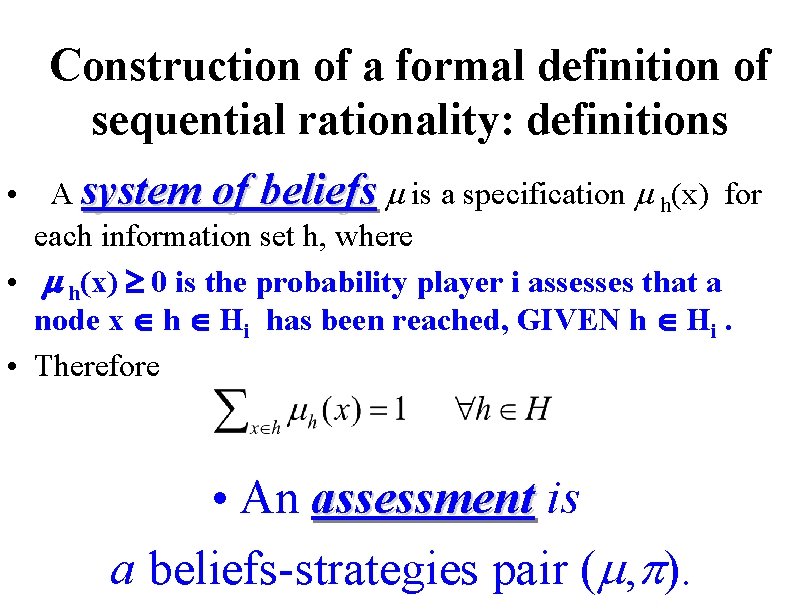
Construction of a formal definition of sequential rationality: definitions • A system of beliefs is a specification h(x) for each information set h, where • h(x) 0 is the probability player i assesses that a node x h Hi has been reached, GIVEN h Hi. • Therefore • An assessment is a beliefs-strategies pair ( , ).
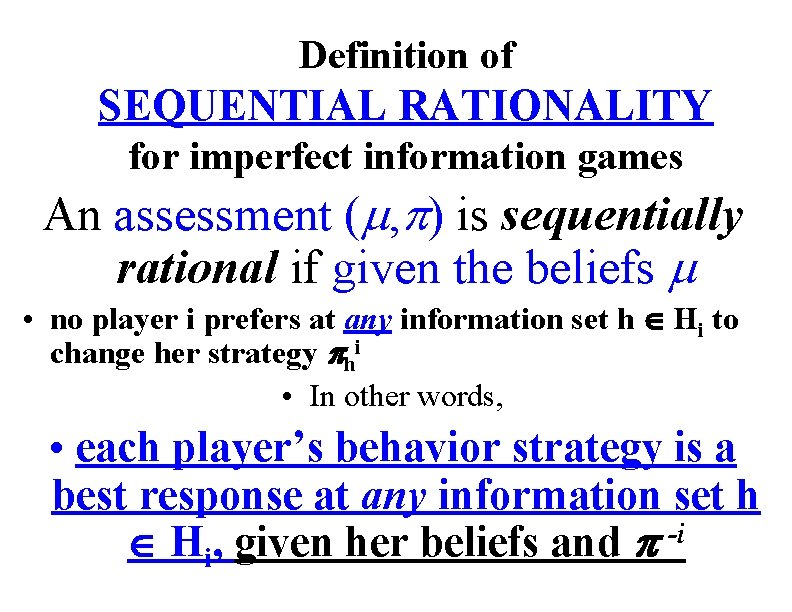
Definition of SEQUENTIAL RATIONALITY for imperfect information games An assessment ( , ) is sequentially rational if given the beliefs • no player i prefers at any information set h Hi to change her strategy hi • In other words, • each player’s behavior strategy is a best response at any information set h -i Hi, given her beliefs and
Effect of sequential rationality for imperfect information games 1. First, it eliminates strictly dominated actions from consideration off the equilibrium path: actions are credible 2. Second, it elevates beliefs to the importance of strategies. • This provides a language — the language of beliefs — for discussing the merits of competing sequentially rational equilibria.
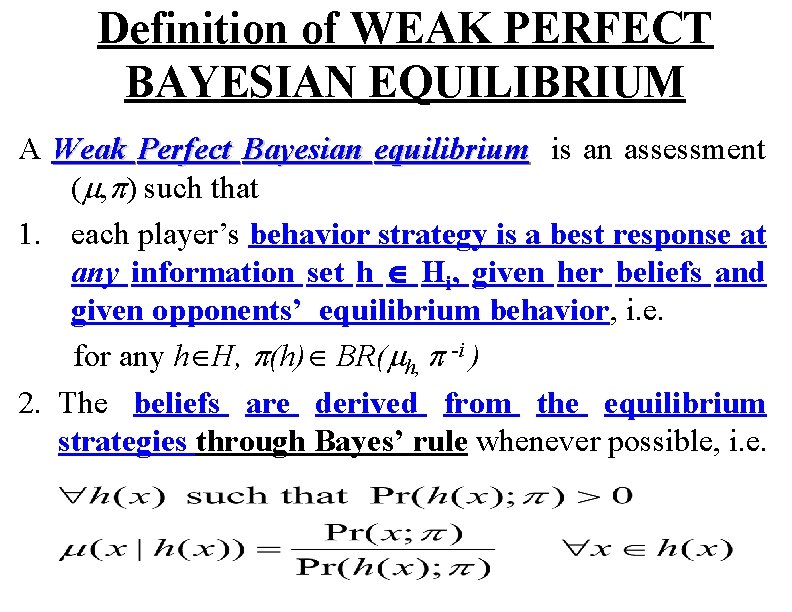
Definition of WEAK PERFECT BAYESIAN EQUILIBRIUM A Weak Perfect Bayesian equilibrium is an assessment equilibrium ( , ) such that 1. each player’s behavior strategy is a best response at any information set h Hi, given her beliefs and given opponents’ equilibrium behavior, i. e. for any h H, (h) BR( h, -i ) 2. The beliefs are derived from the equilibrium strategies through Bayes’ rule whenever possible, i. e.
THE PROBLEMS WITH WPBE AND THE NOTION OF SEQUENTIAL EQUILIBRIA
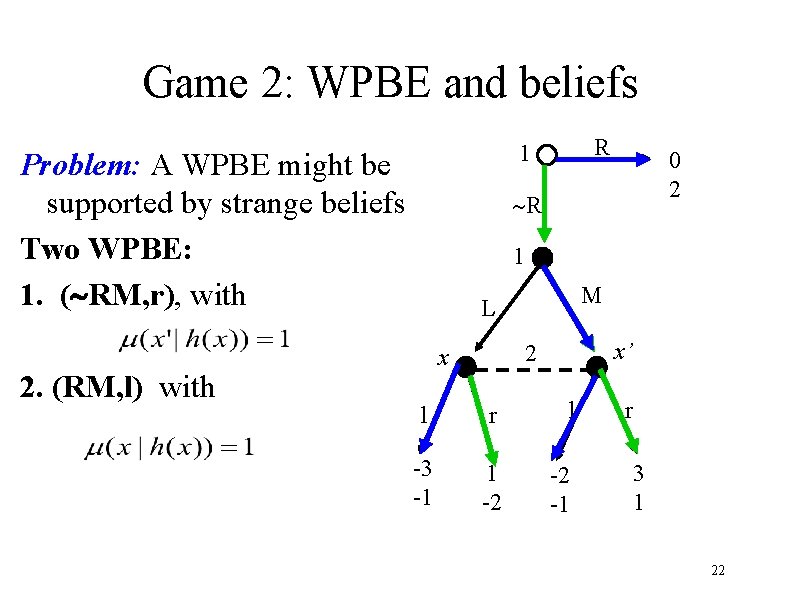
Game 2: WPBE and beliefs Problem: A WPBE might be supported by strange beliefs Two WPBE: 1. ( RM, r), with 2. (RM, l) with R 1 0 2 R 1 M L x’ 2 x l r l -3 -1 1 -2 -2 -1 r 3 1 22
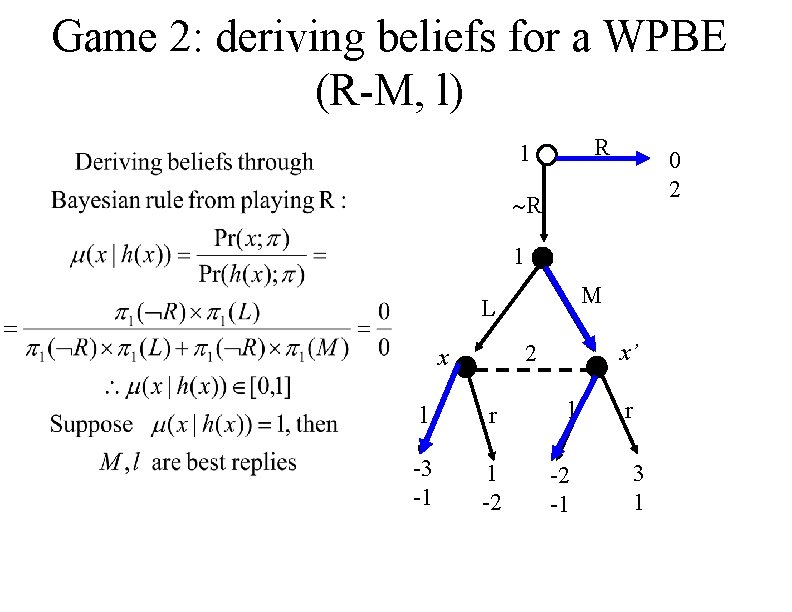
Game 2: deriving beliefs for a WPBE (R-M, l) R 1 0 2 R 1 M L x’ 2 x l r l -3 -1 1 -2 -2 -1 r 3 1
Refining the notion of Weak Perfect Bayesian Equilibrium • To solve the previous problem we try to refine the notion of WPBE, using totally mixed strategies and defining SEQUENTIAL EQUILIBRIA. • A strategy profile is totally mixed if it assigns strictly positive probability to each action a A(h) for each information set h H.
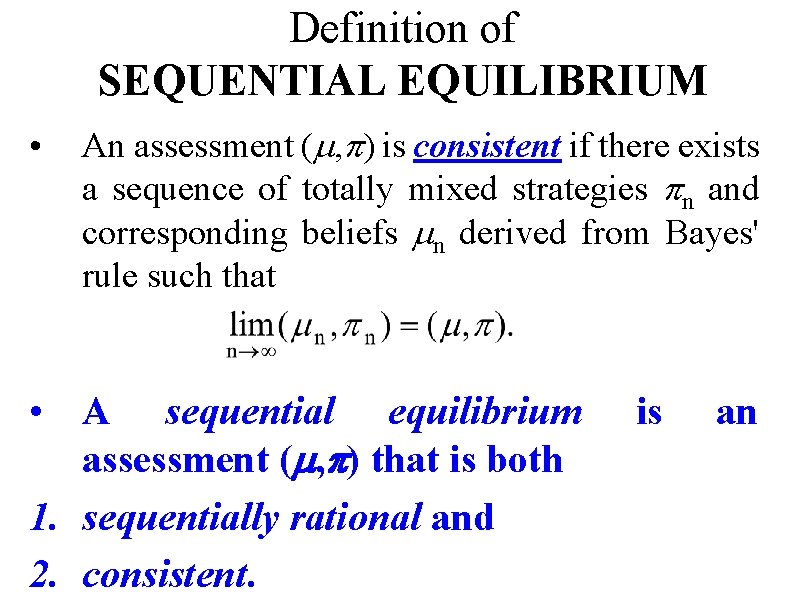
Definition of SEQUENTIAL EQUILIBRIUM • An assessment ( , ) is consistent if there exists a sequence of totally mixed strategies n and corresponding beliefs n derived from Bayes' rule such that • A sequential equilibrium assessment ( , ) that is both 1. sequentially rational and 2. consistent. is an
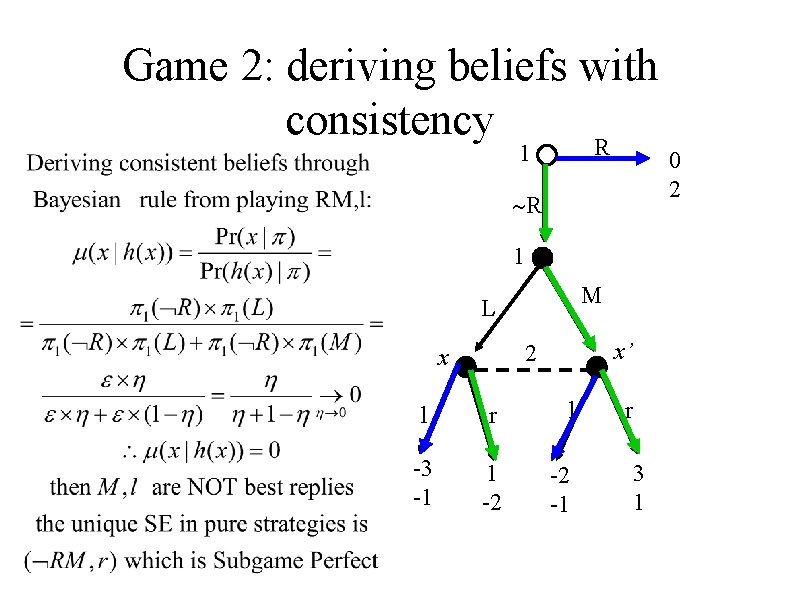
Game 2: deriving beliefs with consistency R 1 0 2 R 1 M L x’ 2 x l r l -3 -1 1 -2 -2 -1 r 3 1
DIFFERENT REFINEMENTS AND DIFFERENT EXPLANATIONS OF DEVIATIONS 27
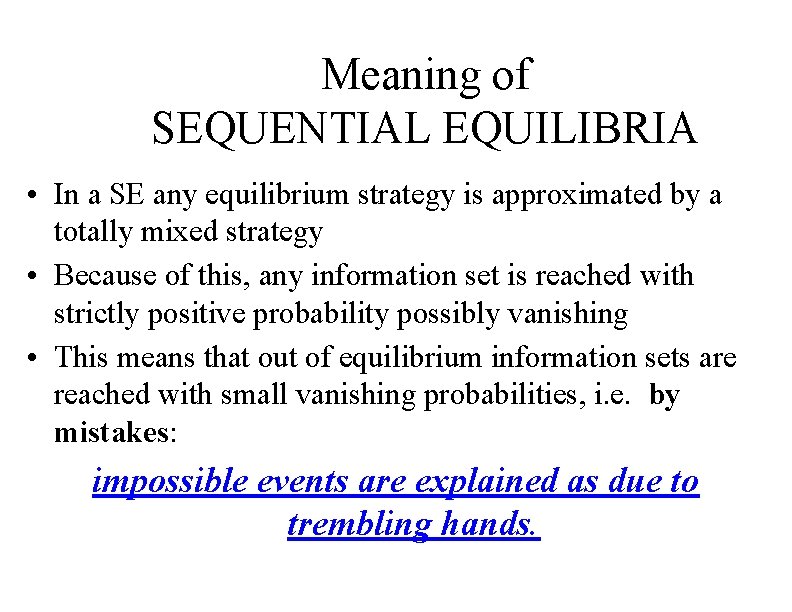
Meaning of SEQUENTIAL EQUILIBRIA • In a SE any equilibrium strategy is approximated by a totally mixed strategy • Because of this, any information set is reached with strictly positive probability possibly vanishing • This means that out of equilibrium information sets are reached with small vanishing probabilities, i. e. by mistakes: impossible events are explained as due to trembling hands.
SIMPLE MISTAKES • The simplest explanations of a deviation from the equilibrium path is just a simple mistake: – One holds to the hypothesis that all players intend to follow the prescription of the equilibrium, but that they sometimes fail • In Signaling Games useful restrictions on out-of-equilibrium beliefs are possible only insofar as one is willing to attribute relative likelihood to particular mistakes. 29
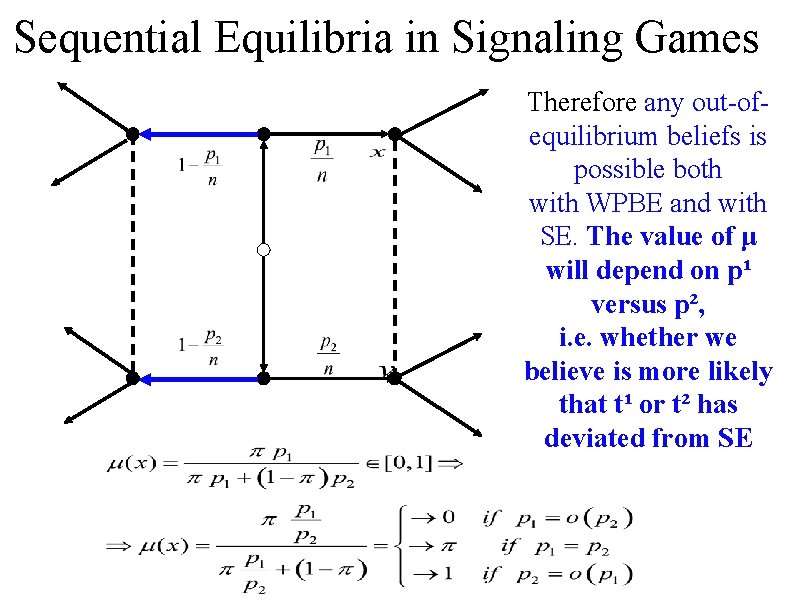
Sequential Equilibria in Signaling Games Therefore any out-ofequilibrium beliefs is possible both with WPBE and with SE. The value of μ will depend on p¹ versus p², i. e. whether we believe is more likely that t¹ or t² has deviated from SE
MISTAKEN THEORIES (1) • • § Deviations from equilibrium play may be explained by the fact that one or more players does not understand what is expected of him or wish to signal something One would then look for relatively likely alternative theories for how to play the game to explain 1. Who has defected 2. What has been the nature of defection 3. Why some player has deviated , e. g. what might be the consequences of that defection for later play. Structural consistency is a way of formalizing this type of reasoning. 31
MISTAKEN THEORIES (2) • • • this reasoning can lead to direct attack to Sequential Equilibrium, in particular to the hypothesis that player countenance no further deviations from the equilibrium when evaluating what to do in the face of an apparent deviation, for example if after a deviation one believes that the error in theory may be one’s own, then deviations among different players may be thought to be correlated. • Forward Induction: a deviation might be due to a prospective attempt to get a better payoff, e. g. a deviation from a specified equilibrium is said to be "bad" if it always yields the deviator less than her equilibrium payoff in every circumstance, according to FI this deviation should generate beliefs equal to zero 32
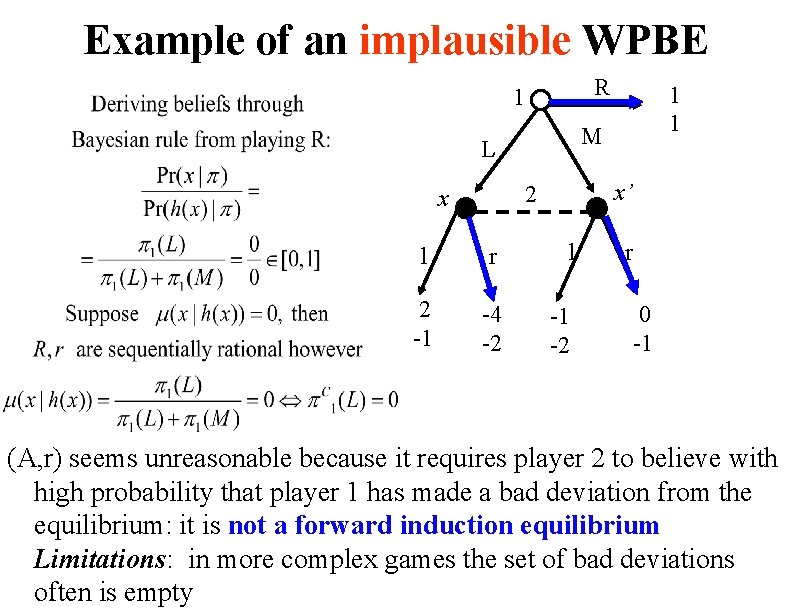
Example of an implausible WPBE R 1 M L x’ 2 x 1 1 l r l 2 -1 -4 -2 -1 -2 r 0 -1 (A, r) seems unreasonable because it requires player 2 to believe with high probability that player 1 has made a bad deviation from the equilibrium: it is not a forward induction equilibrium Limitations: in more complex games the set of bad deviations often is empty
SIGNALING GAMES EQUILIBRIA & BELIEFS
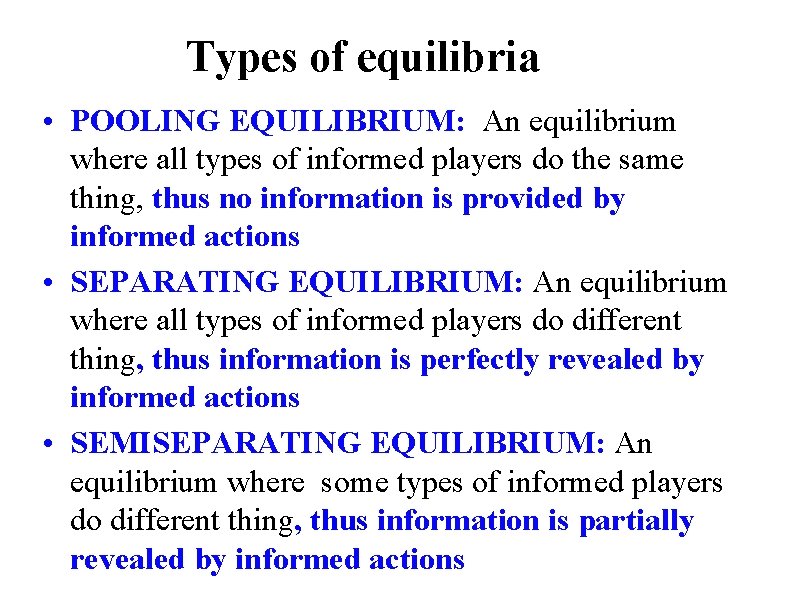
Types of equilibria • POOLING EQUILIBRIUM: An equilibrium where all types of informed players do the same thing, thus no information is provided by informed actions • SEPARATING EQUILIBRIUM: An equilibrium where all types of informed players do different thing, thus information is perfectly revealed by informed actions • SEMISEPARATING EQUILIBRIUM: An equilibrium where some types of informed players do different thing, thus information is partially revealed by informed actions
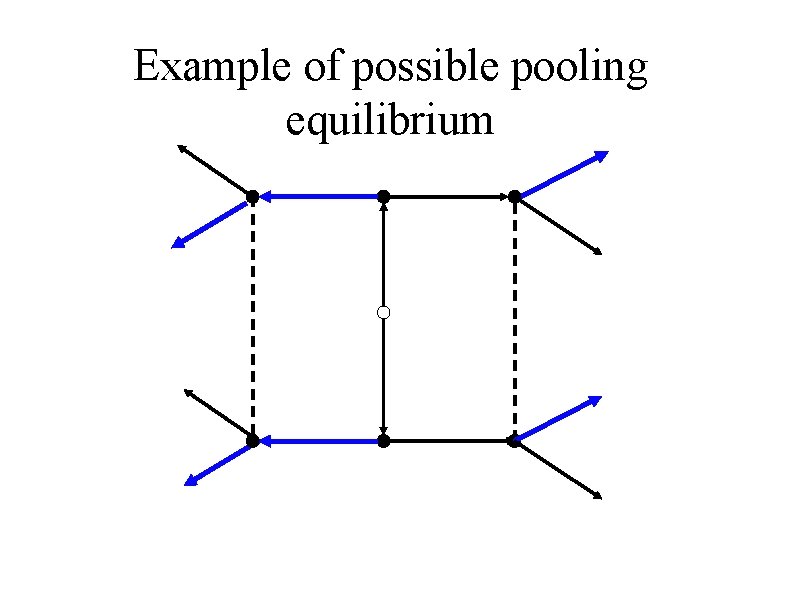
Example of possible pooling equilibrium
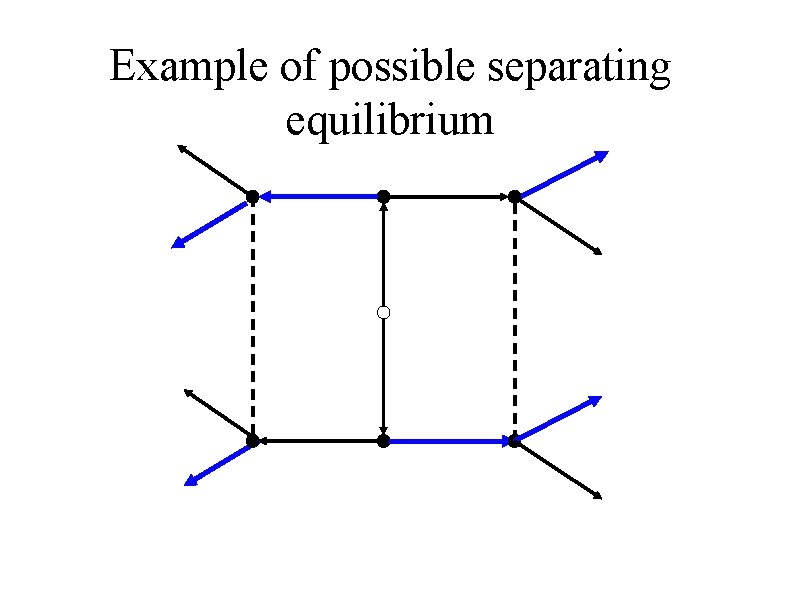
Example of possible separating equilibrium
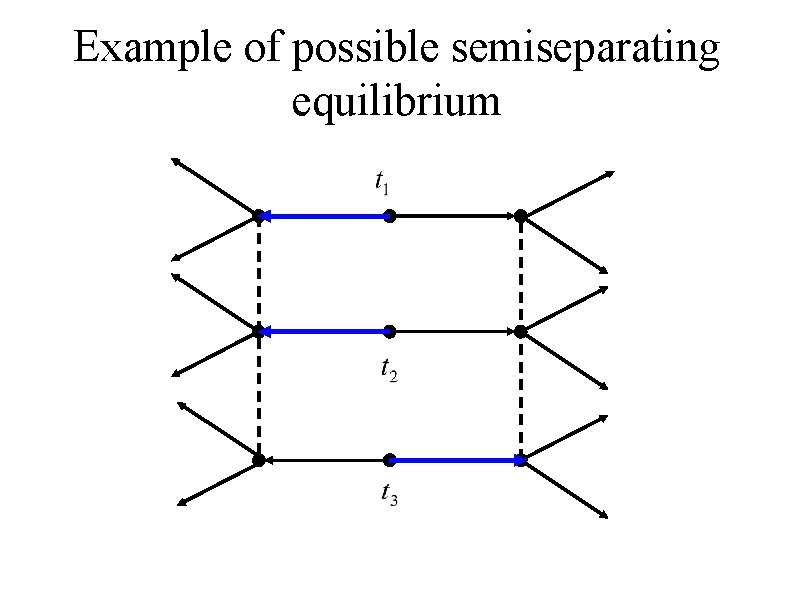
Example of possible semiseparating equilibrium
Refinements in Signalling Games
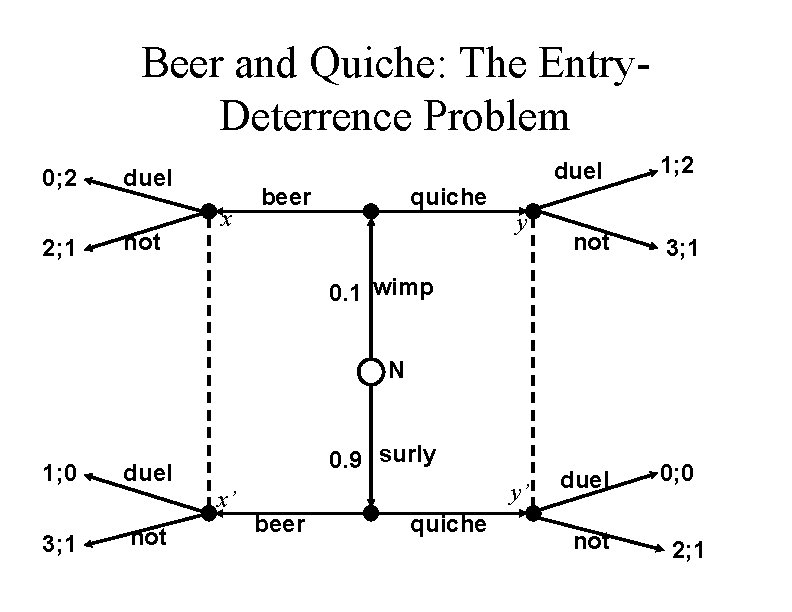
Beer and Quiche: The Entry. Deterrence Problem 0; 2 2; 1 duel not x beer quiche y duel 1; 2 not 3; 1 duel 0; 0 0. 1 wimp N 1; 0 duel 3; 1 not 0. 9 surly x’ y’ beer quiche not 2; 1
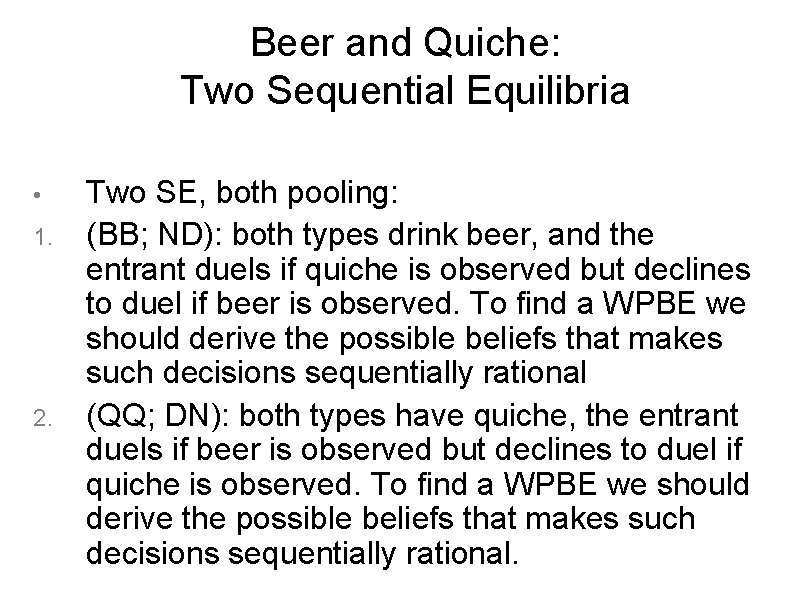
Beer and Quiche: Two Sequential Equilibria • 1. 2. Two SE, both pooling: (BB; ND): both types drink beer, and the entrant duels if quiche is observed but declines to duel if beer is observed. To find a WPBE we should derive the possible beliefs that makes such decisions sequentially rational (QQ; DN): both types have quiche, the entrant duels if beer is observed but declines to duel if quiche is observed. To find a WPBE we should derive the possible beliefs that makes such decisions sequentially rational.
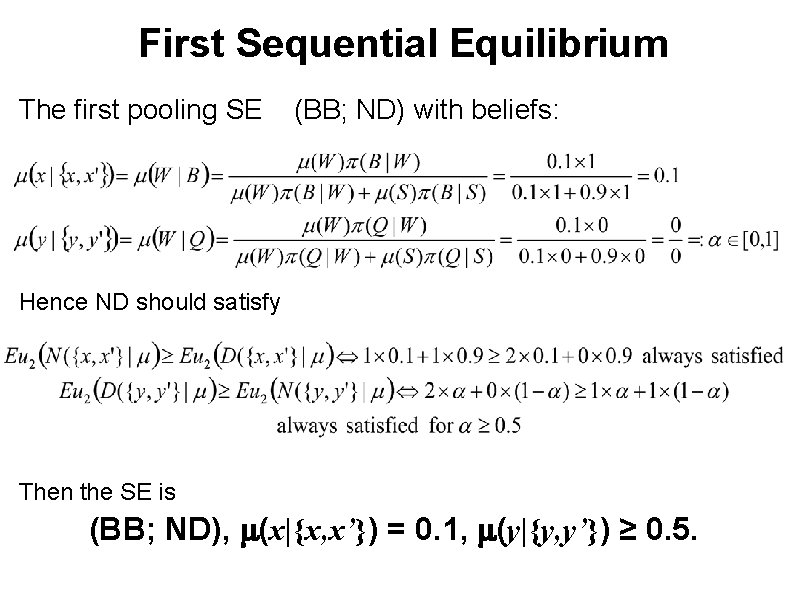
First Sequential Equilibrium The first pooling SE (BB; ND) with beliefs: Hence ND should satisfy Then the SE is (BB; ND), (x|{x, x’}) = 0. 1, (y|{y, y’}) ≥ 0. 5.

First SE: beer-beer, then μ(x|{x. x’})=0. 1& μ(y|{y, y’}) [0, 1]; μ(x|{x. x’})=0. 1 implies not. In turn this implies that 1 will not deviate if and only if 2 duel in {y, y’}, i. e. μ(y|{y. y’}) > 1/2 0; 2 2; 1 duel not x beer quiche y duel 1; 2 not 3; 1 duel 0; 0 0. 1 wimp N 1; 0 duel 3; 1 not 0. 9 surly x’ y’ beer quiche not 2; 1
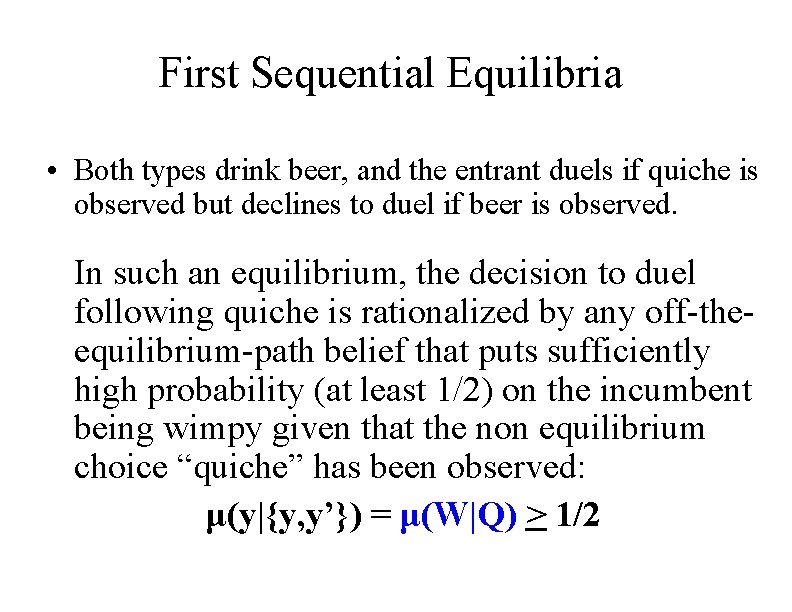
First Sequential Equilibria • Both types drink beer, and the entrant duels if quiche is observed but declines to duel if beer is observed. In such an equilibrium, the decision to duel following quiche is rationalized by any off-theequilibrium-path belief that puts sufficiently high probability (at least 1/2) on the incumbent being wimpy given that the non equilibrium choice “quiche” has been observed: μ(y|{y, y’}) = μ(W|Q) > 1/2
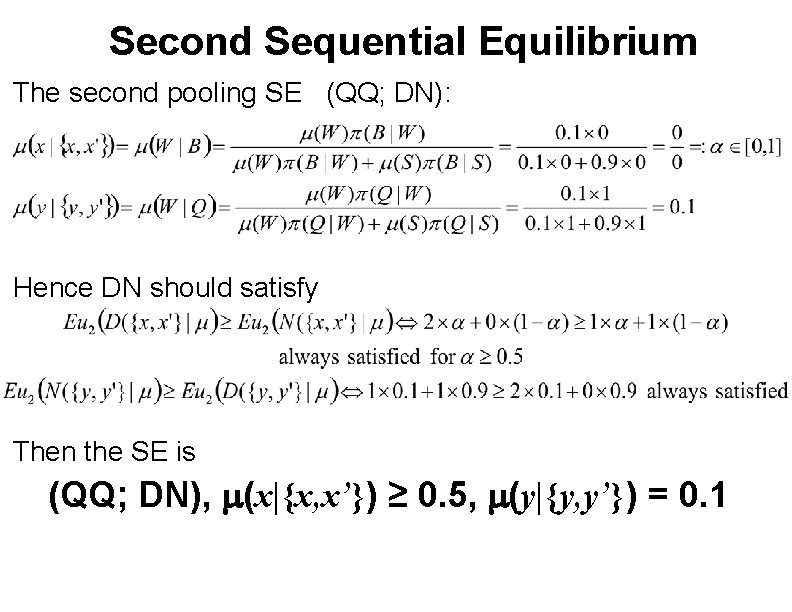
Second Sequential Equilibrium The second pooling SE (QQ; DN): Hence DN should satisfy Then the SE is (QQ; DN), (x|{x, x’}) ≥ 0. 5, (y|{y, y’}) = 0. 1

Second SE: quiche-quiche, then μ(y|{y, y’})=0. 1& μ(x|{x, x’}) [0, 1]; μ(y|{y, y’})=0. 1 implies not. In turn this implies that 1 will not deviate if and only if 2 duel in {x, x’}, i. e. μ(x|{x, x’})>1/2 0; 2 2; 1 duel not x beer quiche y duel 1; 2 not 3; 1 duel 0; 0 0. 1 wimp N 1; 0 duel 3; 1 not 0. 9 surly x’ y’ beer quiche not 2; 1
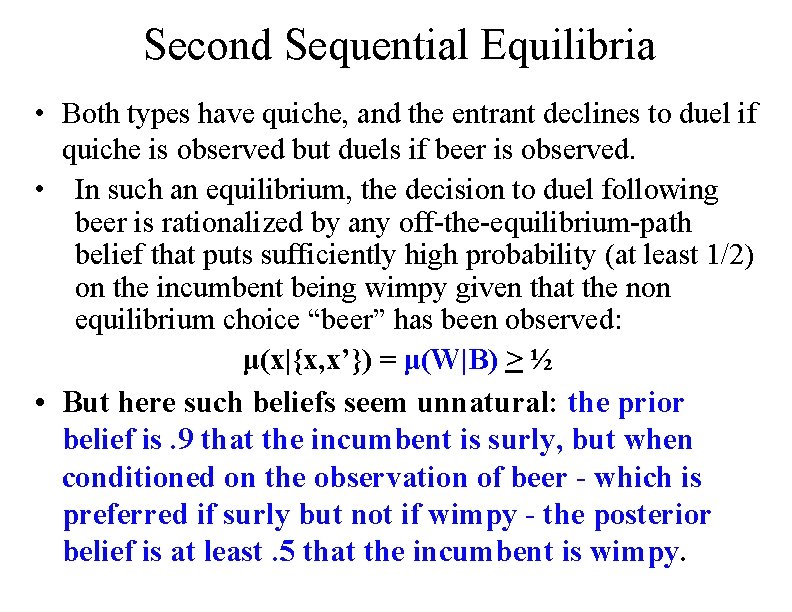
Second Sequential Equilibria • Both types have quiche, and the entrant declines to duel if quiche is observed but duels if beer is observed. • In such an equilibrium, the decision to duel following beer is rationalized by any off-the-equilibrium-path belief that puts sufficiently high probability (at least 1/2) on the incumbent being wimpy given that the non equilibrium choice “beer” has been observed: μ(x|{x, x’}) = μ(W|B) > ½ • But here such beliefs seem unnatural: the prior belief is. 9 that the incumbent is surly, but when conditioned on the observation of beer - which is preferred if surly but not if wimpy - the posterior belief is at least. 5 that the incumbent is wimpy.
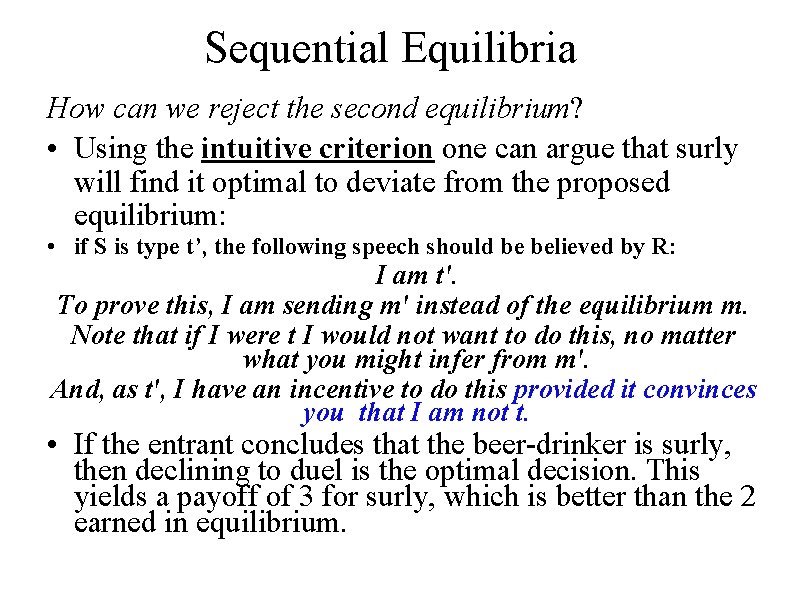
Sequential Equilibria How can we reject the second equilibrium? • Using the intuitive criterion one can argue that surly will find it optimal to deviate from the proposed equilibrium: • if S is type t’, the following speech should be believed by R: I am t'. To prove this, I am sending m' instead of the equilibrium m. Note that if I were t I would not want to do this, no matter what you might infer from m'. And, as t', I have an incentive to do this provided it convinces you that I am not t. • If the entrant concludes that the beer-drinker is surly, then declining to duel is the optimal decision. This yields a payoff of 3 for surly, which is better than the 2 earned in equilibrium.
SIGNALING GAMES EQUILIBRIA and BELIEFS in POLITICAL ECONOMICS MODELS: THE ACCOUNTABILITY PROBLEM
Accountability and Signalling Games • Two models to understand the determinants of good government. • The basic idea is that good government is associated with institutions which affects the incentives and the selection of those who make policy decisions. • The incentive problem is studied analyzing the possible equilibria of principal-agent models between citizens and government, where the principals are the citizens and the agents are the politicians. • The heart of these models is rulers' accountability towards citizens, i. e. the responsibility of rulers as agents towards the citizens and the political elites as principals • Whether and how accountability is achieved depends on the rules of the game.
Accountability in Democratic Polities
Accountability in Democratic Polities • In democracies, elections are the main tool to enforce government accountability towards citizens. • We will consider a model that assume that voters do have a common interest in achieving some outcome and discuss whether we would expect the political system to deliver it. • Basic Model – Two-period political-agency model with incomplete information played by two protagonists: the leader and the citizens. – the leader is elected to make a single political decision. – The key issue is the use of this policy choices as a signaling device as different type of politicians try to differentiate themselves from one another.
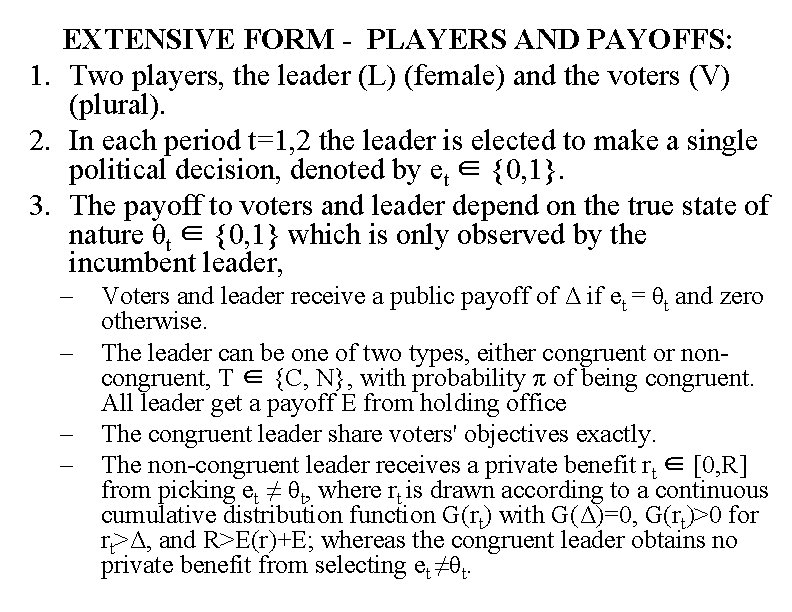
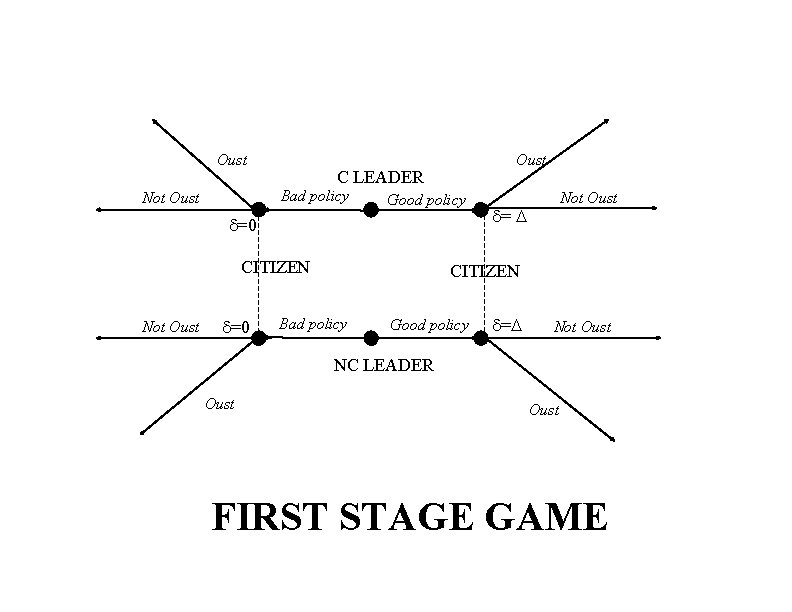
EXTENSIVE FORM - PLAYERS AND PAYOFFS: 1. Two players, the leader (L) (female) and the voters (V) (plural). 2. In each period t=1, 2 the leader is elected to make a single political decision, denoted by et ∈ {0, 1}. 3. The payoff to voters and leader depend on the true state of nature θt ∈ {0, 1} which is only observed by the incumbent leader, – – Voters and leader receive a public payoff of Δ if et = θt and zero otherwise. The leader can be one of two types, either congruent or noncongruent, T ∈ {C, N}, with probability π of being congruent. All leader get a payoff E from holding office The congruent leader share voters' objectives exactly. The non-congruent leader receives a private benefit rt ∈ [0, R] from picking et ≠ θt, where rt is drawn according to a continuous cumulative distribution function G(rt) with G(Δ)=0, G(rt)>0 for rt>Δ, and R>E(r)+E; whereas the congruent leader obtains no private benefit from selecting et ≠θt.
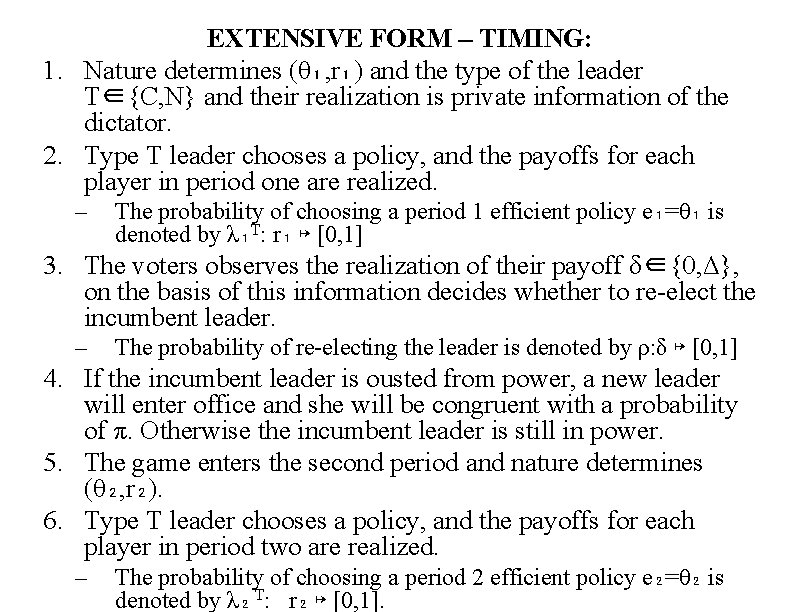
EXTENSIVE FORM – TIMING: 1. Nature determines (θ₁, r₁) and the type of the leader T∈{C, N} and their realization is private information of the dictator. 2. Type T leader chooses a policy, and the payoffs for each player in period one are realized. – The probability of choosing a period 1 efficient policy e₁=θ₁ is denoted by λ₁T: r₁ ↦ [0, 1] 3. The voters observes the realization of their payoff δ∈{0, Δ}, on the basis of this information decides whether to re-elect the incumbent leader. – The probability of re-electing the leader is denoted by ρ: δ ↦ [0, 1] 4. If the incumbent leader is ousted from power, a new leader will enter office and she will be congruent with a probability of π. Otherwise the incumbent leader is still in power. 5. The game enters the second period and nature determines (θ₂, r₂). 6. Type T leader chooses a policy, and the payoffs for each player in period two are realized. – The probability of choosing a period 2 efficient policy e₂=θ₂ is denoted by λ₂ T: r₂ ↦ [0, 1].
Oust C LEADER Bad policy Not Oust Good policy =0 CITIZEN Not Oust =0 Not Oust = CITIZEN Bad policy Good policy = Not Oust NC LEADER Oust FIRST STAGE GAME
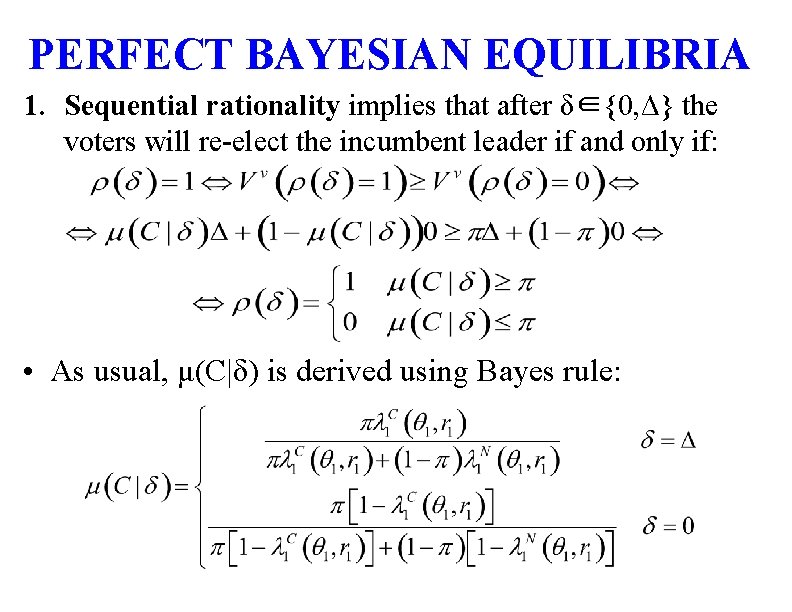
PERFECT BAYESIAN EQUILIBRIA 1. Sequential rationality implies that after δ∈{0, Δ} the voters will re-elect the incumbent leader if and only if: • As usual, μ(C|δ) is derived using Bayes rule:
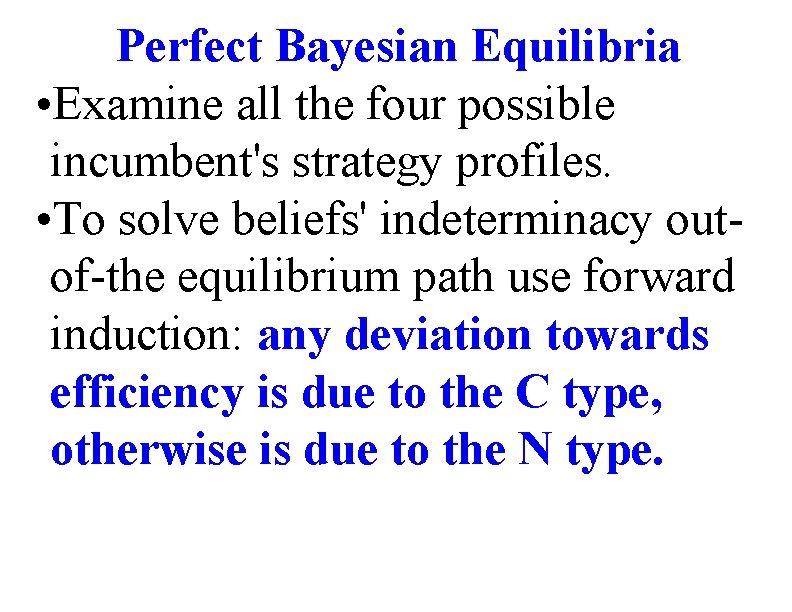
Perfect Bayesian Equilibria • Examine all the four possible incumbent's strategy profiles. • To solve beliefs' indeterminacy outof-the equilibrium path use forward induction: any deviation towards efficiency is due to the C type, otherwise is due to the N type.
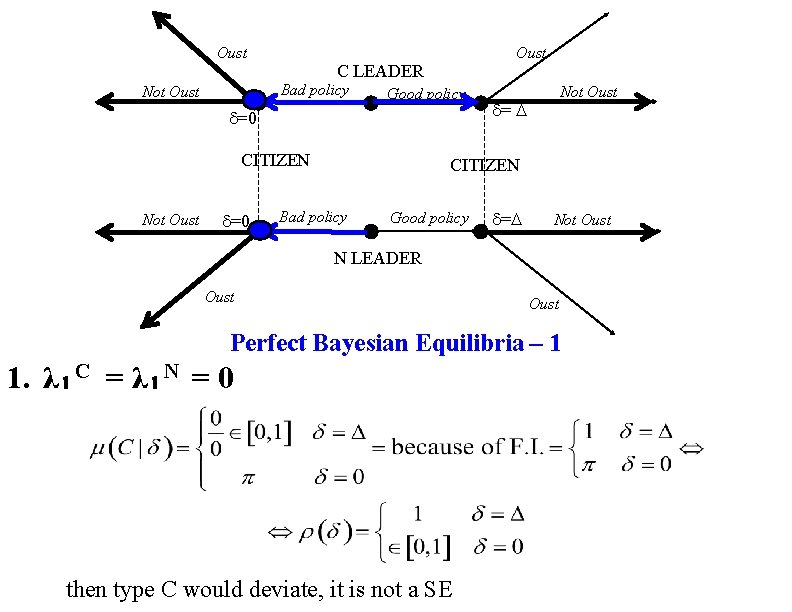
Oust C LEADER Bad policy Not Oust Good policy =0 CITIZEN Not Oust =0 Not Oust = CITIZEN Bad policy Good policy = Not Oust N LEADER Oust Perfect Bayesian Equilibria – 1 1. λ₁C = λ₁N = 0 then type C would deviate, it is not a SE
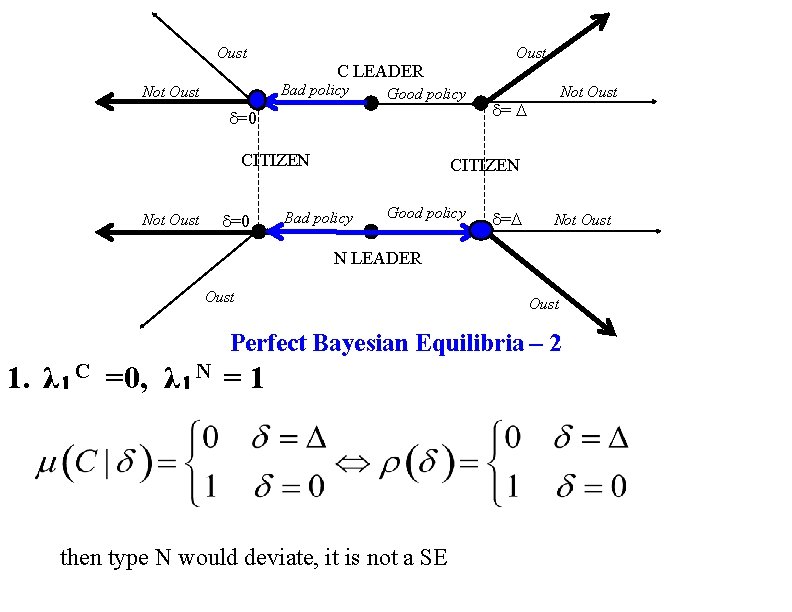
Oust C LEADER Bad policy Not Oust Good policy =0 CITIZEN Not Oust =0 Not Oust = CITIZEN Bad policy Good policy = Not Oust N LEADER Oust Perfect Bayesian Equilibria – 2 1. λ₁C =0, λ₁N = 1 then type N would deviate, it is not a SE
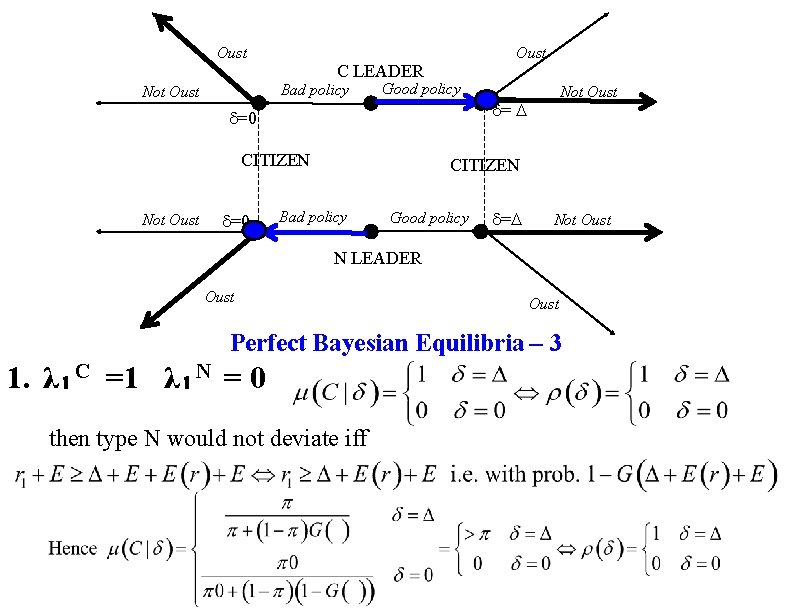
Oust C LEADER Bad policy Not Oust Good policy = =0 CITIZEN Not Oust =0 Not Oust CITIZEN Bad policy Good policy = Not Oust N LEADER Oust Perfect Bayesian Equilibria – 3 1. λ₁C =1 λ₁N = 0 then type N would not deviate iff
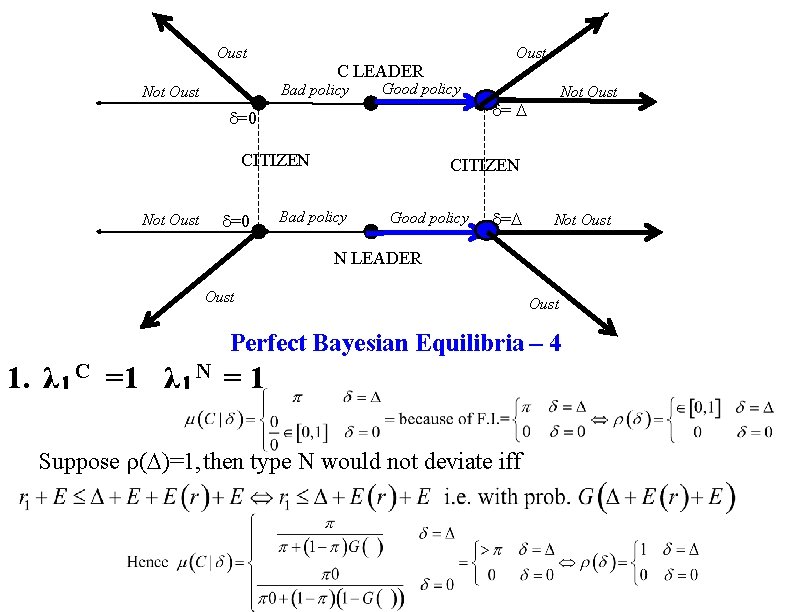
Oust C LEADER Bad policy Not Oust Good policy = =0 CITIZEN Not Oust =0 Not Oust CITIZEN Bad policy Good policy = Not Oust N LEADER Oust Perfect Bayesian Equilibria – 4 1. λ₁C =1 λ₁N = 1 Suppose ( )=1, then type N would not deviate iff
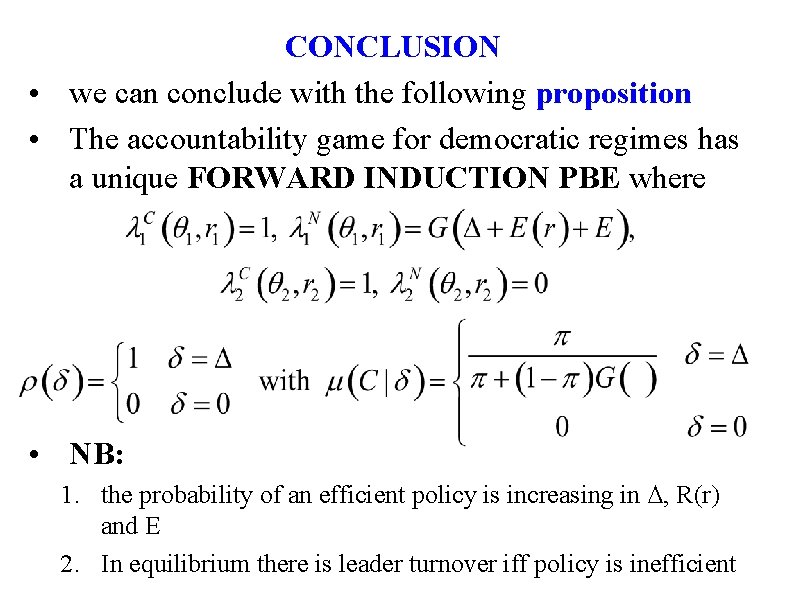
CONCLUSION • we can conclude with the following proposition • The accountability game for democratic regimes has a unique FORWARD INDUCTION PBE where • NB: 1. the probability of an efficient policy is increasing in , R(r) and E 2. In equilibrium there is leader turnover iff policy is inefficient
Perfect Bayesian Equilibria with PASSIVE UPDATING • Examine all the four possible incumbent's strategy profiles. • To solve beliefs' indeterminacy outof-the equilibrium path use passive updating: any deviation is due to both types, with equal probability
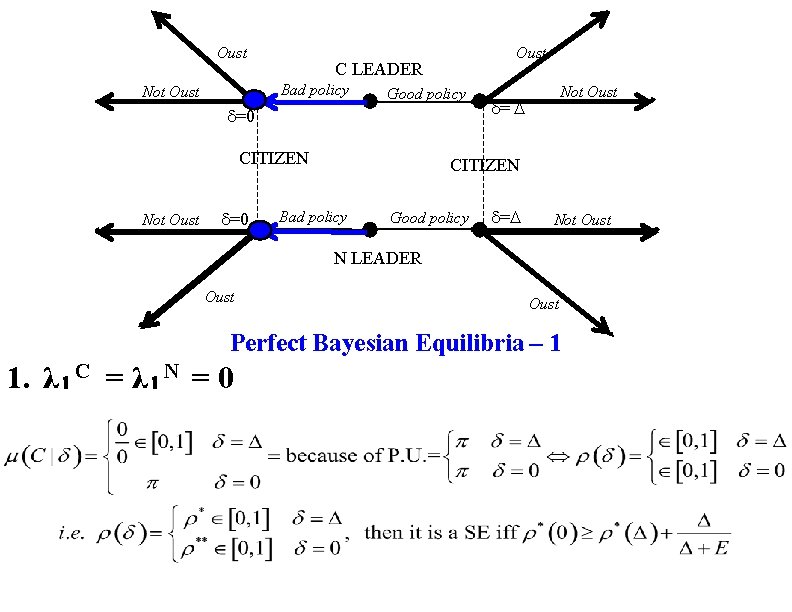
Oust C LEADER Bad policy Not Oust Good policy =0 CITIZEN Not Oust =0 Not Oust = CITIZEN Bad policy Good policy = Not Oust N LEADER Oust Perfect Bayesian Equilibria – 1 1. λ₁C = λ₁N = 0
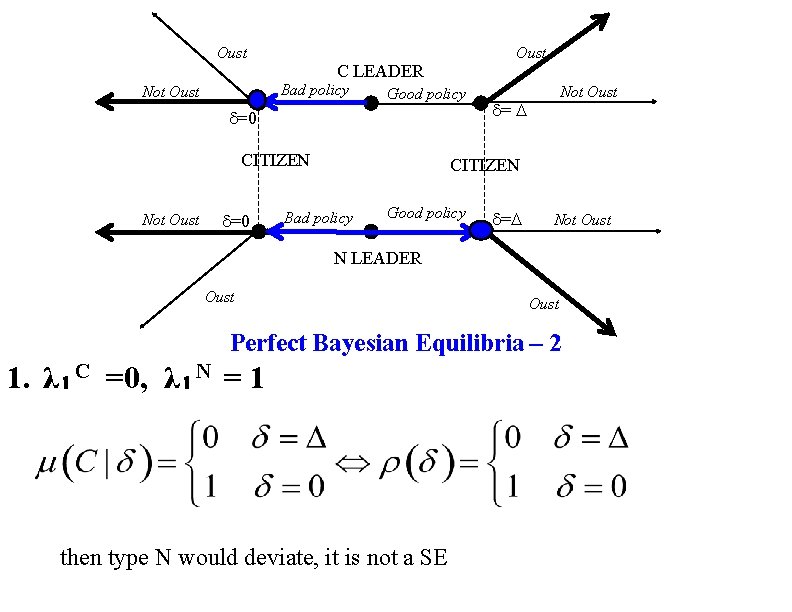
Oust C LEADER Bad policy Not Oust Good policy =0 CITIZEN Not Oust =0 Not Oust = CITIZEN Bad policy Good policy = Not Oust N LEADER Oust Perfect Bayesian Equilibria – 2 1. λ₁C =0, λ₁N = 1 then type N would deviate, it is not a SE
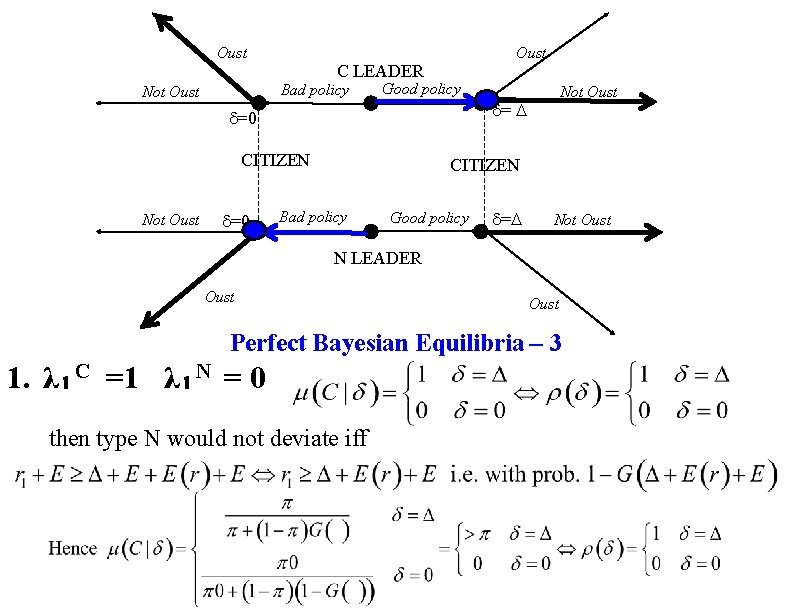
Oust C LEADER Bad policy Not Oust Good policy = =0 CITIZEN Not Oust =0 Not Oust CITIZEN Bad policy Good policy = Not Oust N LEADER Oust Perfect Bayesian Equilibria – 3 1. λ₁C =1 λ₁N = 0 then type N would not deviate iff
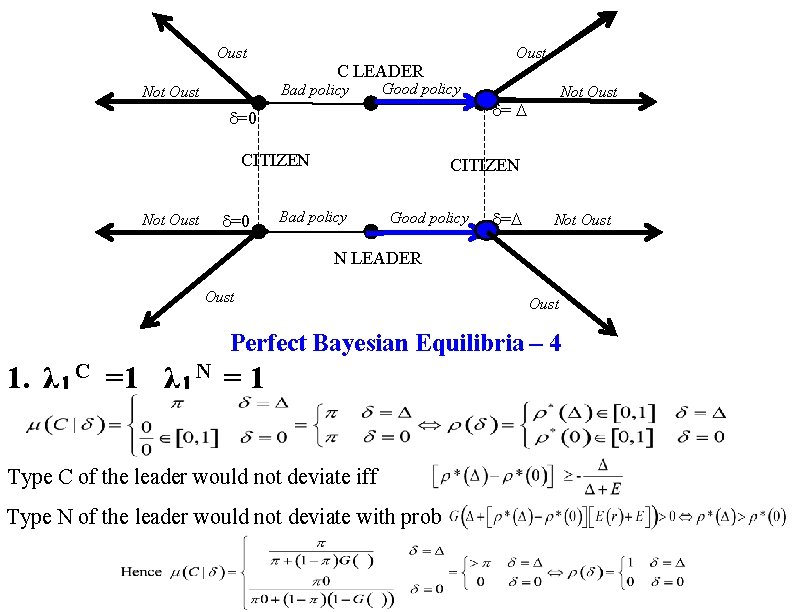
Oust C LEADER Bad policy Not Oust Good policy = =0 CITIZEN Not Oust =0 Not Oust CITIZEN Bad policy Good policy = Not Oust N LEADER Oust Perfect Bayesian Equilibria – 4 1. λ₁C =1 λ₁N = 1 Type C of the leader would not deviate iff Type N of the leader would not deviate with prob
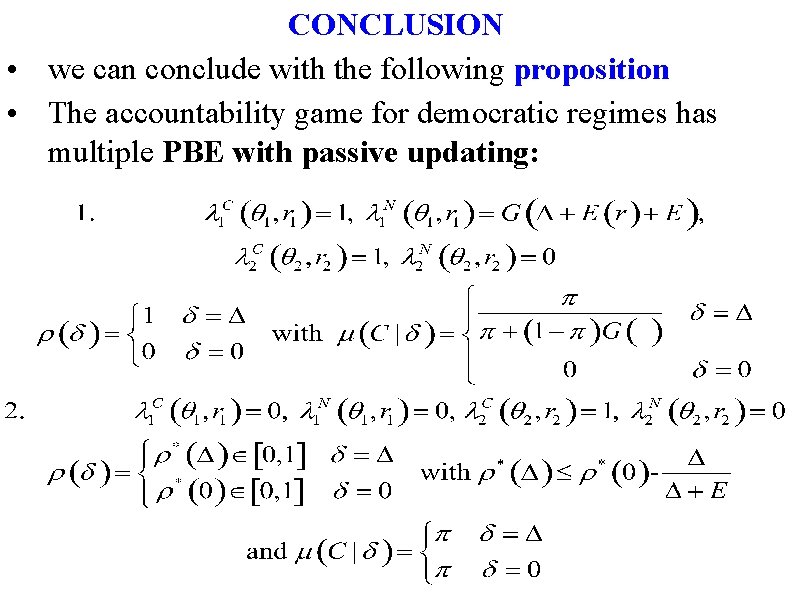
CONCLUSION • we can conclude with the following proposition • The accountability game for democratic regimes has multiple PBE with passive updating:
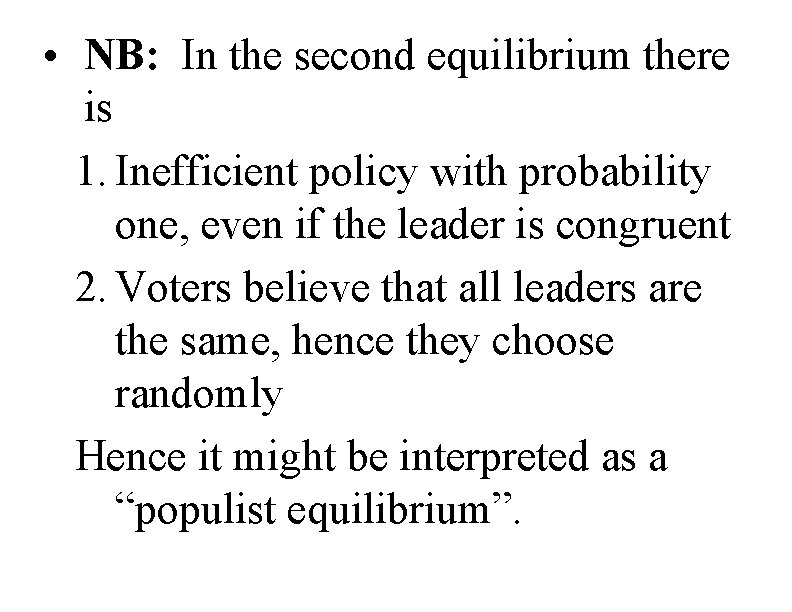
• NB: In the second equilibrium there is 1. Inefficient policy with probability one, even if the leader is congruent 2. Voters believe that all leaders are the same, hence they choose randomly Hence it might be interpreted as a “populist equilibrium”.
Accountability in Autocratic Polities
Accountability in Autocratic Polities • The purpose of this part of the paper is to explore autocratic decision making when policy choices are constrained by the joint work of two mechanisms: 1. the threat of a coup d'état by the political elite and 2. the threat of a revolution by the citizens. • How will the actual policy choices be affected by the political institutions and in particular by these players' de facto power? • Our analysis will help to explain when and why the policy choices are congruent and in this way it will provide a partial understanding of the evidence that autocracies have both the strongest and the most negative growth rates across and within countries.
The model • A two-period political-agency model with incomplete information played by three protagonists: 1. the dictator, 2. the selectorate, and 3. the citizens. • Contrary to standard political-agency models for democracies, there is no regular general election, hence the dictators' term might be indeterminate. • However, dictators can be removed from office by 1. the selectorate through a coup or 2. by the citizens through a revolution.
The model • Dictators differ in their ability to control the selectorate and repress the citizens. • To model this institutional difference, we introduce two separate conflict technologies, one for coups and one for revolutions. 1. Revolutions are defined as popular revolts whose goal is a permanent change in the distribution of a country's wealth. 2. Coups, instead, are defined as a forced resignation of the dictator without any transformation in the political regime. A coup does not change the distribution of a country's wealth instead changes the composition of the selectorate and the identity of the dictator. • Hence, the threat of a revolution is different from the threat of a coup.
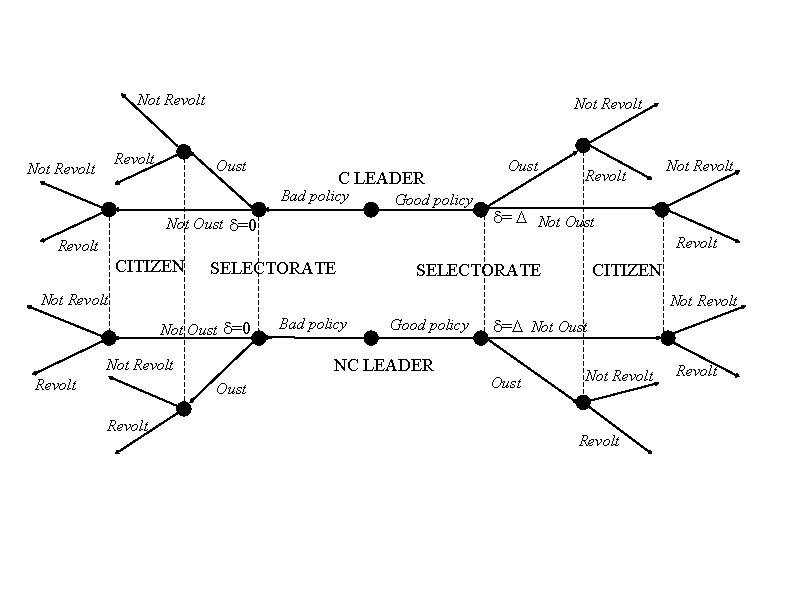
Not Revolt Oust C LEADER Bad policy Good policy Not Oust =0 Oust Revolt = Not Oust Revolt CITIZEN SELECTORATE CITIZEN Not Revolt Not Oust =0 Oust Revolt Bad policy Good policy NC LEADER Not Revolt = Not Oust Not Revolt
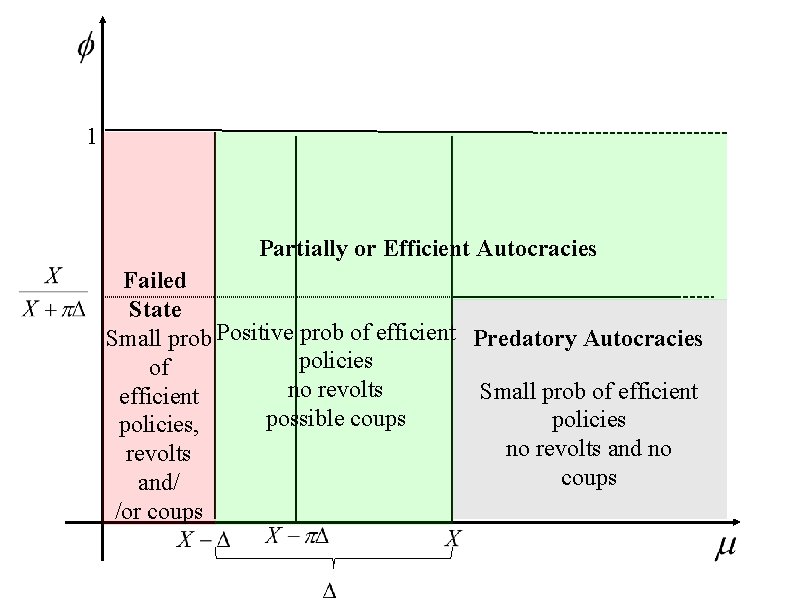
1 Partially or Efficient Autocracies Failed State Small prob Positive prob of efficient Predatory Autocracies policies of no revolts Small prob of efficient possible coups policies, no revolts and no revolts coups and/ /or coups

THANKS !

- Slides: 77