
Signal Timing Putting it All Together Steps in
![EB/WB Clearance Interval τ1 = tr + [u 0 /(2 a)] + [(W+L)/u 0]](https://slidetodoc.com/presentation_image_h/bc10a56845089a135dd0676c33c4c1f9/image-20.jpg "EB/WB Clearance Interval τ1 = tr + [u 0 /(2 a)] + [(W+L)/u 0]")
- Slides: 30
Signal Timing: Putting it All Together
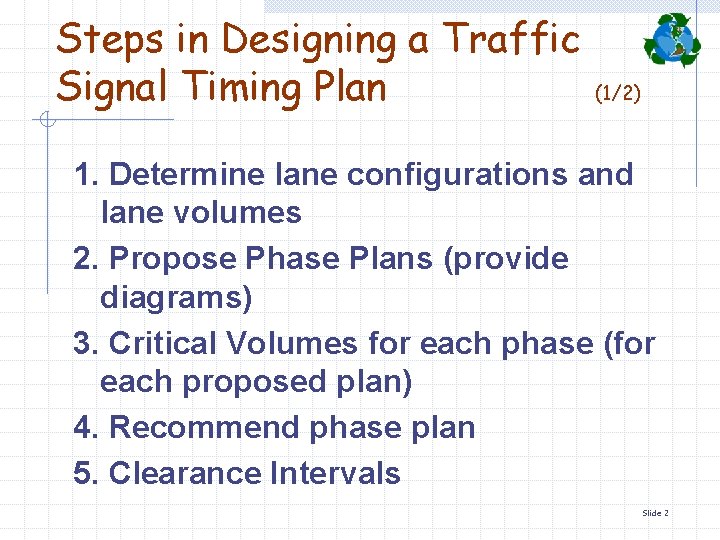
Steps in Designing a Traffic Signal Timing Plan (1/2) 1. Determine lane configurations and lane volumes 2. Propose Phase Plans (provide diagrams) 3. Critical Volumes for each phase (for each proposed plan) 4. Recommend phase plan 5. Clearance Intervals Slide 2
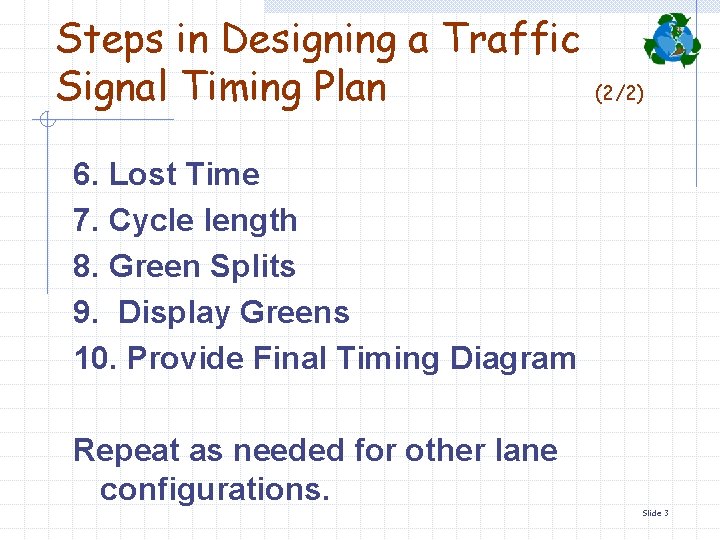
Steps in Designing a Traffic Signal Timing Plan (2/2) 6. Lost Time 7. Cycle length 8. Green Splits 9. Display Greens 10. Provide Final Timing Diagram Repeat as needed for other lane configurations. Slide 3
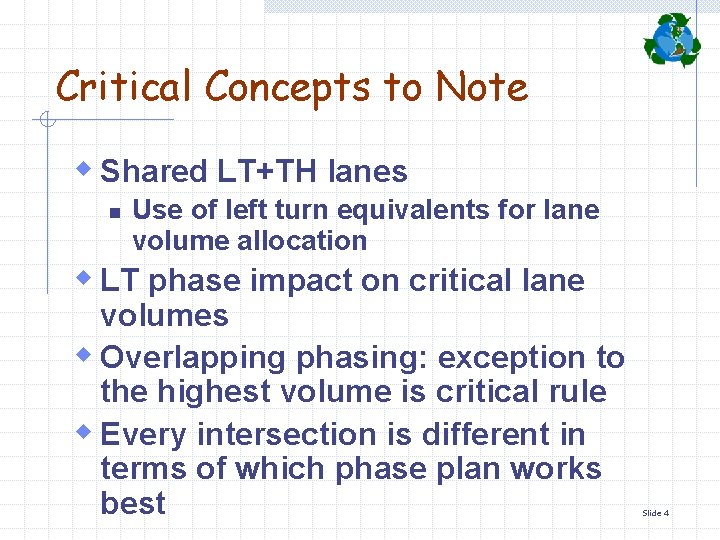
Critical Concepts to Note w Shared LT+TH lanes n Use of left turn equivalents for lane volume allocation w LT phase impact on critical lane volumes w Overlapping phasing: exception to the highest volume is critical rule w Every intersection is different in terms of which phase plan works best Slide 4
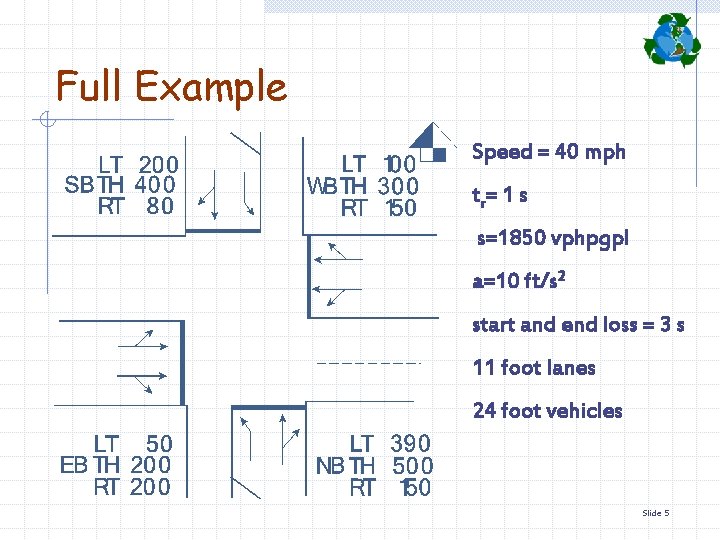
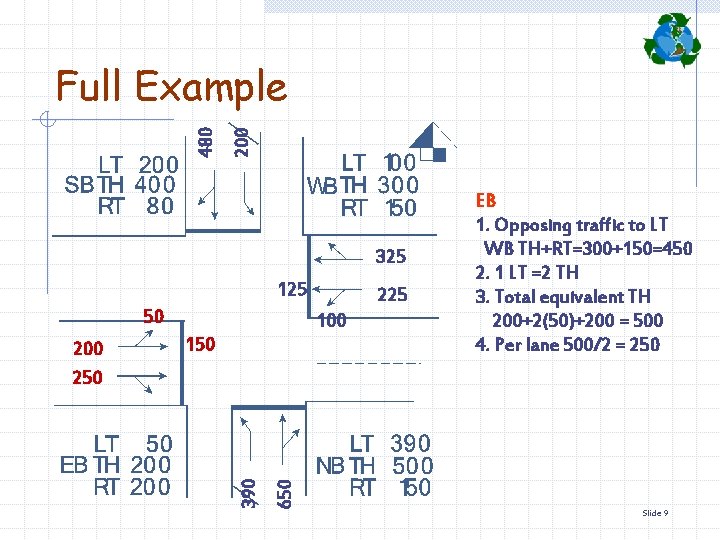
Full Example Speed = 40 mph t r= 1 s s=1850 vphpgpl a=10 ft/s 2 start and end loss = 3 s 11 foot lanes 24 foot vehicles Slide 5
Steps in Designing a Traffic Signal Timing Plan 1. Determine lane configurations and lane volumes 2. Propose Phase Plans (provide diagrams) 3. Critical Volumes for each phase (for each proposed plan) 4. Recommend phase plan 5. Clearance Intervals Slide 6
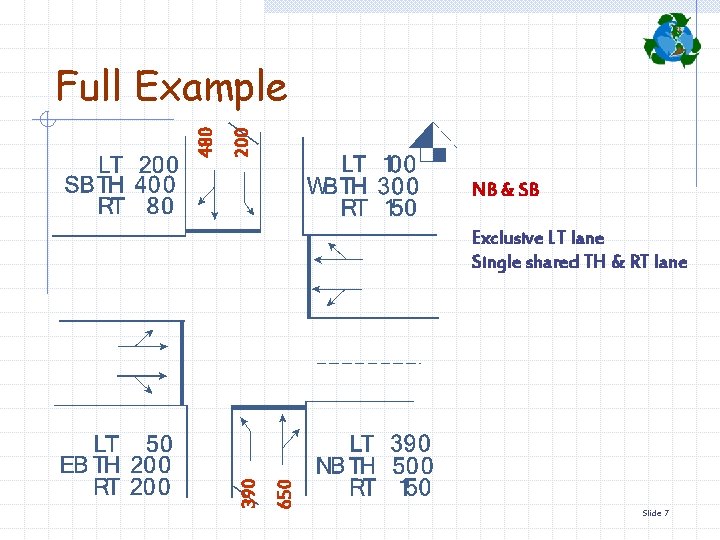
200 NB & SB 650 Exclusive LT lane Single shared TH & RT lane 390 480 Full Example Slide 7
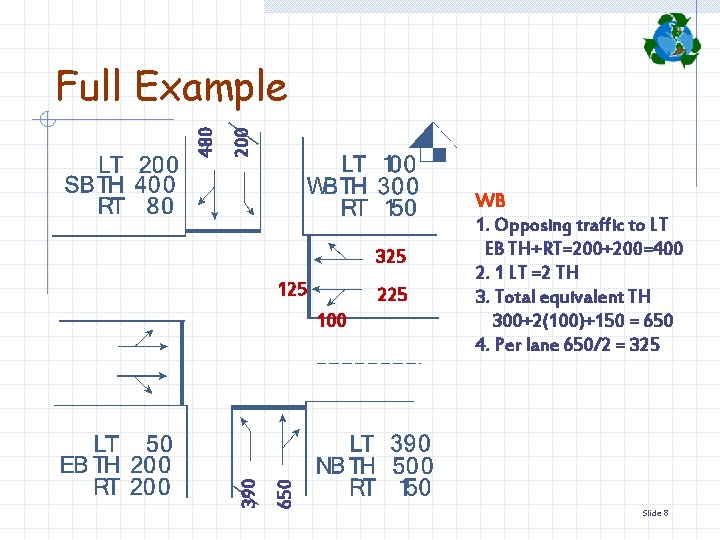
200 325 125 225 650 100 390 480 Full Example WB 1. Opposing traffic to LT EB TH+RT=200+200=400 2. 1 LT =2 TH 3. Total equivalent TH 300+2(100)+150 = 650 4. Per lane 650/2 = 325 Slide 8
200 480 Full Example 325 125 50 100 650 150 390 200 250 225 EB 1. Opposing traffic to LT WB TH+RT=300+150=450 2. 1 LT =2 TH 3. Total equivalent TH 200+2(50)+200 = 500 4. Per lane 500/2 = 250 Slide 9
Steps in Designing a Traffic Signal Timing Plan 1. Determine lane configurations and lane volumes 2. Propose Phase Plans (provide diagrams) 3. Critical Volumes for each phase (for each proposed plan) 4. Recommend phase plan 5. Clearance Intervals Slide 10
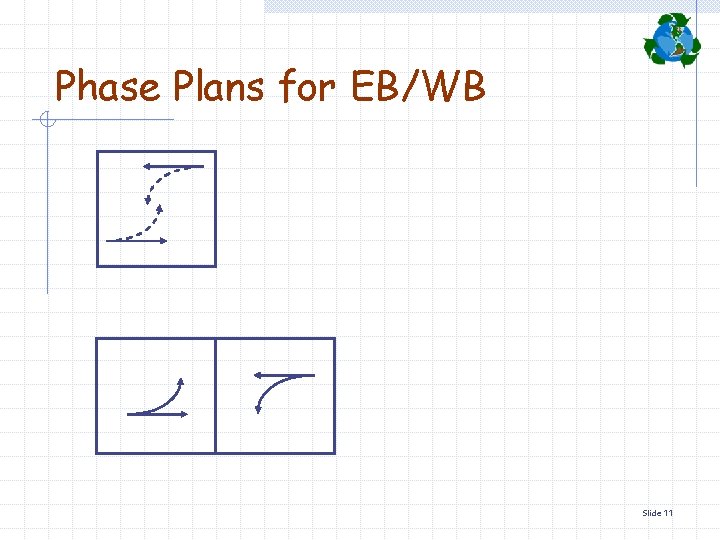
Phase Plans for EB/WB Slide 11
Steps in Designing a Traffic Signal Timing Plan 1. Determine lane configurations and lane volumes 2. Propose Phase Plans (provide diagrams) 3. Critical Volumes for each phase (for each proposed plan) 4. Recommend phase plan 5. Clearance Intervals Slide 12
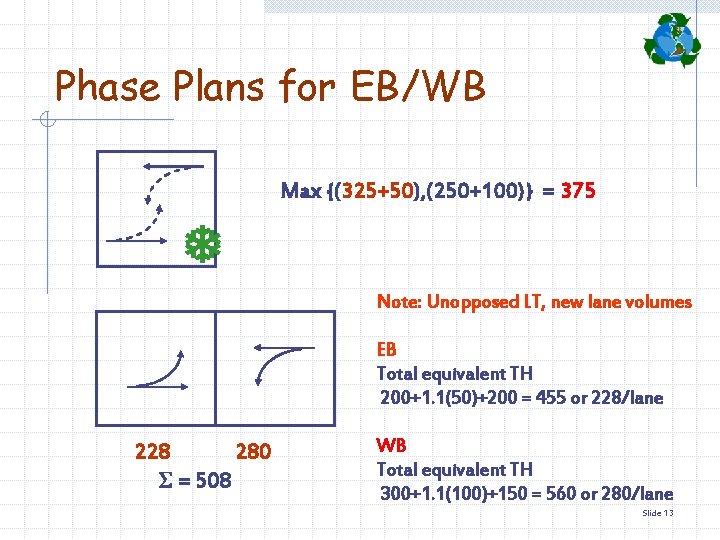
Phase Plans for EB/WB Max {(325+50), (250+100)} = 375 T Note: Unopposed LT, new lane volumes EB Total equivalent TH 200+1. 1(50)+200 = 455 or 228/lane 228 280 Σ = 508 WB Total equivalent TH 300+1. 1(100)+150 = 560 or 280/lane Slide 13
Steps in Designing a Traffic Signal Timing Plan 1. Determine lane configurations and lane volumes 2. Propose Phase Plans (provide diagrams) 3. Critical Volumes for each phase (for each proposed plan) 4. Recommend phase plan 5. Clearance Intervals Slide 14
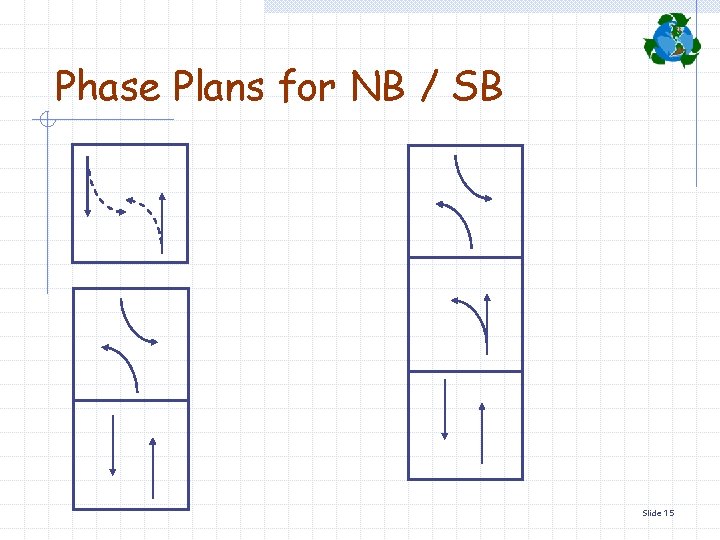
Phase Plans for NB / SB Slide 15
Steps in Designing a Traffic Signal Timing Plan 1. Determine lane configurations and lane volumes 2. Propose Phase Plans (provide diagrams) 3. Critical Volumes for each phase (for each proposed plan) 4. Recommend phase plan 5. Clearance Intervals Slide 16
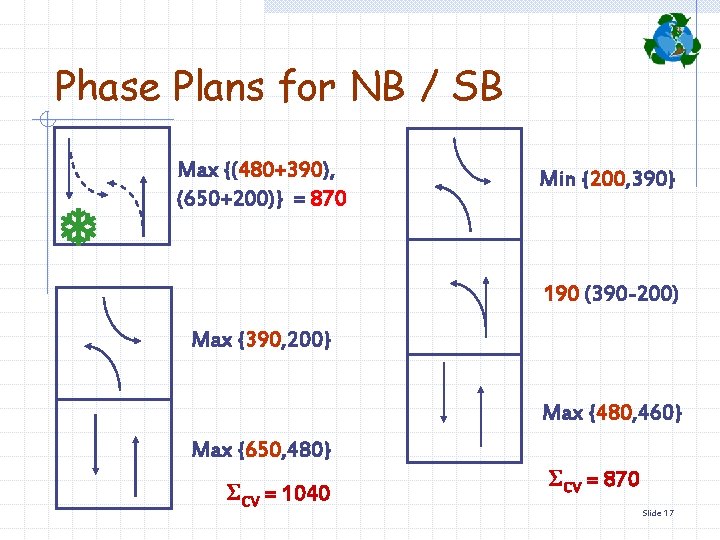
Phase Plans for NB / SB T Max {(480+390), (650+200)} = 870 Min {200, 390} 190 (390 -200) Max {390, 200} Max {480, 460} Max {650, 480} ΣCV = 1040 ΣCV = 870 Slide 17
Steps in Designing a Traffic Signal Timing Plan 1. Determine lane configurations and lane volumes 2. Propose Phase Plans (provide diagrams) 3. Critical Volumes for each phase (for each proposed plan) 4. Recommend phase plan 5. Clearance Intervals Slide 18
Steps in Designing a Traffic Signal Timing Plan 1. Determine lane configurations and lane volumes 2. Propose Phase Plans (provide diagrams) 3. Critical Volumes for each phase (for each proposed plan) 4. Recommend phase plan 5. Clearance Intervals Slide 20
EB/WB Clearance Interval τ1 = tr + [u 0 /(2 a)] + [(W+L)/u 0] W is road width to be cleared (ft or m) = L is vehicle length (ft or m) = u 0 is approach speed of vehicles (f/s or m/s) = tr is driver’s reaction time (sec) = a is deceleration rate (ft/s 2 or m/s 2) = Slide 21
Steps in Designing a Traffic Signal Timing Plan 6. Lost Time 7. Cycle length 8. Green Splits 9. Display Greens 10. Provide Final Timing Diagram Repeat as needed for other lane configurations. Slide 24
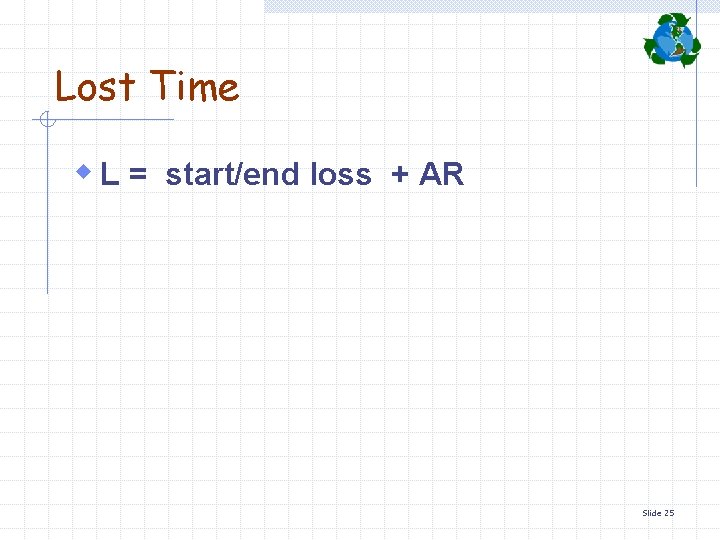
Lost Time w L = start/end loss + AR Slide 25
Steps in Designing a Traffic Signal Timing Plan 6. Lost Time 7. Cycle length 8. Green Splits 9. Display Greens 10. Provide Final Timing Diagram Repeat as needed for other lane configurations. Slide 26
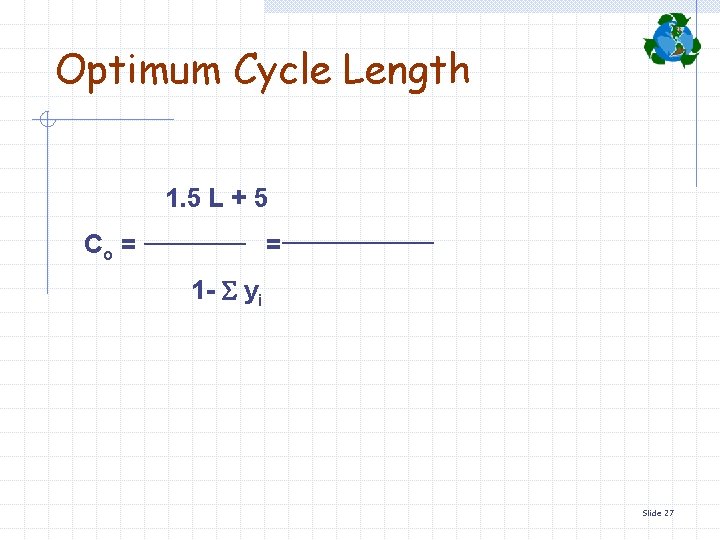
Optimum Cycle Length 1. 5 L + 5 Co = = 1 - S yi Slide 27
Steps in Designing a Traffic Signal Timing Plan 6. Lost Time 7. Cycle length 8. Green Splits 9. Display Greens 10. Provide Final Timing Diagram Repeat as needed for other lane configurations. Slide 28
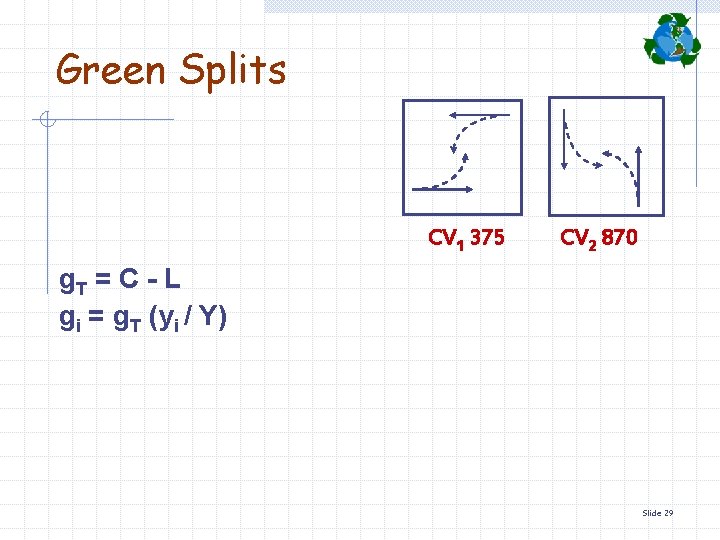
Green Splits CV 1 375 CV 2 870 g. T = C - L gi = g. T (yi / Y) Slide 29
Steps in Designing a Traffic Signal Timing Plan 6. Lost Time 7. Cycle length 8. Green Splits 9. Display Greens 10. Provide Final Timing Diagram Repeat as needed for other lane configurations. Slide 30
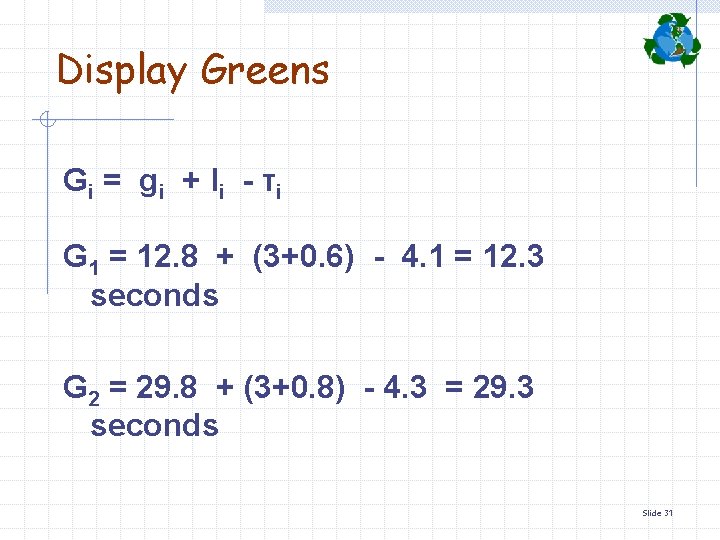
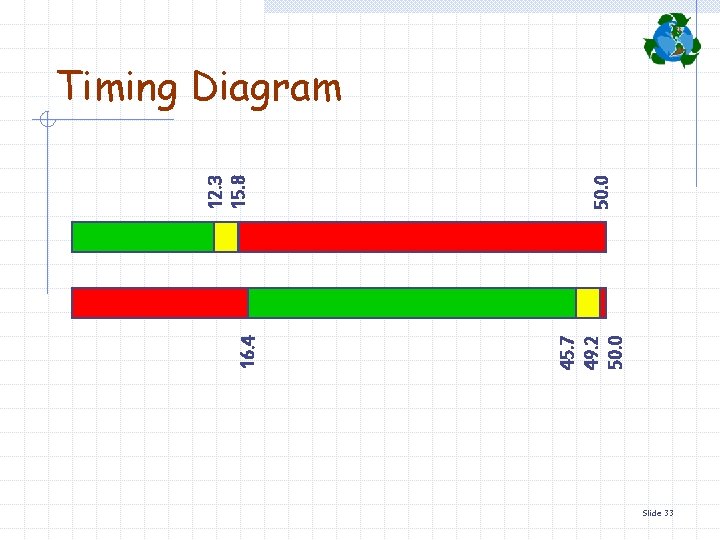
Display Greens G i = g i + l i - τi G 1 = 12. 8 + (3+0. 6) - 4. 1 = 12. 3 seconds G 2 = 29. 8 + (3+0. 8) - 4. 3 = 29. 3 seconds Slide 31
Steps in Designing a Traffic Signal Timing Plan 6. Lost Time 7. Cycle length 8. Green Splits 9. Display Greens 10. Provide Final Timing Diagram Repeat as needed for other lane configurations. Slide 32
45. 7 49. 2 50. 0 16. 4 50. 0 12. 3 15. 8 Timing Diagram Slide 33