
SIGNAL PROCESSING AND NETWORKING FOR BIG DATA APPLICATIONS
SIGNAL PROCESSING AND NETWORKING FOR BIG DATA APPLICATIONS LECTURE 2: PRELIMINARY REVIEW ZHU HAN UNIVERSITY OF HOUSTON http: //www 2. egr. uh. edu/~zhan 2/big_data_course/ 1
OUTLINE • Machine learning basics (thanks for Xunsheng Du and Huaqing Zhang) • • • Supervised learning: support vector machine (SVM) Unsupervised learning: K-means Reinforcement learning 2
MACHINE LEARNING BASICS • “Computers the ability to learn without being explicitly programmed” • Types: • Supervised learning: The computer is presented with example inputs and their desired outputs, given by a "teacher", and the goal is to learn a general rule that maps inputs to outputs. • Unsupervised learning: No labels are given to the learning algorithm, leaving it on its own to find structure in its input. Unsupervised learning can be a goal in itself (discovering hidden patterns in data) or a means towards an end (feature learning). • Reinforcement learning: A computer program interacts with a dynamic environment in which it must perform a certain goal (such as driving a vehicle or playing a game against an opponent). The program is provided feedback in terms of rewards and punishments as it navigates its problem space. 3
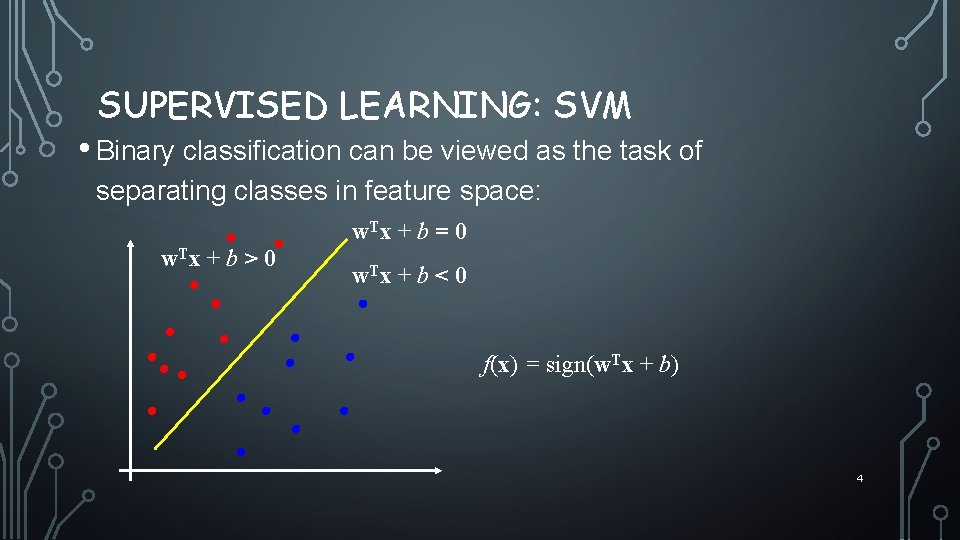
SUPERVISED LEARNING: SVM • Binary classification can be viewed as the task of separating classes in feature space: w. T x + b = 0 w. T x + b > 0 w. T x + b < 0 f(x) = sign(w. Tx + b) 4
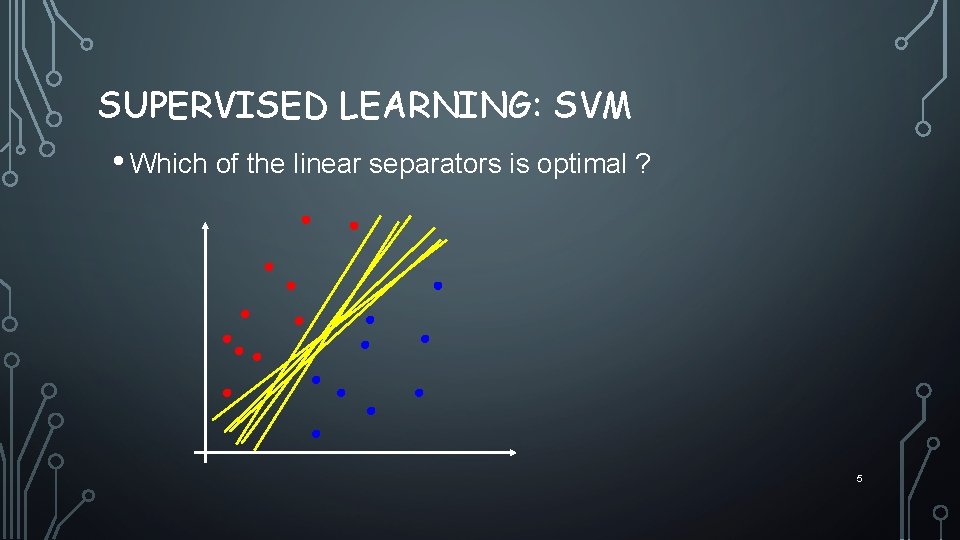
SUPERVISED LEARNING: SVM • Which of the linear separators is optimal ? 5

SUPERVISED LEARNING: SVM • Distance from example xi to the separator is • Examples closest to the hyperplane are support vectors. • Margin ρ of the separator is theρ distance between support vectors. r Intuitively, we’re going to maximize the margin ρ 6
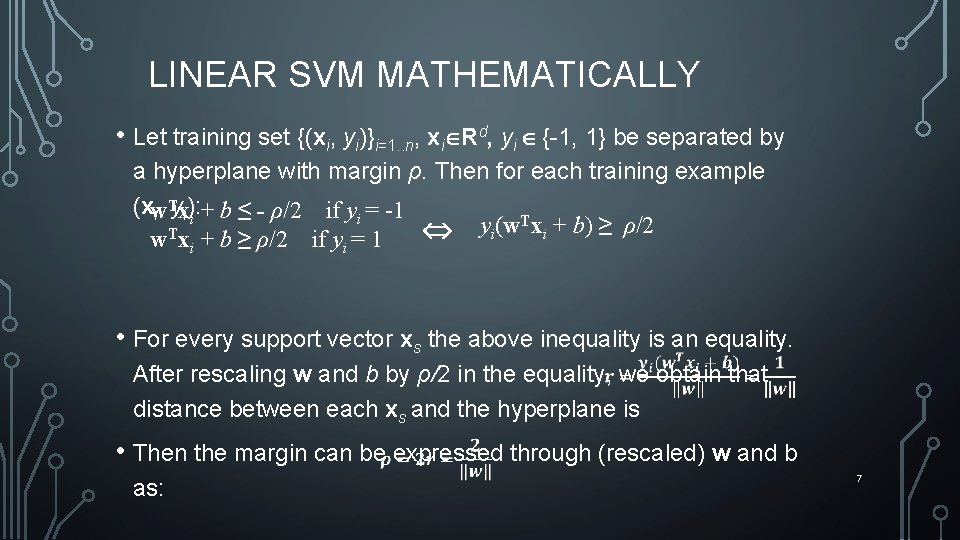
LINEAR SVM MATHEMATICALLY • Let training set {(xi, yi)}i=1. . n, xi Rd, yi {-1, 1} be separated by a hyperplane with margin ρ. Then for each training example T + b ≤ - ρ/2 (xw if yi = -1 i, yxi): i yi(w. Txi + b) ≥ ρ/2 T w xi + b ≥ ρ/2 if yi = 1 • For every support vector xs the above inequality is an equality. After rescaling w and b by ρ/2 in the equality, we obtain that distance between each xs and the hyperplane is • Then the margin can be expressed through (rescaled) w and b as: 7
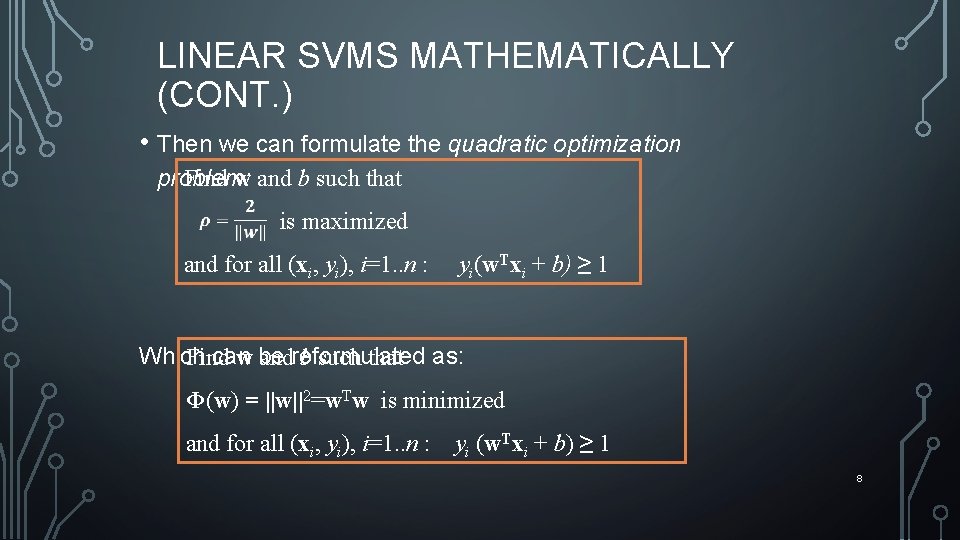
LINEAR SVMS MATHEMATICALLY (CONT. ) • Then we can formulate the quadratic optimization Find w and b such that problem: is maximized and for all (xi, yi), i=1. . n : yi(w. Txi + b) ≥ 1 Which can Find w be andreformulated b such that as: Φ(w) = ||w||2=w. Tw is minimized and for all (xi, yi), i=1. . n : yi (w. Txi + b) ≥ 1 8
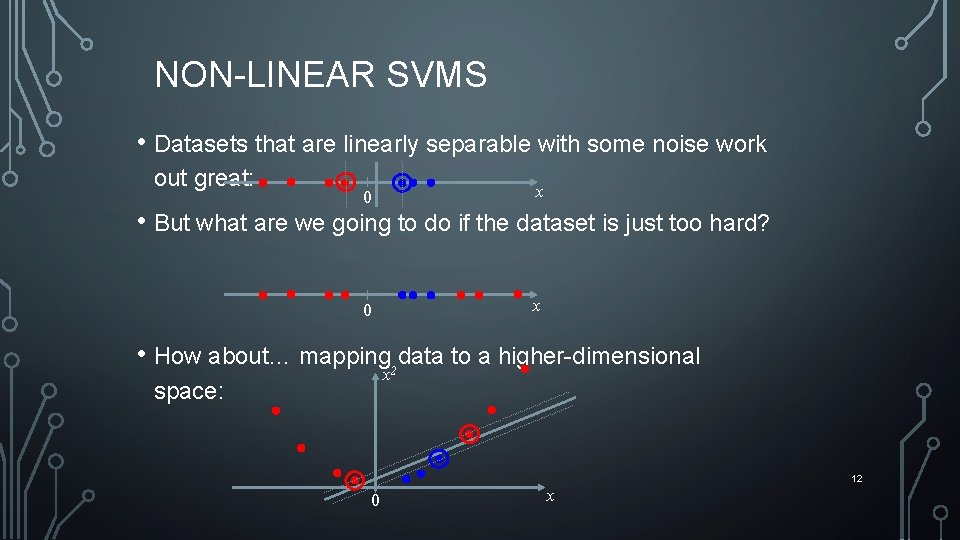
NON-LINEAR SVMS • Datasets that are linearly separable with some noise work out great: 0 x • But what are we going to do if the dataset is just too hard? • How about… mapping data to a higher-dimensional x 2 space: 12 0 x
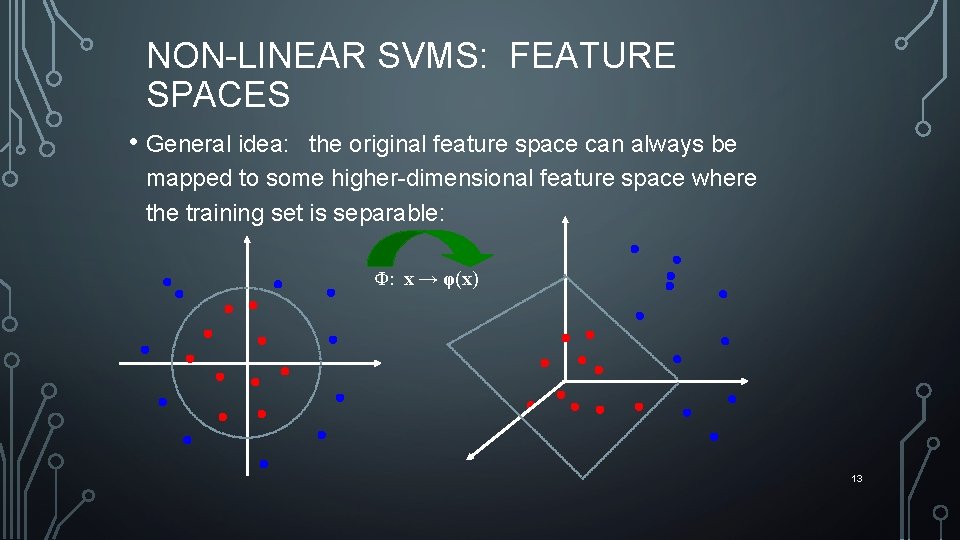
NON-LINEAR SVMS: FEATURE SPACES • General idea: the original feature space can always be mapped to some higher-dimensional feature space where the training set is separable: Φ: x → φ(x) 13
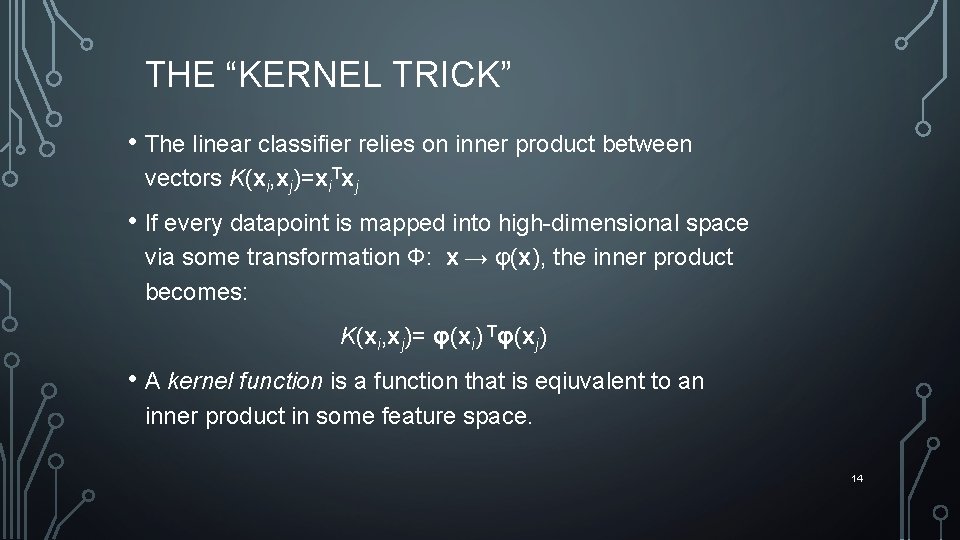
THE “KERNEL TRICK” • The linear classifier relies on inner product between vectors K(xi, xj)=xi. Txj • If every datapoint is mapped into high-dimensional space via some transformation Φ: x → φ(x), the inner product becomes: K(xi, xj)= φ(xi) Tφ(xj) • A kernel function is a function that is eqiuvalent to an inner product in some feature space. 14
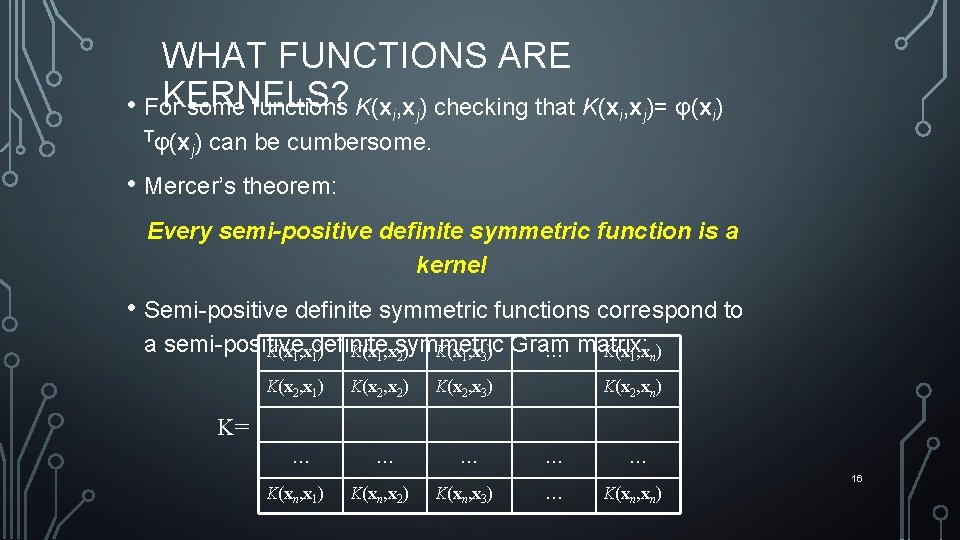
WHAT FUNCTIONS ARE KERNELS? • For some functions K(xi, xj) checking that K(xi, xj)= φ(xi) Tφ(x ) j can be cumbersome. • Mercer’s theorem: Every semi-positive definite symmetric function is a kernel • Semi-positive definite symmetric functions correspond to a semi-positive K(x 1, xdefinite K(x 1, xsymmetric K(x 1, x 3) Gram … matrix: K(x 1, xn) 1) 2) K(x 2, x 1) K(x 2, x 2) K(x 2, x 3) K(x 2, xn) K= … K(xn, x 1) … K(xn, x 2) … K(xn, x 3) … … … K(xn, xn) 16
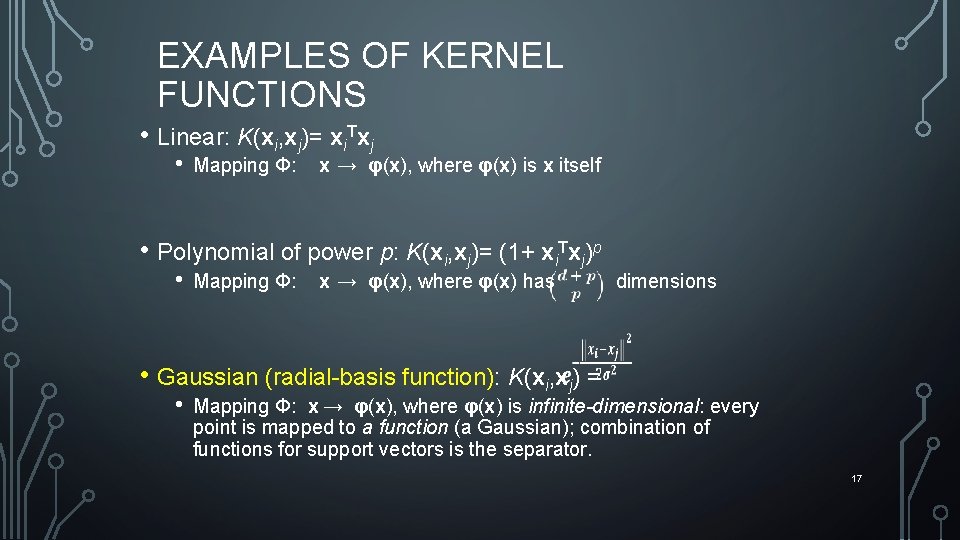
EXAMPLES OF KERNEL FUNCTIONS • Linear: K(xi, xj)= xi. Txj • Mapping Φ: x → φ(x), where φ(x) is x itself • Polynomial of power p: K(xi, xj)= (1+ xi. Txj)p • Mapping Φ: x → φ(x), where φ(x) has dimensions • Gaussian (radial-basis function): K(xi, xj) = • Mapping Φ: x → φ(x), where φ(x) is infinite-dimensional: every point is mapped to a function (a Gaussian); combination of functions for support vectors is the separator. 17
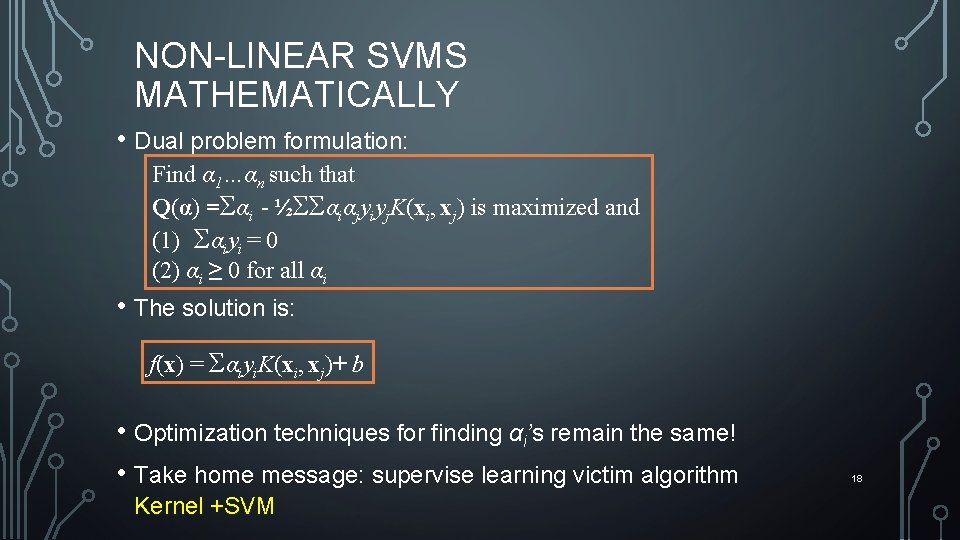
NON-LINEAR SVMS MATHEMATICALLY • Dual problem formulation: Find α 1…αn such that Q(α) =Σαi - ½ΣΣαiαjyiyj. K(xi, xj) is maximized and (1) Σαiyi = 0 (2) αi ≥ 0 for all αi • The solution is: f(x) = Σαiyi. K(xi, xj)+ b • Optimization techniques for finding αi’s remain the same! • Take home message: supervise learning victim algorithm Kernel +SVM 18
SVM APPLICATIONS • SVMs are currently among the best performers for a number of classification tasks ranging from text to genomic data. • SVMs can be applied to complex data types beyond feature vectors (e. g. graphs, sequences, relational data) by designing kernel functions for such data. • SVM techniques have been extended to a number of tasks such as regression [Vapnik et al. ’ 97], principal component analysis [Schölkopf et al. ’ 99], etc. 19
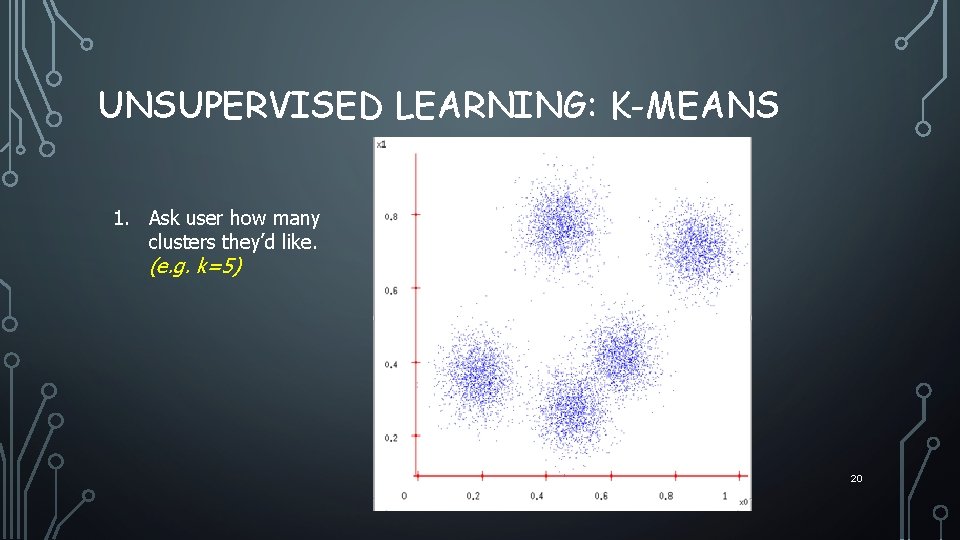
UNSUPERVISED LEARNING: K-MEANS 1. Ask user how many clusters they’d like. (e. g. k=5) 20
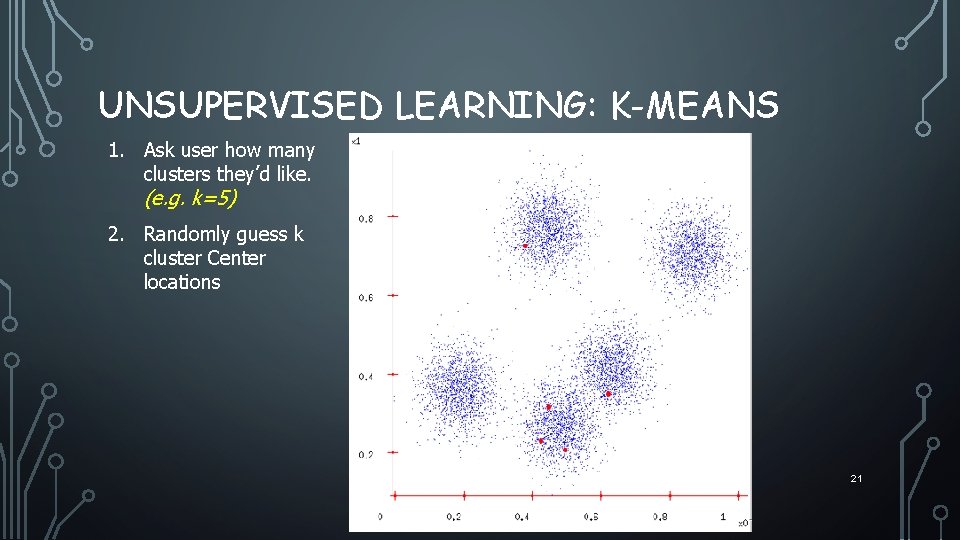
UNSUPERVISED LEARNING: K-MEANS 1. Ask user how many clusters they’d like. (e. g. k=5) 2. Randomly guess k cluster Center locations 21
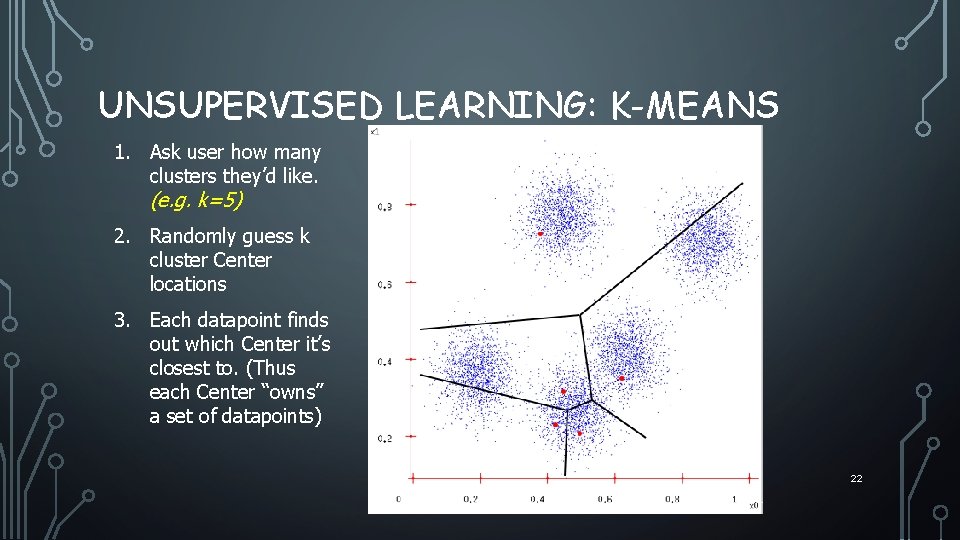
UNSUPERVISED LEARNING: K-MEANS 1. Ask user how many clusters they’d like. (e. g. k=5) 2. Randomly guess k cluster Center locations 3. Each datapoint finds out which Center it’s closest to. (Thus each Center “owns” a set of datapoints) 22
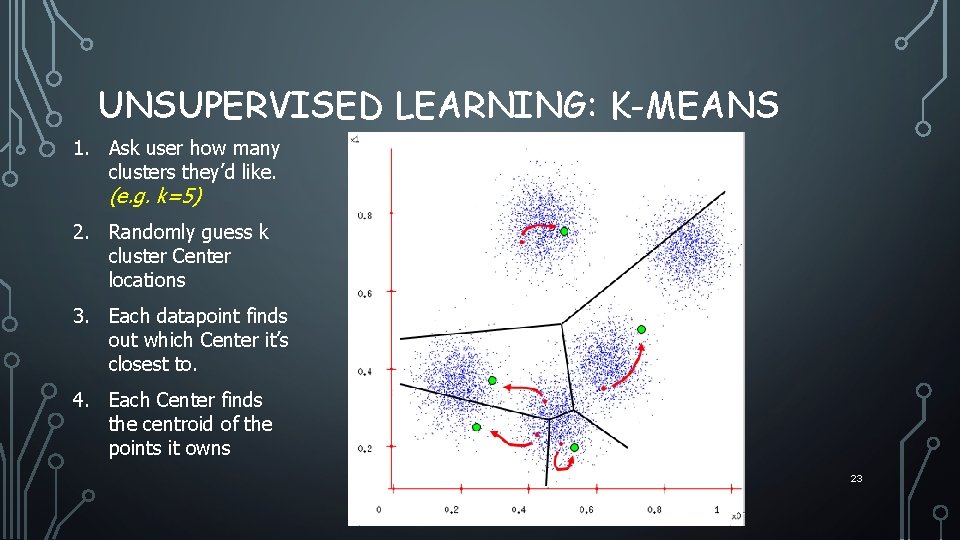
UNSUPERVISED LEARNING: K-MEANS 1. Ask user how many clusters they’d like. (e. g. k=5) 2. Randomly guess k cluster Center locations 3. Each datapoint finds out which Center it’s closest to. 4. Each Center finds the centroid of the points it owns 23
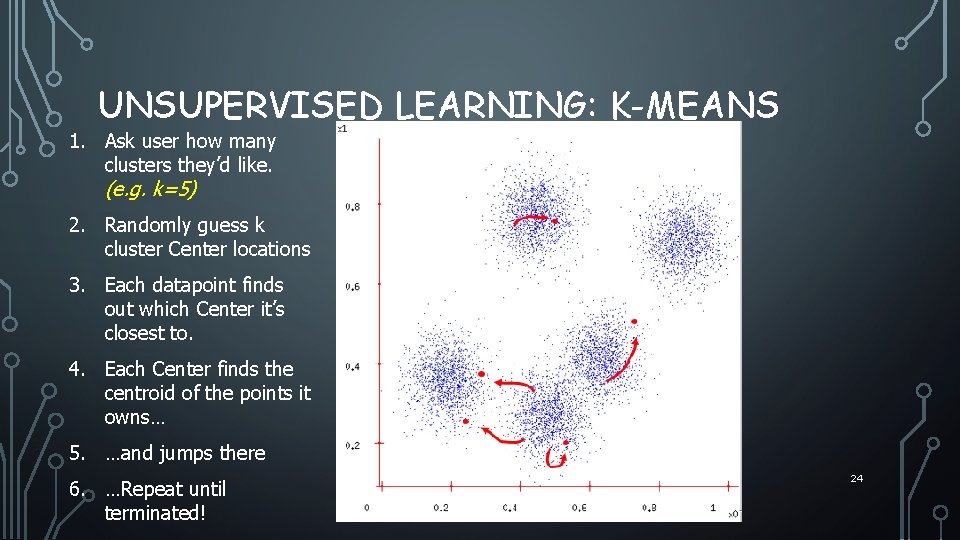
UNSUPERVISED LEARNING: K-MEANS 1. Ask user how many clusters they’d like. (e. g. k=5) 2. Randomly guess k cluster Center locations 3. Each datapoint finds out which Center it’s closest to. 4. Each Center finds the centroid of the points it owns… 5. …and jumps there 6. …Repeat until terminated! 24
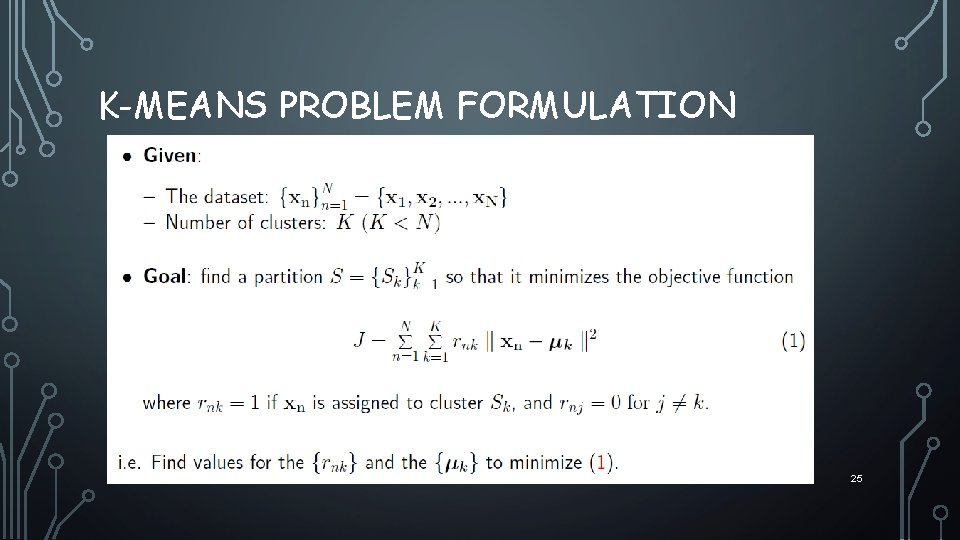
K-MEANS PROBLEM FORMULATION 25
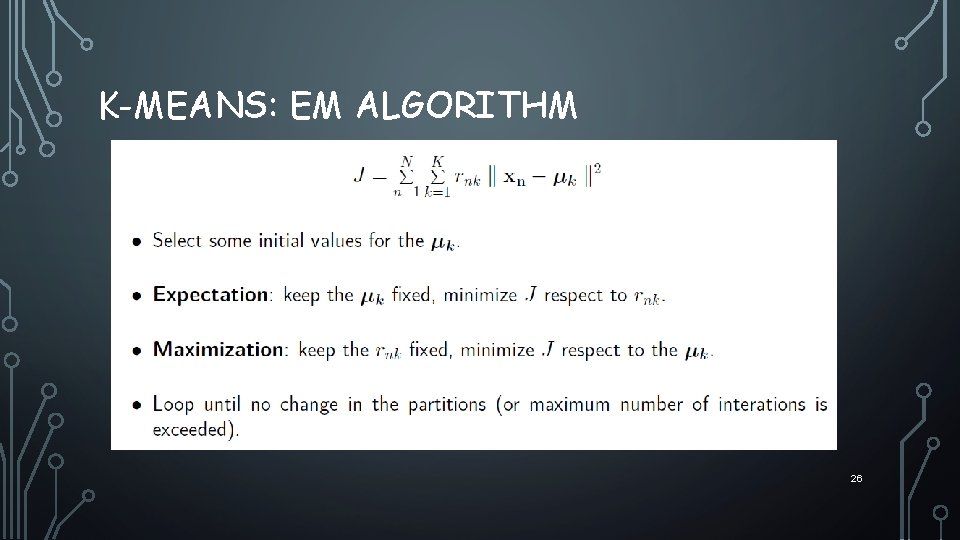
K-MEANS: EM ALGORITHM 26
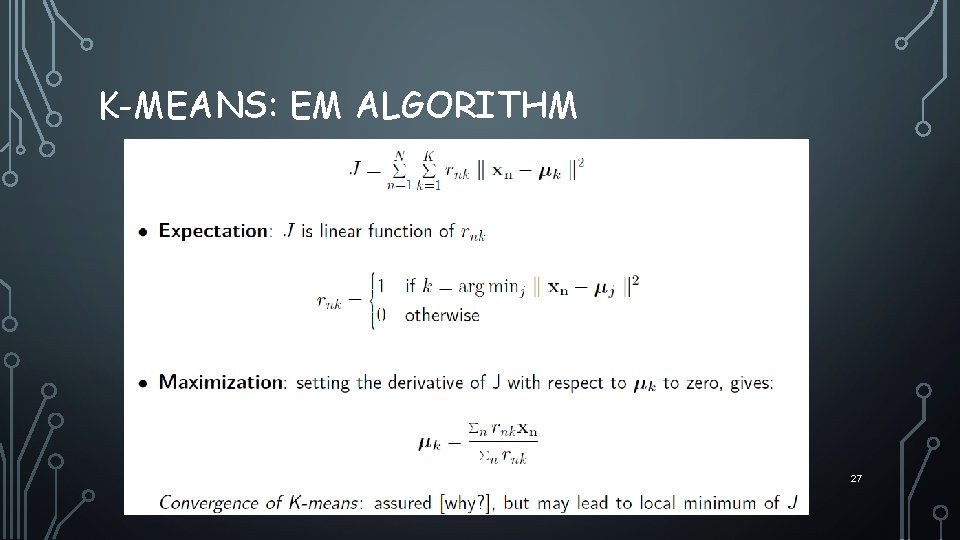
K-MEANS: EM ALGORITHM 27
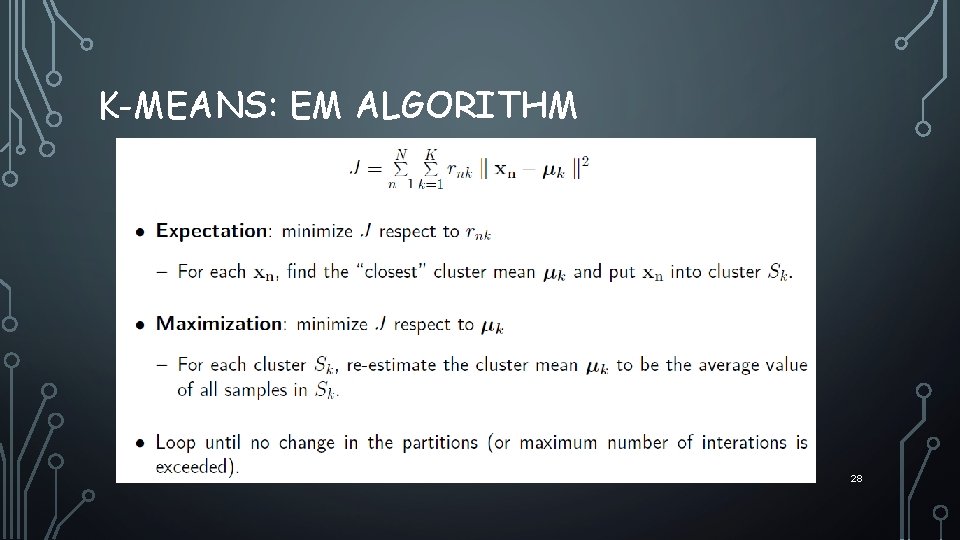
K-MEANS: EM ALGORITHM 28
WEAKNESSES OF K-MEAN CLUSTERING 1. When the numbers of data are not so many, initial grouping will determine the cluster significantly. 2. The number of cluster, K, must be determined before hand. Its disadvantage is that it does not yield the same result with each run, since the resulting clusters depend on the initial random assignments. 3. We never know the real cluster, using the same data, because if it is inputted in a different order it may produce different cluster if the number of data is few. 4. It is sensitive to initial condition. Different initial condition may produce different result of cluster. The algorithm may be trapped in the local optimum. 29
APPLICATIONS OF K-MEANS CLUSTERING • It is relatively efficient and fast. It computes result at O(tkn), where n is number of objects or points, k is number of clusters and t is number of iterations. • k-means clustering can be applied to machine learning or data mining • Used on acoustic data in speech understanding to convert waveforms into one of k categories (known as Vector Quantization or Image Segmentation). • Also used for choosing color palettes on old fashioned graphical display devices and Image Quantization. 30 • Take home message: unsupervised learning victim algorithm: K-Mean
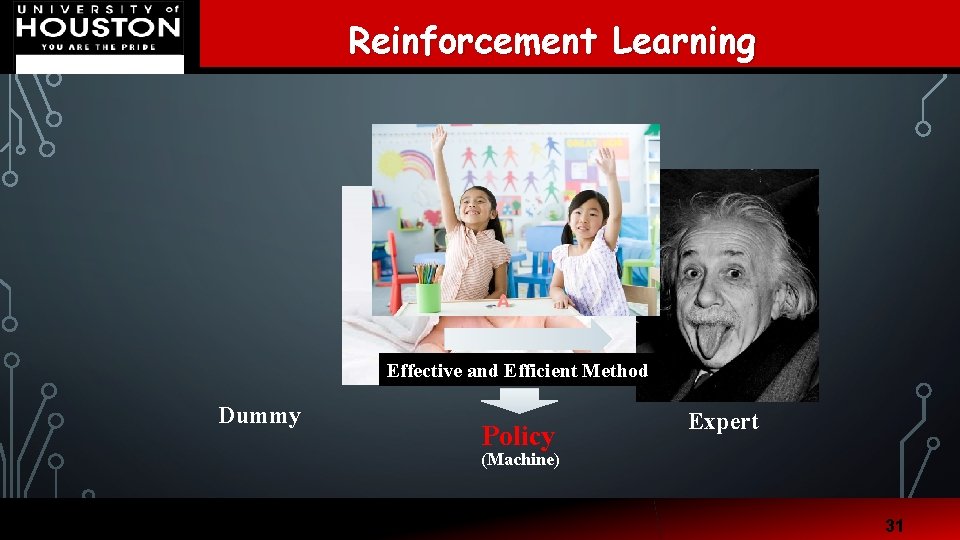
Reinforcement Learning Department of Electrical and Computer Engineering Effective and Efficient Method Dummy Policy Expert (Machine) 31
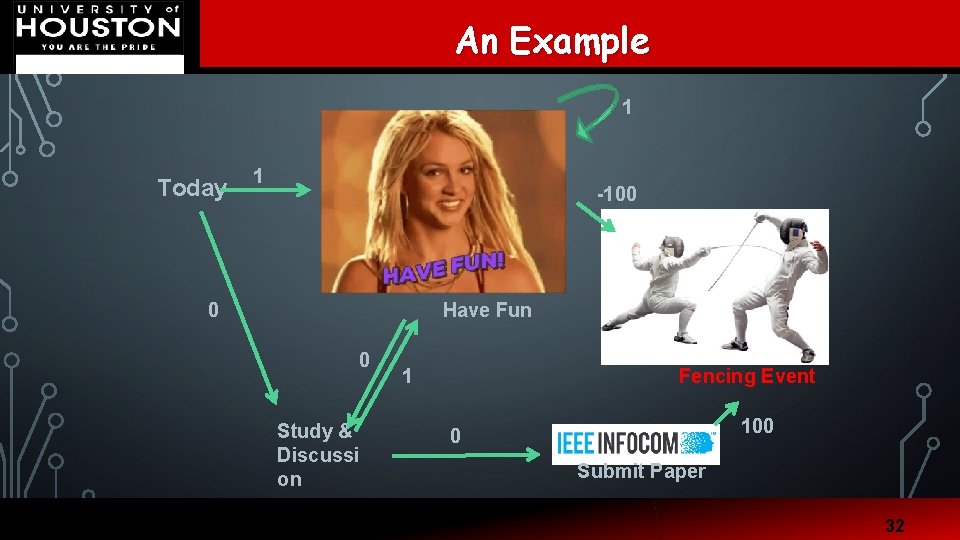
An Example Department of Electrical and Computer Engineering 1 Today 1 -100 0 Have Fun 0 Study & Discussi on 1 Fencing Event 100 0 Submit Paper 32
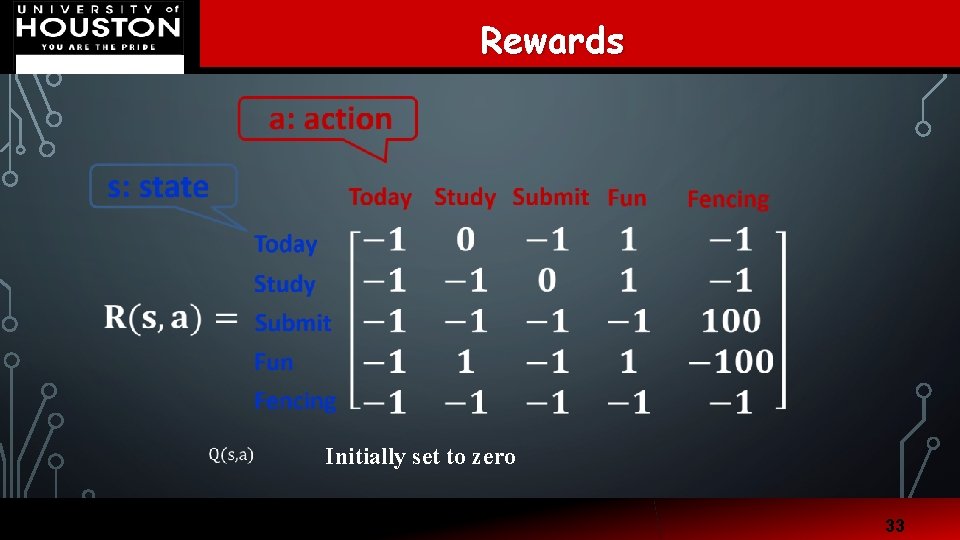
Department of Electrical and Computer Engineering Rewards Initially set to zero 33
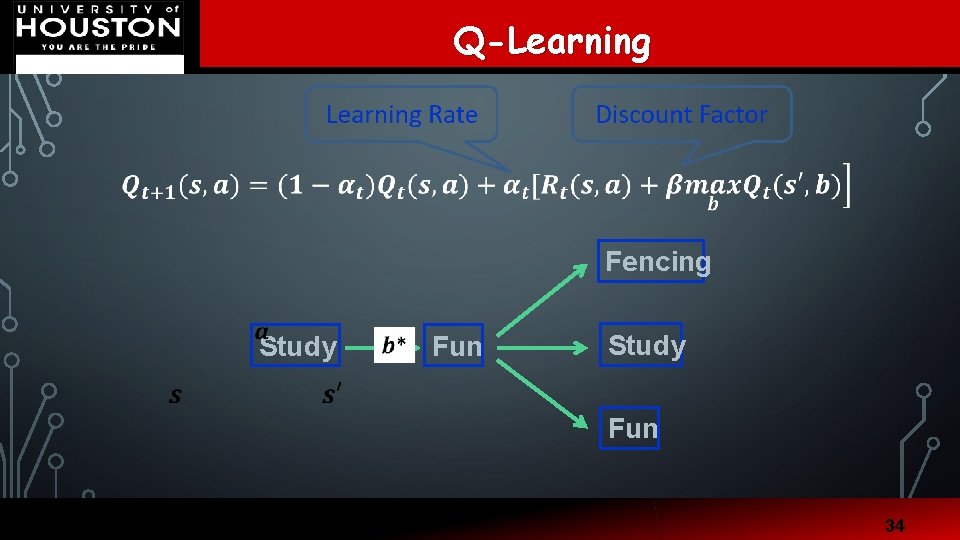
Q-Learning Department of Electrical and Computer Engineering Fencing Study Fun 34
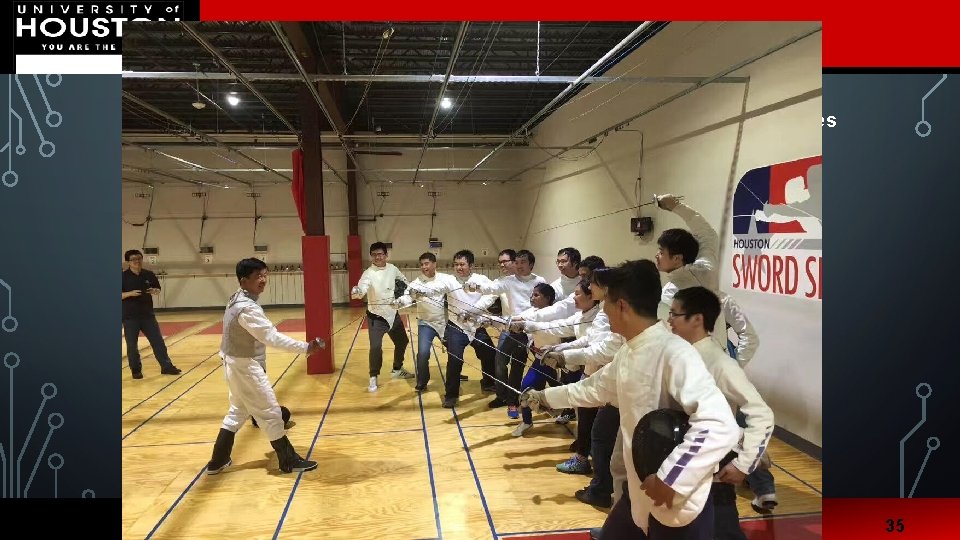
Results Department of Electrical and Computer Engineering 52. 2 Today 52. 2 317182 Games -100 • • 64 64 Study & Discussion 1 million steps Learning rate: 0. 9999954 Discount rate: 0. 8 Have Fun Epsilon: 0. 1 52. 2 Fencing Event 100 80 Submit Paper 35
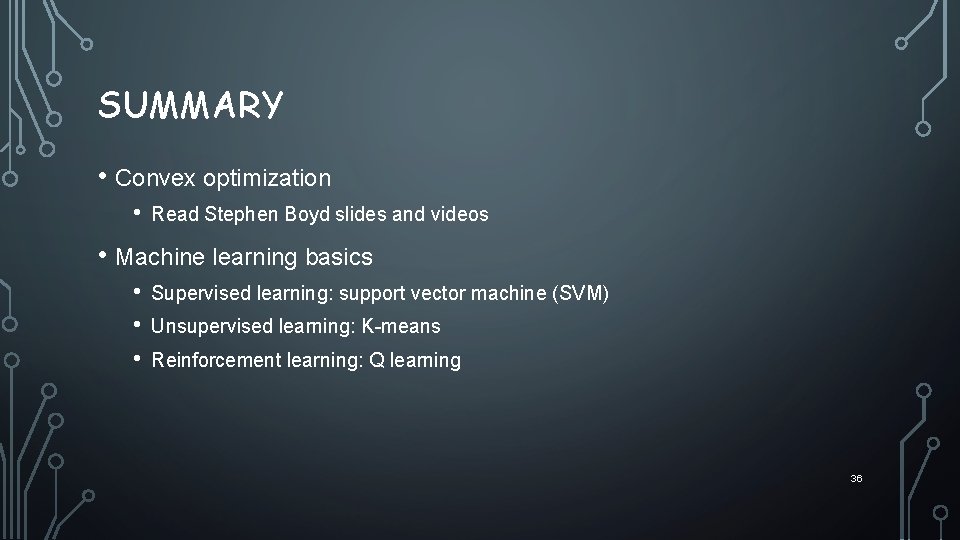
SUMMARY • Convex optimization • Read Stephen Boyd slides and videos • Machine learning basics • • • Supervised learning: support vector machine (SVM) Unsupervised learning: K-means Reinforcement learning: Q learning 36
- Slides: 32