
Signal Linear system Chapter 2 Time Domain Analysis
- Slides: 54
Signal & Linear system Chapter 2 Time Domain Analysis of CT System Basil Hamed
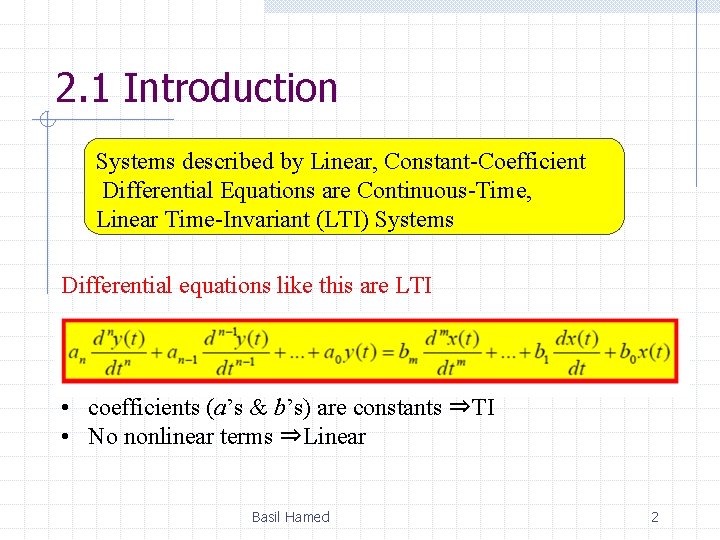
2. 1 Introduction Systems described by Linear, Constant-Coefficient Differential Equations are Continuous-Time, Linear Time-Invariant (LTI) Systems Differential equations like this are LTI • coefficients (a’s & b’s) are constants ⇒TI • No nonlinear terms ⇒Linear Basil Hamed 2
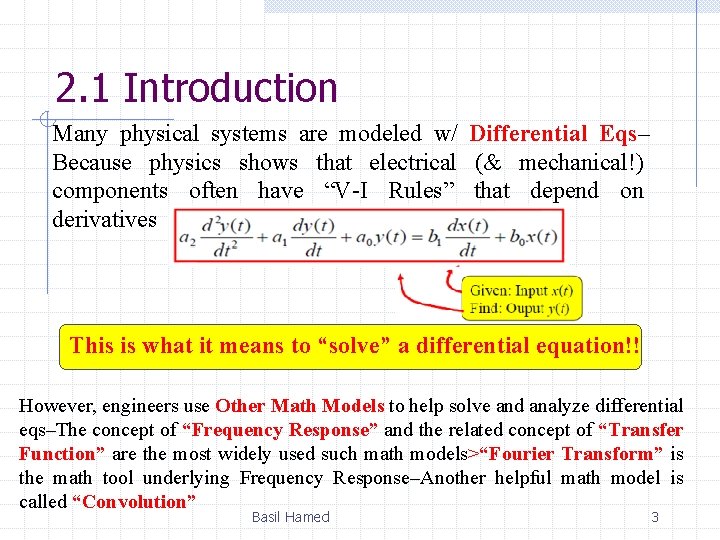
2. 1 Introduction Many physical systems are modeled w/ Differential Eqs– Because physics shows that electrical (& mechanical!) components often have “V-I Rules” that depend on derivatives This is what it means to “solve” a differential equation!! However, engineers use Other Math Models to help solve and analyze differential eqs–The concept of “Frequency Response” and the related concept of “Transfer Function” are the most widely used such math models>“Fourier Transform” is the math tool underlying Frequency Response–Another helpful math model is called “Convolution” Basil Hamed 3
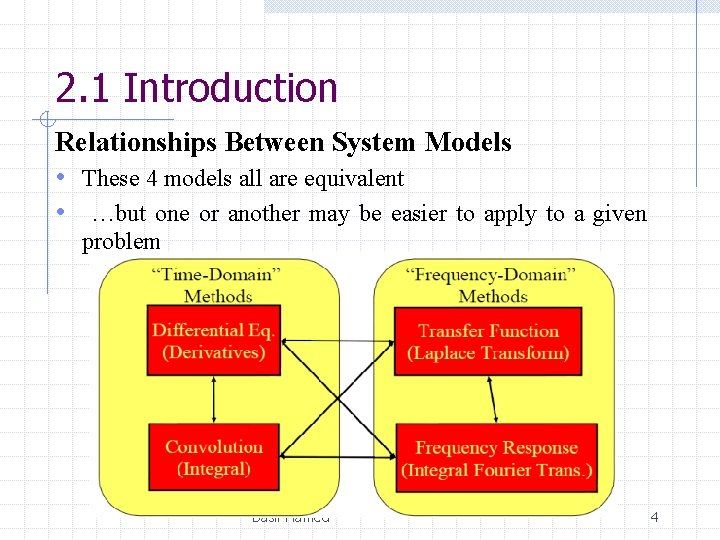
2. 1 Introduction Relationships Between System Models • These 4 models all are equivalent • …but one or another may be easier to apply to a given problem Basil Hamed 4
2. 1 Introduction Example System: RC Circuit System You’ve seen in Circuits Class that R, L, C circuits are modeled by Differential Equations: • From Physical Circuit…get schematic • From Schematic write circuit equations…get Differential Equation • Solve Differential Equation for specific input…get specific output Basil Hamed 5
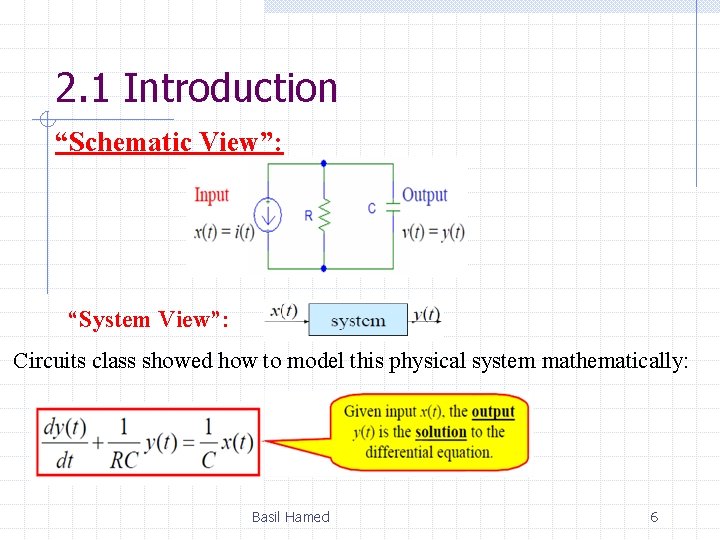
2. 1 Introduction “Schematic View”: “System View”: Circuits class showed how to model this physical system mathematically: Basil Hamed 6
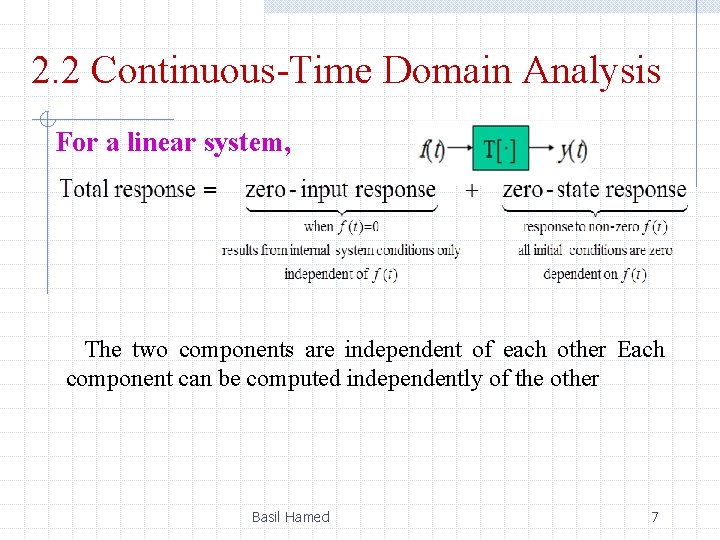
2. 2 Continuous-Time Domain Analysis For a linear system, The two components are independent of each other Each component can be computed independently of the other Basil Hamed 7
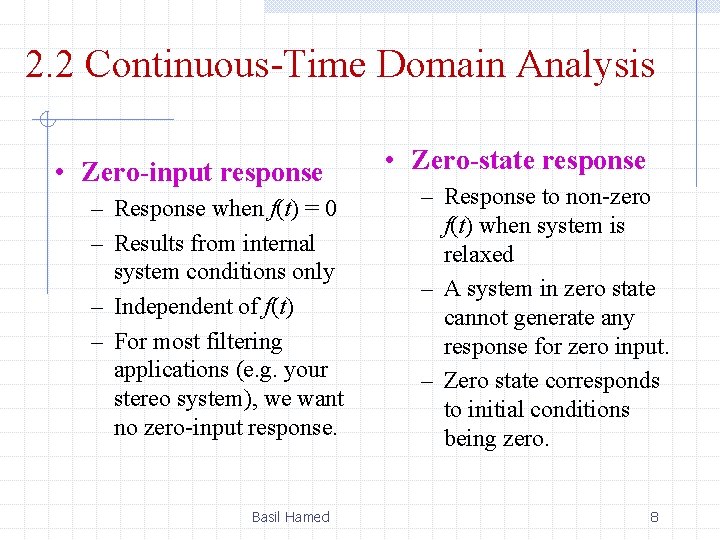
2. 2 Continuous-Time Domain Analysis • Zero-input response – Response when f(t) = 0 – Results from internal system conditions only – Independent of f(t) – For most filtering applications (e. g. your stereo system), we want no zero-input response. Basil Hamed • Zero-state response – Response to non-zero f(t) when system is relaxed – A system in zero state cannot generate any response for zero input. – Zero state corresponds to initial conditions being zero. 8
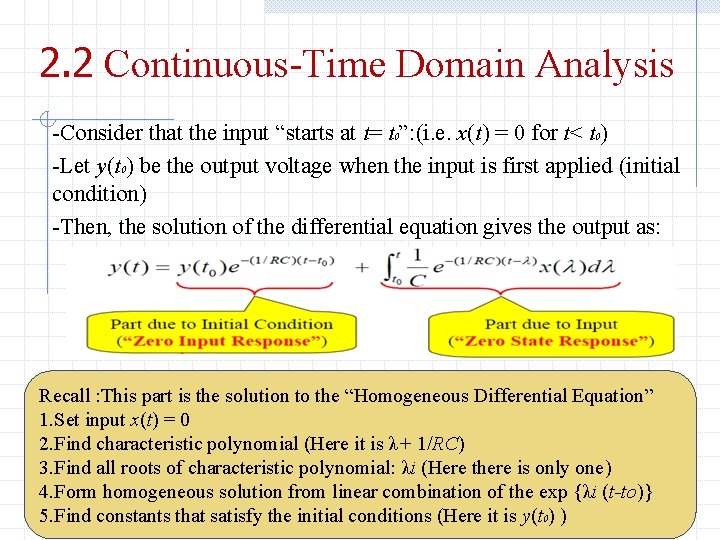
2. 2 Continuous-Time Domain Analysis -Consider that the input “starts at t= t 0”: (i. e. x(t) = 0 for t< t 0) -Let y(t 0) be the output voltage when the input is first applied (initial condition) -Then, the solution of the differential equation gives the output as: Recall : This part is the solution to the “Homogeneous Differential Equation” 1. Set input x(t) = 0 2. Find characteristic polynomial (Here it is λ+ 1/RC) 3. Find all roots of characteristic polynomial: λi (Here there is only one) 4. Form homogeneous solution from linear combination of the exp {λi (t-to)} 9 5. Find constants that satisfy. Basil the. Hamed initial conditions (Here it is y(t 0) )
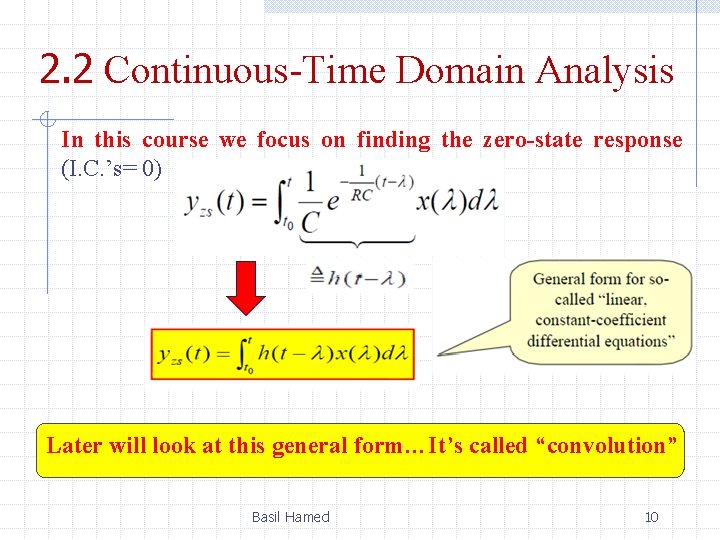
2. 2 Continuous-Time Domain Analysis In this course we focus on finding the zero-state response (I. C. ’s= 0) Later will look at this general form…It’s called “convolution” Basil Hamed 10
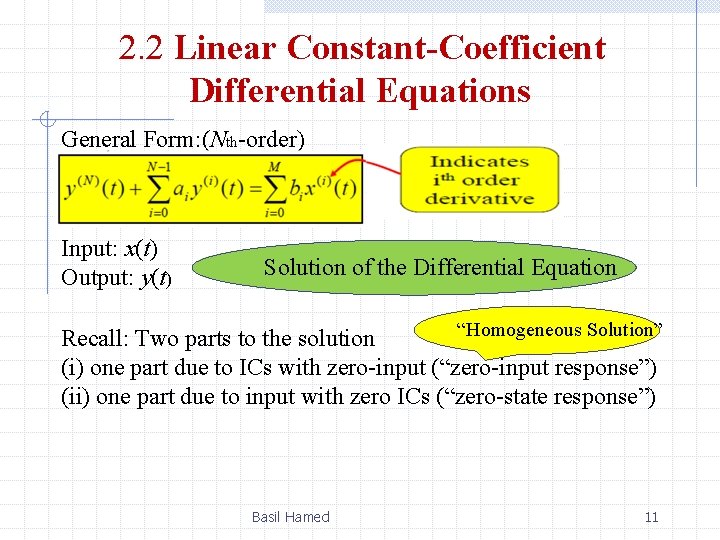
2. 2 Linear Constant-Coefficient Differential Equations General Form: (Nth-order) Input: x(t) Output: y(t) Solution of the Differential Equation “Homogeneous Solution” Recall: Two parts to the solution (i) one part due to ICs with zero-input (“zero-input response”) (ii) one part due to input with zero ICs (“zero-state response”) Basil Hamed 11
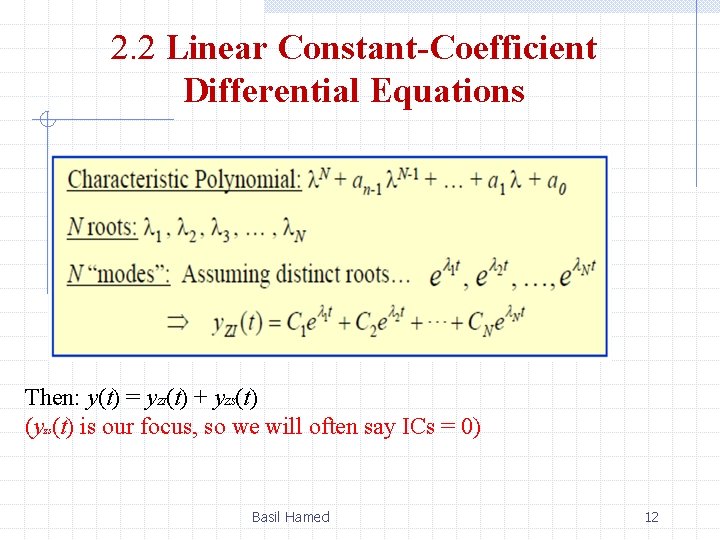
2. 2 Linear Constant-Coefficient Differential Equations Then: y(t) = y. ZI(t) + y. ZS(t) (yzs(t) is our focus, so we will often say ICs = 0) Basil Hamed 12
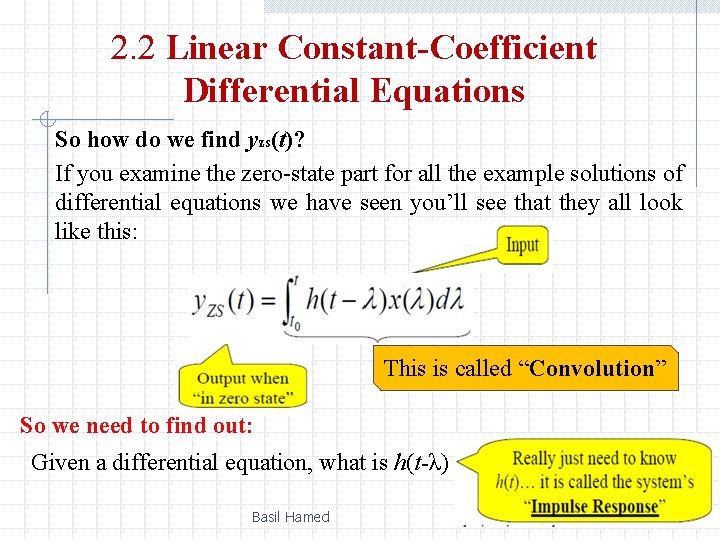
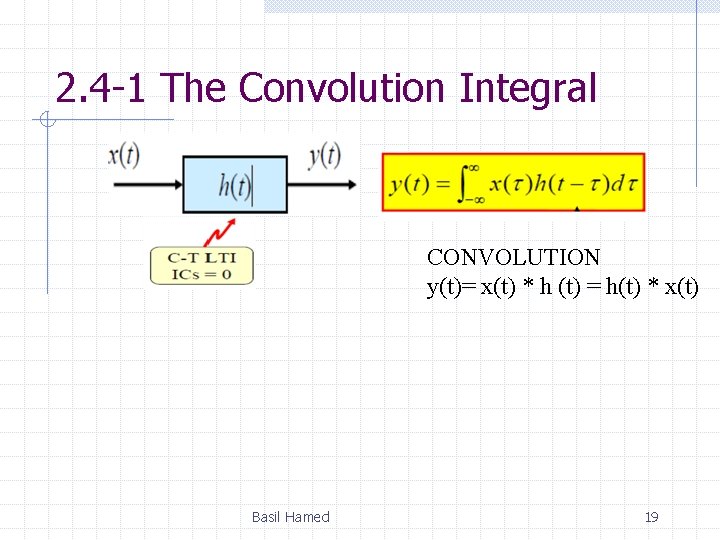
2. 2 Linear Constant-Coefficient Differential Equations So how do we find y. ZS(t)? If you examine the zero-state part for all the example solutions of differential equations we have seen you’ll see that they all look like this: This is called “Convolution” So we need to find out: Given a differential equation, what is h(t-λ) Basil Hamed 13
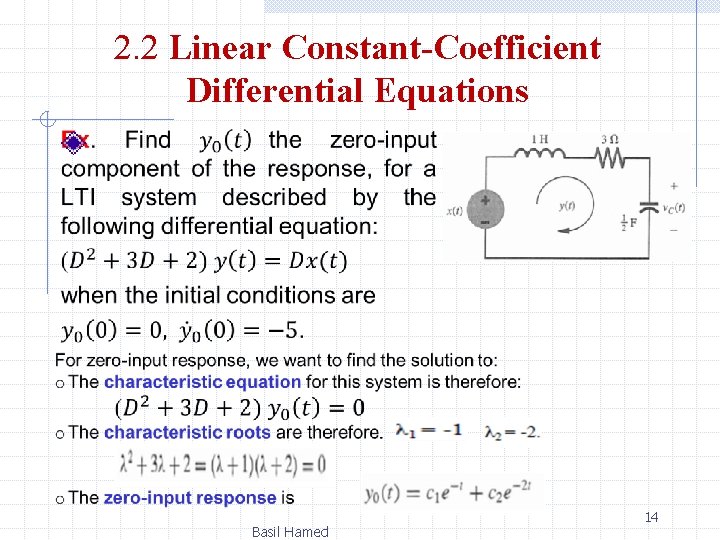
2. 2 Linear Constant-Coefficient Differential Equations Basil Hamed 14
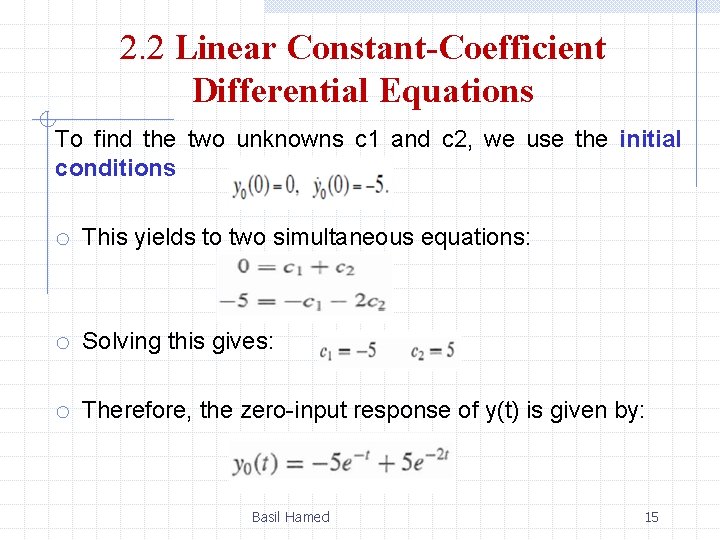
2. 2 Linear Constant-Coefficient Differential Equations To find the two unknowns c 1 and c 2, we use the initial conditions o This yields to two simultaneous equations: o Solving this gives: o Therefore, the zero-input response of y(t) is given by: Basil Hamed 15
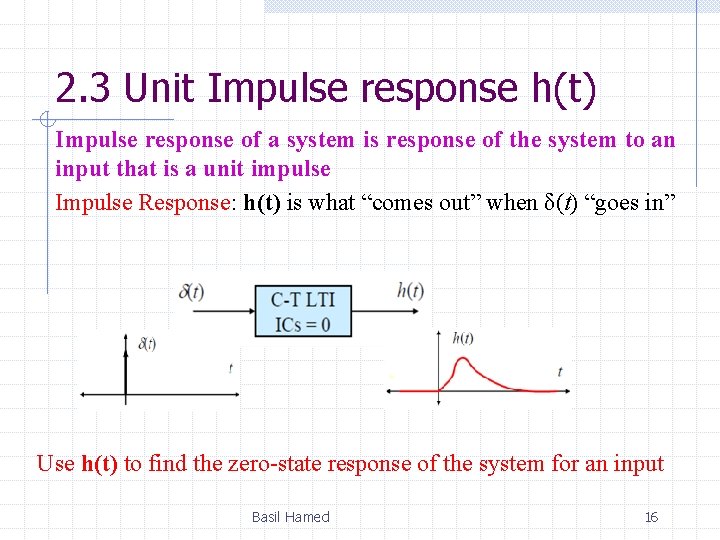
2. 3 Unit Impulse response h(t) Impulse response of a system is response of the system to an input that is a unit impulse Impulse Response: h(t) is what “comes out” when δ(t) “goes in” Use h(t) to find the zero-state response of the system for an input Basil Hamed 16
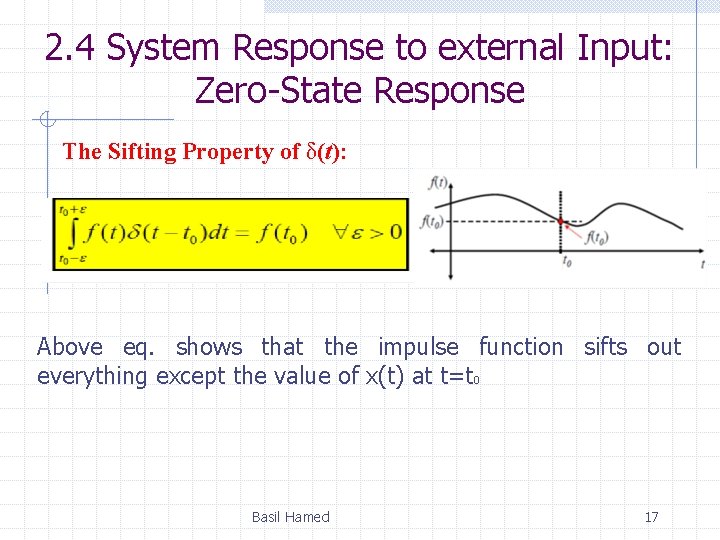
2. 4 System Response to external Input: Zero-State Response The Sifting Property of δ(t): Above eq. shows that the impulse function sifts out everything except the value of x(t) at t=t 0 Basil Hamed 17
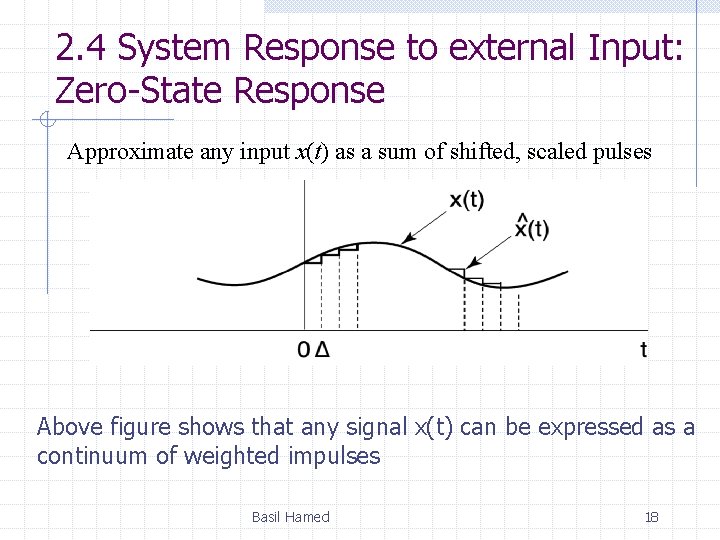
2. 4 System Response to external Input: Zero-State Response Approximate any input x(t) as a sum of shifted, scaled pulses Above figure shows that any signal x(t) can be expressed as a continuum of weighted impulses Basil Hamed 18
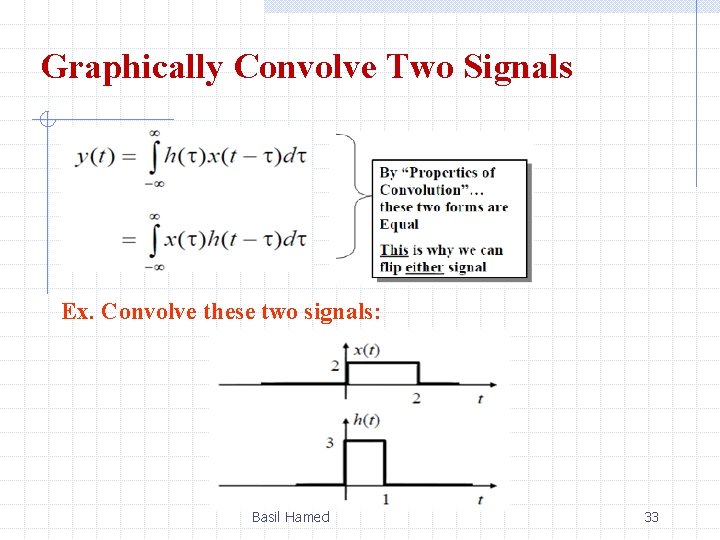
2. 4 -1 The Convolution Integral CONVOLUTION y(t)= x(t) * h (t) = h(t) * x(t) Basil Hamed 19
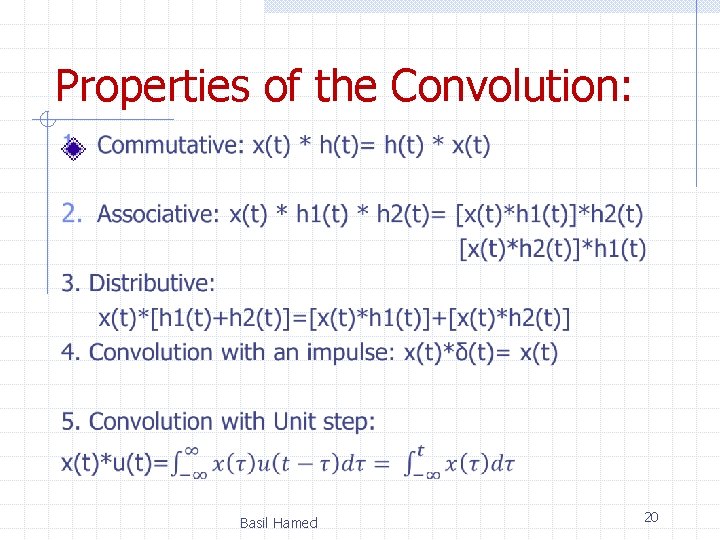
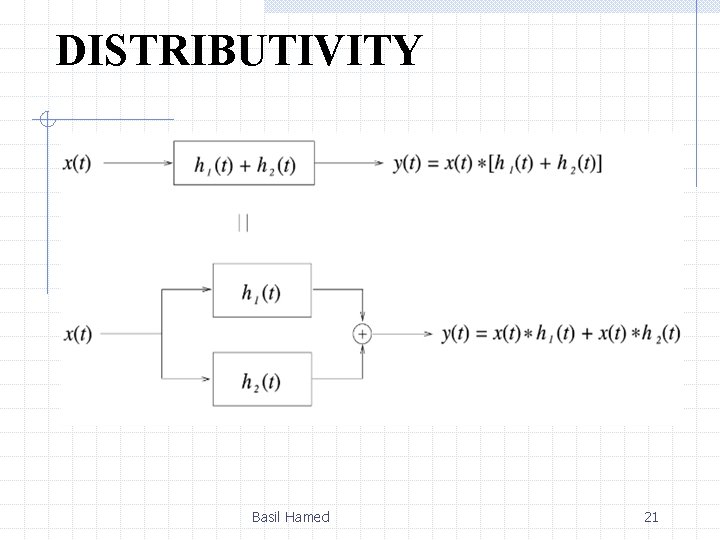
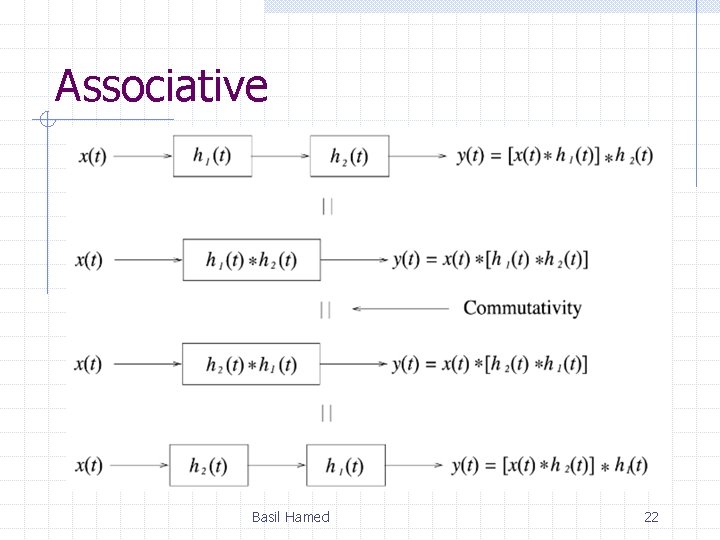
Properties of the Convolution: Basil Hamed 20
DISTRIBUTIVITY Basil Hamed 21
Associative Basil Hamed 22
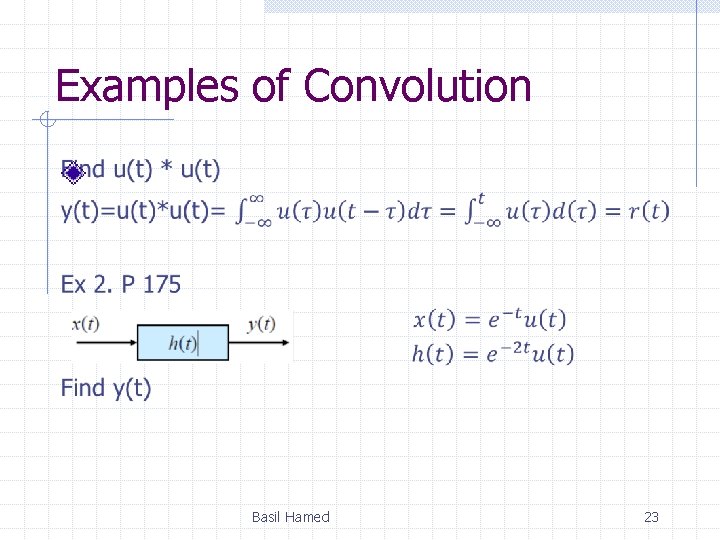
Examples of Convolution Basil Hamed 23
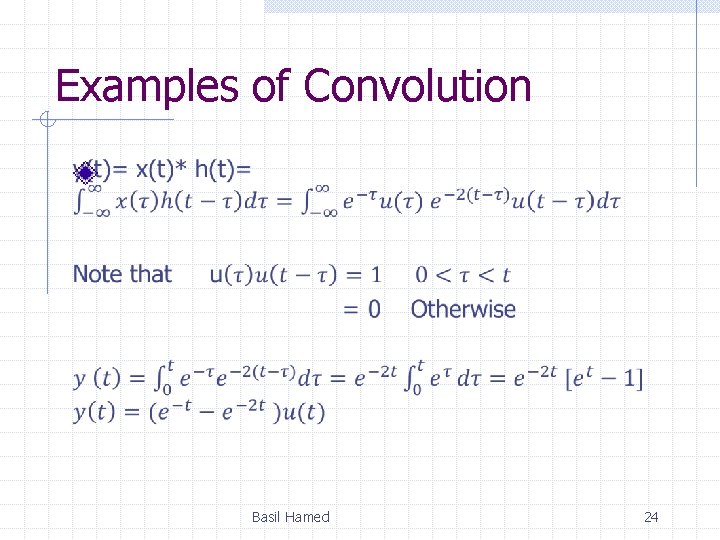
Examples of Convolution Basil Hamed 24
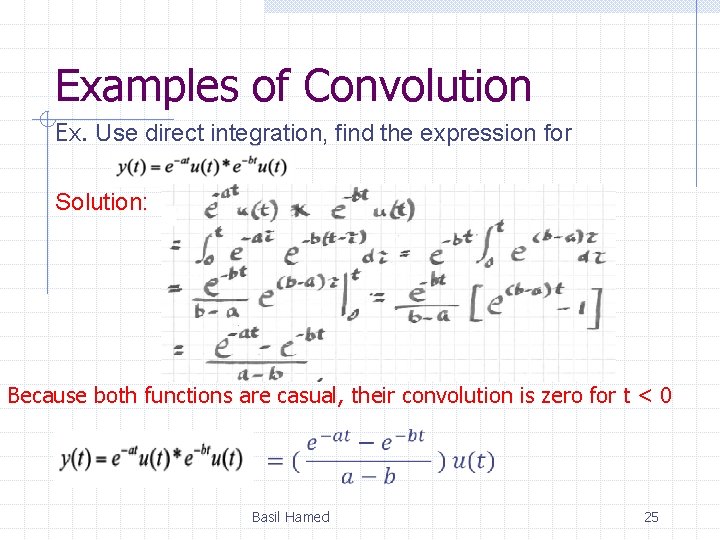
Examples of Convolution Ex. Use direct integration, find the expression for Solution: Because both functions are casual, their convolution is zero for t < 0 Basil Hamed 25
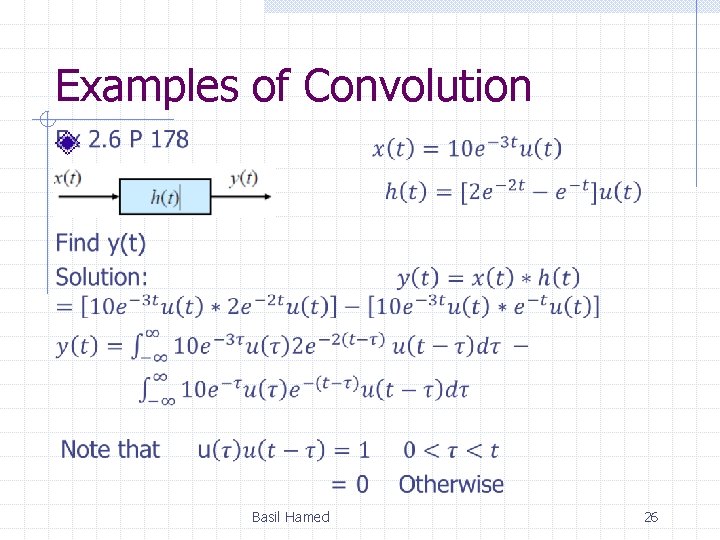
Examples of Convolution Basil Hamed 26
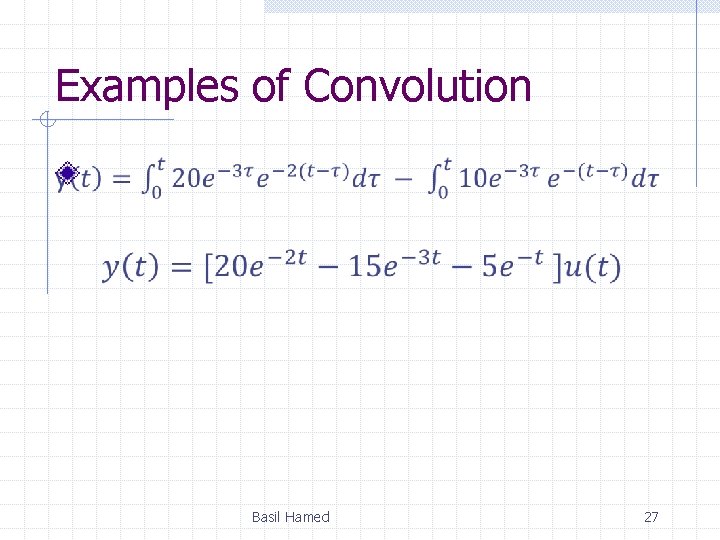
Examples of Convolution Basil Hamed 27
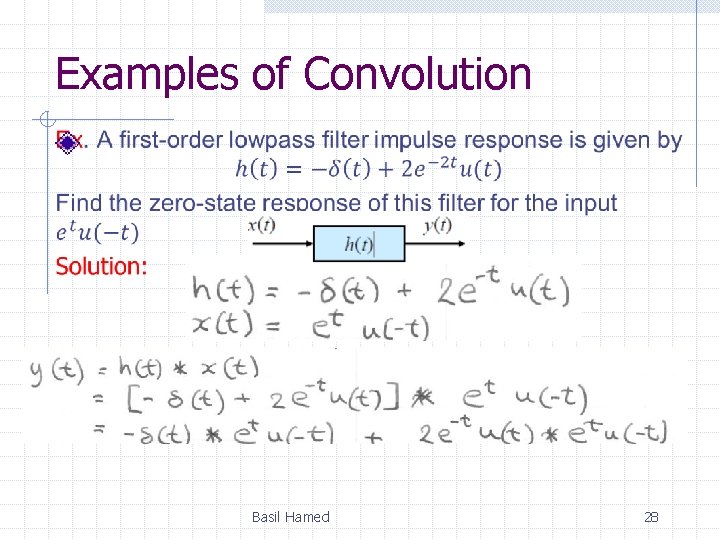
Examples of Convolution Basil Hamed 28
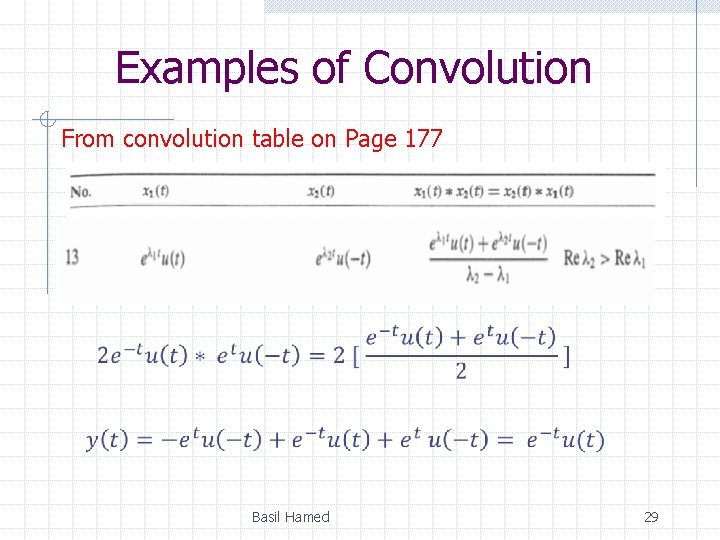
Examples of Convolution From convolution table on Page 177 Basil Hamed 29
Graphical Convolution Operation Graphical convolution allows us to grasp visually or mentally the convolution integral’s result. Many signals have no exact mathematical description, so they can be described only graphically. We’ll learn how to perform “Graphical Convolution, ” which is nothing more than steps that help you use graphical insight to evaluate the convolution integral. Basil Hamed 30
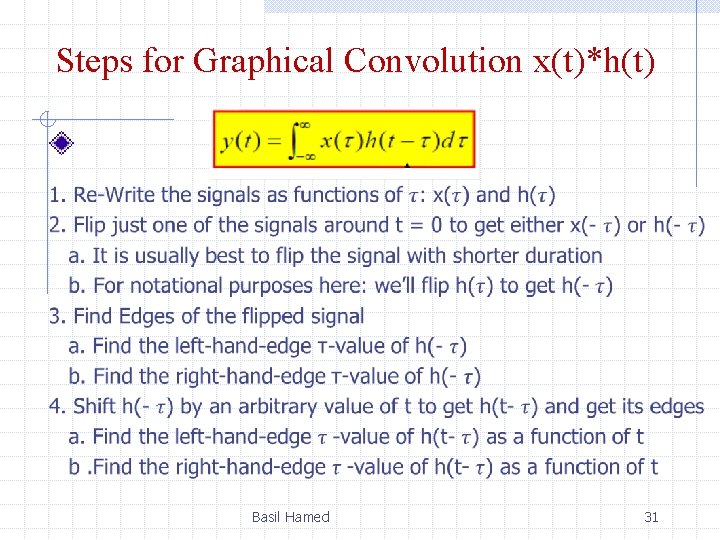
Steps for Graphical Convolution x(t)*h(t) Basil Hamed 31
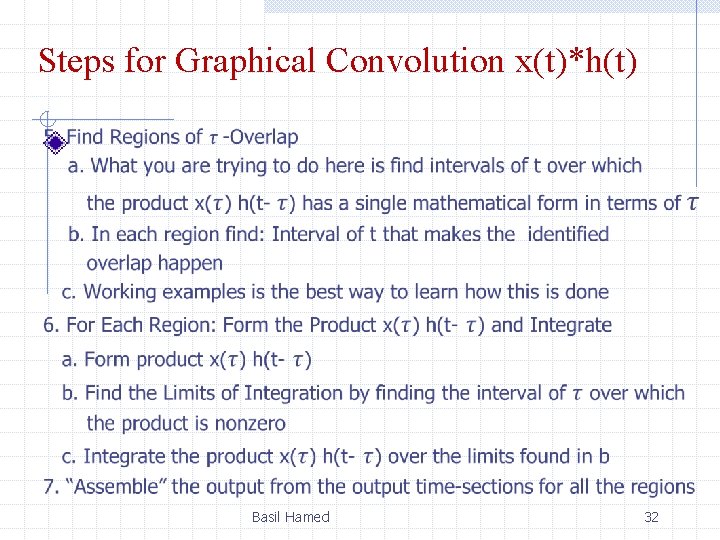
Steps for Graphical Convolution x(t)*h(t) Basil Hamed 32
Graphically Convolve Two Signals Ex. Convolve these two signals: Basil Hamed 33
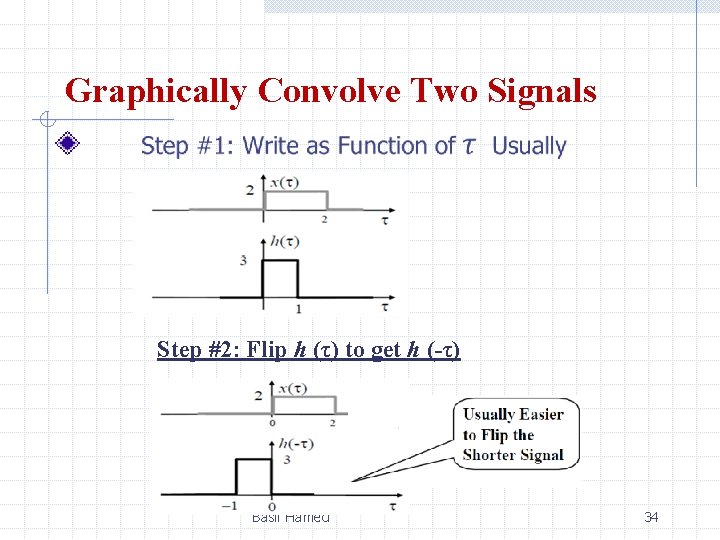
Graphically Convolve Two Signals Step #2: Flip h (τ) to get h (-τ) Basil Hamed 34
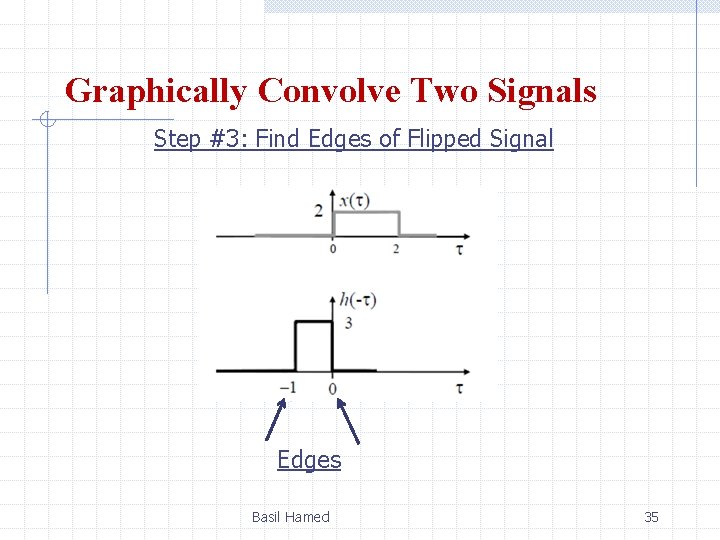
Graphically Convolve Two Signals Step #3: Find Edges of Flipped Signal Edges Basil Hamed 35
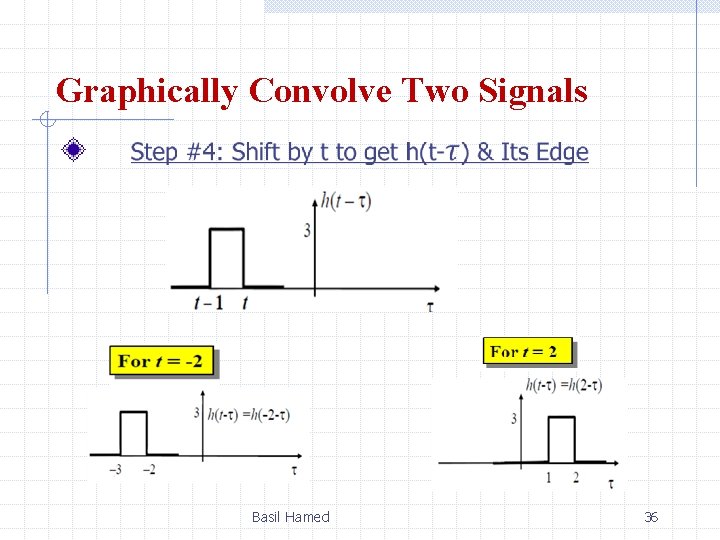
Graphically Convolve Two Signals Basil Hamed 36
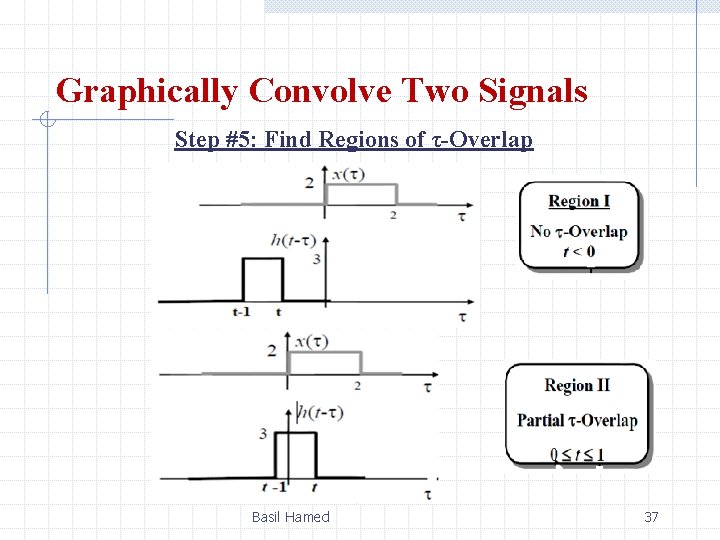
Graphically Convolve Two Signals Step #5: Find Regions of τ-Overlap Basil Hamed 37
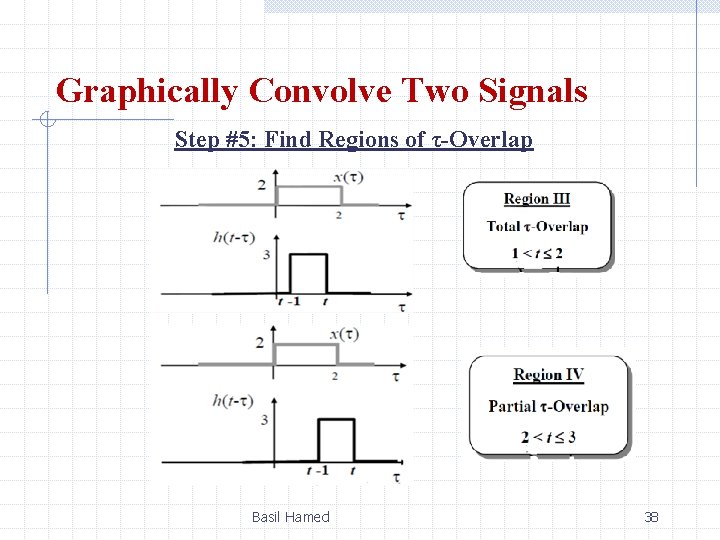
Graphically Convolve Two Signals Step #5: Find Regions of τ-Overlap Basil Hamed 38
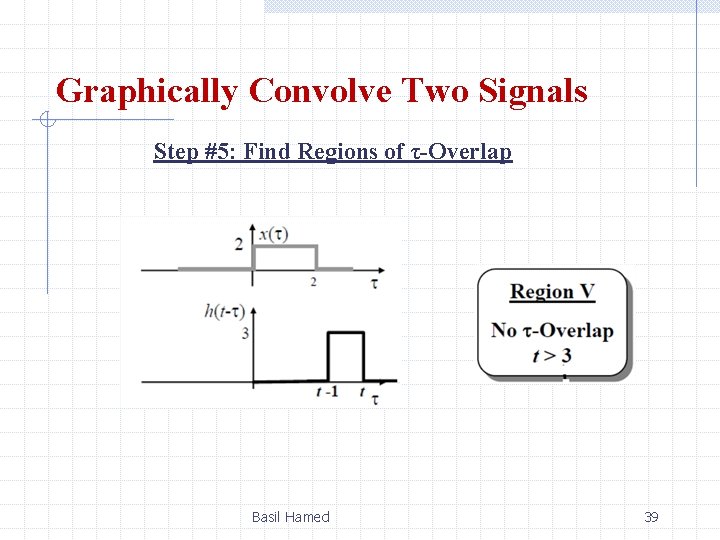
Graphically Convolve Two Signals Step #5: Find Regions of τ-Overlap Basil Hamed 39
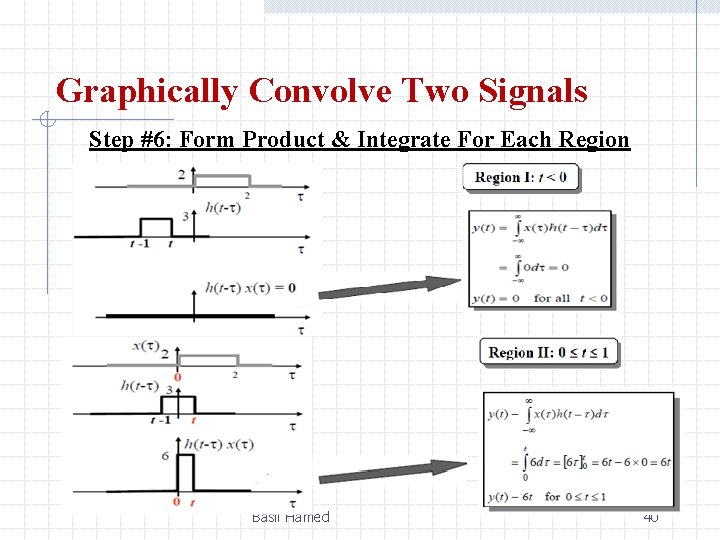
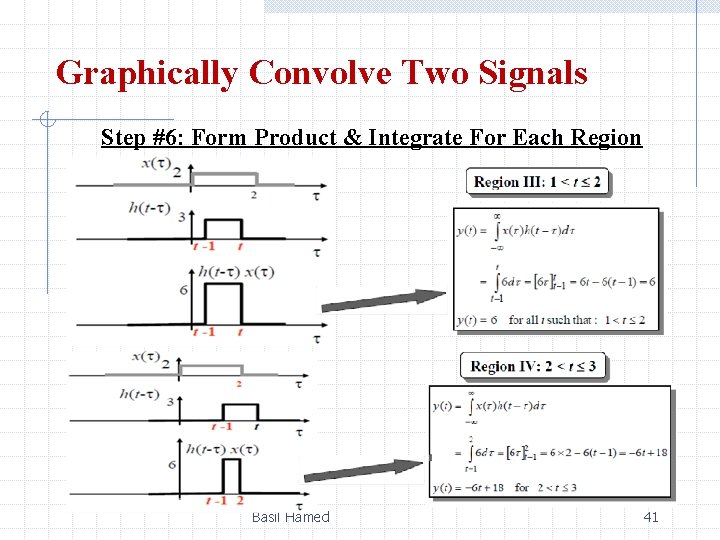
Graphically Convolve Two Signals Step #6: Form Product & Integrate For Each Region Basil Hamed 40
Graphically Convolve Two Signals Step #6: Form Product & Integrate For Each Region Basil Hamed 41
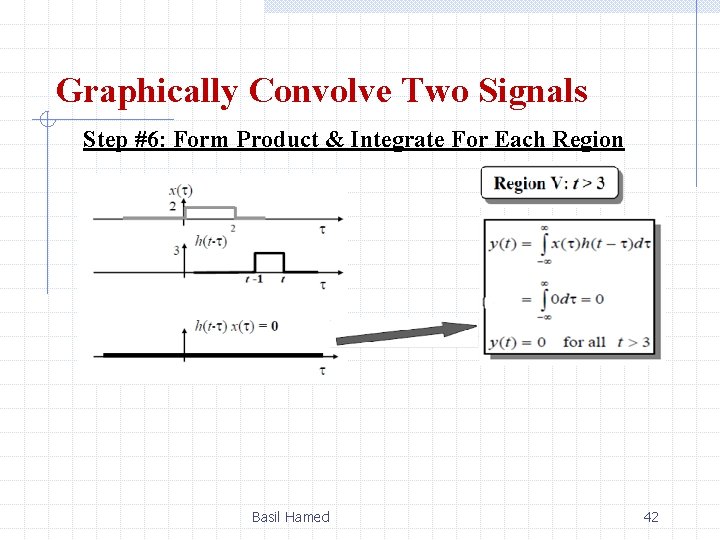
Graphically Convolve Two Signals Step #6: Form Product & Integrate For Each Region Basil Hamed 42
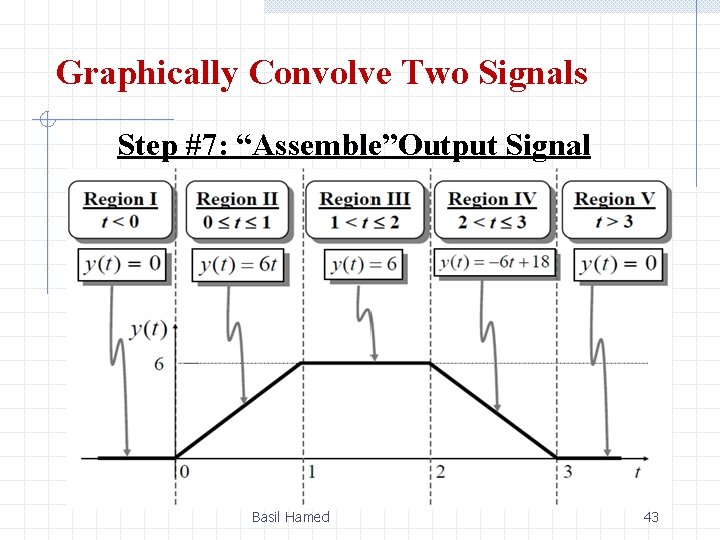
Graphically Convolve Two Signals Step #7: “Assemble”Output Signal Basil Hamed 43
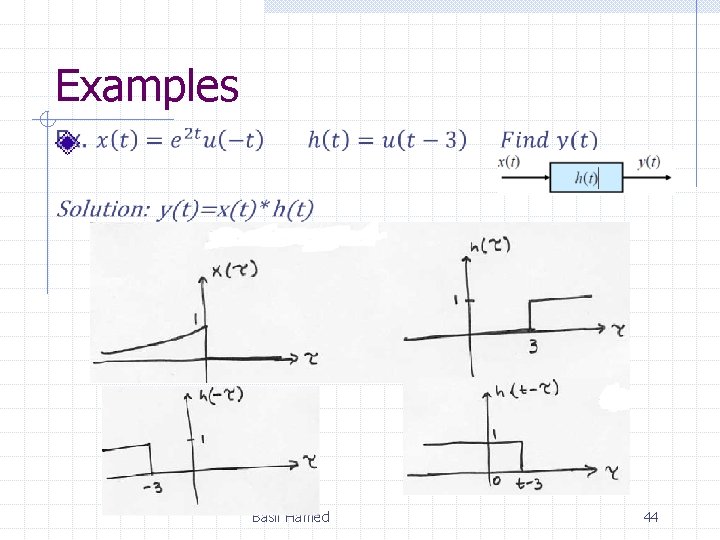
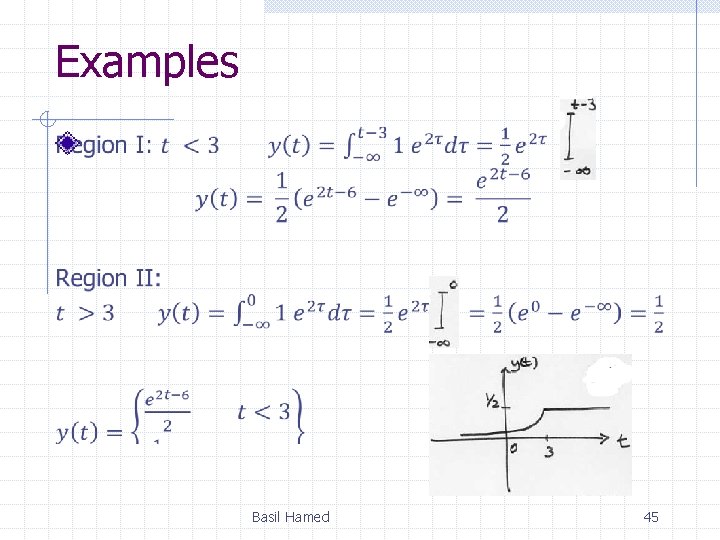
Examples Basil Hamed 44
Examples Basil Hamed 45
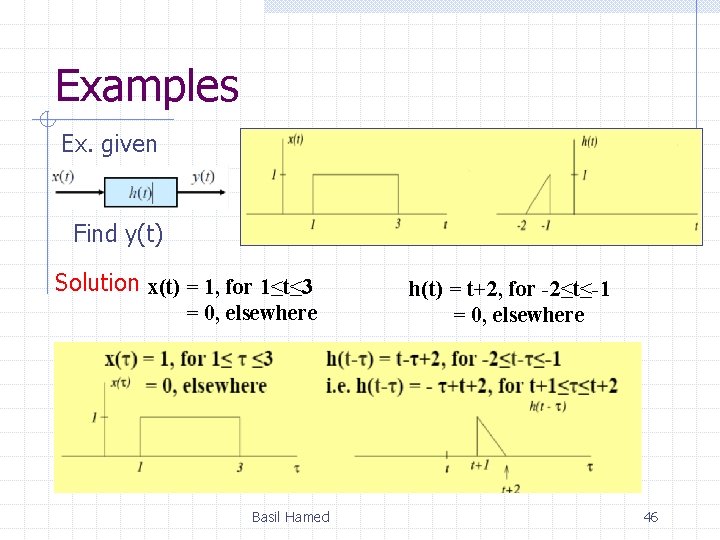
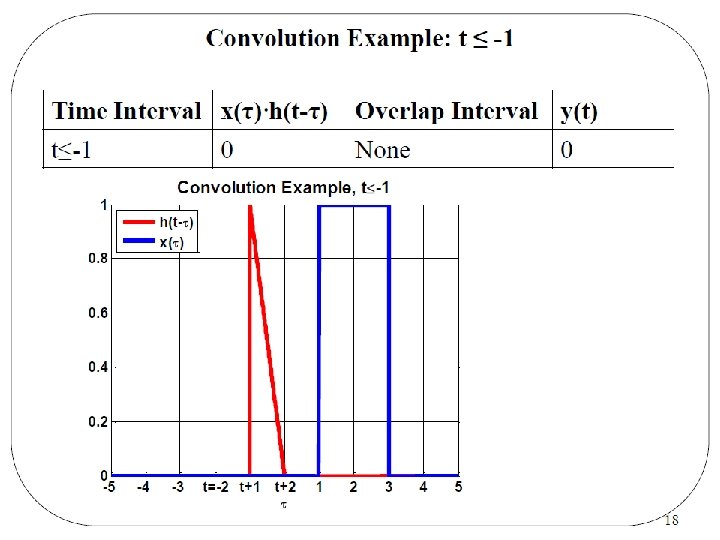
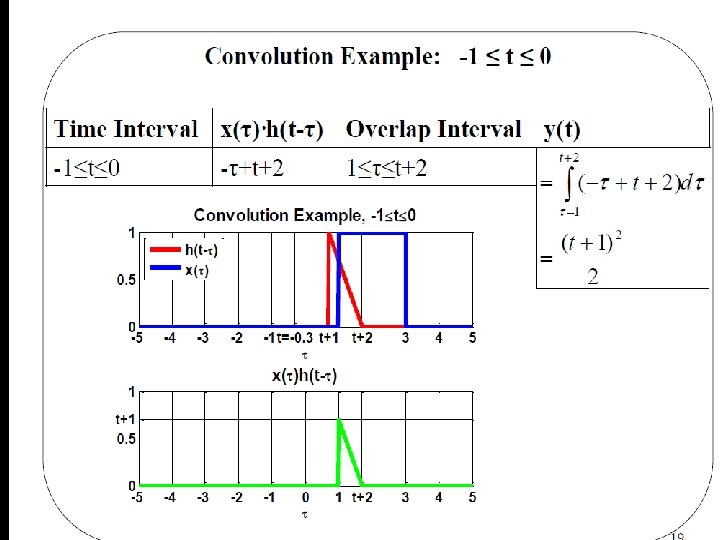
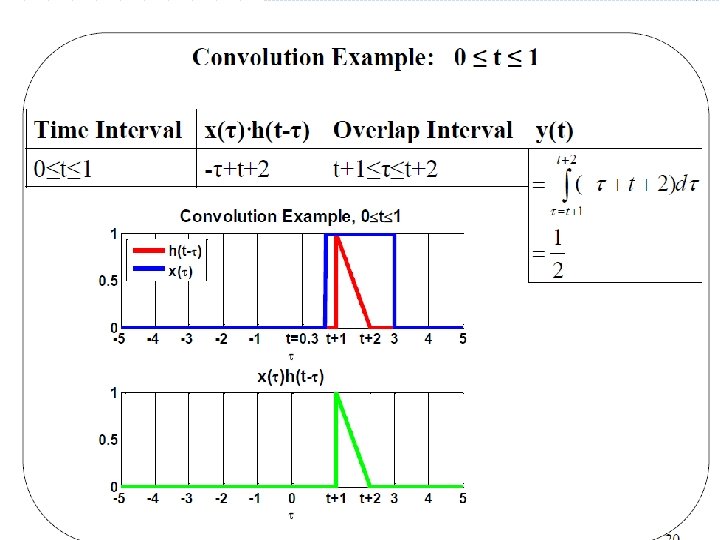
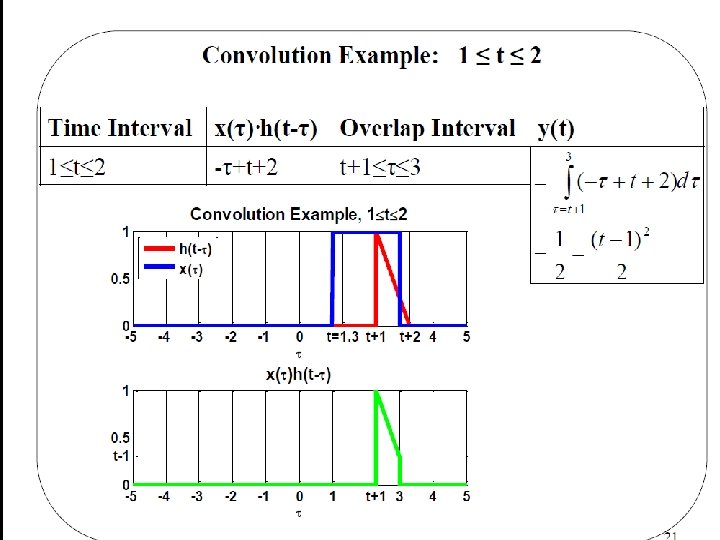
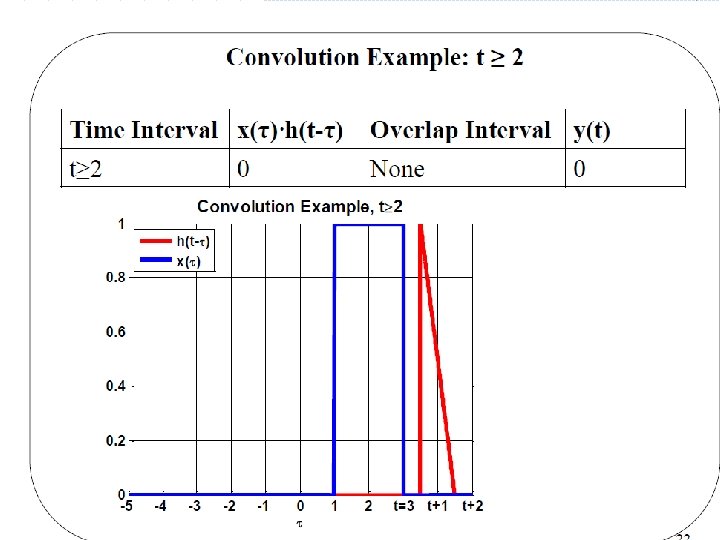
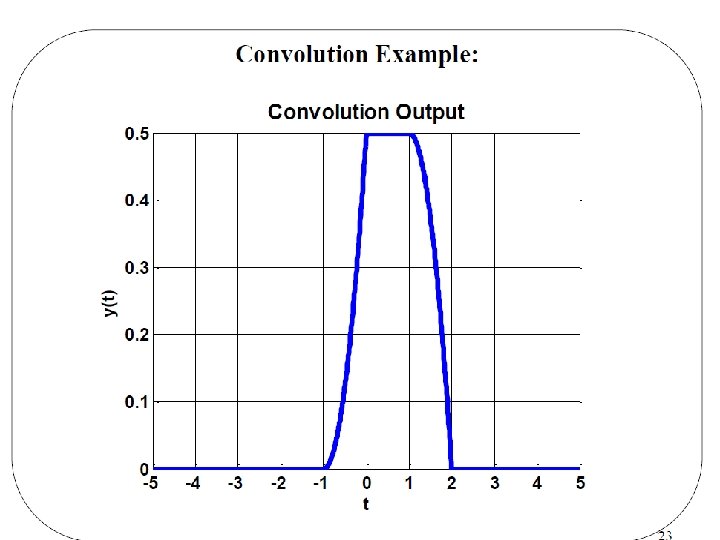
Examples Ex. given Find y(t) Solution x(t) = 1, for 1≤t≤ 3 = 0, elsewhere Basil Hamed h(t) = t+2, for -2≤t≤-1 = 0, elsewhere 46
Examples Basil Hamed 47
Basil Hamed 48
Basil Hamed 49
Basil Hamed 50
Basil Hamed 51
Basil Hamed 52
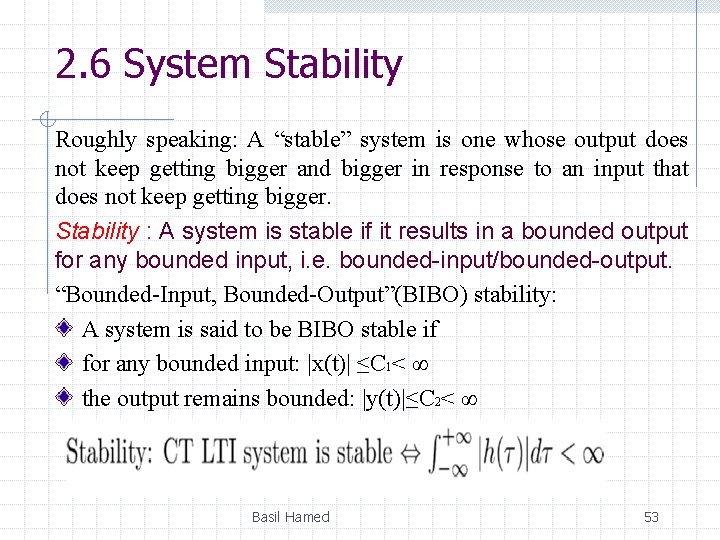
2. 6 System Stability Roughly speaking: A “stable” system is one whose output does not keep getting bigger and bigger in response to an input that does not keep getting bigger. Stability : A system is stable if it results in a bounded output for any bounded input, i. e. bounded-input/bounded-output. “Bounded-Input, Bounded-Output”(BIBO) stability: A system is said to be BIBO stable if for any bounded input: |x(t)| ≤C 1< ∞ the output remains bounded: |y(t)|≤C 2< ∞ Basil Hamed 53
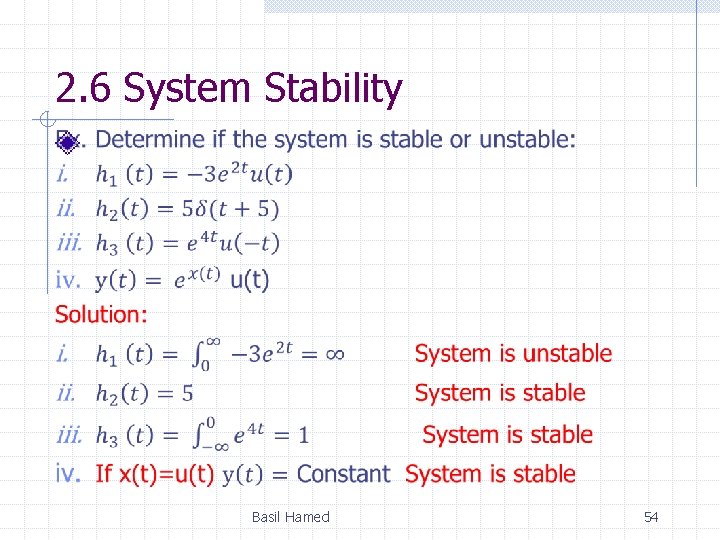
2. 6 System Stability Basil Hamed 54