
Signal Linear system Chapter 1 Introduction Basil Hamed
Signal & Linear system Chapter 1 Introduction Basil Hamed
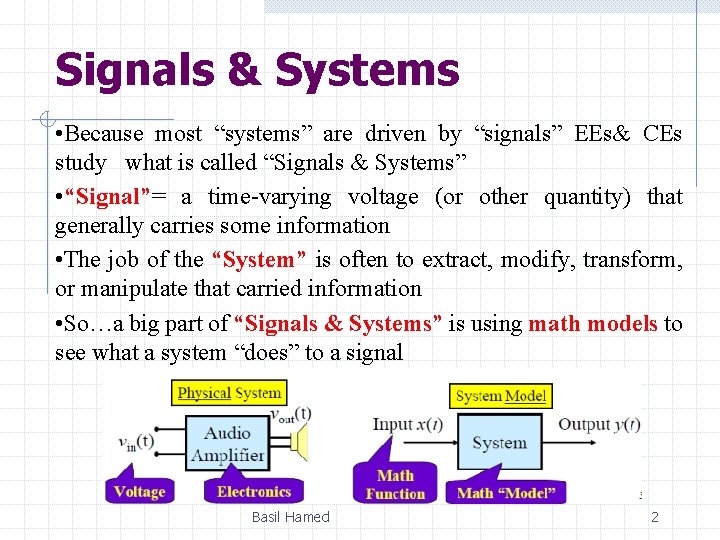
Signals & Systems • Because most “systems” are driven by “signals” EEs& CEs study what is called “Signals & Systems” • “Signal”= a time-varying voltage (or other quantity) that generally carries some information • The job of the “System” is often to extract, modify, transform, or manipulate that carried information • So…a big part of “Signals & Systems” is using math models to see what a system “does” to a signal Basil Hamed 2
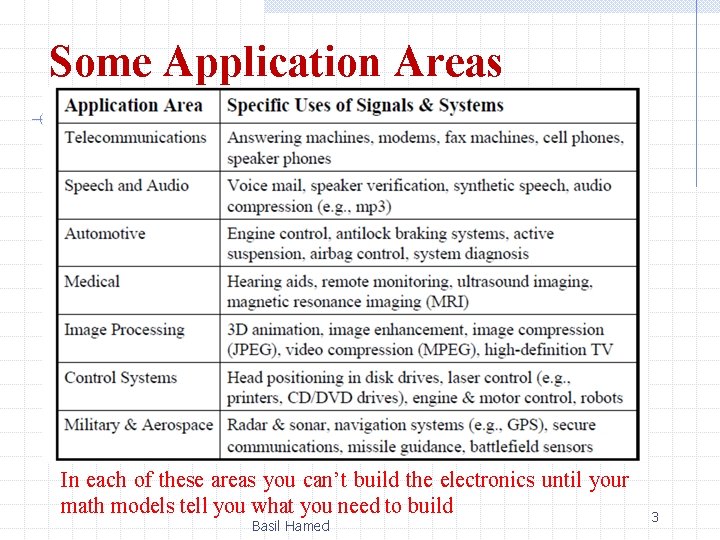
Some Application Areas In each of these areas you can’t build the electronics until your math models tell you what you need to build Basil Hamed 3
What is a signal ? The concept of signal refers to the space or time variations in the physical state of an object. Basil Hamed 4
SIGNALS Signals are functions of independent variables that carry information. For example: • Electrical signals ---voltages and currents in a circuit • Acoustic signals ---audio or speech signals (analog or digital) • Video signals ---intensity variations in an image (e. g. a CAT scan) • Biological signals ---sequence of bases in a gene Basil Hamed 5 • .
THE INDEPENDENT VARIABLES • Can be continuous—Trajectory of a space shuttle— Mass density in a cross-section of a brain • Can be discrete—DNA base sequence—Digital image pixels • Can be 1 -D, 2 -D, • • • N-D • For this course: Focus on a single (1 -D) independent variable which we call “time”. Continuous-Time (CT) signals: x(t), t—continuous values Discrete-Time (DT) signals: x[n], n—integer values only Basil Hamed 6
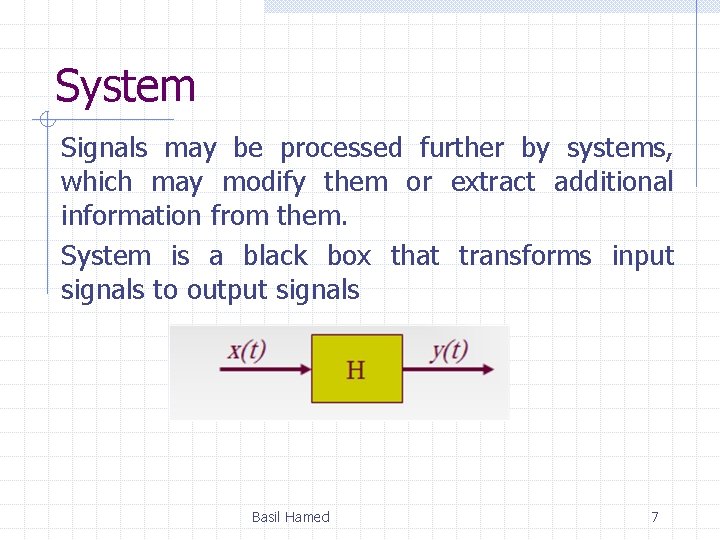
System Signals may be processed further by systems, which may modify them or extract additional information from them. System is a black box that transforms input signals to output signals Basil Hamed 7
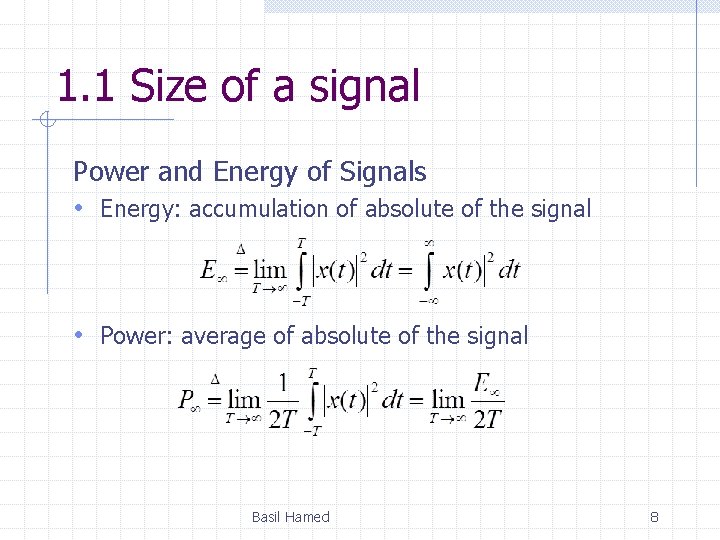
1. 1 Size of a signal Power and Energy of Signals • Energy: accumulation of absolute of the signal • Power: average of absolute of the signal Basil Hamed 8
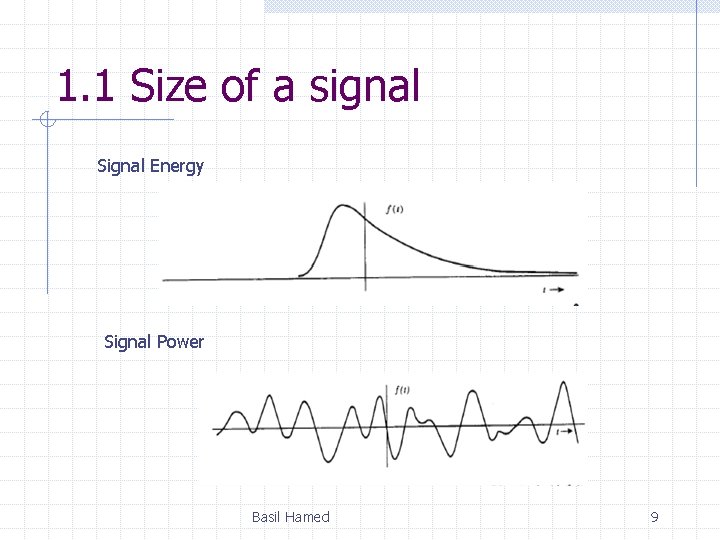
1. 1 Size of a signal Signal Energy Signal Power Basil Hamed 9
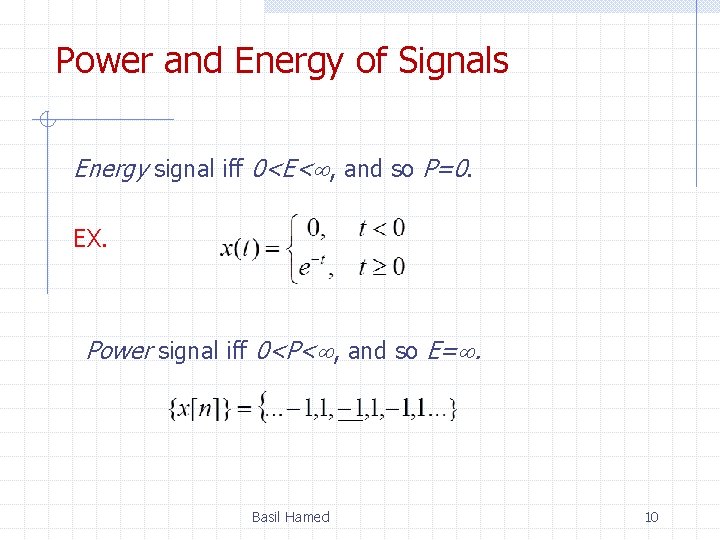
Power and Energy of Signals Energy signal iff 0<E< , and so P=0. EX. Power signal iff 0<P< , and so E=. Basil Hamed 10
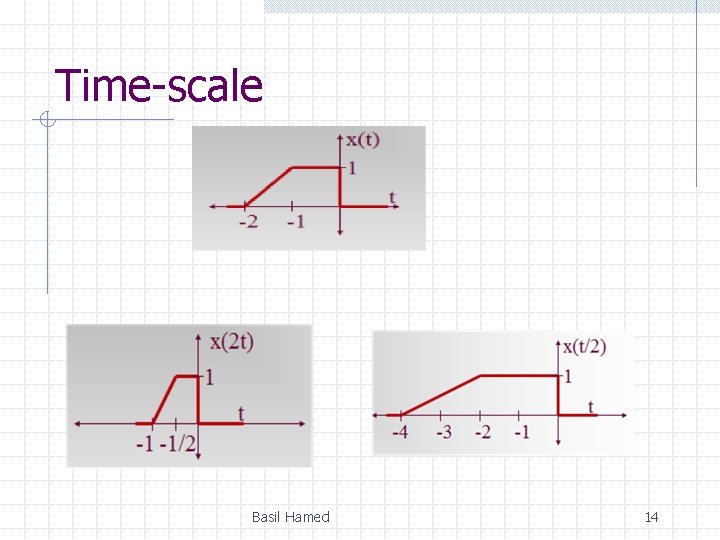
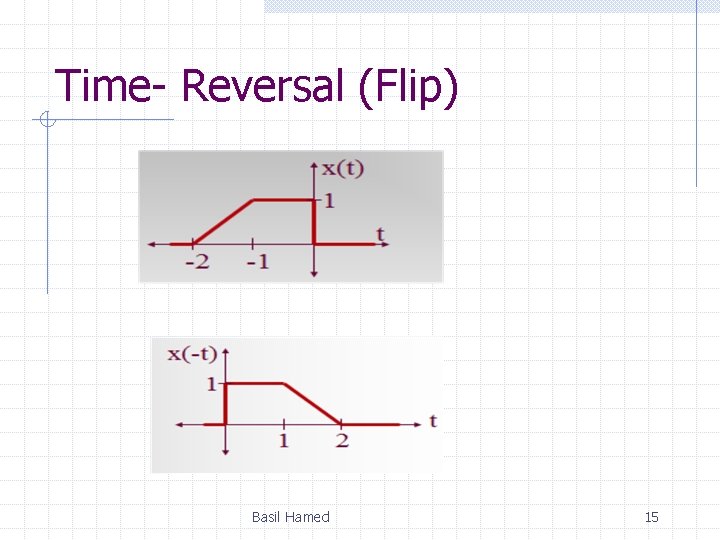
1. 2 Some Useful Signal Operations (Transformation) Three possible time transformations: • Time Shifting • Time Scaling • Time Reversal Basil Hamed 11
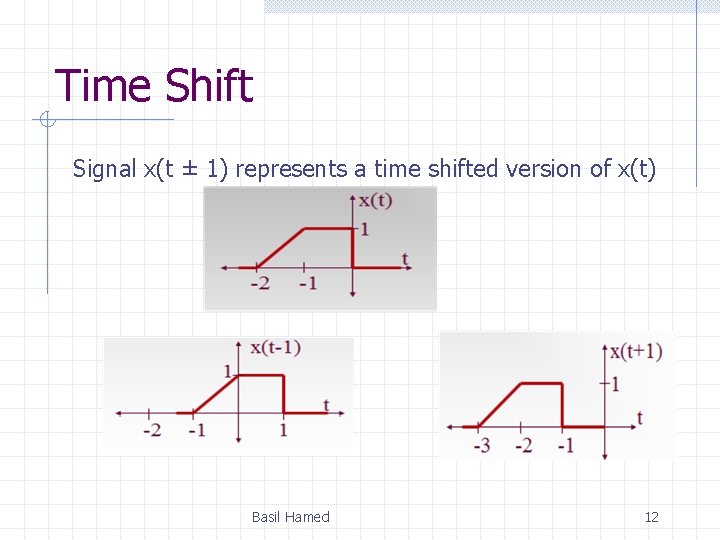
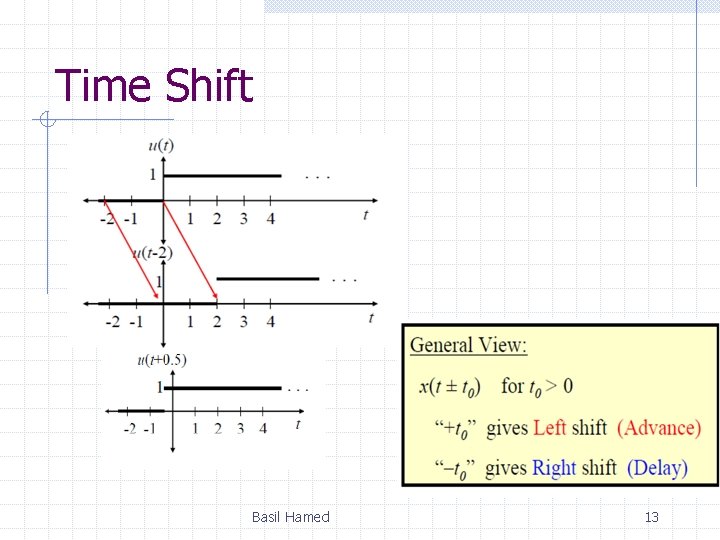
Time Shift Signal x(t ± 1) represents a time shifted version of x(t) Basil Hamed 12
Time Shift Basil Hamed 13
Time-scale Basil Hamed 14
Time- Reversal (Flip) Basil Hamed 15
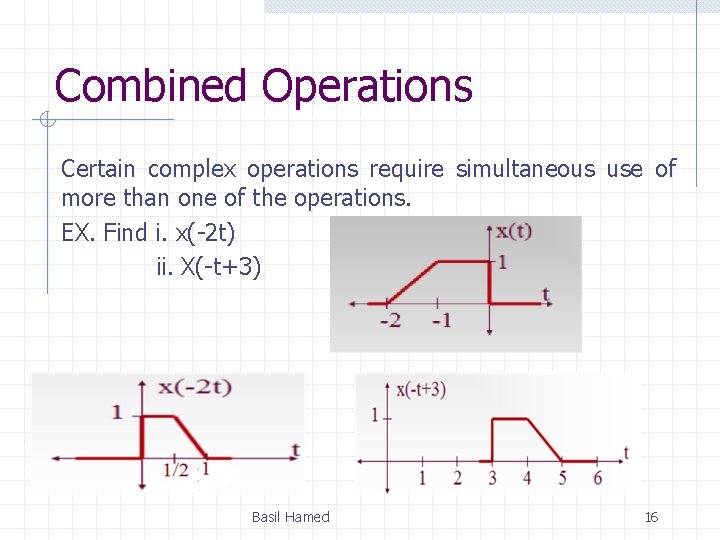
Combined Operations Certain complex operations require simultaneous use of more than one of the operations. EX. Find i. x(-2 t) ii. X(-t+3) Basil Hamed 16
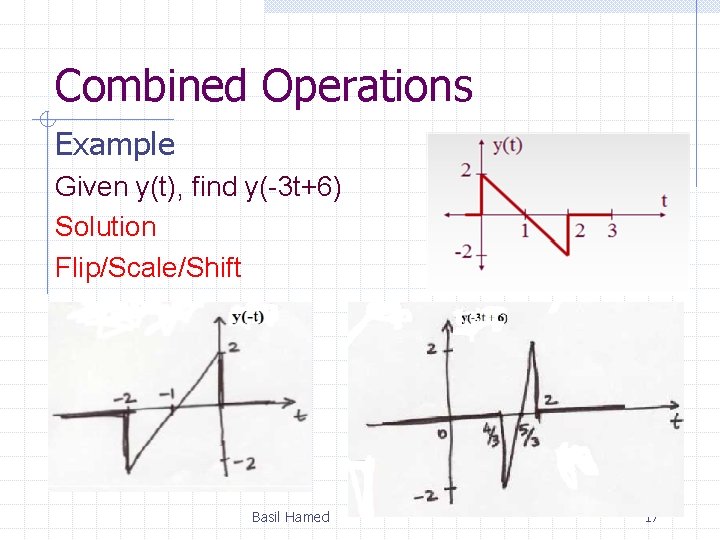
Combined Operations Example Given y(t), find y(-3 t+6) Solution Flip/Scale/Shift Basil Hamed 17
1. 3 Classification of Signals There are several classes of signals: 1234 - Continuous-time and Discrete-time signals Periodic and Aperiodic Signals Energy and Power Signals Deterministic and probabilistic Signals Basil Hamed 18
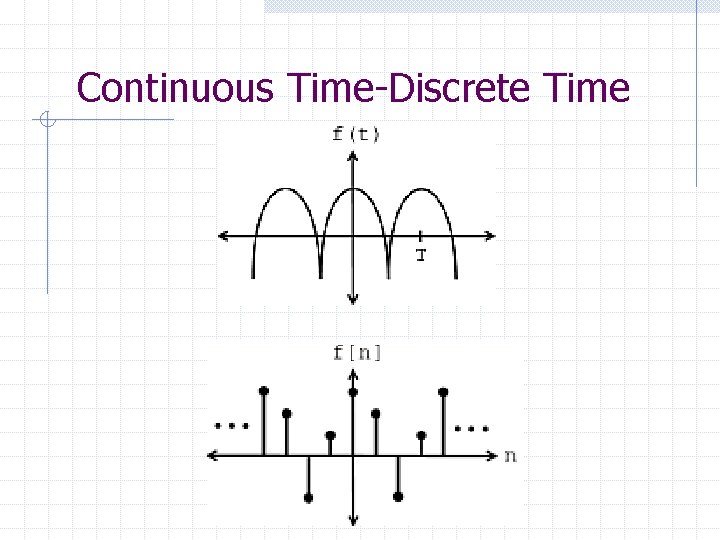
Continuous-time and Discretetime Signals • Continuous-time signals are functions of a real argument x(t) where t can take any real value x(t) may be 0 for a given range of values of t • Discrete-time signals are functions of an argument that takes values from a discrete set x[n] where n {. . . -3, -2, -1, 0, 1, 2, 3. . . } We sometimes use “index” instead of “time” when discussing discrete-time signals • Values for x may be real or complex Basil Hamed 19
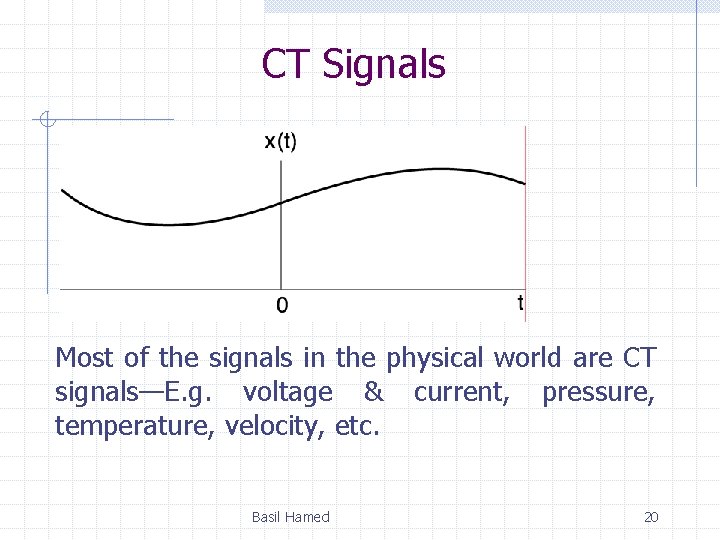
CT Signals Most of the signals in the physical world are CT signals—E. g. voltage & current, pressure, temperature, velocity, etc. Basil Hamed 20
![DT Signals • x[n], n—integer, time varies discretely • Examples of DT signals in](http://slidetodoc.com/presentation_image_h2/fdc66e0ac13b0275b5fc567613260131/image-21.jpg "DT Signals • x[n], n—integer, time varies discretely • Examples of DT signals in")
DT Signals • x[n], n—integer, time varies discretely • Examples of DT signals in nature: —DNA base sequence —Population of the nth generation of certain species Basil Hamed 21
Continuous Time-Discrete Time
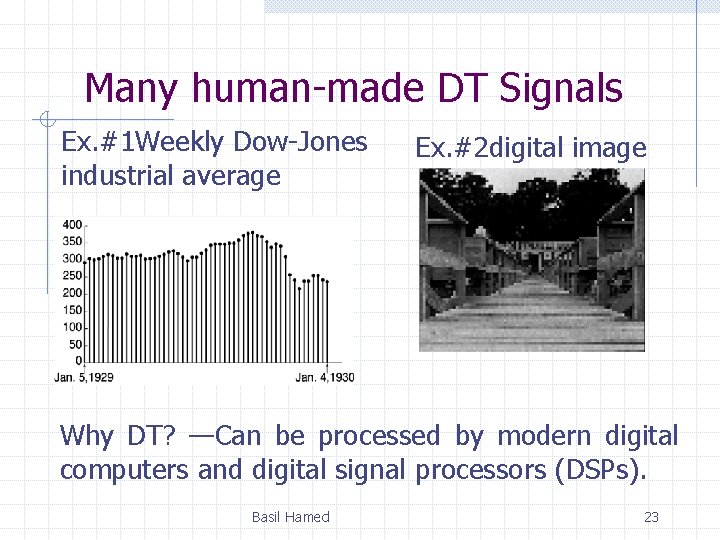
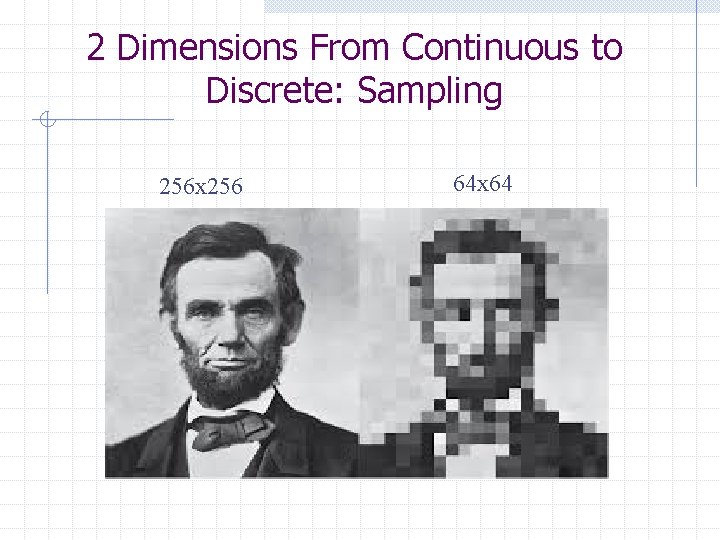
Many human-made DT Signals Ex. #1 Weekly Dow-Jones industrial average Ex. #2 digital image Why DT? —Can be processed by modern digital computers and digital signal processors (DSPs). Basil Hamed 23
Applications § Electrical Engineering voltages/currents in a circuit speech signals image signals § Physics radiation
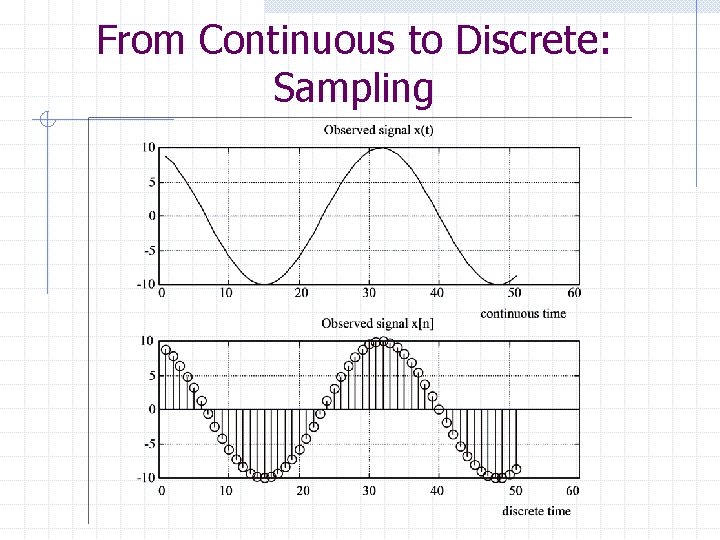
From Continuous to Discrete: Sampling
2 Dimensions From Continuous to Discrete: Sampling 256 x 256 64 x 64
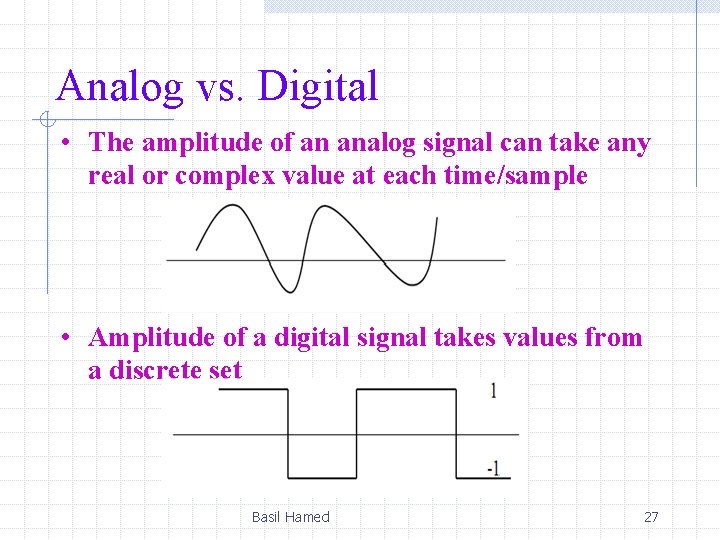
Analog vs. Digital • The amplitude of an analog signal can take any real or complex value at each time/sample • Amplitude of a digital signal takes values from a discrete set Basil Hamed 27
Digital vs. Analog
Digital vs. Analog
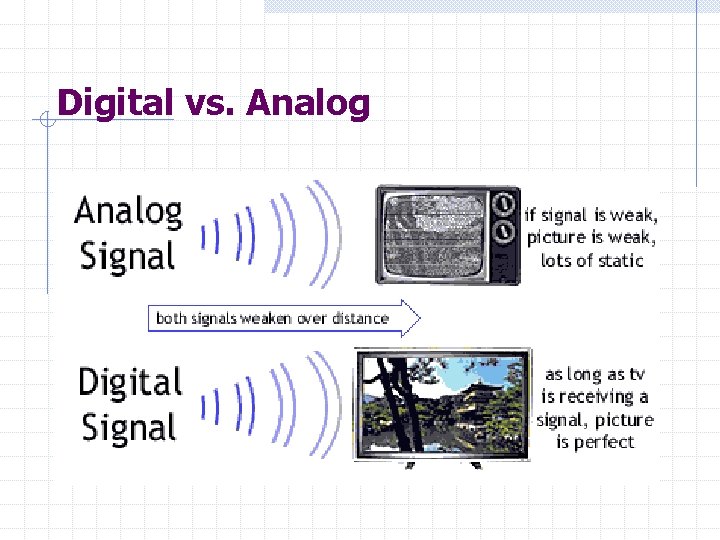
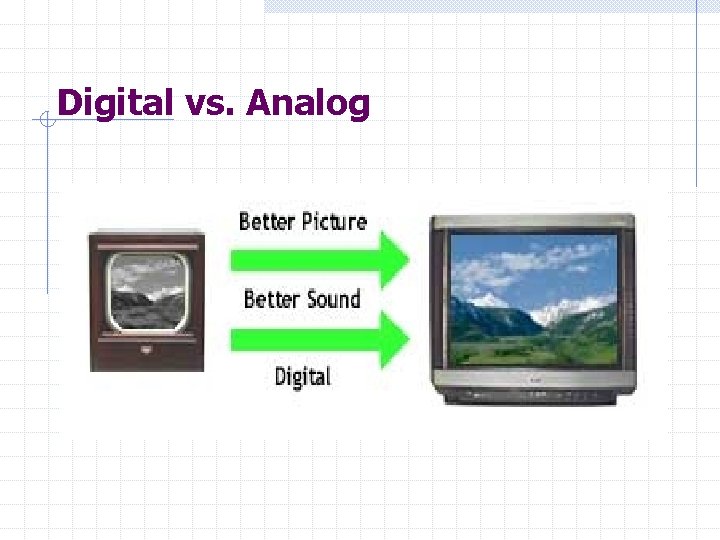
Analog-Digital Examples of analog technology photocopiers telephones audio tapes televisions (intensity and color info per scan line) VCRs (same as TV) Examples of digital technology Digital computers!
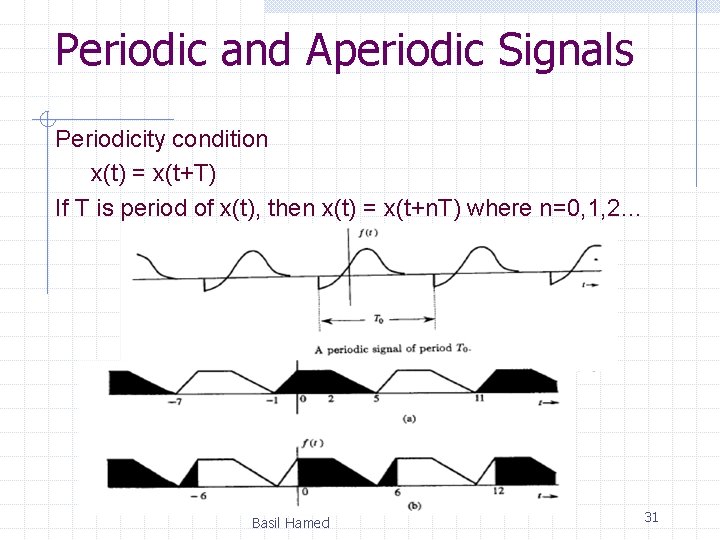
Periodic and Aperiodic Signals Periodicity condition x(t) = x(t+T) If T is period of x(t), then x(t) = x(t+n. T) where n=0, 1, 2… Basil Hamed 31
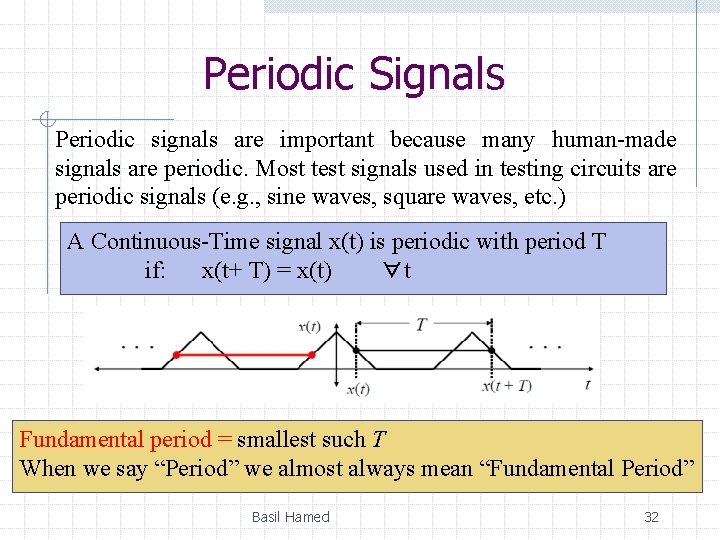
Periodic Signals Periodic signals are important because many human-made signals are periodic. Most test signals used in testing circuits are periodic signals (e. g. , sine waves, square waves, etc. ) A Continuous-Time signal x(t) is periodic with period T if: x(t+ T) = x(t) ∀t Fundamental period = smallest such T When we say “Period” we almost always mean “Fundamental Period” Basil Hamed 32
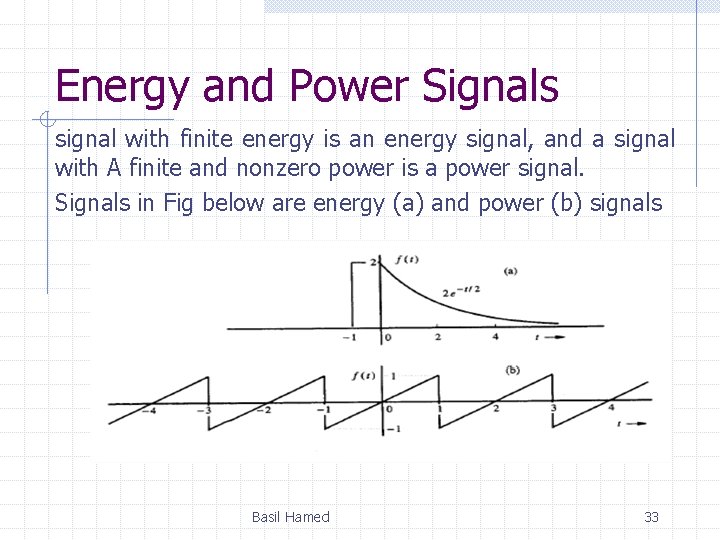
Energy and Power Signals signal with finite energy is an energy signal, and a signal with A finite and nonzero power is a power signal. Signals in Fig below are energy (a) and power (b) signals Basil Hamed 33
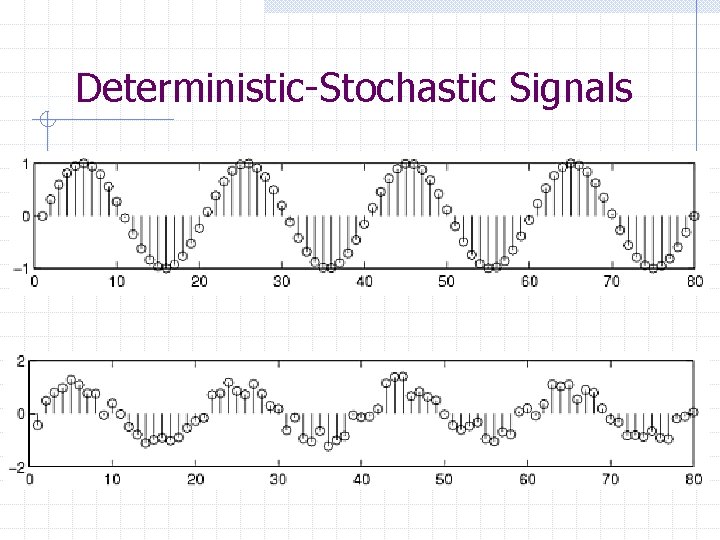
Deterministic-Stochastic Signals
1. 4 Some Useful Signal Model • • Step Signal Ramp Signal Impulse Signal Exponential Signal Basil Hamed 35
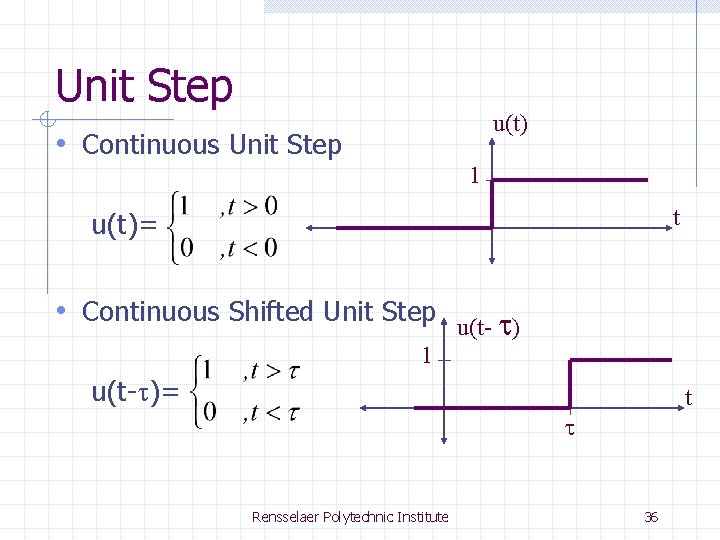
Unit Step u(t) • Continuous Unit Step 1 t u(t)= • Continuous Shifted Unit Step 1 u(t- )= t Rensselaer Polytechnic Institute 36
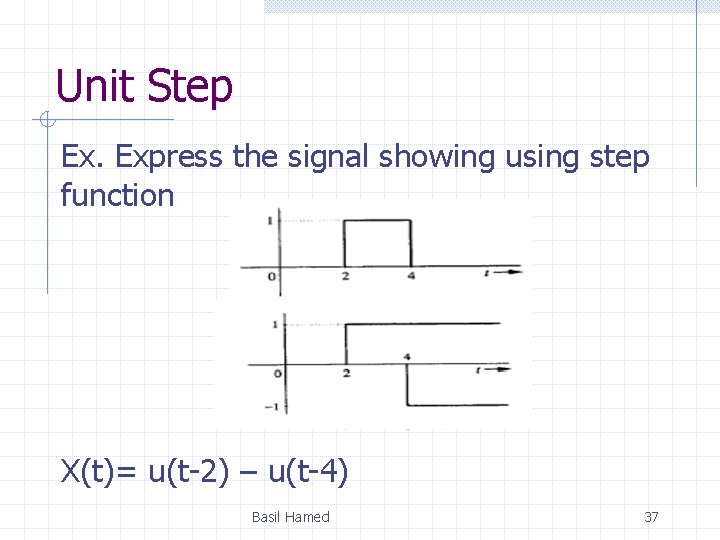
Unit Step Ex. Express the signal showing using step function X(t)= u(t-2) – u(t-4) Basil Hamed 37
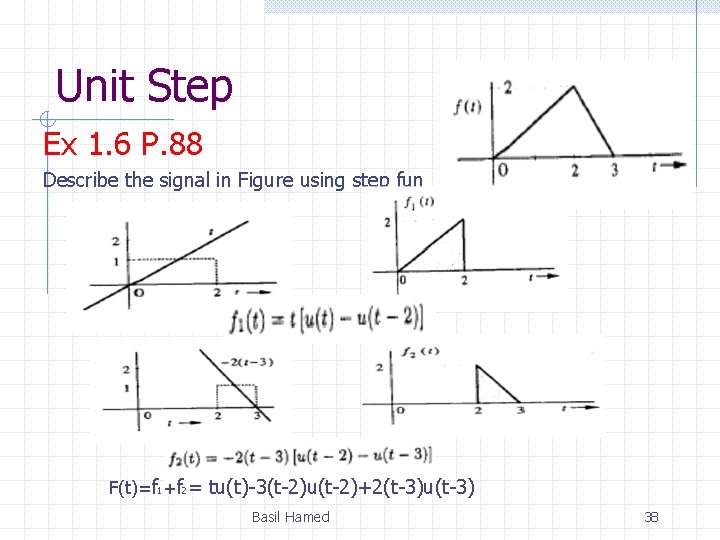
Unit Step Ex 1. 6 P. 88 Describe the signal in Figure using step fun F(t)=f 1+f 2= tu(t)-3(t-2)u(t-2)+2(t-3)u(t-3) Basil Hamed 38
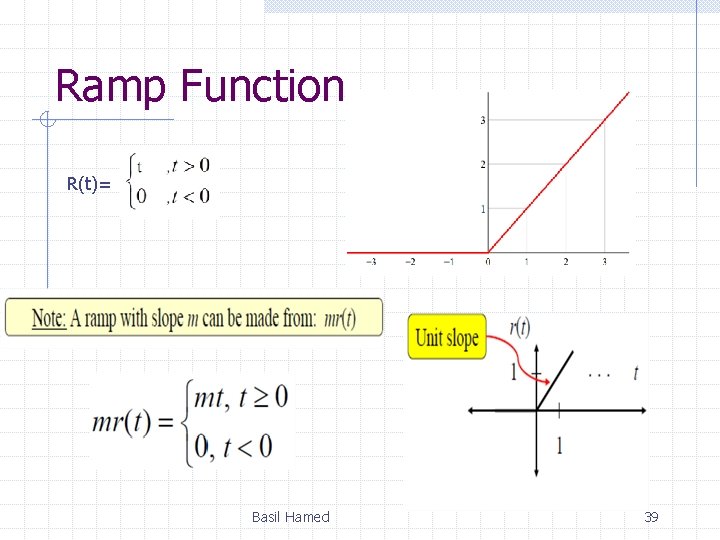
Ramp Function R(t)= Basil Hamed 39
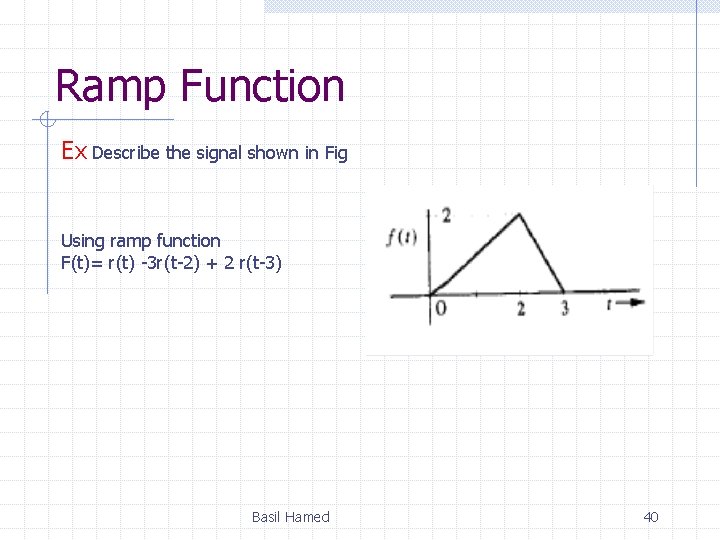
Ramp Function Ex Describe the signal shown in Fig Using ramp function F(t)= r(t) -3 r(t-2) + 2 r(t-3) Basil Hamed 40
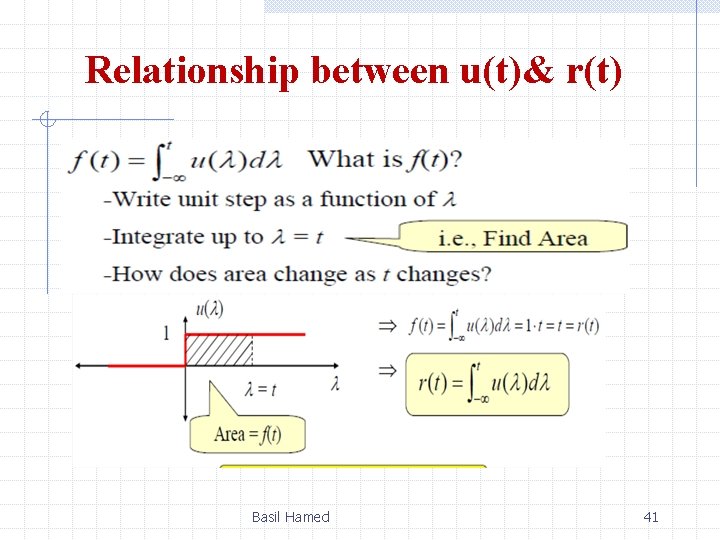
Relationship between u(t)& r(t) Basil Hamed 41
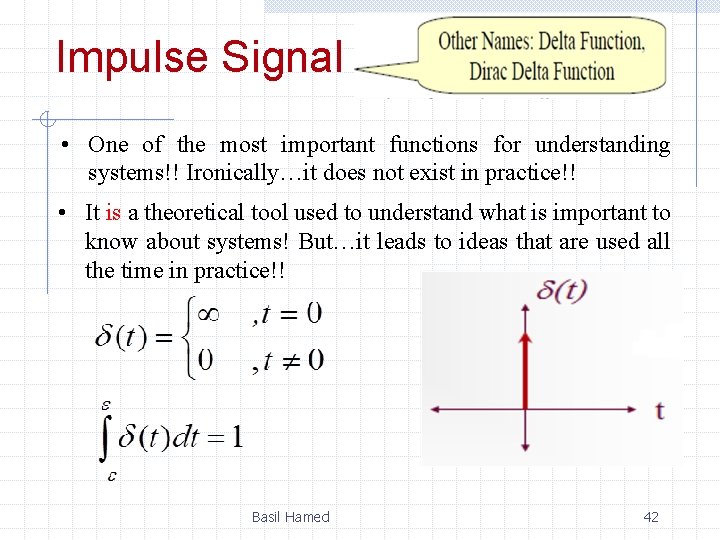
Impulse Signal • One of the most important functions for understanding systems!! Ironically…it does not exist in practice!! • It is a theoretical tool used to understand what is important to know about systems! But…it leads to ideas that are used all the time in practice!! Basil Hamed 42
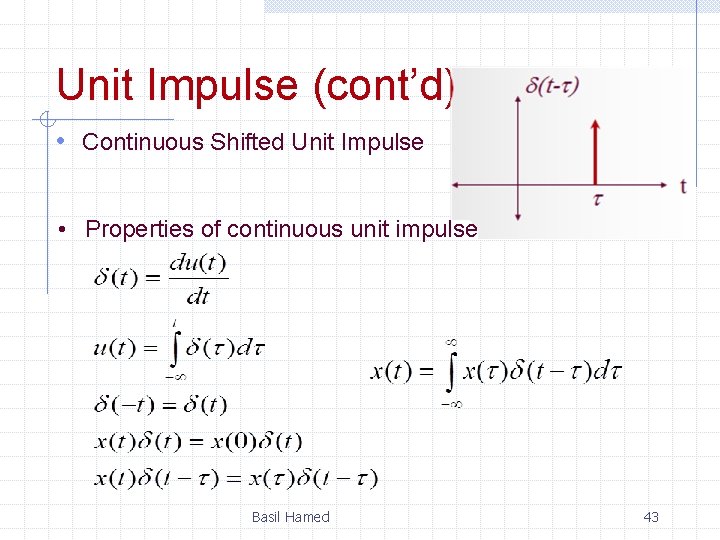
Unit Impulse (cont’d) • Continuous Shifted Unit Impulse • Properties of continuous unit impulse Basil Hamed 43
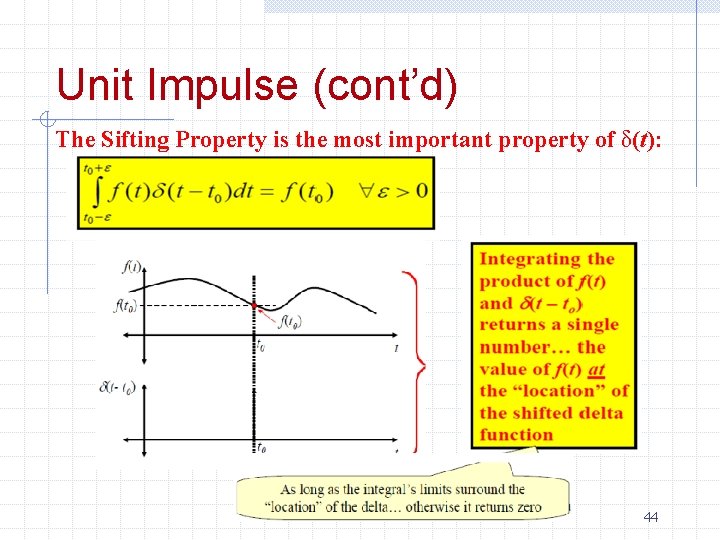
Unit Impulse (cont’d) The Sifting Property is the most important property of δ(t): Basil Hamed 44
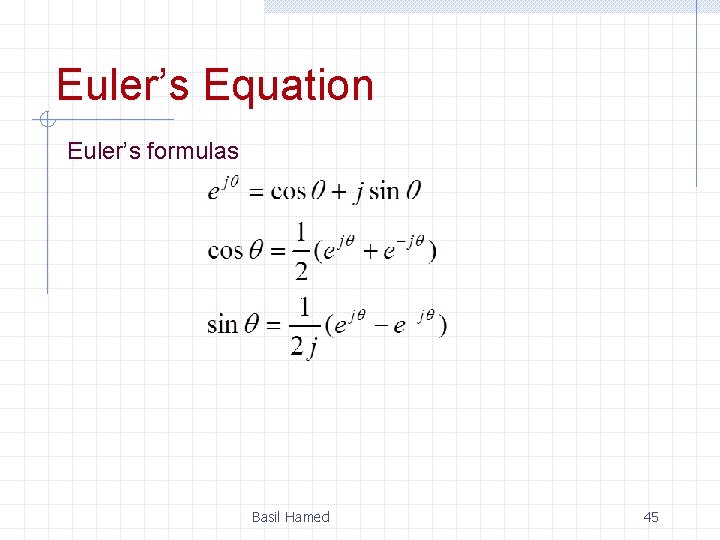
Euler’s Equation Euler’s formulas Basil Hamed 45
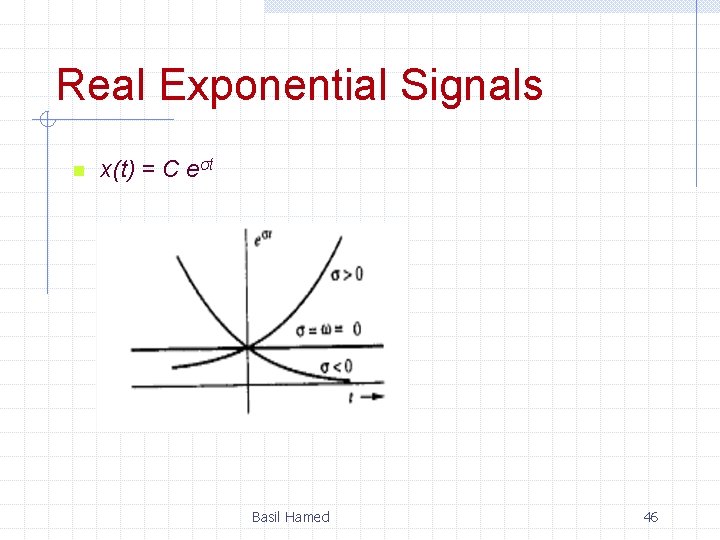
Real Exponential Signals n x(t) = C eσt Basil Hamed 46
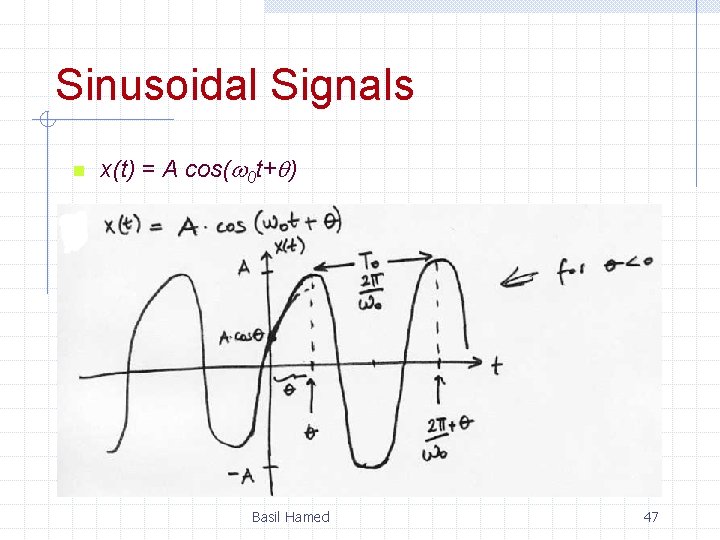
Sinusoidal Signals n x(t) = A cos( 0 t+ ) Basil Hamed 47
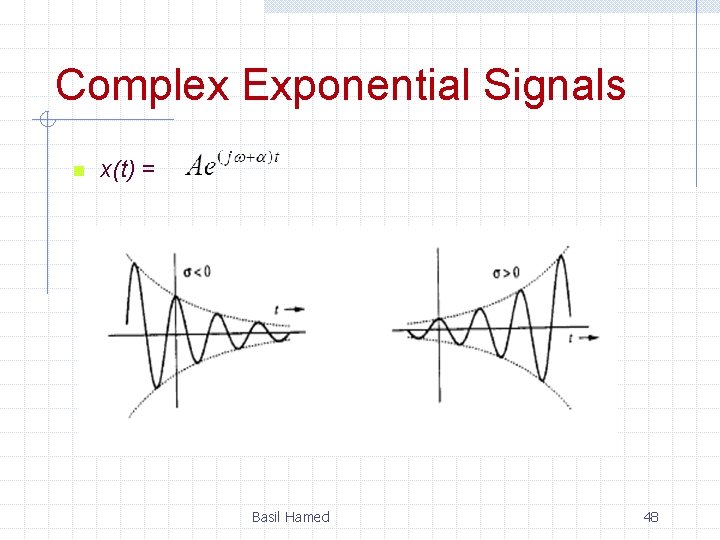
Complex Exponential Signals n x(t) = Basil Hamed 48
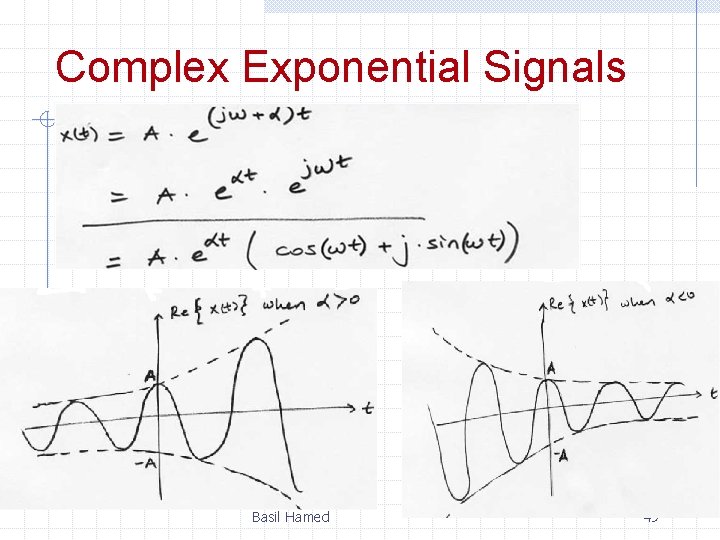
Complex Exponential Signals Basil Hamed 49
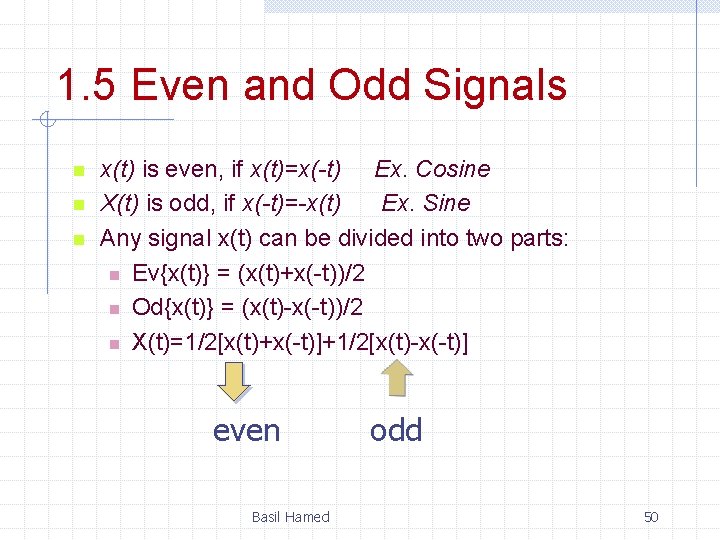
1. 5 Even and Odd Signals n n n x(t) is even, if x(t)=x(-t) Ex. Cosine X(t) is odd, if x(-t)=-x(t) Ex. Sine Any signal x(t) can be divided into two parts: n Ev{x(t)} = (x(t)+x(-t))/2 n Od{x(t)} = (x(t)-x(-t))/2 n X(t)=1/2[x(t)+x(-t)]+1/2[x(t)-x(-t)] even Basil Hamed odd 50
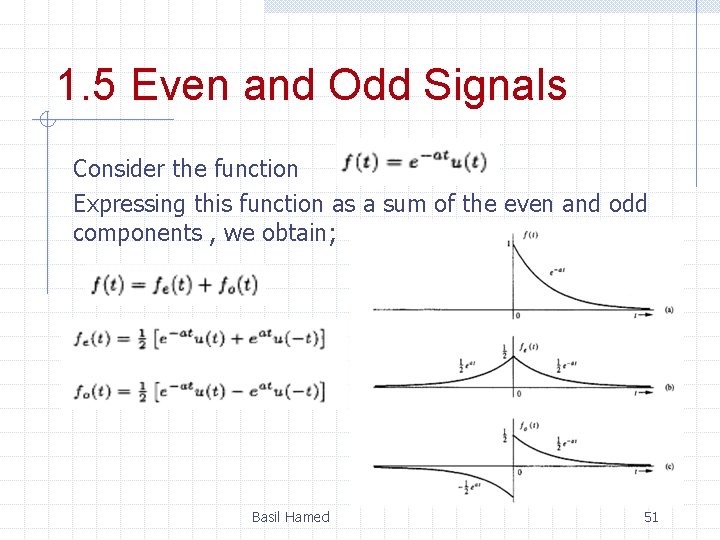
1. 5 Even and Odd Signals Consider the function Expressing this function as a sum of the even and odd components , we obtain; Basil Hamed 51
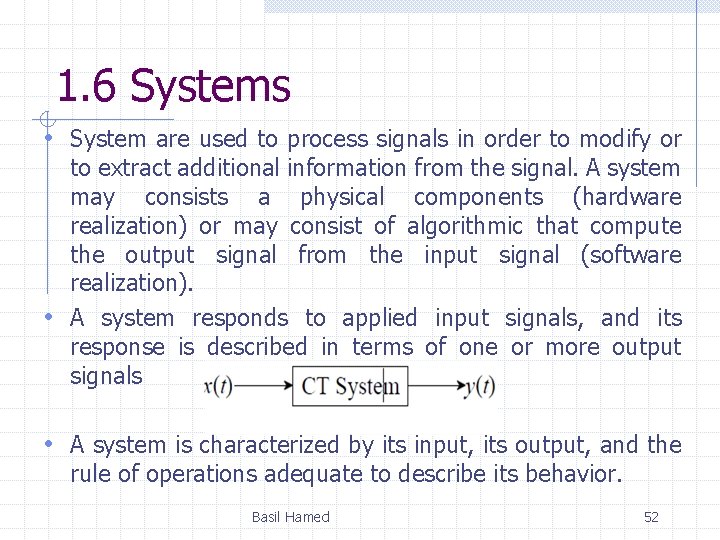
1. 6 Systems • System are used to process signals in order to modify or to extract additional information from the signal. A system may consists a physical components (hardware realization) or may consist of algorithmic that compute the output signal from the input signal (software realization). • A system responds to applied input signals, and its response is described in terms of one or more output signals • A system is characterized by its input, its output, and the rule of operations adequate to describe its behavior. Basil Hamed 52
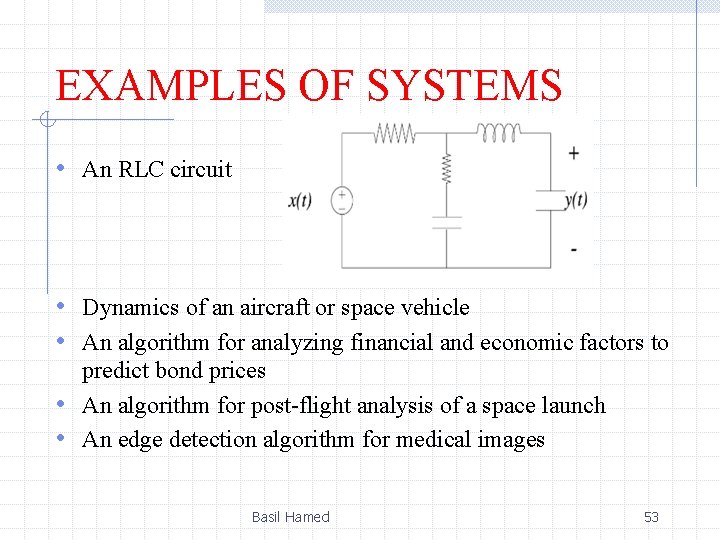
EXAMPLES OF SYSTEMS • An RLC circuit • Dynamics of an aircraft or space vehicle • An algorithm for analyzing financial and economic factors to predict bond prices • An algorithm for post-flight analysis of a space launch • An edge detection algorithm for medical images Basil Hamed 53
1. 7 Classification of Systems • • • Linear and Nonlinear Constant-parameter and Time-Varying parameter Systems Instantaneous (Memoryless) and Dynamic (with Memory) Casual and Noncasual Systems Lumped parameter and distributed parameter System Analog and Digital System Basil Hamed 54
Linear and Nonlinear System • Many systems are nonlinear. For example: many circuit elements (e. g. , diodes), dynamics of aircraft, econometric models, … • However, in this class we focus exclusively on linear systems. • Why? Linear models represent accurate representations of behavior of many systems (e. g. , linear resistors, capacitors, other examples, …) v Can often linearize models to examine “small signal” perturbations around “operating points” v Linear systems are analytically tractable, providing basis for important tools and considerable insight v Basil Hamed 55
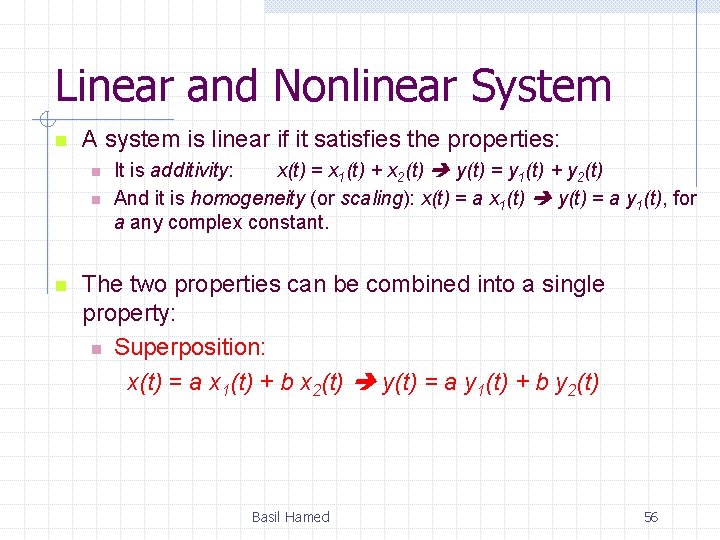
Linear and Nonlinear System n A system is linear if it satisfies the properties: n n n It is additivity: x(t) = x 1(t) + x 2(t) y(t) = y 1(t) + y 2(t) And it is homogeneity (or scaling): x(t) = a x 1(t) y(t) = a y 1(t), for a any complex constant. The two properties can be combined into a single property: n Superposition: x(t) = a x 1(t) + b x 2(t) y(t) = a y 1(t) + b y 2(t) Basil Hamed 56
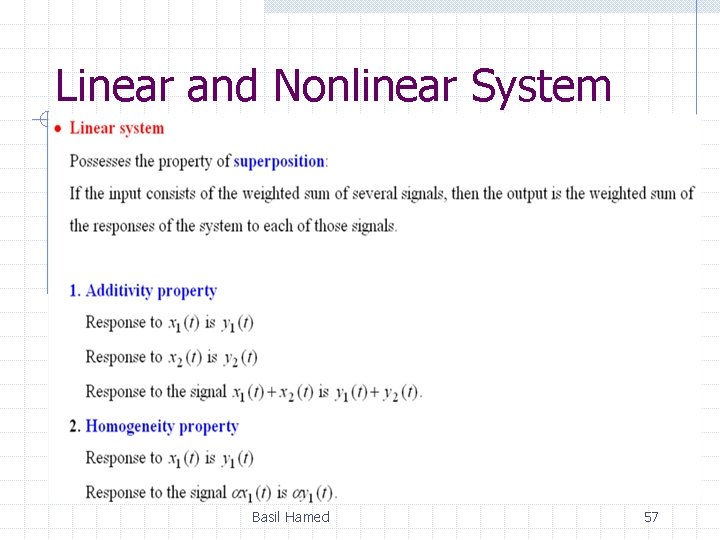
Linear and Nonlinear System Basil Hamed 57
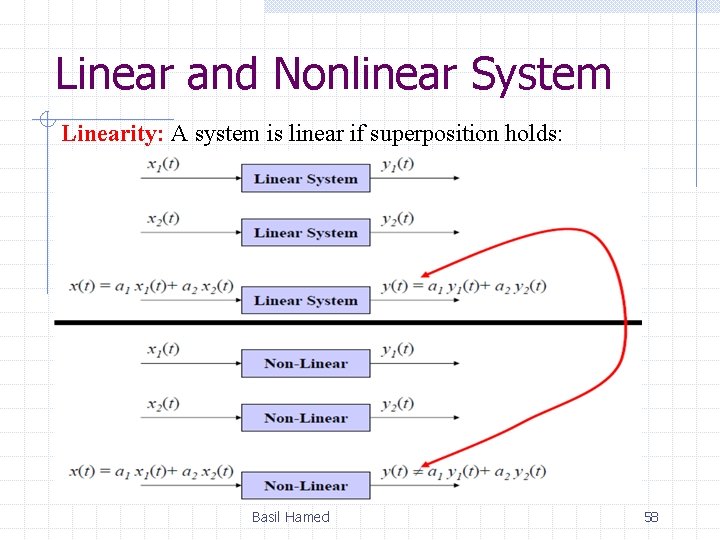
Linear and Nonlinear System Linearity: A system is linear if superposition holds: Basil Hamed 58
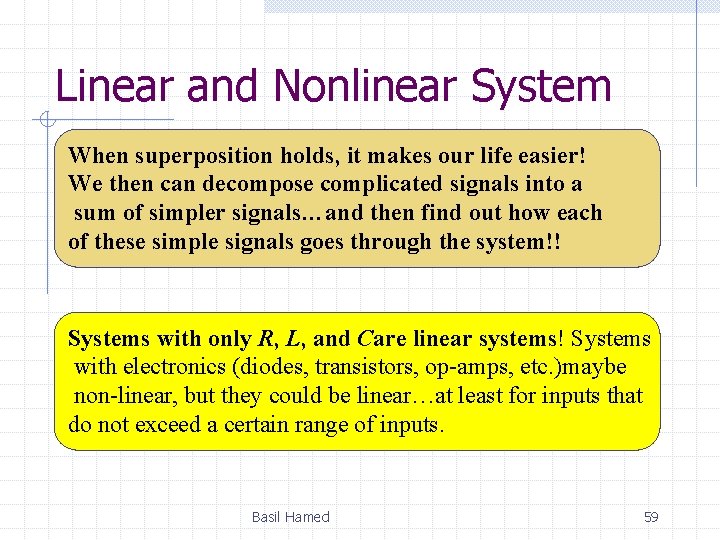
Linear and Nonlinear System When superposition holds, it makes our life easier! We then can decompose complicated signals into a sum of simpler signals…and then find out how each of these simple signals goes through the system!! Systems with only R, L, and Care linear systems! Systems with electronics (diodes, transistors, op-amps, etc. )maybe non-linear, but they could be linear…at least for inputs that do not exceed a certain range of inputs. Basil Hamed 59
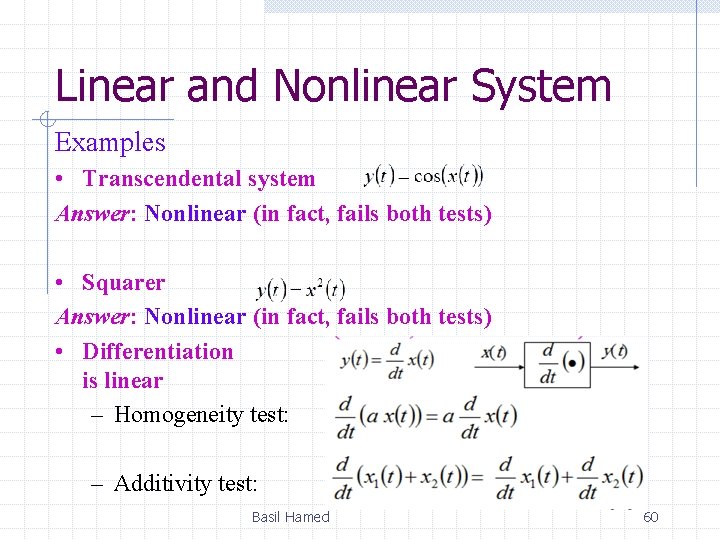
Linear and Nonlinear System Examples • Transcendental system Answer: Nonlinear (in fact, fails both tests) • Squarer Answer: Nonlinear (in fact, fails both tests) • Differentiation is linear – Homogeneity test: – Additivity test: Basil Hamed 60
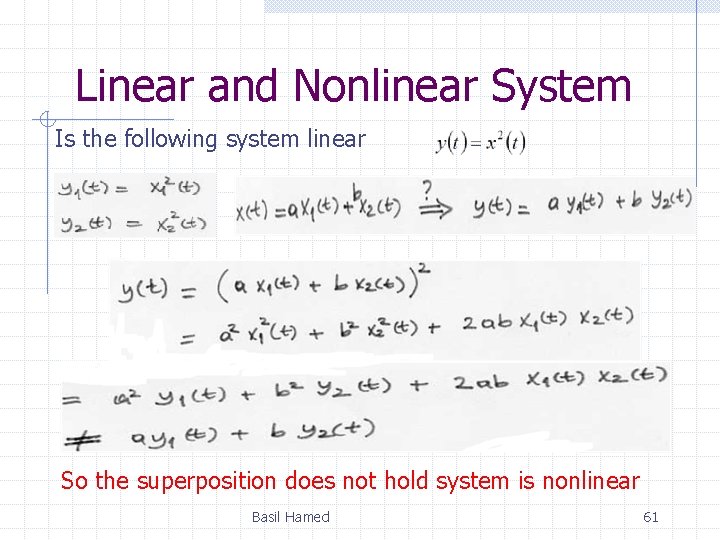
Linear and Nonlinear System Is the following system linear So the superposition does not hold system is nonlinear Basil Hamed 61
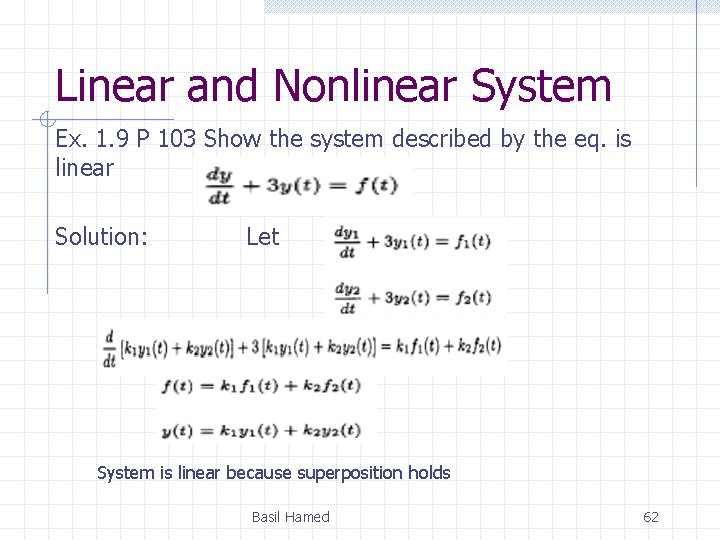
Linear and Nonlinear System Ex. 1. 9 P 103 Show the system described by the eq. is linear Solution: Let System is linear because superposition holds Basil Hamed 62
Time-Invariant and Time varying Time-Invariance Physical View: The system itself does not change with time Ex. A circuit with fixed R, L, C is time invariant. Actually, R, L, C values change slightly over time due to temperature & aging effects. A circuit with, say, a variable R is time variant Basil Hamed 63
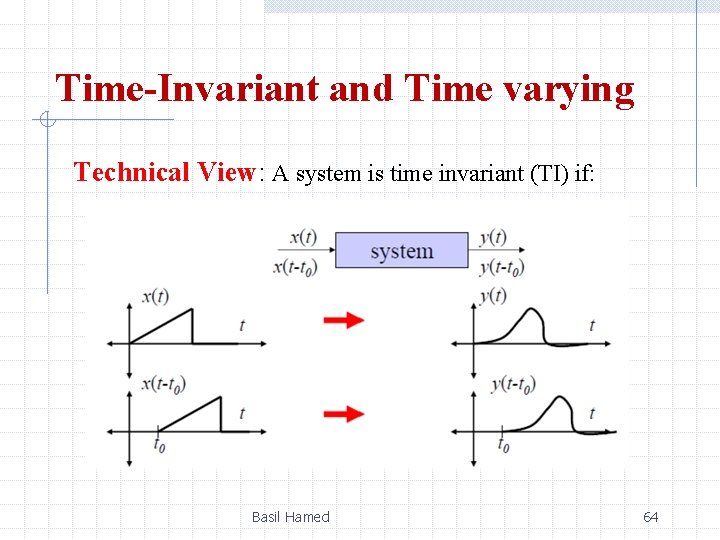
Time-Invariant and Time varying Technical View: A system is time invariant (TI) if: Basil Hamed 64
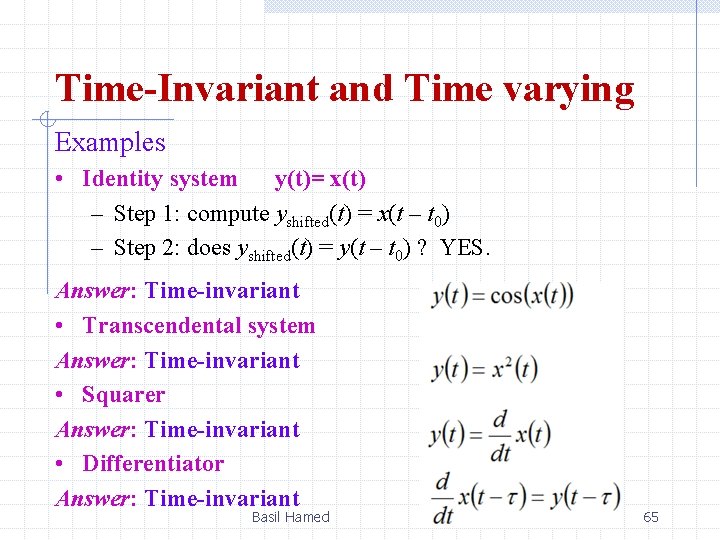
Time-Invariant and Time varying Examples • Identity system y(t)= x(t) – Step 1: compute yshifted(t) = x(t – t 0) – Step 2: does yshifted(t) = y(t – t 0) ? YES. Answer: Time-invariant • Transcendental system Answer: Time-invariant • Squarer Answer: Time-invariant • Differentiator Answer: Time-invariant Basil Hamed 65
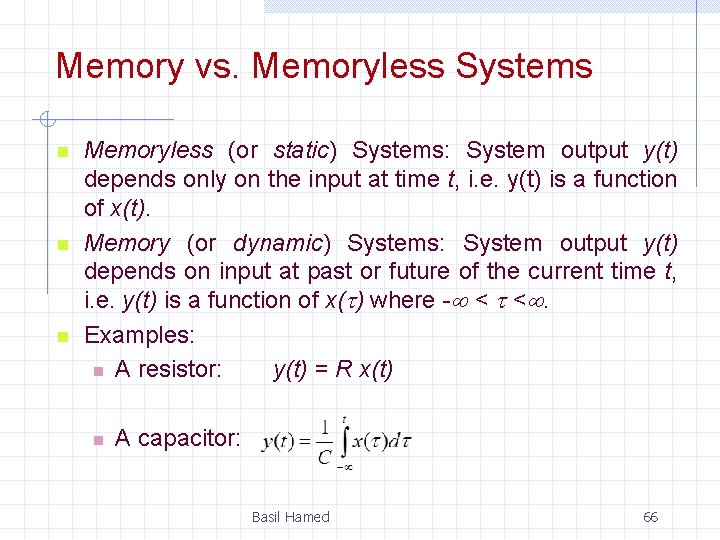
Memory vs. Memoryless Systems n n n Memoryless (or static) Systems: System output y(t) depends only on the input at time t, i. e. y(t) is a function of x(t). Memory (or dynamic) Systems: System output y(t) depends on input at past or future of the current time t, i. e. y(t) is a function of x( ) where - < <. Examples: n A resistor: y(t) = R x(t) n A capacitor: Basil Hamed 66
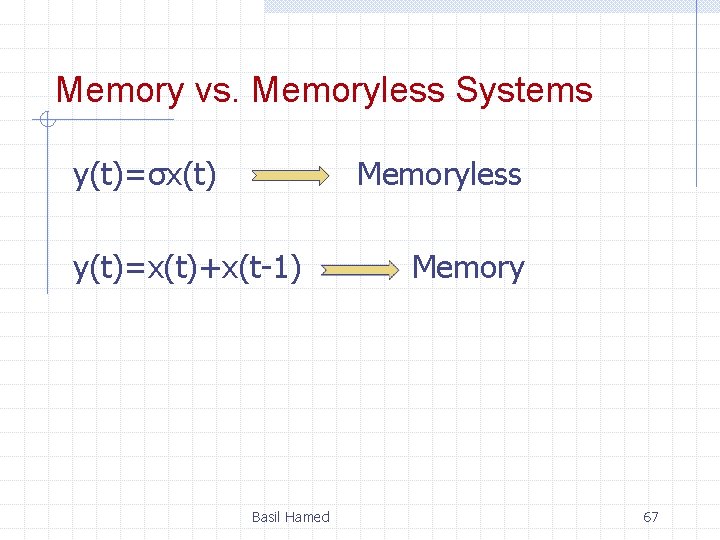
Memory vs. Memoryless Systems y(t)=σx(t) Memoryless y(t)=x(t)+x(t-1) Basil Hamed Memory 67
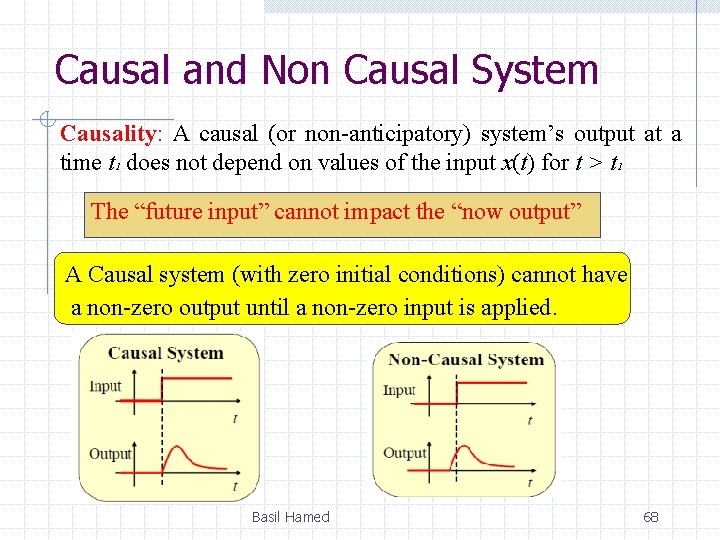
Causal and Non Causal System Causality: A causal (or non-anticipatory) system’s output at a time t 1 does not depend on values of the input x(t) for t > t 1 The “future input” cannot impact the “now output” A Causal system (with zero initial conditions) cannot have a non-zero output until a non-zero input is applied. Basil Hamed 68
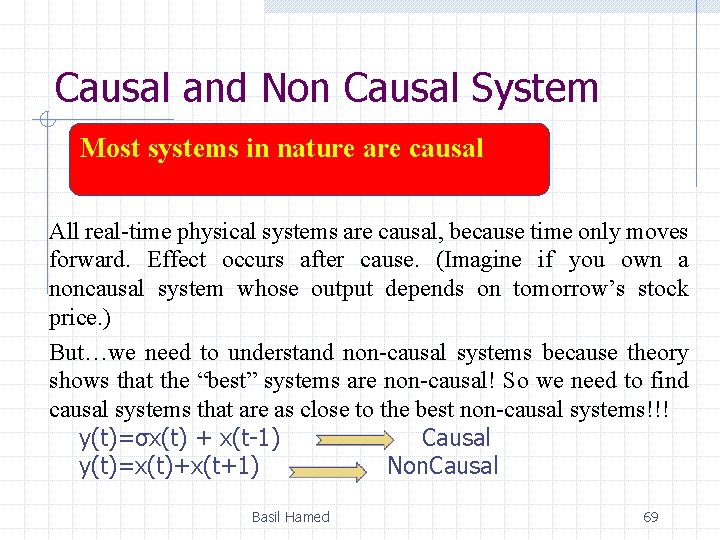
Causal and Non Causal System Most systems in nature are causal All real-time physical systems are causal, because time only moves forward. Effect occurs after cause. (Imagine if you own a noncausal system whose output depends on tomorrow’s stock price. ) But…we need to understand non-causal systems because theory shows that the “best” systems are non-causal! So we need to find causal systems that are as close to the best non-causal systems!!! y(t)=σx(t) + x(t-1) Causal y(t)=x(t)+x(t+1) Non. Causal Basil Hamed 69
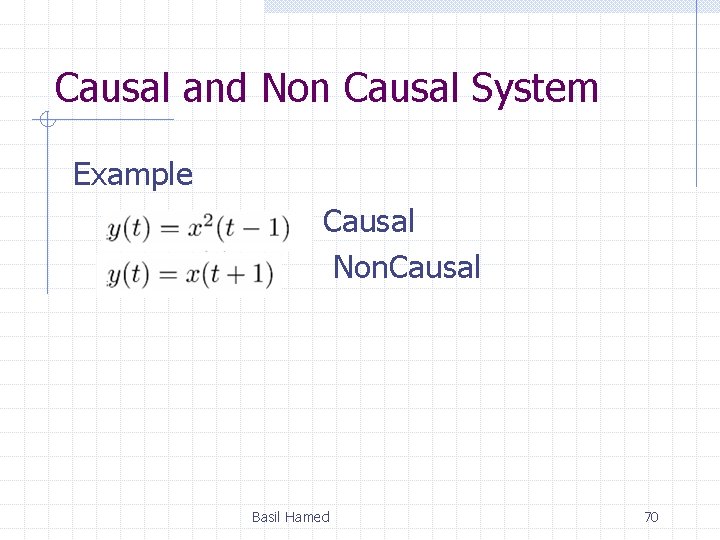
Causal and Non Causal System Example Causal Non. Causal Basil Hamed 70
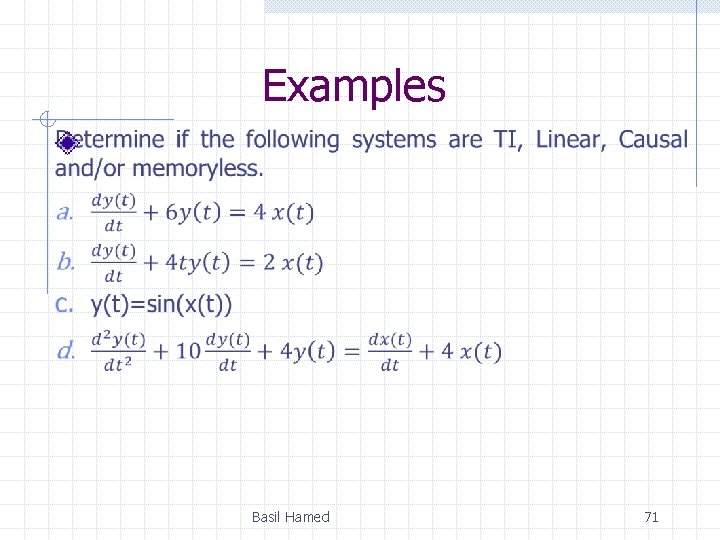
Examples Basil Hamed 71
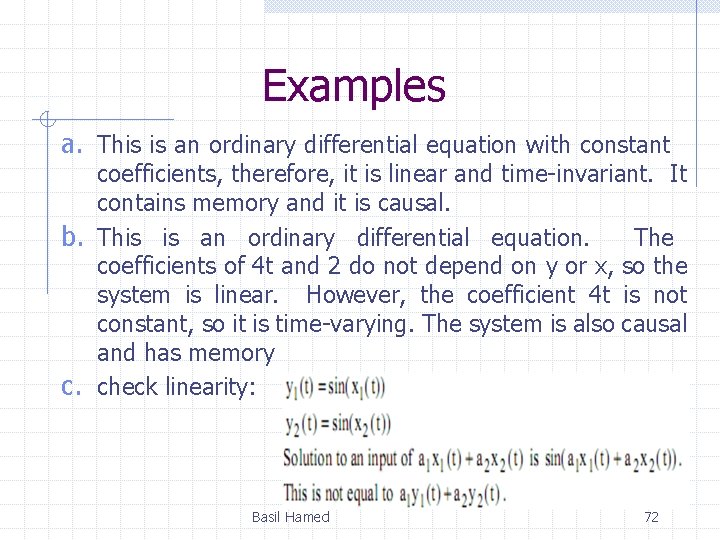
Examples a. This is an ordinary differential equation with constant coefficients, therefore, it is linear and time-invariant. It contains memory and it is causal. b. This is an ordinary differential equation. The coefficients of 4 t and 2 do not depend on y or x, so the system is linear. However, the coefficient 4 t is not constant, so it is time-varying. The system is also causal and has memory c. check linearity: Basil Hamed 72
Examples c. the system is causal since the output does not depend on future values of time, and it is memoryless the system is time-invariant d. This is an ordinary differential equation with constant coefficients, so it is linear and time-invariant. It is also causal and has memory. Basil Hamed 73
- Slides: 73