
Sign de Saussure Linguistic sign unites not a
- Slides: 12
Sign de Saussure • Linguistic sign unites not a thing and a name, but a concept and a sound image. • A sound image is not the material sound, but the psychological imprint of the sound, the impression that it makes in our senses. • Without moving our lips or tongue, we can talk to ourselves or recite mentally a selection of verse. http: //didisukyadi. staf. upi. edu/2011/
Sound-image • Sound image is not the same as a morpheme. • Sound image is not a physical thing or something that we can observe like sound or print. • Morpheme is applicable to spoken word only • Morpheme is a vocal activity.
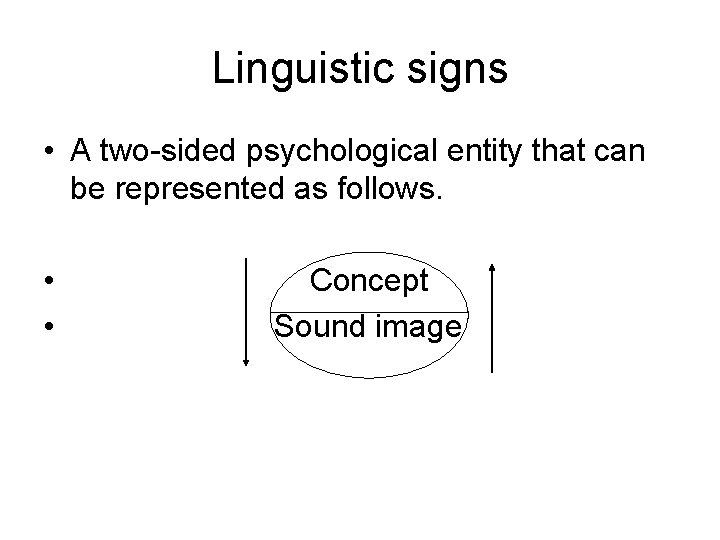
Linguistic signs • A two-sided psychological entity that can be represented as follows. • • Concept Sound image
Linguistic sign • A sign is a combination between a concept and a sound image. • Arbor (Latin) or “tree” is called as a sign only because it carries the concept “tree” with the result that the idea of sensory part implies the idea of the whole • Concept then is called a SIGNIFIED • Sound image is called a SIGNIFIER
Arbitrary Nature of Sign • The bond between signifier and signified is arbitrary • The idea of “sister” is not linked by any inner relationship to the succession of the sound /sistər/ • Signifier or symbol is NEVER wholly arbitrary • There is the rudiment of a natural bond between the signifier and signified.
Arbitrary • Should not imply that the choice is left entirely to the speaker. • Arbitrary is unmotivated • It has no natural connection with the signified. • There are signs which are motivated: 1) Onomatopeia 2) Interjection
Linier nature of the Signifier • Represents a span • Is measurable in single dimension • It is a line
Synchronic-Diachronic Distinction Synchronic • Disregards changes of little importance. • Sees language as a living whole • Exists as a state at a particular moment in time Diachronic • Sees language as a continually changing medium
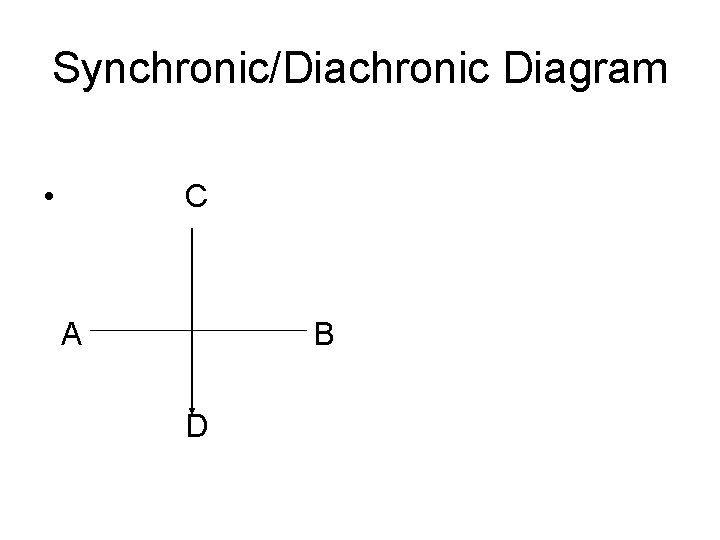
Synchronic/Diachronic Diagram • C A B D
Synchronic/Diachronic Diagram • AB represent a synchronic axis of simultaneity of a language state at some point in time. • CD is diachronic axis of succession: the historical path the language has traveled.
Paradigmatic/Syntagmatic • Every language has a paradigmatic relationship with every other item which can be substituted for it and syntagmatic relationship with items which occur within the same construction (The cat sat on the mat: the syntagmatic relation is between cat and sat the and on the mat)
Langue/Parole • Langue: the language system of a group • Parole: instances of the language use • Competence: person’s knowledge of a language • Performance: person’s use of language