
Sigmund Freuds Psychosexual Stages in the Personality Development

- Slides: 13
Sigmund Freud’s Psychosexual Stages in the Personality Development Course Code- MALS 514 Course Title- Personality Development Presented By Athokpam Soniya Devi MALS 12 R 502 School of Life Skills Education and Social Harmony
Objectives �To know about the psychosexual development �To know about the psychosexual stages of development �To know the criticisms of the psychosexual of Sigmund Freud
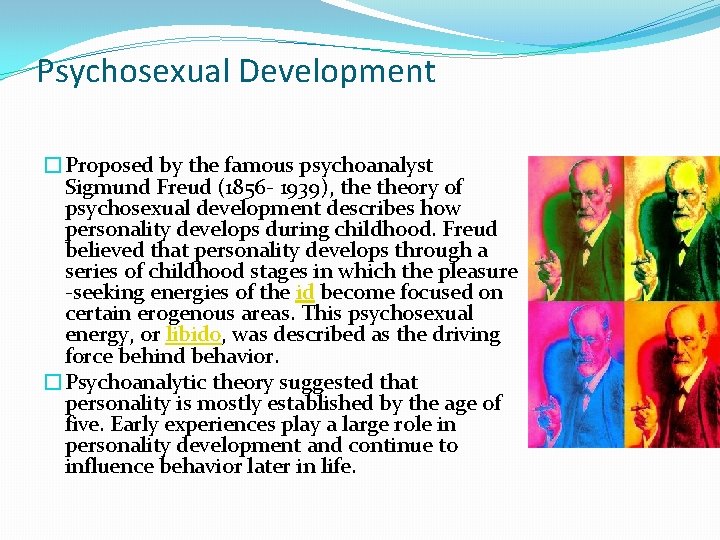
Psychosexual Development �Proposed by the famous psychoanalyst Sigmund Freud (1856 - 1939), theory of psychosexual development describes how personality develops during childhood. Freud believed that personality develops through a series of childhood stages in which the pleasure -seeking energies of the id become focused on certain erogenous areas. This psychosexual energy, or libido, was described as the driving force behind behavior. �Psychoanalytic theory suggested that personality is mostly established by the age of five. Early experiences play a large role in personality development and continue to influence behavior later in life.
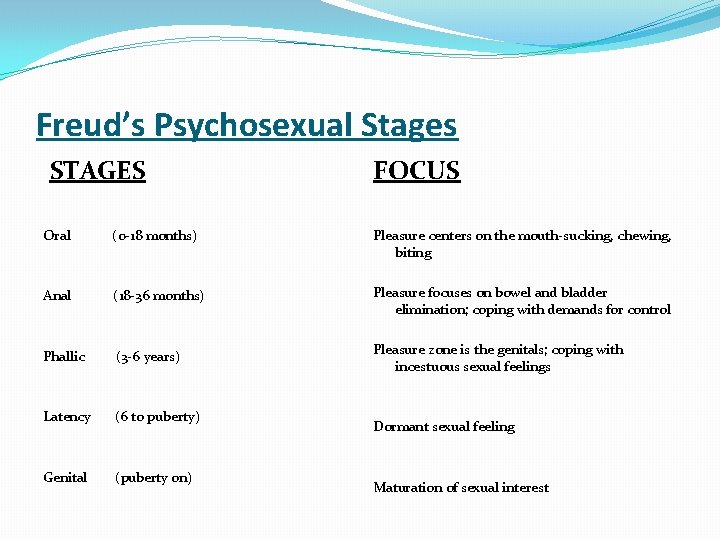
Freud’s Psychosexual Stages STAGES FOCUS Oral (0 -18 months) Pleasure centers on the mouth-sucking, chewing, biting Anal (18 -36 months) Pleasure focuses on bowel and bladder elimination; coping with demands for control Phallic (3 -6 years) Pleasure zone is the genitals; coping with incestuous sexual feelings Latency (6 to puberty) Genital (puberty on) Dormant sexual feeling Maturation of sexual interest
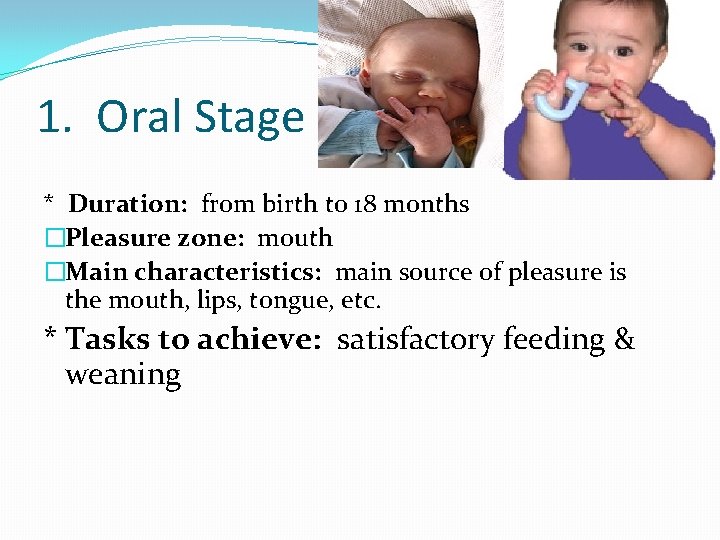
1. Oral Stage * Duration: from birth to 18 months �Pleasure zone: mouth �Main characteristics: main source of pleasure is the mouth, lips, tongue, etc. * Tasks to achieve: satisfactory feeding & weaning
2. Anal Stage �Duration: from 18 -36 months �Pleasure zone: Anus �Main characteristics: controlling and controlling the bowels and bladder; the ego starts to control the id �Tasks to achieve: potty and toilet training
3. Phallic Stage �Duration: from 3 -6 years of age �Pleasure zone: genital �Main characteristics: some pleasure is gained from playing with the genitals. This pleasure is associated with the same sex parent leading to the Oedipus and Electra Complexes �Id demands, ego tries to satisfy id, and superego tries to impose moral choices
4. Latency Stage �Duration: from 6 -11 years of age �Pleasure zone: none �Main characteristics: Oedipus and Electra Complexes are resolved and identification with same sex parent occurs, and loss of interest in opposite sex. Id, ego, superego continue to compete �Tasks to achieve: none
5. Genital Stage �Duration: from 11 years on �Pleasure zone: genitals �Main characteristics: increasing concern with adult ways of experiencing sexual pleasure �Tasks to achieve: good relationships with members of both sexes
Criticism �The theory is focused almost entirely on male development with little mention of female psychosexual development. � His theories are difficult to test scientifically. Concepts such as the libido are impossible to measure, and therefore cannot be tested. The research that has been conducted tends to discredit Freud's theory. � Future predictions are too vague. � Freud's theory is based upon case studies and not empirical research. Also, Freud based his theory on the recollections of his adult patients, not on actual observation and study of children.
Conclusion �Psychosexual development theory is development of human development which having five stages. Each stage is a good representation of the child’s age and his or her reaction to their development. So if the stages are completed successfully, the result is a healthy personality.
Reference Mischel Walter et al. (2008). Introduction to Personality. USA: Jhon Wiley and Sons, Inc. . 2. Salkind. J. Neil, (2004), An Introduction to Theories of Human Development, New Delhi: Sage Publication 3. http: //psychology. about. com/od/theoriesofpersonal ity/ss/psychosexualdev_7. htm 4. http: //psychology. about. com/od/theoriesofpersonal ity/ss/psychosexualdev. htm 1.
THANK U