
Sigmund Freud 1856 1939 Sigmund Freud Origins Born
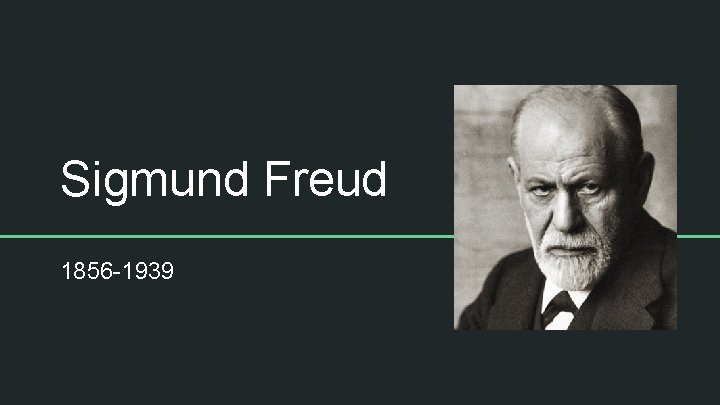
Sigmund Freud 1856 -1939

Sigmund Freud Origins ➢Born in 1856 in the Austrian-Empire ➢Grew up in Vienna His Parents Vienna

Freud’s Family and Early Career ❖ He received his medical degree at University of Vienna in 1881 and then became engaged the next year ❖ He set up a medical practice after graduation that treated patients with mental disorders ❖ Helped patients remember events in their life that they chose to forget. Coauthored book called Studies in Hysteria, describing discoveries. His Family
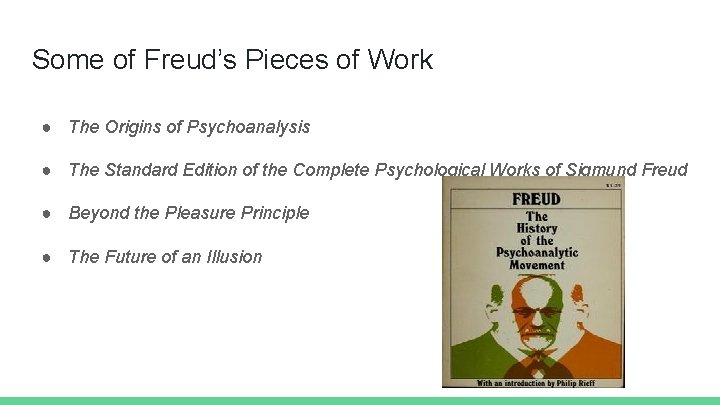
Some of Freud’s Pieces of Work ● The Origins of Psychoanalysis ● The Standard Edition of the Complete Psychological Works of Sigmund Freud ● Beyond the Pleasure Principle ● The Future of an Illusion

A Few of Sigmund Freud’s Theories ● Sexuality is Everyone’s Weakness-and Strength ● Thought is a Roundabout Way of Wishing ● Talking Cures ● The Past Impacts the Present ● The Price of Civilization is Neurotic Discontent
Freud’s Impact Sigmund Freud and Psychoanalysis: By using and developing techniques such as dream interpretation and free association, Freud is rightly called the founding father of psychoanalysis, a term which he first used in 1896. This therapy is still widely used today.

Freud’s Discoveries of Psychoanalysis = “talking cure” It is a therapy that is designed to treat mental disorders. It is related to the study of the unconscious mind. Psychoanalysis focuses on a method of mind investigation, especially of the unconscious mind.
Psychoanalysis Continued ❖ Freud believed that people could be cured by making conscious their unconscious thoughts and motivations, thus gaining insight. ❖ The aim of psychoanalysis therapy is to release repressed emotions and experiences. ❖ Typical causes include unresolved issues during development or repressed trauma. ❖ Treatment focuses on bringing the repressed conflict to consciousness, where the client can deal with it.
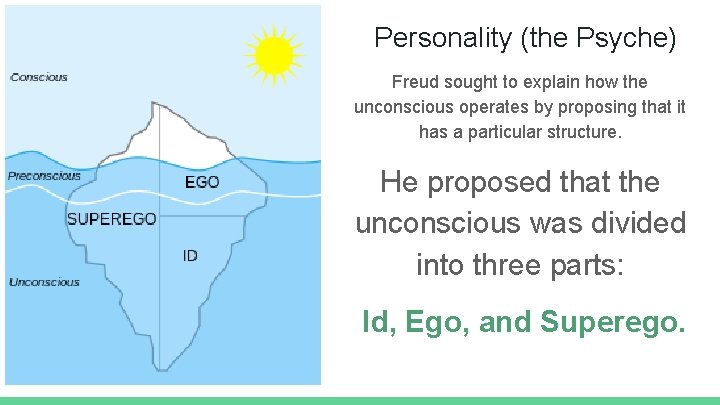
Personality (the Psyche) Freud sought to explain how the unconscious operates by proposing that it has a particular structure. He proposed that the unconscious was divided into three parts: Id, Ego, and Superego.
Id ● Only part of personality that is present from birth and simplest one ● This part of personality is entirely unconscious and impulsive ● Responds directly and immediately to the instincts ● Follows idea that every impulse should be satisfied immediately despite the consequences; ex. hunger
Id (cont. ) ● ● ● Irrational, illogical thinking Has no comprehension of reality Selfish and wishing Based on urgent desires, wants, needs Example: babies cry when hungry no matter what time it is without the ability to realize his/her parents may be asleep
Ego ● Unlike id that is unrealistic, ego works by reason to the external world ● Develops around the age of 3 ● Based on reality principle; aware that other people have needs and desires too ● Understands being selfish can harm us ● Creates way to satisfy id’s demands
Ego (cont. ) ● Often postpones satisfaction of needs to avoid negative consequences from others Secondary process thinking -rational, realistic ● Helps with self-control ● Goal is to satisfy needs of id and work with the superego
Superego ● Usually developed around the age of 5 ● It is our moral and values for dealing with society ● Contains our beliefs of right and wrong usually taught by caregiver ● Helps to control id impulses ● Persuades egos of moralistic goal rather than just realistic ones ● Contains two systems: the conscience and ideal self
Superego (cont. ) ● The conscience - can punish ego for giving into id’s demands by making the person feel guilt and can reward by making a person feel proud when they behave in a desired way ● Behavior falling short or living up to ideal self leads to guilty feeling or proud ● Greatly determined in childhood by parents morals and the way you were raised

Credit: Kaylee Doherty Kaylee Bosinger
- Slides: 16