
SIGGRAPH 2015 Advances in RealTime Rendering in Games

![Camera Depth Reprojection • Similar to [Silvennoinen 12] • But, mask not effective because](https://slidetodoc.com/presentation_image_h/d1b645190be1d726a7a57253e424043a/image-36.jpg "Camera Depth Reprojection • Similar to [Silvennoinen 12] • But, mask not effective because")
![References [SBOT 08] Shopf, J. , Barczak, J. , Oat, C. , Tatarchuk, N.](https://slidetodoc.com/presentation_image_h/d1b645190be1d726a7a57253e424043a/image-58.jpg "References [SBOT 08] Shopf, J. , Barczak, J. , Oat, C. , Tatarchuk, N.")

- Slides: 60
SIGGRAPH 2015: Advances in Real-Time Rendering in Games GPU-Driven Rendering Pipelines Ulrich Haar, Lead Programmer 3 D, Ubisoft Montreal Sebastian Aaltonen, Senior Lead Programmer, Red. Lynx a Ubisoft Studio
Topics • • • Motivation Mesh Cluster Rendering Pipeline Overview Occlusion Depth Generation Results and future work SIGGRAPH 2015: Advances in Real-Time Rendering course
GPU-Driven Rendering? • GPU controls what objects are actually rendered • “draw scene” GPU-command – n viewports/frustums – GPU determines (sub-)object visibility – No CPU/GPU roundtrip • Prior work [SBOT 08] SIGGRAPH 2015: Advances in Real-Time Rendering course
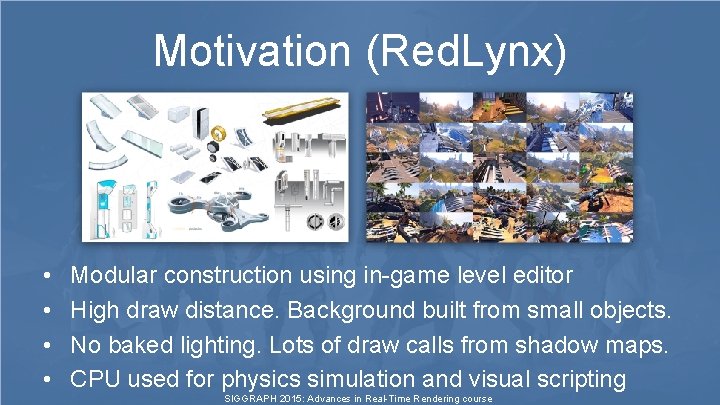
Motivation (Red. Lynx) • • Modular construction using in-game level editor High draw distance. Background built from small objects. No baked lighting. Lots of draw calls from shadow maps. CPU used for physics simulation and visual scripting SIGGRAPH 2015: Advances in Real-Time Rendering course
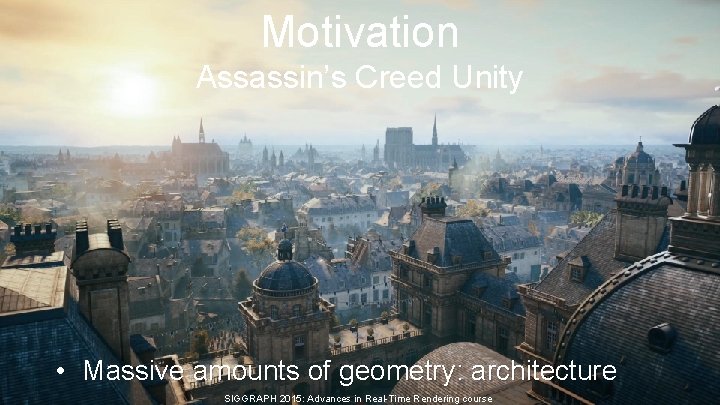
Motivation Assassin’s Creed Unity • Massive amounts of geometry: architecture SIGGRAPH 2015: Advances in Real-Time Rendering course
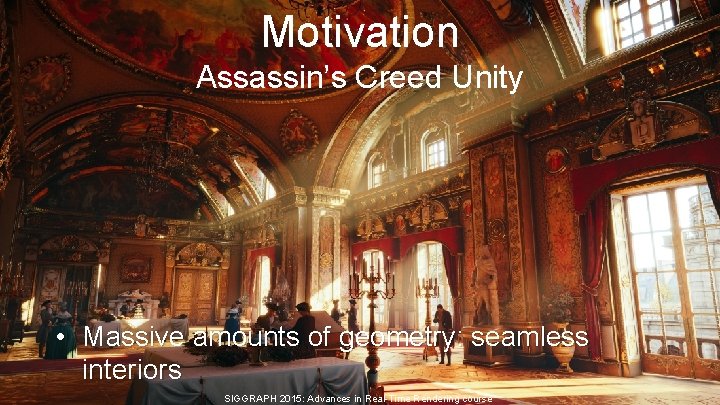
Motivation Assassin’s Creed Unity • Massive amounts of geometry: seamless interiors SIGGRAPH 2015: Advances in Real-Time Rendering course
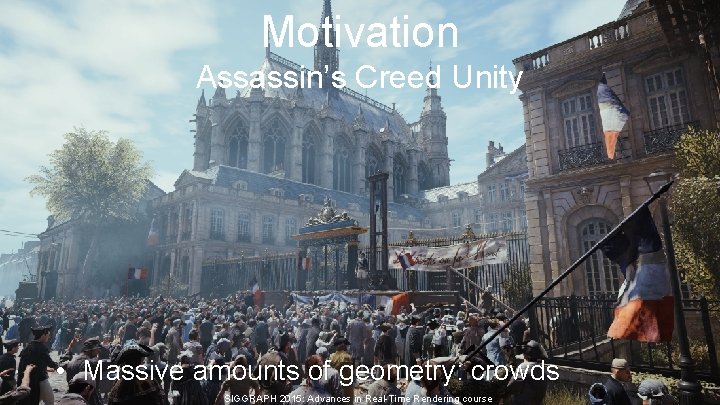
Motivation Assassin’s Creed Unity • Massive amounts of geometry: crowds SIGGRAPH 2015: Advances in Real-Time Rendering course
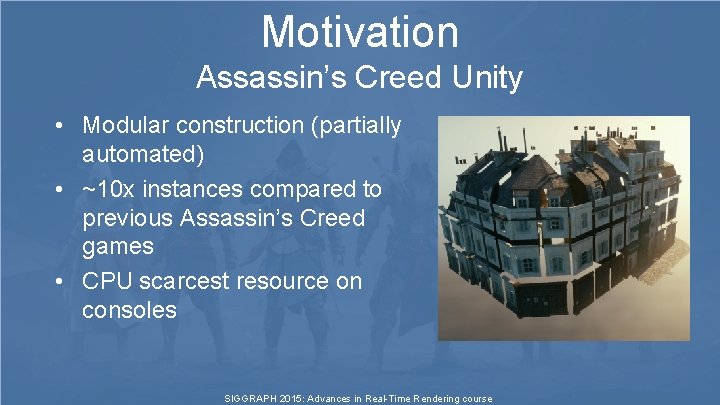
Motivation Assassin’s Creed Unity • Modular construction (partially automated) • ~10 x instances compared to previous Assassin’s Creed games • CPU scarcest resource on consoles SIGGRAPH 2015: Advances in Real-Time Rendering course
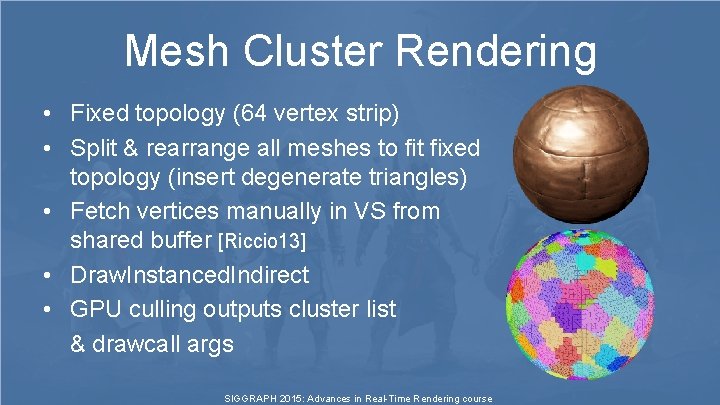
Mesh Cluster Rendering • Fixed topology (64 vertex strip) • Split & rearrange all meshes to fit fixed topology (insert degenerate triangles) • Fetch vertices manually in VS from shared buffer [Riccio 13] • Draw. Instanced. Indirect • GPU culling outputs cluster list & drawcall args SIGGRAPH 2015: Advances in Real-Time Rendering course
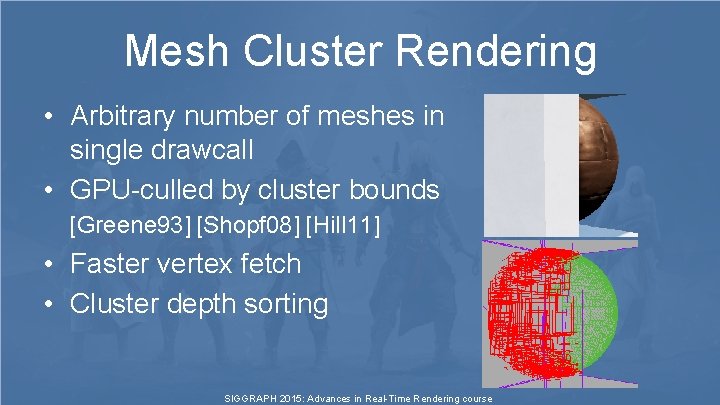
Mesh Cluster Rendering • Arbitrary number of meshes in single drawcall • GPU-culled by cluster bounds [Greene 93] [Shopf 08] [Hill 11] • Faster vertex fetch • Cluster depth sorting SIGGRAPH 2015: Advances in Real-Time Rendering course
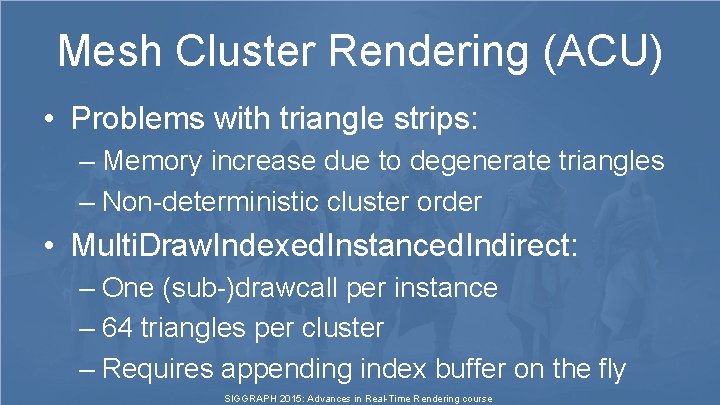
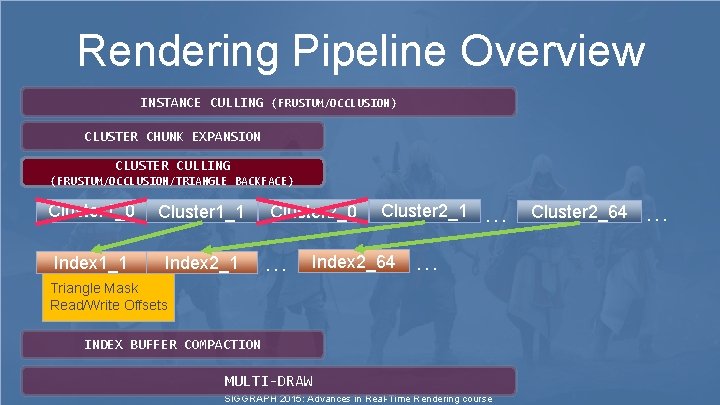
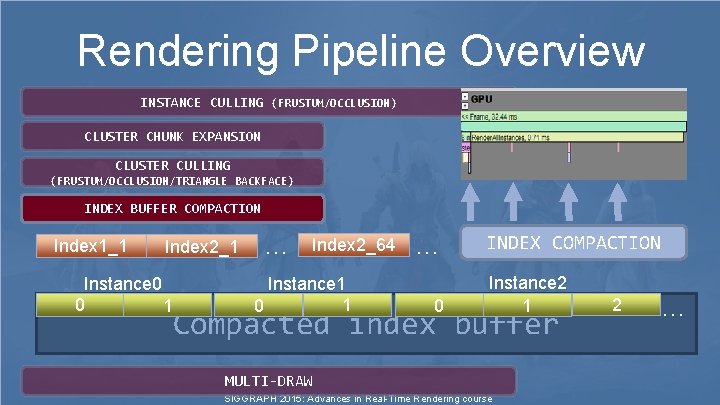
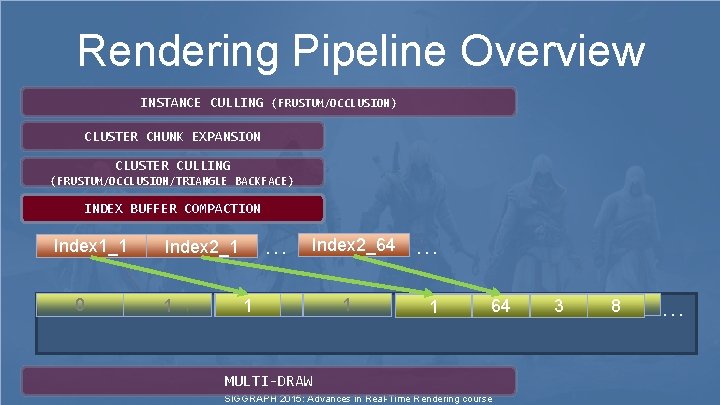
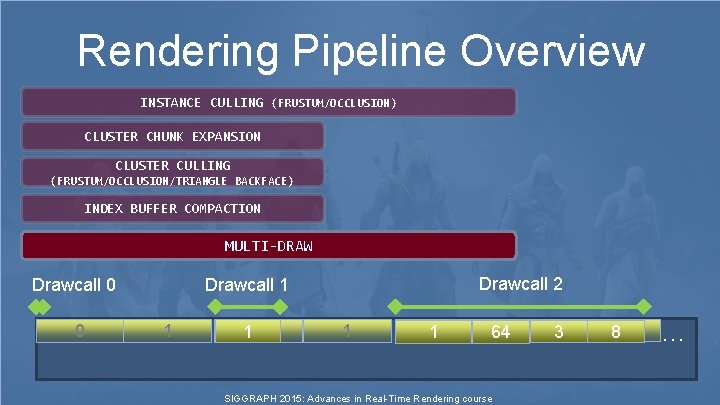
Mesh Cluster Rendering (ACU) • Problems with triangle strips: – Memory increase due to degenerate triangles – Non-deterministic cluster order • Multi. Draw. Indexed. Instanced. Indirect: – One (sub-)drawcall per instance – 64 triangles per cluster – Requires appending index buffer on the fly SIGGRAPH 2015: Advances in Real-Time Rendering course
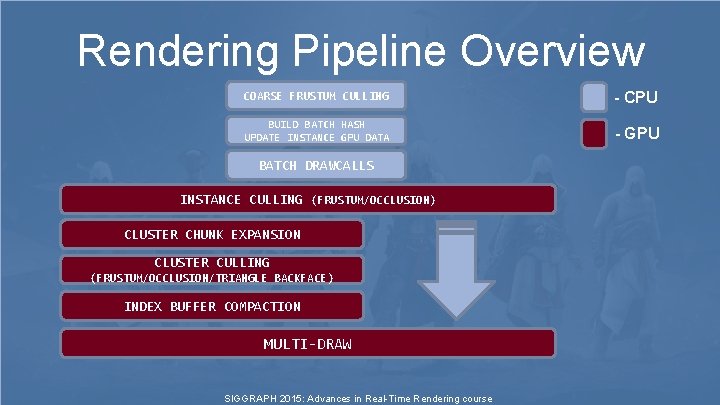
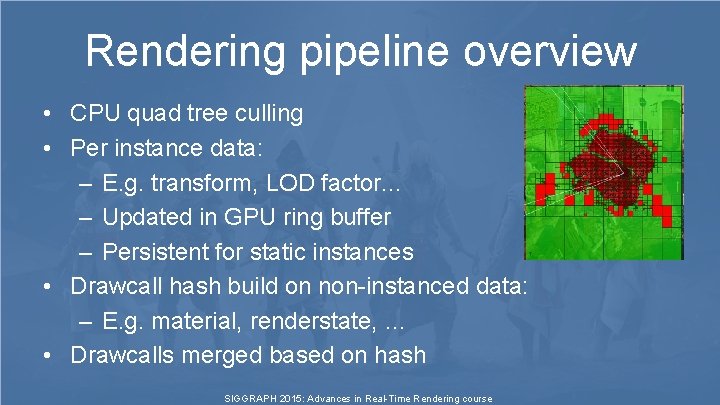
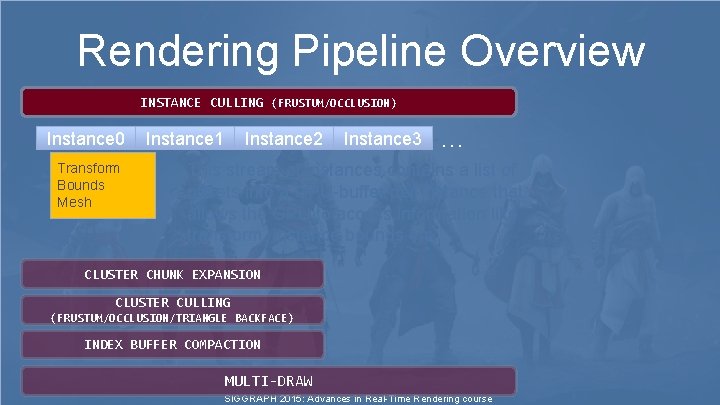
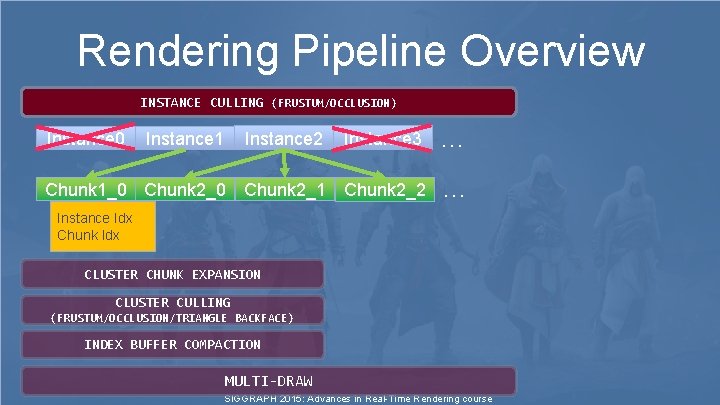
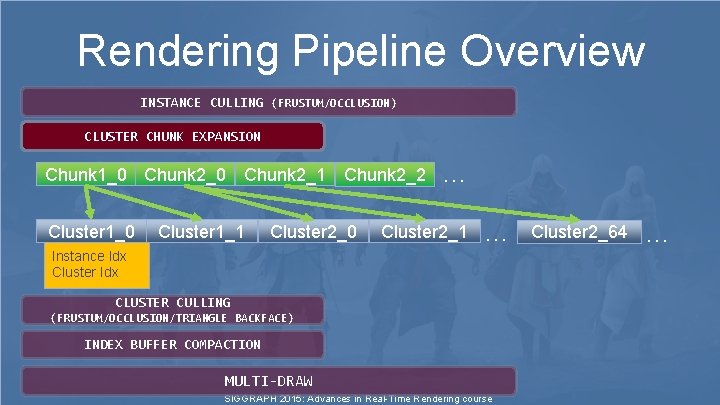
Rendering Pipeline Overview COARSE FRUSTUM CULLING - CPU BUILD BATCH HASH UPDATE INSTANCE GPU DATA - GPU BATCH DRAWCALLS INSTANCE CULLING (FRUSTUM/OCCLUSION) CLUSTER CHUNK EXPANSION CLUSTER CULLING (FRUSTUM/OCCLUSION/TRIANGLE BACKFACE) INDEX BUFFER COMPACTION MULTI-DRAW SIGGRAPH 2015: Advances in Real-Time Rendering course
Rendering pipeline overview • CPU quad tree culling • Per instance data: – E. g. transform, LOD factor. . . – Updated in GPU ring buffer – Persistent for static instances • Drawcall hash build on non-instanced data: – E. g. material, renderstate, … • Drawcalls merged based on hash SIGGRAPH 2015: Advances in Real-Time Rendering course
Rendering Pipeline Overview INSTANCE CULLING (FRUSTUM/OCCLUSION) Instance 0 Transform Bounds Mesh Instance 1 Instance 2 Instance 3 … This stream of instances contains a list of offsets into a GPU-buffer per instance that allows the GPU to access information like transform, instance bounds etc. CLUSTER CHUNK EXPANSION CLUSTER CULLING (FRUSTUM/OCCLUSION/TRIANGLE BACKFACE) INDEX BUFFER COMPACTION MULTI-DRAW SIGGRAPH 2015: Advances in Real-Time Rendering course
Rendering Pipeline Overview INSTANCE CULLING (FRUSTUM/OCCLUSION) Instance 1 Instance 2 Instance 3 … Chunk 1_0 Chunk 2_1 Chunk 2_2 … Instance 0 Instance Idx Chunk Idx CLUSTER CHUNK EXPANSION CLUSTER CULLING (FRUSTUM/OCCLUSION/TRIANGLE BACKFACE) INDEX BUFFER COMPACTION MULTI-DRAW SIGGRAPH 2015: Advances in Real-Time Rendering course
Rendering Pipeline Overview INSTANCE CULLING (FRUSTUM/OCCLUSION) CLUSTER CHUNK EXPANSION Chunk 1_0 Chunk 2_0 Cluster 1_0 Chunk 2_1 Cluster 1_1 Chunk 2_2 Cluster 2_0 … Cluster 2_1 … Instance Idx Cluster Idx CLUSTER CULLING (FRUSTUM/OCCLUSION/TRIANGLE BACKFACE) INDEX BUFFER COMPACTION MULTI-DRAW SIGGRAPH 2015: Advances in Real-Time Rendering course Cluster 2_64 …
Rendering Pipeline Overview INSTANCE CULLING (FRUSTUM/OCCLUSION) CLUSTER CHUNK EXPANSION CLUSTER CULLING (FRUSTUM/OCCLUSION/TRIANGLE BACKFACE) Cluster 1_0 Cluster 1_1 Index 2_1 Cluster 2_0 … Cluster 2_1 Index 2_64 … … Triangle Mask Read/Write Offsets INDEX BUFFER COMPACTION MULTI-DRAW SIGGRAPH 2015: Advances in Real-Time Rendering course Cluster 2_64 …
Rendering Pipeline Overview INSTANCE CULLING (FRUSTUM/OCCLUSION) CLUSTER CHUNK EXPANSION CLUSTER CULLING (FRUSTUM/OCCLUSION/TRIANGLE BACKFACE) INDEX BUFFER COMPACTION Index 1_1 Index 2_1 Instance 0 0 1 … Index 2_64 Instance 1 1 0 … 0 INDEX COMPACTION Instance 2 1 Compacted index buffer MULTI-DRAW SIGGRAPH 2015: Advances in Real-Time Rendering course 2 …
Rendering Pipeline Overview INSTANCE CULLING (FRUSTUM/OCCLUSION) CLUSTER CHUNK EXPANSION CLUSTER CULLING (FRUSTUM/OCCLUSION/TRIANGLE BACKFACE) INDEX BUFFER COMPACTION Index 1_1 0 … Index 2_1 1 Index 2_64 10 1 … 10 64 1 MULTI-DRAW SIGGRAPH 2015: Advances in Real-Time Rendering course 3 2 8 …
Rendering Pipeline Overview INSTANCE CULLING (FRUSTUM/OCCLUSION) CLUSTER CHUNK EXPANSION CLUSTER CULLING (FRUSTUM/OCCLUSION/TRIANGLE BACKFACE) INDEX BUFFER COMPACTION MULTI-DRAW Drawcall 0 0 Drawcall 2 Drawcall 1 1 10 64 1 SIGGRAPH 2015: Advances in Real-Time Rendering course 3 2 8 …
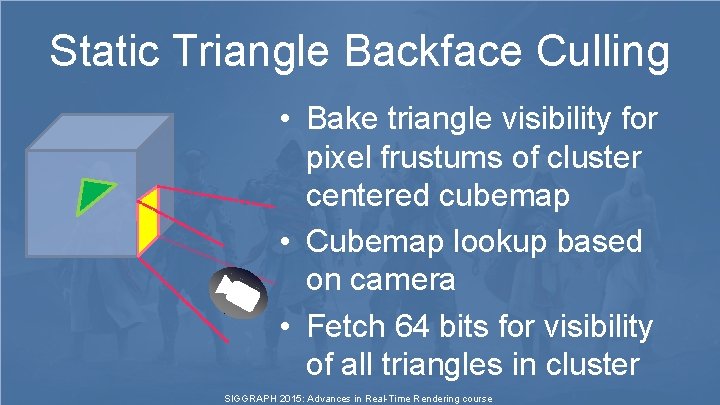
Static Triangle Backface Culling • Bake triangle visibility for pixel frustums of cluster centered cubemap • Cubemap lookup based on camera • Fetch 64 bits for visibility of all triangles in cluster SIGGRAPH 2015: Advances in Real-Time Rendering course
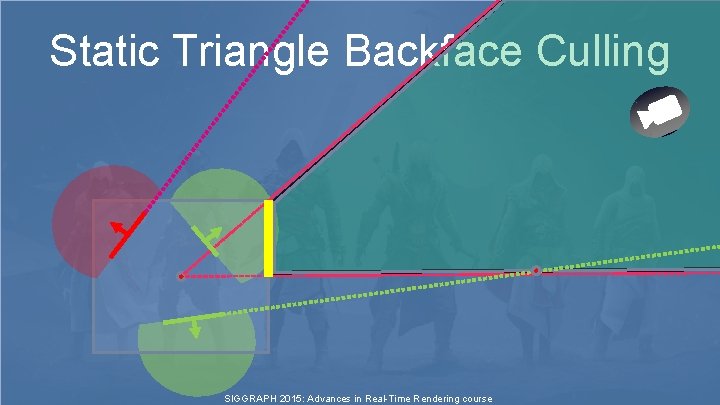
Static Triangle Backface Culling SIGGRAPH 2015: Advances in Real-Time Rendering course
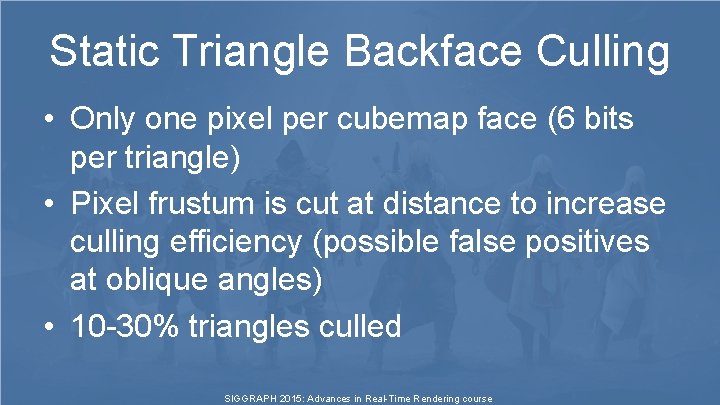
Static Triangle Backface Culling • Only one pixel per cubemap face (6 bits per triangle) • Pixel frustum is cut at distance to increase culling efficiency (possible false positives at oblique angles) • 10 -30% triangles culled SIGGRAPH 2015: Advances in Real-Time Rendering course
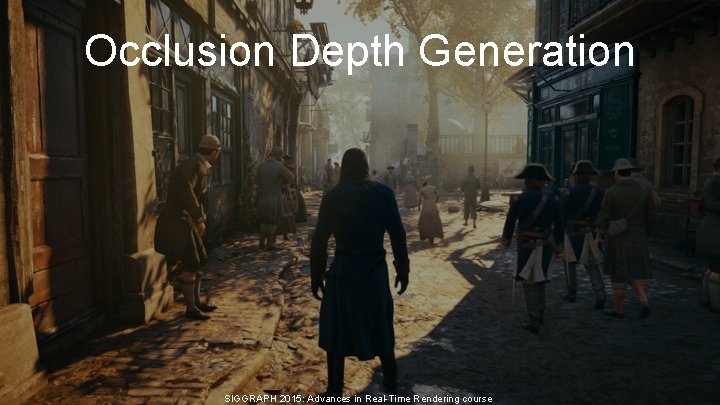
Occlusion Depth Generation SIGGRAPH 2015: Advances in Real-Time Rendering course
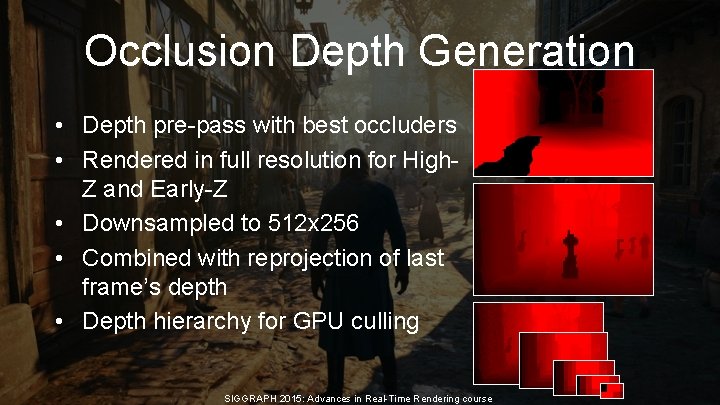
Occlusion Depth Generation • Depth pre-pass with best occluders • Rendered in full resolution for High. Z and Early-Z • Downsampled to 512 x 256 • Combined with reprojection of last frame’s depth • Depth hierarchy for GPU culling Hierar chy SIGGRAPH 2015: Advances in Real-Time Rendering course
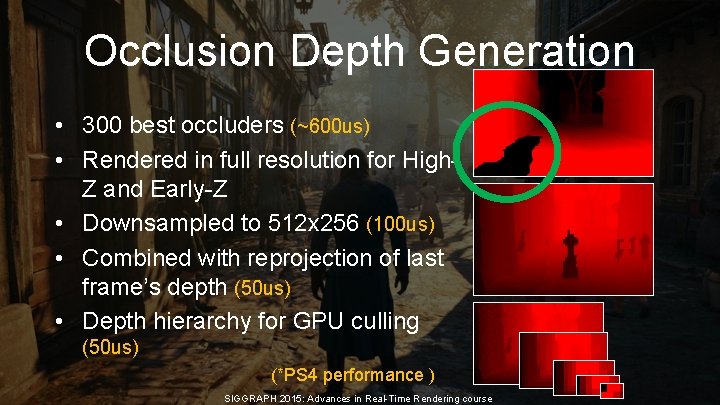
Occlusion Depth Generation • 300 best occluders (~600 us) • Rendered in full resolution for High. Z and Early-Z • Downsampled to 512 x 256 (100 us) • Combined with reprojection of last frame’s depth (50 us) • Depth hierarchy for GPU culling (50 us) Hierar chy (*PS 4 performance ) SIGGRAPH 2015: Advances in Real-Time Rendering course
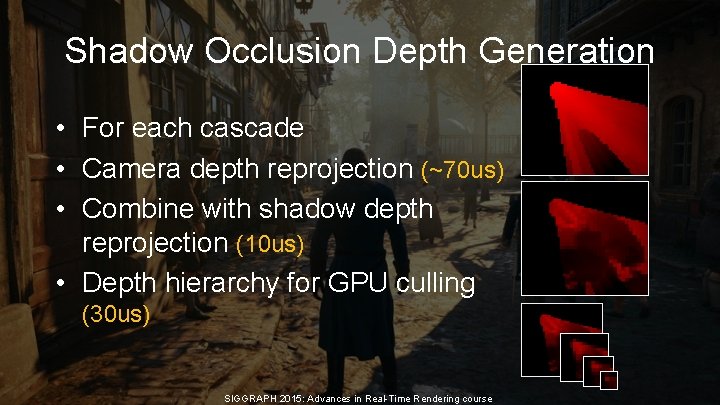
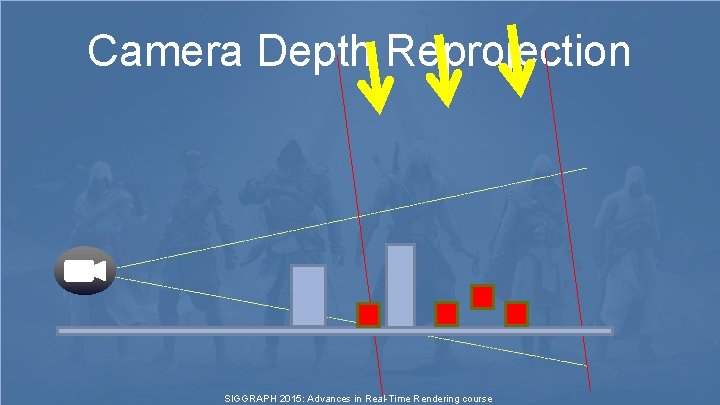
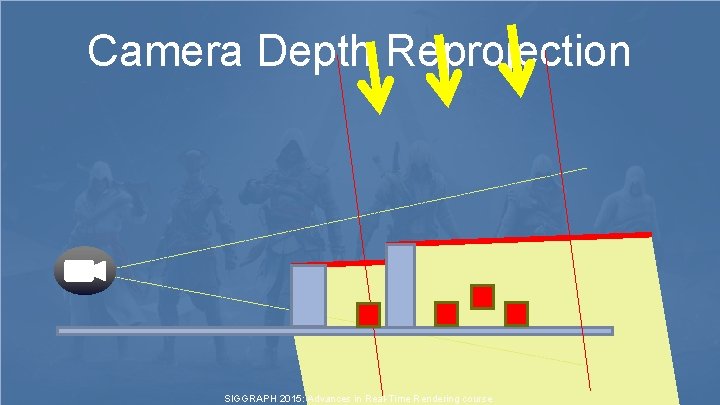
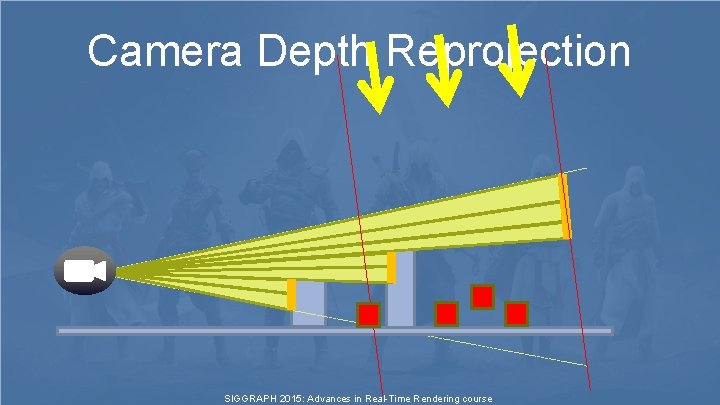
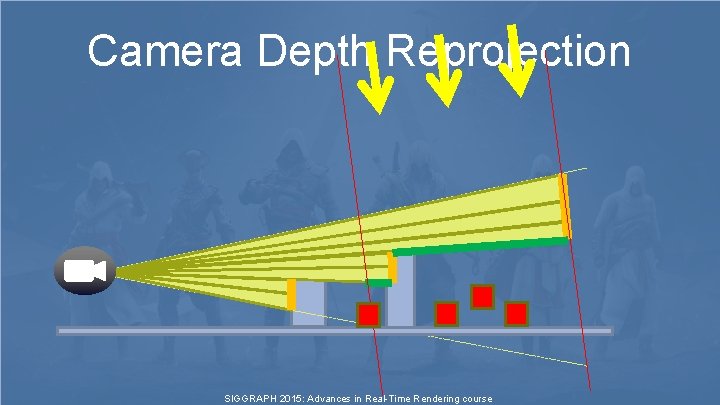
Shadow Occlusion Depth Generation • For each cascade • Camera depth reprojection (~70 us) • Combine with shadow depth reprojection (10 us) • Depth hierarchy for GPU culling (30 us) SIGGRAPH 2015: Advances in Real-Time Rendering course
Camera Depth Reprojection SIGGRAPH 2015: Advances in Real-Time Rendering course
Camera Depth Reprojection SIGGRAPH 2015: Advances in Real-Time Rendering course
Camera Depth Reprojection SIGGRAPH 2015: Advances in Real-Time Rendering course
Camera Depth Reprojection SIGGRAPH 2015: Advances in Real-Time Rendering course
Camera Depth Reprojection SIGGRAPH 2015: Advances in Real-Time Rendering course
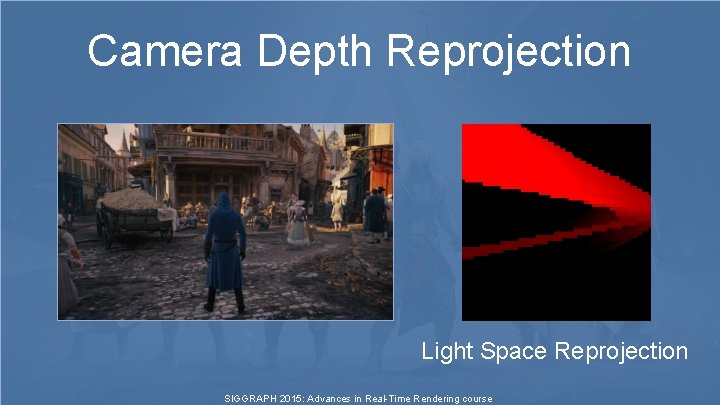
Camera Depth Reprojection Light Space Reprojection SIGGRAPH 2015: Advances in Real-Time Rendering course
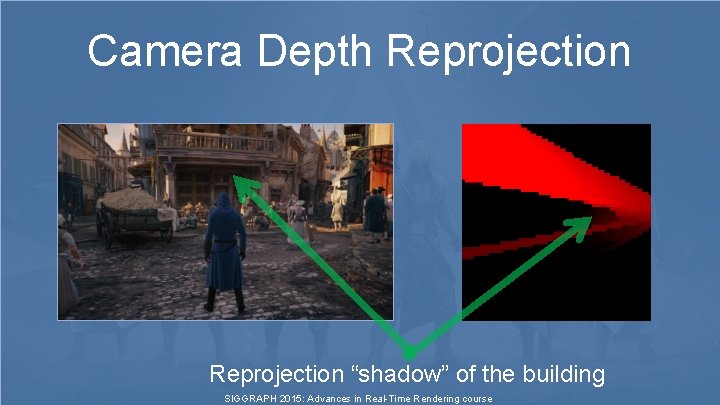
Camera Depth Reprojection “shadow” of the building SIGGRAPH 2015: Advances in Real-Time Rendering course
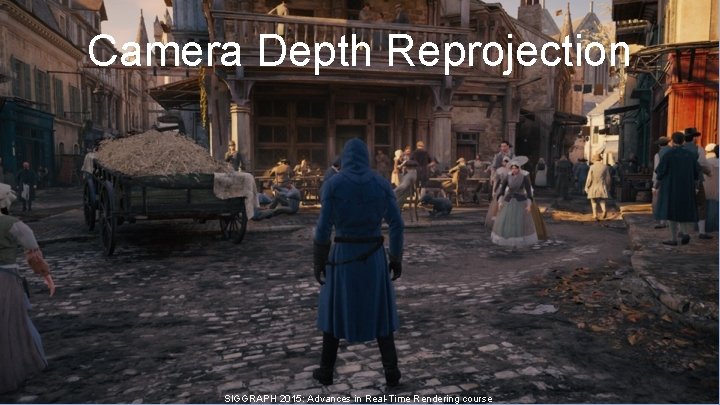
Camera Depth Reprojection • Similar to [Silvennoinen 12] • But, mask not effective because of fog: – Cannot use min-depth – Cannot exclude far-plane • 64 x 64 pixel reprojection • Could pre-process depth to remove redundant overdraw SIGGRAPH 2015: Advances in Real-Time Rendering course
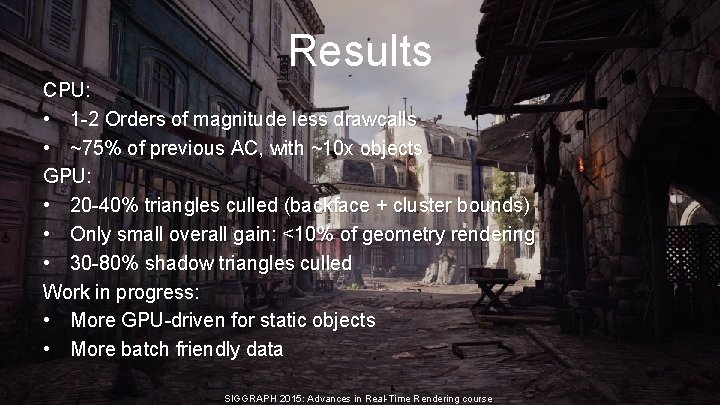
Results CPU: • 1 -2 Orders of magnitude less drawcalls • ~75% of previous AC, with ~10 x objects GPU: • 20 -40% triangles culled (backface + cluster bounds) • Only small overall gain: <10% of geometry rendering • 30 -80% shadow triangles culled Work in progress: • More GPU-driven for static objects • More batch friendly data SIGGRAPH 2015: Advances in Real-Time Rendering course
Future • Bindless textures • GPU-driven vs. DX 12/Vulkan SIGGRAPH 2015: Advances in Real-Time Rendering course
Red. Lynx Topics • • • Virtual Texturing in GPU-Driven Rendering Virtual Deferred Texturing MSAA Trick Two-Phase Occlusion Culling Virtual Shadow Mapping SIGGRAPH 2015: Advances in Real-Time Rendering course
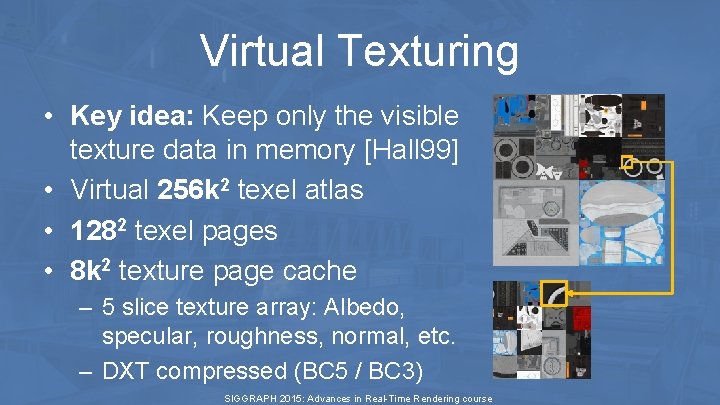
Virtual Texturing • Key idea: Keep only the visible texture data in memory [Hall 99] • Virtual 256 k 2 texel atlas • 1282 texel pages • 8 k 2 texture page cache – 5 slice texture array: Albedo, specular, roughness, normal, etc. – DXT compressed (BC 5 / BC 3) SIGGRAPH 2015: Advances in Real-Time Rendering course
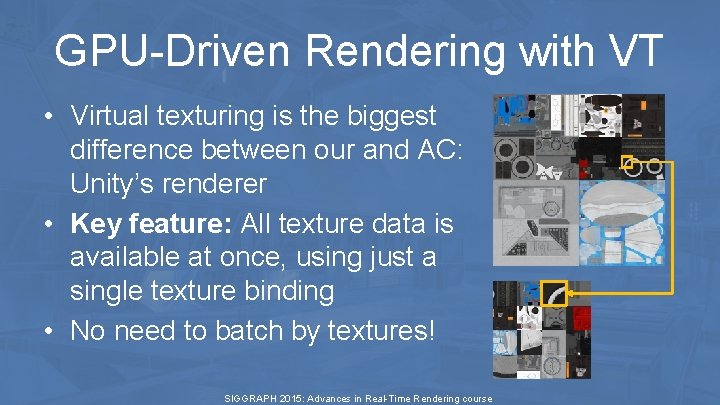
GPU-Driven Rendering with VT • Virtual texturing is the biggest difference between our and AC: Unity’s renderer • Key feature: All texture data is available at once, using just a single texture binding • No need to batch by textures! SIGGRAPH 2015: Advances in Real-Time Rendering course
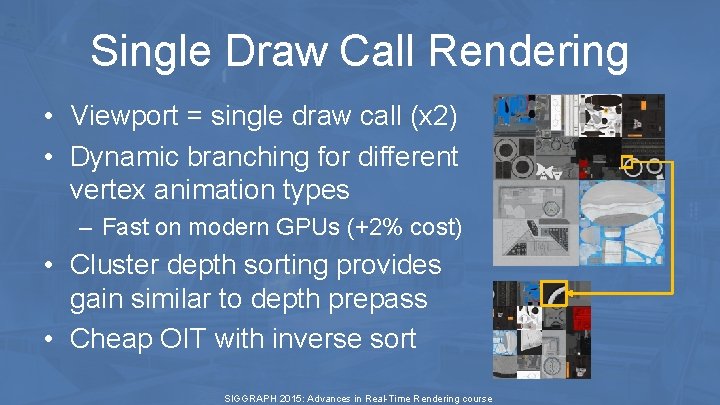
Single Draw Call Rendering • Viewport = single draw call (x 2) • Dynamic branching for different vertex animation types – Fast on modern GPUs (+2% cost) • Cluster depth sorting provides gain similar to depth prepass • Cheap OIT with inverse sort SIGGRAPH 2015: Advances in Real-Time Rendering course
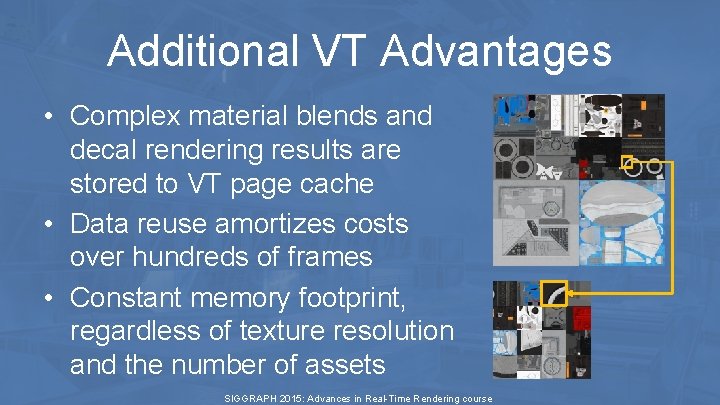
Additional VT Advantages • Complex material blends and decal rendering results are stored to VT page cache • Data reuse amortizes costs over hundreds of frames • Constant memory footprint, regardless of texture resolution and the number of assets SIGGRAPH 2015: Advances in Real-Time Rendering course
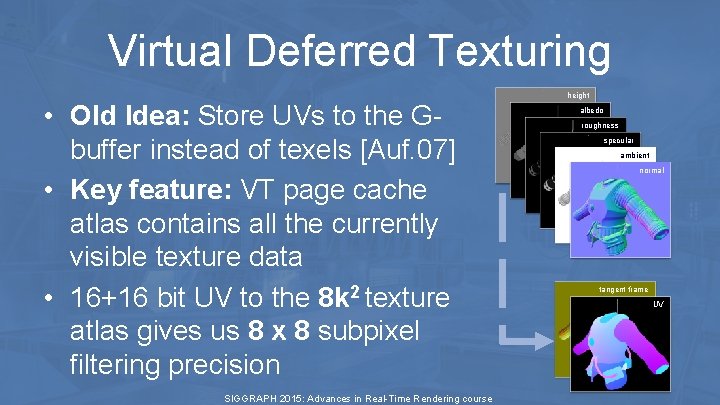
Virtual Deferred Texturing • Old Idea: Store UVs to the Gbuffer instead of texels [Auf. 07] • Key feature: VT page cache atlas contains all the currently visible texture data • 16+16 bit UV to the 8 k 2 texture atlas gives us 8 x 8 subpixel filtering precision SIGGRAPH 2015: Advances in Real-Time Rendering course height albedo roughness specular ambient normal tangent frame UV
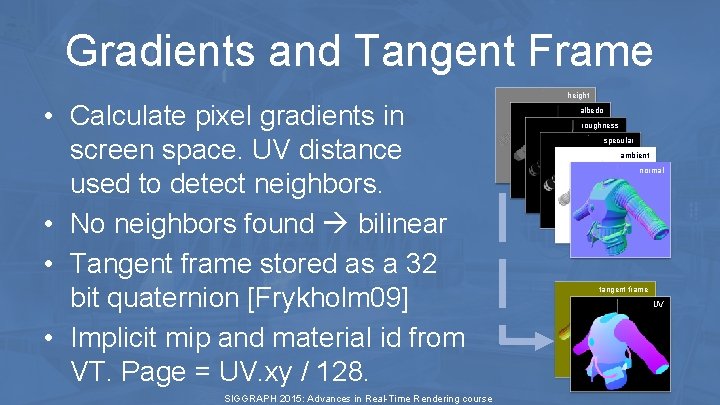
Gradients and Tangent Frame • Calculate pixel gradients in screen space. UV distance used to detect neighbors. • No neighbors found bilinear • Tangent frame stored as a 32 bit quaternion [Frykholm 09] • Implicit mip and material id from VT. Page = UV. xy / 128. SIGGRAPH 2015: Advances in Real-Time Rendering course height albedo roughness specular ambient normal tangent frame UV
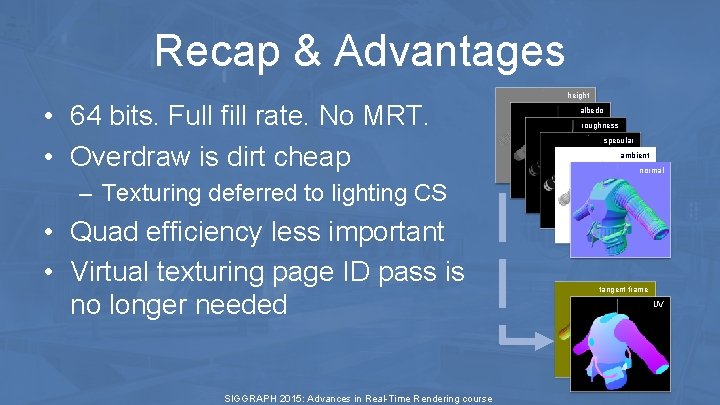
Recap & Advantages • 64 bits. Full fill rate. No MRT. • Overdraw is dirt cheap height albedo roughness specular ambient normal – Texturing deferred to lighting CS • Quad efficiency less important • Virtual texturing page ID pass is no longer needed SIGGRAPH 2015: Advances in Real-Time Rendering course tangent frame UV
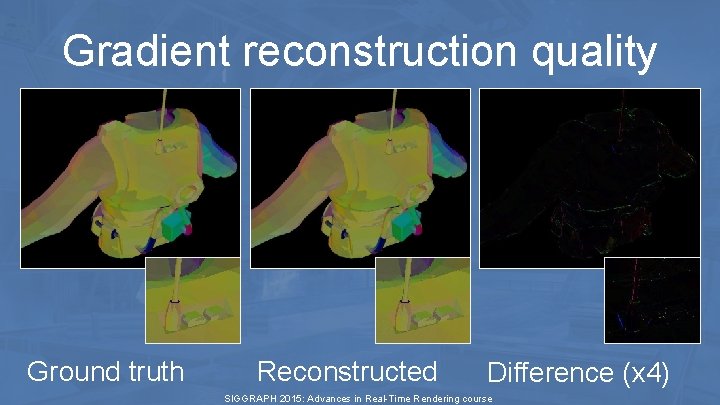
Gradient reconstruction quality Ground truth Reconstructed Difference (x 4) SIGGRAPH 2015: Advances in Real-Time Rendering course
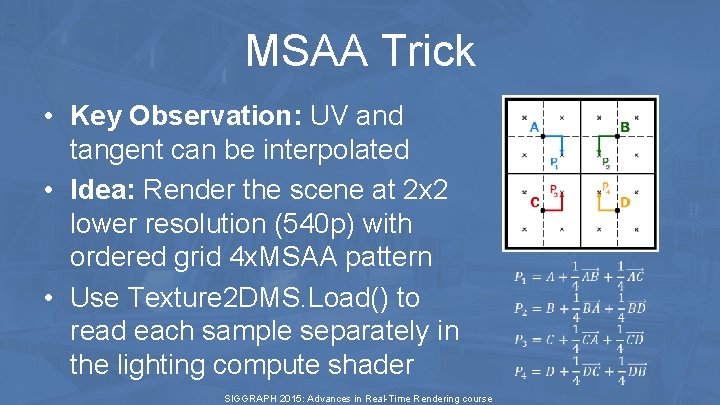
MSAA Trick • Key Observation: UV and tangent can be interpolated • Idea: Render the scene at 2 x 2 lower resolution (540 p) with ordered grid 4 x. MSAA pattern • Use Texture 2 DMS. Load() to read each sample separately in the lighting compute shader SIGGRAPH 2015: Advances in Real-Time Rendering course
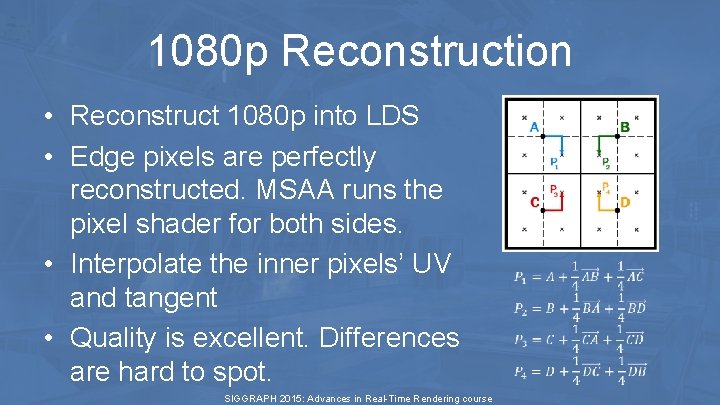
1080 p Reconstruction • Reconstruct 1080 p into LDS • Edge pixels are perfectly reconstructed. MSAA runs the pixel shader for both sides. • Interpolate the inner pixels’ UV and tangent • Quality is excellent. Differences are hard to spot. SIGGRAPH 2015: Advances in Real-Time Rendering course
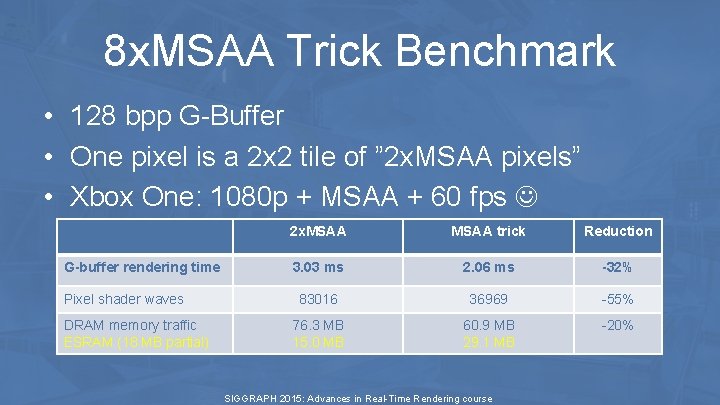
8 x. MSAA Trick Benchmark • 128 bpp G-Buffer • One pixel is a 2 x 2 tile of ” 2 x. MSAA pixels” • Xbox One: 1080 p + MSAA + 60 fps G-buffer rendering time Pixel shader waves DRAM memory traffic ESRAM (18 MB partial) 2 x. MSAA trick Reduction 3. 03 ms 2. 06 ms -32% 83016 36969 -55% 76. 3 MB 15. 0 MB 60. 9 MB 29. 1 MB -20% SIGGRAPH 2015: Advances in Real-Time Rendering course
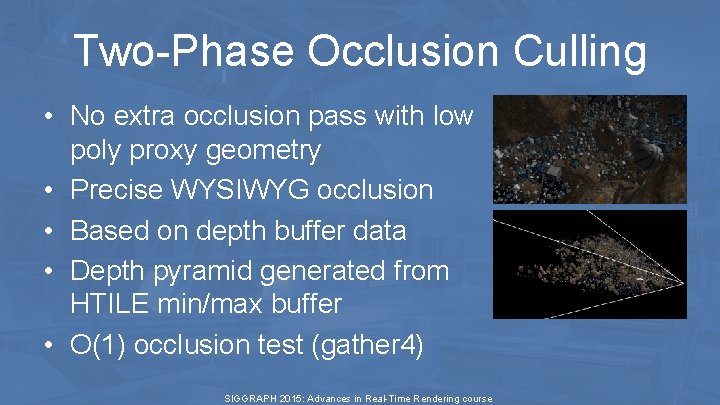
Two-Phase Occlusion Culling • No extra occlusion pass with low poly proxy geometry • Precise WYSIWYG occlusion • Based on depth buffer data • Depth pyramid generated from HTILE min/max buffer • O(1) occlusion test (gather 4) SIGGRAPH 2015: Advances in Real-Time Rendering course
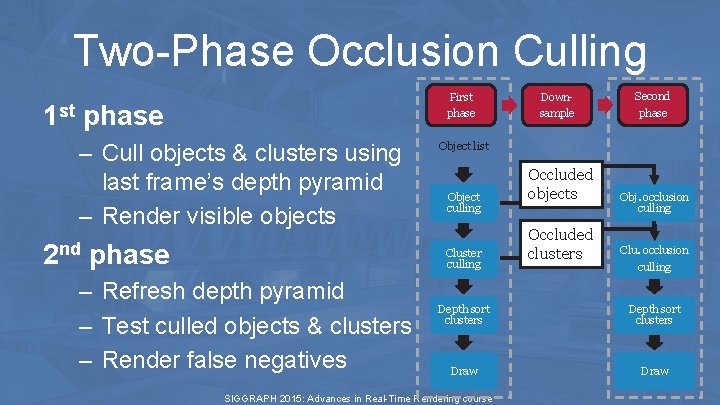
Two-Phase Occlusion Culling First phase 1 st phase – Cull objects & clusters using last frame’s depth pyramid – Render visible objects 2 nd phase Second phase Object list Object culling Cluster culling – Refresh depth pyramid – Test culled objects & clusters – Render false negatives Downsample Occluded objects Occluded clusters Obj. occlusion culling Clu. occlusion culling Depth sort clusters Draw SIGGRAPH 2015: Advances in Real-Time Rendering course
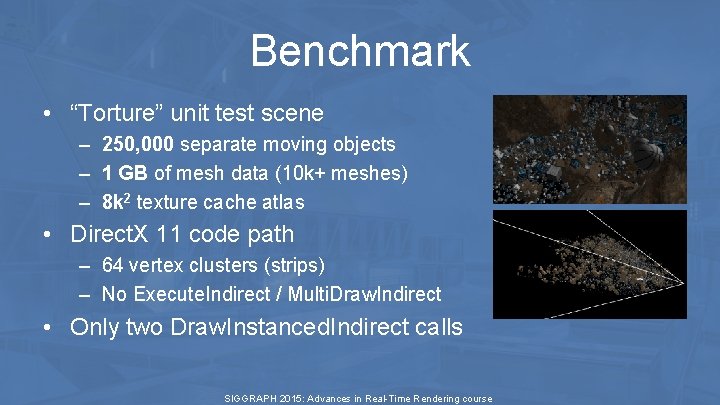
Benchmark • “Torture” unit test scene – 250, 000 separate moving objects – 1 GB of mesh data (10 k+ meshes) – 8 k 2 texture cache atlas • Direct. X 11 code path – 64 vertex clusters (strips) – No Execute. Indirect / Multi. Draw. Indirect • Only two Draw. Instanced. Indirect calls SIGGRAPH 2015: Advances in Real-Time Rendering course
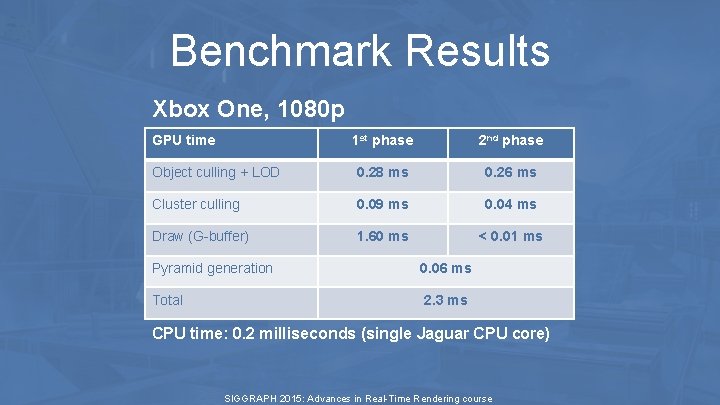
Benchmark Results Xbox One, 1080 p GPU time 1 st phase 2 nd phase Object culling + LOD 0. 28 ms 0. 26 ms Cluster culling 0. 09 ms 0. 04 ms Draw (G-buffer) 1. 60 ms < 0. 01 ms Pyramid generation 0. 06 ms Total 2. 3 ms CPU time: 0. 2 milliseconds (single Jaguar CPU core) SIGGRAPH 2015: Advances in Real-Time Rendering course
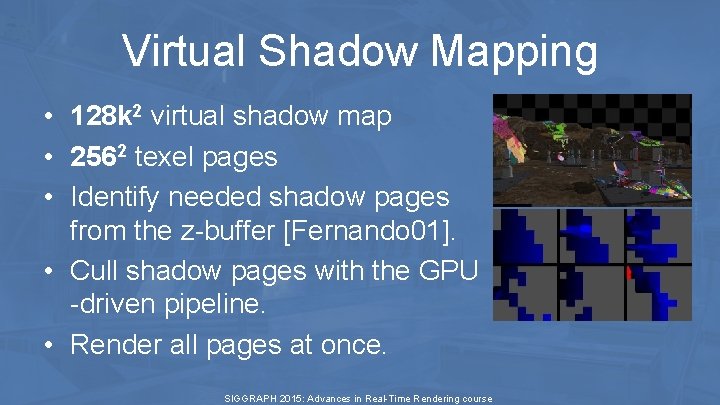
Virtual Shadow Mapping • 128 k 2 virtual shadow map • 2562 texel pages • Identify needed shadow pages from the z-buffer [Fernando 01]. • Cull shadow pages with the GPU -driven pipeline. • Render all pages at once. SIGGRAPH 2015: Advances in Real-Time Rendering course
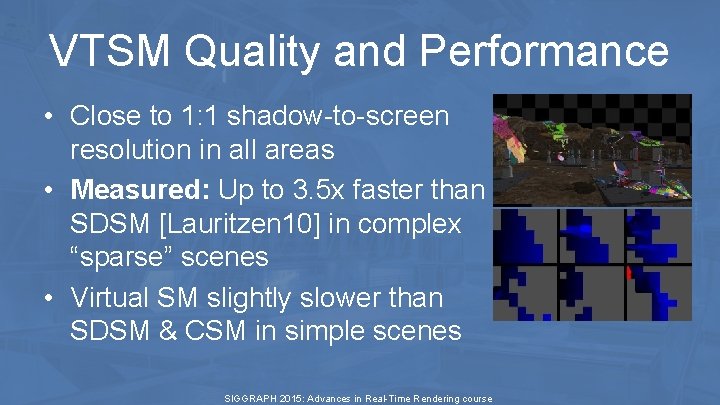
VTSM Quality and Performance • Close to 1: 1 shadow-to-screen resolution in all areas • Measured: Up to 3. 5 x faster than SDSM [Lauritzen 10] in complex “sparse” scenes • Virtual SM slightly slower than SDSM & CSM in simple scenes SIGGRAPH 2015: Advances in Real-Time Rendering course
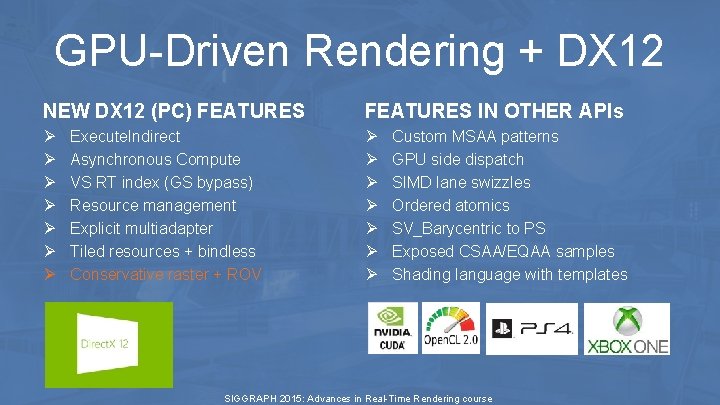
GPU-Driven Rendering + DX 12 NEW DX 12 (PC) FEATURES IN OTHER APIs Ø Ø Ø Ø Execute. Indirect Asynchronous Compute VS RT index (GS bypass) Resource management Explicit multiadapter Tiled resources + bindless Conservative raster + ROV Custom MSAA patterns GPU side dispatch SIMD lane swizzles Ordered atomics SV_Barycentric to PS Exposed CSAA/EQAA samples Shading language with templates SIGGRAPH 2015: Advances in Real-Time Rendering course
References [SBOT 08] Shopf, J. , Barczak, J. , Oat, C. , Tatarchuk, N. March of the Froblins: simulation and rendering massive crowds of intelligent and detailed creatures on GPU, SIGGRAPH 2008. [Persson 12] Merge-Instancing, SIGGRAPH 2012. [Greene 93] Hierarchical Z-buffer visibility, SIGGRAPH 1993. [Hill 11] Practical, Dynamic Visibility for Games, GPU Pro 2, 2011. [Decoret 05] N-Buffers for efficient depth map query, Computer Graphics Forum, Volume 24, Number 3, 2005. [Zhang 97] Visibility Culling using Hierarchical Occlusion Maps, SIGGRAPH 1997. [Riccio 13] Introducing the Programmable Vertex Pulling Rendering Pipeline, GPU Pro 4, 2013. [Silvennoinen 12] Chasing Shadows, GDMag Feb/2012. [Hall 99] Virtual Textures, Texture Management in Silicon, 1999. [Aufderheide 07] Deferred Texture mapping? , 2007. [Reed 14] Deferred Texturing, 2014. [Frykholm 09] The Bit. Squid low level animation system, 2009. [Fernando 01] Adaptive Shadow Maps, SIGGRAPH 2001. [Lauritzen 10] Sample Distribution Shadow Maps, SIGGRAPH 2010. SIGGRAPH 2015: Advances in Real-Time Rendering course
Acknowledgements • • Stephen Hill Roland Kindermann Jussi Knuuttila Jalal Eddine El Mansouri Tiago Rodrigues Lionel Berenguier Stephen Mc. Auley Ivan Nevraev
GPU-Driven Rendering Pipelines. Ulrich Haar, Lead Programmer 3 D Ubisoft Montreal Sebastian Aaltonen, Senior Lead Programmer Red. Lynx, a Ubisoft Studio