
SIFT keypoint detection D Lowe Distinctive image features
- Slides: 40
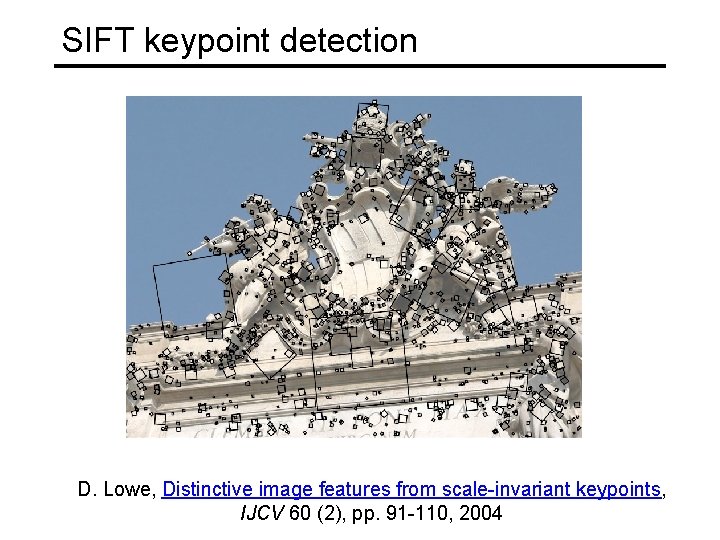
SIFT keypoint detection D. Lowe, Distinctive image features from scale-invariant keypoints, IJCV 60 (2), pp. 91 -110, 2004
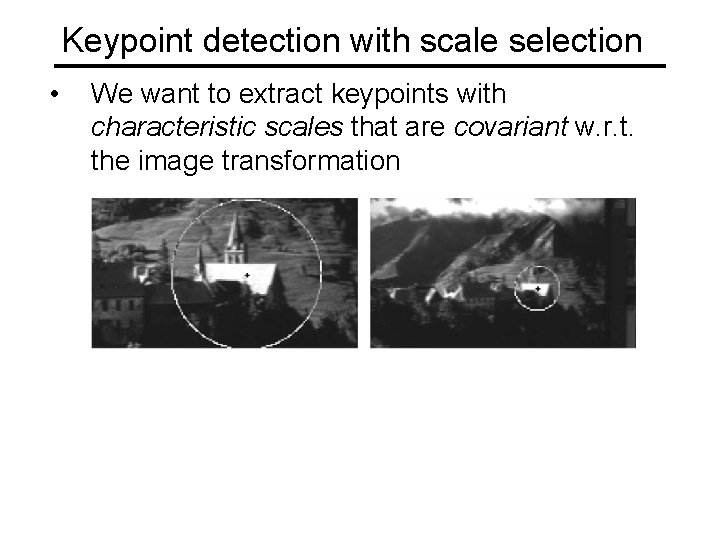
Keypoint detection with scale selection • We want to extract keypoints with characteristic scales that are covariant w. r. t. the image transformation
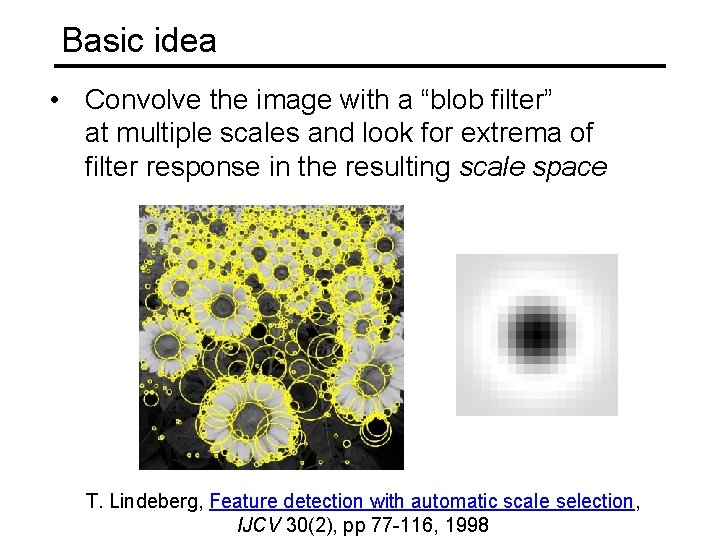
Basic idea • Convolve the image with a “blob filter” at multiple scales and look for extrema of filter response in the resulting scale space T. Lindeberg, Feature detection with automatic scale selection, IJCV 30(2), pp 77 -116, 1998
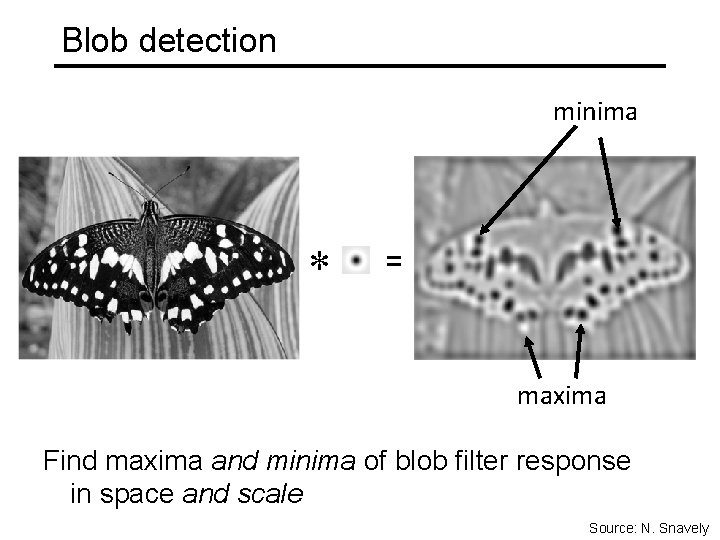
Blob detection minima * = maxima Find maxima and minima of blob filter response in space and scale Source: N. Snavely
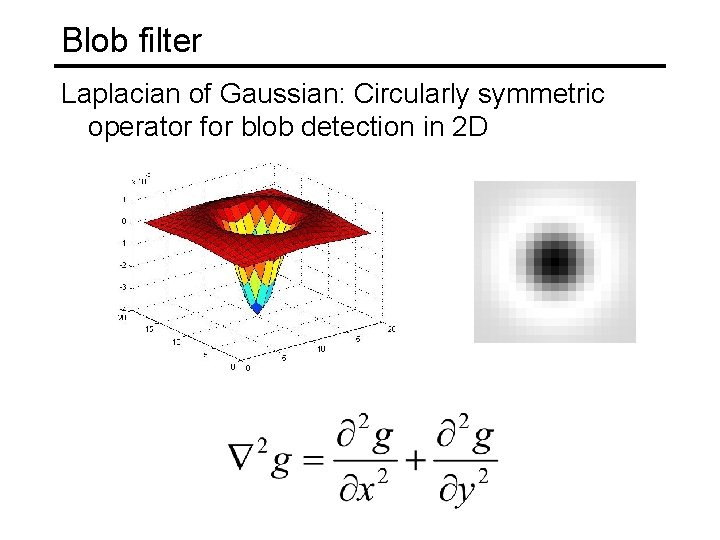
Blob filter Laplacian of Gaussian: Circularly symmetric operator for blob detection in 2 D
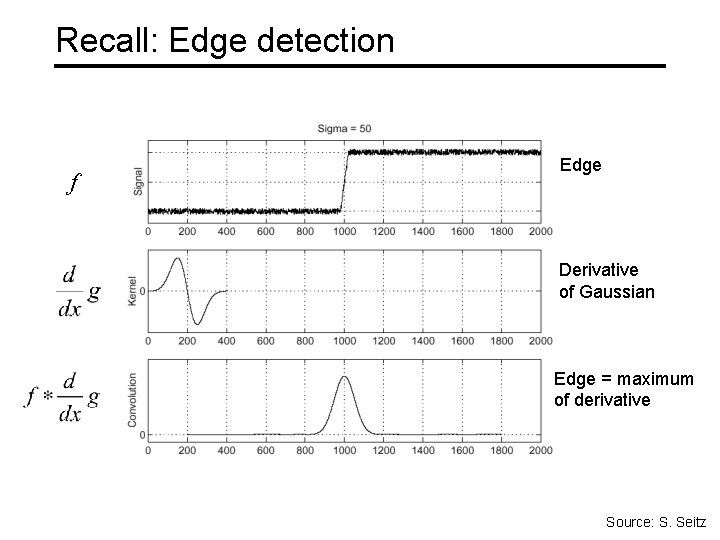
Recall: Edge detection f Edge Derivative of Gaussian Edge = maximum of derivative Source: S. Seitz
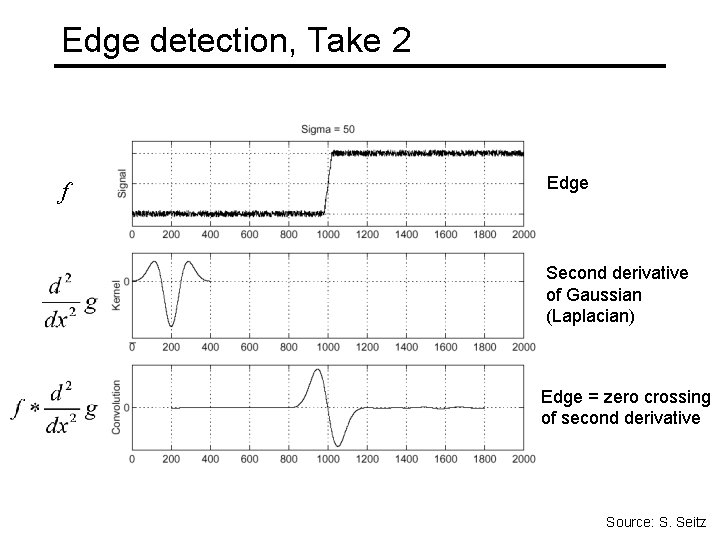
Edge detection, Take 2 f Edge Second derivative of Gaussian (Laplacian) Edge = zero crossing of second derivative Source: S. Seitz
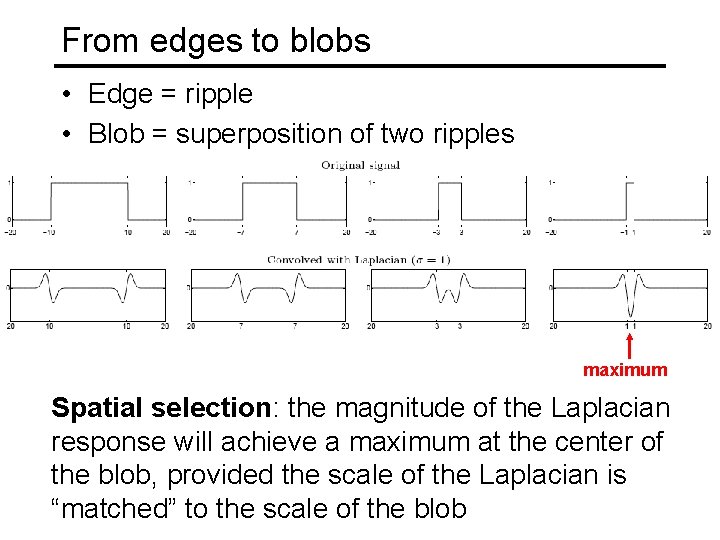
From edges to blobs • Edge = ripple • Blob = superposition of two ripples maximum Spatial selection: the magnitude of the Laplacian response will achieve a maximum at the center of the blob, provided the scale of the Laplacian is “matched” to the scale of the blob
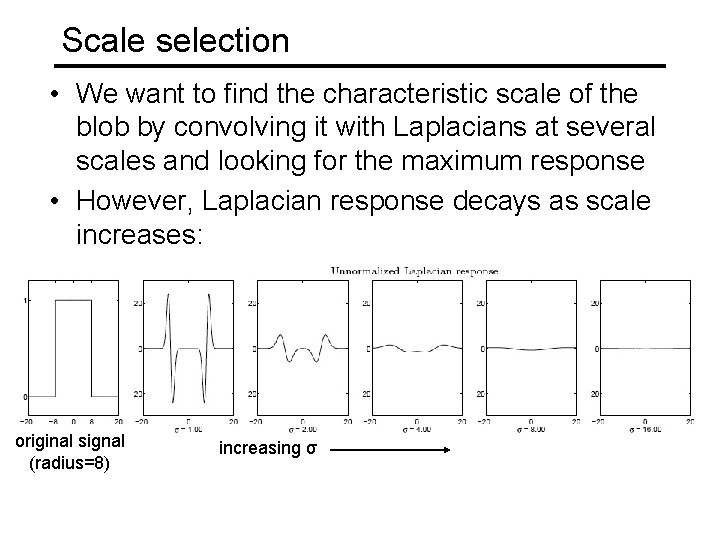
Scale selection • We want to find the characteristic scale of the blob by convolving it with Laplacians at several scales and looking for the maximum response • However, Laplacian response decays as scale increases: original signal (radius=8) increasing σ
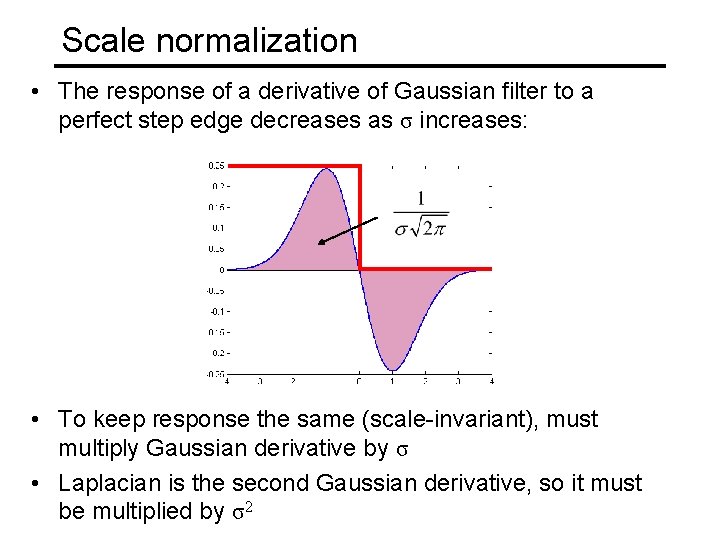
Scale normalization • The response of a derivative of Gaussian filter to a perfect step edge decreases as σ increases: • To keep response the same (scale-invariant), must multiply Gaussian derivative by σ • Laplacian is the second Gaussian derivative, so it must be multiplied by σ2
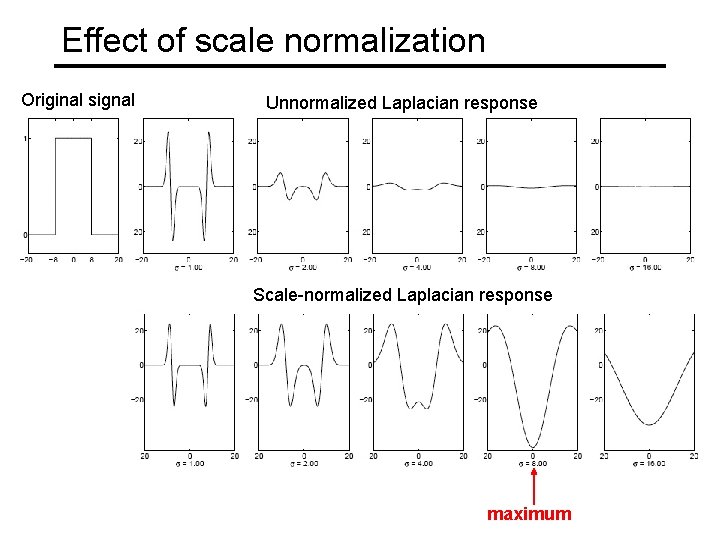
Effect of scale normalization Original signal Unnormalized Laplacian response Scale-normalized Laplacian response maximum
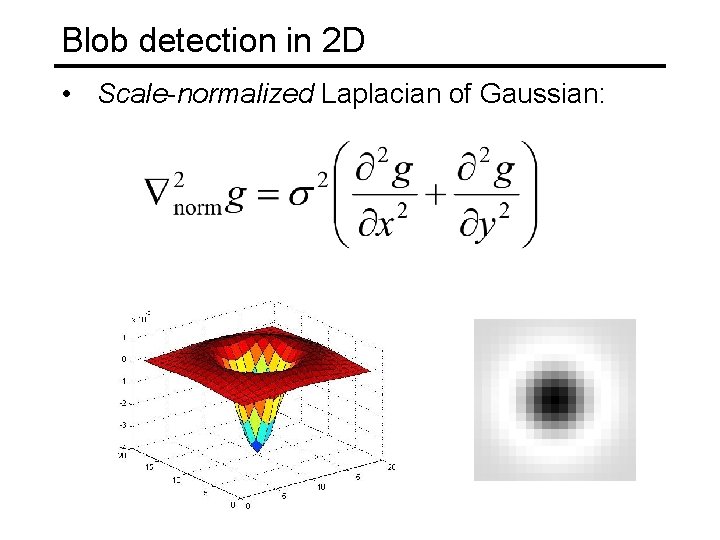
Blob detection in 2 D • Scale-normalized Laplacian of Gaussian:
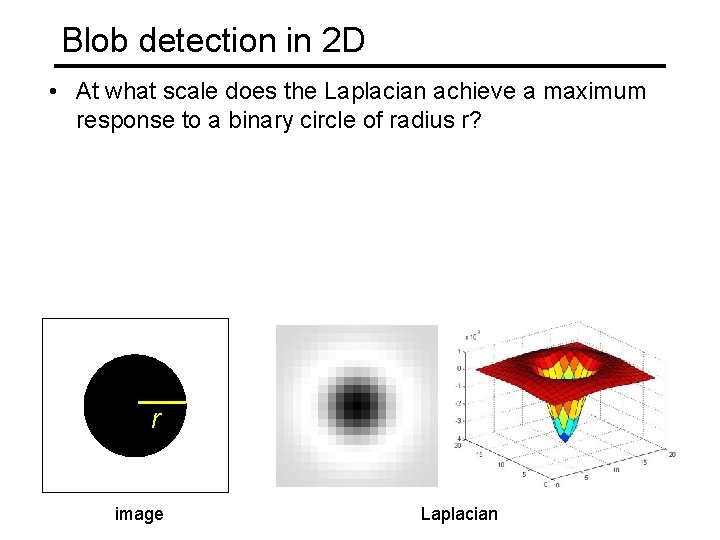
Blob detection in 2 D • At what scale does the Laplacian achieve a maximum response to a binary circle of radius r? r image Laplacian
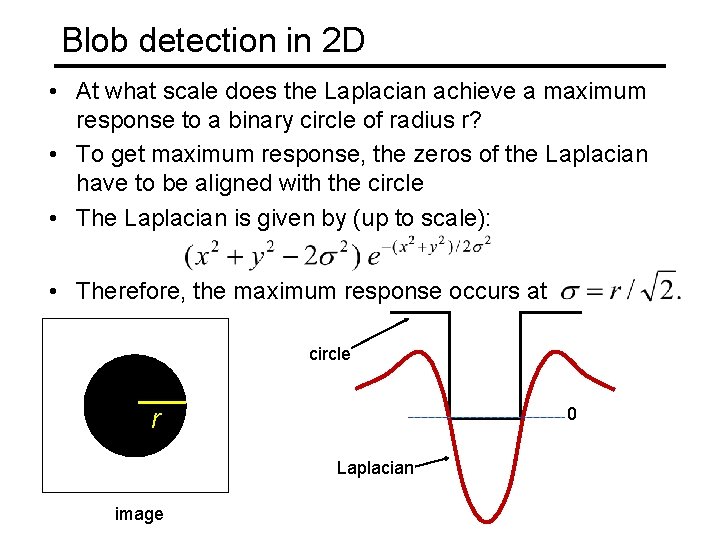
Blob detection in 2 D • At what scale does the Laplacian achieve a maximum response to a binary circle of radius r? • To get maximum response, the zeros of the Laplacian have to be aligned with the circle • The Laplacian is given by (up to scale): • Therefore, the maximum response occurs at circle r 0 Laplacian image
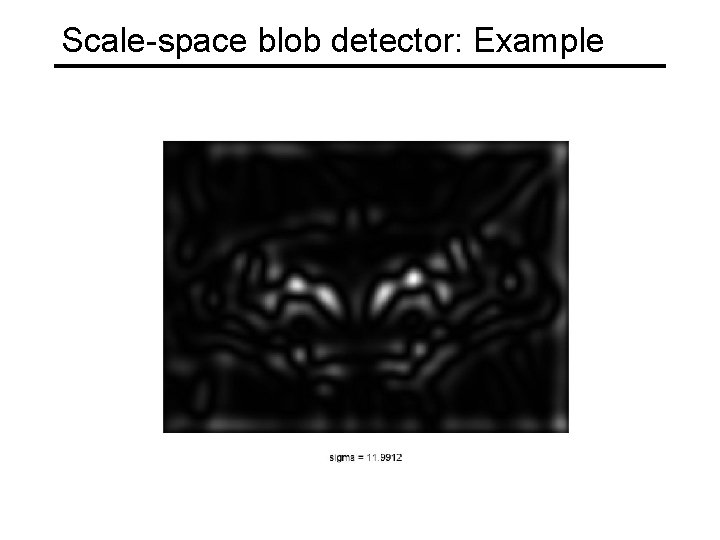
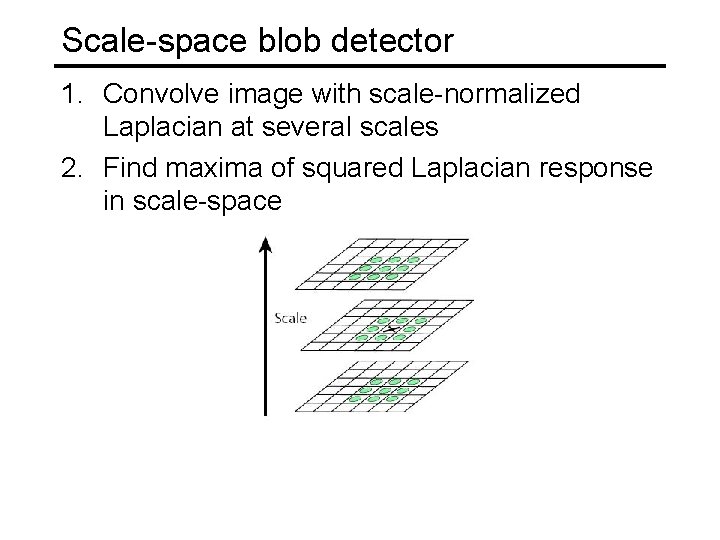
Scale-space blob detector 1. Convolve image with scale-normalized Laplacian at several scales
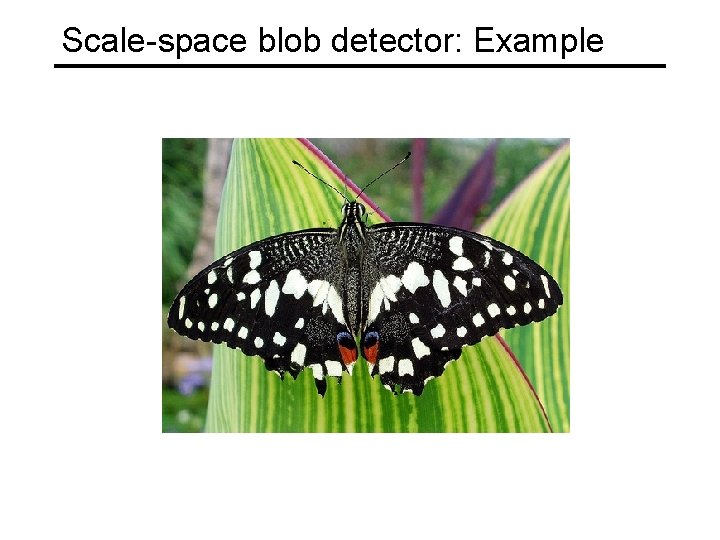
Scale-space blob detector: Example
Scale-space blob detector: Example
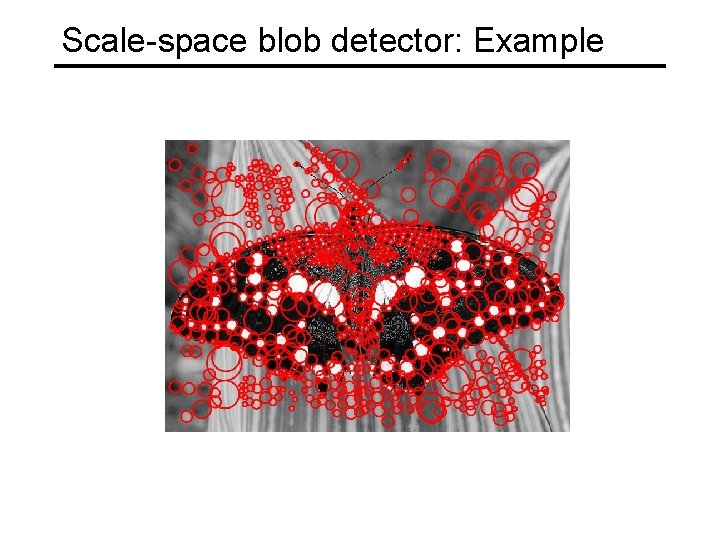
Scale-space blob detector 1. Convolve image with scale-normalized Laplacian at several scales 2. Find maxima of squared Laplacian response in scale-space
Scale-space blob detector: Example
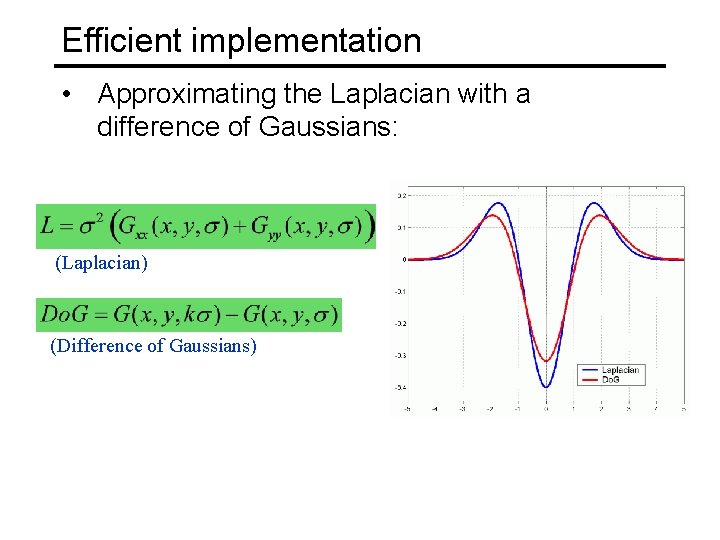
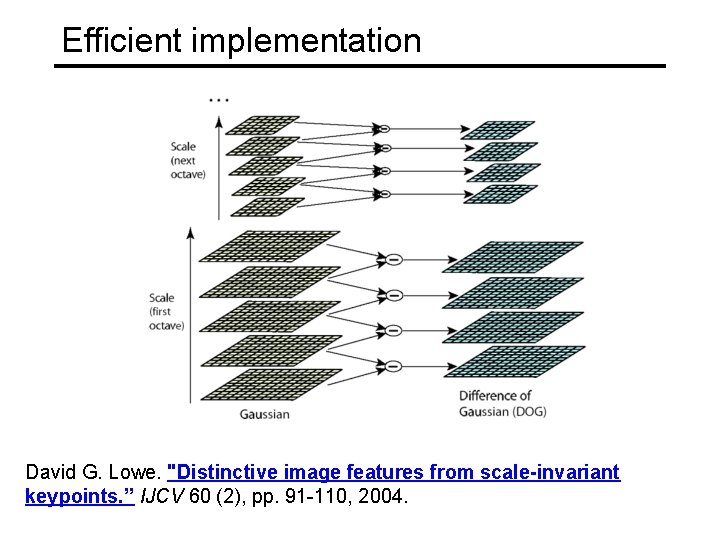
Efficient implementation • Approximating the Laplacian with a difference of Gaussians: (Laplacian) (Difference of Gaussians)
Efficient implementation David G. Lowe. "Distinctive image features from scale-invariant keypoints. ” IJCV 60 (2), pp. 91 -110, 2004.
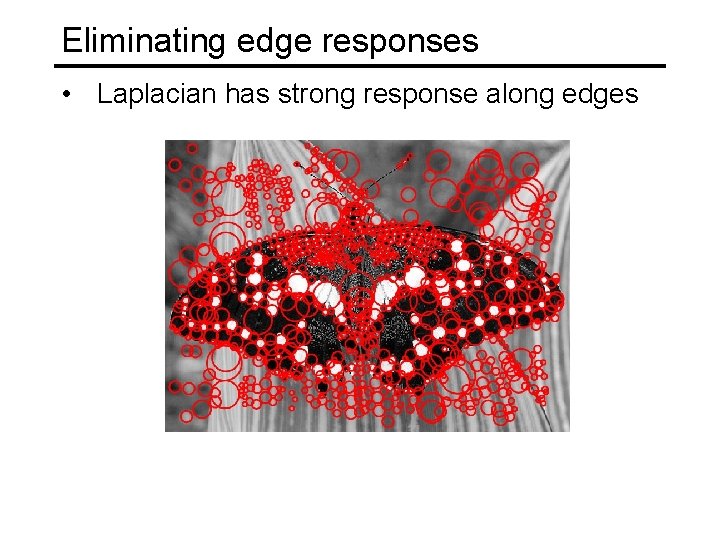
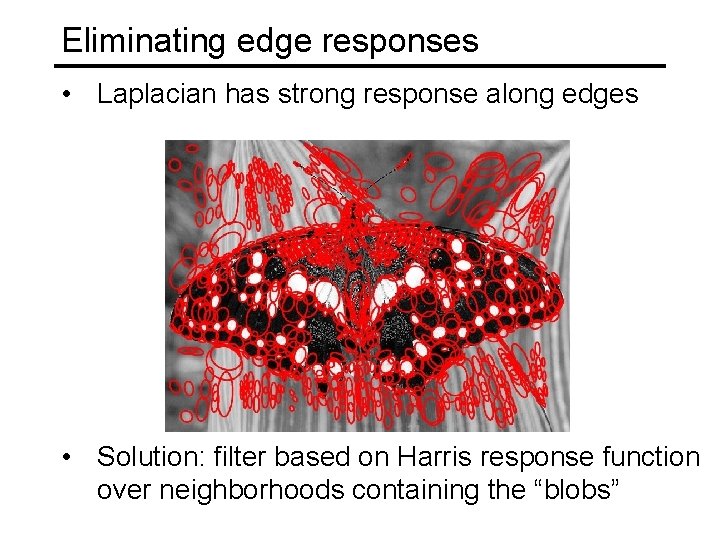
Eliminating edge responses • Laplacian has strong response along edges
Eliminating edge responses • Laplacian has strong response along edges • Solution: filter based on Harris response function over neighborhoods containing the “blobs”
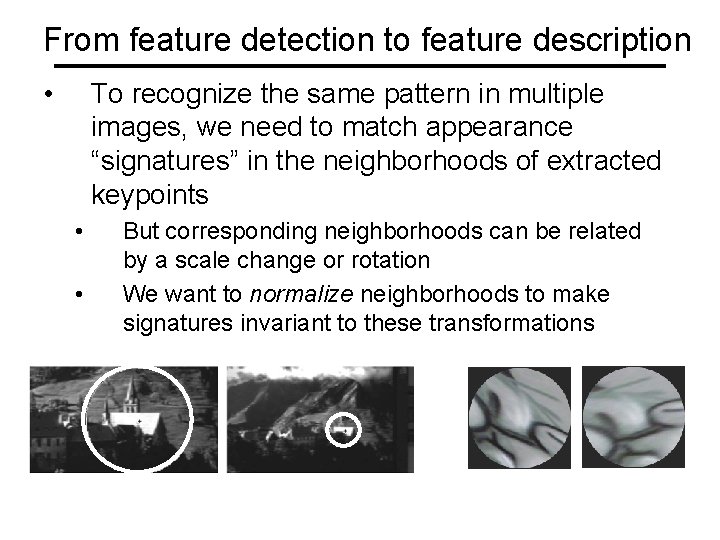
From feature detection to feature description • To recognize the same pattern in multiple images, we need to match appearance “signatures” in the neighborhoods of extracted keypoints • • But corresponding neighborhoods can be related by a scale change or rotation We want to normalize neighborhoods to make signatures invariant to these transformations
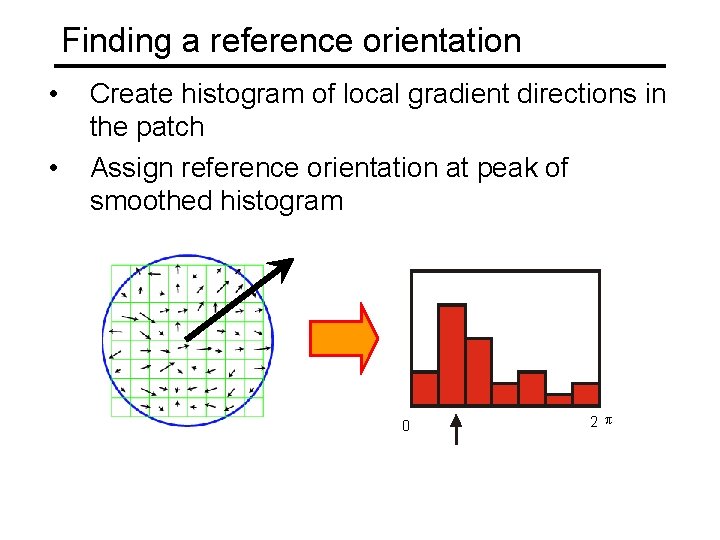
Finding a reference orientation • • Create histogram of local gradient directions in the patch Assign reference orientation at peak of smoothed histogram 0 2 p
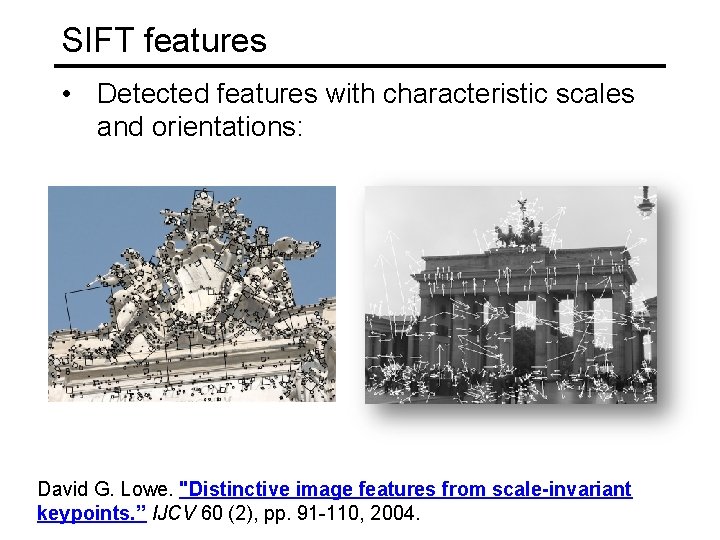
SIFT features • Detected features with characteristic scales and orientations: David G. Lowe. "Distinctive image features from scale-invariant keypoints. ” IJCV 60 (2), pp. 91 -110, 2004.
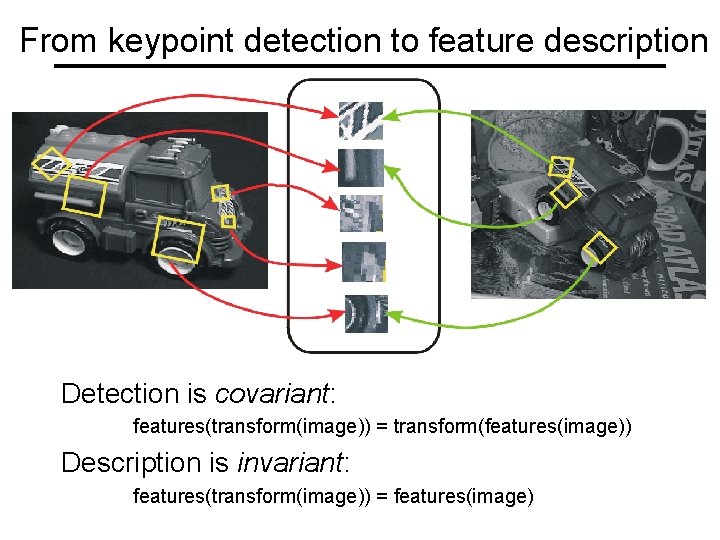
From keypoint detection to feature description Detection is covariant: features(transform(image)) = transform(features(image)) Description is invariant: features(transform(image)) = features(image)
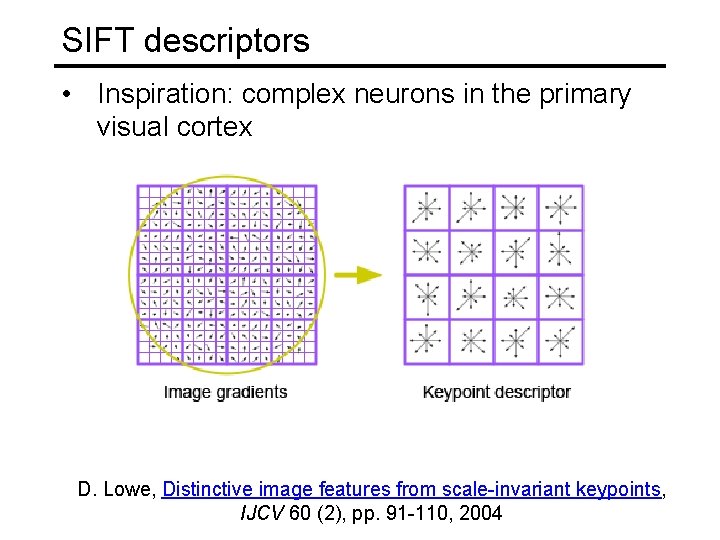
SIFT descriptors • Inspiration: complex neurons in the primary visual cortex D. Lowe, Distinctive image features from scale-invariant keypoints, IJCV 60 (2), pp. 91 -110, 2004
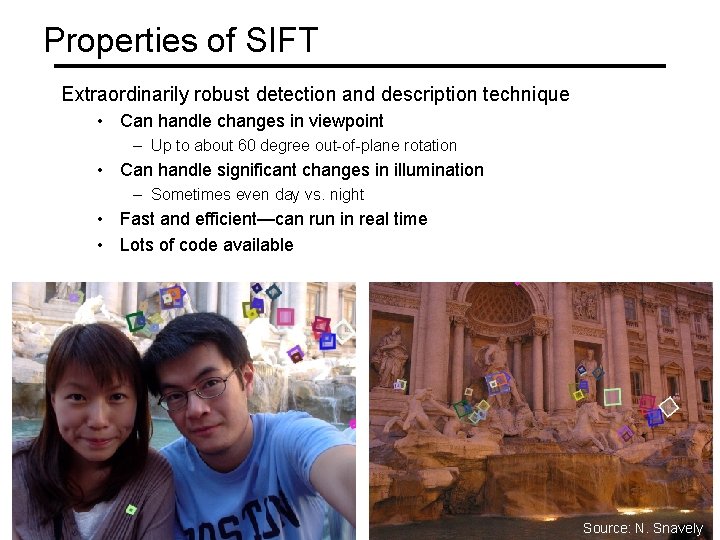
Properties of SIFT Extraordinarily robust detection and description technique • Can handle changes in viewpoint – Up to about 60 degree out-of-plane rotation • Can handle significant changes in illumination – Sometimes even day vs. night • Fast and efficient—can run in real time • Lots of code available Source: N. Snavely
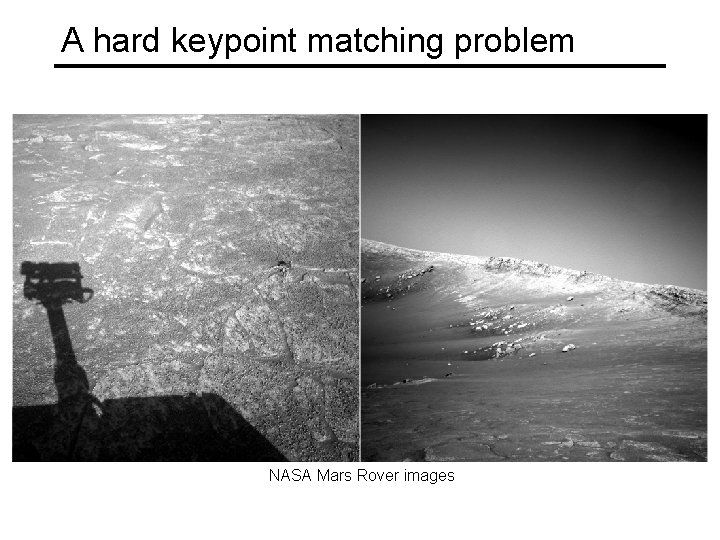
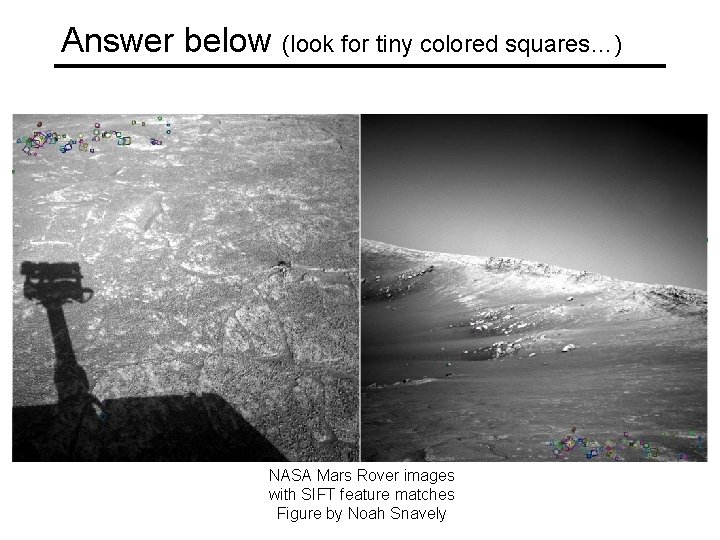
A hard keypoint matching problem NASA Mars Rover images
Answer below (look for tiny colored squares…) NASA Mars Rover images with SIFT feature matches Figure by Noah Snavely
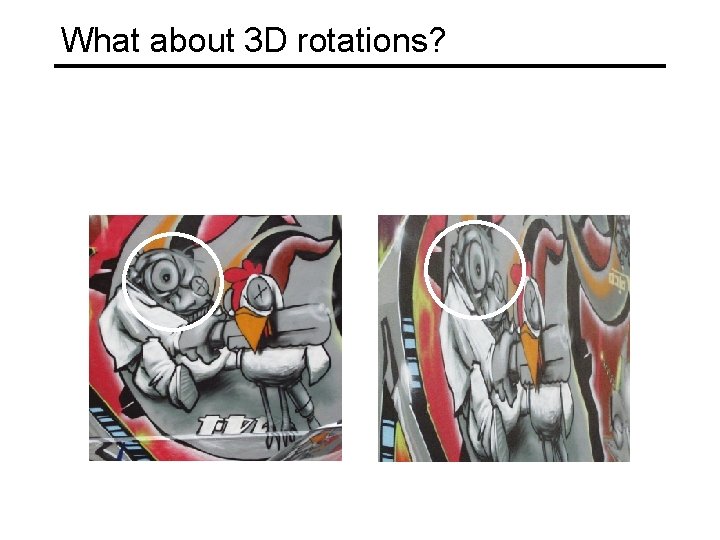
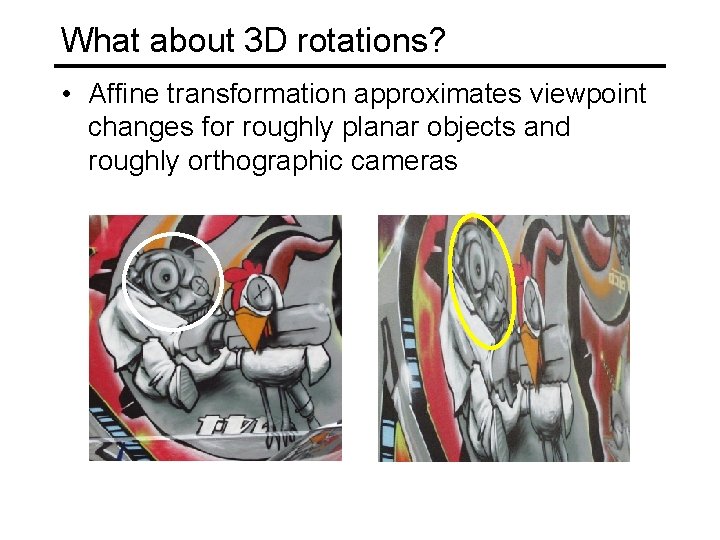
What about 3 D rotations?
What about 3 D rotations? • Affine transformation approximates viewpoint changes for roughly planar objects and roughly orthographic cameras
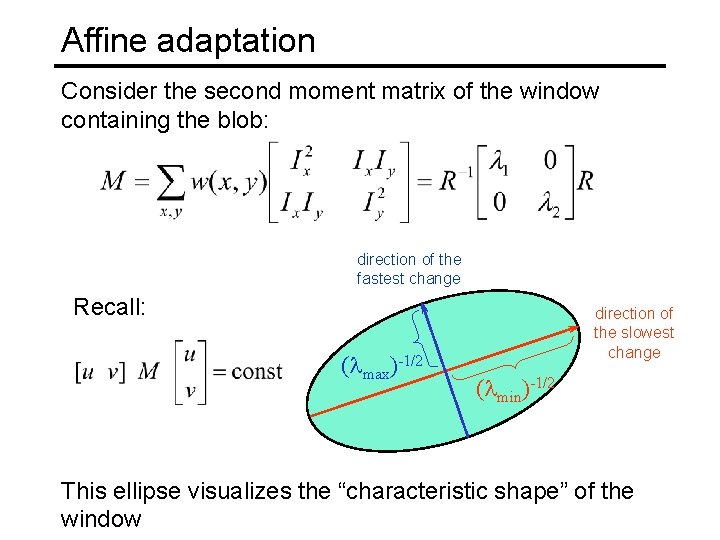
Affine adaptation Consider the second moment matrix of the window containing the blob: direction of the fastest change Recall: ( max)-1/2 direction of the slowest change ( min)-1/2 This ellipse visualizes the “characteristic shape” of the window
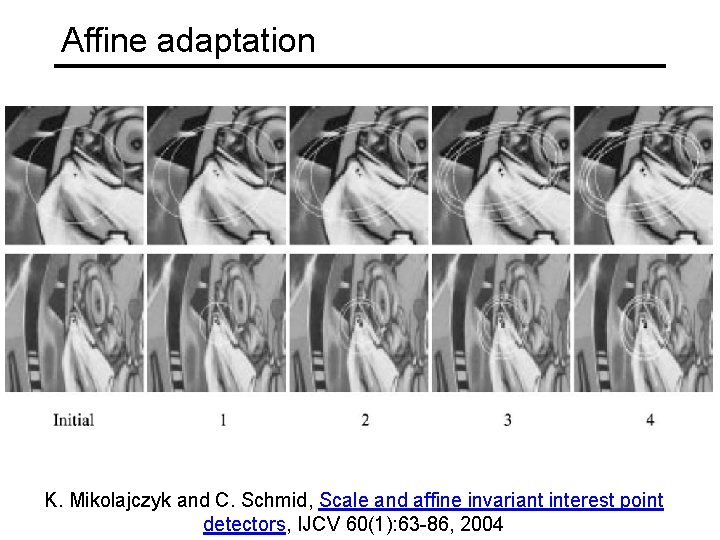
Affine adaptation K. Mikolajczyk and C. Schmid, Scale and affine invariant interest point detectors, IJCV 60(1): 63 -86, 2004
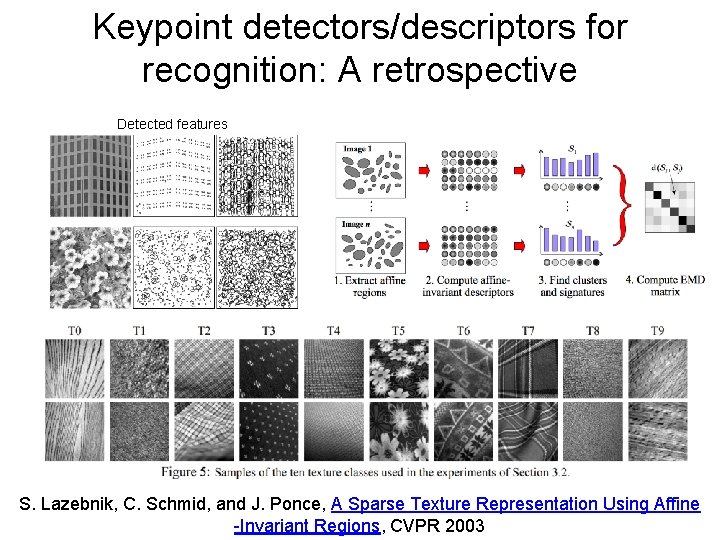
Keypoint detectors/descriptors for recognition: A retrospective Detected features S. Lazebnik, C. Schmid, and J. Ponce, A Sparse Texture Representation Using Affine -Invariant Regions, CVPR 2003
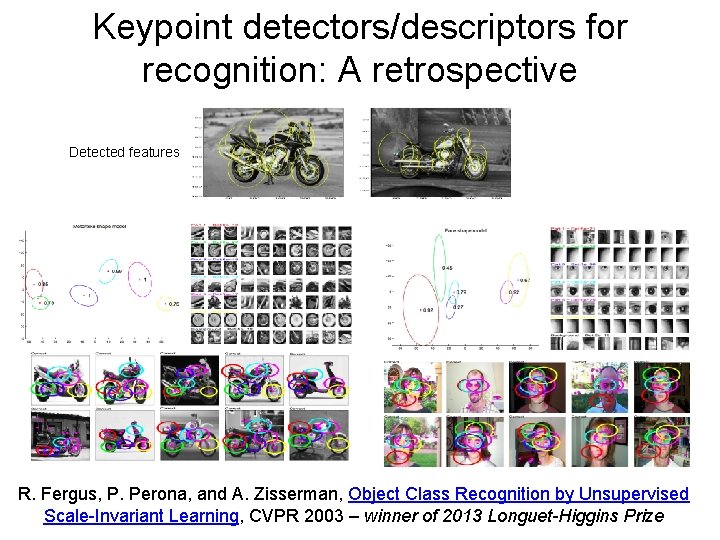
Keypoint detectors/descriptors for recognition: A retrospective Detected features R. Fergus, P. Perona, and A. Zisserman, Object Class Recognition by Unsupervised Scale-Invariant Learning, CVPR 2003 – winner of 2013 Longuet-Higgins Prize
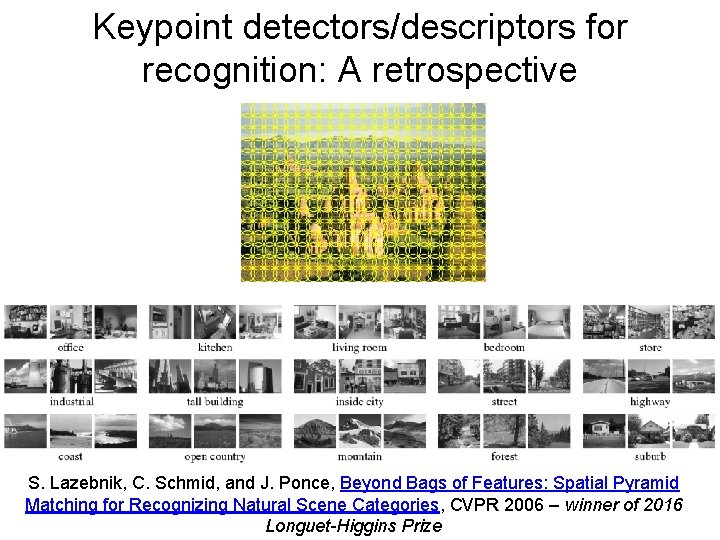
Keypoint detectors/descriptors for recognition: A retrospective S. Lazebnik, C. Schmid, and J. Ponce, Beyond Bags of Features: Spatial Pyramid Matching for Recognizing Natural Scene Categories, CVPR 2006 – winner of 2016 Longuet-Higgins Prize
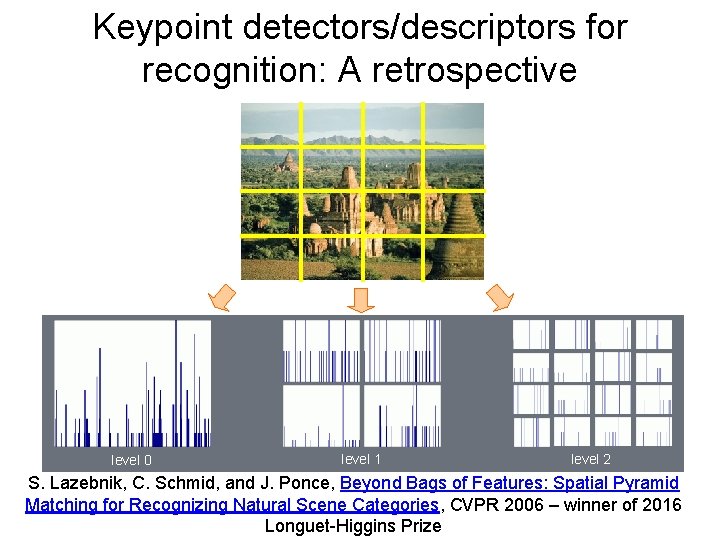
Keypoint detectors/descriptors for recognition: A retrospective level 0 level 1 level 2 S. Lazebnik, C. Schmid, and J. Ponce, Beyond Bags of Features: Spatial Pyramid Matching for Recognizing Natural Scene Categories, CVPR 2006 – winner of 2016 Longuet-Higgins Prize
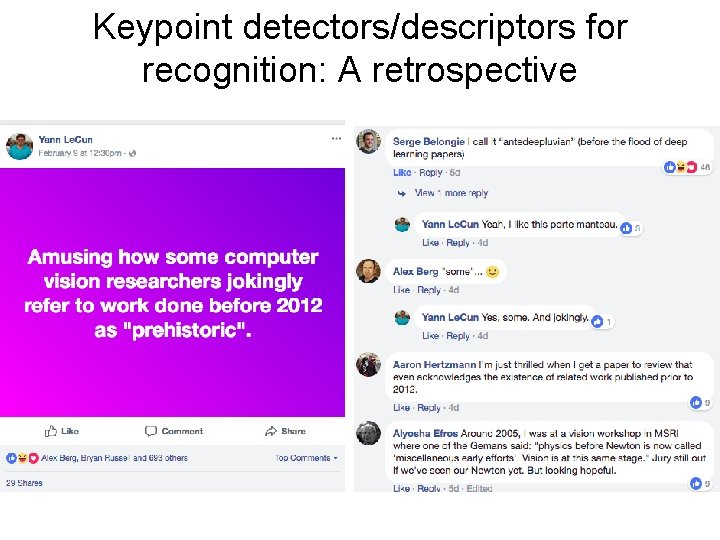
Keypoint detectors/descriptors for recognition: A retrospective