
Sift A MAC Protocol for EventDriven Wireless Sensor
- Slides: 26
Sift: A MAC Protocol for Event-Driven Wireless Sensor Networks Kyle Jamieson, Hari Balakrishnan, Y. C. Tay LNCS Springer 2006 Suho Yang (CS 710: November 4, 2008) KAIST
Contents Introduction Motivation Our proposal: Sift Performance Evaluation Conclusion & Discussion Sift: A MAC Protocol for Event-Driven Wireless Sensor Networks 2 / 24
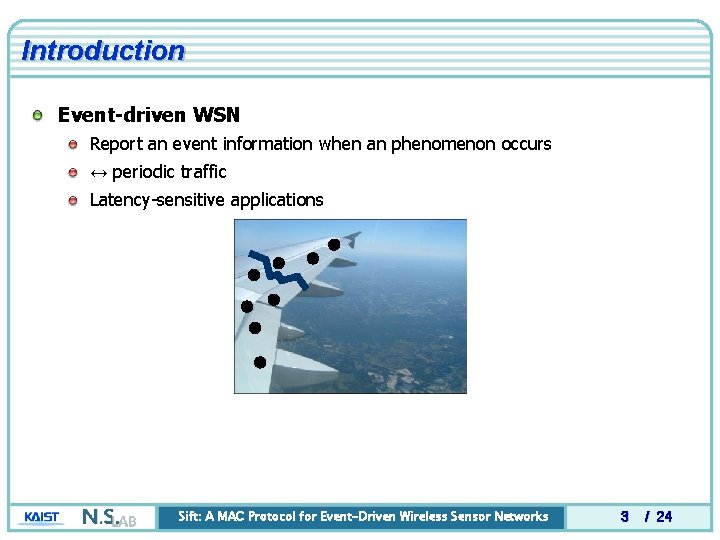
Introduction Event-driven WSN Report an event information when an phenomenon occurs ↔ periodic traffic Latency-sensitive applications Sift: A MAC Protocol for Event-Driven Wireless Sensor Networks 3 / 24
Introduction Sift Focus Designing MAC protocol to handle event-driven traffic Challenges Low latency Good throughput Good fairness Sift: A MAC Protocol for Event-Driven Wireless Sensor Networks 4 / 24
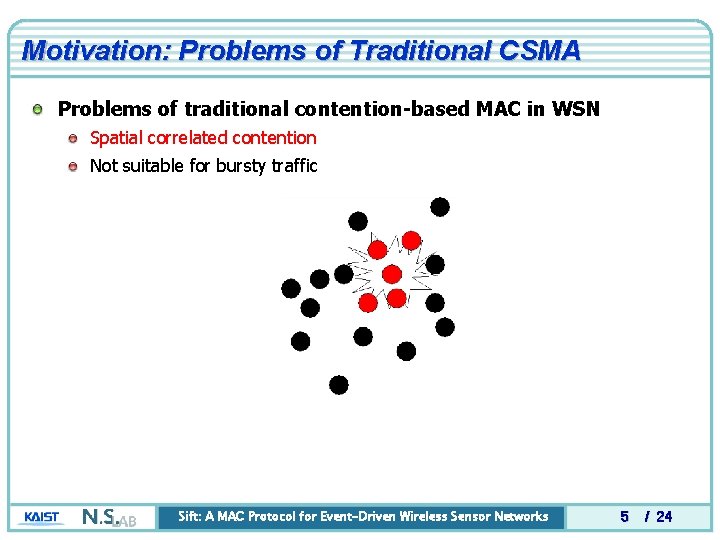
Motivation: Problems of Traditional CSMA Problems of traditional contention-based MAC in WSN Spatial correlated contention Not suitable for bursty traffic Sift: A MAC Protocol for Event-Driven Wireless Sensor Networks 5 / 24
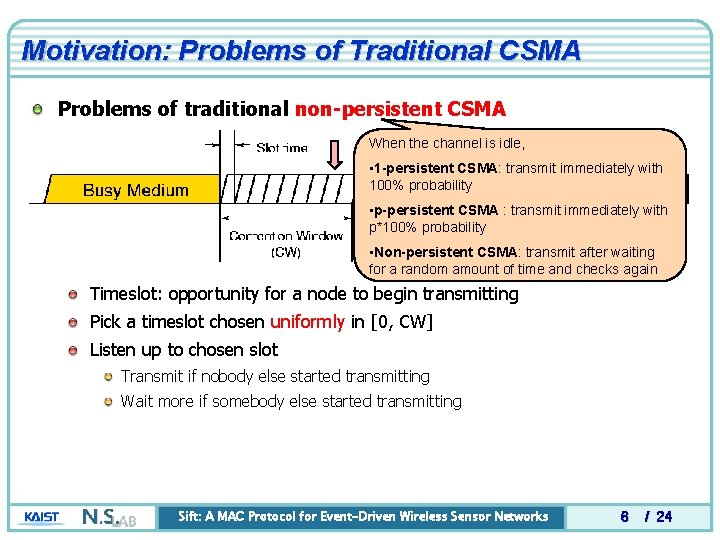
Motivation: Problems of Traditional CSMA Problems of traditional non-persistent CSMA When the channel is idle, • 1 -persistent CSMA: transmit immediately with 100% probability Busy Medium • p-persistent CSMA : transmit immediately with p*100% probability • Non-persistent CSMA: transmit after waiting for a random amount of time and checks again Timeslot: opportunity for a node to begin transmitting Pick a timeslot chosen uniformly in [0, CW] Listen up to chosen slot Transmit if nobody else started transmitting Wait more if somebody else started transmitting Sift: A MAC Protocol for Event-Driven Wireless Sensor Networks 6 / 24
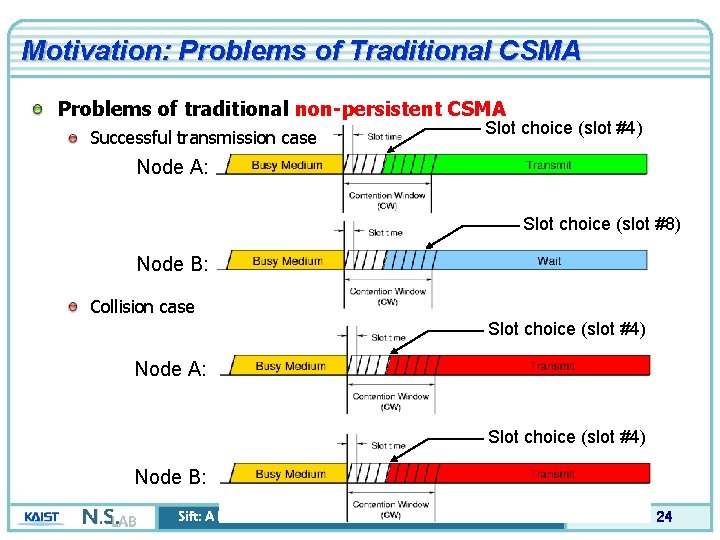
Motivation: Problems of Traditional CSMA Problems of traditional non-persistent CSMA Successful transmission case Slot choice (slot #4) Node A: Slot choice (slot #8) Node B: Collision case Slot choice (slot #4) Node A: Slot choice (slot #4) Node B: Sift: A MAC Protocol for Event-Driven Wireless Sensor Networks 7 / 24
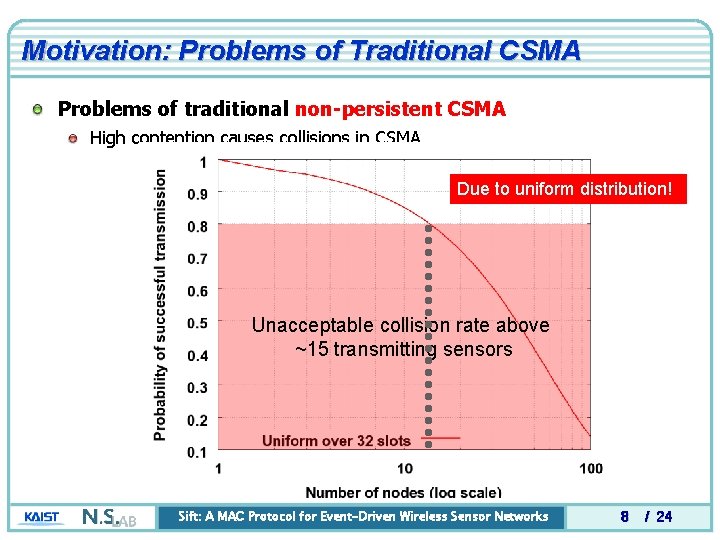
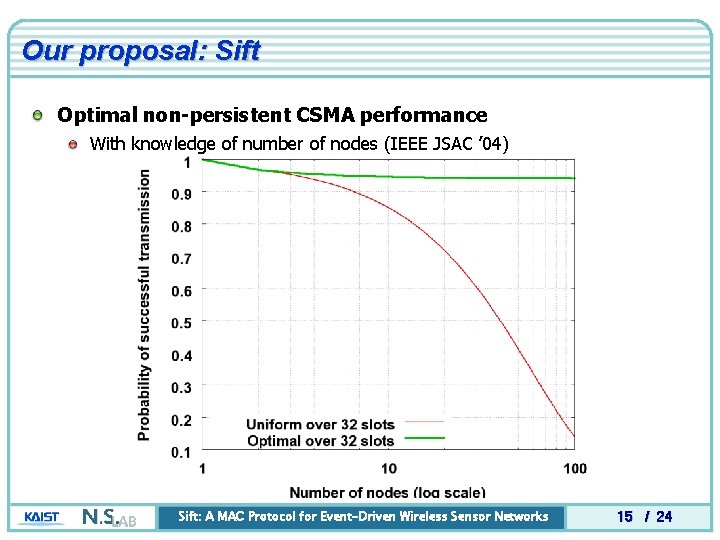
Motivation: Problems of Traditional CSMA Problems of traditional non-persistent CSMA High contention causes collisions in CSMA Due to uniform distribution! Unacceptable collision rate above ~15 transmitting sensors Sift: A MAC Protocol for Event-Driven Wireless Sensor Networks 8 / 24
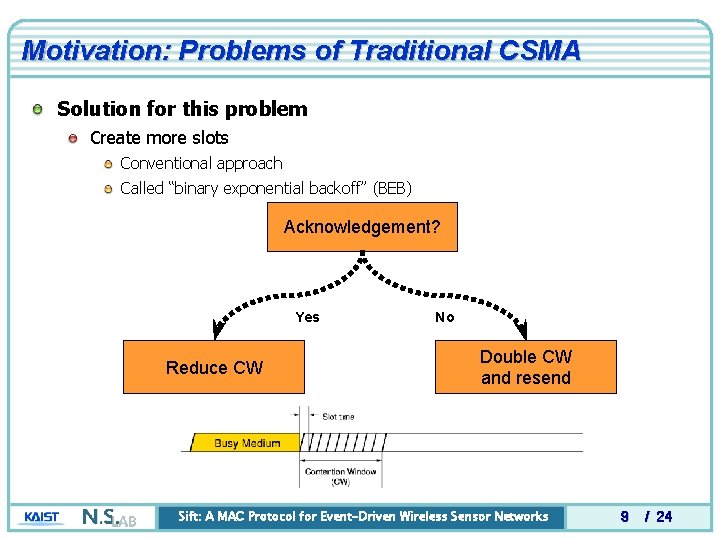
Motivation: Problems of Traditional CSMA Solution for this problem Create more slots Conventional approach Called “binary exponential backoff” (BEB) Acknowledgement? Yes Reduce CW No Double CW and resend Sift: A MAC Protocol for Event-Driven Wireless Sensor Networks 9 / 24
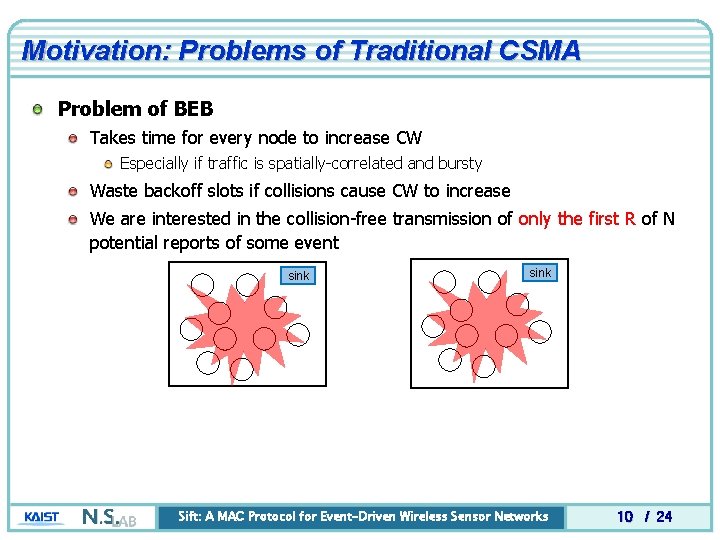
Motivation: Problems of Traditional CSMA Problem of BEB Takes time for every node to increase CW Especially if traffic is spatially-correlated and bursty Waste backoff slots if collisions cause CW to increase We are interested in the collision-free transmission of only the first R of N potential reports of some event sink Sift: A MAC Protocol for Event-Driven Wireless Sensor Networks 10 / 24
Our proposal: Sift is a MAC protocol for. . . Event-driven traffic Low-latency requirements Sift’s properties Extremely simple Offers up to 7 -fold lower latency Goal Design a MAC protocol that minimizes the latency taken to send R of without collisions Sift: A MAC Protocol for Event-Driven Wireless Sensor Networks 11 / 24
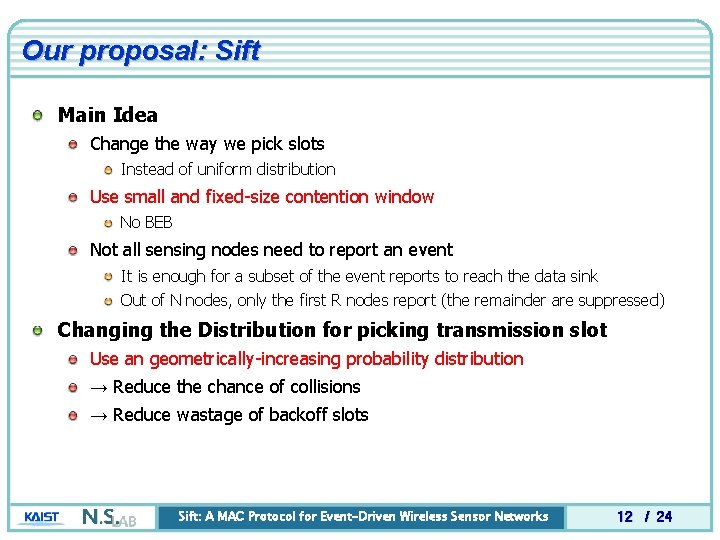
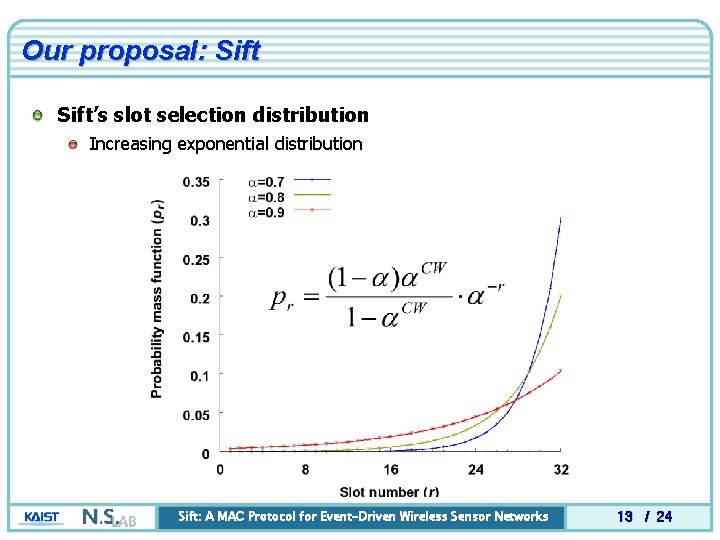
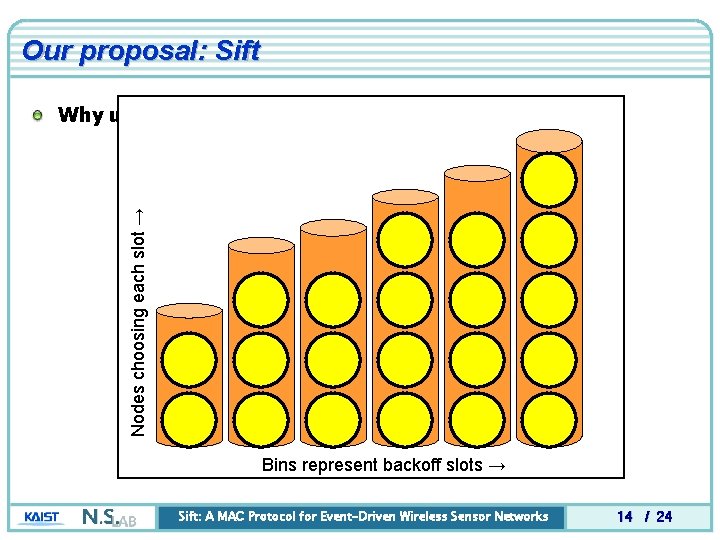
Our proposal: Sift Main Idea Change the way we pick slots Instead of uniform distribution Use small and fixed-size contention window No BEB Not all sensing nodes need to report an event It is enough for a subset of the event reports to reach the data sink Out of N nodes, only the first R nodes report (the remainder are suppressed) Changing the Distribution for picking transmission slot Use an geometrically-increasing probability distribution → Reduce the chance of collisions → Reduce wastage of backoff slots Sift: A MAC Protocol for Event-Driven Wireless Sensor Networks 12 / 24
Our proposal: Sift’s slot selection distribution Increasing exponential distribution Sift: A MAC Protocol for Event-Driven Wireless Sensor Networks 13 / 24
Our proposal: Sift Nodes choosing each slot → Why use this pdf? A Bins represent backoff slots → Sift: A MAC Protocol for Event-Driven Wireless Sensor Networks 14 / 24
Our proposal: Sift Optimal non-persistent CSMA performance With knowledge of number of nodes (IEEE JSAC ’ 04) Sift: A MAC Protocol for Event-Driven Wireless Sensor Networks 15 / 24
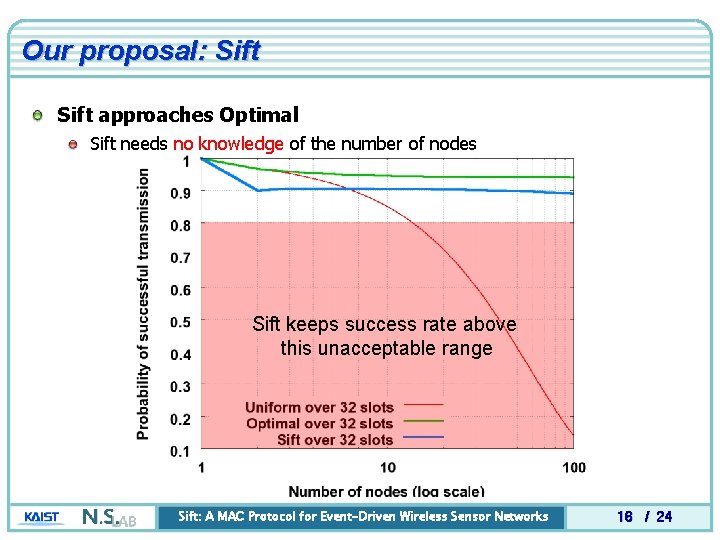
Our proposal: Sift approaches Optimal Sift needs no knowledge of the number of nodes Sift keeps success rate above this unacceptable range Sift: A MAC Protocol for Event-Driven Wireless Sensor Networks 16 / 24
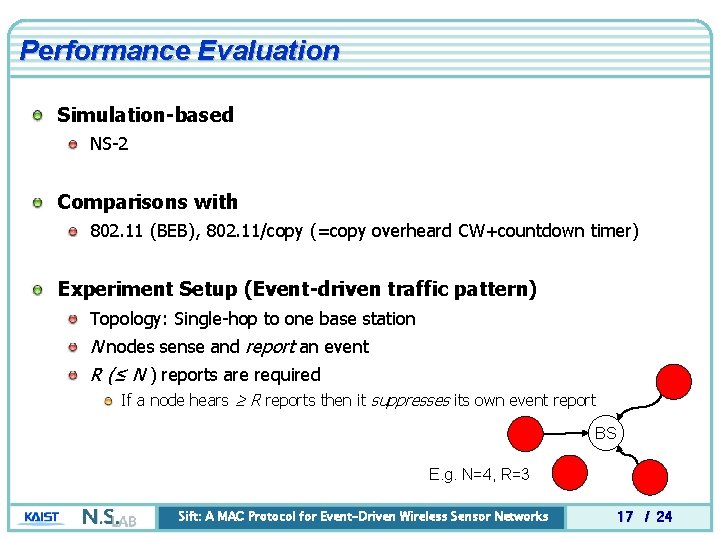
Performance Evaluation Simulation-based NS-2 Comparisons with 802. 11 (BEB), 802. 11/copy (=copy overheard CW+countdown timer) Experiment Setup (Event-driven traffic pattern) Topology: Single-hop to one base station N nodes sense and report an event R (≤ N ) reports are required If a node hears ≥ R reports then it suppresses its own event report BS E. g. N=4, R=3 Sift: A MAC Protocol for Event-Driven Wireless Sensor Networks 17 / 24
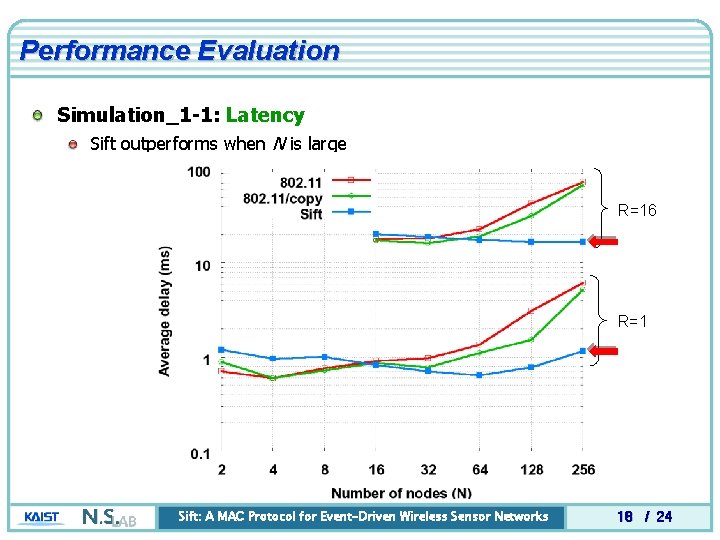
Performance Evaluation Simulation_1 -1: Latency Sift outperforms when N is large R=16 R=1 Sift: A MAC Protocol for Event-Driven Wireless Sensor Networks 18 / 24
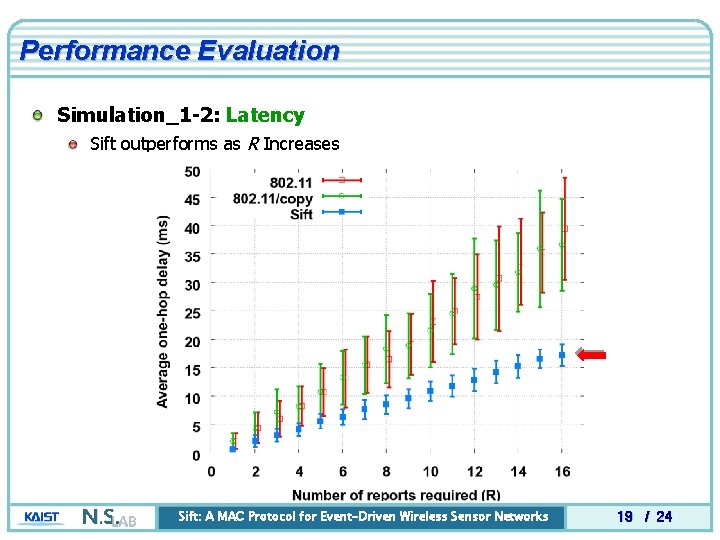
Performance Evaluation Simulation_1 -2: Latency Sift outperforms as R Increases Sift: A MAC Protocol for Event-Driven Wireless Sensor Networks 19 / 24
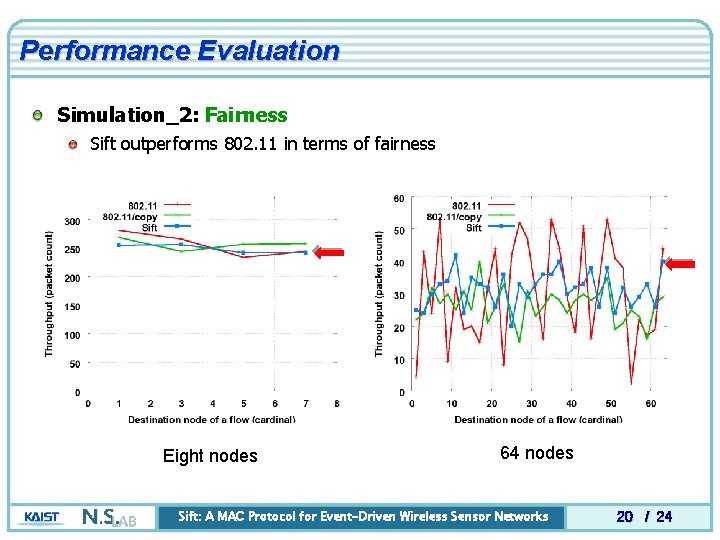
Performance Evaluation Simulation_2: Fairness Sift outperforms 802. 11 in terms of fairness Eight nodes 64 nodes Sift: A MAC Protocol for Event-Driven Wireless Sensor Networks 20 / 24
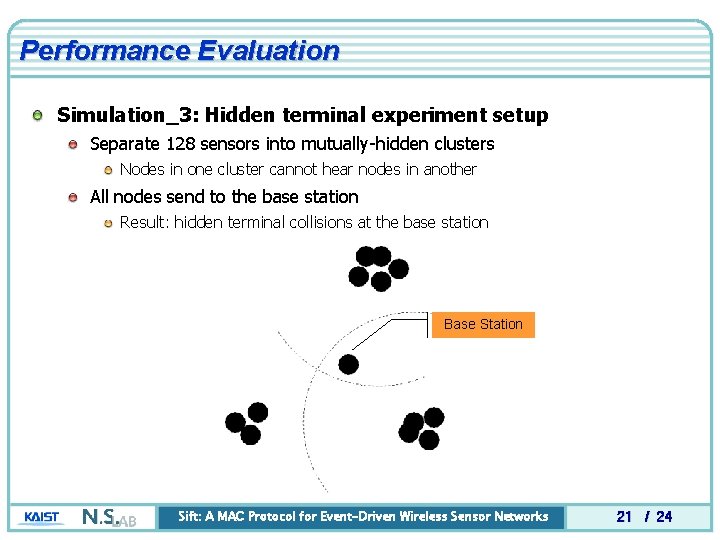
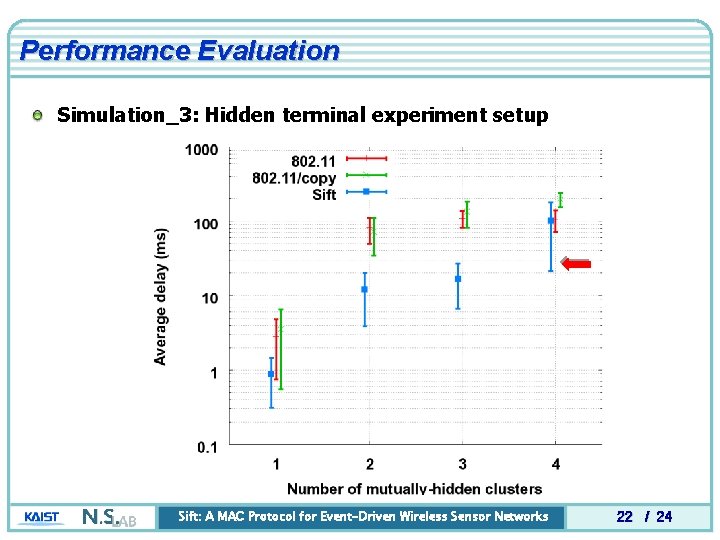
Performance Evaluation Simulation_3: Hidden terminal experiment setup Separate 128 sensors into mutually-hidden clusters Nodes in one cluster cannot hear nodes in another All nodes send to the base station Result: hidden terminal collisions at the base station Base Station Sift: A MAC Protocol for Event-Driven Wireless Sensor Networks 21 / 24
Performance Evaluation Simulation_3: Hidden terminal experiment setup Sift: A MAC Protocol for Event-Driven Wireless Sensor Networks 22 / 24
Conclusion Sift is ideal for sensor networks, where. . . it is often sufficient that any R of N sensors that observe an event report it spatially-correlated contention occurs sudden changes in the number of sensors that are trying to send data Key idea Use a geometrically-increasing probability distribution for picking a transmission slot within a fixed-size contention window Sift is a latency-enhancing MAC for event-driven sensor networks Sift: A MAC Protocol for Event-Driven Wireless Sensor Networks 23 / 24
Discussion The lack of mentions about. . . Energy consumption No attention about. . . How to determine R? Only manual setting Too strong assumption Single-hop communication to one base station Sift: A MAC Protocol for Event-Driven Wireless Sensor Networks 24 / 24
Thank you Sift: A MAC Protocol for Event-Driven Wireless Sensor Networks 25 / 24
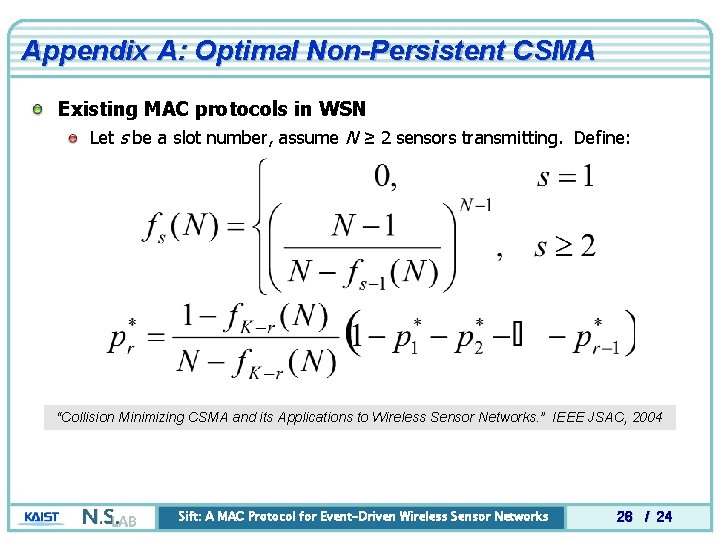
Appendix A: Optimal Non-Persistent CSMA Existing MAC protocols in WSN Let s be a slot number, assume N ≥ 2 sensors transmitting. Define: “Collision Minimizing CSMA and its Applications to Wireless Sensor Networks. ” IEEE JSAC, 2004 Sift: A MAC Protocol for Event-Driven Wireless Sensor Networks 26 / 24