
SIDS MidAtlantic presents Using the 5 As SIDS
- Slides: 43
SIDS Mid-Atlantic presents Using the 5 A’s
SIDS Mid-Atlantic 2700 S. Quincy St. Suite 220 n Arlington VA 22206 n 703 -933 -9100 n www. sidsma. org n sidsma 27@aol. com n Betty Connal, RN, MS, Director n Created March 2002 Presented by Health Care Education & Training, Inc. 2
Objectives n n To establish evidence-based, best practice prenatal smoking cessation interventions as a routine part of prenatal care by training health care providers in the Five A’s Method of Smoking Cessation To assure that all pregnant women in Virginia are asked about their use of tobacco and that all pregnant smoking women in Virginia receive evidence-based treatments in smoking cessation Created March 2002 Presented by Health Care Education & Training, Inc. 3
Program Objectives Describe the 5 A prenatal smoking cessation method n Incorporate the 5 A prenatal smoking cessation method into the standard protocol n Identify readily available smoking cessation resources n Created March 2002 Presented by Health Care Education & Training, Inc. 4
Agenda Introduction n Ask n Advise/Assess n Assist/Arrange for follow-up n Implementation issues and role play n Resource identification n Wrap-up n Created March 2002 Presented by Health Care Education & Training, Inc. 5
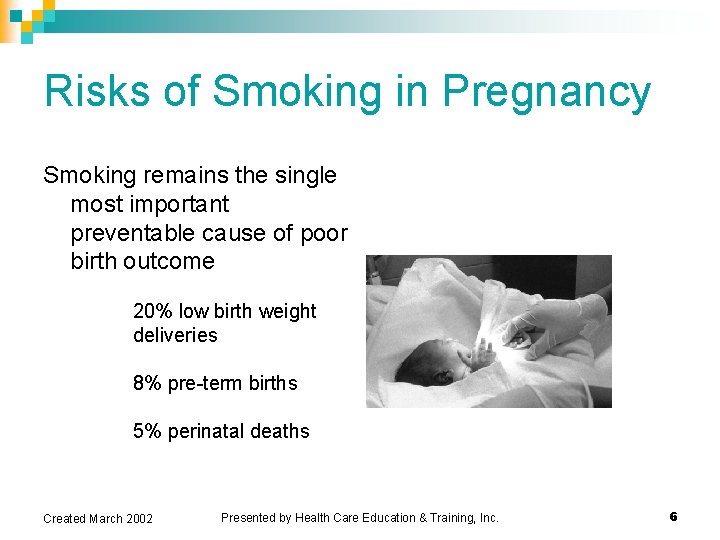
Risks of Smoking in Pregnancy Smoking remains the single most important preventable cause of poor birth outcome n 20% low birth weight deliveries n 8% pre-term births n 5% perinatal deaths Created March 2002 Presented by Health Care Education & Training, Inc. 6
Risks of Smoking n n n Placenta previa Miscarriage Ectopic pregnancy Preterm Premature Rupture Of Membranes Abruptio placenta Created March 2002 Presented by Health Care Education & Training, Inc. 7
Risks of Smoking n Low birth weight n Small for gestational age n Preterm delivery n 3 to 4 times greater risk of Sudden Infant Death Syndrome (SIDS) n Stillbirths Created March 2002 Presented by Health Care Education & Training, Inc. 8
Smoking effects on the baby n Otitis media (ear infections) n Asthma n Bronchitis and pneumonia n Wheezing and lower respiratory illness Created March 2002 Presented by Health Care Education & Training, Inc. 9
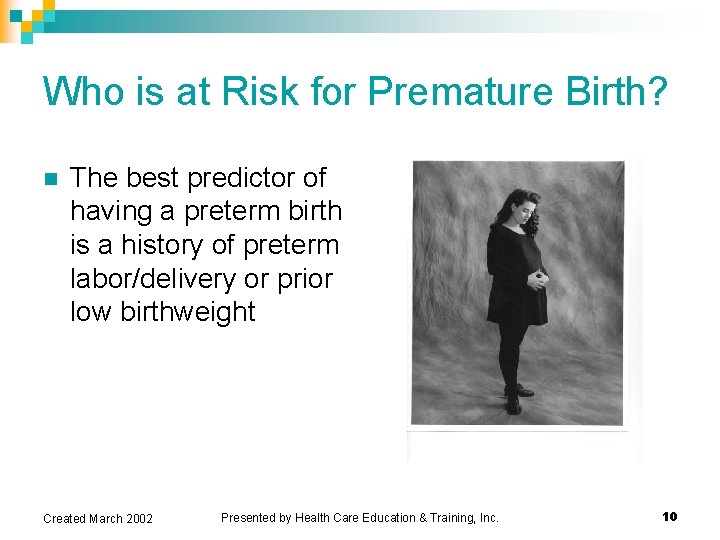
Who is at Risk for Premature Birth? n The best predictor of having a preterm birth is a history of preterm labor/delivery or prior low birthweight Created March 2002 Presented by Health Care Education & Training, Inc. 10
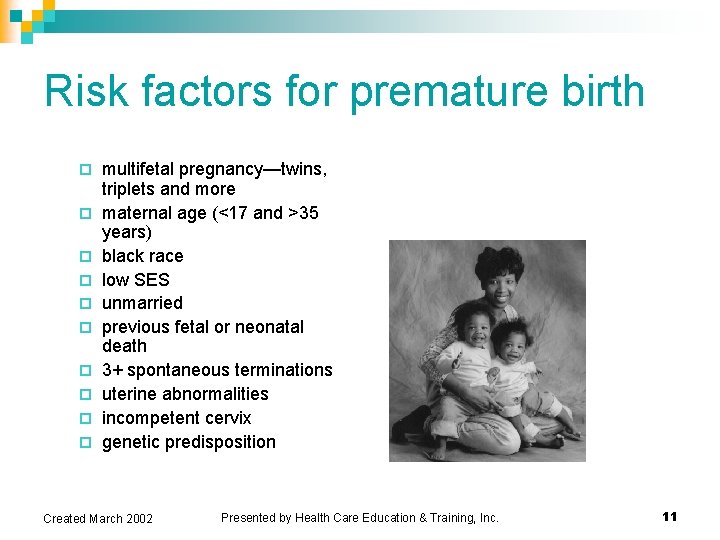
Risk factors for premature birth ¨ ¨ ¨ ¨ ¨ multifetal pregnancy—twins, triplets and more maternal age (<17 and >35 years) black race low SES unmarried previous fetal or neonatal death 3+ spontaneous terminations uterine abnormalities incompetent cervix genetic predisposition Created March 2002 Presented by Health Care Education & Training, Inc. 11
Risk for premature birth ¨ ¨ ¨ low pre-pregnant weight obesity infections bleeding anemia major stress lack of social supports tobacco use illicit drug use alcohol abuse folic acid deficiency Created March 2002 Presented by Health Care Education & Training, Inc. 12
Signs of Premature Labor Contractions every 10 minutes or more n Changes in vaginal discharge (leaking fluid or blood from vagina) n Pelvic pressure—baby pushing down n Low dull backache n Cramps that feel like a period n Abdominal cramps with or without diarrhea n Created March 2002 Presented by Health Care Education & Training, Inc. 13
Why use the Five A’s? n About 35% of women will quit smoking during pregnancy, benefiting themselves, their next pregnancy, their children and their families Created March 2002 Presented by Health Care Education & Training, Inc. 14
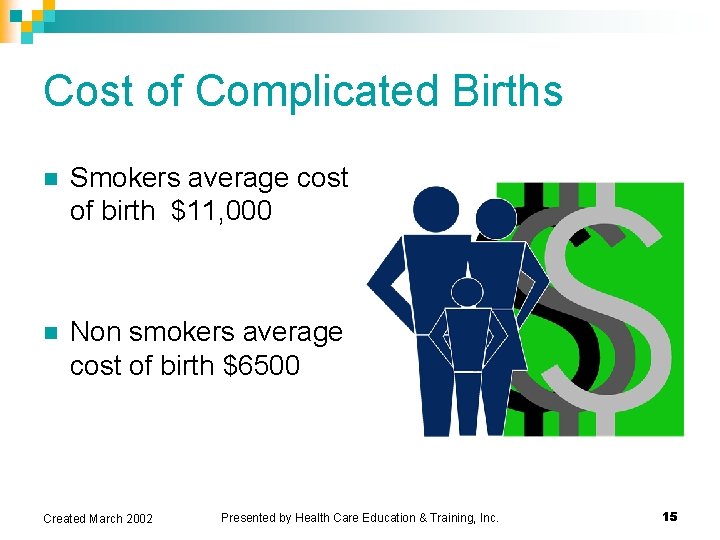
Cost of Complicated Births n Smokers average cost of birth $11, 000 n Non smokers average cost of birth $6500 Created March 2002 Presented by Health Care Education & Training, Inc. 15
Cost Effectiveness of Smoking Cessation Intervention Cost per life year saved, in thousands of dollars n Smoking Cessation Intervention $2500 n Mammography $50, 000 n Treatment of high cholesterol $100, 000 n Created March 2002 Presented by Health Care Education & Training, Inc. 16
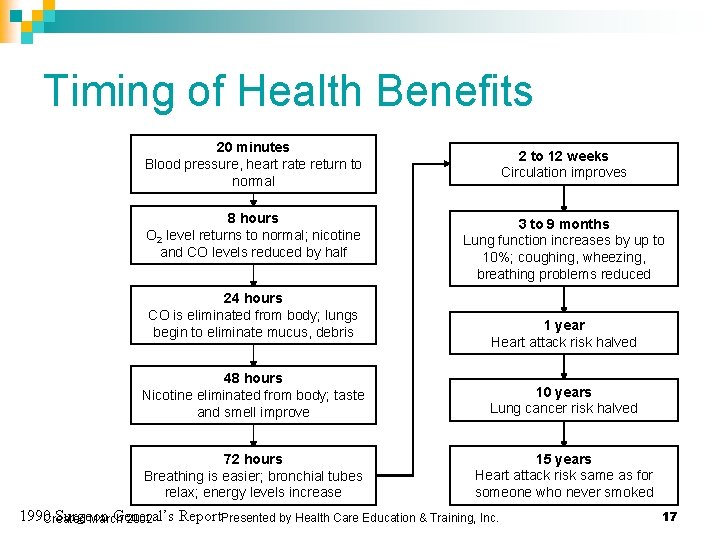
Timing of Health Benefits 20 minutes Blood pressure, heart rate return to normal 8 hours O 2 level returns to normal; nicotine and CO levels reduced by half 24 hours CO is eliminated from body; lungs begin to eliminate mucus, debris 2 to 12 weeks Circulation improves 3 to 9 months Lung function increases by up to 10%; coughing, wheezing, breathing problems reduced 1 year Heart attack risk halved 48 hours Nicotine eliminated from body; taste and smell improve 10 years Lung cancer risk halved 72 hours Breathing is easier; bronchial tubes relax; energy levels increase 15 years Heart attack risk same as for someone who never smoked 1990 Created Surgeon General’s Report. Presented by Health Care Education & Training, Inc. March 2002 17
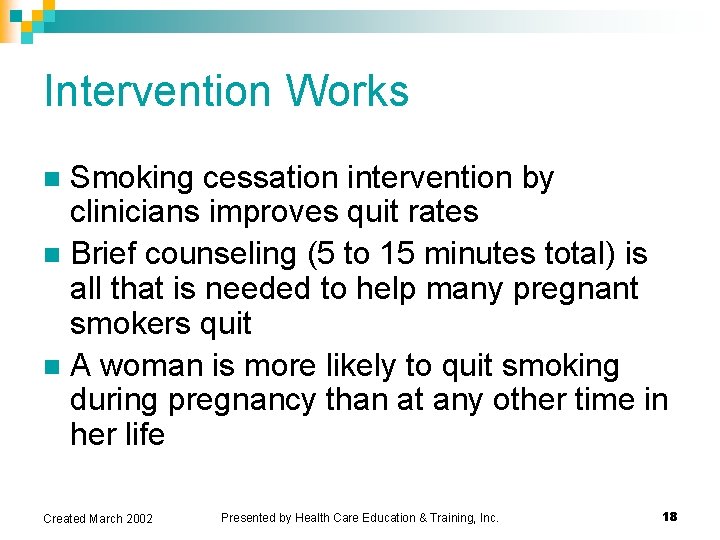
Intervention Works Smoking cessation intervention by clinicians improves quit rates n Brief counseling (5 to 15 minutes total) is all that is needed to help many pregnant smokers quit n A woman is more likely to quit smoking during pregnancy than at any other time in her life n Created March 2002 Presented by Health Care Education & Training, Inc. 18
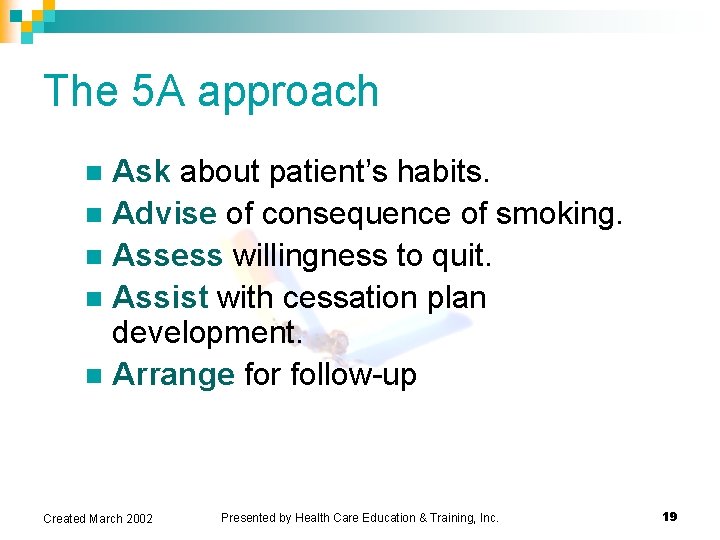
The 5 A approach Ask about patient’s habits. n Advise of consequence of smoking. n Assess willingness to quit. n Assist with cessation plan development. n Arrange for follow-up n Created March 2002 Presented by Health Care Education & Training, Inc. 19
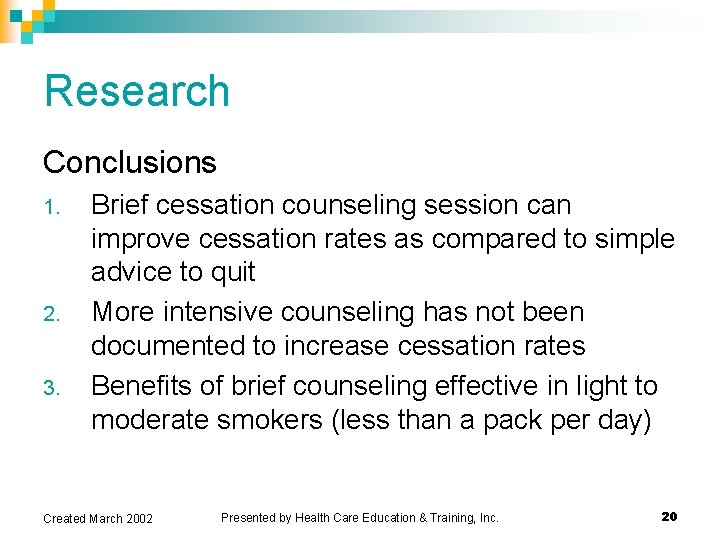
Research Conclusions 1. 2. 3. Brief cessation counseling session can improve cessation rates as compared to simple advice to quit More intensive counseling has not been documented to increase cessation rates Benefits of brief counseling effective in light to moderate smokers (less than a pack per day) Created March 2002 Presented by Health Care Education & Training, Inc. 20
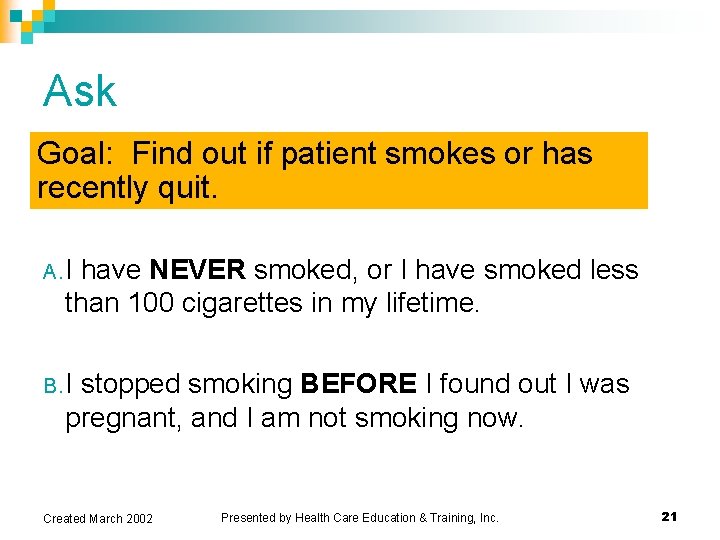
Ask Goal: Find out if patient smokes or has recently quit. A. I have NEVER smoked, or I have smoked less than 100 cigarettes in my lifetime. B. I stopped smoking BEFORE I found out I was pregnant, and I am not smoking now. Created March 2002 Presented by Health Care Education & Training, Inc. 21
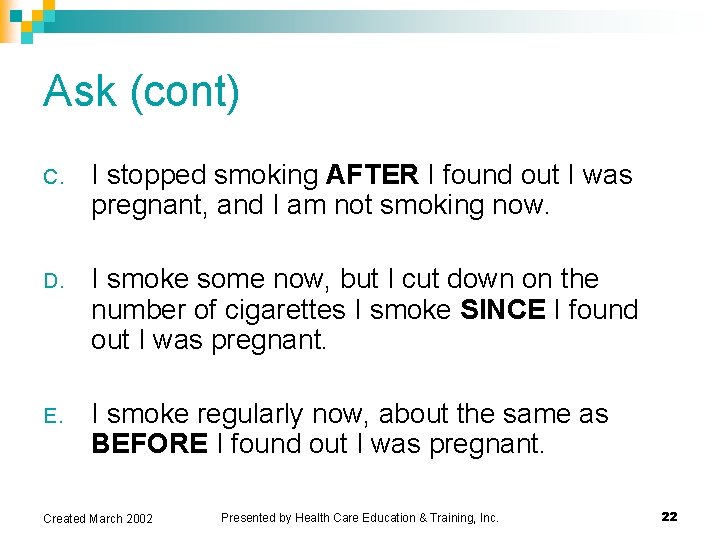
Ask (cont) C. I stopped smoking AFTER I found out I was pregnant, and I am not smoking now. D. I smoke some now, but I cut down on the number of cigarettes I smoke SINCE I found out I was pregnant. E. I smoke regularly now, about the same as BEFORE I found out I was pregnant. Created March 2002 Presented by Health Care Education & Training, Inc. 22
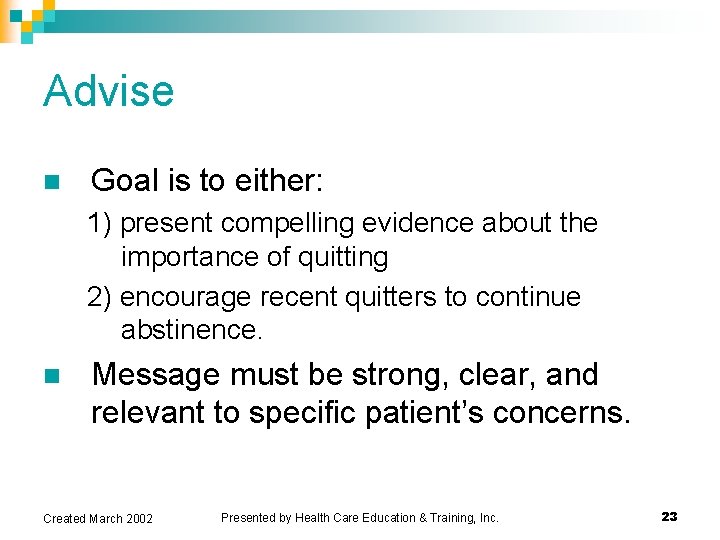
Advise n Goal is to either: 1) present compelling evidence about the importance of quitting 2) encourage recent quitters to continue abstinence. n Message must be strong, clear, and relevant to specific patient’s concerns. Created March 2002 Presented by Health Care Education & Training, Inc. 23
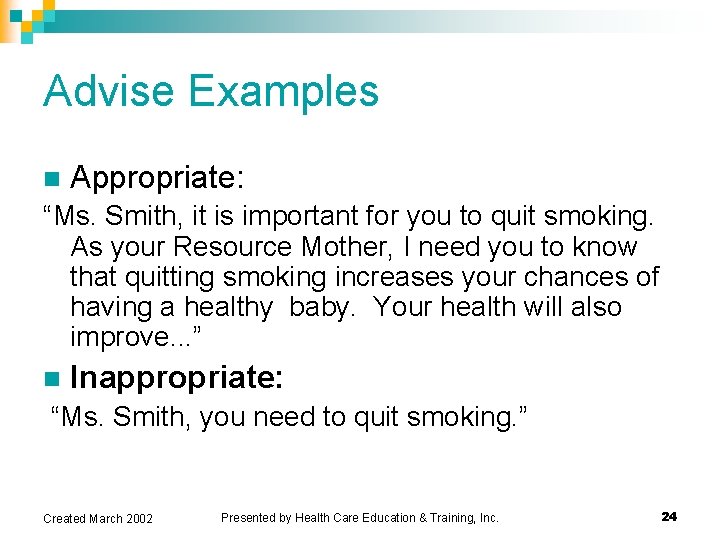
Advise Examples n Appropriate: “Ms. Smith, it is important for you to quit smoking. As your Resource Mother, I need you to know that quitting smoking increases your chances of having a healthy baby. Your health will also improve. . . ” n Inappropriate: “Ms. Smith, you need to quit smoking. ” Created March 2002 Presented by Health Care Education & Training, Inc. 24
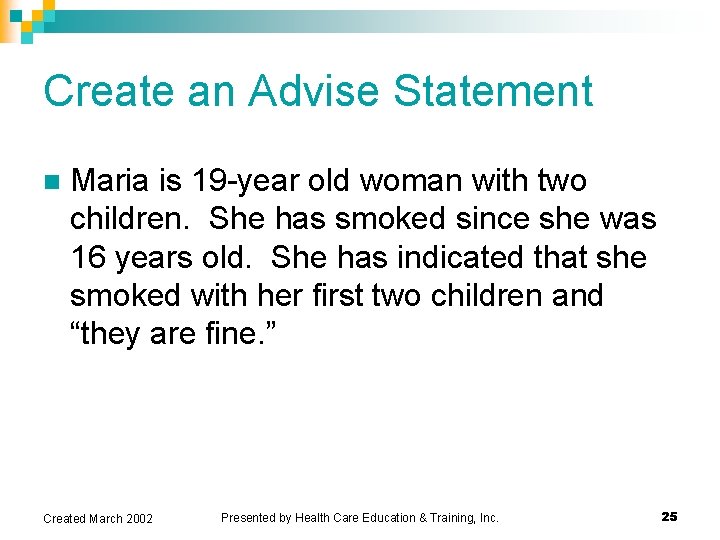
Create an Advise Statement n Maria is 19 -year old woman with two children. She has smoked since she was 16 years old. She has indicated that she smoked with her first two children and “they are fine. ” Created March 2002 Presented by Health Care Education & Training, Inc. 25
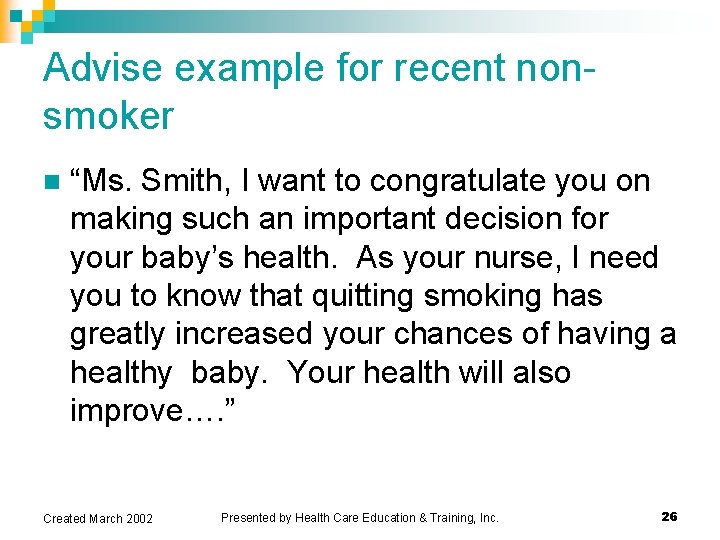
Advise example for recent nonsmoker n “Ms. Smith, I want to congratulate you on making such an important decision for your baby’s health. As your nurse, I need you to know that quitting smoking has greatly increased your chances of having a healthy baby. Your health will also improve…. ” Created March 2002 Presented by Health Care Education & Training, Inc. 26
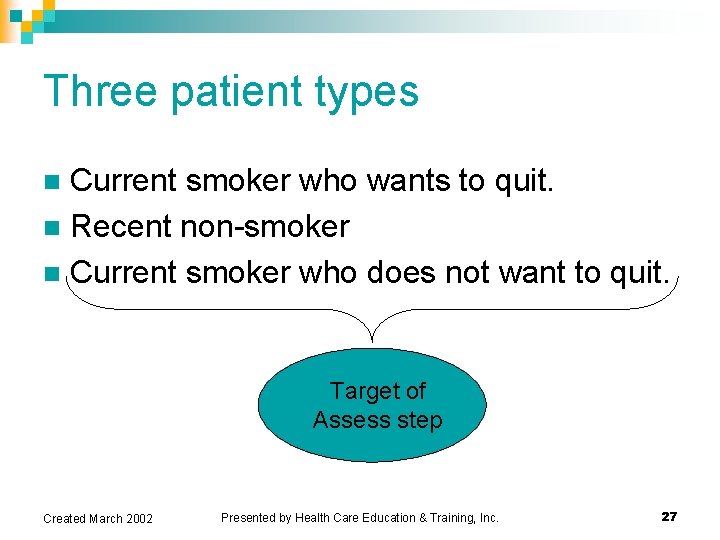
Three patient types Current smoker who wants to quit. n Recent non-smoker n Current smoker who does not want to quit. n Target of Assess step Created March 2002 Presented by Health Care Education & Training, Inc. 27
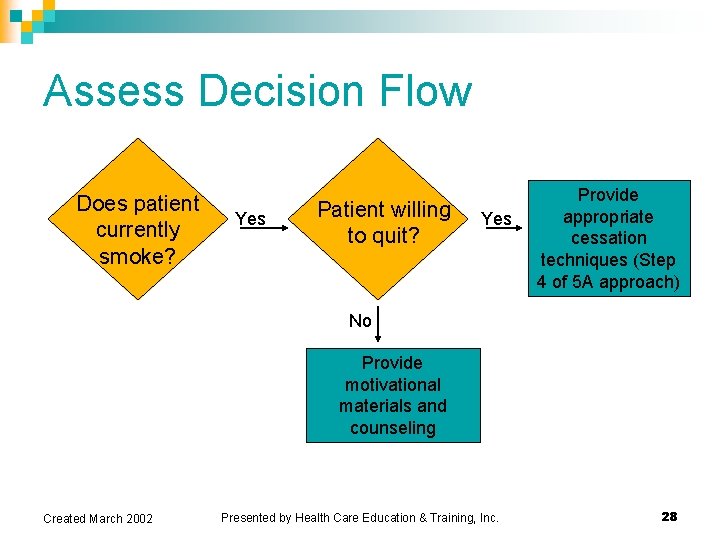
Assess Decision Flow Does patient currently smoke? Yes Patient willing to quit? Yes Provide appropriate cessation techniques (Step 4 of 5 A approach) No Provide motivational materials and counseling Created March 2002 Presented by Health Care Education & Training, Inc. 28
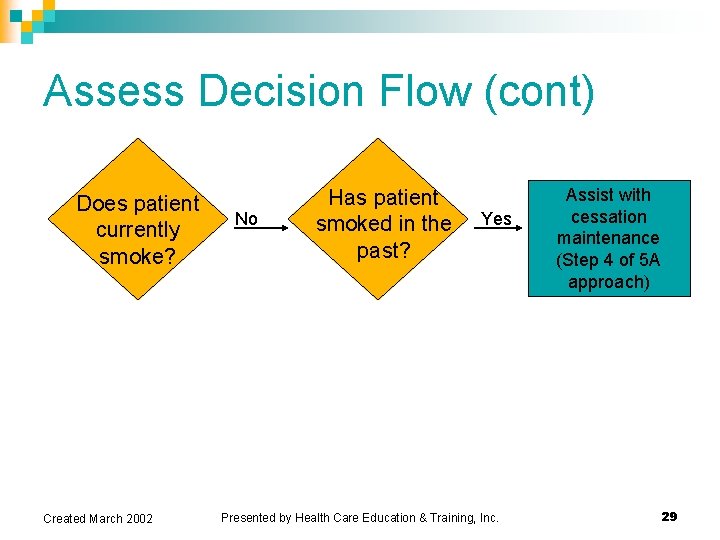
Assess Decision Flow (cont) Does patient currently smoke? Created March 2002 No Has patient smoked in the past? Yes Presented by Health Care Education & Training, Inc. Assist with cessation maintenance (Step 4 of 5 A approach) 29
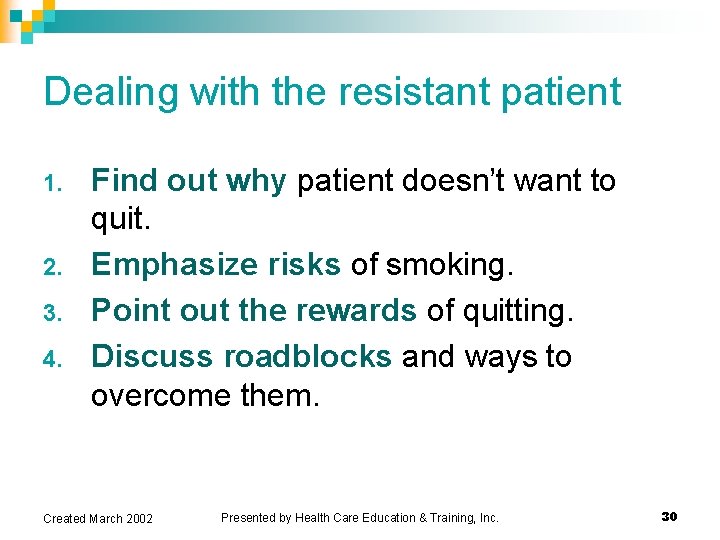
Dealing with the resistant patient 1. 2. 3. 4. Find out why patient doesn’t want to quit. Emphasize risks of smoking. Point out the rewards of quitting. Discuss roadblocks and ways to overcome them. Created March 2002 Presented by Health Care Education & Training, Inc. 30
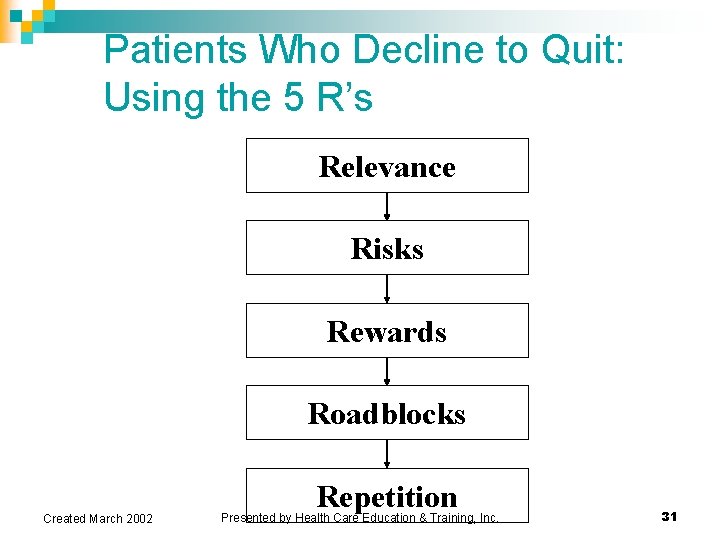
Patients Who Decline to Quit: Using the 5 R’s Relevance Risks Rewards Roadblocks Created March 2002 Repetition Presented by Health Care Education & Training, Inc. 31
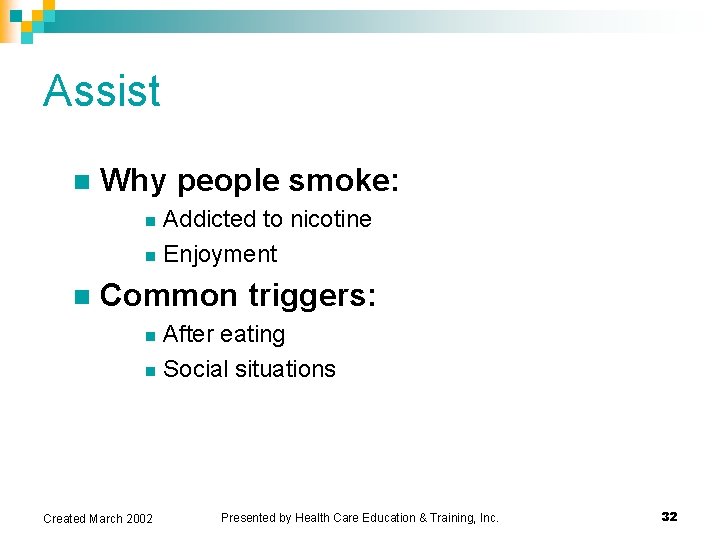
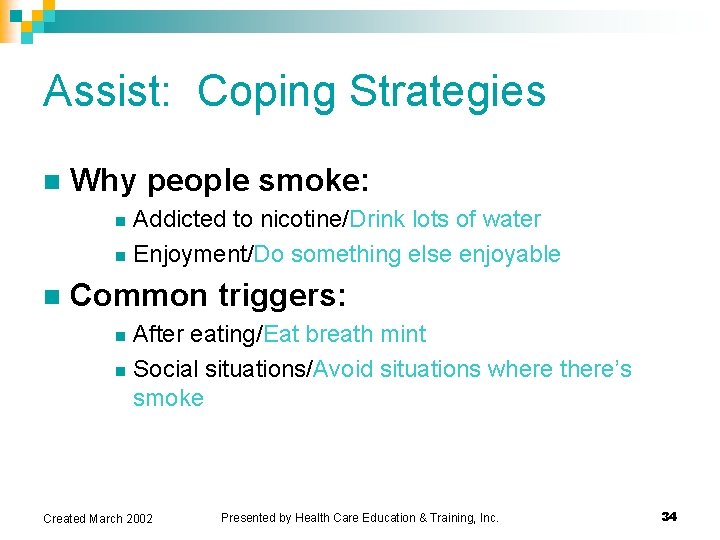
Assist n Why people smoke: Addicted to nicotine n Enjoyment n n Common triggers: After eating n Social situations n Created March 2002 Presented by Health Care Education & Training, Inc. 32
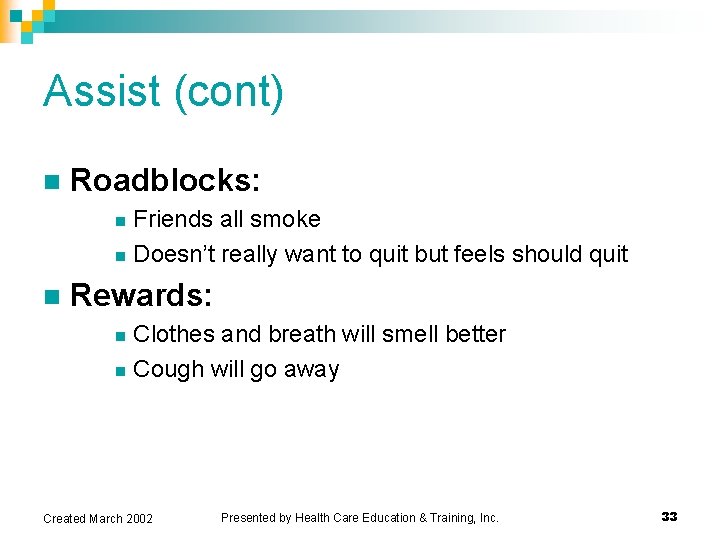
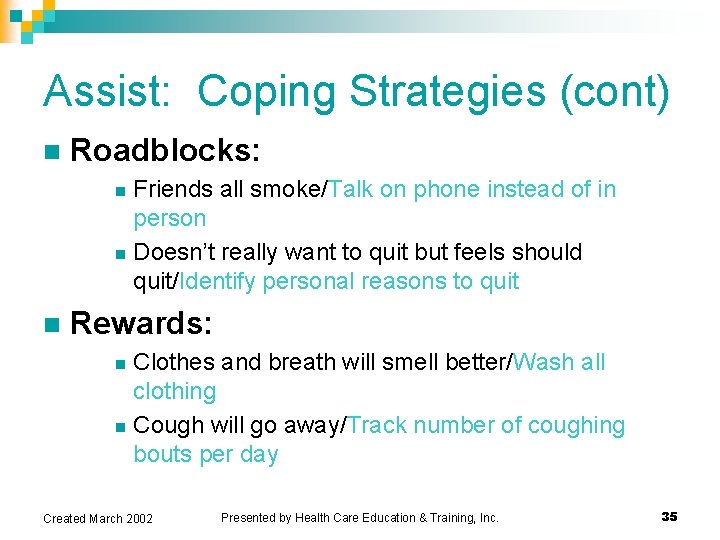
Assist (cont) n Roadblocks: Friends all smoke n Doesn’t really want to quit but feels should quit n n Rewards: Clothes and breath will smell better n Cough will go away n Created March 2002 Presented by Health Care Education & Training, Inc. 33
Assist: Coping Strategies n Why people smoke: Addicted to nicotine/Drink lots of water n Enjoyment/Do something else enjoyable n n Common triggers: After eating/Eat breath mint n Social situations/Avoid situations where there’s smoke n Created March 2002 Presented by Health Care Education & Training, Inc. 34
Assist: Coping Strategies (cont) n Roadblocks: Friends all smoke/Talk on phone instead of in person n Doesn’t really want to quit but feels should quit/Identify personal reasons to quit n n Rewards: Clothes and breath will smell better/Wash all clothing n Cough will go away/Track number of coughing bouts per day n Created March 2002 Presented by Health Care Education & Training, Inc. 35
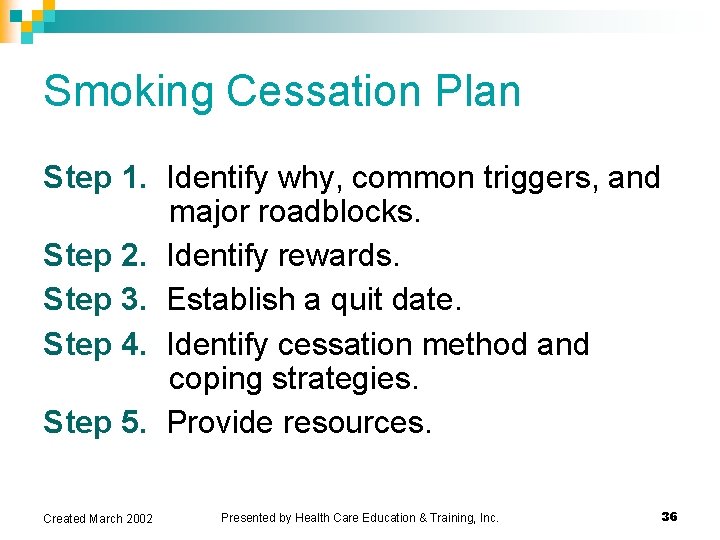
Smoking Cessation Plan Step 1. Identify why, common triggers, and major roadblocks. Step 2. Identify rewards. Step 3. Establish a quit date. Step 4. Identify cessation method and coping strategies. Step 5. Provide resources. Created March 2002 Presented by Health Care Education & Training, Inc. 36
Arrange for follow-up For patient who has remained smoke-free, offer congratulations. n For patient who has relapsed, return to Assist step in 5 A approach. n Created March 2002 Presented by Health Care Education & Training, Inc. 37
Relapse Questions n n n What was the trigger? When did the relapse occur? What was going on in your life at the time of relapse? Did you have a support person there? What techniques did you try to help you work through the craving? Would you like to set another quit date? Created March 2002 Presented by Health Care Education & Training, Inc. 38
Reimbursement n n ICD-9 -CM code 305. 1 (tobacco use disorder, tobacco dependence) AND CPT code 99401 (15 -minute physician-provided counseling) ¨ with n modifier 25 as part of regular prenatal visit OR CPT code 99211 (nurse counseling) Created March 2002 Presented by Health Care Education & Training, Inc. 39
Resources SIDS Mid-Atlantic www. sidsma. org n Go to ‘Professionals’ n ‘Stop Smoking Stop SIDS Program’ n Links to state and national info and resources March of Dimes www. marchofdimes. com Created March 2002 Presented by Health Care Education & Training, Inc. 40
Great Start 1 -866 -66 Start Interactive Quitline for Pregnant Smokers Created March 2002 Presented by Health Care Education & Training, Inc. 41
Resources n Smoke Free Families www. smokefreefamilies. org n National Partnership to Help Pregnant Smokers Quit www. helppregnantsmokersquit. org Created March 2002 Presented by Health Care Education & Training, Inc. 42
Virginia Quit Line n 1 -800 -QUIT Created March 2002 NOW Presented by Health Care Education & Training, Inc. 43