
SICURA Gamma and X ray detectors Probe design
SICURA Gamma and X ray detectors
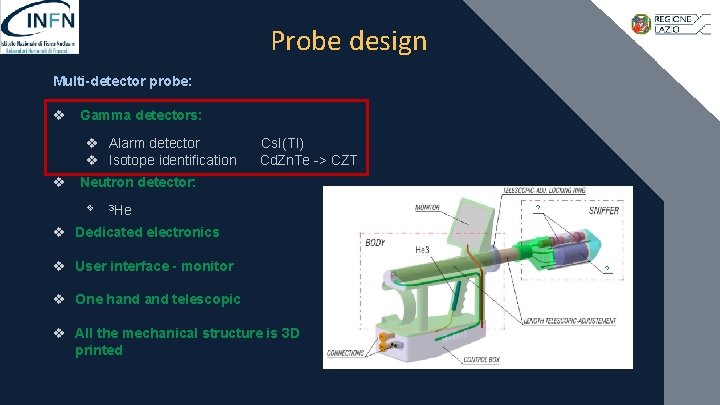
Probe design Multi-detector probe: v Gamma detectors: v Alarm detector v Isotope identification v Neutron detector: v Cs. I(Tl) Cd. Zn. Te -> CZT 3 He ? v Dedicated electronics v User interface - monitor v One hand telescopic v All the mechanical structure is 3 D printed ?
CONTENTS OF THIS CONTRIBUTION v Two Gamma and X detectors v Alert stage v Choice of the light output reading v Identification stage v Simulations v MCNP 6 v Conclusions
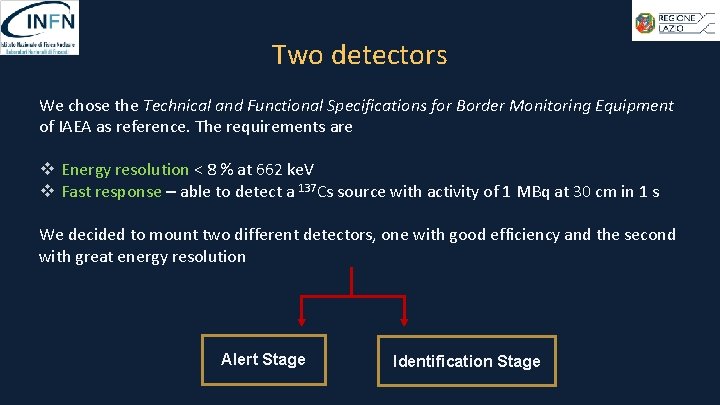
Two detectors We chose the Technical and Functional Specifications for Border Monitoring Equipment of IAEA as reference. The requirements are v Energy resolution < 8 % at 662 ke. V v Fast response – able to detect a 137 Cs source with activity of 1 MBq at 30 cm in 1 s We decided to mount two different detectors, one with good efficiency and the second with great energy resolution Alert Stage Identification Stage
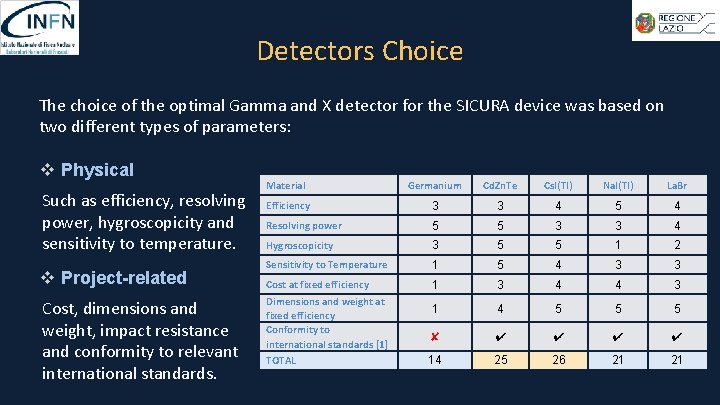
Detectors Choice The choice of the optimal Gamma and X detector for the SICURA device was based on two different types of parameters: v Physical Such as efficiency, resolving power, hygroscopicity and sensitivity to temperature. v Project-related Cost, dimensions and weight, impact resistance and conformity to relevant international standards. Material Germanium Cd. Zn. Te Cs. I(Tl) Na. I(Tl) La. Br Efficiency 3 3 4 5 4 Resolving power 5 5 3 3 4 Hygroscopicity 3 5 5 1 2 Sensitivity to Temperature 1 5 4 3 3 Cost at fixed efficiency 1 3 4 4 3 1 4 5 5 5 ✘ ✔ ✔ 14 25 26 21 21 Dimensions and weight at fixed efficiency Conformity to international standards [1] TOTAL
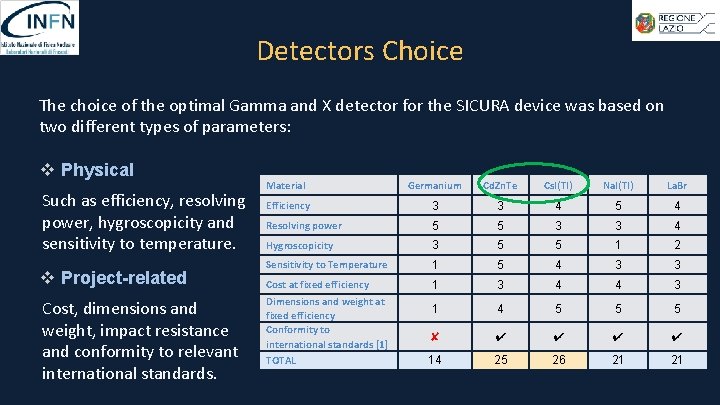
Detectors Choice The choice of the optimal Gamma and X detector for the SICURA device was based on two different types of parameters: v Physical Such as efficiency, resolving power, hygroscopicity and sensitivity to temperature. v Project-related Cost, dimensions and weight, impact resistance and conformity to relevant international standards. Material Germanium Cd. Zn. Te Cs. I(Tl) Na. I(Tl) La. Br Efficiency 3 3 4 5 4 Resolving power 5 5 3 3 4 Hygroscopicity 3 5 5 1 2 Sensitivity to Temperature 1 5 4 3 3 Cost at fixed efficiency 1 3 4 4 3 1 4 5 5 5 ✘ ✔ ✔ 14 25 26 21 21 Dimensions and weight at fixed efficiency Conformity to international standards [1] TOTAL
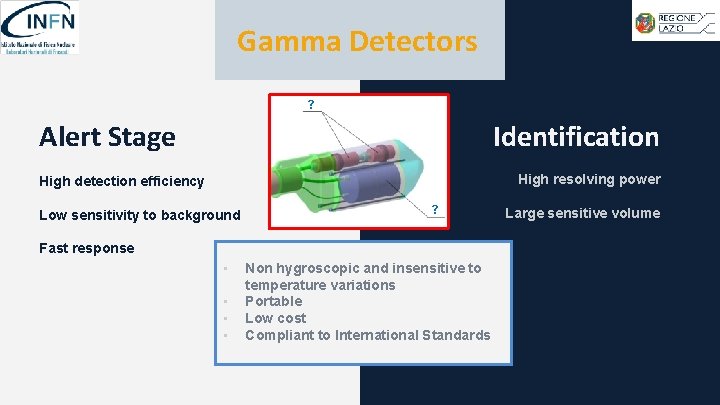
Gamma Detectors ? Alert Stage Identification High resolving power High detection efficiency Low sensitivity to background ? Fast response • • Non hygroscopic and insensitive to temperature variations Portable Low cost Compliant to International Standards Large sensitive volume
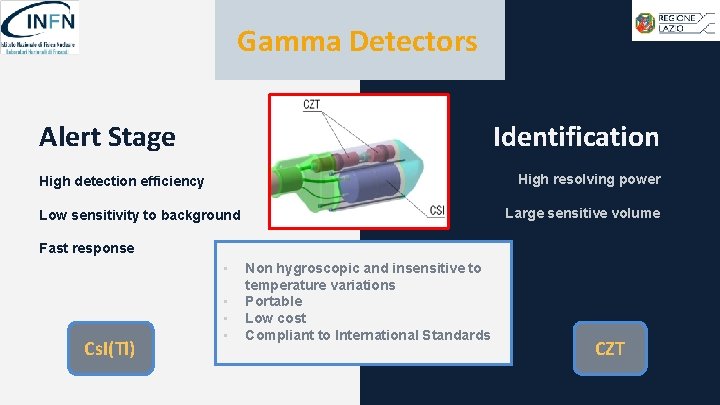
Gamma Detectors Alert Stage Identification High resolving power High detection efficiency Large sensitive volume Low sensitivity to background Fast response • Cs. I(Tl) • • • Non hygroscopic and insensitive to temperature variations Portable Low cost Compliant to International Standards CZT
Alert Stage - Cs. I(Tl) It was chosen a cylindrical Cs. I(Tl) crystal 51 mm h x 51 mm Ø We tested and compared three different light reading systems: v v v Photodiode Si. PM Phototube All detectors were calibrated employing point-like sources. Their efficiency and energy resolution were measured and evaluated.
![All produced and assembled by Scionix [4] Photodiode Si. PM Phototube](http://slidetodoc.com/presentation_image_h2/482fd9ae60c2ea7ae5414074ed3d65fa/image-10.jpg "All produced and assembled by Scionix [4] Photodiode Si. PM Phototube")
All produced and assembled by Scionix [4] Photodiode Si. PM Phototube
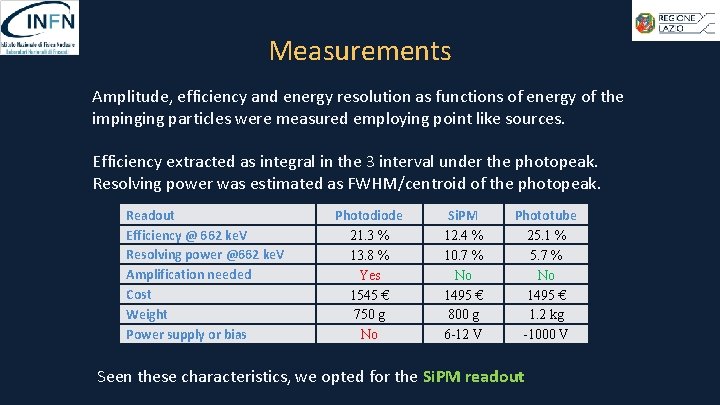
Measurements Amplitude, efficiency and energy resolution as functions of energy of the impinging particles were measured employing point like sources. Efficiency extracted as integral in the 3 interval under the photopeak. Resolving power was estimated as FWHM/centroid of the photopeak. Readout Efficiency @ 662 ke. V Resolving power @662 ke. V Amplification needed Cost Weight Power supply or bias Photodiode 21. 3 % 13. 8 % Yes 1545 € 750 g No Si. PM 12. 4 % 10. 7 % No 1495 € 800 g 6 -12 V Phototube 25. 1 % 5. 7 % No 1495 € 1. 2 kg -1000 V Seen these characteristics, we opted for the Si. PM readout
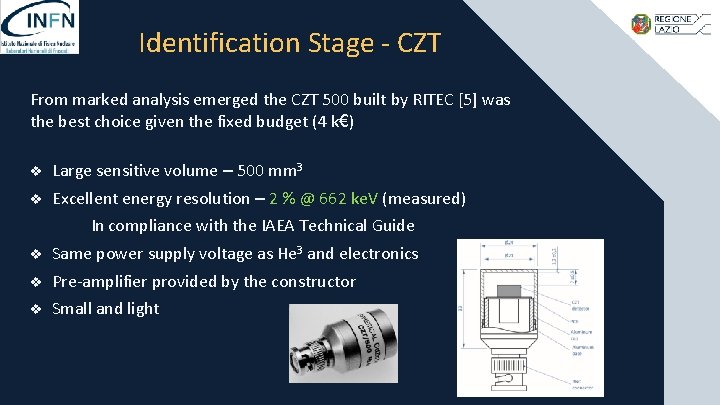
Identification Stage - CZT From marked analysis emerged the CZT 500 built by RITEC [5] was the best choice given the fixed budget (4 k€) v Large sensitive volume – 500 mm 3 v Excellent energy resolution – 2 % @ 662 ke. V (measured) In compliance with the IAEA Technical Guide v Same power supply voltage as He 3 and electronics v Pre-amplifier provided by the constructor v Small and light
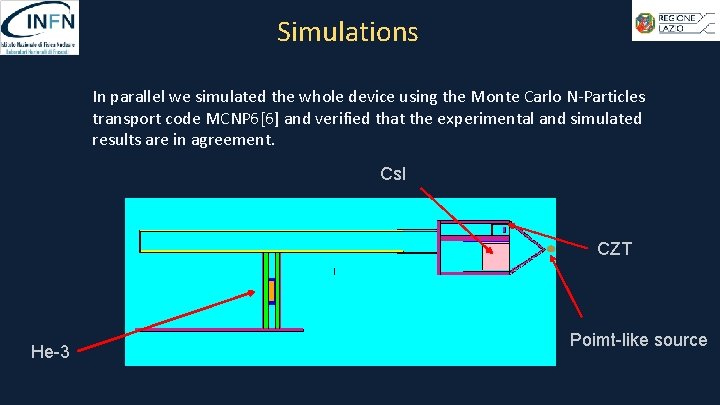
Simulations In parallel we simulated the whole device using the Monte Carlo N-Particles transport code MCNP 6[6] and verified that the experimental and simulated results are in agreement. Cs. I CZT He-3 Poimt-like source
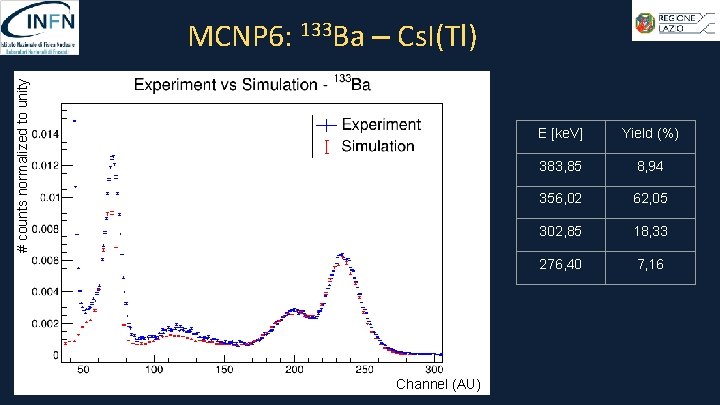
# counts normalized to unity MCNP 6: 133 Ba – Cs. I(Tl) Channel (AU) E [ke. V] Yield (%) 383, 85 8, 94 356, 02 62, 05 302, 85 18, 33 276, 40 7, 16
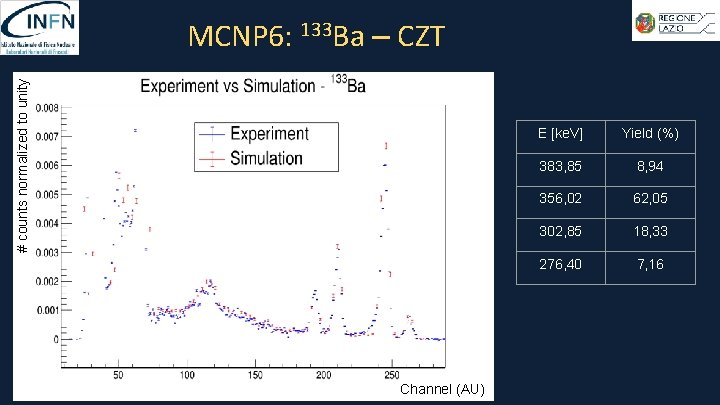
# counts normalized to unity MCNP 6: 133 Ba – CZT Channel (AU) E [ke. V] Yield (%) 383, 85 8, 94 356, 02 62, 05 302, 85 18, 33 276, 40 7, 16
Conclusions v Conclusions
![References [1] [2] [3] [4] [5] [6] Technical and Functional Specifications for Border Monitoring](http://slidetodoc.com/presentation_image_h2/482fd9ae60c2ea7ae5414074ed3d65fa/image-17.jpg "References [1] [2] [3] [4] [5] [6] Technical and Functional Specifications for Border Monitoring")
References [1] [2] [3] [4] [5] [6] Technical and Functional Specifications for Border Monitoring Equipment, Technical Guidance – Reference Manual, IAEA Nuclear Security Series no. 1 Monitoring for inadvertent movement and illicit trafficking of radioactive material, ISO, Geneve, 2004. Radiation Detection and Measurement, Glenn F. Knoll, 4 a edizione, Wiley. https: //scionix. nl/scintillation-crystals/ http: //www. ritec. lv/html/czt 500. html C. J. Werner(editor), "MCNP Users Manual - Code Version 6. 2", Los Alamos National Laboratory, report LA-UR-17 -29981 (2017).

Thanks for your attention!!
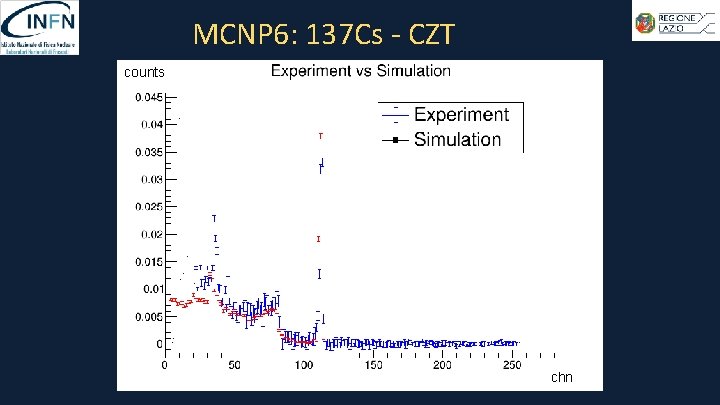
MCNP 6: 137 Cs - CZT counts chn
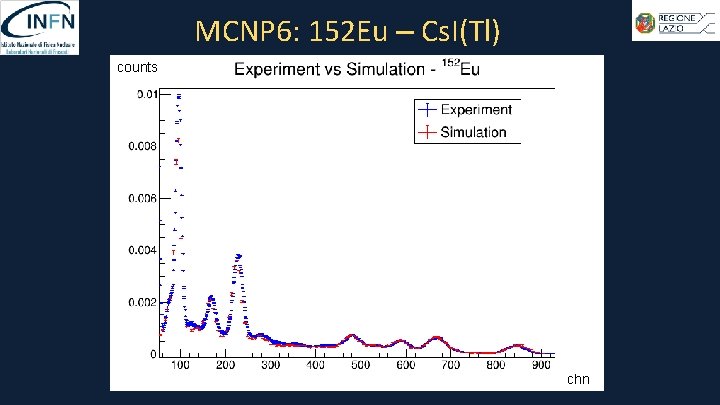
MCNP 6: 152 Eu – Cs. I(Tl) counts chn
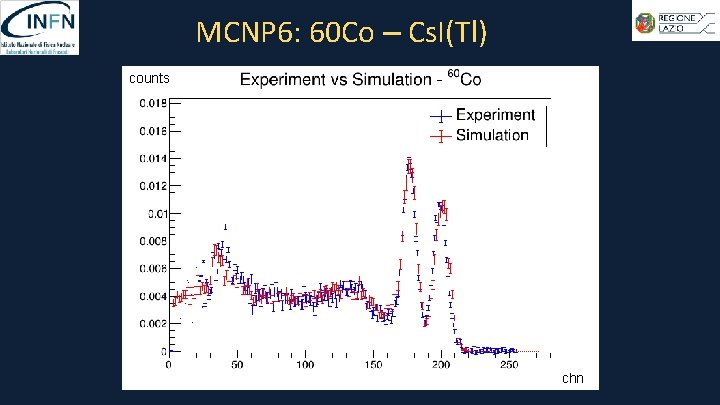
MCNP 6: 60 Co – Cs. I(Tl) counts chn
![GEB: gaussian energy broadening Fwhm [Me. V] E [Me. V]](http://slidetodoc.com/presentation_image_h2/482fd9ae60c2ea7ae5414074ed3d65fa/image-22.jpg "GEB: gaussian energy broadening Fwhm [Me. V] E [Me. V]")
GEB: gaussian energy broadening Fwhm [Me. V] E [Me. V]
- Slides: 22