
SIAM DM 2016 Cops and Robbers and PursuitEvasion
SIAM DM 2016 Cops and Robbers and Pursuit-Evasion in Discrete Structures A probabilistic version of the game of Zombies and Survivors on graphs Anthony Bonato Ryerson University
About the minisymposium • Cops and Robbers is a trending topic in graph theory – structural, probabilistic, topological, algorithmic… • pursuit-evasion/graph searching • three sessions and 14 speakers: Mon, Wed, Thurs
Cops and Robbers C R C
Cops and Robbers C R C
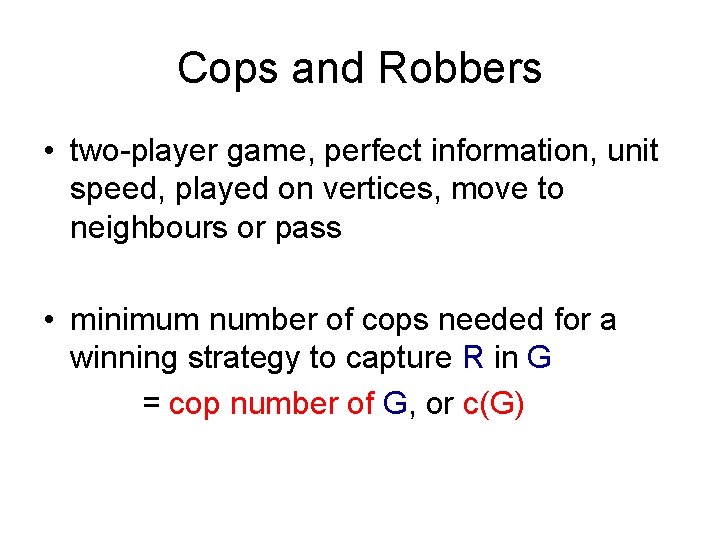
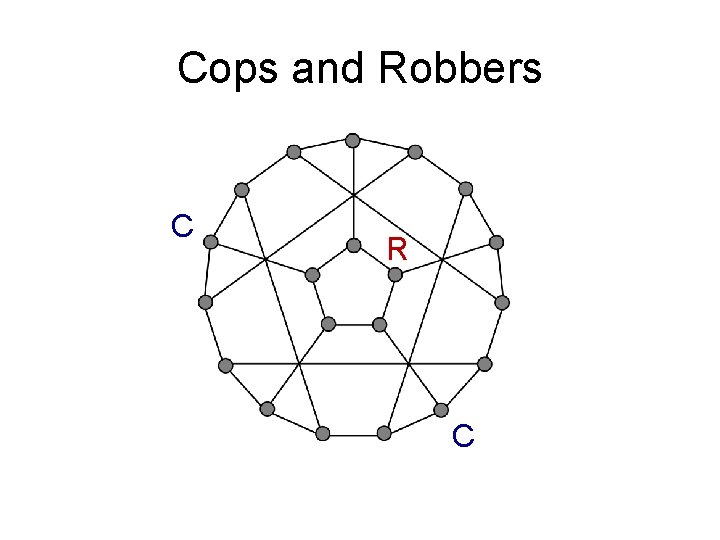
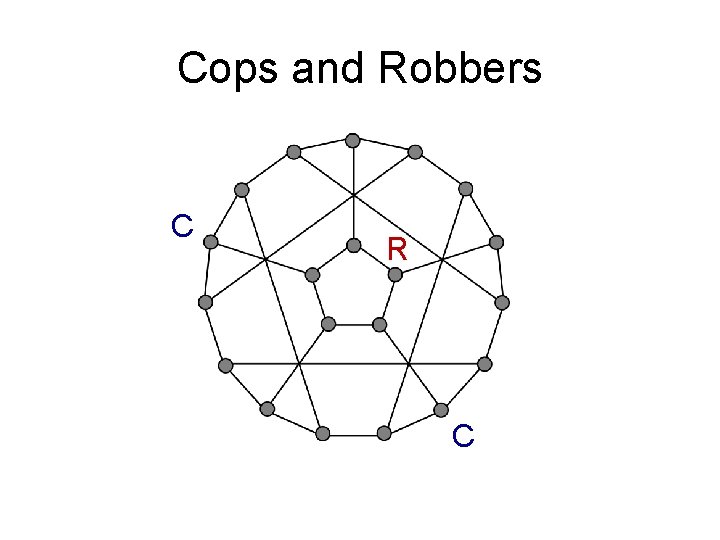
Cops and Robbers • two-player game, perfect information, unit speed, played on vertices, move to neighbours or pass • minimum number of cops needed for a winning strategy to capture R in G = cop number of G, or c(G)
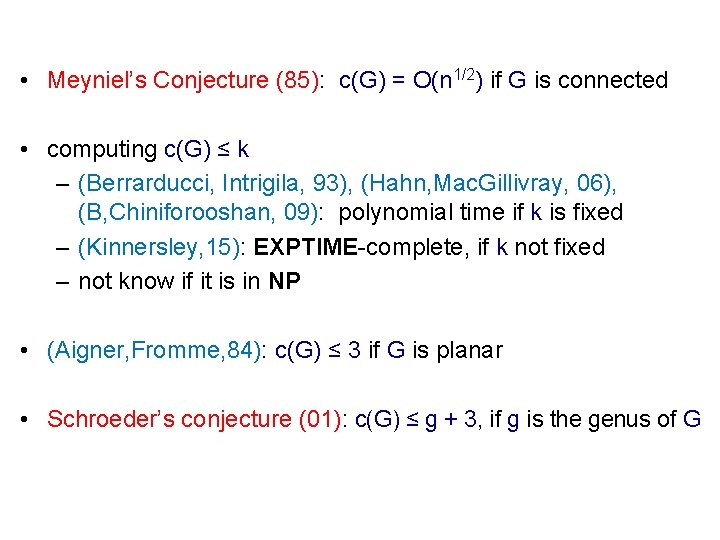
• Meyniel’s Conjecture (85): c(G) = O(n 1/2) if G is connected • computing c(G) ≤ k – (Berrarducci, Intrigila, 93), (Hahn, Mac. Gillivray, 06), (B, Chiniforooshan, 09): polynomial time if k is fixed – (Kinnersley, 15): EXPTIME-complete, if k not fixed – not know if it is in NP • (Aigner, Fromme, 84): c(G) ≤ 3 if G is planar • Schroeder’s conjecture (01): c(G) ≤ g + 3, if g is the genus of G
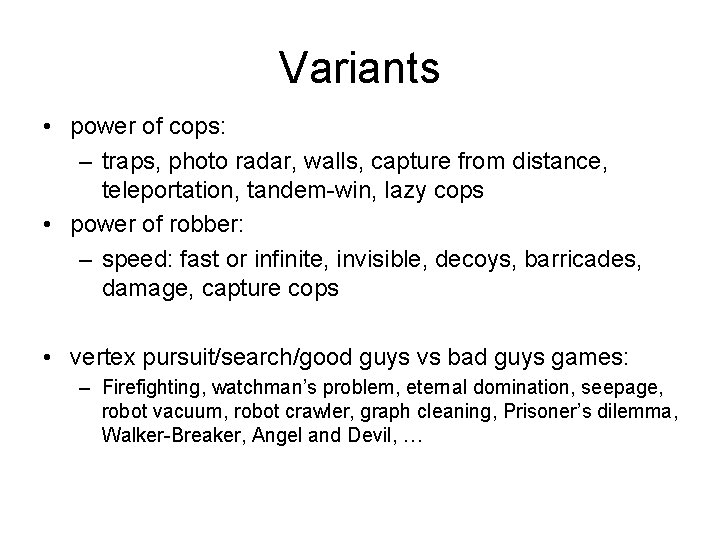
Variants • power of cops: – traps, photo radar, walls, capture from distance, teleportation, tandem-win, lazy cops • power of robber: – speed: fast or infinite, invisible, decoys, barricades, damage, capture cops • vertex pursuit/search/good guys vs bad guys games: – Firefighting, watchman’s problem, eternal domination, seepage, robot vacuum, robot crawler, graph cleaning, Prisoner’s dilemma, Walker-Breaker, Angel and Devil, …
Zombies and Survivors
Zombies and Survivors
Zombie horde Zombies and Survivors
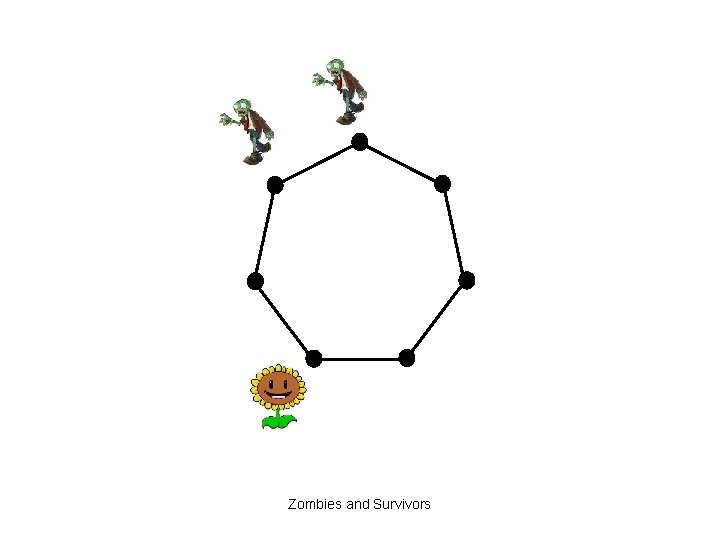
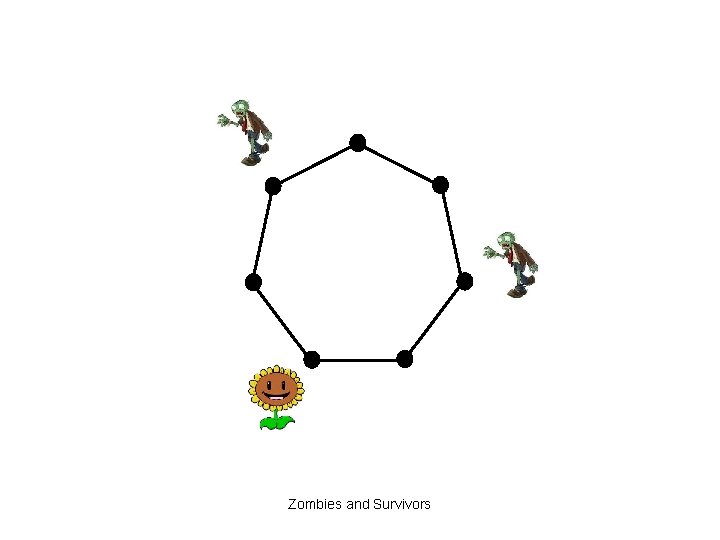
Zombies and Survivors • set of zombies, one survivor • players move at alternate ticks of the clock, from vertex to vertex along edges • zombies choose their initial locations u. a. r. • at each step the zombies move along a shortest path connected to the survivor – if more than one such path, then they choose one u. a. r. • zombies win if one or more can eat the survivor – land on the survivor’s vertex • otherwise, survivor wins • NB: zombies have no strategy! Zombies and Survivors
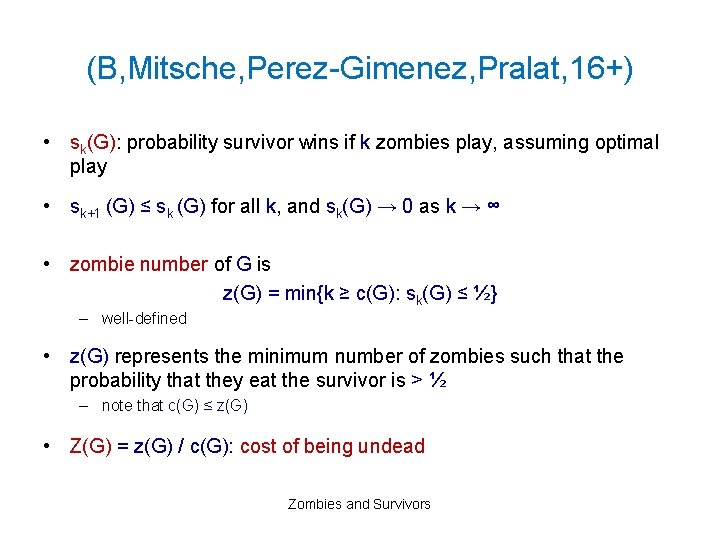
(B, Mitsche, Perez-Gimenez, Pralat, 16+) • sk(G): probability survivor wins if k zombies play, assuming optimal play • sk+1 (G) ≤ sk (G) for all k, and sk(G) → 0 as k → ∞ • zombie number of G is z(G) = min{k ≥ c(G): sk(G) ≤ ½} – well-defined • z(G) represents the minimum number of zombies such that the probability that they eat the survivor is > ½ – note that c(G) ≤ z(G) • Z(G) = z(G) / c(G): cost of being undead Zombies and Survivors
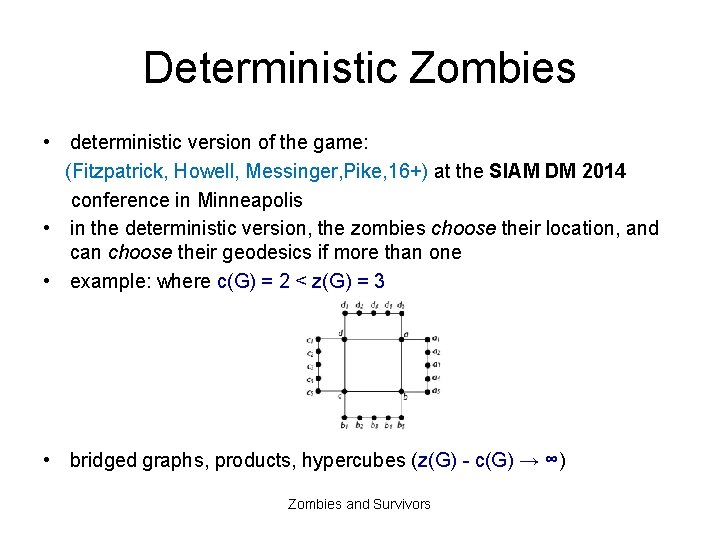
Deterministic Zombies • deterministic version of the game: (Fitzpatrick, Howell, Messinger, Pike, 16+) at the SIAM DM 2014 conference in Minneapolis • in the deterministic version, the zombies choose their location, and can choose their geodesics if more than one • example: where c(G) = 2 < z(G) = 3 • bridged graphs, products, hypercubes (z(G) - c(G) → ∞) Zombies and Survivors
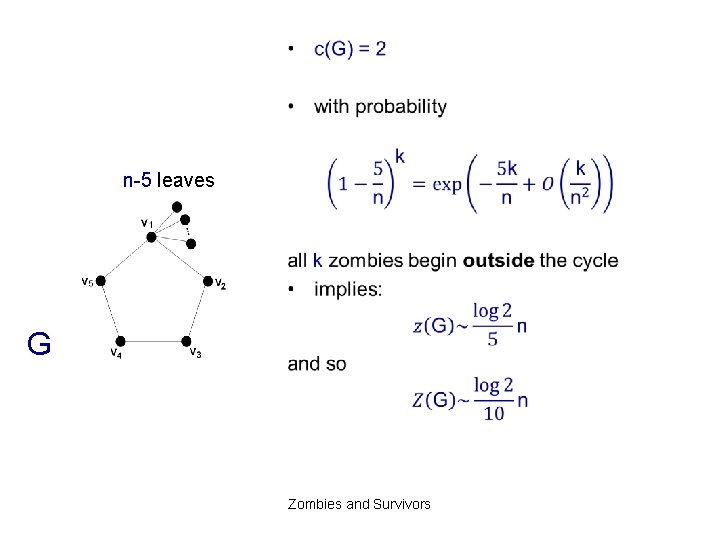
n-5 leaves G Zombies and Survivors
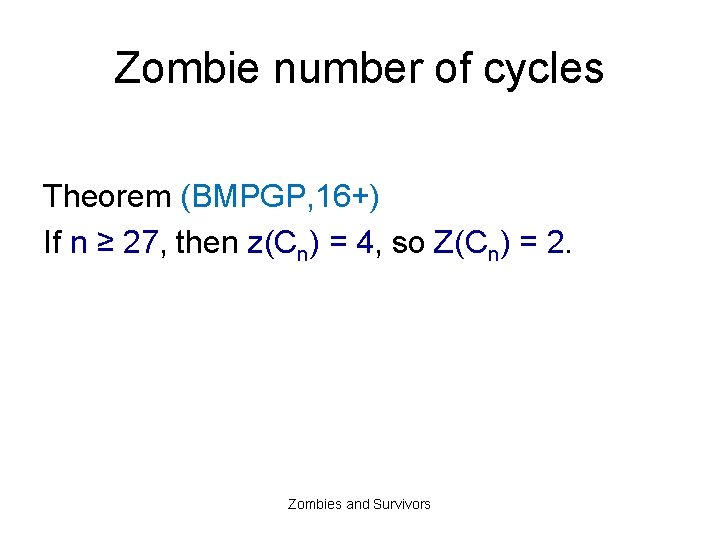
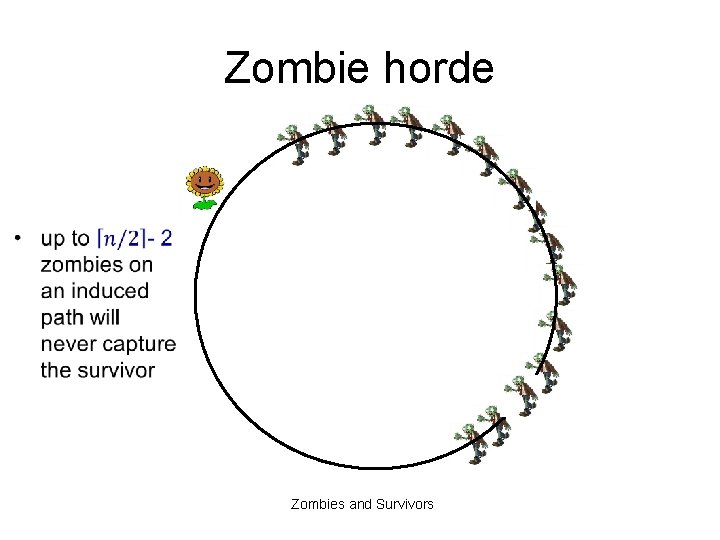
Zombie number of cycles Theorem (BMPGP, 16+) If n ≥ 27, then z(Cn) = 4, so Z(Cn) = 2. Zombies and Survivors
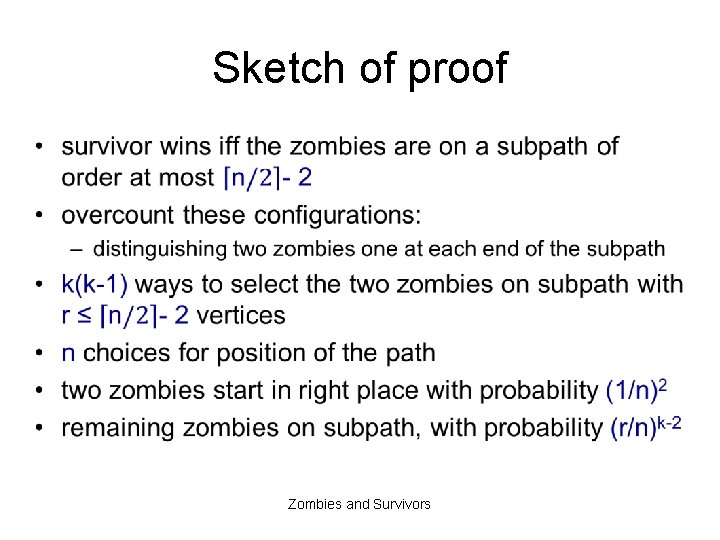
Sketch of proof • Zombies and Survivors
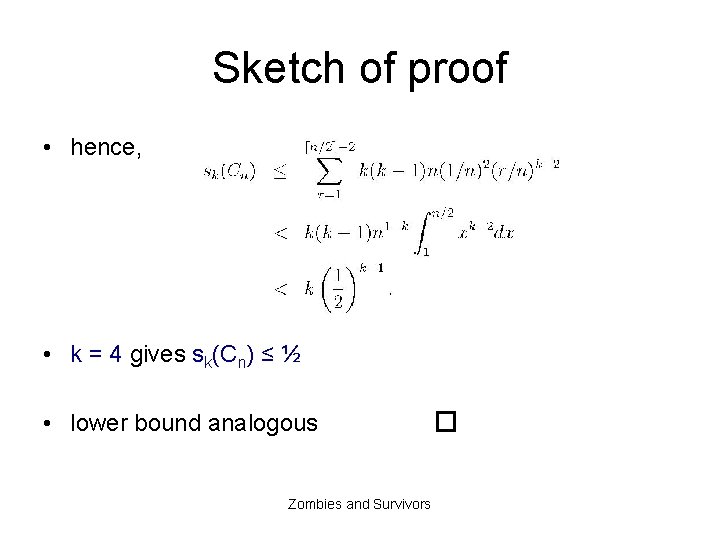
Sketch of proof • hence, • k = 4 gives sk(Cn) ≤ ½ • lower bound analogous Zombies and Survivors
• finite projective plane P: – two lines meet in a unique point – two points determine a unique line – exist 4 points, no line contains more than two of them • q 2+q+1 points; each line (point) contains (is incident with) q+1 points (lines) • incidence graph (IG) of P: – bipartite graph G(P) with red nodes the points of P and blue nodes the lines of P – a point is joined to a line if it is on that line Zombies and Survivors
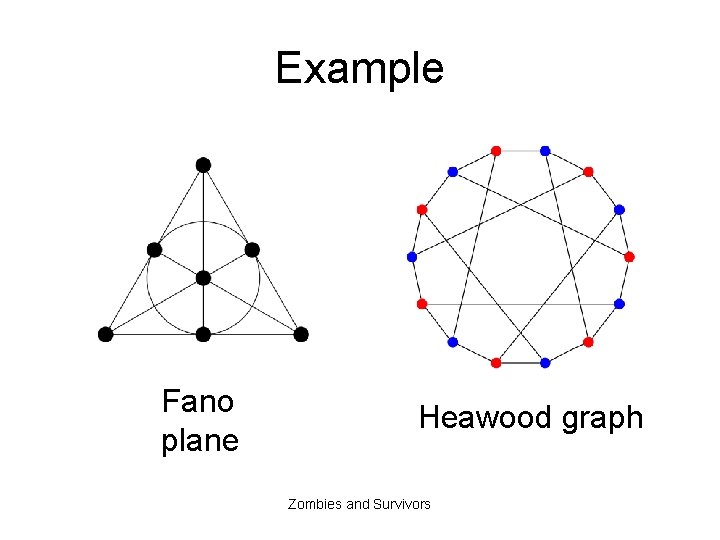
Example Fano plane Heawood graph Zombies and Survivors
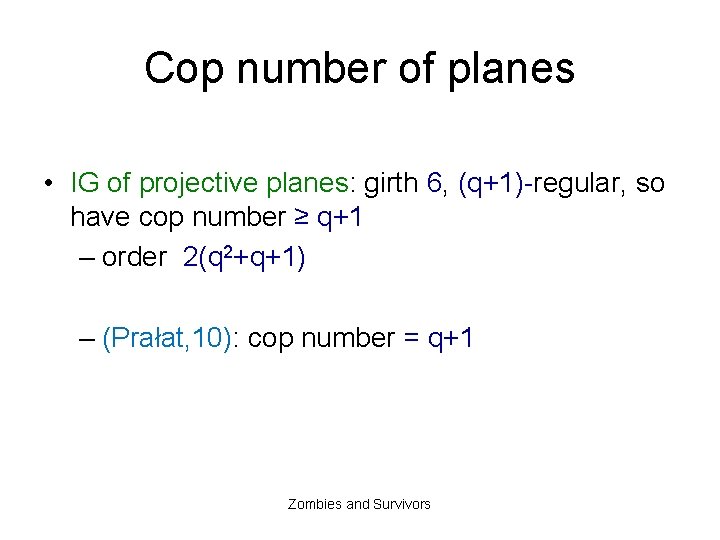
Cop number of planes • IG of projective planes: girth 6, (q+1)-regular, so have cop number ≥ q+1 – order 2(q 2+q+1) – (Prałat, 10): cop number = q+1 Zombies and Survivors
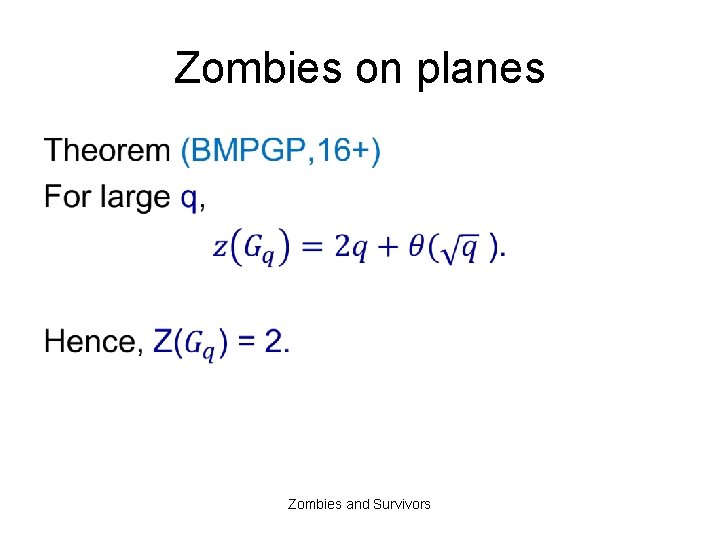
Zombies on planes • Zombies and Survivors
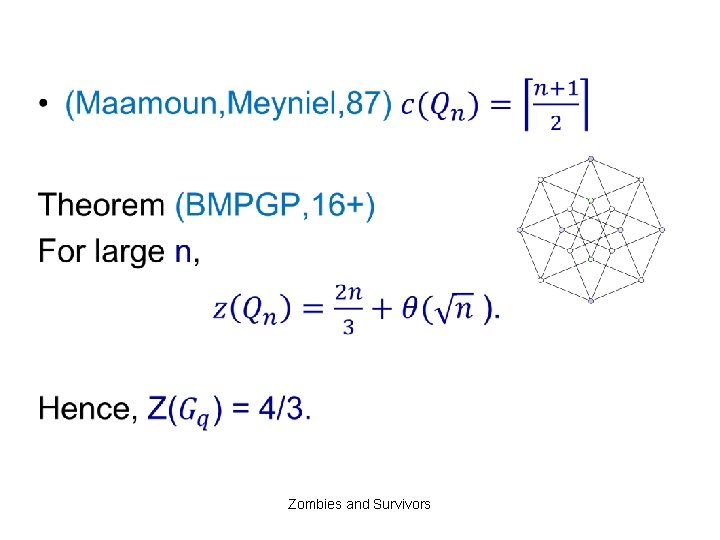
• Zombies and Survivors
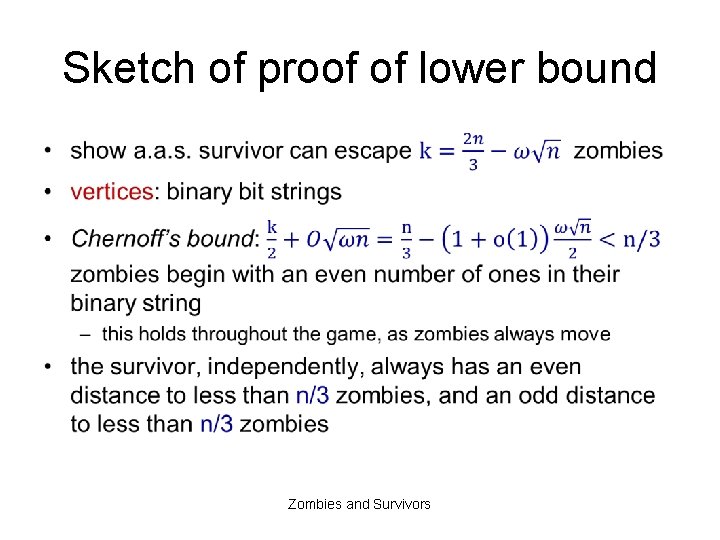
Sketch of proof of lower bound • Zombies and Survivors
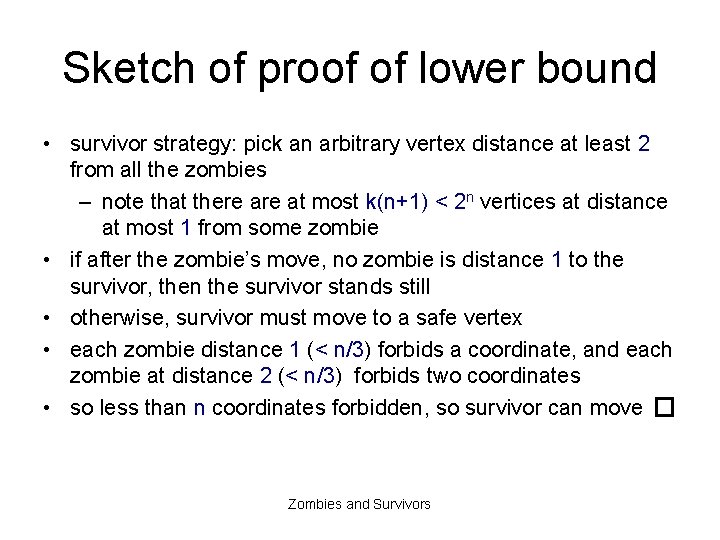
Sketch of proof of lower bound • survivor strategy: pick an arbitrary vertex distance at least 2 from all the zombies – note that there at most k(n+1) < 2 n vertices at distance at most 1 from some zombie • if after the zombie’s move, no zombie is distance 1 to the survivor, then the survivor stands still • otherwise, survivor must move to a safe vertex • each zombie distance 1 (< n/3) forbids a coordinate, and each zombie at distance 2 (< n/3) forbids two coordinates • so less than n coordinates forbidden, so survivor can move Zombies and Survivors
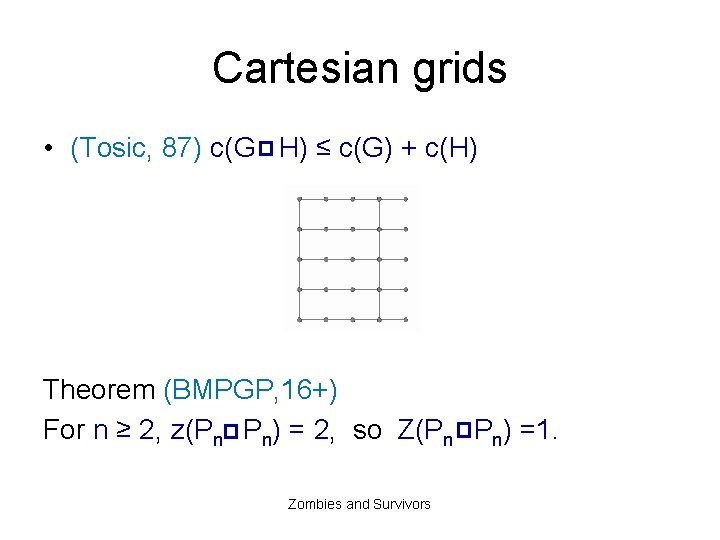
Cartesian grids • (Tosic, 87) c(G H) ≤ c(G) + c(H) Theorem (BMPGP, 16+) For n ≥ 2, z(Pn Pn) = 2, so Z(Pn Pn) =1. Zombies and Survivors
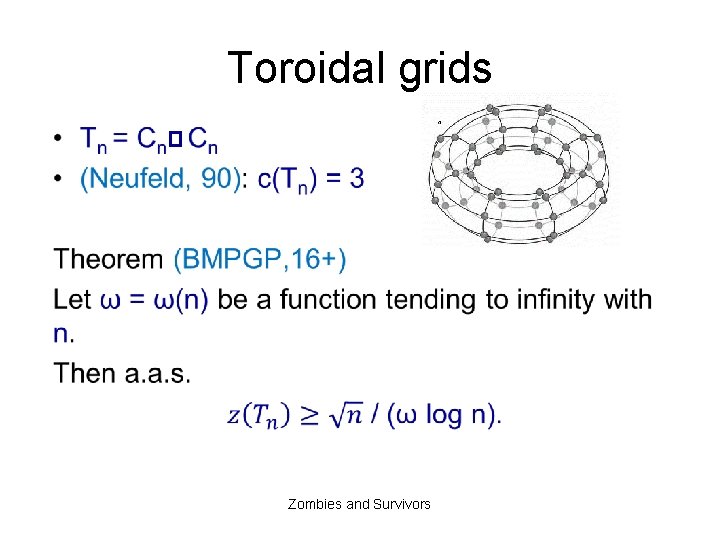
Toroidal grids • Zombies and Survivors
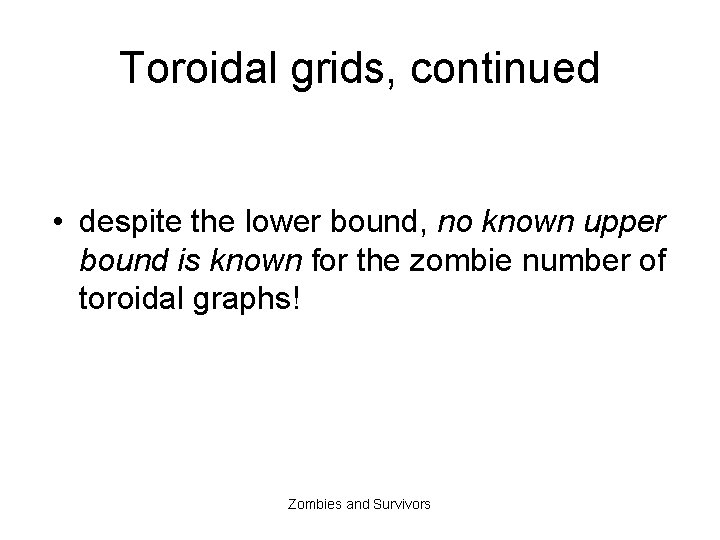
Toroidal grids, continued • despite the lower bound, no known upper bound is known for the zombie number of toroidal graphs! Zombies and Survivors
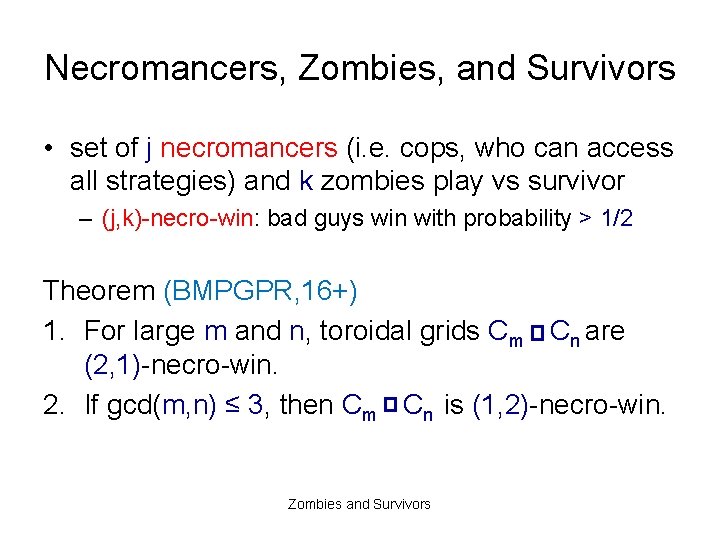
Necromancers, Zombies, and Survivors • set of j necromancers (i. e. cops, who can access all strategies) and k zombies play vs survivor – (j, k)-necro-win: bad guys win with probability > 1/2 Theorem (BMPGPR, 16+) 1. For large m and n, toroidal grids Cm Cn are (2, 1)-necro-win. 2. If gcd(m, n) ≤ 3, then Cm Cn is (1, 2)-necro-win. Zombies and Survivors
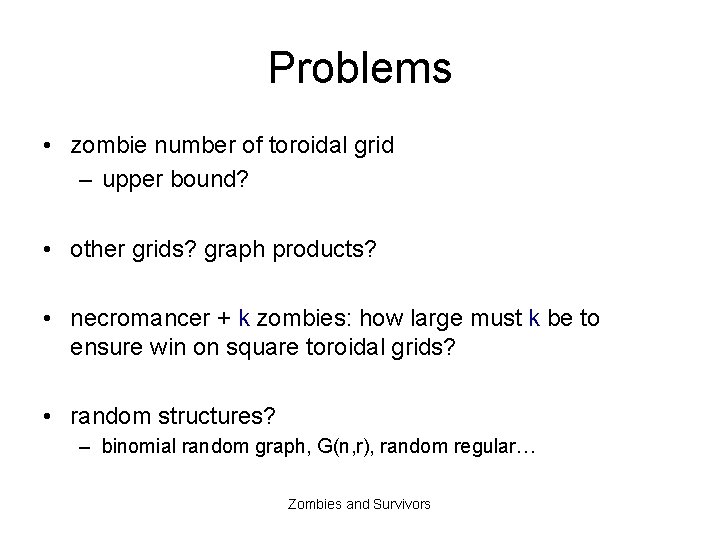
Problems • zombie number of toroidal grid – upper bound? • other grids? graph products? • necromancer + k zombies: how large must k be to ensure win on square toroidal grids? • random structures? – binomial random graph, G(n, r), random regular… Zombies and Survivors
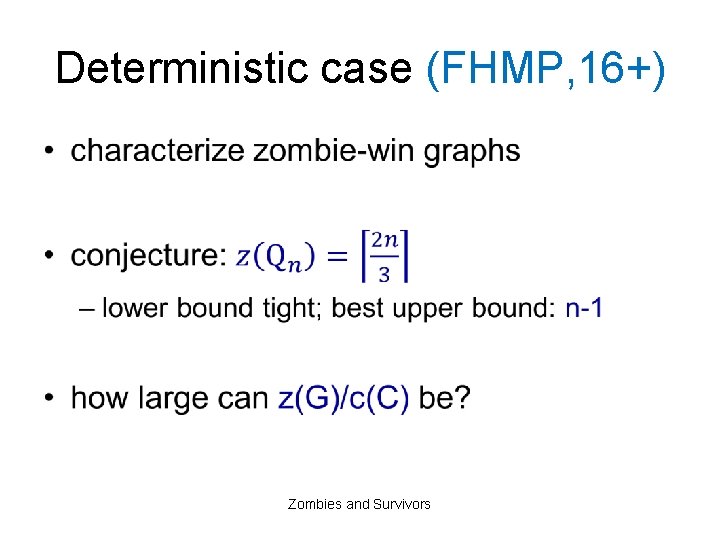
Deterministic case (FHMP, 16+) • Zombies and Survivors

Cana. DAM 2017 Ryerson University, Toronto
Math Ph. D program at Ryerson • starts Fall 2016 • emphasis on modelling, applications – discrete math/graph theory is a field • taking applications in October for Fall 2017 • http: //math. ryerson. ca/graduate/overviewphd. html Zombies and Survivors
- Slides: 33