
SIA and structural adjustment programs improving the dialogue
- Slides: 22
SIA and structural adjustment programs: improving the dialogue between SIA practitioners and government Jacki Schirmer Research Fellow School of Resources, Environment and Society - ANU Co-operative Research Centre for Forestry jacki. schirmer@anu. edu. au
Overview § Aim: To explore ways to improve dialogue between policy makers and SIA practitioners § Focussing on use of SIA when government policy makers developing structural adjustment programs (SAP) § Examples of recent SAP in Australia § Case study of designing a fisheries SAP • Challenges for policy makers • Challenges for SIA practitioner • Most importantly, challenges for the people potentially impacted by the SAP Disclaimer: I am talking from my personal experiences of involvement while employed in government. These views are not those of the government department I was employed by.
Structural adjustment programs – a (very) incomplete Australian history… § SAP are policies designed to assist people to adjust in situations where a government has changed access to publicly owned resources § Typically involve government providing payments which are designed to: • Assist businesses directly dependent on the publicly owned resource to exit the industry or restructure their business (most payments) • Assist workers employed in these businesses retrain or relocate • Assist affected communities § Not allowed to be called ‘compensation’ as legislation does not provide for the ‘c’ word § Must always be provided to assist with ‘adjustment’
Examples of recent SAP forestry § Regional Forest Agreements (various agreements made during 1997 -2003). After consultation process and scientific evaluation, decisions made to reserve some native forests from logging. Govt provided Forest Industry Structural Adjustment Program (FISAP) to help industry adjust. Payments provided to those directed affected by change, some training opportunities. Several SIA undertaken (http: //www. daff. gov. au/rfa) § Tasmanian Community Forestry Agreement (2005). Federal government reserved 180, 000 ha of native forest from logging. Federal & Tasmanian governments provided $AUD 250 million to assist forest industry, local communities to adjust to this and previous changes. No SIA undertaken (see
Examples of recent SAP fishing § Securing our fishing future, Nov 2005. Federal government aimed to reduce fishing effort in Commonwealth controlled waters through reducing number of fishing licences, and declaring Marine Protected Areas. $AUD 220 million SAP provides various types of assistance including ‘Business Exit Assistance, Business Advice Assistance, Assistance for Skippers and Crew, Onshore Business Assistance, Fishing Community Assistance and the AFMA Levy Subsidy’ (see http: //www. daff. gov. au/fisheries/domestic/fishingfuture). Some SIA undertaken § Cod Grounds Commonwealth Marine Reserve. 2007. Fishing ground turned into marine reserve excluding all commercial and recreational fishing. Unspecified SAP provided. SIA undertaken (http: //www. environment. gov. au/coasts/mpa/codgrounds/index. html) § Great Barrier Reef Marine Protected Area ‘Green Zones’. New areas reserved from fishing in 2004. Cost of SAP originally estimated at $2. 5 M-$10 M. Actual cost $50 million. Highly controversial. Some SIA undertaken. Became politically contentious due to cost blow-out (e. g. www. aph. gov. au/Senate/committee/ecita_ctte/estimates/add_050
Case study of use of SIA in SAP To assist in honest discussion of the case and the challenges it presented, this “case study” amalgamates two different SIAs I was involved in, both of which had similar challenges. Background: • Government identified a potential need to reserve an area of ocean in a Marine Protected Area currently used by commercial fishers • Put out a discussion paper & asked for submissions from interested members of the public • After reviewing submissions, identified that they were likely to reserve the area & began developing SAP • Decided to commission an SIA to assist process of
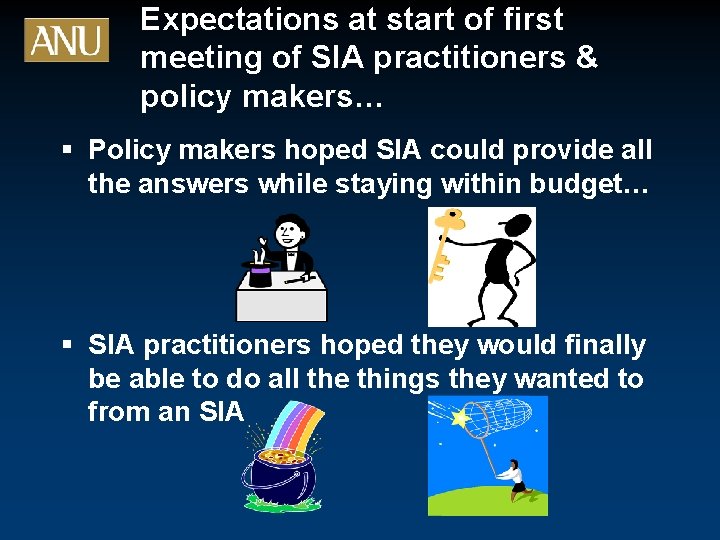
Expectations at start of first meeting of SIA practitioners & policy makers… § Policy makers hoped SIA could provide all the answers while staying within budget… § SIA practitioners hoped they would finally be able to do all the things they wanted to from an SIA
First meeting… § Policy makers set out their expectations § SIA practitioners set out their expectations § The views of fishers were presented by the government agent who had been consulting with them
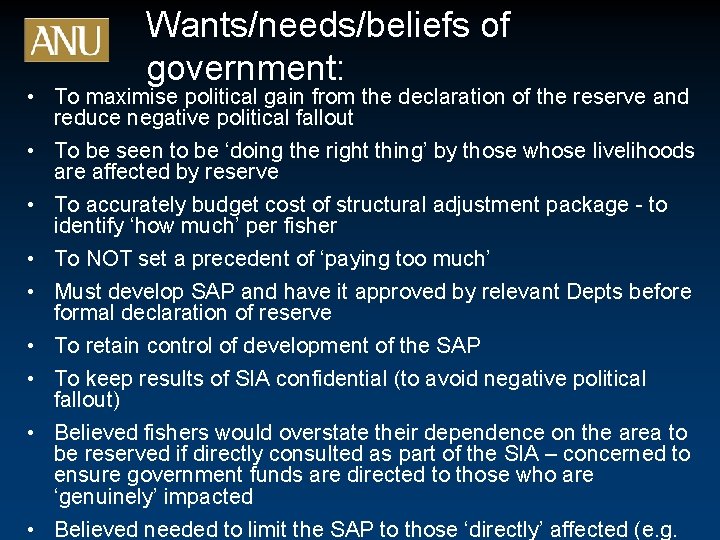
Wants/needs/beliefs of government: • To maximise political gain from the declaration of the reserve and reduce negative political fallout • To be seen to be ‘doing the right thing’ by those whose livelihoods are affected by reserve • To accurately budget cost of structural adjustment package - to identify ‘how much’ per fisher • To NOT set a precedent of ‘paying too much’ • Must develop SAP and have it approved by relevant Depts before formal declaration of reserve • To retain control of development of the SAP • To keep results of SIA confidential (to avoid negative political fallout) • Believed fishers would overstate their dependence on the area to be reserved if directly consulted as part of the SIA – concerned to ensure government funds are directed to those who are ‘genuinely’ impacted • Believed needed to limit the SAP to those ‘directly’ affected (e. g.
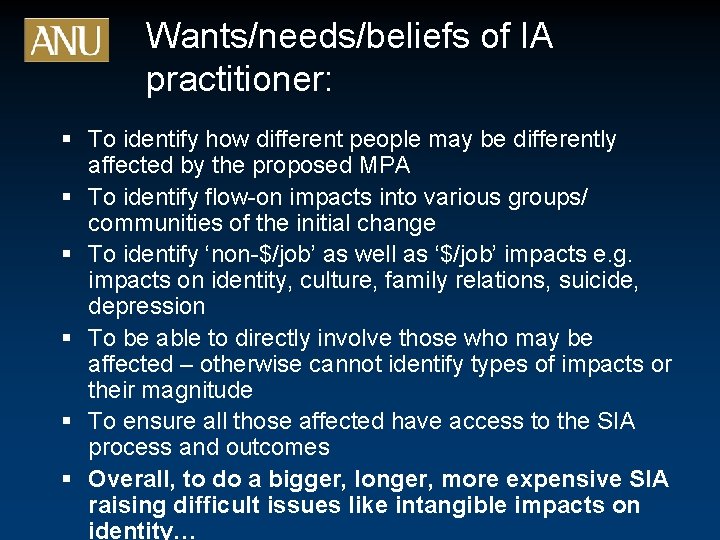
Wants/needs/beliefs of IA practitioner: § To identify how different people may be differently affected by the proposed MPA § To identify flow-on impacts into various groups/ communities of the initial change § To identify ‘non-$/job’ as well as ‘$/job’ impacts e. g. impacts on identity, culture, family relations, suicide, depression § To be able to directly involve those who may be affected – otherwise cannot identify types of impacts or their magnitude § To ensure all those affected have access to the SIA process and outcomes § Overall, to do a bigger, longer, more expensive SIA raising difficult issues like intangible impacts on identity…
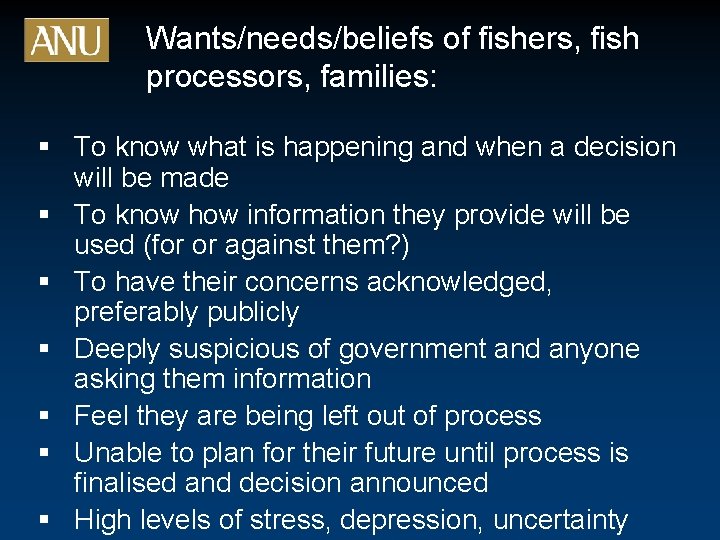
Wants/needs/beliefs of fishers, fish processors, families: § To know what is happening and when a decision will be made § To know how information they provide will be used (for or against them? ) § To have their concerns acknowledged, preferably publicly § Deeply suspicious of government and anyone asking them information § Feel they are being left out of process § Unable to plan for their future until process is finalised and decision announced § High levels of stress, depression, uncertainty
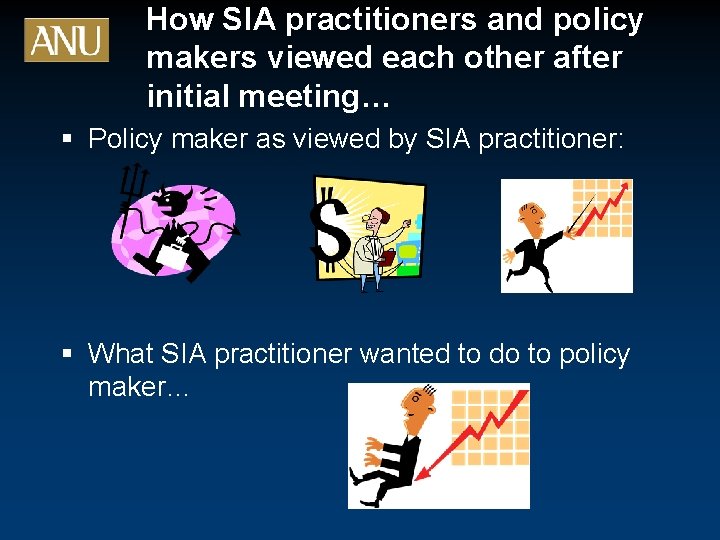
How SIA practitioners and policy makers viewed each other after initial meeting… § Policy maker as viewed by SIA practitioner: § What SIA practitioner wanted to do to policy maker…
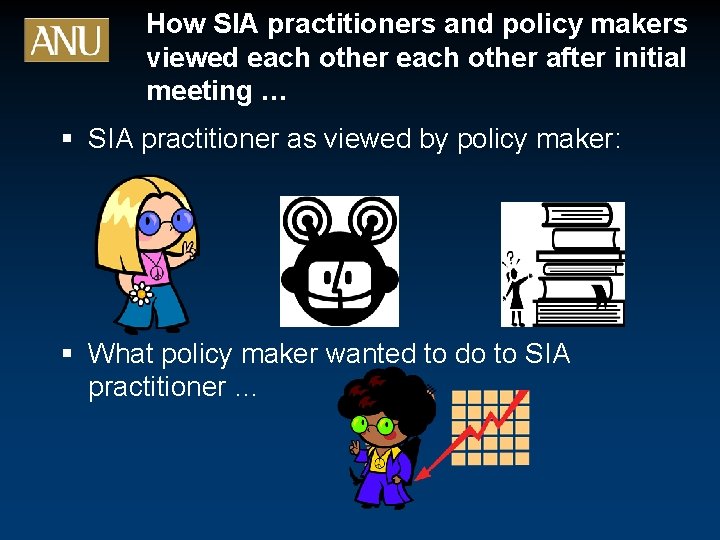
How SIA practitioners and policy makers viewed each other after initial meeting … § SIA practitioner as viewed by policy maker: § What policy maker wanted to do to SIA practitioner …
What happened then? Road trip! § Policy makers, SIA practitioners, went to have a meeting with fishers to scope out the SIA § Involved 22 hours of driving, 2 nights in dodgy motels, and several beers with fishers § Some bonding & sharing of perspectives occurred Started to think that maybe we needed to think of using SIA techniques to understand the policy makers… § What were their constraints, how could they act in this situation? § How could they be influenced? § How could their knowledge be used to improve SIA outcomes?
Scoping the policy makers… § We studied the policy making environment • The policy makers we were dealing with had no power to approve changes in the SIA being commissioned § What was the hierarchy? § Who made decisions? § Who needed to give permission for the SIA to be a broader process? • Met with a series of people, identified who could approve was what viewed as a ‘risky’ process • Involved them in subsequent dialogue • Delicate process, but very worthwhile
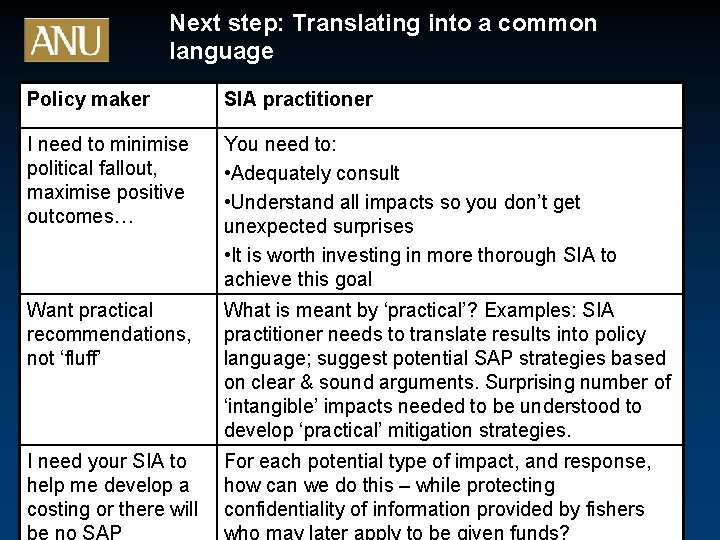
Next step: Translating into a common language Policy maker SIA practitioner I need to minimise political fallout, maximise positive outcomes… You need to: • Adequately consult • Understand all impacts so you don’t get unexpected surprises • It is worth investing in more thorough SIA to achieve this goal Want practical recommendations, not ‘fluff’ What is meant by ‘practical’? Examples: SIA practitioner needs to translate results into policy language; suggest potential SAP strategies based on clear & sound arguments. Surprising number of ‘intangible’ impacts needed to be understood to develop ‘practical’ mitigation strategies. I need your SIA to help me develop a costing or there will be no SAP For each potential type of impact, and response, how can we do this – while protecting confidentiality of information provided by fishers who may later apply to be given funds?
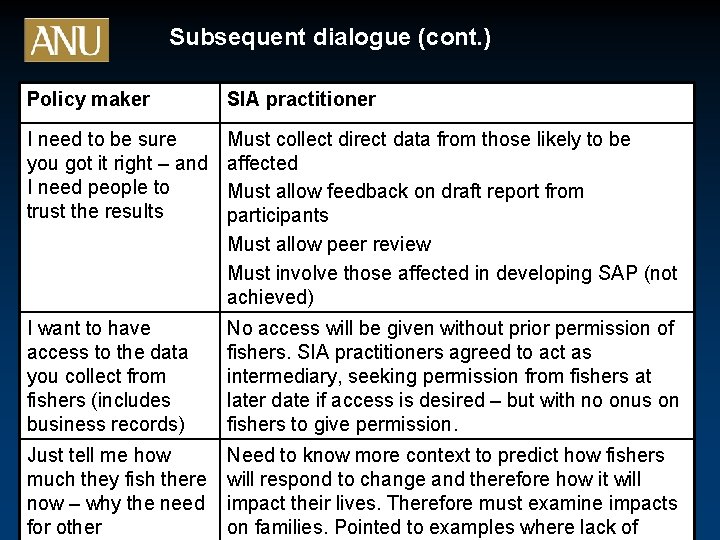
Subsequent dialogue (cont. ) Policy maker SIA practitioner I need to be sure you got it right – and I need people to trust the results Must collect direct data from those likely to be affected Must allow feedback on draft report from participants Must allow peer review Must involve those affected in developing SAP (not achieved) I want to have access to the data you collect from fishers (includes business records) No access will be given without prior permission of fishers. SIA practitioners agreed to act as intermediary, seeking permission from fishers at later date if access is desired – but with no onus on fishers to give permission. Just tell me how much they fish there now – why the need for other Need to know more context to predict how fishers will respond to change and therefore how it will impact their lives. Therefore must examine impacts on families. Pointed to examples where lack of
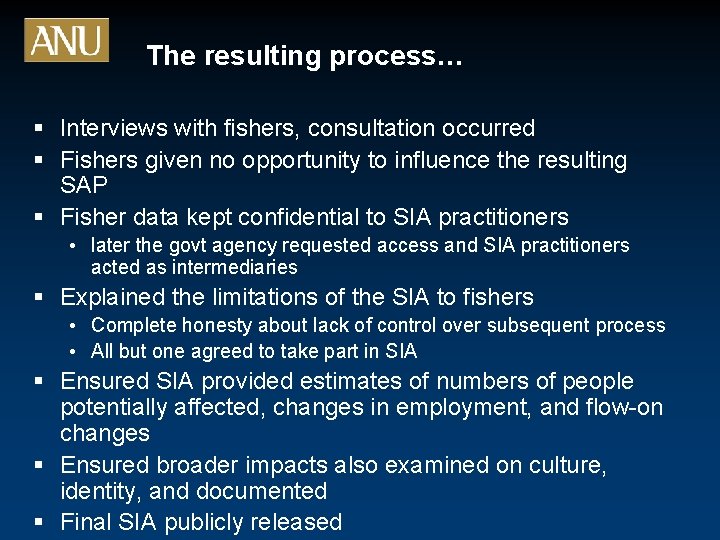
The resulting process… § Interviews with fishers, consultation occurred § Fishers given no opportunity to influence the resulting SAP § Fisher data kept confidential to SIA practitioners • later the govt agency requested access and SIA practitioners acted as intermediaries § Explained the limitations of the SIA to fishers • Complete honesty about lack of control over subsequent process • All but one agreed to take part in SIA § Ensured SIA provided estimates of numbers of people potentially affected, changes in employment, and flow-on changes § Ensured broader impacts also examined on culture, identity, and documented § Final SIA publicly released
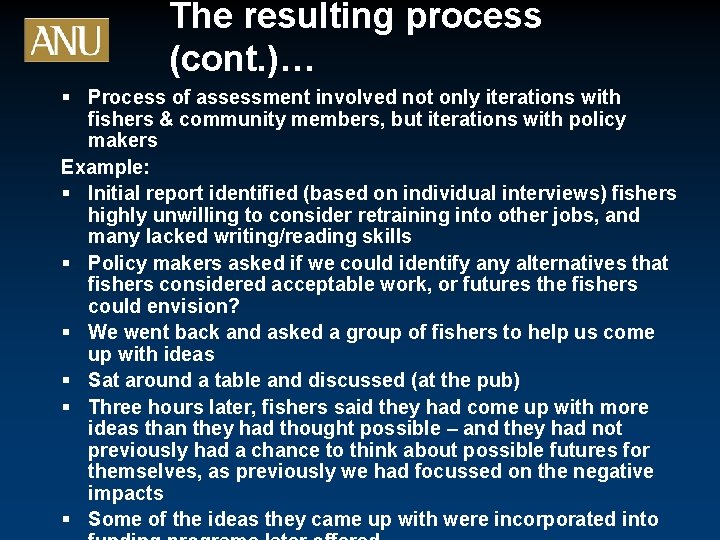
The resulting process (cont. )… § Process of assessment involved not only iterations with fishers & community members, but iterations with policy makers Example: § Initial report identified (based on individual interviews) fishers highly unwilling to consider retraining into other jobs, and many lacked writing/reading skills § Policy makers asked if we could identify any alternatives that fishers considered acceptable work, or futures the fishers could envision? § We went back and asked a group of fishers to help us come up with ideas § Sat around a table and discussed (at the pub) § Three hours later, fishers said they had come up with more ideas than they had thought possible – and they had not previously had a chance to think about possible futures for themselves, as previously we had focussed on the negative impacts § Some of the ideas they came up with were incorporated into
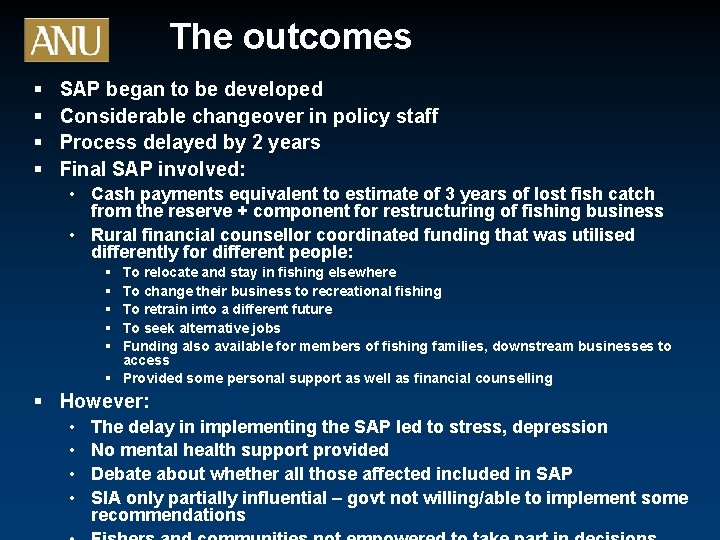
The outcomes § § SAP began to be developed Considerable changeover in policy staff Process delayed by 2 years Final SAP involved: • Cash payments equivalent to estimate of 3 years of lost fish catch from the reserve + component for restructuring of fishing business • Rural financial counsellor coordinated funding that was utilised differently for different people: § § § To relocate and stay in fishing elsewhere To change their business to recreational fishing To retrain into a different future To seek alternative jobs Funding also available for members of fishing families, downstream businesses to access § Provided some personal support as well as financial counselling § However: • • The delay in implementing the SAP led to stress, depression No mental health support provided Debate about whether all those affected included in SAP SIA only partially influential – govt not willing/able to implement some recommendations
Outcomes? § Overall not a resounding success, but managed to: • Honestly represent point of view of different fishers, fishing families, other businesses and people potentially affected • Be honest with the fishers/fishing communities about limitations of process • Achieved publicly reported SIA • The SIA did influence the SAP developed – albeit not as much as hoped • SIA practitioners learned more about making policy-ready recommendations
So how do we improve the dialogue between policy makers and SIA practitioners? § Need to view each other as having legitimate perspectives. Harder than it sounds… § Understand needs and constraints of each • Government has budgetary constraints, accountability for spending that leads to focus on costing • SIA practitioner cannot produce data from thin air and is limited in the extent to which they can predict impacts § Spend time translating SIA-speak and policy-speak into each other’s languages § Set out clear documentation of process, including draft outline of expectations of content of SIA agreed to by all § Ensure resources allow for policy makers and SIA practitioners to work together on the SIA as it progresses § Decide where you are willing to be flexible in SIA, and what is non-negotiable