
SI Units of Measurement International System of Units



- Slides: 13
SI Units of Measurement (International System of Units) Length, Mass, Volume
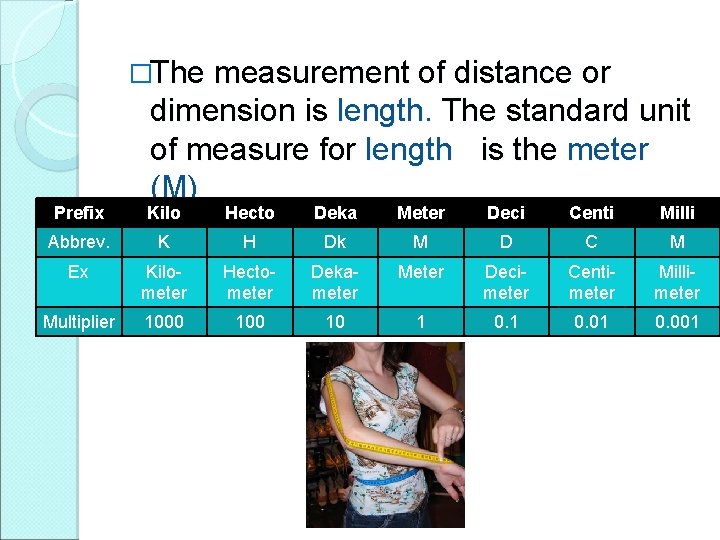
�The measurement of distance or dimension is length. The standard unit of measure for length is the meter (M) Prefix Kilo Hecto Deka Meter Deci Centi Milli Abbrev. K H Dk M D C M Ex Kilometer Hectometer Dekameter Meter Decimeter Centimeter Millimeter Multiplier 1000 10 1 0. 01 0. 001
For Example: 10 millimeters 1 centimeter 10 centimeters 1 decimeter 10 decimeters 1 meter 1000 meters 1 kilometer
�The fundamental measure of the amount of matter in an object is referred to as mass �The standard unit of measure for mass is the gram (g). �**Mass and Weight are not the same thing!! The mass of an object is unchanging! ** �Weight is the measure of the force of gravity on an object. Its S 1 unit is the Newton It can be determined by multiplying the acceleration of gravity
For Example: � 1 kg x 9. 8 N/kg = 9. 8 N � 100 kg x 9: 8 N/kg = 980 N
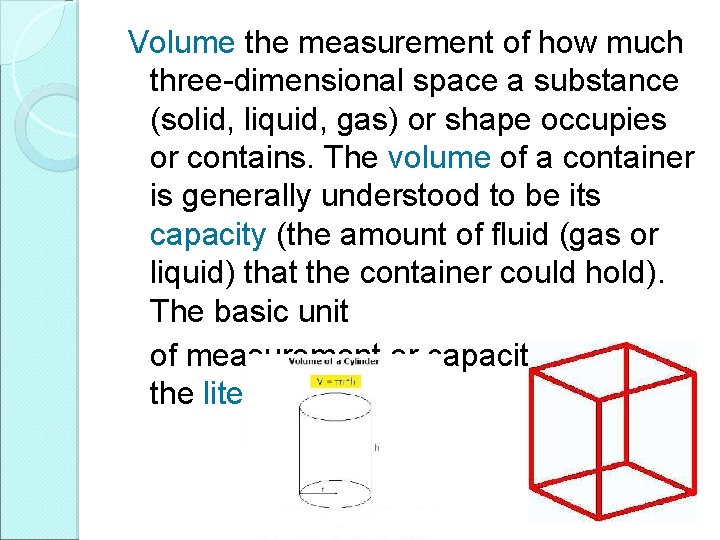
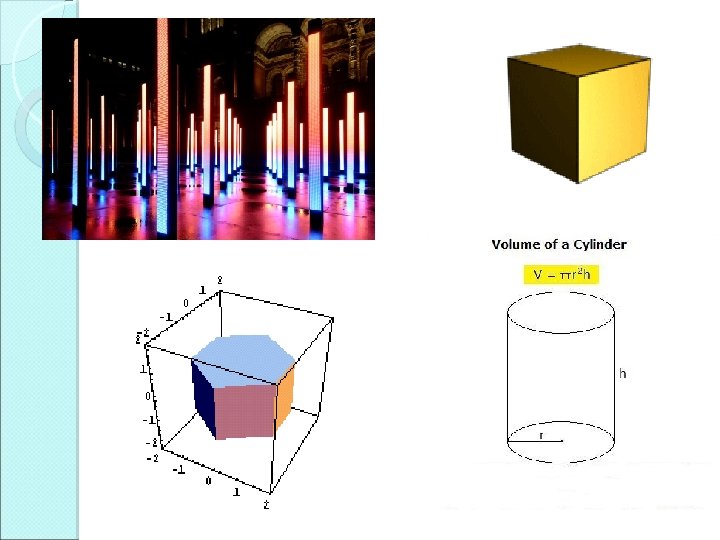
Volume the measurement of how much three-dimensional space a substance (solid, liquid, gas) or shape occupies or contains. The volume of a container is generally understood to be its capacity (the amount of fluid (gas or liquid) that the container could hold). The basic unit of measurement or capacity is usually the liter.
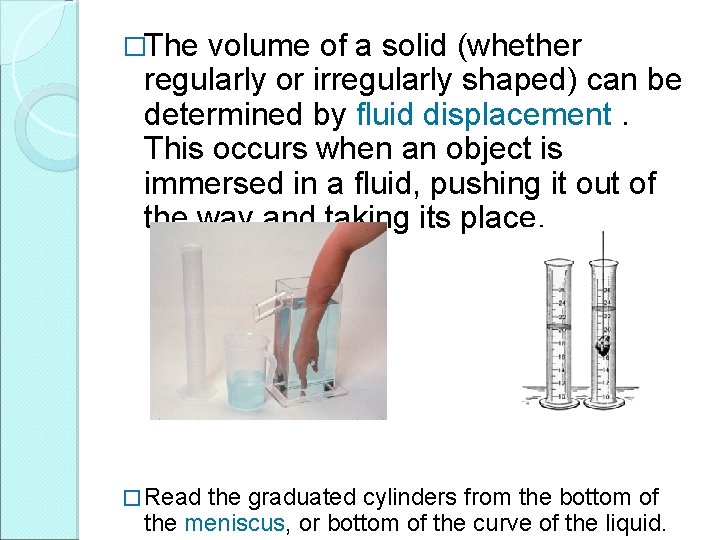
�The volume of a solid (whether regularly or irregularly shaped) can be determined by fluid displacement. This occurs when an object is immersed in a fluid, pushing it out of the way and taking its place. � Read the graduated cylinders from the bottom of the meniscus, or bottom of the curve of the liquid.
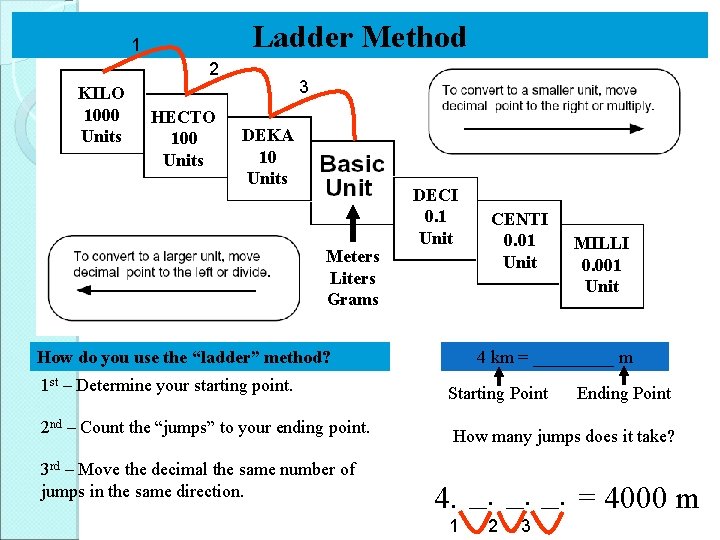
Ladder Method 1 2 KILO 1000 Units HECTO 100 Units 3 DEKA 10 Units Meters Liters Grams DECI 0. 1 Unit How do you use the “ladder” method? 1 st – Determine your starting point. 2 nd – Count the “jumps” to your ending point. 3 rd – Move the decimal the same number of jumps in the same direction. CENTI 0. 01 Unit MILLI 0. 001 Unit 4 km = _____ m Starting Point Ending Point How many jumps does it take? 4. __. __. = 4000 m 1 2 3
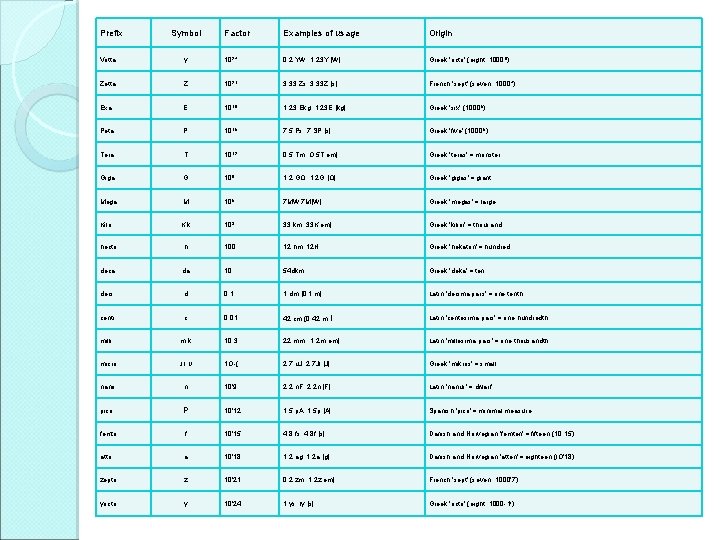
Prefix Symbol Factor Examples of usage Origin Votta y 1024 0. 2 YW, 1. 23 Y [W] Greek 'octo' (eight, 1000 8) Zetta Z 1021 3. 33 Zs, 3. 33 Z [s] French 'sept' (seven, 1000 7) Exa E 1018 1. 23 Ekg, 1. 23 E [kg] Greek 'six' (10006) Peta P 1015 7. 5 Ps, 7. SP [s] Greek 'five' (1000 5) Tera T 1012 0. 5 Tm, O. 5 T em] Greek 'teras' = monster Giga G 109 1. 2 GQ, 1. 2 G [Q] Greek 'gigas' = giant Mega M 106 7 MW, 7 M[W] Greek 'megas' = large K, k 103 33 km, 33 K em] Greek 'kilioi' = thousand hecto h 100 12 hm, 12 H Greek 'hekaton' = hundred deca da 10 54 dkm Greek 'deka' = ten deci d 0. 1 1 dm [0. 1 m] Latin 'decima pars' = one tenth centi c 0. 01 42 cm (0. 42 m milli m, k 10, 3 22 mm , 1. 2 m em] Latin 'millesima pars' = one thousandth micro J 1, U 1 O-{; 2. 7 u. J , 2. 7 Jl [J] Greek 'mikros' = small nano n 10'9 2. 2 n. F, 2. 2 n [F] Latin 'nanus' = dwarf pico P 10'12 1. 5 p. A, 1. 5 p [A] Spanish 'pico' = minimal measure femto f 10'15 4. 8 fs, 4. 8 f [s] Danish and Norvegian 'femten' = fifteen (10, 15) atto a 10'18 1. 2 ag, 1. 2 a [g] Danish and Norvegian 'atten' = eighteen (l. O'18) zepto z 10'21 0. 2 zm, 1. 2 z em] French 'sept' (seven, 1000'7) yocto y 10'24 1 ys, ly [s] Greek 'octo' (eight, 1000 -1!) Kilo I Latin 'centesima pars' = one hundredth
The End