
SI Measurement Outline copy Scientists measure stuff regularly

- Slides: 21
SI Measurement Outline (copy) Scientists measure stuff regularly. l They must have a standard. l A standard is an exact quantity people agree to use for comparison. l A standard means two people using the same object should get close to the same results. l
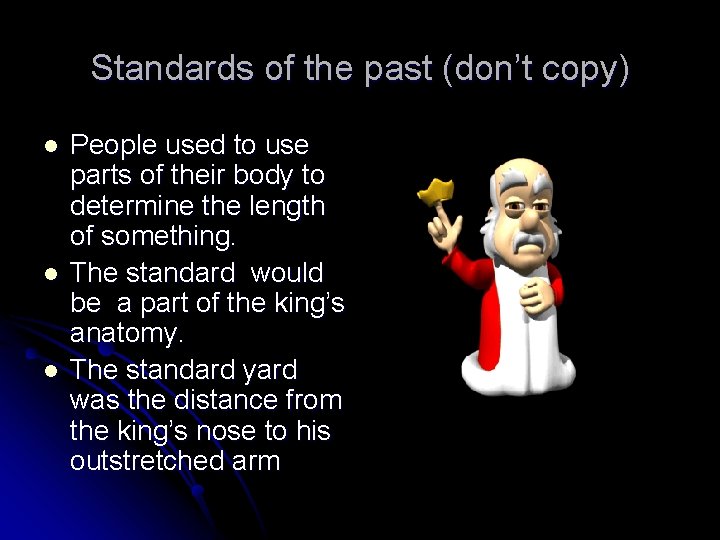
Standards of the past (don’t copy) l l l People used to use parts of their body to determine the length of something. The standard would be a part of the king’s anatomy. The standard yard was the distance from the king’s nose to his outstretched arm
People would use their feet to measure distance (don’t copy) l l l This is how the term foot came about. Today the standard “foot” in the English system is 12 inches = 1 foot
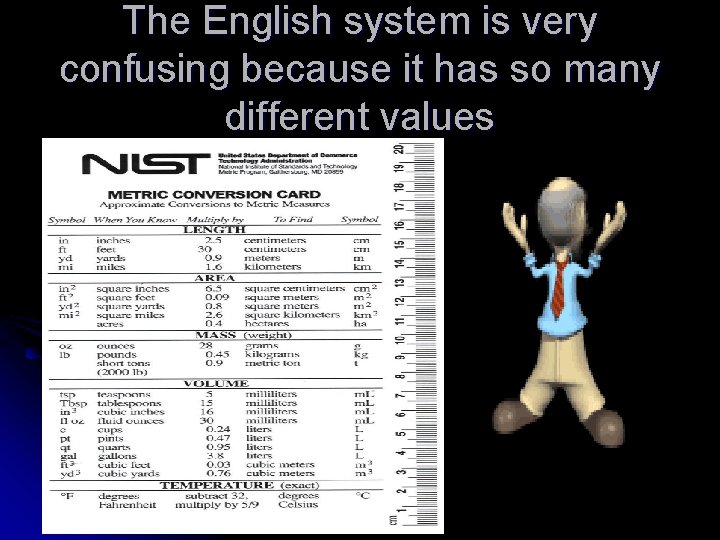
The English system is very confusing because it has so many different values
America is the only country that still uses the old English system
Scientists give the English system the thumbs down Scientists needed an exact and uniform system of weights and measurements
Check for understanding! Copy and answer the questions below (required for full credit on outline) 1. Consider the following: A mean gym teacher has his students run during class – when a student asks how long they should run, the teacher said, “Run until your legs feel like jello! Now get going!” a. b. 2. How is this teacher not using standards? How could the teacher standardize his “assignment? ” What are 2 problems with the English system of measurement?
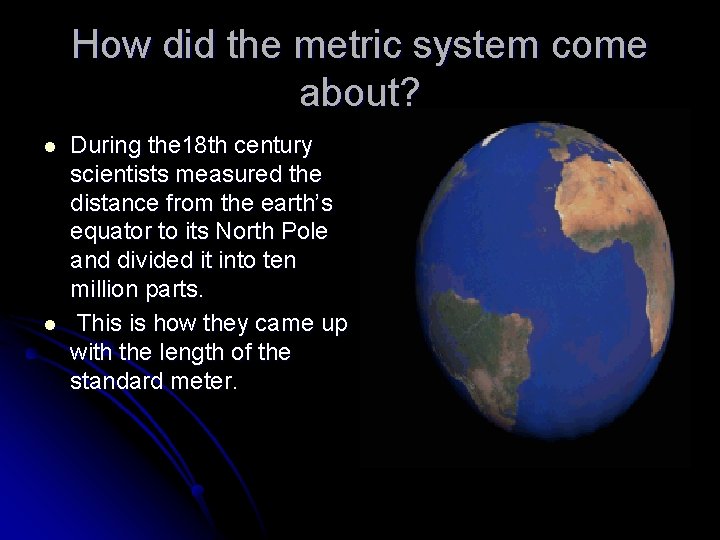
How did the metric system come about? l l During the 18 th century scientists measured the distance from the earth’s equator to its North Pole and divided it into ten million parts. This is how they came up with the length of the standard meter.
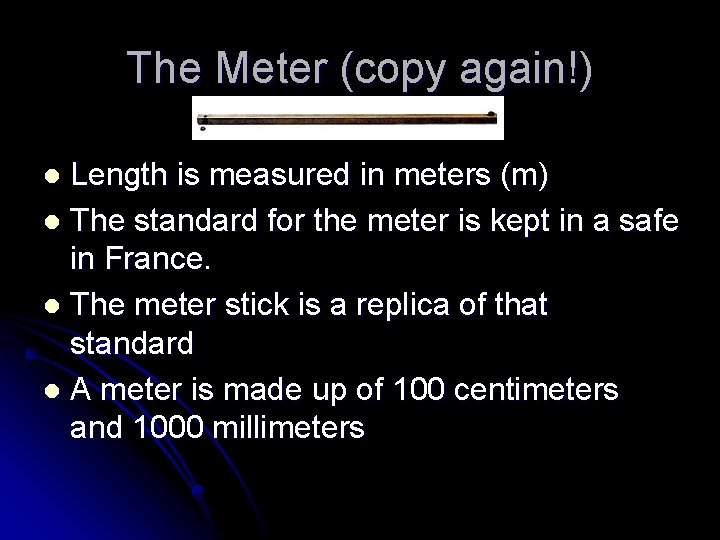
The Meter (copy again!) Length is measured in meters (m) l The standard for the meter is kept in a safe in France. l The meter stick is a replica of that standard l A meter is made up of 100 centimeters and 1000 millimeters l
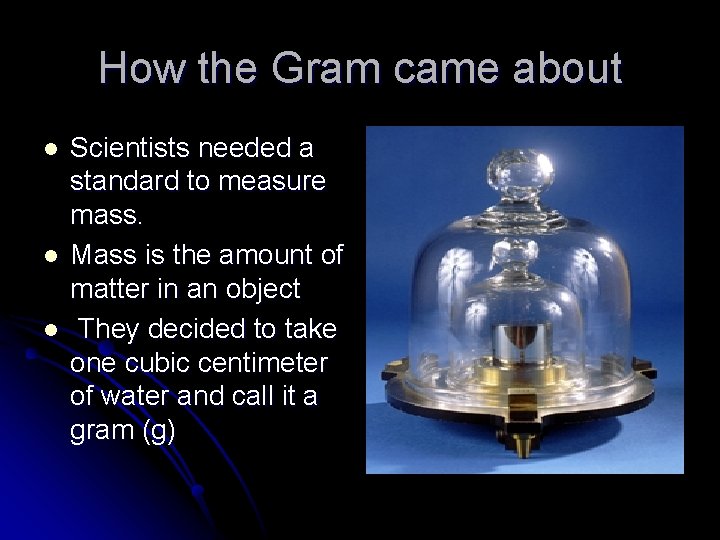
How the Gram came about l l l Scientists needed a standard to measure mass. Mass is the amount of matter in an object They decided to take one cubic centimeter of water and call it a gram (g)
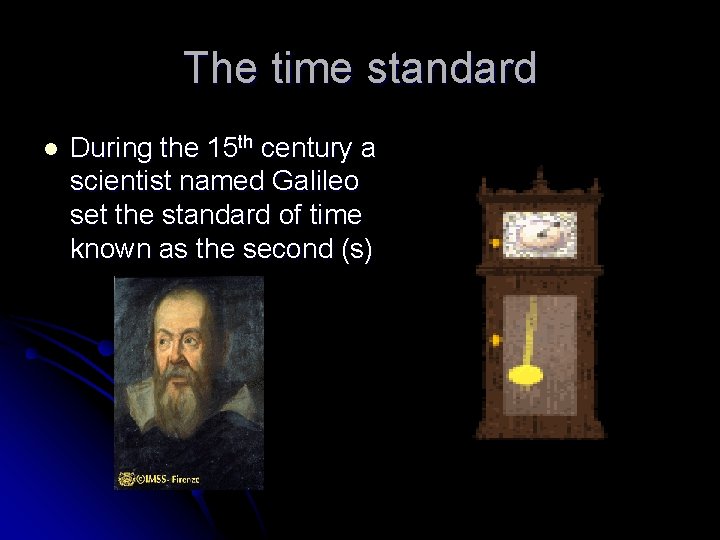
The time standard l During the 15 th century a scientist named Galileo set the standard of time known as the second (s)
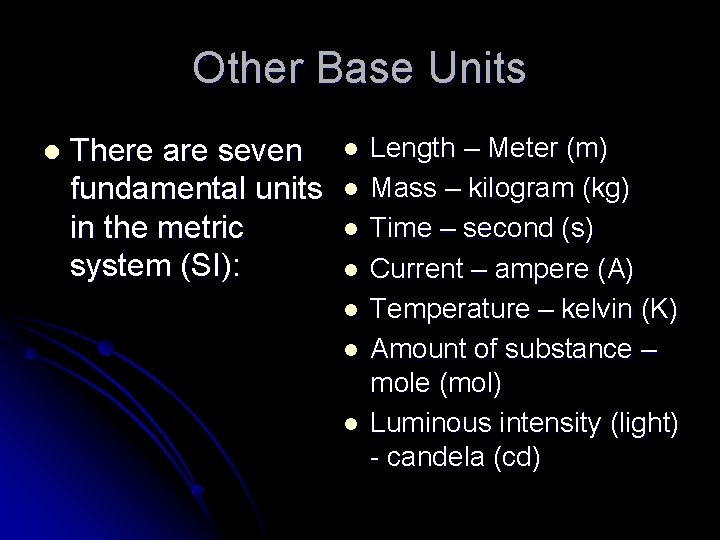
Other Base Units l There are seven fundamental units in the metric system (SI): l l l l Length – Meter (m) Mass – kilogram (kg) Time – second (s) Current – ampere (A) Temperature – kelvin (K) Amount of substance – mole (mol) Luminous intensity (light) - candela (cd)
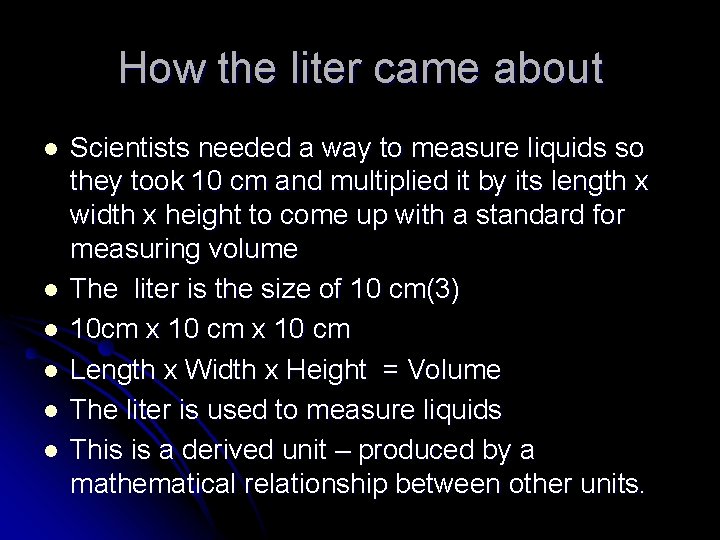
How the liter came about l l l Scientists needed a way to measure liquids so they took 10 cm and multiplied it by its length x width x height to come up with a standard for measuring volume The liter is the size of 10 cm(3) 10 cm x 10 cm Length x Width x Height = Volume The liter is used to measure liquids This is a derived unit – produced by a mathematical relationship between other units.
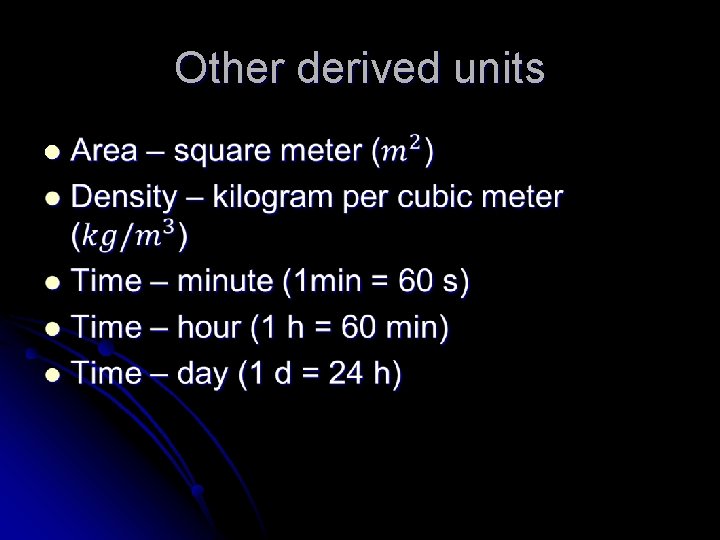
Other derived units l
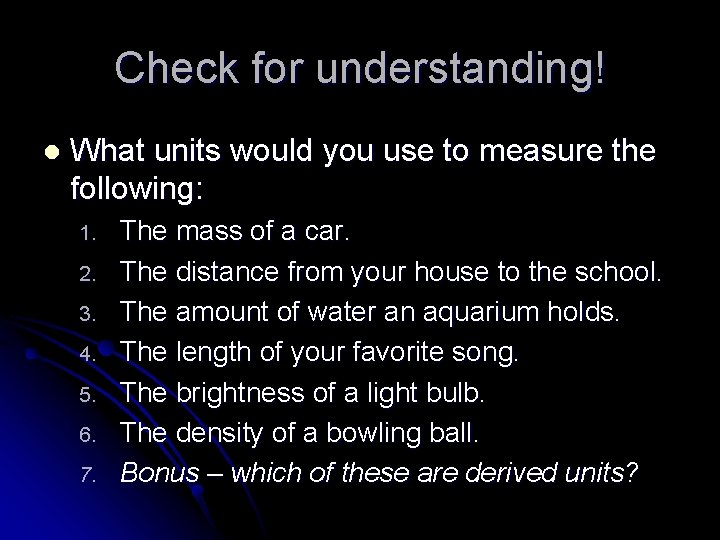
Check for understanding! l What units would you use to measure the following: 1. 2. 3. 4. 5. 6. 7. The mass of a car. The distance from your house to the school. The amount of water an aquarium holds. The length of your favorite song. The brightness of a light bulb. The density of a bowling ball. Bonus – which of these are derived units?
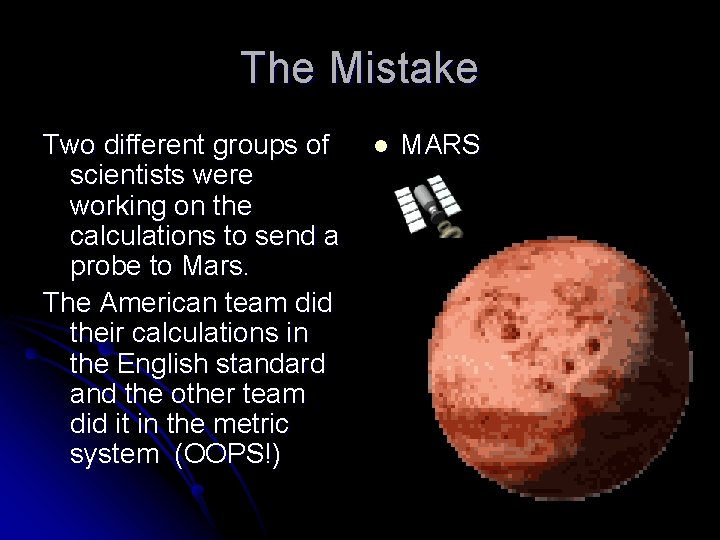
The Mistake Two different groups of scientists were working on the calculations to send a probe to Mars. The American team did their calculations in the English standard and the other team did it in the metric system (OOPS!) l MARS
l This made scientists very upset. l l It cost the space program 125 million dollars It cost the scientists their time
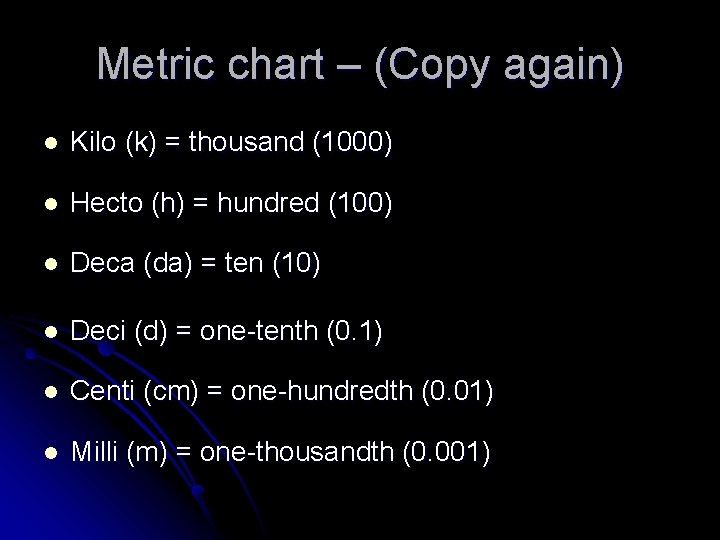
Metric chart – (Copy again) l Kilo (k) = thousand (1000) l Hecto (h) = hundred (100) l Deca (da) = ten (10) l Deci (d) = one-tenth (0. 1) l Centi (cm) = one-hundredth (0. 01) l Milli (m) = one-thousandth (0. 001)
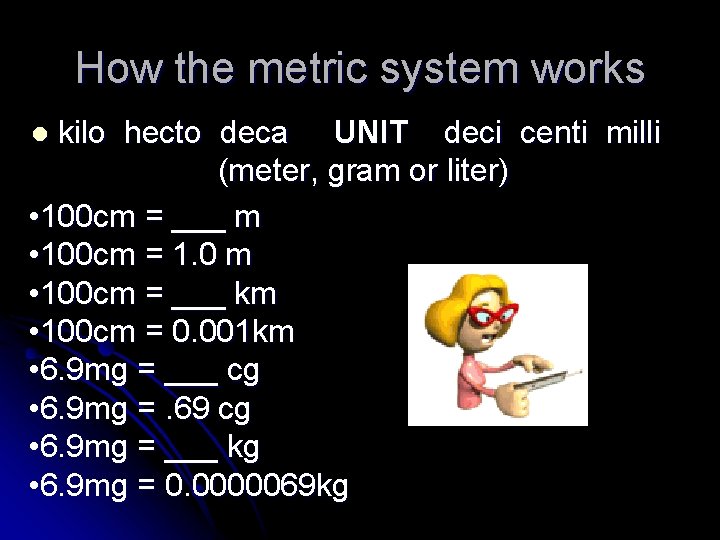
How the metric system works kilo hecto deca UNIT deci centi milli (meter, gram or liter) • 100 cm = ___ m • 100 cm = 1. 0 m • 100 cm = ___ km • 100 cm = 0. 001 km • 6. 9 mg = ___ cg • 6. 9 mg =. 69 cg • 6. 9 mg = ___ kg • 6. 9 mg = 0. 0000069 kg l
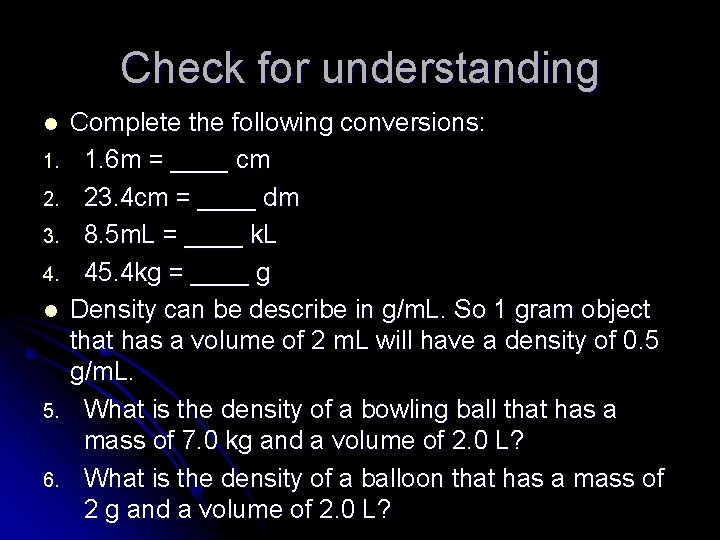
Check for understanding l 1. 2. 3. 4. l 5. 6. Complete the following conversions: 1. 6 m = ____ cm 23. 4 cm = ____ dm 8. 5 m. L = ____ k. L 45. 4 kg = ____ g Density can be describe in g/m. L. So 1 gram object that has a volume of 2 m. L will have a density of 0. 5 g/m. L. What is the density of a bowling ball that has a mass of 7. 0 kg and a volume of 2. 0 L? What is the density of a balloon that has a mass of 2 g and a volume of 2. 0 L?
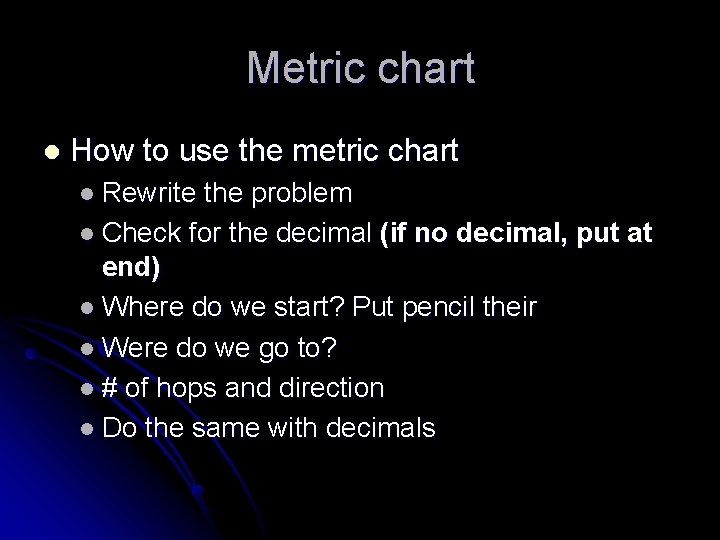
Metric chart l How to use the metric chart l Rewrite the problem l Check for the decimal (if no decimal, put at end) l Where do we start? Put pencil their l Were do we go to? l # of hops and direction l Do the same with decimals