
SI Framework Public Health Reporting SI Framework CEDD
S&I Framework Public Health Reporting – S&I Framework CEDD Overview Tuesday, December 1, 2020
Why is a CEDD needed? • Helps define the understanding of data exchanged across S&I Framework initiatives. – Provides a view of the clinical and technical requirements of data – Go from requirements to clinical need to technical representation to implementation – Supports implementation guidance development and requirements traceability • Advances interoperability within the S&I Framework by serving as a common foundation for standards – Draws from underlying information models within standards to help in the identification of gaps and enhancements needed to provide tangible value
S&I CEDD Development to Date • Used as a fundamental building block to move from clinical need to technical representation to implementation – Draw from past and current work in S&I and FHA – Provide a path to harmonize clinical concepts with public health understanding and know-how • Foundational tools and presentations are available and education will be part of the approach
S&I Framework CEDD - Evolution • Focus on keeping as lightweight as possible because maintenance ultimately will fall to the SDO’s whose standards we are adopting. – CIM –started as a clinical information modeling effort, then shifted to – CEDD – became a more clinically focused data dictionary – CEDD to Consolidated CDA – then focused on mapping – The “To. C CEDD" is for all practical purposes the HL 7 balloted specification and is fully aligned to the Consolidated CDA. • By default, the S&I CEDD will have fewer data elements available to Transitions of Care for initial review than what can be described by CDA.
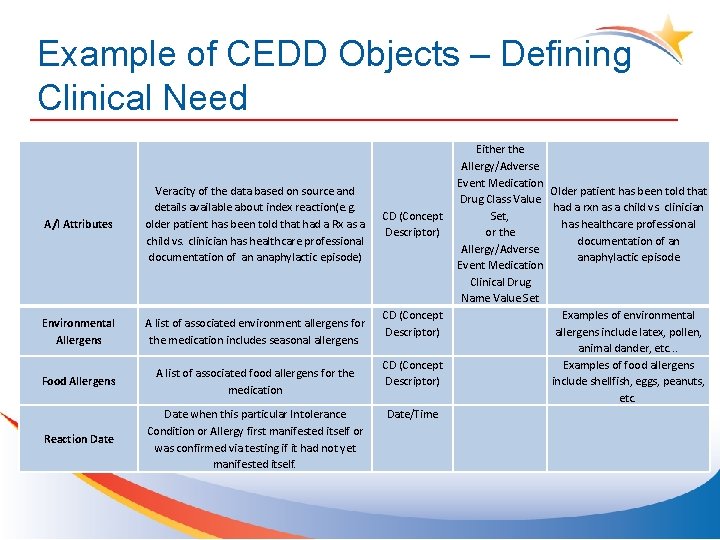
Example of CEDD Objects – Defining Clinical Need A/I Attributes Veracity of the data based on source and details available about index reaction(e. g. older patient has been told that had a Rx as a child vs. clinician has healthcare professional documentation of an anaphylactic episode) Environmental Allergens A list of associated environment allergens for the medication includes seasonal allergens. Food Allergens A list of associated food allergens for the medication Reaction Date when this particular Intolerance Condition or Allergy first manifested itself or was confirmed via testing if it had not yet manifested itself. Either the Allergy/Adverse Event Medication Older patient has been told that Drug Class Value had a rxn as a child vs. clinician CD (Concept Set, has healthcare professional Descriptor) or the documentation of an Allergy/Adverse anaphylactic episode Event Medication Clinical Drug Name Value Set CD (Concept Examples of environmental Descriptor) allergens include latex, pollen, animal dander, etc. . . CD (Concept Examples of food allergens Descriptor) include shellfish, eggs, peanuts, etc. Date/Time
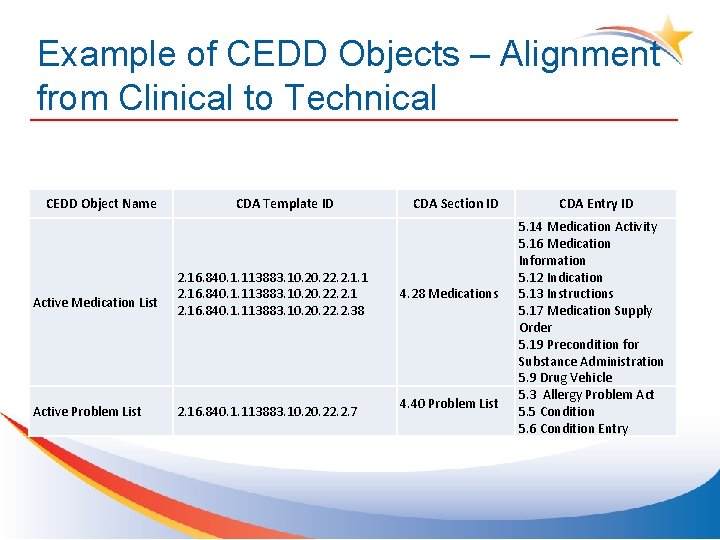
Example of CEDD Objects – Alignment from Clinical to Technical CEDD Object Name CDA Template ID CDA Section ID Active Medication List 2. 16. 840. 1. 113883. 10. 22. 2. 1. 1 2. 16. 840. 1. 113883. 10. 20. 22. 2. 38 4. 28 Medications Active Problem List 2. 16. 840. 1. 113883. 10. 22. 2. 7 4. 40 Problem List CDA Entry ID 5. 14 Medication Activity 5. 16 Medication Information 5. 12 Indication 5. 13 Instructions 5. 17 Medication Supply Order 5. 19 Precondition for Substance Administration 5. 9 Drug Vehicle 5. 3 Allergy Problem Act 5. 5 Condition 5. 6 Condition Entry
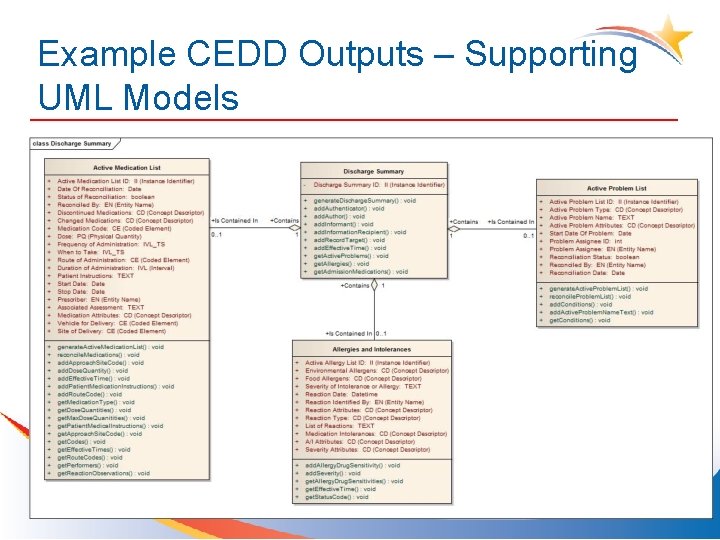
Example CEDD Outputs – Supporting UML Models
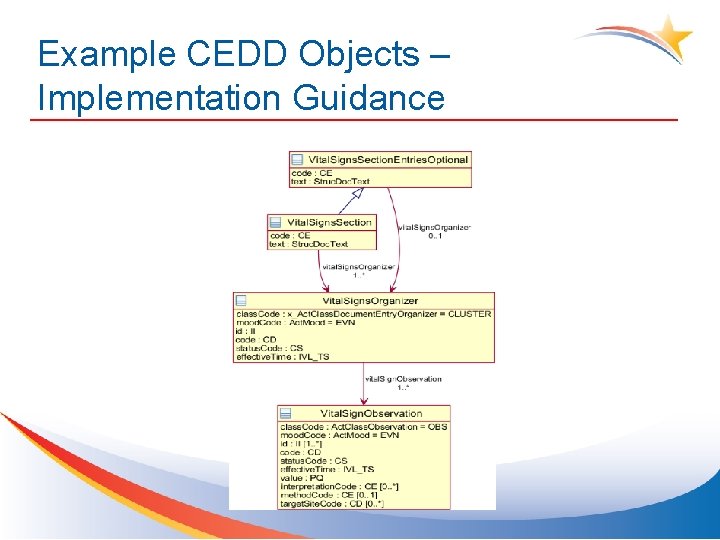
Example CEDD Objects – Implementation Guidance
CEDD Workgroup • Chairs – Holly Miller, Med. Allies, Russell Leftwich, State of Tennessee, and John Donnelly, IHE – Combination of clinical and technical expertise • The S&I Framework CEDD Workgroup is the main volunteer body responsible for maintaining and improving the CEDD – The CEDD Workgroup serves primarily as a control board, not an exploratory/design activity • The workgroup meets on a monthly basis to discuss changes and improvements to the S&I Framework CEDD
CEDD Supporting Blocks • CEDD Tooling – UML Models – some supporting UML models may be developed for implementation guidance, but also coordinate with current efforts like FHIM, CIMI and other information modeling efforts. – ERD Models – used to support implementation of the data dictionary as a data source or to map to existing data sources – Value Set Index – similar structure to HITSP C 80 – CEDD Recommendation Forms – to propose changes and additions
CEDD Challenges • How is it actualized and accessed? • Avoiding replication of effort • Avoiding “doing too much” – Focus on what we do well • Clarity required to map from the functional names to the actual data element names, – Example – how to support the qualifier "ACTIVE" for accurate interpretation when applied to "medications list" or "conditions".
What the CEDD cannot do • Not intended to replicate current information modeling efforts – Not a true “clinical information model” • Does not fix or mitigate existing gaps in standards or underlying information models – Ultimately the SDO maintains and improves their standards • Not intended to be a super-model of data – Focused on S&I Framework initiatives and their interoperability requirements
Building Block - Domain Analysis • For Public Health, start with 1 domain and work forward – promote reuse, understanding and momentum • Transitions of Care tried to draw from other approaches already in use or in motion (HL 7 Domain Analysis Models, CIMI, etc…) and also looked to use FHIM and FTRM as well • Defined specifics on information exchange requirements – Used Consolidated CDA as a starting point to align clinical need to technical representation – Included identification of gaps for eventual submission to HL 7, IHE, and other SDO’s
Building Block - Public Health CEDD “Blueprint” • The nature of the Public Health CEDD would be defined like Transitions of Care • Identify and design to create reusable components representing public health information – Promote reuse of public health standardized data elements in other contexts – Serves as a temporary blueprint to eventually promote reuse through the S&I Framework CEDD – Develop a temporary mechanism that eventually populates the larger S&I Framework CEDD and also can be implemented in other formats and mechanisms
Building Blocks – Public Health Data Element Reuse • Harmonization of public health data elements – Draw from existing S&I CEDD work – Establish Public Health CEDD “temporary” blueprint to represent each of the 5 domains – Leverage FHIM and FHTM to finalize UML models • Harmonization of vocabularies – Identify where and what freely consumable and identifiable value sets are needed – Reuse value sets from S&I Framework where appropriate – Leverage FHIM and FHTM to model
- Slides: 15