
SI 410 Ethics and Information Technology Week 14

- Slides: 22
SI 410 Ethics and Information Technology Week 14: Take Away Points
Information as the Fourth Revolution � Long succession of scientific revolutions since the advent of “history” � Copernicus – humans not at the center of the universe � Darwin – humans not at center of biological kingdom � Freud – mind is not at the center of pure rationality “… we are not standalone and unique entities, but informationally embodied organisms (inforgs), mutually connected and embedded in an informational environment, which we share with both natural and artificial agents similar to us in may respects. ” (Luciano Floridi 2010, p. 11) 2 SI 410 Ethics and Information Technology Winter 2017
• Oxford English Dictionary “Ethics” and “Moral” � Ethics: The science of morals; the department of study concerned with the principles of human duty. � a. The moral principles or system of a particular leader or school of thought. � Moral: 1. a. Of or relating to human character or behavior considered as good or bad; of or relating to the distinction between right and wrong, or good and evil, in relation to the actions, desires, or character of responsible human beings; ethical. 3 SI 410 Ethics and Information Technology Winter 2017
Computer/Information Ethics � Computer Ethics: (James Moor) � “In my view, computer ethics is the analysis of the nature and social impact of computer technology and the corresponding formulation and justification of policies for the ethical use of such technology. ” � Information Ethics (Luciano Floridi, others) � Information ethics is the field that investigates the ethical issues arising from the development and application of information technologies. 4 SI 410 Ethics and Information Technology Winter 2017
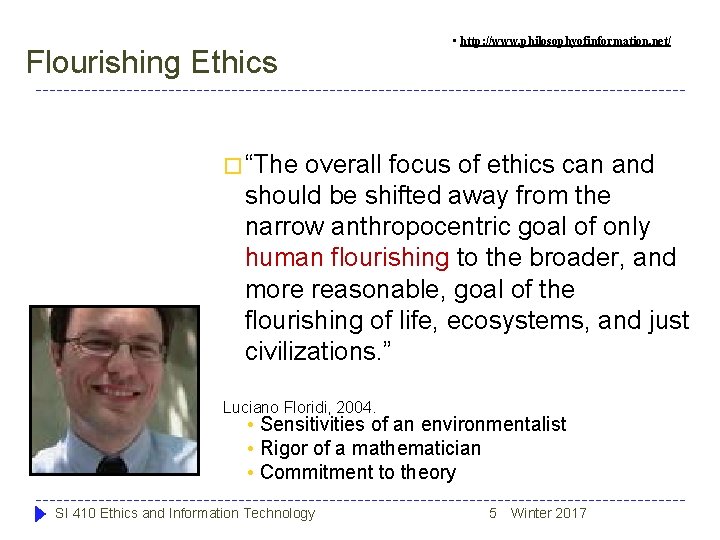
Flourishing Ethics • http: //www. philosophyofinformation. net/ � “The overall focus of ethics can and should be shifted away from the narrow anthropocentric goal of only human flourishing to the broader, and more reasonable, goal of the flourishing of life, ecosystems, and just civilizations. ” Luciano Floridi, 2004. • Sensitivities of an environmentalist • Rigor of a mathematician • Commitment to theory SI 410 Ethics and Information Technology 5 Winter 2017
• Luciano Floridi , Information Ethics (2008) Entropy ala Floridi (a core principle) � Information entropy is the destruction, pollution, and depletion (marked reduction in quantity, content, quality, and value) of information objects. � Ought not to be caused in the infosphere � Ought to be prevented… � Ought to be removed … � The infosphere ought to be protected, extended, improved, enriched and enhanced. � Duty of moral agent: sustainable blooming of infosphere � Any process, action, or event with negative impact increases entropy and is, therefore, an “instance of evil. ” 6 SI 410 Ethics and Information Technology Winter 2017
• James Moor, Why We Need Better Ethics (2005) Moor’s Law � “As technological revolutions increase their social impact, ethical problems increase. ” � Rip | Mix | Burn [limits of sampling] � Online simulation [identity and community] � Wikipedia [authority, expertise, accountability] � Digital photo editing [truth, trust, meaning] “This phenomenon happens … because inevitably revolutionary technology will provide numerous novel opportunities for action for which well thought out ethical policies will not have been developed. ” Moor (2006): 117. 7 SI 410 Ethics and Information Technology Winter 2017
Embedded Values and Disclosive Ethics � Philip Brey (p. 42): “The embedded values approach holds that computer systems and software not morally neutral and that it is possible to identify tendencies in them to promote or demote particular moral values and norms. ” �… moral consequences subject to ethical analysis as values � Philip Brey (p. 51): “The aim of disclosive ethics is to identify morally opaque practices, describe and analyze them, so as to bring them into view, and to identify and reflect on any problematic moral features in them. ” �… 8 operations of systems that are unknowingly value SI 410 Ethics and Information Technology Winter 2017 laden
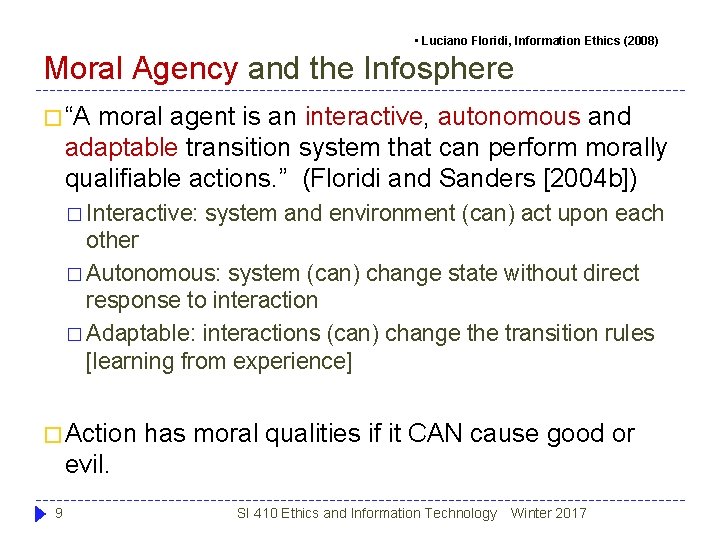
• Luciano Floridi, Information Ethics (2008) Moral Agency and the Infosphere � “A moral agent is an interactive, autonomous and adaptable transition system that can perform morally qualifiable actions. ” (Floridi and Sanders [2004 b]) � Interactive: system and environment (can) act upon each other � Autonomous: system (can) change state without direct response to interaction � Adaptable: interactions (can) change the transition rules [learning from experience] � Action has moral qualities if it CAN cause good or evil. 9 SI 410 Ethics and Information Technology Winter 2017
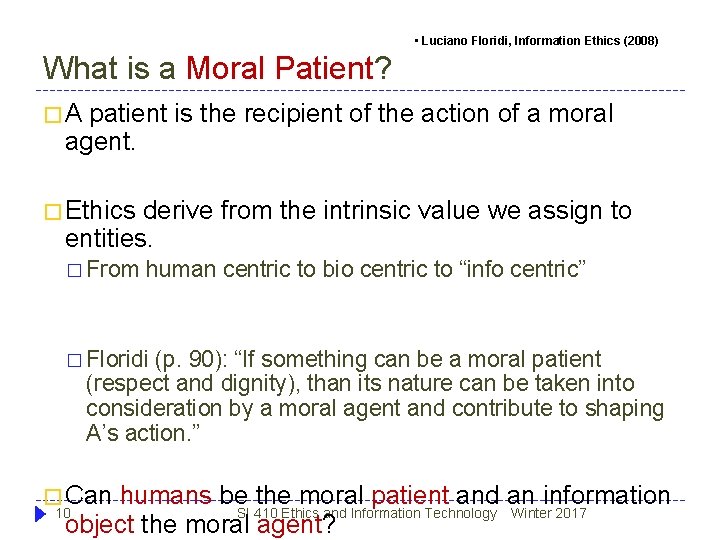
• Luciano Floridi, Information Ethics (2008) What is a Moral Patient? �A patient is the recipient of the action of a moral agent. � Ethics derive from the intrinsic value we assign to entities. � From human centric to bio centric to “info centric” � Floridi (p. 90): “If something can be a moral patient (respect and dignity), than its nature can be taken into consideration by a moral agent and contribute to shaping A’s action. ” � Can humans be the moral patient and an information SI 410 Ethics and Information Technology Winter 2017 object the moral agent? 10
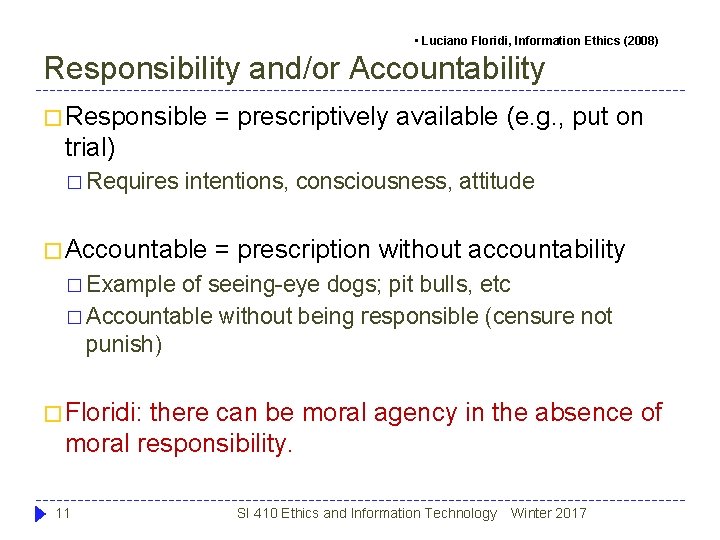
• Luciano Floridi, Information Ethics (2008) Responsibility and/or Accountability � Responsible = prescriptively available (e. g. , put on trial) � Requires intentions, consciousness, attitude � Accountable = prescription without accountability � Example of seeing-eye dogs; pit bulls, etc � Accountable without being responsible (censure not punish) � Floridi: there can be moral agency in the absence of moral responsibility. 11 SI 410 Ethics and Information Technology Winter 2017
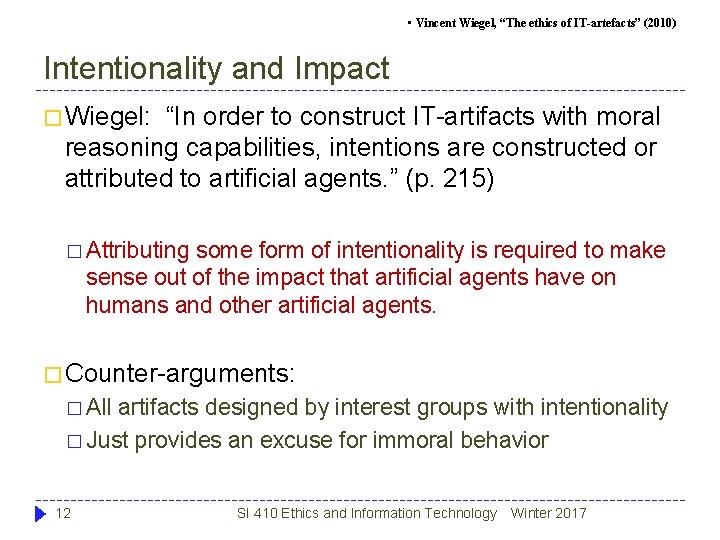
• Vincent Wiegel, “The ethics of IT-artefacts” (2010) Intentionality and Impact � Wiegel: “In order to construct IT-artifacts with moral reasoning capabilities, intentions are constructed or attributed to artificial agents. ” (p. 215) � Attributing some form of intentionality is required to make sense out of the impact that artificial agents have on humans and other artificial agents. � Counter-arguments: � All artifacts designed by interest groups with intentionality � Just provides an excuse for immoral behavior 12 SI 410 Ethics and Information Technology Winter 2017
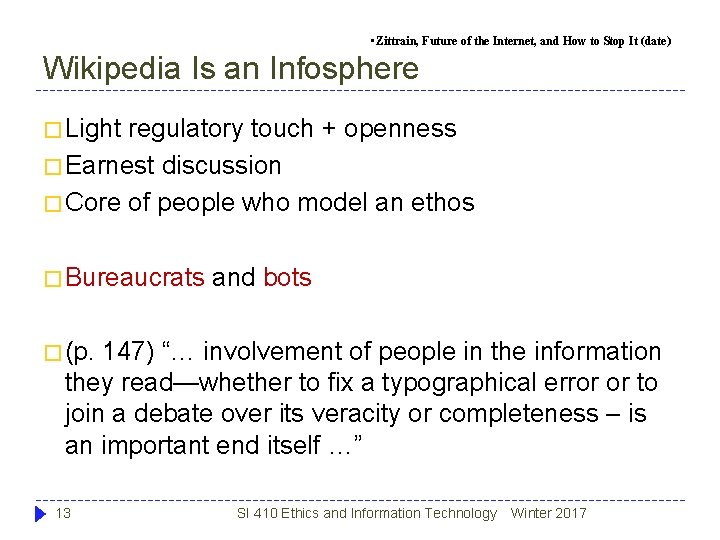
• Zittrain, Future of the Internet, and How to Stop It (date) Wikipedia Is an Infosphere � Light regulatory touch + openness � Earnest discussion � Core of people who model an ethos � Bureaucrats and bots � (p. 147) “… involvement of people in the information they read—whether to fix a typographical error or to join a debate over its veracity or completeness – is an important end itself …” 13 SI 410 Ethics and Information Technology Winter 2017
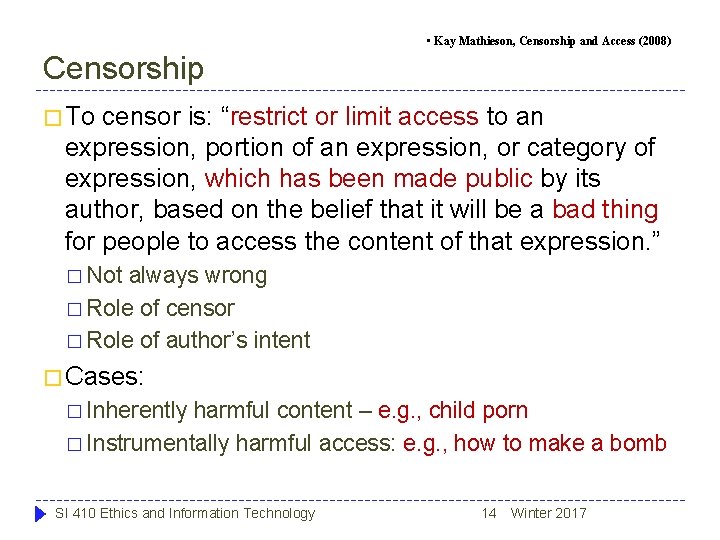
• Kay Mathieson, Censorship and Access (2008) Censorship � To censor is: “restrict or limit access to an expression, portion of an expression, or category of expression, which has been made public by its author, based on the belief that it will be a bad thing for people to access the content of that expression. ” � Not always wrong � Role of censor � Role of author’s intent � Cases: � Inherently harmful content – e. g. , child porn � Instrumentally harmful access: e. g. , how to make a bomb SI 410 Ethics and Information Technology 14 Winter 2017
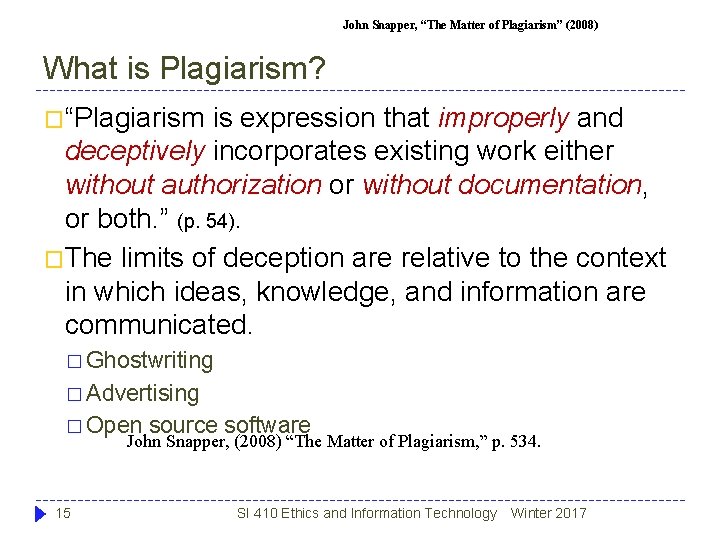
John Snapper, “The Matter of Plagiarism” (2008) What is Plagiarism? �“Plagiarism is expression that improperly and deceptively incorporates existing work either without authorization or without documentation, or both. ” (p. 54). �The limits of deception are relative to the context in which ideas, knowledge, and information are communicated. � Ghostwriting � Advertising � Open source software John Snapper, (2008) “The Matter of Plagiarism, ” p. 534. 15 SI 410 Ethics and Information Technology Winter 2017
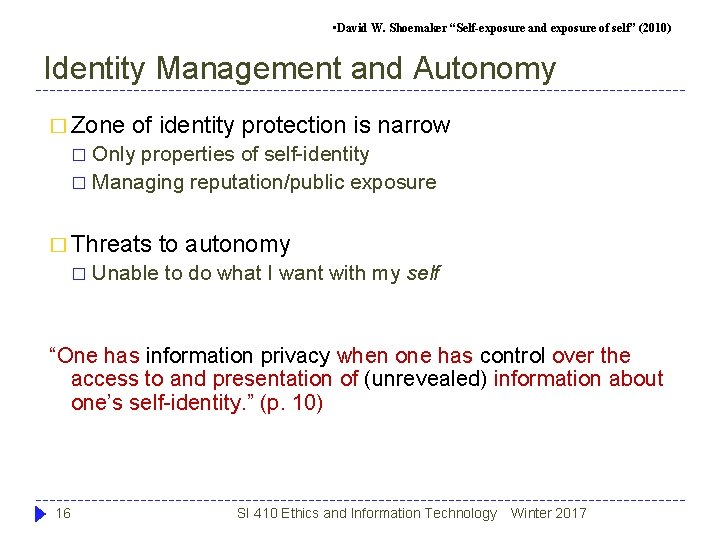
• David W. Shoemaker “Self-exposure and exposure of self” (2010) Identity Management and Autonomy � Zone of identity protection is narrow Only properties of self-identity � Managing reputation/public exposure � � Threats � to autonomy Unable to do what I want with my self “One has information privacy when one has control over the access to and presentation of (unrevealed) information about one’s self-identity. ” (p. 10) 16 SI 410 Ethics and Information Technology Winter 2017
• Kathleen Wallace, Concept of Anonymity (2008) Anonymity � P. 170. “… Anonymity: unable to coordinate some known trait(s) with other traits such that the person cannot be identified. � “non-identifiability by others in a shared social environment, even if only or primarily by virtue of the effects of one’s actions. ” � Anonymity is social-context specific. � My point: loss of anonymity may be a bigger threat than the loss of privacy. 17 SI 410 Ethics and Information Technology Winter 2017
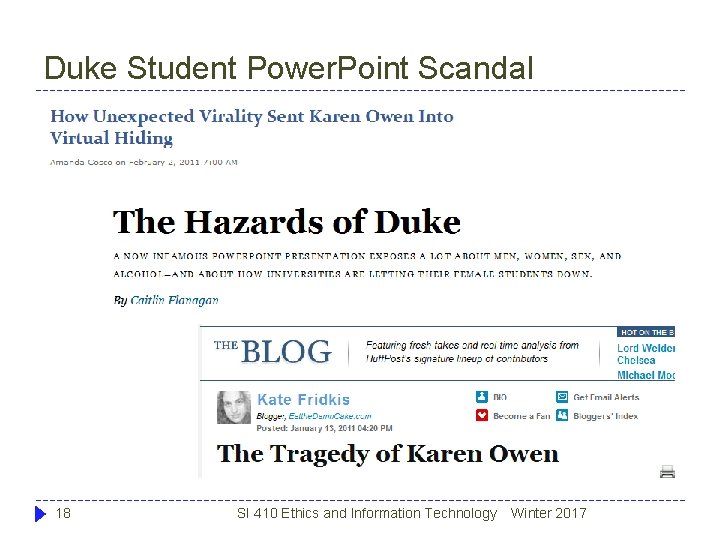
Duke Student Power. Point Scandal 18 SI 410 Ethics and Information Technology Winter 2017
• Miguel Sicart, “Banality of Simulated Evil, ” 2009 Games as Infospheres (Systems) �A construction of rules and mechanics of the game, how they interact, and form behavioral patterns. � Floridi’s IE: moral action modeled as an information process: Messages (M) invoked by agent (A) that brings a transformation of states directly affecting patient (P) � P responds to M with other changes or messages, “depending on how M is interpreted by P’s methods. ” � � The act of playing a game is an act of agency within an infosphere. � 19 Ethical values and agency in-game and through simulation. SI 410 Ethics and Information Technology Winter 2017
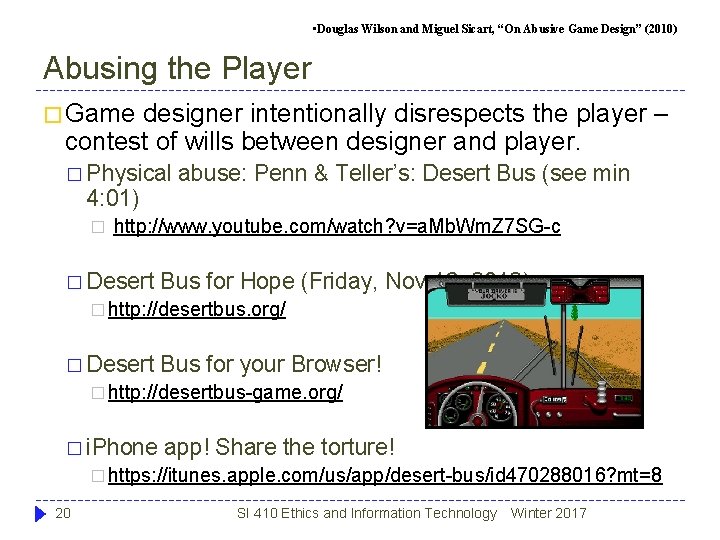
• Douglas Wilson and Miguel Sicart, “On Abusive Game Design” (2010) Abusing the Player � Game designer intentionally disrespects the player – contest of wills between designer and player. � Physical 4: 01) � abuse: Penn & Teller’s: Desert Bus (see min http: //www. youtube. com/watch? v=a. Mb. Wm. Z 7 SG-c � Desert Bus for Hope (Friday, Nov 16, 2012) � http: //desertbus. org/ � Desert Bus for your Browser! � http: //desertbus-game. org/ � i. Phone app! Share the torture! � https: //itunes. apple. com/us/app/desert-bus/id 470288016? mt=8 20 SI 410 Ethics and Information Technology Winter 2017
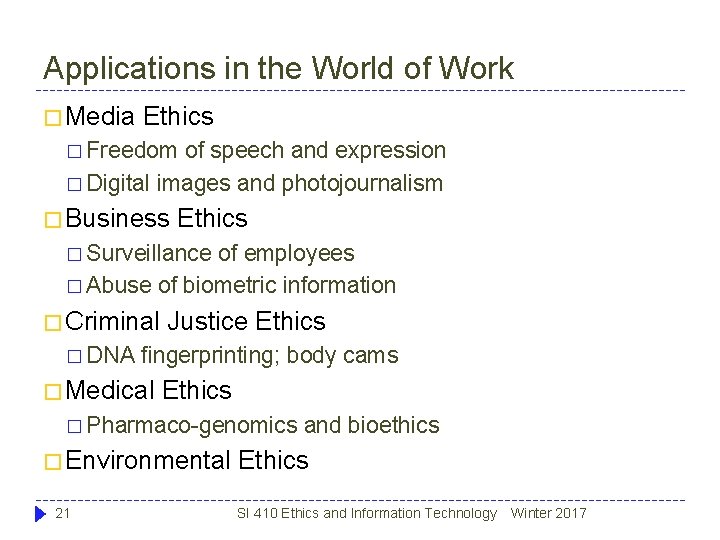
Applications in the World of Work � Media Ethics � Freedom of speech and expression � Digital images and photojournalism � Business Ethics � Surveillance of employees � Abuse of biometric information � Criminal � DNA Justice Ethics fingerprinting; body cams � Medical Ethics � Pharmaco-genomics � Environmental 21 and bioethics Ethics SI 410 Ethics and Information Technology Winter 2017
Thank you for your ideas, your work, and your participation! Best wishes for the remainder of your studies at Michigan. Paul Conway Associate Professor University of Michigan School of Information pconway@umich. edu