
Shunt CALIBRATION n Calibration with the Shunt Resistor
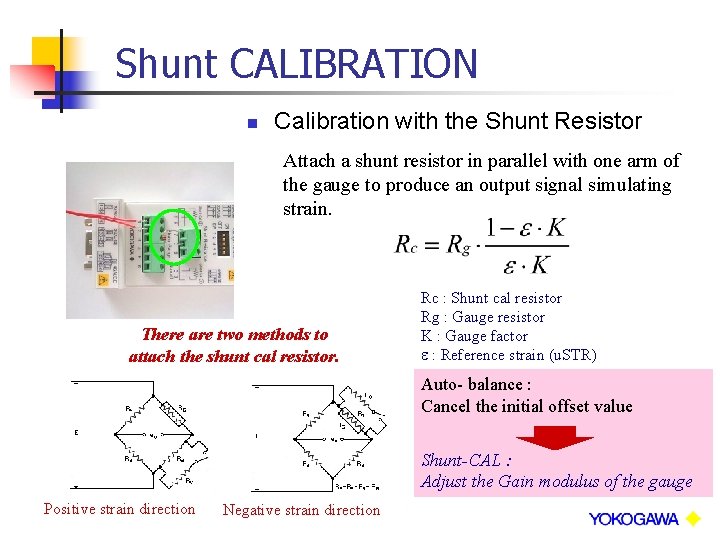
Shunt CALIBRATION n Calibration with the Shunt Resistor Attach a shunt resistor in parallel with one arm of the gauge to produce an output signal simulating strain. There are two methods to attach the shunt cal resistor. Rc : Shunt cal resistor Rg : Gauge resistor K : Gauge factor : Reference strain (u. STR) Auto- balance : Cancel the initial offset value Shunt-CAL : Adjust the Gain modulus of the gauge Positive strain direction Negative strain direction
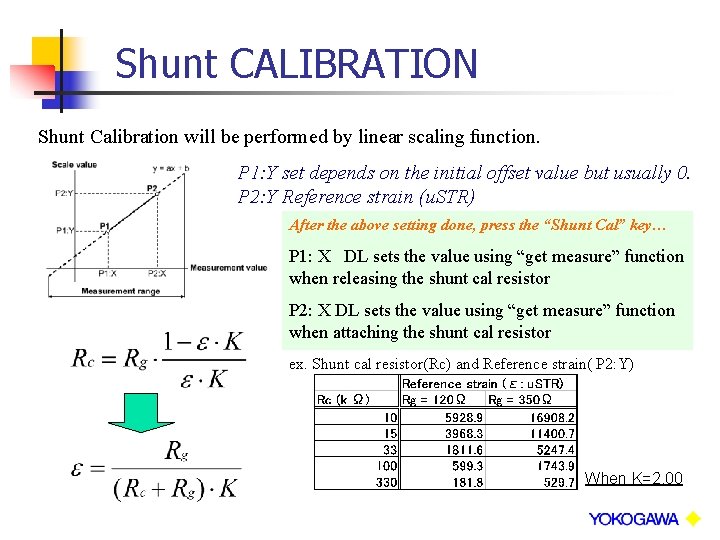
Shunt CALIBRATION Shunt Calibration will be performed by linear scaling function. P 1: Y set depends on the initial offset value but usually 0. P 2: Y Reference strain (u. STR) After the above setting done, press the “Shunt Cal” key… P 1: X DL sets the value using “get measure” function when releasing the shunt cal resistor P 2: X DL sets the value using “get measure” function when attaching the shunt cal resistor ex. Shunt cal resistor(Rc) and Reference strain( P 2: Y) When K=2. 00
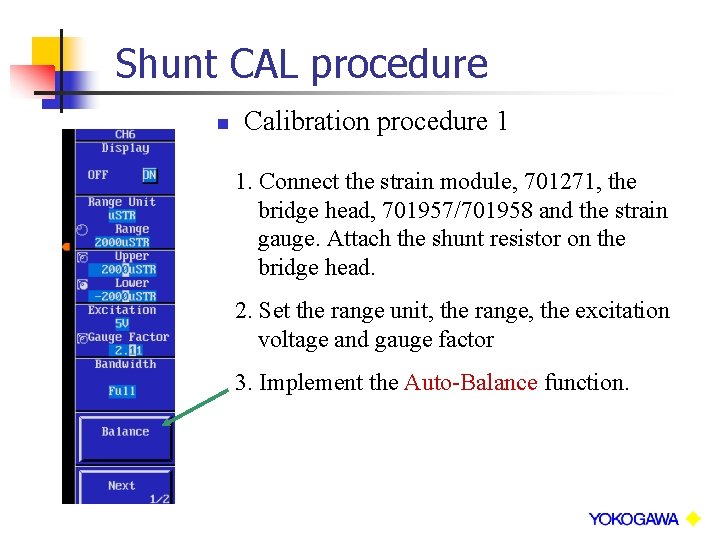
Shunt CAL procedure n Calibration procedure 1 1. Connect the strain module, 701271, the bridge head, 701957/701958 and the strain gauge. Attach the shunt resistor on the bridge head. 2. Set the range unit, the range, the excitation voltage and gauge factor 3. Implement the Auto-Balance function.
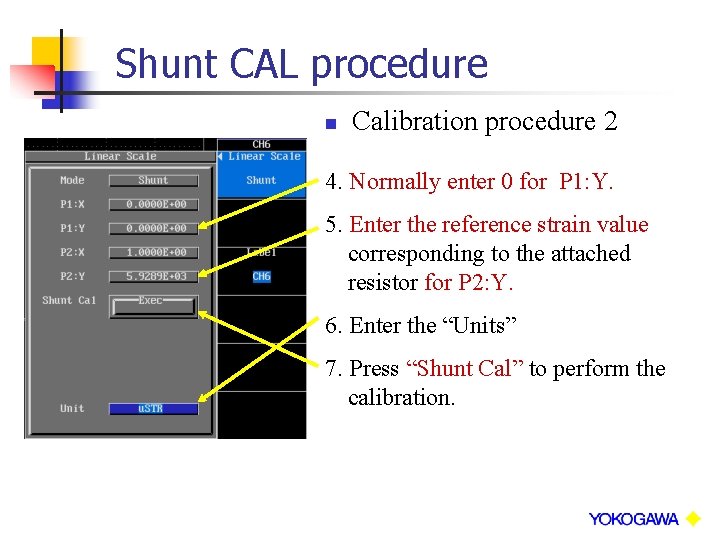
Shunt CAL procedure n Calibration procedure 2 4. Normally enter 0 for P 1: Y. 5. Enter the reference strain value corresponding to the attached resistor for P 2: Y. 6. Enter the “Units” 7. Press “Shunt Cal” to perform the calibration.
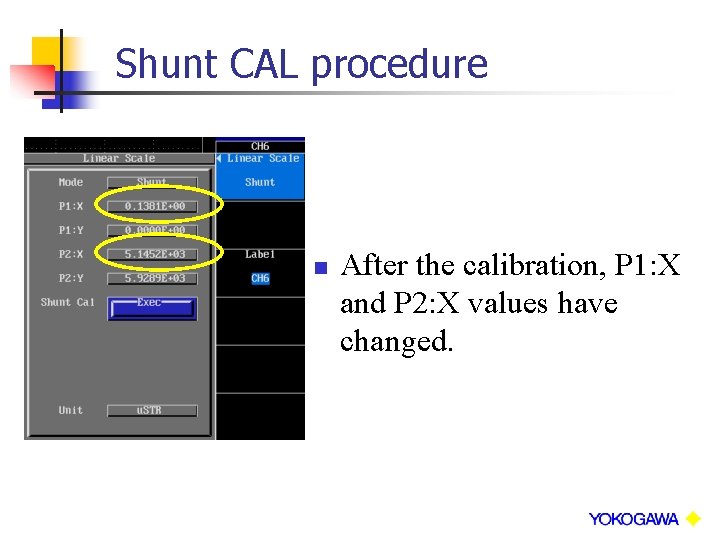
Shunt CAL procedure n After the calibration, P 1: X and P 2: X values have changed.
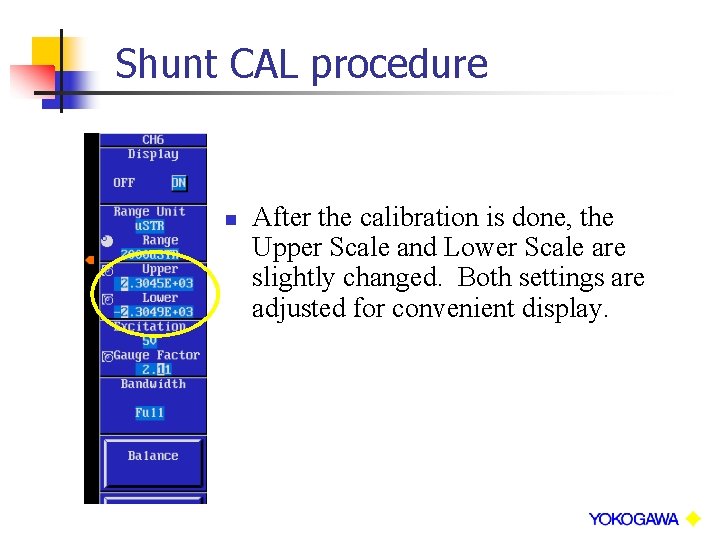
Shunt CAL procedure n After the calibration is done, the Upper Scale and Lower Scale are slightly changed. Both settings are adjusted for convenient display.
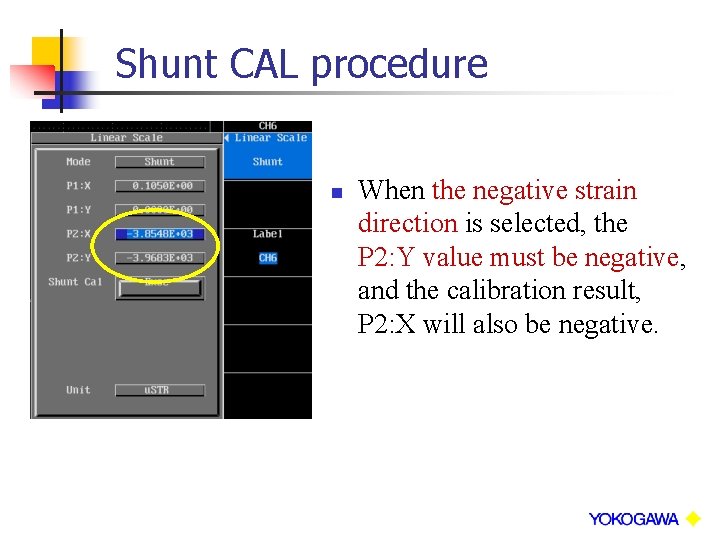
Shunt CAL procedure n When the negative strain direction is selected, the P 2: Y value must be negative, and the calibration result, P 2: X will also be negative.
- Slides: 7