
Shumen Region Bulgaria Case Study Report Julia Spiridonova
Shumen Region Bulgaria Case Study Report Julia Spiridonova
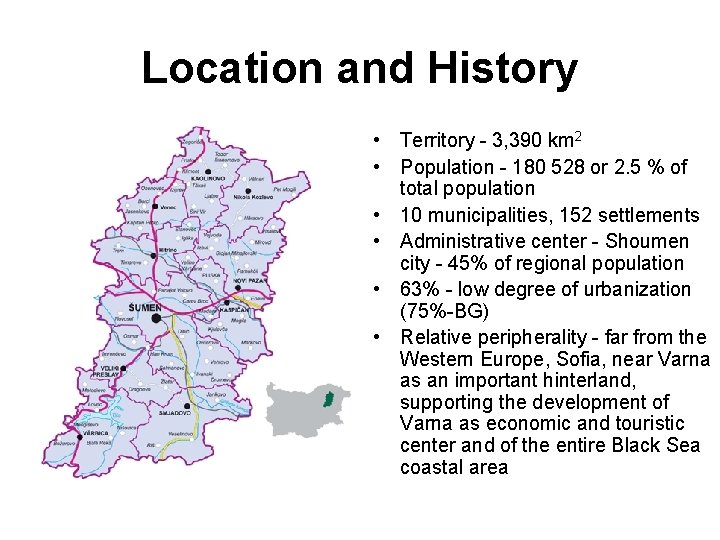
Location and History • Territory - 3, 390 km 2 • Population - 180 528 or 2. 5 % of total population • 10 municipalities, 152 settlements • Administrative center - Shoumen city - 45% of regional population • 63% - low degree of urbanization (75%-BG) • Relative peripherality - far from the Western Europe, Sofia, near Varna as an important hinterland, supporting the development of Varna as economic and touristic center and of the entire Black Sea coastal area
Specifics • Unique anthropogenic touristic resources – in the year 681 the First Bulgarian State was founded here. Here ancient Bulgarian capitals Pliska and Veliki Preslav; the declared and promulgated immobile cultural landmarks amount to 629 sites (including 1 of world significance and 147 of national significance), an acute need of investments in conservation and exhibition of the sites, as well as in touristic infrastructure; • Ethnic situation – with the socio-economic implications – Bulgarian ethnic group - 59. 2 % of the inh. at 84. 8% BG average; Turkish ethnic group - 30. 3 % of all the inhabitants as compared to 8. 8 % country average; Roma population is 8. 3 % at 4. 9 % country average. • The structure of the local economy is not coparable with that of the country – The agrarian sector plays an important role with a share of 13% of the GVA. Industry accounts for about 30% and the services account for the remaining 57%. • Significant agroecological potential for diverse and highly effective agriculture
Starting positions in 1989 • The structure inherited before the transition period was with a high share of the agrarian and food sector and well-developed manufacturing entities in the transport vehicle engineering and silicate production: – In Shumen region used to operate one of the biggest plants for manufacture of heavy-duty trucks in the Eastern block – “Madara” Shumen and manufacturing facilities supporting shipbuilding, strongly developed in the neighboring Varna region, as well as other large-scale production facilities, including for production of non-ferrous metals and mineral raw materials. – With the breakdown of the COMECON market these production facilities were almost liquidated. • A small portion of the former industrial installations have survived thanks to the profound restructuring processes, whereat they have reduced their scale down to 15 -30% of their previous size, as for instance the “Madara” works, the food-and-beverages industry, the textile factories;
Main socio-economic Trends • Between the 2 last census the rate of population decline is higher than the national average (-11%), but nevertheless the region continues to demonstrate a more favorable demographic picture because of the better age structure; • The persons with higher education between 25 and 64 years of age represented 20 % /on the average for Bulgaria 35%/. The persons with high school education are 38 % of the total (national average 43%). - The district gains from the existence of the Shumen University with 5 098 students /28 students per 1000 inh. /. There are five faculties: humanitarian sciences, mathematics and informatics, natural sciences, engineering and pedagogical faculty. - The human resources and more specifically its “drain” stands out as a major problem of the region. • On the other hand, the existence of high unemployment rate (especially in the small municipalities) is a factor blocking regional development.
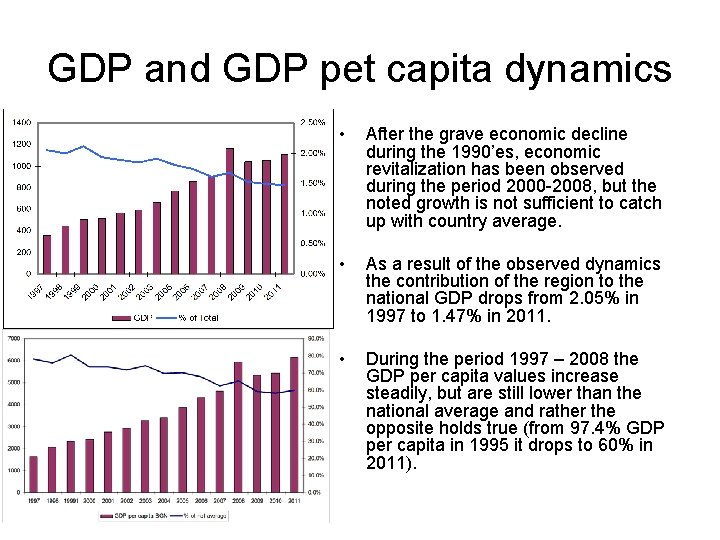
GDP and GDP pet capita dynamics • After the grave economic decline during the 1990’es, economic revitalization has been observed during the period 2000 -2008, but the noted growth is not sufficient to catch up with country average. • As a result of the observed dynamics the contribution of the region to the national GDP drops from 2. 05% in 1997 to 1. 47% in 2011. • During the period 1997 – 2008 the GDP per capita values increase steadily, but are still lower than the national average and rather the opposite holds true (from 97. 4% GDP per capita in 1995 it drops to 60% in 2011).
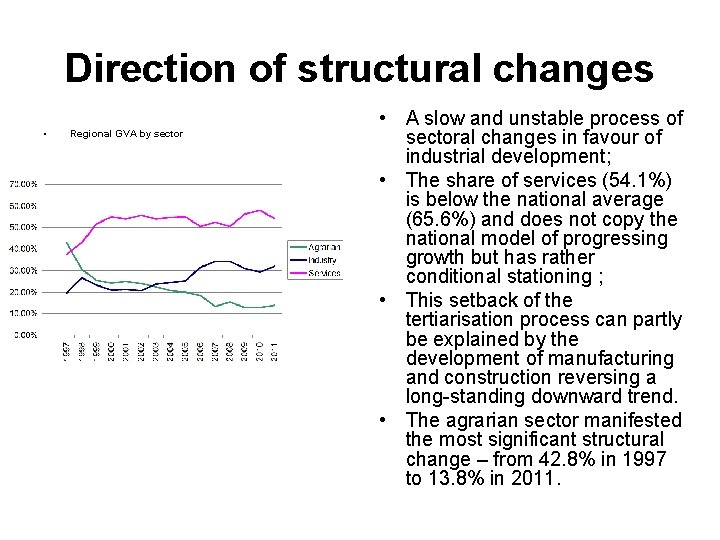
Direction of structural changes • Regional GVA by sector • A slow and unstable process of sectoral changes in favour of industrial development; • The share of services (54. 1%) is below the national average (65. 6%) and does not copy the national model of progressing growth but has rather conditional stationing ; • This setback of the tertiarisation process can partly be explained by the development of manufacturing and construction reversing a long-standing downward trend. • The agrarian sector manifested the most significant structural change – from 42. 8% in 1997 to 13. 8% in 2011.
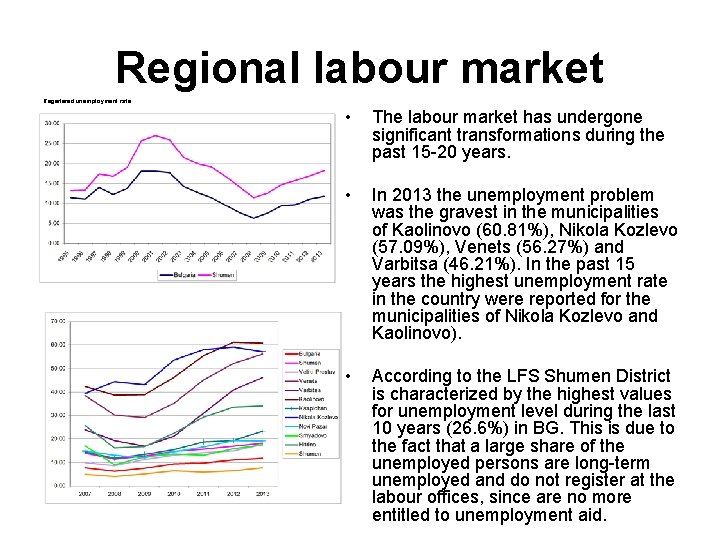
Regional labour market Registered unemployment rate • The labour market has undergone significant transformations during the past 15 -20 years. • In 2013 the unemployment problem was the gravest in the municipalities of Kaolinovo (60. 81%), Nikola Kozlevo (57. 09%), Venets (56. 27%) and Varbitsa (46. 21%). In the past 15 years the highest unemployment rate in the country were reported for the municipalities of Nikola Kozlevo and Kaolinovo). • According to the LFS Shumen District is characterized by the highest values for unemployment level during the last 10 years (26. 6%) in BG. This is due to the fact that a large share of the unemployed persons are long-term unemployed and do not register at the labour offices, since are no more entitled to unemployment aid.
Scale of social problems • The most serious problem for the population of the region represents the standard of living. Over half of those surveyed citizens to varying degrees dissatisfied with their standard compared to 24 % who are satisfied. This is related to the economic situation in the region. • The share of household members with low intensity of economic activeness is relatively high – 13. 8% as compared to 10. 1% for the country. • People, living under conditions of material deprivation, account for 48. 3% of the population of the district. • The relative share of the poor as regards the poverty line for the region has increased from 16. 8% in 2008 to 22. 6% in 2012.
Interregional disparities • There is a significant difference in the economic development of the municipalities within the Shumen region. Regional differences are manifested in the performance levels of all aspects of the operation and development of the labour market - employment, unemployment, wages, labour productivity, educational and professional qualification, demographic structure of the workforce, social standards of living. • Contrasts between "center" and "periphery " (between "West - East“ axis, including municipalities Shumen, Kaspichan, Novi Pazar and Veliki Preslav and lagging northern and southern periphery and rural areas).
Factors of regional development Exogenous factors • Low attractiveness for FDIs contributed to substantial growth due. FDI have a token share (0. 5% ) of the total for the country. The strategic foreign investments are the following: the Turkish company Faf Metal, which owns the majority share of Alcomet AD; the Danish company Carlsberg - a major shareholder in Shoumensko. Pivo AD; the Spanish company Roca - a major shareholder in Faience AD, Kaspichan town. Other companies with foreign participation are: Mebel Gen AD, Seres Glass AD, Novi Pazar, Teba Glass OOD, Novi Pazar and others, • Low degree of internationalization of SMEs and the need to expand export orientation and internationalization of the SMEs. • Weak national regional policy – mainly trough Cohesion policy support
Factors of regional development Endogenous factors • • • Low entrepreneurship ability and development; Low productivity and relatively low competitiveness, based primarily on cost factors; The idea of creating the high-tech park - Shumen has remained dormant and replaced with existing projects for industrial park. The existing R&D potential is limited and hence does not contribute for development of the innovation potential of the region. The number of functioning R&D institutions is very small and is concentrated in the city of Shumen. It is represented by the Institute of Agriculture and the R&D divisions with the bigger enterprises. Ongoing process of deleveraging (not updated capital used for research) and deskilling ( the working age population is not actively involved in continuing education and are not perceived as a way of improving professional development ) are factors having negative effects on the productivity and competitiveness of the regional economy.
Factors of regional development Endogenous factors - Significant discrepancy between actual staffing needs of the labour market and specialties offered in vocational schools in the region; - Not secured financially storage, socialization and commercialization of cultural and historical heritage and natural resources through tourism; • Health and education are also not in good condition. Although the demographic structure of the population is relatively favorable, the risk of deterioration due to its many problem areas that reduce quality of life. • The region has a reliable connection to the main transport corridors, via which a relatively easy access is obtained to the neighboring countries and to important centers in BG.
Factors of regional development Regional institutions and policies • System of regional planning. The process of planning has indication of formality. Hierarchical subordination and compliance with related strategic documents are incomplete. Coordination of sectoral policies and programmes is partial. In CSF missing directions "Territorial Cooperationq integration and complementaraty". The evaluation of the coordination of the use of CSF is unsatisfactory. • The co-operation between different actors is not effective and efficient • According to the conducted interviews, the major remark concerning the operation of the administration concerns the speed of responding to challenges. • The need for the development of local business and technological environment have been identified several groups of factors that depend to a greater or lesser extent by the local administration and the influence of the environment for doing business. These are factors such as local tax policy, employment of local administration, economic activity, procedures for construction permits, perception of corruption, the availability and supply of e-governance, adequate production sites and more.
Factors of regional development EU membership • The membership in the EU is evaluated positively by all the interviewed stakeholders for regional development. Part of the respondents, however, remark that the membership in the EU has failed as yet to influence substantially the development of a number of key spheres, like for instance improvement of the competitiveness of Bulgarian companies, agriculture, protection of the environment, R&D and science, social policies but they noted the positive EU inputs. • At the same time, under the circumstances of crisis and post-crisis recovery (which as a period coincides with the beginning of the membership of Bulgaria in the EU), in a situation of limited investment resources, the EU funds and operational programmes offer one opportunity to enhance regional development and their full and effective utilization is an important function of the state and its administration.
Future prospects • Close the gap in terms of quantity and quality of growth factors - the need for targeted support of the main factors / sources of growth - regional components; • Finding a suitable intervention system for displaying Shumen region of the spiral of socio-economic gap, marginalization and demographic risk.

Thank you
- Slides: 17